Disclosure: airfryerkitchensupply.com is reader-supported. When you buy through links on our site, we may earn an affiliate commission at no extra cost to you.
Where to buy
Amazon carries the best bakeware for toaster ovens from the serious pan makers, and every pick below was verified against the maker’s own catalog listing for this site before a link was added — sizes and materials in the reviews come from those verified listings. Use the links to check price on Amazon, and do the one thing this category demands before ordering: measure your oven’s interior, width, depth and height with the rack in its lowest position, and compare it with the pan’s full dimensions including handles and rims. In toaster oven bakeware, fit is not a detail; fit is the product.
- USA Pan Bakeware Nonstick Square Cake Pan, 8 Inch — Best Overall: Check the current price on Amazon
- Wilton Gold Non-Stick Square Brownie Cake Pan, 8×8 — Best Nonstick Release: Check the current price on Amazon
- Nordic Ware Naturals Aluminum 8×8 Square Cake Pan — Best Uncoated Aluminum: Check the current price on Amazon
- USA Pan Bakeware Seamless Nonstick Square Baking Pan, 8x8x2 — Best Deep Pan: Check the current price on Amazon
- Vinino 8×8 Inch Silicone Brownie Pan, 2 Pack, Steel Frame — Best Silicone: Check the current price on Amazon
- SILIVO 2 Pack 8 Inch Cake Pans, Silicone — Best Budget: Check the current price on Amazon
Here is the small secret of toaster oven cooking: the oven gets the credit, but the pan does the work. A toaster oven’s cavity is compact, its elements sit close to the food, and its airflow is nothing like a full oven’s — so the pan’s size, material and surface decide whether your brownies bake evenly or scorch at the edges while the center sulks. Standard bakeware does not fit, and the bakeware that does fit is dominated by one footprint: the 8×8-inch square, sized for the classic 4-slice oven, joined by quarter-sheet trays in larger models. The best bakeware for toaster ovens is therefore a short, serious list of pans in that footprint, differentiated by material — aluminized steel, bare aluminum, silicone — because in a small oven, material is destiny.
That focus is a feature, not a limitation. An 8×8 pan is the most useful small pan in any kitchen: brownies and blondies, cornbread, coffee cake, a half batch of lasagna, roasted vegetables for two, a casserole that does not commit you to a week of leftovers, and the reheating tray for everything the toaster oven revives better than a microwave. Buy the right two or three pans in this size and your small oven becomes a real oven. Buy the wrong material for your cooking and you will blame the oven for the pan’s decisions — which is why this guide spends as much time on materials and fit as on the picks themselves.
Every pick below is a genuine 8-inch-class pan from a maker whose listing we verified, and the six divide cleanly: two nonstick steel all-rounders (one of them seamless and deep), one bare aluminum traditionalist, and two silicone options for bakers who prize release and storage over browned edges — plus the Wilton, whose handles and coating make it the easiest pan here to live with. There is no filler and no novelty shape, because a toaster oven’s small cavity forgives neither.
In this guide
Quick Picks
USA Pan Bakeware Nonstick Square Cake Pan, 8 Inch — Best Overall. Aluminized steel with a quality nonstick surface — the even-baking, long-wearing standard pan for the standard toaster oven. Check the current price on Amazon
Wilton Gold Non-Stick Square Brownie Cake Pan, 8×8 — Best Nonstick Release. A PFAS-free nonstick coating (per its maker), scratch resistance, warp resistance and extended handles that make a small oven easier to load. Check the current price on Amazon
Nordic Ware Naturals Aluminum 8×8 Square Cake Pan — Best Uncoated Aluminum. Bare commercial aluminum with nothing to wear out — line it, grease it, and hand it down. Check the current price on Amazon
USA Pan Bakeware Seamless Nonstick Square Baking Pan, 8x8x2 — Best Deep Pan. Seamless corners and a full 2-inch depth for casseroles and lasagnas, with no folded seams to trap batter or sauce. Check the current price on Amazon
Vinino 8×8 Inch Silicone Brownie Pan, 2 Pack, Steel Frame — Best Silicone. Flexible silicone release stiffened by a stainless steel frame, in a 2-pack — the storage-friendly, easy-clean option. Check the current price on Amazon
SILIVO 2 Pack 8 Inch Cake Pans, Silicone — Best Budget. Two silicone 8-inch pans at a budget tier — the second-pan solution for batch baking in a small oven. Check the current price on Amazon
How These Picks Were Chosen
Fit came first, and it eliminated most of the bakeware market: a pick had to be a true 8-inch-class pan suited to standard toaster oven cavities. Every pick was then verified against Amazon’s catalog data for this site — maker, size and material in the listing had to match the pan described here before it earned a purchase link. Within the footprint, we chose for material diversity, because material is the real decision in this category: coated steel for release and evenness, bare aluminum for permanence, silicone for flexibility and storage.
We also weighted the toaster oven’s specific physics. Elements sit inches from the food, so pans that conduct evenly and resist warping matter more than in a big oven; a warped pan rocks on the rack, pools batter to one side, and bakes lopsided in a cavity with no room to forgive it. Handles, usually an afterthought, matter in a small oven too — there is less room for mitts, so a pan that offers a grip, like the Wilton, earns real points. What we did not reward: novelty shapes, oversized “toaster oven sets” padded with pans nobody uses, and coatings with no maker accountability behind them.
The 6 Best Bakeware Picks for Toaster Ovens
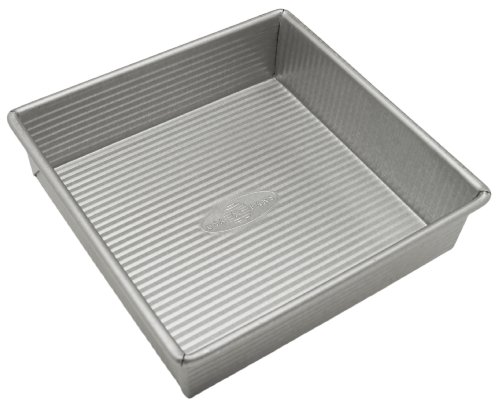
USA Pan Bakeware Nonstick Square Cake Pan, 8 Inch — Best Overall
USA Pan is the name serious home bakers reach for in full-size bakeware, and its 8-inch square is the same pan, correctly shrunk: aluminized steel for even conduction and strength, with a nonstick surface that releases brownies and cornbread without a wrestling match. In a toaster oven, where hot spots are a fact of life, the pan’s even conduction does quiet damage control — edges and center finish closer together than they do in thin, cheap pans that transmit every hot spot straight into the batter.
Strengths
- Aluminized steel bakes evenly and resists the warping that ruins small-oven results
- Quality nonstick release for cakes, brownies and casseroles
- The standard 8-inch footprint fits the classic toaster oven class
Trade-offs
- Nonstick surfaces have a lifespan; this is a years-long pan, not a forever pan
- No extended handles — oven mitts and care are part of loading it
- Premium tier among 8×8 pans, though the cost-per-bake math favors it quickly
| Size | 8 inch square |
| Material | Aluminized steel |
| Surface | Nonstick |
| Fit | Standard toaster oven footprint |
This is the pan to buy if you are buying one. It handles the sweet work — brownies with set edges and a fudgy middle — and the savory work — a two-person lasagna, a tray of roasted potatoes started under the broiler’s neighbor elements — with the same even temper. Owners of basic toaster ovens will find it flatters the oven; owners of better ovens will find it keeps up. It is the reference pan against which the rest of this list justifies itself.
Buy it first, and add specialty pans around it only when a specific job demands one: depth, silicone flexibility, or a second pan for batches. Most toaster oven kitchens are, at heart, this pan plus one other.
Best for: Most toaster oven owners who want one pan that bakes, roasts and reheats evenly for years / Not suited for: Anyone whose oven interior is smaller than the standard 4-slice class.
Check the current price on Amazon

Wilton Gold Non-Stick Square Brownie Cake Pan, 8×8 — Best Nonstick Release
The Wilton Gold’s case is livability. Its maker specifies a non-stick coating made without PFAS, scratch resistance, and a pan body that resists warping — the three anxieties of coated bakeware, addressed in the listing itself. Then there are the extended handles, which in a toaster oven are worth more than in a big one: the cavity is small, the elements are close, and a pan you can grip confidently with mitts is a pan that gets loaded and unloaded without the wobble that spills batter and burns knuckles. Wilton calls it a brownie and cake pan, and brownies are indeed its home turf.
Strengths
- Extended handles make small-oven loading safer and steadier
- Nonstick coating made without PFAS, per the maker, with scratch resistance
- Warp-resistant steel keeps the pan flat on the rack, bake after bake
Trade-offs
- The handles add width — measure your cavity before assuming the fit
- Coated pans still ask for non-metal utensils to live their longest life
- Dishwasher safe per the maker, though hand washing keeps any coating younger
| Size | 8 x 8 in |
| Surface | Non-stick steel, scratch-resistant coating, made without PFAS (per maker listing) |
| Design | Resists warping, extended handles |
| Care | Dishwasher safe (per maker listing) |
The handle point deserves emphasis because it is easy to miss in a photograph. In a full oven you reach in with both mitts and room to spare; in a toaster oven you are threading a hot pan through a small door, close to elements, often one-handed while the other hand holds the door. A pan designed with that grip in mind changes the experience of every bake. Combined with a coating that releases a brownie cleanly enough to serve from the pan at the table, the Wilton is the most beginner-friendly pick here.
Buy it if brownies and cakes are your oven’s main job, or if confidence in handling hot pans is a concern in your household. Measure first — the handles that make it great make it the widest pick in the roundup.
Best for: Brownie and cake bakers who want clean release and easy handling in and out of a small oven / Not suited for: Metal-utensil users who cut servings in the pan.
Check the current price on Amazon

Nordic Ware Naturals Aluminum 8×8 Square Cake Pan — Best Uncoated Aluminum
The Nordic Ware Naturals is the purist’s pan: natural aluminum, commercial in style, with no coating at all. That absence is the feature. There is nothing to scratch, chip, or wear thin; with parchment or a smear of butter and flour, release is a technique rather than a coating, and the pan you buy this year is the pan your grandchildren can argue over. Aluminum is also the best heat conductor in this roundup, which in a toaster oven’s uneven cavity translates to responsive, even baking for those who learn its manners.
Strengths
- Nothing to wear out — the longest-lived pan in this guide by design
- Excellent aluminum conduction for even, responsive baking
- Commercial-style build from a heritage American bakeware maker
Trade-offs
- Sticky bakes need parchment or proper greasing — there is no nonstick safety net
- Bare aluminum can discolor with certain foods and dishwasher detergents; hand wash
- Light-colored surface browns more gently than dark pans
| Size | 8 x 8 inches |
| Material | Natural aluminum, commercial style |
| Surface | Uncoated — no nonstick layer to wear out |
Generations of bakers did all their work in pans like this, and the technique is not hard: parchment slings for brownies and bars, a thorough greasing for cakes, and a soak rather than a scour when something catches. In exchange you get a pan that sears roasted vegetables honestly, broils without coating anxiety at high heat, and never asks to be replaced. For the toaster oven owner who broils often, that high-heat freedom is a genuine advantage over every coated pick here.
Buy it if you value permanence and high-heat freedom over effortless release. Pair it with the USA Pan and you own both philosophies of bakeware in the size your oven actually uses.
Best for: Bakers who prefer bare aluminum, parchment and a pan that can outlive the oven / Not suited for: Anyone who wants effortless nonstick release for sticky bakes.
Check the current price on Amazon

USA Pan Bakeware Seamless Nonstick Square Baking Pan, 8x8x2 — Best Deep Pan
The USA Pan Seamless takes the standard pan and fixes its one structural flaw: corners. Ordinary square pans are folded and seamed at the corners, and those folds trap batter, sauce and cheese in crevices that no sponge fully reaches — a nuisance in any oven, and a baked-on permanent resident in a toaster oven’s high-heat small cavity. This pan is seamless, with a full 2-inch depth, so casseroles, lasagnas, deep cornbreads and layered bakes cook in a vessel that rinses clean like a bowl. Same aluminized steel, same nonstick family as the Best Overall pick; different mission.
Strengths
- Seamless corners — nothing traps, nothing hides, cleaning is honest
- Full 2-inch depth suits casseroles and lasagnas the shallower pans cannot hold
- Aluminized steel evenness for slow, bubbling bakes
Trade-offs
- Depth is wasted on flat bakes, and can slow their browning
- The taller profile needs your oven’s height checked with the rack low
- A specialist second pan for most kitchens, not the first pan to buy
| Size | 8 x 8 x 2 inches |
| Construction | Seamless — no folded corners |
| Material | Aluminized steel, nonstick |
Think of the division this way: the standard USA Pan is the baker’s pan, this is the cook’s pan. Its natural habitat is the small casserole for two, the scalloped potatoes, the baked pasta that a 13×9 would spread into sadness. Portion math favors it constantly — so many recipes halve perfectly into an 8x8x2 — and the seamless interior means the cheesy corner, everyone’s favorite bite, comes out of the pan instead of being excavated from a seam.
Buy it as your second pan when casseroles enter your toaster oven’s repertoire. If your oven only ever bakes flat things, its depth will never earn its shelf space.
Best for: Casseroles, lasagnas and deep bakes where batter hides in ordinary pans’ corners / Not suited for: Shallow bakes where the extra depth only slows browning.
Check the current price on Amazon

Vinino 8×8 Inch Silicone Brownie Pan, 2 Pack, Steel Frame — Best Silicone
Silicone bakeware’s eternal problem is flop: a flexible pan full of wet batter is a spill looking for a place to happen. Vinino’s answer is a stainless steel frame inside the silicone, so the 8×8 pan holds its shape like metal while releasing like silicone — brownies and cakes push out cleanly, the pan flexes for storage in a drawer a rigid pan cannot use, and the maker rates it reusable and easy to clean. A 2-pack means one pan can bake while the other cools, which in a small oven is how batch baking actually gets done.
Strengths
- Steel frame cures silicone flop — rigid to carry, flexible to release
- Two pans enable real batch workflow in a small oven
- Stores flat and flexibly; ideal for small kitchens and RVs
Trade-offs
- Silicone insulates, so edges brown more gently and slowly than in metal
- Not the pan for broiling or for crisp-bottomed bakes
- Silicone can hold onto odors from strong savory bakes; wash promptly
| Size | 8 x 8 inch, 2 pack |
| Material | Silicone with stainless steel frame |
| Traits | Reusable, easy to clean (per maker listing) |
Set expectations by physics and silicone delights: it is the release champion and the storage champion, and the browning bronze medalist. For muffins-style bakes, egg dishes, and anything you want to unmold whole, that trade is happily made. The frame also makes these the safest silicone pans to move in and out of a small oven, because the load stays level — the exact moment unframed silicone chooses to fold.
Buy the Vinino pair if your baking leans soft and sweet, your storage is tight, or your oven travels with an RV. Keep one metal pan in the house for the jobs — roasting, broiling, crisping — where silicone should not be asked to perform.
Best for: Bakers who want flexible release and storage, with a frame that keeps silicone rigid / Not suited for: Anyone chasing crisp, dark edges on brownies — silicone browns gently.
Check the current price on Amazon

SILIVO 2 Pack 8 Inch Cake Pans, Silicone — Best Budget
The SILIVO 2-pack is the budget expression of the silicone idea: two 8-inch pans, nonstick by material, easy release and easy clean per the maker, at a tier that makes them nearly consumable. Their best use is not as your only pans but as the bench depth every small-oven baker needs — the second pan that lets a double batch rotate through a small cavity, the loaner, the RV pan, the one that goes to the potluck and is not mourned if it stays there.
Strengths
- Two pans at a budget tier — batch baking becomes possible
- Silicone release needs no greasing for most bakes
- Light, flexible and forgiving in storage and travel
Trade-offs
- Unframed silicone flexes under heavy, wet batters — use a tray underneath to move them
- Gentle browning, like all silicone; not for crisp edges or broiling
- Budget build — treat them as hardworking, replaceable tools
| Size | 8 inch, 2 pack |
| Material | Silicone |
| Surface | Nonstick, easy release and easy clean (per maker listing) |
There is a workflow these pans unlock that deserves naming: in a toaster oven, the oven is the bottleneck, not the baker. While one batch bakes, the next can be mixed and panned only if a second pan exists. The SILIVO pair is the cheapest way to own that workflow, and for cornbread, snack cakes and egg bakes — forgiving foods that do not demand metal’s browning — the results will not tell you that you economized.
Buy them as your second and third pans, or as the starter set for a dorm or first apartment oven. Graduate to the metal picks when your baking ambitions do.
Best for: Budget and backup pans — a second pan for batch baking in a small oven / Not suited for: Bakers who need the rigid support of metal for heavy, wet batters.
Check the current price on Amazon
Comparison Table
| Pick | Badge | Key spec | Best for |
|---|---|---|---|
| USA Pan 8 Inch Square | Best Overall | Aluminized steel, nonstick | The one-pan answer for most ovens |
| Wilton Gold 8×8 | Best Nonstick Release | PFAS-free coating per maker, extended handles | Brownies, cakes, confident handling |
| Nordic Ware Naturals 8×8 | Best Uncoated Aluminum | Bare commercial aluminum | Permanence and high-heat freedom |
| USA Pan Seamless 8x8x2 | Best Deep Pan | Seamless, 2-inch depth | Casseroles and lasagnas for two |
| Vinino Silicone 8×8 | Best Silicone | Steel-framed silicone, 2 pack | Release, storage and batch baking |
| SILIVO Silicone 2 Pack | Best Budget | Silicone 8-inch, 2 pack | Second pans and starter kitchens |
USA Pan 8 Inch Square: Check the current price on Amazon
Wilton Gold 8×8: Check the current price on Amazon
Nordic Ware Naturals 8×8: Check the current price on Amazon
USA Pan Seamless 8x8x2: Check the current price on Amazon
Vinino Silicone 8×8: Check the current price on Amazon
SILIVO Silicone 2 Pack: Check the current price on Amazon
How to Choose the Best Bakeware for Toaster Ovens
Measure your oven before anything else, and measure the right things: interior width and depth with the door closed, and the height from the lowest rack position to the upper elements. A pan must fit with air space around it — a pan that walls off the cavity blocks circulation and bakes unevenly no matter how good it is. Remember that rims and handles count: the Wilton’s helpful handles make it the widest pick here. If your oven is a larger 6-slice model, you may also fit a quarter-sheet tray, which becomes your roasting and reheating workhorse; the 4-slice class lives on the 8×8, which is why this guide is built around it.
Then choose material by menu. Sweet bakes and sticky things want nonstick steel. Roasting and broiling want bare aluminum’s high-heat freedom. Soft bakes, egg dishes and tight storage want silicone. Most kitchens end at two pans — one metal, one silicone or deep — and this guide’s badges are arranged so that any two picks you combine cover the realistic range of a small oven’s work.
Materials in a Small Oven: Steel, Aluminum and Silicone
Aluminized steel — the USA Pan picks — is steel’s strength with aluminum’s cooking surface: it resists warping, conducts evenly, and carries the best nonstick coatings. In a toaster oven it is the safe pair of hands. Bare aluminum — the Nordic Ware — conducts fastest and most evenly of all, browns gently because of its light color, and asks for parchment or grease in place of a coating; it is also the only material here that shrugs off broiler heat and metal utensils indefinitely. Silicone insulates rather than conducts, which is why its bakes are pale-edged and its release is miraculous; it is a specialist material, happiest below roasting temperatures and in bakes where structure comes from the batter, not the crust.
The toaster oven exaggerates all of this because the food sits inches from the elements. A dark pan in a small oven can scorch bottoms before centers set — if your bakes keep burning underneath, a lighter pan or a silicone one is a fix, not a superstition. Conversely, a pale roast usually wants the dark steel or bare aluminum and the rack position closest to the lower element. Owning two materials is not redundancy; it is how you tune a small oven that has fewer knobs than a big one.
How to Bake Well in a Toaster Oven: Fit, Position and Rotation
Step 1: Preheat with the pan in mind. Give a small oven five minutes to stabilize. Metal pans can go in during the preheat for roasting; for batters, preheat the oven empty and load the pan after, so the bake times you expect actually apply.
Step 2: Use the middle or lowest rack position. Distance from the top element is your scorch insurance. Deep pans like the seamless 8x8x2 need the lowest position and a height check before the door closes, not after.
Step 3: Rotate halfway. Every small oven has a hot side. Turning the pan 180 degrees at the halfway point is the oldest, cheapest fix in this entire guide, and it works in every oven ever made.
Step 4: Support silicone. Carry silicone pans on the oven’s tray or a small sheet, in and out. The bake stays level, the batter stays in the pan, and the flexibility becomes a release feature instead of a transport hazard.
Step 5: Rest before unmolding. Ten minutes in the pan lets crumb set and steam loosen the bond. Then the nonstick and silicone picks do their party trick, and even the bare aluminum, properly lined, lets go gracefully.
Halving Recipes for the 8×8: The Small Oven’s Superpower
The 8×8 pan holds almost exactly half of a 9×13 recipe, and that single ratio unlocks most of mainstream baking for a toaster oven household. Halve the ingredients, keep the temperature, and start checking five minutes before the original time — the shallower, smaller bake often finishes a touch sooner, and a small oven’s enthusiasm near the elements argues for vigilance the first time you convert a favorite. Brownies, blondies, coffee cakes, cornbreads, fruit crisps and most casseroles convert without complaint. Layered and deep dishes halve into the 8x8x2 seamless pick, whose extra inch of depth is precisely the difference between a lasagna that fits and one that boils over onto the elements.
The deeper gift of the half batch is freshness. A household of two that bakes a full 9×13 of brownies eats four great brownies and eight increasingly negotiable ones; the 8×8 household bakes eight, eats them at their peak, and bakes again next week. Small-oven baking is not a compromise on quantity — it is an upgrade in turnover, and the pans in this guide are sized to make it the easiest habit in your kitchen.
Roasting and Reheating: The Pans’ Second Career
Half of what a toaster oven does is not baking at all, and the right pans serve both careers. For roasting vegetables for two, the bare aluminum and aluminized steel picks give the honest browning that silicone cannot; spread the vegetables in a single layer with air between them, because an overcrowded small pan steams where a roomy one roasts. For reheating, the pan is a serving strategy: pizza slices on the steel pan return with their crust re-crisped, casseroles reheat in the very seamless pan they were baked in, and the silicone pans — never the reheating choice — sit this shift out. A rack over a pan, the accessory mentioned in the FAQ, adds the finishing move: fatty foods drain, breaded foods crisp underneath, and the drippings land in a pan instead of on the oven floor.
Broiling deserves its own sentence, because it is where pan choice becomes safety. Only the bare aluminum pick should go under a toaster oven’s broiler without a second thought; coated pans should be used at broil temperatures only within their makers’ guidance, and silicone never. The small cavity concentrates broiler heat like a lens. Respect the materials and the toaster oven will do steakhouse-adjacent things to a salmon fillet; disrespect them and the evening ends with the windows open.
Care That Keeps Pans Baking Evenly
Small pans live hard lives — they cycle to temperature faster and more often than big-oven bakeware — and three habits decide how long they stay true. First, avoid thermal shock: a pan straight from a hot oven into cold water is a pan learning to warp, and a warped pan in a small cavity bakes at a tilt forever after. Let pans cool on the rack or a trivet before washing. Second, wash for the material: coated steel wants a soft sponge and no scouring, bare aluminum wants a soak instead of an abrasive argument and will forgive almost anything else, and silicone wants a proper wash rather than a rinse, because its surface holds a fine film of fat that builds into stickiness if it is only ever wiped. Third, store them nested with a cloth or paper between coated surfaces; the scratches that kill nonstick are usually inflicted by other pans in a drawer, not by anything that happens in the oven.
None of this is precious. It is the same respect you would give a good knife, applied to the pans that touch your food more often than any others you own. A well-kept 8×8 from this list will still be baking evenly when the oven around it has been replaced — and by then it will have opinions about the new oven’s hot spots, which it will correct, quietly, the way it always has.
What About the Tray That Came With the Oven?
Every toaster oven ships with a small baking tray, and the honest question is why buy pans at all. The included tray is a fine reheating platform and a competent drip catcher, but it is shallow, usually thin, and sized to the oven rather than to any recipe — you cannot bake a brownie in it, halve a casserole into it, or roast in it with any depth for juices. Treat it as the oven’s floor, not as bakeware: it catches what the real pans miss, carries what needs only a platform, and protects the cavity. The pans in this guide are the cooking vessels; the tray is infrastructure. Once that division is clear, the included tray stops disappointing people, because it stops being asked to do a job it was never shaped for.
There is one more use for it worth knowing: as a heat buffer and a transport sled. A pan set on the tray slides in and out of a small oven more safely than a pan alone, and a tray under a bubbling casserole catches the boil-over that would otherwise bake onto the oven floor. Keep it, use it constantly — just do not mistake it for the bakeware this guide is about.
A closing word about expectations, because bakeware invites magical thinking. No pan will make a weak oven strong, and no oven will make a warped, paper-thin pan bake evenly. What the right pan does is remove itself from the list of variables: the brownie that fails in a USA Pan failed because of the recipe or the timing, and that certainty is what lets a baker actually improve. Buy pans that tell you the truth about your cooking, and your cooking — in the small oven as in the large — gets better at a speed that surprises people.
And one small habit separates bakers who love their toaster ovens from bakers who merely own them: keep the two core pans where the oven is, not in a distant cupboard with the big bakeware. A pan that must be fetched is a pan that gets skipped, and a skipped pan means the big oven gets heated for a job the small one was born to do. Proximity is a feature. Arrange the shelf, and the habit arranges itself.
Common Buying Mistakes
Assuming your big-oven pans fit. A 9×13 in a 4-slice oven is not optimism, it is geometry denial. Measure the cavity, then buy to the tape.
Buying a padded “toaster oven set”. Sets bundle the one pan you need with four you do not. Two well-chosen pans beat a dozen-piece box every time.
Ignoring handles in the dimensions. The pan that fits on paper jams on its handles in the door. Full footprint, always.
Broiling in silicone or delicate nonstick. High, direct heat is bare aluminum’s home. Asking silicone to broil ends the pan and possibly the dinner.
Cutting servings in a coated pan. One knife-scored brownie service at a time, a nonstick pan becomes a sticking pan. Serve with a plastic or wooden tool, or unmold first.
Final Recommendation
Start with the USA Pan 8 Inch Square — it is the best single pan for the most toaster ovens. Add the USA Pan Seamless when casseroles join the menu, the Nordic Ware when you broil and roast seriously, the Wilton if handles and release are your priorities, and the Vinino or SILIVO silicone pairs when storage, batches or gentle bakes call. Fitted correctly and chosen by material, these pans turn a basic toaster oven into the hardest-working small appliance in the kitchen.
Shopping the oven itself? Start with Best Basic Toaster Ovens, then compare Best Affordable Toaster Ovens, Best Air Fry Toaster Ovens and Best Big Toaster Ovens, or browse the wider Best Countertop Toaster Convection Ovens field.
USA Pan 8 Inch Square: Check the current price on Amazon
Wilton Gold 8×8: Check the current price on Amazon
Nordic Ware Naturals 8×8: Check the current price on Amazon
Frequently Asked Questions
What size pan fits a standard toaster oven?
The classic 4-slice toaster oven takes an 8×8-inch pan comfortably, which is why every pick in this guide lives in that footprint. Larger 6-slice ovens often accept a quarter-sheet tray as well. Always confirm against your own cavity measurements — width, depth and height, including the pan’s handles — because interiors vary more than the slice counts suggest.
Can I use my regular 9×13 pan in a toaster oven?
Almost never in a standard model, and forcing the question is the most common bakeware mistake in this category. A pan that fills the cavity wall to wall blocks airflow and bakes unevenly even if the door closes. The good news is that most 9×13 recipes halve neatly into an 8×8 — the deep seamless pick here exists for exactly that translation.
Is silicone bakeware safe in a toaster oven?
Food-grade silicone bakeware is made for oven use, and the picks here are sold as oven bakeware. Respect two limits: keep silicone away from direct contact with the heating elements, since a small cavity puts everything close to them, and do not use it under the broiler, where intense direct heat is beyond its design. For ordinary baking temperatures and bakes, it is a safe, practical material.
Why do my bakes burn on the bottom in a toaster oven?
The food sits close to the lower element, and a dark or thin pan transmits that heat aggressively. Fixes, in order: move the rack up a position, choose a lighter-colored or thicker pan — the aluminum and steel picks here — or set the pan on the oven’s tray as a heat buffer. A silicone pan also softens bottom heat, at the cost of crispness.
How do I keep nonstick pans nonstick for longer?
Avoid metal utensils in the pan, skip aerosol sprays whose additives build up on coatings, wash by hand when you can even if the maker allows the dishwasher, and never cut servings in the pan. Treated that way, a quality coated pan gives years of release; treated carelessly, any coating in this guide will surrender within a season.
Do I need a rack as well as pans?
A small rack that fits your oven or your quarter-sheet tray earns its place for two jobs: elevating foods so air circulates underneath for crisper reheats, and cooling bakes out of the pan. Verified options exist in the same size class as these pans. It is the first accessory to add after your two core pans — before any third pan.
Can I use glass or ceramic dishes in a toaster oven?
Only if the dish is rated by its maker for oven use and — critically — it fits with air space around it, which most glass and ceramic dishes do not in a 4-slice cavity. Glass also sits closer to its thermal limits in a small oven, where elements radiate intensely at short range, and a cold glass dish meeting that heat is a cracking risk. The metal and silicone picks in this guide exist because they are the materials sized and suited to the cavity; treat glass as an occasional, verified exception rather than a system.
How many pans does a toaster oven kitchen really need?
Two, chosen across materials, cover nearly everything: one metal pan for browning, roasting and general baking, and one silicone or deep pan for release or casseroles. A third — the budget second pan — pays off only if you batch bake. More than three pans for a 4-slice oven is storage performing as ambition; the oven can still only hold one at a time.
Should I grease silicone pans?
For most bakes, no — release is silicone’s reason to exist, and the pans in this guide are sold on easy release. Delicate, high-sugar bakes that caramelize against the surface are the exception, where a light greasing buys insurance without costing anything. When in doubt, bake the first batch ungreased and let the pan tell you its manners; silicone is honest about what it needs.
What is a quarter-sheet pan, and should I buy one?
A quarter sheet is the restaurant tray scaled for homes — roughly 9.5 by 13 inches — and it is the roasting and reheating platform of larger toaster ovens. If your cavity fits one with air to spare, it becomes the most-used pan you own for vegetables, reheats and sheet-pan dinners for two. If your oven is the classic 4-slice class, it will not fit, and the 8×8 picks in this guide remain your system. Measure, then decide — the humble tape measure is, in the end, the only truly honest reviewer of pan fit anywhere in the kitchen.