Disclosure: airfryerkitchensupply.com is reader-supported. When you buy through links on our site, we may earn an affiliate commission at no extra cost to you.
Start with the honest truth about the best baby toilets for 6 month old babies: a six-month-old is not potty training. Most babies this age are just learning to sit with support, and no pediatric guidance expects independent toileting for another year or more. What parents shopping this search actually need is one of three things — a small, stable mini potty for elimination communication (EC) practice, a first potty to have ready as sitting skills firm up, or a potty that will still be the right buy at twelve to eighteen months. This guide is organized around those real needs, and it flags every product’s actual age suitability rather than pretending a six-month-old will use a toddler ladder seat.
The picks below split into genuinely infant-appropriate options — a mini potty designed for EC from the earliest months, and compact low potties a supported sitter can be held over or placed on briefly — and grow-into options that are excellent buys now for the toddler stage ahead. Every product was verified against Amazon’s catalog. One rule governs everything at this age: a baby on any potty is supervised, hands-on, every second. No potty on this list is a seat you walk away from.
A word on budget before the picks: this is one of the cheapest categories in baby gear, and the expensive options are usually expensive because of features — music, flushing sounds, character licensing — that serve the toddler stage, not infancy. At six months, money is best spent on correct size and easy cleaning, which happen to be the cheap seats. Save the difference for the stage where features actually entertain a trainee.
Where to buy
The confirmed picks in this guide are sold through Amazon, where you can check the current price on Amazon for each potty, confirm dimensions and age guidance on the listing, and have a lightweight item delivered quickly. Start with these confirmed options:
- The Baby Potty Mini V2.0 — Best for Elimination Communication: Check the current price on Amazon
- BabyBjörn Smart Potty, Gray/White — Best Compact First Potty: Check the current price on Amazon
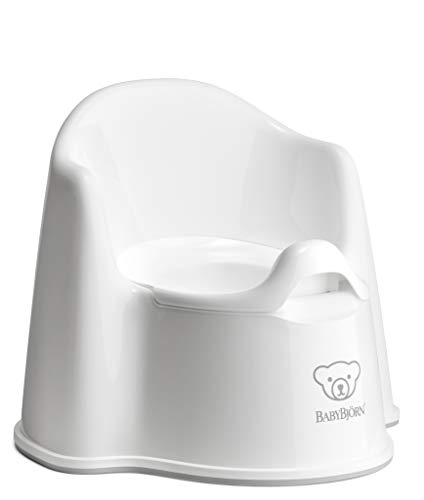
- BabyBjörn Potty Chair, White/Gray — Best Supported Seat: Check the current price on Amazon
- Jool Baby Potty Chair with Splash Guard & Handles — Best with Handles: Check the current price on Amazon
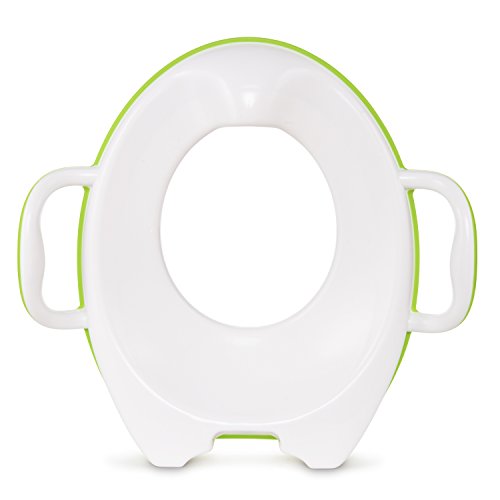
- Munchkin Sturdy Toddler Toilet Seat — Best On-Toilet Seat for Later: Check the current price on Amazon
- Ingenuity My Size Potty Pro 2-in-1 — Best to Grow Into: Check the current price on Amazon
Check the listing’s stated age and weight guidance for your exact situation. Several excellent potties below are honestly rated by their makers for older babies and toddlers; they are included as grow-into buys and labeled as such, not disguised as six-month equipment.
In this guide
Quick Picks
- Best for Elimination Communication: The Baby Potty Mini V2.0 — The only pick designed from the start for the youngest babies and EC practice — Check price on Amazon
- Best Compact First Potty: BabyBjörn Smart Potty, Gray/White — A small, low, simple potty from the category’s most trusted name — easy to hold a supported baby over — Check price on Amazon
- Best Supported Seat: BabyBjörn Potty Chair, White/Gray — The supported option — high back and armrests for babies learning to sit on a potty steadily — Check price on Amazon
- Best with Handles: Jool Baby Potty Chair with Splash Guard & Handles — Handles and a backrest help little sitters feel secure — a toddler chair a growing baby graduates into — Check price on Amazon
- Best On-Toilet Seat for Later: Munchkin Sturdy Toddler Toilet Seat — For the stage after floor potties — a stable child seat for the real toilet, bought when the time comes — Check price on Amazon
- Best to Grow Into: Ingenuity My Size Potty Pro 2-in-1 — A miniature realistic toilet for the training stage — its own listing says 18+ months, and this guide agrees — Check price on Amazon
How These Picks Were Chosen
Verification followed the standing method: every product was searched by brand and model through the airfry site’s Amazon listing data, the returned Amazon title was matched to the product reviewed, and only then did it receive a link. For this category, the returned titles mattered doubly, because several state their age guidance in the title itself — that guidance is quoted and respected in the reviews rather than smoothed over.
Selection prioritized three infant realities. First, size: a potty for a small baby must be low, with a small opening and a stable base, or the baby simply cannot be positioned on it safely. Second, support: high backs, armrests and handles matter because a six-month-old’s sitting is new and wobbly. Third, cleanability: at this age the potty is emptied and washed by an adult after every single use, so a removable inner bowl that rinses clean in seconds beats any feature list. Products designed for EC and early introduction were ranked first; toddler products appear only where they are the smart buy-ahead, clearly badged.
Safety framing is strict throughout: babies are held or supervised on any potty, potties sit on the floor (never on a raised surface), and nothing here is presented as a developmental requirement. EC is described as an optional practice some families enjoy — not a milestone your baby can miss.
One more selection principle deserves stating: every infant-appropriate pick here is a simple molded product with no electronics, no fabric and no small parts. That is deliberate. At six months, a potty is washed constantly, mouthed occasionally, and used in a wet room — the correct infant product is the one that tolerates all three without a manual full of warnings.
The 6 Best Baby Toilets for a 6 Month Old

The Baby Potty Mini V2.0 — Best for Elimination Communication
The Baby Potty Mini V2.0 exists for exactly the family reading this article: it is a deliberately tiny potty designed for early training and elimination communication, sized for babies who are still held or just beginning to sit. It suits parents practicing EC part-time — offering the potty at diaper changes and after feeds — and anyone who wants a potty a small baby can actually be positioned on. It will be outgrown sooner than toddler potties, and it is not the buy for a family that plans to start at eighteen months; for them it solves a problem they do not have.
Strengths
- Purpose-sized for infants — a small opening and low profile a young baby can genuinely use with support
- Designed explicitly for elimination communication, the main real use case at six months
- Portable and lightweight, so the potty can live where diaper changes actually happen
Trade-offs
- Small size means a shorter service life before a toddler potty takes over
- EC is a parent-led practice — the potty enables it but the routine is the work
- Minimal structure compared with high-back potty chairs as sitting turns to standing practice
| Specification | Detail |
|---|---|
| Type | Mini floor potty |
| Design purpose | Early training / elimination communication (per Amazon title) |
| Portability | Portable, lightweight |
EC-friendly design is mostly about geometry: the bowl must be small enough that a young baby’s bottom is supported rather than swallowed, light enough to bring to the baby instead of carrying the baby to a fixed spot, and simple enough to rinse instantly. The Mini V2.0 is built to those three facts, which is why it anchors this guide while bigger-name toddler potties sit further down as grow-into picks. Families practicing even casual EC — potty offered at wake-ups and changes — will use it daily from the start.
Set expectations the way EC practitioners do: the goal at six months is familiarity and caught chances, not dryness. A baby who sits happily on the mini potty for a few seconds at changes is succeeding. The potty’s job is to be unremarkable — always nearby, always clean, never a production — and its size and weight serve exactly that. When the toddler stage arrives, this becomes the travel and grandparent-house potty while a bigger chair takes over at home.
Cost perspective: the Mini V2.0 plus a later toddler chair together typically cost less than one feature-loaded musical potty, and each piece is right-sized for its stage. Stage-correct simplicity beats stage-wrong features at every age in this category.
Best for: EC families and parents starting potty familiarity in the first year / Not suited for: Families planning to begin at toddler age — buy a toddler potty instead
Check the current price on Amazon

BabyBjörn Smart Potty, Gray/White — Best Compact First Potty
The BabyBjörn Smart Potty is the compact, low-profile member of the Swedish maker’s line: a small potty with a removable inner bowl and a non-slip base that stays put on hard floors. For a six-month-old it works as a held-over or briefly-sat potty during EC-style practice, and it becomes a genuinely good first independent potty as the baby grows into a young toddler. It suits small bathrooms and minimalists — there is almost nothing to it, in the best way. Parents wanting back and arm support for a wobbly sitter should look at the Potty Chair below instead.
Strengths
- Low, compact and stable — proportions that suit the youngest sitters better than tall potty chairs
- Removable inner potty lifts out for fast, hygienic emptying and rinsing
- BabyBjörn build quality and materials record is the benchmark in this category
Trade-offs
- No backrest or armrests — a six-month-old must be held or very steady
- Compact size is outgrown earlier than the larger Potty Chair
- Minimalist design means no splash-guard height for older boys learning standing later
| Specification | Detail |
|---|---|
| Type | Compact floor potty |
| Insert | Removable inner potty |
| Base | Non-slip |
The Smart Potty’s virtue is restraint. At this age, every extra feature is something to clean around, and this design is two pieces that rinse clean in seconds. Its low stance matters developmentally too: a baby being introduced to sitting on a potty should have the experience at floor level, close to the ground they are learning to balance on, not perched on a tall chair-toilet replica. Keep it beside the changing area, offer it at the natural moments, and it quietly becomes part of the routine.
As the months pass, the same compactness pays off again: this is the potty that fits in a car footwell for travel, in a small apartment bathroom permanently, and in a diaper bag’s neighborhood without dominating it. Many families end up owning exactly this progression — Smart Potty first, larger chair later — and the combined cost is modest because both pieces are simple molded designs with nothing to break, wear out or outgrow electronically.
A practical detail: the Smart Potty’s inner bowl has a pouring spout shape that makes emptying into the toilet cleaner than flat-rimmed rivals. It is a tiny molding decision you will appreciate roughly a thousand times, which is the sort of detail this brand’s long category history produces.
Best for: Minimalist families wanting a low, simple, quality first potty / Not suited for: Parents who want back and arm support for an unsteady sitter
Check the current price on Amazon
BabyBjörn Potty Chair, White/Gray — Best Supported Seat
Where the Smart Potty is minimal, the BabyBjörn Potty Chair is supportive: a high backrest and proper armrests give a young sitter something to lean on and hold, which is precisely what a six- to nine-month-old’s new sitting skill needs. It suits families who want one potty to carry from first supported sits through confident toddler use, and babies who startle at feeling unsupported. It is bulkier to store and move room to room, and its seat height, while low, is a touch more than the Smart Potty’s — the smallest babies start on the mini or the Smart first.
Strengths
- High backrest and armrests give a new sitter real support and security
- Removable inner potty keeps the adult cleaning job as fast as the Smart Potty
- Sized to remain comfortable well into the toddler training stage — the longest service life here
Trade-offs
- Larger footprint to store in a small bathroom
- Slightly higher seat than the mini options — youngest babies graduate into it
- Heavier to carry between rooms than the portable picks
| Specification | Detail |
|---|---|
| Type | Potty chair with backrest |
| Insert | Removable inner potty |
| Base | Non-slip |
Support changes the emotional experience of early potty sits. A baby who can lean back and grip armrests relaxes, and a relaxed baby is the entire mechanism of early potty success — there is no training happening at six months, only comfort being associated with a place. The Potty Chair is engineered for that association, with proportions tested across the brand’s long history in the category. Buy it as the home-base potty: the one that lives in the bathroom and anchors the routine from first sits to independent toddler trips.
The armrests earn a second mention for the toddler stage: they become the push-off points a toddler uses to stand up independently, which is a genuine developmental convenience a flat potty cannot offer. Between that and the backrest, this chair supports both ends of the journey — the held baby at the start and the self-sufficient toddler at the end — better than any other single product in this guide.
Storage tip for the chair: it nests neatly over a corner of the bathroom and the inner potty removes for the wash while the chair stays put. In a one-bathroom home, that separation keeps the routine fast even when the bathroom is busy.
Best for: Families buying one supported potty for the whole journey / Not suited for: Travel or multi-room use, where the portable picks win
Check the current price on Amazon

Jool Baby Potty Chair with Splash Guard & Handles — Best with Handles
The Jool Baby Potty Chair is honestly a toddler product — its own listing frames it for toilet training — included here as the smart buy-ahead for families whose six-month-old will be a training toddler before they know it. Its handles and backrest are designed to make a child feel secure, and its splash guard matters once boys are in the picture. For a six-month-old today it is a supervised, supported sit at most; its real service starts later. Buy it now only if storage is free and a sale makes the timing right — otherwise buy it when training approaches.
Strengths
- Handles plus backrest give toddlers grip and confidence for independent sits
- Splash guard is a practical necessity for boys that infant potties lack
- Comfortable, child-scaled seat sized for the full training period
Trade-offs
- A toddler product — not sized or intended for a six-month-old’s independent use
- Larger than the infant picks; a storage commitment bought ahead of need
- Splash guard height can catch a small baby’s legs if used too early — supervision essential
| Specification | Detail |
|---|---|
| Type | Toddler potty chair |
| Features | Handles, backrest, splash guard (per Amazon title) |
Judged on its actual stage, this is a well-thought toddler chair: the handles answer the real reason toddlers resist potties — feeling unsteady — and the guard answers the real reason parents of boys give up on floor potties. Families who think a season ahead often buy exactly one infant mini potty for now and this chair for the training stage, skipping the mid-size shuffle entirely. That two-potty strategy is the most economical reading of this whole guide.
If you do buy ahead, store it assembled where the baby sees it during diaper changes. Familiarity is half of training: a chair that has simply always been part of the bathroom furniture gets sat on experimentally, then routinely, then independently. The families who struggle are usually introducing an unfamiliar object and a new expectation on the same day. This chair rewards the slow introduction its handles were designed for.
If grandparents will host the baby regularly, this chair’s price makes a second unit for their house realistic — and consistency of equipment across houses genuinely helps babies settle into a routine faster.
Best for: Buy-ahead families pairing it with a mini potty for now / Not suited for: Anyone needing a potty a six-month-old can use today as the main solution
Check the current price on Amazon
Munchkin Sturdy Toddler Toilet Seat — Best On-Toilet Seat for Later
The Munchkin Sturdy is a child-sized seat that sits on top of the adult toilet, shrinking the opening to toddler scale. For a six-month-old it is not usable at all — a baby cannot sit on a raised toilet seat — and it is included, clearly badged, because many parents shopping ‘baby toilets’ are really planning the whole arc and want to know the endgame. When the toddler stage arrives, a seat like this removes the emptying-and-washing chore of floor potties entirely: everything flushes. Buy it then, not now, unless it is part of a deliberate full-arc purchase.
Strengths
- Ends the potty-emptying chore — waste goes straight into the toilet and flushes
- Non-slip, stable design addresses the wobble that makes toddlers fear big toilets
- Small and light — hangs or stores beside the toilet between uses
Trade-offs
- Completely unsuitable at six months — a later-stage product, full stop
- Toddler needs a step stool to climb up, an extra purchase and a supervision duty
- Fit varies across toilet seat shapes; check your bowl before the training stage begins
| Specification | Detail |
|---|---|
| Type | On-toilet child seat |
| Stage | Toddler potty training (per Amazon title) |
The honest reason to show this product in a six-month guide is sequencing. Families move from held-over mini potties, to floor potties, to an on-toilet seat, and knowing the last step exists prevents over-buying the middle ones. The Sturdy is a category staple for that final step: simple, stable, easy to clean, and cheap enough to buy a second for a grandparents’ house. When your child starts asking about the big toilet — the surest readiness signal — this is the purchase that week.
Pair it in your mind with a sturdy step stool and a household rule: the seat lives on a hook beside the toilet, the child fetches both, and an adult is always in the room while a toddler is elevated. Falls from toilet height are the one real hazard of this stage, and they are entirely a supervision matter. Respect that, and the on-toilet seat is the cleanest, most grown-up-feeling finish to the potty journey.
When the on-toilet stage arrives, keep the floor potty in service for nighttime and travel rather than retiring it abruptly. Toddlers regress during changes — new siblings, travel, illness — and a familiar low potty is the pressure-free fallback that keeps the whole project calm.
Best for: The final training stage, when a toddler is ready for the real toilet / Not suited for: Any use in the first year — this is a planning pick, not a baby product
Check the current price on Amazon

Ingenuity My Size Potty Pro 2-in-1 — Best to Grow Into
The Ingenuity My Size Potty Pro is the clearest example of why this guide reads listings carefully: its own title states it is for toddlers ages 18+ months, up to 50 lb. It is a charming miniature toilet with a realistic flushing sound and a removable seat that later fits a standard toilet — an excellent training-stage product and a completely inappropriate six-month purchase for use. It earns its place as the designated grow-into pick: if a registry or a gift budget is buying ahead, this is the fun, functional choice for the second year. Just store it until the baby is a toddler.
Strengths
- Realistic toilet look and flushing sound make training feel like imitation, which toddlers love
- 2-in-1 design: floor potty first, then the seat transfers to the family toilet
- Honest manufacturer age guidance (18+ months) right in the listing title
Trade-offs
- Rated 18+ months — a six-month-old cannot use it, by its maker’s own specification
- Realistic size is bulky beside the infant mini potties
- Sound features delight toddlers and mean batteries to manage
| Specification | Detail |
|---|---|
| Type | 2-in-1 floor potty / removable seat |
| Age guidance | Toddlers 18+ months, up to 50 lb (per Amazon title) |
Realism is a legitimate training strategy: toddlers are imitators, and a potty that looks, sounds and ‘flushes’ like the family toilet converts curiosity into practice. The removable seat extends the product’s life onto the real toilet, which is the correct endgame. None of that changes the calendar — imitation play with a toilet replica is a second-year activity. Respect the maker’s own age line and this is a five-star-stage product; ignore it and you own an expensive, tippy stool a baby cannot use.
Gift-givers, take note: this is the potty to give at a first birthday, not a baby shower. Paired with the mini potty at the top of this guide for the first year, it completes a two-product arc that covers birth to trained with nothing wasted. That pairing — small and simple now, realistic and playful later — is the shopping strategy this entire article exists to explain.
Registry strategy, stated plainly: put the mini potty on the baby registry, and this Ingenuity on a first-birthday wishlist. Asking for both at the shower guarantees one sits in a closet for a year while the packaging tempts someone into using it far too early.
Best for: Registries and gift purchases aimed at the 18-month training stage / Not suited for: Any family needing a usable potty in the first year
Check the current price on Amazon
Comparison Table
| Pick | Badge | Key spec | Best for |
|---|---|---|---|
| The Baby Potty Mini V2.0 (check price on Amazon) | Best for Elimination Communication | Mini potty designed for early training and EC, portable and lightweight | EC families and parents starting potty familiarity in the first year |
| BabyBjörn Smart Potty, Gray/White (check price on Amazon) | Best Compact First Potty | Compact low potty with removable inner potty, non-slip base | Minimalist families wanting a low, simple, quality first potty |
| BabyBjörn Potty Chair, White/Gray (check price on Amazon) | Best Supported Seat | High backrest and armrests, removable inner potty, non-slip | Families buying one supported potty for the whole journey |
| Jool Baby Potty Chair with Splash Guard & Handles (check price on Amazon) | Best with Handles | Potty chair with handles, backrest and splash guard | Buy-ahead families pairing it with a mini potty for now |
| Munchkin Sturdy Toddler Toilet Seat (check price on Amazon) | Best On-Toilet Seat for Later | Child seat that sits on the adult toilet, non-slip, easy-clean | The final training stage, when a toddler is ready for the real toilet |
| Ingenuity My Size Potty Pro 2-in-1 (check price on Amazon) | Best to Grow Into | Realistic mini toilet, 2-in-1 with removable seat, rated 18+ months | Registries and gift purchases aimed at the 18-month training stage |
How to Choose the Best Baby Toilets for 6 Month Old Babies
Choose by stage, not by marketing. At six months the usable category is exactly one product deep: mini potties and low compact potties a baby can be held over or sit on with full support. Everything with a ladder, a step, or an on-toilet design belongs to later stages. Within the usable category, judge three things. Size of the opening — small enough to support a small bottom. Height — low enough that the experience happens near the floor. Cleaning — a removable insert that rinses in seconds, because you will wash it after every use, every day.
Then decide your philosophy honestly. Families practicing elimination communication will use a mini potty many times a day from now and should optimize for portability and speed. Families who simply want a potty present as sitting firms up should buy the supported chair that will serve through training. Families buying gifts or registries should target the training stage deliberately, with realistic mini toilets and on-toilet seats, and label the gift for later. All three philosophies are respectable; mixing them up is how nurseries fill with unusable plastic.
- Using it now with support → mini potty or compact low potty
- One purchase for the whole arc → supported potty chair with backrest
- Buying ahead or gifting → realistic 2-in-1 or on-toilet seat, labeled for 18 months+
- Small space or travel → the compact potty doubles as the travel potty later
Elimination Communication at Six Months: A Realistic Introduction
Elimination communication is the practice of offering a baby chances to use a potty at predictable moments — after waking, after feeds, at diaper changes — while watching for the baby’s own signals. It is common worldwide, optional everywhere, and at six months it is entirely parent-led: you are building the baby’s familiarity with a position and a place, and catching some output that would otherwise go in a diaper. Families who enjoy it describe less diaper laundry and an easier training transition later; families who skip it lose nothing developmental. There is no window to miss and no milestone attached.
The practical routine is modest: keep the mini potty where changes happen, offer it at the natural moments for as long as the baby is content (seconds count), and end the moment the baby objects. A cue sound — the classic soft ‘psss’ — gives the baby an association to learn. Never hold a baby on a potty against resistance, never leave a baby on one unattended, and treat every catch as a bonus rather than a score. With that framing, EC at six months is a calm, low-cost experiment that a mini potty makes easy to try.
What Babies Actually Learn From a Potty Before Age One
Strip away the marketing and the real curriculum of the first year is short. The baby learns that a particular small chair is a normal place to sit at certain moments. They learn that the position — feet supported by the floor, body held securely — is comfortable rather than alarming. They may learn to associate a cue sound with relaxing and releasing, which is a genuine reflex-level association infants can form. And the parents learn the baby’s timing and signals, which is arguably the largest benefit: EC is as much parent training as baby training.
What is not learned before one is equally important. Bladder control in the neurological sense develops later; a six-month-old who ‘uses’ the potty is being well-timed by an attentive adult, not demonstrating continence. Independence, wiping, clothing management and night dryness are all years away. Holding this distinction keeps expectations — and purchases — sane. You are buying familiarity and convenience now, with training equipment staged for later. Any product or program promising trained babies in the first year is selling the parents’ effort back to them as the baby’s achievement.
Setting Up a Potty Corner That Actually Gets Used
Where the potty lives decides whether the routine survives. The evidence of family life is blunt: equipment stored in a closet is equipment used twice. Set the mini potty on the bathroom floor beside the changing area, or — for EC families changing diapers in a bedroom — on a washable mat in that room, with wipes, a spare diaper and a small towel within arm’s reach. The offer has to be completable in under a minute with one hand holding the baby; any setup requiring a fetch-quest fails at 3 a.m. and then fails permanently.
Add three small comforts. A washable mat under the potty protects floors and defines the spot visually for the baby. A tiny basket of two or three board books gives older babies something to hold during the brief sit — association with a pleasant ritual matters more than duration. And a hook or shelf for the insert’s rinse routine keeps cleaning supplies at the sink rather than under it. Review the corner monthly: as the baby grows from held-over, to supported sit, to cruising past and patting the potty, the setup should evolve — books change, the mat moves to the bathroom, the chair stage approaches. A potty corner that evolves with the baby is the physical form of the whole philosophy in this guide: right product, right stage, zero drama.
How to Introduce a Potty to a 6 Month Old Safely
Introduction at this age is a routine you build around diaper changes, in seconds-long moments, with safety rules that never bend.
- Place the potty on the floor — never on a table, bed or changing surface — beside where diaper changes happen
- Offer at predictable moments: on waking, after a feed, and at each diaper change, when output is most likely anyway
- Support the baby fully: held over the mini potty in the early weeks, or seated with your hands at their torso once sitting emerges — you are the chair’s backrest until they have their own
- Keep it brief and pleasant: a cue sound, a few seconds of opportunity, and finish the moment the baby fusses, arches or cries
- Empty and rinse the insert immediately, every time; a potty that is always clean is a potty a baby stays relaxed around
- Dress for access: leggings or open-crotch EC clothing make offers fast enough to catch the moment; wrestling with snaps teaches everyone to skip it
- Stop entirely during illness, travel chaos or any week it stops being easy — familiarity resumes fine after a pause
The measure of success at six months is a baby who regards the potty as ordinary furniture. Dryness, signaling and independence belong to later stages and later products — several of which are honestly reviewed above for when you get there.
Track nothing. Some EC families log catches; most find the notebook becomes its own pressure within a fortnight. The routine survives on ease, not data — if you remember the natural moments, you are doing the whole method.
Common Buying Mistakes
Buying a ladder seat or realistic toilet for a six-month-old to use now. Their own listings rate them for toddlers — 18 months and up in the Ingenuity’s case. A baby cannot climb, balance or sit at that height. Buy the stage the baby is in.
Leaving a baby on a potty “for a moment.” Babies this age topple silently and instantly. A potty is a held activity, every second, no exceptions — this is the one rule in this guide with no flexibility.
Placing the potty on a raised surface. Potties belong on the floor. A fall from a changing table with a hard plastic potty involved is exactly the accident the floor rule prevents.
Turning EC into a performance. Pressure — on the baby or yourself — is the fastest way to make the potty a place of protest. Brief, cheerful, optional offers are the entire method at this age.
Skipping the insert and buying a one-piece sculptured potty. You will wash this object constantly. A removable inner bowl that rinses in the sink is the difference between a sustainable routine and an abandoned one.
Using the potty as a containment seat. A potty is not a baby seat for while you shower. Babies tip, strain and grow to hate a chair they are parked in. Offers are brief; entertainment happens elsewhere.
Final Recommendation
For a six-month-old today, the shortlist is short and honest: the Baby Potty Mini V2.0 if you are practicing elimination communication, the BabyBjörn Smart Potty for a compact first potty from the most trusted name in the category, and the BabyBjörn Potty Chair if you want supported sits now and a training chair later in one purchase. The Jool chair, the Munchkin seat and the Ingenuity mini toilet are all good products — for the toddler your baby is about to become — and this guide has badged them as exactly that rather than pretend otherwise. Buy for the stage you are in, keep a hand on the baby, and the potty becomes the easiest routine in the house.
Finally, keep the whole project in proportion: a potty is a few dollars of molded plastic and a few calm minutes a day. If it becomes a source of household stress, the correct move is always to pause and let the baby grow — the chairs and seats reviewed above will be waiting, unchanged, at the stage they were designed for.
To compare the leading options side by side, start with The Baby Potty Mini V2.0, BabyBjörn Smart Potty, Gray/White, BabyBjörn Potty Chair, White/Gray — each listing confirms the current configuration and lets you check price on Amazon before you commit.
Keep researching within this category cluster: Best Baby Toilets For Infants Best Autoflush Toilets Best Automatic Toilets Best Ada Compliant Toilets
Frequently Asked Questions
Can a 6 month old really use a potty?
With full adult support, yes — babies this age can be held over a mini potty or sit on one briefly once they can sit with help, which is the basis of elimination communication. Independent use is a toddler skill. Any product suggesting otherwise should be read very carefully.
What is elimination communication, in one sentence?
It is offering your baby regular, relaxed chances to use a potty at predictable moments, based on timing and the baby’s signals, instead of relying on diapers for every output.
Which potty is safest for a baby who has just learned to sit?
A low floor potty with a non-slip base and either a high backrest or your hands providing the support. The BabyBjörn Potty Chair’s backrest and armrests are designed for exactly this wobbly stage — with an adult always within arm’s reach.
Do I need a potty at six months at all?
No. It is an optional convenience for families interested in EC or early familiarity. Babies who start with a potty at sixteen months train perfectly well. Buy one because the routine appeals to you, not from developmental anxiety.
How do I clean a baby potty?
Empty the insert into the toilet, rinse it, wash with warm soapy water, and dry. The removable-insert designs in this guide make that a one-minute job; avoid harsh chemicals on surfaces a baby’s skin contacts, and rinse thoroughly.
When should we move from a mini potty to a toddler chair or seat?
When the baby outgrows the mini potty’s size, starts standing and cruising, or shows interest in the family toilet — typically across the second year. The supported chair stage comes next, and the on-toilet seat finishes the arc.
Are splash guards important at this age?
Not for infants — they matter for toddler boys learning aim and control. At six months, prioritize size, support and cleaning over guards and features.
Should a baby’s feet touch the floor on a potty?
Ideally yes, or be supported — dangling legs make sitting less stable and less comfortable, which is one reason low infant potties beat tall chair designs at this age. On the mini potties here, a small baby’s feet reach the floor naturally.
How many potties does a family need?
One is enough; two is convenient if the home has two floors or a grandparent’s house in regular rotation. Beyond that, extra potties are storage problems wearing a bargain’s clothes.
What should a baby wear during potty offers?
As little as practical. EC families often use open-crotch pants or a diaper that opens fast, because the window between signal and event is seconds long. For ordinary brief sits at changes, simply removing the diaper is enough — the offer is built into the change itself.
Is it unhygienic to keep a potty in the room where diapers are changed?
No — that is where it is most useful, provided the insert is emptied into the toilet and washed after every use. The hygiene rule is the washing routine, not the room. A potty that is always rinsed immediately is cleaner in practice than a rarely washed one stored anywhere else.


