Disclosure: airfryerkitchensupply.com is reader-supported. When you buy through links on our site, we may earn an affiliate commission at no extra cost to you.
Where to buy
Stock, colours and sizes move around, so use the links below to check the current configuration for your room before you commit:
- SAFAVIEH Carousel Kids 100 Area Rug, 4 x 6, Navy & Ivory CRK167N — Best Overall. Check the current price on Amazon.
- Play Rug Road Car Track Playmat, 5 x 7, Washable — Best Play Value. Check the current price on Amazon.
- jinchan Washable Kids Playroom Rug, 5 x 7, Checkered Diamond — Best Washable Style. Check the current price on Amazon.
- Lahome Abstract Washable Rug, 5 x 7, Rainbow — Best for Art and Messy Play. Check the current price on Amazon.
- Kids Carpet Playmat Rug City Life Road Traffic Play Mat — Best for Imaginative Play. Check the current price on Amazon.
- KICHOWUA Fluffy Shag Rainbow Rug, 4 x 6 — Best Plush Corner Rug. Check the current price on Amazon.
The best area rugs for kids playroom use have to survive a job description no living-room rug would accept: hot wheels traffic, spilled juice, craft glue, fort construction, bare feet, knees, and a weekly negotiation with the washing machine. Every rug in this guide was verified in the Amazon catalogue and chosen against playroom criteria specifically — washability or wipe-clean fibres, a non-slip plan, pile that toy wheels can cross but small bodies can fall on, and patterns busy enough to forgive the evidence of childhood between cleanings.
We have deliberately mixed construction types, because playrooms differ. There is a durable power-loomed rug for the high-traffic room, flat washable rugs that go in the machine after the inevitable spill, a road-map playmat that is half rug and half toy, and a plush shag for the reading corner where comfort beats practicality. What there is not is a delicate natural-fibre rug pretending to be childproof — the buying guide below explains exactly what to look for, and what to avoid, when a rug’s real users are under ten.
In this guide
Quick Picks
Best Overall: SAFAVIEH Carousel Kids 100 Area Rug, 4 x 6, Navy & Ivory CRK167N. A power-loomed polypropylene kids rug with a medium 5/8-inch pile — the durable, stain-resistant workhorse from a maker that specialises in exactly this category.
Best Play Value: Play Rug Road Car Track Playmat, 5 x 7, Washable. A printed city road map the size of a real rug — washable, non-slip, and engineered so the floor itself becomes the favourite toy in the room.
Best Washable Style: jinchan Washable Kids Playroom Rug, 5 x 7, Checkered Diamond. A soft, non-slip, machine-washable rug in a cheerful checkered diamond pattern on cream — the washable pick that still looks like decor.
Best for Art and Messy Play: Lahome Abstract Washable Rug, 5 x 7, Rainbow. An ultra-thin washable rug in an abstract rainbow wash of colour — thin enough for doors and robot vacuums, forgiving enough for paint day.
Best for Imaginative Play: Kids Carpet Playmat Rug City Life Road Traffic Play Mat. A city-life playmat printed with roads and buildings, designed as an educational play surface for cars, figures and storytelling.
Best Plush Corner Rug: KICHOWUA Fluffy Shag Rainbow Rug, 4 x 6. A plush rainbow shag for the soft corner of the playroom — reading nests, dressing-up zones and any patch of floor meant for lying on, not driving on.
How These Picks Were Chosen
Each candidate had to clear a playroom-specific bar. First, cleaning: the rug either had to be machine washable, made from polypropylene — the most stain-resistant common rug fibre — or flat enough to wipe and shake out easily. Second, stability: a playroom rug must not become a sled on hard floors, so every pick either carries a non-slip design claim in its verified listing or is heavy enough in its size class to sit flat, and we still recommend a rug pad beneath all of them. Third, verification: brand and model were searched in the Amazon catalogue and the returned title had to match the rug we describe; only confirmed rugs carry links.
Within those gates we balanced the two honest poles of playroom flooring. At one pole, low, dense, washable rugs that toys roll across and parents can launder. At the other, plush rugs that cushion falls and invite lying-down play but demand more vacuuming and spot-cleaning patience. Age matters too: road-map rugs peak for toddlers and preschoolers, while the abstract and shag picks keep working into the tween years. The six picks below are labelled by which pole, and which age, they serve best.
The 6 Best Area Rugs for Kids Playroom
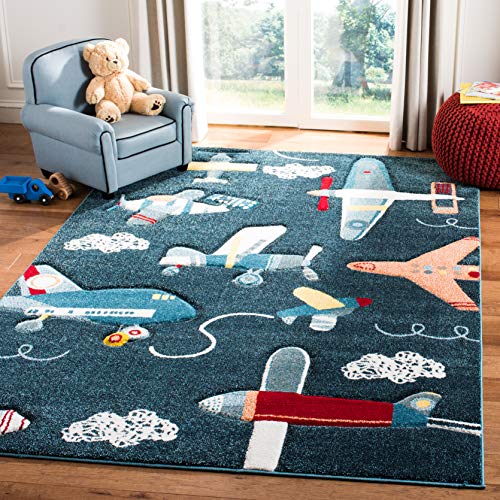
SAFAVIEH Carousel Kids 100 Area Rug, 4 x 6, Navy & Ivory CRK167N — Best Overall
Safavieh’s Carousel Kids line is built for rooms like yours: polypropylene fibre that shrugs off juice and paint water, a power-loomed construction with no loose tufts for small fingers to pull, and a medium pile that cushions knees without swallowing toy cars. The navy and ivory palette hides everyday evidence better than pastel nursery rugs do.
Strengths
- Polypropylene fibre resists stains and cleans easily
- Medium 5/8-inch pile balances cushion and toy mobility
- Power-loomed construction has no tufts to unravel
Trade-offs
- Not machine washable; spot clean and hose-down territory
- Synthetic feel is less plush than shag alternatives
- 4 x 6 size suits small to medium playrooms best
| Fibre | Polypropylene |
| Pile | 5/8 inch, medium |
| Size verified | 4 x 6 feet |
| Construction | Power-loomed, made in Turkey |
This is the rug we recommend when the playroom is a daily-use room rather than a showpiece. Polypropylene is the pragmatic fibre of kids’ rugs for a reason: it does not absorb spills quickly, it tolerates vigorous spot-cleaning, and it does not shed. The medium pile is the thoughtful middle — thick enough that a toddler’s tumble ends softly, low enough that building blocks still stand and puzzle pieces stay findable. Put a non-slip pad under it and it will outlast several childhood phases.
One practical note from the construction: power-loomed polypropylene rugs lie flat quickly and stay flat, which matters in a room where a curling corner is a trip hazard at running speed. The Carousel line’s patterns are designed at child scale — motifs big enough to register as scenery in play — and the navy ground will carry the rug visually from toddler room to early school years without demanding a redecorate in between.
Best for: daily-use playrooms needing durability and easy cleaning / Not suited for: parents who want a machine-washable rug above all
Check on Amazon — check the current price on Amazon before ordering.

Play Rug Road Car Track Playmat, 5 x 7, Washable — Best Play Value
Road rugs earn their floor space twice: once as a rug, and once as the play surface that keeps toy cars, figures and imaginary errands occupied for hours. This 5 by 7 version is washable with a non-slip backing, sized generously enough for two children to run parallel traffic systems without territorial disputes, and flat enough that vehicles roll true.
Strengths
- Road-map print turns the rug into a play activity
- Machine washable for real playroom messes
- Non-slip backing plus a roomy 5 x 7 layout
Trade-offs
- Flat profile offers minimal fall cushioning
- Print dates the room as children outgrow car play
- Busy design will not suit a calm, minimal nursery
| Size | 5 x 7 feet |
| Design | City road track print |
| Care | Machine washable |
| Backing | Non-slip |
The hidden virtue of a road rug is behavioural: it gives play a geography. Cars live on the rug, routes get invented, and the mess of a play session concentrates on one washable rectangle instead of the whole room. For toddlers through early primary years it is routinely the most-used square footage in the house. Pair it with a thin pad if your floors are hard and falls are a concern, and accept that in five years you will replace it with a plainer rug — five years of daily use is a fair trade.
Buy two accessories with it and the rug’s value doubles: a handful of vehicles scaled to its printed roads, and a small storage bin that lives at the rug’s edge. The bin is the discipline trick — cars that sleep beside the rug stay on the rug, and the playroom’s floor traffic problem solves itself. When guests come, the whole city rolls up or washes, which no rigid play table can claim.
Best for: toddlers and preschoolers who live for toy vehicles / Not suited for: older kids or style-led nursery designs
Check on Amazon — check the current price on Amazon before ordering.

jinchan Washable Kids Playroom Rug, 5 x 7, Checkered Diamond — Best Washable Style
Some parents want the playroom to look like part of the house rather than a toy warehouse, and this jinchan rug is for them. The checkered diamond design is playful without a licensed character in sight, the surface is soft for floor play, and when the room’s week catches up with it, the whole rug goes in the wash — the feature that separates genuinely kid-proof rugs from merely stain-resistant ones.
Strengths
- Fully machine washable, the key playroom feature
- Soft surface with non-slip backing
- Pattern reads playful but not babyish
Trade-offs
- Low, washable profile means modest cushioning
- Cream background shows marks between washes
- Thin rugs can curl at corners without a pad
| Size | 5 x 7 feet |
| Design | Checkered diamond, cream background |
| Care | Machine washable |
| Backing | Non-slip |
Washability changes how you feel about a playroom. Snacks stop being contraband, paint water stops being a crisis, and the rug’s hygiene is a laundry cycle rather than a prayer. The trade is pile: washable rugs are woven thin so they fit machines and dry quickly, so plan on a cushioned pad beneath if the room hosts crawlers. As a design-led washable option that works from nursery through the school years, this is the strongest balance in the guide.
Because it washes as a single piece, this rug also suits the allergy-managed household: the dust, pollen and pet dander that accumulate in any playroom rug leave in the wash water rather than redistributing under the vacuum. Dry it fully before relaying — a damp washable rug on a pad is a mildew invitation — and rotate it a quarter turn at each wash so machine and sun wear it evenly.
Best for: parents wanting a washable rug that still looks styled / Not suited for: rooms needing thick fall cushioning from the rug itself
Check on Amazon — check the current price on Amazon before ordering.

Lahome Abstract Washable Rug, 5 x 7, Rainbow — Best for Art and Messy Play
Lahome’s abstract rainbow design solves the oldest playroom-rug problem: camouflage. The swirling colour field hides crayon marks, play-dough crumbs and the general patina of creative play better than any solid or cream rug can, and its ultra-thin profile slides under doors and lets robot vacuums patrol — a real consideration in a room that generates crumbs hourly.
Strengths
- Abstract rainbow pattern camouflages marks and crumbs
- Ultra-thin profile clears doors and robot vacuums
- Washable with a non-slip backing
Trade-offs
- Ultra-thin means almost no cushioning on its own
- Abstract style is bold; not for muted rooms
- Needs a pad for comfort on hard floors
| Size | 5 x 7 feet |
| Profile | Ultra-thin |
| Design | Abstract rainbow |
| Care | Washable, non-slip |
Choose this rug when the playroom doubles as the art room. Its whole design philosophy is forgiveness: colour everywhere so no single stain announces itself, a surface that washes clean, and a profile that stays out of the way of the room’s traffic. It is the least cushioned pick here, so we would not put a newly crawling baby straight onto it over tile — but over a pad, or for the three-to-ten crowd whose falls are from standing height onto their own dignity, it is the most practical square in this guide.
The ultra-thin profile has one more household virtue: chair castors, ride-on toys and robotic vacuums all cross it without the negotiation a piled rug demands. In a playroom that doubles as a home office corner or a homework station, that traffic tolerance keeps the rug from becoming the room’s obstacle. Its abstract wash of colour also photographs kindly, which matters more to modern parents than any of us admit.
Best for: messy, creative playrooms and art corners / Not suited for: crawlers on hard floors without a pad beneath
Check on Amazon — check the current price on Amazon before ordering.

Kids Carpet Playmat Rug City Life Road Traffic Play Mat — Best for Imaginative Play
This playmat leans fully into the city theme: streets, buildings and the little geography of a town, printed as a dedicated play surface. Compared with the washable road rug above, it is the more toy-like option — best understood as a giant play accessory that also covers the floor, for children whose play is narrative: shops to visit, buses to route, deliveries to make.
Strengths
- Detailed city print fuels imaginative, narrative play
- Flat surface keeps toy vehicles and figures stable
- Covers and protects a defined play zone
Trade-offs
- Playmat profile offers little softness underfoot
- Theme suits younger children; ages out sooner
- Cleaning is surface-level rather than machine washing
| Design | City Life road traffic print |
| Type | Flat playmat rug |
| Use | Cars, toys and imaginative play |
| Setting | Bedroom and playroom |
There is a developmental honesty to this pick: for roughly ages two to six, a printed town is not decor, it is curriculum — children rehearse how the world fits together on these streets. The flat weave is a feature for that play, since buildings stand and cars track straight. Its limits are equally clear: it will not cushion like a pile rug and it will not wash like the jinchan or Lahome picks, so it belongs in rooms where play is dry — cars, blocks, figures — rather than paint and snacks.
Use this mat as the defined stage for the toys that otherwise colonise the house: when the town is out, play is in session, and when the mat is rolled, the room resets. That ritual — unroll the city, roll up the city — gives younger children a beginning and an end to play they can perform themselves, and gives parents a floor again in the evenings.
Best for: imaginative vehicle and town play for ages two to six / Not suited for: snack-heavy or cushion-critical playrooms
Check on Amazon — check the current price on Amazon before ordering.

KICHOWUA Fluffy Shag Rainbow Rug, 4 x 6 — Best Plush Corner Rug
Every playroom needs two floor personalities: the practical field and the soft nest. This Kichowua shag is the nest — a fluffy, fuzzy rainbow pile with a non-slip backing, sized 4 by 6 for a corner, a teepee base or beside a bed. Children read, sprawl and stage doll dramas on it precisely because it is the opposite of practical flooring.
Strengths
- Deep plush shag is the most comfortable surface here
- Rainbow colouring suits playful girls’ rooms and nurseries
- Non-slip backing helps it stay in its corner
Trade-offs
- Shag traps crumbs and small toy parts; shake and vacuum often
- Toy cars and blocks do not work on deep pile
- Not a machine-wash candidate; spot clean only
| Size | 4 x 6 feet |
| Pile | Plush shag |
| Design | Rainbow |
| Backing | Non-slip |
Judge this rug as furniture for the floor, not as the room’s work surface, and it earns its place. The deep pile is where a child chooses to be — which is why reading corners built on shag actually get used. Maintenance is the honest cost: shag hides debris the way the Lahome hides stains, except debris must be vacuumed out rather than washed out, and lost LEGO in a shag rug is a genuine archeological exercise. Keep food on the washable side of the room and this rug will be the beloved square of the playroom.
A practical pairing: place a washable pick from this guide as the room’s main field and this shag strictly inside the book corner’s boundary, ideally over the washable rug’s edge or on its own pad. The shag then never meets a juice box in anger, and its one job — being the softest invitation in the room — stays uncompromised for years of story times.
Best for: reading corners, nurseries and cosy play nests / Not suited for: the main traffic and toy-vehicle zone
Check on Amazon — check the current price on Amazon before ordering.
Comparison Table
| Pick | Badge | Key spec | Best for |
|---|---|---|---|
| SAFAVIEH Carousel Kids 100 Area Rug, 4 x 6, Navy & Ivory CRK167N | Best Overall | Polypropylene, 5/8 in pile, 4 x 6 | daily-use playrooms needing durability and easy cleaning |
| Play Rug Road Car Track Playmat, 5 x 7, Washable | Best Play Value | Washable road playmat, 5 x 7, non-slip | toddlers and preschoolers who live for toy vehicles |
| jinchan Washable Kids Playroom Rug, 5 x 7, Checkered Diamond | Best Washable Style | Machine washable, 5 x 7, non-slip | parents wanting a washable rug that still looks styled |
| Lahome Abstract Washable Rug, 5 x 7, Rainbow | Best for Art and Messy Play | Ultra-thin washable, rainbow abstract, 5 x 7 | messy, creative playrooms and art corners |
| Kids Carpet Playmat Rug City Life Road Traffic Play Mat | Best for Imaginative Play | City print playmat, flat profile | imaginative vehicle and town play for ages two to six |
| KICHOWUA Fluffy Shag Rainbow Rug, 4 x 6 | Best Plush Corner Rug | Plush shag, rainbow, 4 x 6, non-slip | reading corners, nurseries and cosy play nests |
How to Choose the Best Area Rugs for Kids Playroom Life
Start with the cleaning question, because it decides everything else. Ask honestly what will happen on this rug: if the answer includes paint, snacks, play dough or a puppy in training, the rug must be machine washable or polypropylene, full stop. Washable flat rugs like the jinchan and Lahome picks trade cushion for hygiene; polypropylene like the Safavieh trades machine washing for superb spot-cleaning. Shag, the third path, is a comfort purchase that belongs away from the mess. Choosing a beautiful rug that cannot survive your child’s actual hobbies is the most expensive mistake in this category.
Second, think in pile heights. Low, dense piles — or flat playmats — are working surfaces: wheels roll, towers stand, chairs slide and crumbs vacuum up. Medium pile around half an inch cushions knees while staying workable, which is why the Safavieh’s 5/8-inch profile anchors this guide. Deep shag is a destination, not a surface. Many good playrooms layer the strategy: a large low rug as the field, a small plush rug as the nest, each sized to its job rather than one rug failing at both.
Third, size and stability. A playroom rug should be big enough that play happens on it rather than half off it — for most rooms that means at least 5 by 7 feet for the main rug — and it must not travel. Non-slip backings help, but a proper rug pad underneath is the real fix: it stops sliding, adds the cushion thin washable rugs lack, and extends the rug’s life by preventing the backing from cracking against hard floors. On carpeted playrooms, choose a low-profile rug and a carpet-to-carpet pad, or the rug will ripple and creep no matter what its listing promises.
Fibre Face-Off: Polypropylene, Washable Synthetics and Shag
Polypropylene is the traditional kids-rug fibre because its weaknesses barely matter in a playroom. It is not the softest fibre and it should be kept away from high friction heat, but it resists water-based stains superbly, does not shed, tolerates strong spot-cleaning, and costs less than natural fibres — which is why classroom and playroom rugs from Safavieh’s Carousel line use it. For a rug expected to survive a childhood, polypropylene is the rational default.
Washable synthetic rugs take a different deal: they are woven thin from polyester or similar yarns so the finished rug fits a domestic machine. The payoff is total hygiene reset — the whole rug, not just the spot — and the cost is pile and presence; these rugs feel more like heavy blankets than carpets. In homes with allergies, pets or chronic spills, that trade wins easily. Shag sits at the comfort extreme: long synthetic pile that feels wonderful and behaves like a crumb archive. None of the three is best in the abstract; the guide’s picks are labelled so you can match fibre to the mess profile of your own room.
Safety and Setup Details Parents Actually Need to Check
A playroom rug is safety equipment as much as decor. Corners that curl become trip lips for running children, so lay a new rug flat with heavy books on the corners for a day, and reject any rug that will not settle. Backings matter on hard floors: latex and TPR non-slip layers grip well when new, and a separate pad restores grip as they age. Keep rugs clear of floor-level heat vents, and in nurseries choose low pile for the crawling zone — deep shag can hide small objects, from dropped grapes to toy parts, that crawling babies are professionally skilled at finding.
Finally, plan the room around the rug rather than dropping the rug into the room. Put the washable rug under the art table and snack chair, the road rug where vehicle play naturally gathers, and the plush rug in the quiet corner with the books. Zoning the playroom this way means each rug does the job its construction suits, cleaning stays targeted, and the whole room works better than any single do-everything rug could make it.
Rugs for Different Ages: From First Steps to Homework Years
For crawlers and new walkers, the specification is cushion and grip: a medium-pile rug like the Safavieh over a thick pad, or a washable rug over a cushioned pad, in a size that covers the whole exploration zone. Avoid deep shag at this age — it hides small objects and makes pulling to stand harder — and avoid road prints as the main surface, since their moment has not yet come. Everything at this stage should survive being washed or wiped weekly without drama.
Ages two to six are the playmat’s golden window and the washable rug’s hardest service. Vehicle and town play peaks, art gets ambitious, and snacks migrate. This is when the road rugs earn their floor space outright and when a machine-washable main rug stops being a preference and becomes the household’s sanity policy. Keep the shag in its corner and accept that it will host stuffed animals more than children during these years.
From seven upward, the room’s centre of gravity shifts to projects, reading, gaming and homework, and the rug brief changes with it: larger, calmer, lower. The jinchan’s checkered pattern and the Lahome’s abstract both survive this transition visually, while the road rugs retire to younger siblings or the top of a wardrobe against future need. A single well-chosen washable rug bought at seven can serve to the teens — the first point in the playroom’s life where buying for longevity beats buying for the phase.
What to Put Under, Around and On Top of a Playroom Rug
The pad deserves its own paragraph in every rug guide and rarely gets one. For playrooms, choose a pad for function: felt-plus-rubber pads add the most cushion under thin washable rugs and grip hard floors at the same time, while thin rubber webbing suffices under the heavier Safavieh. Cut the pad an inch inside the rug’s outline so it stays invisible and cannot become a trip edge of its own. On carpet, use a carpet-lock pad or accept that a rug on carpet is a temporary citizen that will need regular straightening.
Around the rug, think about the room’s edges: storage low enough for children to use themselves keeps toys migrating back to the rug instead of colonising the house, and a washable rug placed under the art table — not merely near it — catches the drips that gravity guarantees. On top of the rug, floor cushions and a low bookcase complete the reading corner around a plush pick, while a small ramp or bridge toy extends a road rug’s city onto the bare floor for the afternoon and packs away by dinner. The rug is the room’s foundation layer; everything else is furniture arranged on its terms.
Cleaning Schedules by Rug Type: A Realistic Household System
A playroom rug stays respectable on a schedule, not on good intentions, and the schedule differs by construction. Washable rugs — the jinchan and Lahome picks — want a rhythm of weekly vacuuming, a wash every few weeks in active service, and an immediate wash after illness or a major spill; their thinness makes each wash cheap in time and drying, which is the entire point of owning them. Set a recurring laundry slot, the way you would for bedding, and the hygiene argument for washable rugs actually materialises instead of remaining a listing claim.
Polypropylene pile rugs like the Safavieh run on a different clock: vacuum twice weekly in the traffic lanes, spot-clean incidents the day they happen with a mild solution and blotting rather than scrubbing, and deep-clean — hose, extraction or a sunny-day wash — once a season. Shag inverts the effort again: shake it outdoors weekly, since gravity removes what vacuums merely rearrange, suction-vacuum gently, and accept a professional clean as an annual event if the reading corner sees daily use.
What unifies the three schedules is inspection. Every deep clean is also a backing check, a corner check and a pad check, and the quarter-turn rotation that evens wear. Households that run this system replace playroom rugs because children outgrow them; households that do not, replace them because the rugs give up. The picks in this guide were chosen so that either outcome is available to you — but the system, as ever, is the difference.
Colour and Pattern Strategy for a Room That Changes Every Two Years
Playroom decor has a built-in obsolescence no other room matches: the occupant’s taste turns over completely every few years, from nursery pastels to primary brashness to the sudden, total seriousness of the pre-teen. Rug strategy should be built on that certainty. The foundation pieces — the large washable rug, the durable polypropylene field — belong in colours and patterns with range: the jinchan’s cream checker and the Safavieh’s navy both survive several redecorates because they read as pattern rather than theme, while the theme pieces, the road rugs, should be bought cheerfully as consumables of a phase.
Pattern scale is the subtler decision. Small, busy patterns forgive marks and suit small rooms; large motifs need floor space to read and turn the rug into the room’s artwork, which is the Lahome abstract’s whole proposition. In a room that will host a decade of phases, a large-pattern washable rug is a surprisingly durable choice — abstract art ages with the child in a way cartoon geography cannot — while the road rug does its irreplaceable two-to-six work and retires with honours.
The final rule is to let the rug be the room’s colour commitment and keep walls and storage neutral. Repainting is a weekend; replacing a large rug is a purchase. Parents who anchor the palette in the rug — replacing it at phase changes, repainting almost never — spend less across the playroom’s life and end up with rooms that look designed at every stage, which is the outcome the redecorating treadmill usually promises and rarely delivers.
A Note on Rug Allergens and the Asthma-Conscious Household
Any rug collects what a hard floor merely displays, and households managing dust sensitivity should choose with that mechanics in mind rather than avoiding rugs altogether — a washable rug, regularly laundered, can hold less airborne dust than a bare floor that is swept into the air daily. The jinchan and Lahome picks are the instruments of that strategy: their entire soil load leaves in the wash, on a schedule the household controls, and their low pile gives dust nowhere deep to retire to. Pair them with the pad, wash the pad’s cover if it has one, and the playroom’s floor becomes the most frequently cleaned surface in the home.
Pile rugs in such households are not forbidden, but they carry duties: the Safavieh’s polypropylene at least releases its dust readily to a good vacuum, while deep shag should be the first furnishing reconsidered if symptoms track the playroom. This guide makes no medical claims — it simply notes that fibre, pile and washability are the levers, that every pick here is labelled by them, and that the household which pulls the washability lever hardest is rarely the one that regrets it.
How to Set Up and Care for a Playroom Rug So It Survives Childhood
A playroom rug’s lifespan is decided in its first week and its weekly routine. The steps below cover unrolling, padding, zoning and the cleaning rhythm that keeps the picks in this guide looking respectable.
- Unroll and flatten patiently. New rugs arrive with roll memory. Unroll yours, reverse-roll it once against the curl, then lay it flat with furniture or books on the corners for 24 to 48 hours. A rug flattened properly at the start rarely becomes a trip hazard later.
- Fit a rug pad cut to size. Trim a non-slip pad an inch smaller than the rug on every side and lay it first. The pad stops sliding, adds the cushion thin washable rugs lack, protects the floor beneath, and keeps the rug itself from wearing against hard surfaces.
- Zone the rug to the activity. Place the main rug where floor play concentrates, not centred decoratively in empty space. Washable rugs go under art and snacks, road rugs where vehicles live, plush rugs in the reading corner — the zoning described in the guide above.
- Vacuum on the right setting. Vacuum washable and low-pile rugs with the brush roll on; for shag, use suction only or shake the rug outdoors weekly, since aggressive beater bars tear long pile. A quick midweek pass keeps grit from grinding into any fibre.
- Wash washable rugs cold and flat-dry. Machine wash washable picks in cold water on gentle, without bleach or fabric softener, then dry flat or on low heat. Hot cycles and softeners degrade non-slip backings — the part of the rug you cannot see is the part harsh washing destroys.
- Rotate and inspect quarterly. Turn the rug 180 degrees every few months so traffic and sunlight even out, and check the backing for cracking. Caught early, a fresh pad restores an aging rug; ignored, a crumbling backing is the rug’s retirement notice.
None of this is burdensome — it is roughly fifteen minutes a week — but it is the difference between a playroom rug that is replaced in embarrassment after a year and one that is handed down to the next child’s room.
Common Buying Mistakes
Buying a beautiful rug that cannot be cleaned. The playroom will test every fibre claim you ignore. A dry-clean-only or delicate natural-fibre rug in a room with juice and paint is not an aesthetic choice; it is a countdown. Match the cleaning method to the mess before falling for a pattern.
Choosing deep pile for the whole room. Shag feels wonderful and functions terribly as a main surface: wheels bog down, blocks topple, crumbs vanish into the pile. Keep deep pile in a corner zone and give the main floor a low or medium pile, as this guide’s picks are arranged.
Skipping the rug pad. A sliding playroom rug is a fall waiting for a running child, and thin washable rugs on hard floors are uncomfortable enough that children migrate off them. The pad solves safety, comfort and rug longevity in one inexpensive layer.
Sizing for the furniture instead of the play. Playroom rugs should be sized for where children actually sit, sprawl and build — usually a bigger area than feels decorative. A rug that only fits under the storage unit leaves the play itself on cold, hard floor.
Forgetting the rug will age out. A road-map rug is perfect at four and embarrassing at nine. That is fine — buy for the child you have, in fibres that clean well, and treat theme rugs as the consumable joy they are rather than heirloom purchases.
Final Recommendation
If you buy one rug for a hardworking playroom, buy the SAFAVIEH Carousel Kids: polypropylene durability, a medium pile that splits the difference between cushion and playability, and a pattern that forgives daily life. If your household’s mess level is higher — snacks, art, pets — the jinchan washable rug is the honest answer, with the Lahome abstract as the bolder, thinner alternative that hides everything between washes.
Layer in the specialists where the room allows: a road playmat (the washable Play Rug or the City Life mat) for the vehicle years, and the KICHOWUA shag to make the reading corner the place children choose to be. Size generously, pad underneath, check the current price on Amazon, and the floor of the playroom stops being a problem you manage and becomes the toy that never needs batteries.
Related guides in this series: Best Area Rugs For Large Dogs Best Area Rugs For Soundproofing Best Area Rugs For Under Kitchen Table Best Area Rugs For Vinyl Floors Best Area Rugs For Under Office Chair
Frequently Asked Questions
What size rug is best for a kids playroom?
For most playrooms, 5 by 7 feet is the practical minimum for the main rug and 8 by 10 suits larger rooms. The rug should hold the play itself — children sitting, building and sprawling — not just sit under furniture, so size for activity rather than decoration.
Are machine washable rugs worth it for a playroom?
If the room hosts snacks, art or pets, yes. A washable rug resets hygiene completely instead of spot-treating forever. The trade-off is a thinner, less cushioned profile, which a good rug pad underneath largely solves.
What rug material is best for kids?
Polypropylene is the durability default: stain-resistant, non-shedding and easy to spot-clean. Washable polyester suits mess-heavy rooms, while plush synthetic shag is best reserved for low-mess comfort corners. Natural fibres look lovely but clean poorly under playroom conditions.
Do playroom rugs need a pad underneath?
Effectively, yes. A pad prevents sliding on hard floors, adds cushioning that thin washable rugs lack, protects the flooring, and extends the rug’s life. It is the cheapest performance upgrade in the whole room.
How do I stop a playroom rug from curling at the corners?
Flatten it on arrival with reverse-rolling and weights for a day or two, keep it on a pad, and avoid folding it for storage. Persistent curl usually means the backing is aging; a fresh pad and corner weights will often settle it again.
When do kids outgrow road-map play rugs?
Typically somewhere between ages six and nine, depending on the child. Road rugs deliver enormous play value in the toddler-to-early-school window, so buy them for that window in an easy-clean construction rather than expecting them to serve a decade.
Can I put a playroom rug over carpet?
Yes, with adjusted expectations and the right support. Choose a low-profile rug — the washable jinchan or Lahome picks behave best — and place a carpet-to-carpet pad or rug tape system beneath it, because a rug on pile wants to creep and ripple as children move across it, no matter what its backing promises. Deep-pile rugs over carpet are the worst combination, doubling the instability. Even set up correctly, check the corners weekly and re-seat the pad when ripples appear; a playroom rug over carpet is a maintained arrangement, not a fitted one, but for rented homes and carpeted family rooms it is often the only way to get a washable, child-scaled surface onto the floor.


