Disclosure: airfryerkitchensupply.com is reader-supported. When you buy through links on our site, we may earn an affiliate commission at no extra cost to you.
Where to buy
For best antifreeze for toilets, start here. Toilet antifreeze means one thing only: non-toxic propylene-glycol RV and plumbing antifreeze, the pink fluid made for potable water systems. Every linked pick below was verified as an RV/marine water-system antifreeze. Never — under any circumstances — use automotive ethylene-glycol antifreeze in a toilet or any plumbing connected to a home or RV water system.
Start here: SPLASH RV & Marine Antifreeze -50°F, 1 Gallon · STAR BRITE Premium -100°F Antifreeze, 1 Gallon · STAR BRITE Premium -50°F RV & Marine Antifreeze — check price on Amazon on each listing.
Best Antifreeze for Toilets: The Pink Fluid That Saves Porcelain
The best antifreeze for toilets is not a car product, and getting that sentence right is the most important thing in this guide. Toilets need protection in three situations: an RV or camper toilet and its water lines being winterized, a vacant home’s toilets sitting through a cold season, and a cabin or seasonal property closed up against freezing. In all three, the fluid that belongs in the bowl and trap is non-toxic propylene-glycol RV antifreeze — the pink, potable-system fluid sold for winterizing — because it protects against burst damage, is safe for plumbing and septic systems in these uses, and flushes away cleanly when the property returns to service.
Automotive antifreeze is the dangerous opposite: ethylene glycol is genuinely toxic, it must never enter a potable plumbing system or a septic tank, and its presence in a toilet is a contamination event, not a winterizing shortcut. This guide therefore recommends only verified RV and marine water-system antifreezes, and it explains the numbers on their labels — the -50°F and -100°F burst-protection figures — so you can match the fluid to your climate honestly instead of buying the biggest number on the shelf.
Six verified picks follow: single gallons for one or two toilets, multi-gallon cases for whole properties and RVs, and a -100°F premium for genuinely cold country. The how-to section then walks the full winterizing sequence for a toilet — bowl, trap and tank — because the right fluid poured the wrong way protects nothing.
In this guide
Quick Picks
All six are propylene-glycol RV/plumbing antifreezes verified via the API. Choose by climate rating first, then by how many fixtures the bottle or case must cover.
- SPLASH RV & Marine Antifreeze -50°F, 1 Gallon — Best Overall: the standard single gallon: -50°F protection for a toilet or two. — Check the current price on Amazon
- STAR BRITE Premium -100°F Antifreeze, 1 Gallon — Best for Extreme Cold: the severe-climate gallon: -100°F class with corrosion inhibitors. — Check the current price on Amazon
- STAR BRITE Premium -50°F RV & Marine Antifreeze — Best with Corrosion Protection: the -50°F fluid that also looks after metals and plastics all winter. — Check the current price on Amazon
- Trade Grade Premium Blend RV Antifreeze -60°F, 4 Gallon 4-Pack — Best Bulk Buy: four gallons at a -60°F class for whole-property winterizing. — Check the current price on Amazon
- RecPro RV Antifreeze -50°F, 4 Pack — Best for RV Owners: the RVer’s case: four bottles of -50°F non-toxic protection. — Check the current price on Amazon
- Prime Guard -50°F RV & Marine Premium Antifreeze, 6 Gallons — Best for Whole Systems: six ready-to-use gallons of glycerin-free PG for the biggest jobs. — Check the current price on Amazon
How These Picks Were Chosen
Safety defined the pool before performance did: only products whose Amazon titles identify them as RV, marine or waterline antifreeze for potable water systems were eligible — automotive coolants and boiler fluids were excluded by category, not by preference. Each eligible product was then verified by brand and product search, with the ASIN taken from the matching API response.
Within the safe pool, picks were spread across the real decision axes: burst-protection rating (-50°F class for most climates, -100°F class for severe ones), pack size (a single gallon handles a toilet or two; cases winterize whole systems), and formula (propylene-glycol blends, with a glycerin-free option noted where the maker states it). No pick’s price is printed here, per this program’s standing rule — the check-price links carry you to the live listing.
The 6 Best Antifreezes for Toilets
Every pick is the same kind of product — non-toxic RV water-system antifreeze — differentiated by rating, pack size and formula. If a fluid you are considering cannot say “RV” and “potable water system” on its label, it does not belong on this list or in your toilet.

SPLASH RV & Marine Antifreeze -50°F, 1 Gallon — Best Overall
SPLASH’s single gallon is the default purchase for this search: a -50°F burst-protection RV and marine antifreeze in the size that matches the actual job. One gallon winterizes a toilet’s bowl and trap with plenty to spare for the tank and a sink trap or two, which is exactly the scale of a single vacant bathroom, a camper toilet, or a cabin close-up. It is the bottle to keep on the shelf if you winterize anything, ever.
Strengths
- -50°F burst protection covers the great majority of winter climates
- Single-gallon size matches toilet-scale jobs without waste
- RV and marine potable-system formula: safe for plumbing and septic in this use
Trade-offs
- Severe-climate properties should step up to the -100°F class
- One gallon will not winterize a whole house — count fixtures first
- Like all RV antifreeze, it is use-straight: never dilute it
| Specification | Detail |
|---|---|
| Rating | -50°F burst protection (per Amazon title) |
| Size | 1 gallon (per Amazon title) |
| System | RV and marine water systems (per Amazon title) |
Burst protection deserves its sentence of honesty: the rating describes the temperature at which the fluid protects pipes and traps from burst damage as it thickens and partially freezes into a slush that does not expand destructively — not a promise that it stays pourable liquid. For toilets, the mechanism that matters is simpler: antifreeze displaces water in the trap and coats the bowl, so there is no solid plug of ice to crack porcelain or split a trap. The -50°F class performs that duty across most of the United States’ winter map.
SPLASH earns the overall badge by being the unremarkable correct choice: right rating, right size, right formula, widely stocked. Winterizing is a chore people postpone; the bottle that is already on the shelf in October is the one that saves the trap in January.
Ownership note: buy the gallon in autumn even if the winterizing date is months away; the season’s first cold snap reliably empties local shelves, and the bottle on your own shelf is the only supply chain that cannot fail you.
A single gallon also serves as the household’s spot reserve through the season: the mid-winter check that finds a trap evaporated low gets topped from the same bottle, which is why the shelf bottle should live where the property’s tools live, not where the groceries do.
Best for: most RV toilets, cabins and vacant-home toilets in typical winter climates / Not suited for: severe northern properties, which should use the -100°F picks
Check on Amazon — check price on Amazon before you order, and confirm the exact variant and tank size on the listing.

STAR BRITE Premium -100°F Antifreeze, 1 Gallon — Best for Extreme Cold
STAR BRITE’s premium gallon is the pick for properties that see real cold: a -100°F-class propylene-glycol winterizing fluid with corrosion protection, ready to use straight from the bottle. For a mountain cabin, a northern vacant home, or an RV stored outdoors where the thermometer does not negotiate, the higher class buys margin exactly where a burst trap costs the most — in a building nobody visits until spring.
Strengths
- -100°F class protection for severe and unattended winters
- Propylene-glycol formula with corrosion protection for metal parts
- Ready to use: no mixing errors at the property in the cold
Trade-offs
- Premium tier among RV antifreezes
- Over-specified for mild climates, where the -50°F class suffices
- Single gallon: whole-property jobs need the case picks below
| Specification | Detail |
|---|---|
| Rating | -100°F class (per Amazon title) |
| Formula | Propylene glycol with corrosion protection (per Amazon title) |
| Use | Ready-to-use winterizing fluid (per Amazon title) |
The case for the -100°F class is about unattended margin. A heated-adjacent bathroom in a lived-in house will never test a -50°F fluid; an unheated cabin trap in a cold snap, in a building winterized in October and opened in April, lives at the edge of the map where ratings stop being marketing. STAR BRITE’s marine heritage shows in the corrosion package, which matters for the metal parts in pump systems and tank hardware that share the fluid all winter.
Buy it by exposure, not by anxiety: if your property’s record low flirts with the -50°F class’s limit, or if a burst means a spring remediation instead of a spring opening, the premium is the cheapest insurance in this guide. Otherwise the SPLASH gallon above is the honest match.
Ownership note: mark the property’s name on the bottle if you winterize more than one; severe-climate fluid and standard fluid look identical in the jug, and spring’s caretaker should not have to guess which protection a given trap received.
For the coldest properties, pair the fluid with a minimum-maximum thermometer left in the coldest bathroom; knowing the true low the building reached converts next year’s rating decision from folklore into data.
Best for: northern, mountain and unattended properties facing severe cold / Not suited for: mild-climate or attended homes, where -50°F protection is sufficient
Check on Amazon — check price on Amazon before you order, and confirm the exact variant and tank size on the listing.

STAR BRITE Premium -50°F RV & Marine Antifreeze — Best with Corrosion Protection
This STAR BRITE -50°F formula is the pick for systems with something to protect beyond the trap: its listing states corrosion inhibitors and safety for metals and plastics, which matters when the same winterizing run serves a toilet plus a water pump, metal fittings and plastic lines. It is the thoughtful middle of the list — standard climate rating, above-standard material care.
Strengths
- Corrosion inhibitors protect pumps and metal fittings over the storage season
- Stated safe for metals and plastics across the whole water system
- Non-toxic RV and marine formula from a specialist maker
Trade-offs
- -50°F class only: severe climates should take the -100°F sibling
- Premium positioning versus basic -50°F gallons
- Confirm pack size on the listing against your fixture count
| Specification | Detail |
|---|---|
| Rating | -50°F (per Amazon title) |
| Formula | Non-toxic with corrosion inhibitors (per Amazon title) |
| Compatibility | Metals and plastics (per Amazon title) |
Winterizing fluid sits in contact with a system for months, which is why the inhibitor package is not a footnote. Bare propylene glycol protects against bursting; an inhibited formula also discourages the corrosion that makes spring’s first flush run rusty and shortens pump life. In an RV, where one fluid run serves the toilet, the pump and every line, that system-wide thinking is the correct unit of purchase.
For a toilet-only job in a vacant bathroom, this care is a bonus rather than a necessity, and the SPLASH gallon does the core duty. For a whole RV or a boat’s water system, the STAR BRITE -50°F is the pick that treats winterizing as preservation rather than mere freeze insurance.
Ownership note: the inhibitor package works across the storage season only if the fluid actually reaches the metal it protects, so run it to every fixture until the color shows — a half-pink line is a half-protected one.
Boat owners will recognize the formula’s second audience: the same inhibited fluid that minds a toilet trap also minds the raw-water side’s winter rest, which is why marine shelves stock it beside the engine winterizing kit rather than the plumbing aisle.
Best for: RV and boat water systems winterized as a whole, toilet included / Not suited for: single-toilet jobs where basic -50°F protection is all that is needed
Check on Amazon — check price on Amazon before you order, and confirm the exact variant and tank size on the listing.
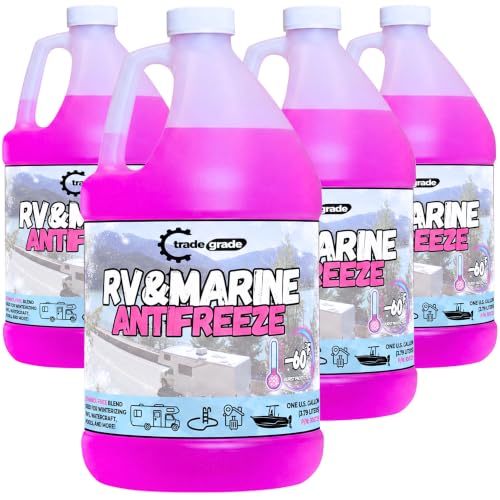
Trade Grade Premium Blend RV Antifreeze -60°F, 4 Gallon 4-Pack — Best Bulk Buy
When the job is a whole property — several toilets, every trap, an RV besides — single gallons become a errand, and this Trade Grade four-pack is the bulk answer: four gallons of premium-blend RV and marine antifreeze at a -60°F protection class, aimed by its own listing at campers, boats and vacation homes. The slightly deeper rating over the -50°F class adds margin for cold snaps in shoulder climates.
Strengths
- Four gallons covers multi-bathroom properties in one purchase
- -60°F class adds margin over the standard -50°F fluids
- Premium blend positioning for seasonal homes and fleets of fixtures
Trade-offs
- Bulk only makes sense if the property count justifies it
- Storage: four gallons need a shelf and a cool, child-safe place
- Check the per-gallon math on the listing against single gallons
| Specification | Detail |
|---|---|
| Rating | -60°F class (per Amazon title) |
| Pack | 4 gallon, 4-pack (per Amazon title) |
| Use | Boats, pools, spas, campers, vacation homes (per Amazon title) |
The economics of winterizing are dominated by a single asymmetry: antifreeze is cheap, and a burst trap in a vacant property is a water-damage claim. Bulk buying simply aligns the shelf with that asymmetry — the property manager or the owner of a three-bathroom seasonal home should never be rationing the last gallon between the second toilet and the washing-machine trap. This pack exists for that arithmetic.
Use the surplus the way professionals do: generous pours in every trap, a reserve bottle labeled for the property, and a note in the close-up checklist of how many gallons the full run consumed, so next autumn’s order is a fact rather than a guess.
Ownership note: date each opened gallon; propylene-glycol fluid kept sealed and clean holds its rating across seasons, but an opened, dusty jug of unknown age is a false economy measured against a burst trap.
The -60°F class also suits the shoulder-season property — the lake house closed in October against a freak early freeze — where the rating’s margin is bought not for January’s average but for November’s surprise.
Best for: seasonal homes, property managers and multi-fixture winterizing / Not suited for: a single toilet, where a single gallon is the right-sized buy
Check on Amazon — check price on Amazon before you order, and confirm the exact variant and tank size on the listing.

RecPro RV Antifreeze -50°F, 4 Pack — Best for RV Owners
RecPro speaks directly to the RV owner, and this four-pack of -50°F non-toxic antifreeze is sized for the RV winterizing ritual: the toilet bowl and trap, the pump run, every faucet and the shower trap, with a bottle left for the spring’s surprises. RV toilets — cassette, gravity or macerator — all end their season with antifreeze in the trap and the lines, and this is the case bottled for exactly that afternoon’s work.
Strengths
- Four-pack sized to a complete RV winterizing run
- Non-toxic -50°F formula made for recreational vehicles
- RV-specialist brand: the use case is the product’s whole design
Trade-offs
- -50°F class: RVs stored in severe cold should consider -100°F fluid
- RV-focused; a vacant house may prefer the property-sized picks
- Bottles are single gallons: pour control is good, storage is on you
| Specification | Detail |
|---|---|
| Rating | -50°F protection (per Amazon title) |
| Formula | Non-toxic (per Amazon title) |
| Pack | 4 pack (per Amazon title) |
RV winterizing has a rhythm the house version lacks: blow out or bypass, run the pump, open each fixture until pink shows, finish at the toilet with a pour that leaves the bowl holding color over the trap and the blade seal wet. RecPro’s case supports that rhythm with quantity in the right units — a gallon per stage of the job, roughly — and a formula whose non-toxicity matters doubly in a vehicle whose fresh system you will drink from in May.
One RV-specific note this guide insists on: leave antifreeze standing in the toilet bowl over the seals. It keeps cassette and gravity-toilet seals from drying and cracking across the storage season, which is the difference between a spring shakedown and a spring parts order.
Ownership note: reserve the fourth bottle untouched until spring commissioning is done; a mid-winter top-up need or a spring surprise is exactly what a reserve is for, and it costs nothing but shelf discipline.
RecPro’s gallon units pour cleanly in the awkward geometry of an RV service bay, a small ergonomic fact that matters when the run is done kneeling in November wind with the pump humming.
Best for: RV and camper owners winterizing the whole vehicle, toilet included / Not suited for: severe-cold storage, which calls for the -100°F class
Check on Amazon — check price on Amazon before you order, and confirm the exact variant and tank size on the listing.

Prime Guard -50°F RV & Marine Premium Antifreeze, 6 Gallons — Best for Whole Systems
Prime Guard’s six-gallon offering closes the list at the largest scale: a ready-to-use, glycerin-free propylene-glycol formula for RV, boat and potable water systems, in the quantity a big rig, a multi-bath seasonal home or a small fleet consumes in one winterizing pass. The glycerin-free note will matter to owners who have dealt with the residue glycerin-blended fluids can leave in pumps and lines.
Strengths
- Six gallons: the one-purchase answer for the largest systems
- Glycerin-free PG formula, stated plainly in the listing
- Ready to use across RV, boat and potable systems
Trade-offs
- The most fluid here: over-buying for small jobs wastes shelf and money
- -50°F class only, despite the premium positioning
- Six gallons is a storage commitment — plan the shelf
| Specification | Detail |
|---|---|
| Size | 6 gallons (per Amazon title) |
| Formula | Glycerin-free PG, ready to use (per Amazon title) |
| Rating | -50°F burst protection (per Amazon title) |
Whole-system winterizing is a logistics exercise disguised as a chore: the fluid must reach the farthest fixture still pink, which means the quantity math includes the pump’s draw, the longest line’s volume and the discipline of not stopping early. Six gallons removes the rationing temptation entirely, and the ready-to-use PG formula removes the mixing question — two failure modes of big jobs, answered by the pack itself.
Choose it when the system is genuinely large or the properties are several, and store the remainder sealed and labeled; propylene-glycol antifreeze keeps for future seasons when kept uncontaminated, which makes the big pack a two-year supply for many owners rather than an extravagance.
Ownership note: for multi-property owners, log gallons per property on the close-up card; after two seasons the log becomes an exact order quantity, and the six-gallon pack’s economics sharpen themselves.
The glycerin-free note also matters at spring commissioning: systems winterized with PG-only fluid flush clear without the slick residue some blends leave in pump heads, shortening the path from pink to potable.
Best for: large RVs, boats and multi-property owners winterizing whole systems / Not suited for: single bathrooms or small campers, where a gallon or a four-pack fits
Check on Amazon — check price on Amazon before you order, and confirm the exact variant and tank size on the listing.
Comparison Table
Ratings are the makers’ stated burst-protection classes from the verified listings; pack sizes decide how many fixtures one purchase covers. Every row is a non-toxic propylene-glycol water-system fluid — the only kind that belongs in a toilet.
| Pick | Badge | Key spec | Best for |
|---|---|---|---|
| SPLASH RV & Marine Antifreeze -50°F, 1 Gallon | Best Overall | -50°F burst protection; 1 gallon; RV and marine | most RV toilets, cabins and vacant-home toilets in typical winter climates |
| STAR BRITE Premium -100°F Antifreeze, 1 Gallon | Best for Extreme Cold | -100°F class; propylene glycol; corrosion protection; ready to use | northern, mountain and unattended properties facing severe cold |
| STAR BRITE Premium -50°F RV & Marine Antifreeze | Best with Corrosion Protection | -50°F; non-toxic; corrosion inhibitors; safe for metals and plastics | RV and boat water systems winterized as a whole, toilet included |
| Trade Grade Premium Blend RV Antifreeze -60°F, 4 Gallon 4-Pack | Best Bulk Buy | -60°F class; 4 gallons total; homes, campers, boats | seasonal homes, property managers and multi-fixture winterizing |
| RecPro RV Antifreeze -50°F, 4 Pack | Best for RV Owners | -50°F protection; non-toxic; 4 pack for RV winterizing | RV and camper owners winterizing the whole vehicle, toilet included |
| Prime Guard -50°F RV & Marine Premium Antifreeze, 6 Gallons | Best for Whole Systems | 6 gallons; glycerin-free PG formula; ready to use | large RVs, boats and multi-property owners winterizing whole systems |
How to Choose Antifreeze for a Toilet: Rating, Formula, Quantity
Formula first, and it is a gate, not a preference: propylene glycol, labeled for RV, marine or potable water systems. Ethylene-glycol automotive antifreeze fails the gate absolutely — it is toxic, it contaminates plumbing and septic systems, and no price or convenience argument reopens the question. If the label does not claim water-system use, the bottle does not touch the toilet.
Rating second: -50°F class covers most climates and most stored RVs; -60°F adds shoulder margin; -100°F class is for severe cold and unattended properties where a burst is discovered months late. Quantity third: a toilet’s bowl and trap take well under a gallon, but a winterizing run is a system — count every trap, the pump and the lines, then buy the pack that finishes the run without rationing. Undiluted, always: these fluids are blended to work straight, and adding water spends the rating you paid for.
Where Toilet Antifreeze Actually Goes: Bowl, Trap, Tank and Seals
In a household toilet being winterized, the antifreeze’s home is the trap: after the water is shut off and the bowl and tank are emptied as fully as sponging allows, a generous pour into the bowl fills the trap with fluid that cannot burst it, and a standing layer in the bowl keeps the trap sealed against sewer gas all winter. The tank itself is best left drained and dry — antifreeze in a tank only dilutes and serves nothing, since the tank holds no trapped water once sponged.
In an RV toilet, the same pour protects the trap and — just as importantly — keeps the blade or ball seal submerged and supple across storage. Cassette toilets travel to winter empty and dry, with a small pour over the seal if the maker’s guidance allows. The pattern is consistent: antifreeze belongs where water would otherwise sit trapped, and nowhere it would merely be stored.
Spring Commissioning: Getting the Pink Back Out
De-winterizing is the winterizing run in reverse, and it is simpler than its reputation. Restore water, flush the toilet repeatedly until the bowl runs clear, run every fixture until no color remains, and sanitize the fresh system in an RV before drinking from it, following the vehicle maker’s procedure. The small quantity of propylene-glycol fluid that reaches a municipal system or a septic tank in this process is the use these products are made and labeled for.
Inspect while you commission: seals that stayed wet under antifreeze should be supple, traps should drain freely, and the first flush is the moment to notice the flapper or valve that aged out over winter. Properties winterized with the right fluid, in the right places, open in spring with a flush and a checklist — which is the entire return on an autumn afternoon’s work.
Toilets in Vacant Homes: The Insurance and Neighbor Dimension
A winterized toilet in a vacant home protects more than porcelain. Insurance policies on unoccupied properties commonly expect the water to be shut off and the system drained or winterized, and a burst trap discovered in spring can turn a claim into an argument. The log card this guide recommends — date, fluid, rating, gallons — is not fussiness; it is the evidence that the property was winterized properly, kept with the same file as the policy itself.
The human layer matters as much: the neighbor or caretaker who checks the property should know the toilets hold pink fluid and must not be flushed, and the spring opener should know the commissioning sequence is a flush-through, not a repair. Most vacant-home water stories are communication failures wearing plumbing costumes, and an hour of autumn clarity — fluid in the traps, card on the counter, note to the caretaker — prevents essentially all of them.
RV Toilets Specifically: Cassette, Gravity and Macerator Notes
RV toilets winterize by type, and the distinctions matter. A gravity toilet over a black tank wants its bowl holding antifreeze over the blade seal all winter, with the tank drained; the seal that dries out in storage is the seal that leaks in May. A cassette toilet travels to winter empty and dry, its seals inspected, with only the pour its maker’s guidance allows — the cassette’s winter enemy is not ice in a trap but a perished seal discovered on the first trip.
Macerator systems add a pump to the list: antifreeze must reach the pump and its lines, which means running the winterizing fluid through the system per the maker’s procedure rather than pouring and hoping. Across all three types the rule from the main guide holds — propylene-glycol water-system fluid, undiluted, everywhere water would otherwise sit — and the RV picks in the reviews are bottled in exactly the quantities those afternoons consume.
How Much Does a Property Actually Need? The Fixture Census
The quantity question defeats more winterizing runs than the cold does, because owners count toilets and forget the census. Walk the property with a notebook and count every water trap and captive volume: each toilet’s trap, each sink and tub trap, shower traps, floor drains — the ones everybody forgets, and the ones that burst most anonymously — the washing machine’s standpipe trap, the dishwasher’s loop if the maker’s guidance calls for it, and any utility sink in the cold zone. An RV’s census is shorter but adds the pump, the water heater’s bypass state and the outside shower everyone remembers in spring.
Against that census, the pour per trap is modest — a cup or two once the line is drained — but the system pour in an RV, where fluid is pumped until it shows pink at every outlet, consumes by the gallon rather than the cup. This is why the picks in this guide scale from one gallon to six: they are census sizes, not enthusiasm sizes. The professional habit worth copying is to record the census and the consumption together on the close-up card, so the property’s true number — not a guess, not a hope — orders next autumn’s bottles.
Buy against the census with a deliberate surplus of one reserve container, because the mid-run discovery of one more floor drain is a law of winterizing, and a run stopped one trap short is a run that must be repeated in the cold. The reserve is not waste; it is the difference between a finished system and an almost-finished one, and in this category “almost” is measured in burst traps.
Antifreeze and the Environment: Disposal Done Properly
A guide that pours anything into the ground’s watershed owes the reader its disposal chapter. Propylene-glycol RV antifreeze is chosen for toilets precisely because it is the lower-toxicity, water-system-rated option — but “lower” is a comparison, not a permission slip. Spring’s flush-through sends modest, diluted quantities into the municipal system or septic the products are labeled for; that designed pathway is the disposal route, and it should not be improvised into storm drains, soil or waterways, where concentrated fluid of any glycol family is a pollutant.
Leftover and recovered fluid follow the same principle. Sealed leftovers keep for next season, as the reviews note. Fluid drained from a system during repairs goes to the sanitary pathway or to the local household-hazardous-waste program where guidance requires it — a question your municipality answers on its website in one search, and the answer is worth the search because rules vary by place. The ethic is uniform even where the rule differs: the fluid that protected the property should not become the property’s gift to its ditch.
Automotive antifreeze, returning for its final mention, lives under stricter law everywhere: it is collected, recycled or disposed of as hazardous material, never poured out and never — the sentence this guide began with — introduced to plumbing. Two fluids, two regimes, one shelf discipline: label everything, store them apart, and let no winterizing afternoon blur the line between them.
The Close-Up Card: A Template Worth Copying
Leave this information at every winterized property, on one card, and the system this guide describes becomes self-explanatory to whoever opens the building next. Property and date. Water shut off at the named location. Fluid used, with its rating. Gallons consumed, and the census they covered. Traps poured, listed. Toilets: traps filled, tanks dry. RV or house specifics: heater bypassed, pump state, seals left wet. Spring instructions in one line: restore water, flush everything clear, then use normally.
The card takes ten minutes at the end of a cold afternoon and repays it at every future opening, every caretaker visit and every insurance conversation the property ever has. Winterizing is a craft of small completions, and the card is the completion that documents all the others.
How to Winterize a Toilet with Antifreeze, Step by Step
This sequence covers a household toilet in a property being closed, with RV notes where the job differs. Allow an unhurried half hour per bathroom the first time.
- Shut off and drain. Close the toilet’s supply valve, flush to empty the tank, hold the handle to drain the bowl as far as it will go, then sponge the remaining tank and bowl water into a bucket. In an RV, drain and bypass the water heater and blow out or pump-drain the lines per the maker’s procedure first.
- Protect the trap. Pour RV antifreeze into the bowl steadily until the trap is filled with fluid and a standing layer covers the bowl’s bottom. This is the step that saves the porcelain: the trap is where ice would otherwise form its plug.
- Leave the tank dry. Sponge the last of the tank water out and leave the tank empty and dry. Antifreeze stored in a tank protects nothing and only dilutes what the spring flush must clear.
- Mind the seals. In RV gravity and cassette toilets, leave a layer of antifreeze standing over the bowl seal so it stays supple; in household toilets, a light coat on the flapper’s seat is unnecessary — dry and clean is correct there.
- Do not forget the neighbors. Every trap in the property — sinks, tubs, showers, floor drains, the washing-machine standpipe — gets the same pour. A winterized toilet beside a burst sink trap is a partial victory.
- Label and log. Note the date, the fluid and its rating, and the gallons used, on a card left at the property. Spring-you, and any plumber you call, will work faster with facts.
Store leftover fluid sealed, upright and away from children and pets — non-toxic in this context means safer for plumbing use, not a beverage, and the bottle should be treated with ordinary chemical respect. Treat any automotive antifreeze found stored beside it as what it is: a different product for a different machine, never a substitute.
Common Buying Mistakes
Using automotive antifreeze because it was already in the garage. Ethylene glycol in a toilet contaminates the plumbing and endangers anyone the system serves. It is the one unforgivable substitution in this entire category — buy the pink RV fluid.
Diluting RV antifreeze to make it go further. The rating is blended for straight use; water spends it. A diluted -50°F fluid is an unknown fluid, and unknown is what bursts are made of.
Filling the tank instead of the trap. Ice damages toilets at the trap, where water sits captive. A full pink tank above an unprotected trap is decoration, not winterizing.
Winterizing the toilet and forgetting the other traps. The property freezes as a system. Walk the whole building with the bottle, including floor drains and the laundry trap, before you call the job done.
Skipping the spring flush-through. Run every fixture until clear and sanitize an RV fresh system before use. The fluid is made to be flushed away — complete the cycle properly.
Final Recommendation
For most readers the answer is one bottle: the SPLASH -50°F gallon for a toilet or two in a normal winter, or the STAR BRITE -100°F gallon where the cold is severe and the property sits empty. Whole RVs take the RecPro four-pack or the STAR BRITE -50°F with its corrosion care; whole properties take the Trade Grade four gallons or Prime Guard’s six. What does not vary is the rule underneath every pick: propylene glycol, water-system labeled, poured into traps undiluted — and automotive antifreeze nowhere near a toilet, ever.
SPLASH RV & Marine Antifreeze -50°F, 1 Gallon — check price on Amazon. STAR BRITE Premium -100°F Antifreeze, 1 Gallon — check price on Amazon. STAR BRITE Premium -50°F RV & Marine Antifreeze — check price on Amazon. Trade Grade Premium Blend RV Antifreeze -60°F, 4 Gallon 4-Pack — check price on Amazon. RecPro RV Antifreeze -50°F, 4 Pack — check price on Amazon. Prime Guard -50°F RV & Marine Premium Antifreeze, 6 Gallons — check price on Amazon.
Keep reading in this series: Best Rv Toilets Best Camper Van Toilets Best Toilets For Cabins Best Antifreeze For Rv Water Lines Best Winterizing Products
Frequently Asked Questions
Can I put regular car antifreeze in a toilet?
No. Automotive antifreeze is ethylene glycol, which is toxic and must never enter a potable plumbing system, a toilet or a septic tank. Only non-toxic propylene-glycol antifreeze labeled for RV, marine or potable water systems belongs in a toilet.
How much antifreeze does one toilet need?
Well under a gallon for the toilet itself: enough to fill the trap and leave a standing layer in the bowl, after the tank and bowl have been drained and sponged. Whole-property and RV runs need more because every trap and line shares the pour.
What does a -50°F rating actually mean?
It is a burst-protection class: the fluid is blended to protect pipes and traps from burst damage down to that temperature as it thickens into a non-expanding slush. It does not mean the fluid stays freely liquid, and it is the correct figure to match against your climate’s realistic lows.
Should antifreeze go in the toilet tank?
No — the tank should be drained, sponged and left dry. Antifreeze protects where water sits trapped, which is the bowl’s trap. The exception is seal care in RV toilets, where a layer standing in the bowl over the seal keeps it supple.
Is RV antifreeze safe for septic systems?
Used as labeled for winterizing — poured into traps and flushed out in spring quantities — propylene-glycol RV antifreeze is the product made for these systems, including homes on septic. Automotive antifreeze, by contrast, must never reach a septic tank.
Can I reuse antifreeze next winter?
Leftover fluid that stayed sealed and uncontaminated keeps for future seasons. Fluid recovered from traps should not be reused: it is diluted and dirty by definition, and its rating is no longer knowable.
My property will only be empty for a few cold weeks. Can I skip winterizing the toilets?
That is the gamble this category exists to retire, because burst damage does not consult the calendar: a single hard freeze inside the empty weeks is sufficient, and traps — holding water by design, in the coldest rooms, often on exterior walls — are where the freeze wins first. The cost asymmetry is the whole argument: an hour and a gallon or two of the right fluid against a spring that begins with a plumber, a floor and possibly an insurance conversation. If the property will be heated reliably and checked daily, the risk shrinks to a judgment call; if it will be cold and unwatched, winterize the toilets and every other trap with the sequence in this guide, leave the close-up card on the counter, and let the few cold weeks pass as a non-event. Cheap certainty is the entire product being sold here, and it is sold by the gallon.


