Disclosure: airfryerkitchensupply.com is reader-supported. When you buy through links on our site, we may earn an affiliate commission at no extra cost to you.
Where to buy
All six entries in this guide to the best and coservative tankless toilets are verified, orderable listings on Amazon, so you can check the current price on Amazon for each one directly: the dual-flush smart tankless toilet (0.8/1.2 GPF) for the lowest water use, the TOTO WASHLET G5A Lite for the premium integrated option, the HOROW T30 if you want a tankless-look one-piece without smart electronics, the Eridanus wall-hung toilet with in-wall carrier for a floating installation, the Swiss Madison SM-WC424 in-wall tank carrier if you are building a wall-hung system around a separate bowl, and the ADA-height smart toilet with bidet for accessibility-led bathrooms. Tankless and wall-hung models involve more installation planning than a standard toilet, so read the installation sections before ordering — the right time to discover you need a GFCI outlet or a 2×6 wall cavity is before the freight arrives.
Searching for the best and coservative tankless toilets — water-conserving tankless toilets, in plain terms — runs into a vocabulary problem first, so let us be straight about it. A domestic toilet cannot flush without stored or pressurised water energy. What “tankless” means in the residential market is one of three real things: the tank is hidden inside the wall (wall-hung systems), the tank is integrated invisibly into a one-piece smart body with pump or pressure assistance, or the fixture is a sleek one-piece design marketed as tankless because there is no separate visible tank. All three genuinely save bathroom space and, in the dual-flush configurations below, genuinely save water. What none of them does is magic. This guide covers the six most credible routes to a conservative-flush, no-visible-tank bathroom, with the water numbers, installation realities and honest limitations of each.
In this guide
Quick Picks
- Best Overall — Smart Tankless Toilet with Dual Flush 0.8/1.2 GPF: the lowest flush volumes in this guide with a heated bidet seat, auto flush and a child mode. Check the current price on Amazon.
- Best Premium — TOTO WASHLET G5A Lite: TOTO’s integrated smart toilet with CEFIONTECT glaze and a choice of 1.2 or 1.0 GPF flushing. Check the current price on Amazon.
- Best Non-Electric Design — HOROW T30 One-Piece Tankless: a one-piece tankless-format toilet with a non-electric bidet function and a powerful flush rating. Check the current price on Amazon.
- Best Wall-Hung Kit — Eridanus Wall Hung Toilet with 2×6 In-Wall Tank Carrier: bowl and dual-flush carrier together, rimless and floating for the easiest floor cleaning there is. Check the current price on Amazon.
- Best Carrier for Custom Builds — Swiss Madison SM-WC424 In-Wall Tank Carrier: the concealed dual-flush carrier that lets you pair your own wall-hung bowl. Check the current price on Amazon.
- Best for Accessibility — Smart Toilet with Bidet, 1.2 GPF, ADA Height: auto open/close lid, heated seat, warm wash and dryer at an ADA-friendly height on 1.2 gallons. Check the current price on Amazon.
How These Picks Were Chosen
Every model here was verified against live Amazon listings, so names, configurations and flush ratings match real products. Selection started with the search’s two demands: no visible tank, and conservative water use. On water, we favoured dual-flush designs whose light setting is genuinely low (0.8–1.0 GPF territory) and one-piece designs at or below the 1.28-gallon modern standard; a “tankless” toilet that flushes at 1.6 gallons is a styling exercise, not a conservation measure. On format, we deliberately covered all three honest meanings of tankless — integrated smart toilets, wall-hung systems with in-wall carriers, and one-piece tankless-format designs — because the right choice depends on whether your renovation opens walls and adds power, or simply swaps a fixture.
We also weighted flush credibility. Tankless-format toilets cannot rely on a tall column of tank water, so they use pressure assistance, pumps or engineered siphons; where a manufacturer publishes a MaP score or a recognised flush rating we noted it, and where claims are vague we said so in the trade-offs. Finally, we considered the ownership picture: smart toilets add electronics that need power and eventual servicing, wall-hung systems hide their mechanics inside a wall, and both facts belong in a buying decision. The reviews below do not hide those costs — they are the price of the aesthetic and the water savings, and for the right bathroom they are worth paying.
The 6 Best and Coservative Tankless Toilets

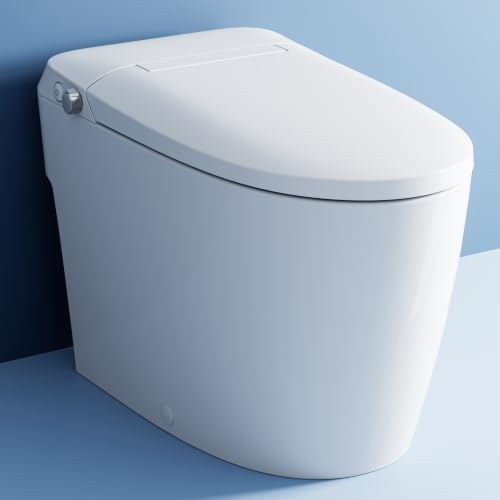
Smart Tankless Toilet with Dual Flush 0.8/1.2 GPF — Best Overall
This integrated smart toilet is the fullest expression of the keyword: a tankless one-piece body, a dual flush that drops to 0.8 gallons for liquid waste, a heated bidet seat with warm water wash and air drying, and a manual seat-and-lid arrangement with a dedicated child mode that reduces spray strength and flush volume for small users. The conservation logic is the same as any good dual-flush — most flushes in a household are liquid-only — but executed at lower volumes than a conventional dual-flush toilet achieves, because the assisted flush does not depend solely on gravity head. The child mode is more than a gimmick: it makes the toilet genuinely easier for families to standardise on, and a toilet everyone in the house uses correctly is the one that actually saves water.
Strengths
- 0.8 GPF light flush is the lowest verified figure in this guide, with a 1.2 GPF full flush still below the 1.28 standard.
- Heated seat, warm wash and air dryer replace most paper use, a second, quieter form of conservation.
- Child mode adapts wash pressure and flush behaviour, making one toilet work for the whole household.
Trade-offs
- It needs a nearby GFCI electrical outlet; bathrooms without one need an electrician before installation day.
- More electronics means more eventual servicing than a gravity toilet — budget for it as an appliance, not a fixture for life.
- The brand is an Amazon-native label rather than a legacy plumbing name, so long-term parts support is less proven.
The deeper question with any smart toilet is whether the features survive contact with real family life. Auto flush removes the forgotten-flush problem and, more subtly, removes the double-flush problem — the sensor flushes once, decisively, instead of a user flushing twice out of uncertainty. The bidet functions shift the conservation story from water to paper, which matters in households that go through rolls quickly. Where this model asks for trust is longevity: legacy brands have decades of parts pipelines behind them, and newer smart-toilet labels do not yet. Buy it for the water numbers and the daily comfort, keep the manual, and register the warranty — that is the honest ownership deal.
Best for: water-focused renovators who want the lowest flush volumes plus full bidet comfort. Not suited for: bathrooms with no path to an electrical outlet, or buyers who want a fit-and-forget 25-year fixture. Check the current price on Amazon.

TOTO WASHLET G5A Lite — Best Premium
TOTO essentially created the integrated smart toilet category, and the WASHLET G5A Lite is its refined, conservation-led expression: a one-piece tankless-format body, CEFIONTECT glaze that keeps waste from sticking so each flush needs less water to clear the bowl, and a choice of 1.2 or 1.0 GPF configurations. TOTO’s flush engineering is the benchmark the rest of this category is measured against — the company publishes its performance data, its glaze technology is proven over decades, and its service network is the deepest in the smart-toilet world. If the budget reaches this tier, the G5A Lite is the conservative tankless toilet with the fewest unknowns attached to it.
Strengths
- TOTO flush engineering and CEFIONTECT glaze deliver reliable clearing at 1.2 or 1.0 GPF.
- The strongest parts, service and warranty ecosystem in the integrated smart toilet category.
- Integrated bidet seat functions are the category’s reference implementation — quiet, consistent, well-sealed.
Trade-offs
- Premium tier pricing — this is the most expensive route in the guide by a clear margin.
- Still needs electrical supply for the seat functions, like every smart toilet here.
- The design language is distinctly TOTO; it suits modern bathrooms better than traditional ones.
What the premium buys, beyond the badge, is refinement in the details owners notice daily: seat heating that is even rather than patchy, wash pressure that ramps rather than jumps, a lid mechanism that will not slam at 2 a.m., and a flush that clears at low volume because the bowl geometry and glaze were engineered together rather than assembled from commodity parts. TOTO also designs for serviceability — seat components can be replaced without replacing the toilet. For a primary bathroom in a long-term home, that depth justifies the tier. For a rental or a flip, it does not, and the picks below exist precisely for those cases.
Best for: primary bathrooms in long-term homes where proven engineering justifies a premium. Not suited for: rentals, flips or tight renovation budgets. Check the current price on Amazon.
HOROW T30 One-Piece Tankless — Best Non-Electric Design
The HOROW T30 takes the tankless one-piece format and strips out the electronics: it pairs the sleek no-visible-tank body with a non-electric bidet function and a manufacturer-rated MaP 1000g flush — the top of the MaP scale — on a standard 12-inch rough-in, and the listing notes no outlet is needed. That combination is rarer than it should be. Most tankless-format toilets assume you want the full smart package; the T30 is for renovators who want the look and the water-efficient one-piece form without wiring, sensors or a remote control. The non-electric bidet runs on water pressure alone, which also makes it the most blackout-proof and the simplest to maintain of the bidet-equipped picks here.
Strengths
- Tankless one-piece format with no electrical requirement — installs like a conventional toilet on a 12-inch rough-in.
- Manufacturer-rated MaP 1000g flush performance, the strongest published figure in this guide.
- Non-electric bidet adds the paper-saving benefit without any electronics to service.
Trade-offs
- Non-electric bidet means cold-water washing only; there is no heated seat or warm air.
- HOROW is a newer brand in the US market, so the long-term parts picture is still developing.
- The single-flush design does not reach the 0.8 GPF light-flush lows of the dual-flush smart models.
The T30’s real competition is not the other picks here but the conventional one-piece toilets in any bathroom showroom — and against those, its argument is format: the same simple installation, the same absence of electronics, but with the tankless silhouette and a bidet built in rather than bolted on later. For guest bathrooms and powder rooms, where heated seats are wasted and outlets are scarce, that argument is strong. For a master bath in a cold climate, the cold-water bidet will decide the question by itself — some households adapt happily, others never use the function again after the first winter morning. Know which household you are before ordering.
Best for: guest baths, powder rooms and renovators who want the tankless look without wiring. Not suited for: buyers who want heated bidet comfort or the absolute lowest flush volumes. Check the current price on Amazon.
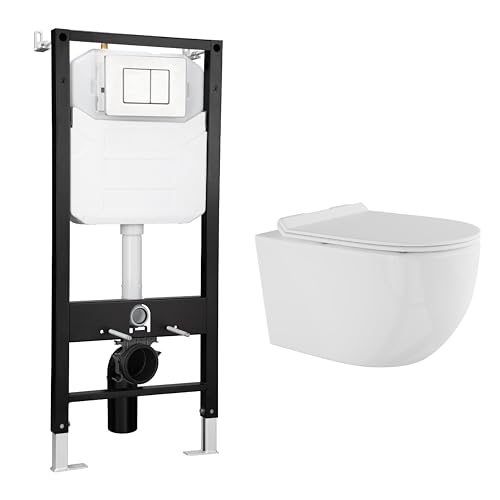
Eridanus Wall Hung Toilet with 2×6 In-Wall Tank Carrier — Best Wall-Hung Kit
The Eridanus is the complete wall-hung route in one purchase: a floating elongated bowl plus the 2×6 in-wall tank carrier that supports it, with dual flush, a rimless bowl interior and the space-saving profile that makes wall-hung toilets so attractive in small bathrooms. The carrier hides the tank and flush mechanism inside the wall framing; the bowl hangs from the carrier’s steel frame, which is rated to carry full user weight when installed into studs correctly. Rimless design deserves its billing here — without a rim channel, there is nowhere for grime to hide, the flush washes the whole bowl surface, and cleaning becomes a single pass with a brush. Combined with a floating bowl that lets you mop underneath, this is the easiest bathroom floor you will ever keep clean.
Strengths
- Complete kit — bowl and dual-flush carrier together, matched by the manufacturer.
- Rimless bowl and floating installation make it the easiest-cleaning format in the guide.
- Seat height is set at installation, so the same kit serves standard and comfort heights.
Trade-offs
- Requires opening the wall and a 2×6 cavity; this is a renovation project, not a fixture swap.
- Future servicing of the flush mechanism happens through the flush-plate opening — workable, but less open than a tank lid.
- Professional installation is strongly advisable; carrier alignment errors are expensive to undo after tiling.
Wall-hung is the one format in this guide where the water conservation and the architecture are the same decision. The dual-flush actuator plate on the wall offers the light/heavy choice, the concealed tank frees ten or more inches of room depth versus a floor-standing toilet, and in a small bathroom that reclaimed space is the difference between a door that clears the bowl and one that does not. The commitment is real, though: you are building the carrier into the wall for the life of the bathroom. Choose this route during a genuine renovation, with the wall already open, and it is excellent value. Choose it as a casual weekend swap and it will punish you.
Best for: full renovations and small bathrooms where floor space and easy cleaning dominate. Not suited for: quick replacements or renters. Check the current price on Amazon.
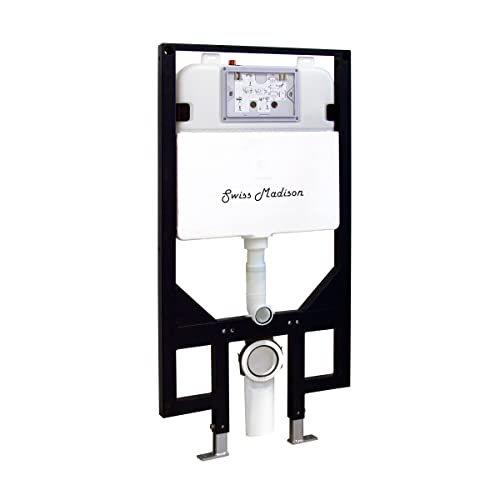
Swiss Madison SM-WC424 In-Wall Tank Carrier — Best Carrier for Custom Builds
This pick is different in kind, and the listing is honest about it: the SM-WC424 is the concealed in-wall tank carrier system itself — the steel frame, dual-flush tank and mounting hardware that a wall-hung bowl hangs from — sold for renovators who want to choose their bowl separately. Swiss Madison’s own bowls, such as the Calice wall-hung round bowl, are the natural pairing, but the carrier format is broadly standardised. Why include a component in a toilet guide? Because for custom builds it is the component that decides everything else: it sets the bowl height, carries the load, determines the flush volumes and defines how servicing works for the next thirty years. Buying a well-made dual-flush carrier is the conservative choice in both senses — water-conserving, and prudently built.
Strengths
- Dual-flush concealed tank gives the light/heavy water choice in any wall-hung build.
- Lets you pair your preferred wall-hung bowl — including Swiss Madison’s own Calice and Ivy bowls — instead of accepting a kit’s bowl.
- Swiss Madison is an established bathroom brand with real distribution and support behind the carrier.
Trade-offs
- It is not a complete toilet — a wall-hung bowl and flush plate are separate purchases, so total project cost is higher than the listing alone suggests.
- Same renovation commitment as any wall-hung system: open wall, correct framing, careful alignment.
- Bowl compatibility should be confirmed with the carrier’s specifications before ordering both parts.
The custom-build route rewards planners. You choose the carrier for its frame strength and flush mechanism, the bowl for its shape and glaze, and the flush plate for its finish — three decisions instead of one compromise. It is how most European bathrooms, where wall-hung is the default, are actually specified. If that sounds like your renovation, the SM-WC424 is the sensible foundation. If it sounds like homework, buy the Eridanus kit above and let the manufacturer make the matching decisions for you.
Best for: custom renovations where bowl choice and finish matter as much as the mechanism. Not suited for: anyone expecting a complete toilet in one box. Check the current price on Amazon.

Smart Toilet with Bidet, 1.2 GPF, ADA Height — Best for Accessibility
The final pick is an integrated smart toilet specified around access: ADA height so sitting and standing take less effort, an auto open/close lid that removes bending and touching, a heated seat, warm water wash, air dryer, UV light and a remote control, all flushing at 1.2 GPF with auto flush. For users with limited mobility, arthritis or post-surgical restrictions, these are not luxuries — the auto lid and remote wash are the difference between independent toileting and assisted toileting. The conservation figure is respectable rather than record-setting: 1.2 gallons sits below the 1.28 standard, and the auto flush’s single decisive flush prevents the accidental double-flushes that quietly inflate a household’s water use.
Strengths
- ADA height plus auto lid, auto flush and remote control deliver genuine hands-free independence.
- Heated seat, warm wash and dryer cover the full comfort set in one integrated unit.
- 1.2 GPF auto flush is water-conservative and eliminates forgotten or doubled flushes.
Trade-offs
- Requires a GFCI outlet near the toilet, as all smart toilets do.
- Feature density means more to learn; the remote needs a sensible home within reach of the seat.
- Amazon-native brand, so verify warranty terms and keep documentation, as with the Best Overall pick.
Position this model where it belongs: it is the accessibility flagship of the guide, and its water figure is a bonus rather than the headline. Households planning for ageing in place should note how many separate products it replaces — a raised seat, a bidet attachment, a night light, grab-bar-adjacent aids for lid handling — each of which would otherwise be bought, fitted and eventually removed separately. One integrated unit, installed once, is tidier and usually cheaper than the stack of accessories. That is the practical case, and it is a strong one.
Best for: accessibility-led bathrooms, ageing in place and post-surgical recovery. Not suited for: buyers chasing the absolute lowest flush volume above all else. Check the current price on Amazon.
Comparison Table
| Pick | Badge | Key spec | Best for |
|---|---|---|---|
| Smart Tankless Toilet Dual Flush | Best Overall | Tankless smart, 0.8/1.2 GPF dual flush | Lowest water use + bidet |
| TOTO WASHLET G5A Lite | Best Premium | Integrated smart, 1.2 or 1.0 GPF, CEFIONTECT | Proven premium engineering |
| HOROW T30 | Best Non-Electric Design | One-piece tankless format, MaP 1000g, no outlet needed | Guest baths, simple installs |
| Eridanus Wall Hung with Carrier | Best Wall-Hung Kit | Floating rimless bowl, 2×6 in-wall dual-flush carrier | Small-bath renovations |
| Swiss Madison SM-WC424 Carrier | Best Carrier for Custom Builds | Concealed dual-flush in-wall tank carrier (bowl separate) | Custom wall-hung builds |
| Smart Toilet with Bidet ADA Height | Best for Accessibility | Smart one-piece, 1.2 GPF, auto lid/flush, ADA height | Mobility and independence |
What “Tankless” Really Means: The Three Formats
Understanding the three formats prevents the most common disappointment in this category — ordering a toilet that does not match the renovation you actually planned. Format one, the integrated smart toilet (our Best Overall, Premium and Accessibility picks), hides its water storage and assistance inside a one-piece body and flushes with pump or pressure help. It installs on a standard floor flange like a normal toilet, but adds an electrical requirement. Format two, wall-hung (the Eridanus kit and the Swiss Madison carrier), moves the tank into the wall on a steel carrier frame. It saves the most space and cleans the easiest, but it is construction, not plumbing alone: framing, carrier alignment and an access strategy for the flush mechanism all have to be settled before the wall closes. Format three, the one-piece tankless-format design (the HOROW T30), keeps everything in a single floor-standing casting with no separate visible tank and no electronics; it is the only format that is a true like-for-like swap for an existing toilet. None of the three is “a toilet with no tank” in the literal sense — the water and the energy to move it always come from somewhere — but each delivers the visual and spatial result buyers mean by the word.
How to Choose a Water-Conserving Tankless Toilet
Work through four questions in order. First, is your wall opening up? If yes, wall-hung is on the table and gives the best space and cleaning outcome; if no, eliminate it and choose between the smart and simple one-piece formats. Second, can you provide power? A GFCI outlet within reach of the toilet unlocks the smart models with their heated seats and sub-1.0 light flushes; without it, the HOROW T30 is your pick. Third, who uses the bathroom? Children argue for the child mode on the Best Overall; mobility limitations argue for the ADA smart model; guests argue for the simplest interface, which is the T30 or the wall-hung plate. Fourth, how conservative is “conservative” for you? If minimising water is the headline goal, rank by light-flush volume — 0.8 GPF dual-flush first — and remember that a bidet reduces paper, which is a resource saving of a different kind. If the goal is a modern look with reasonable water use, any pick in this guide beats the 1.6-gallon toilet most homes are replacing.
How to Plan the Installation: Power, Walls and Rough-In
For a smart one-piece, installation planning is mostly electrical. The toilet mounts on the standard flange with a wax ring exactly like a conventional model, connects to the same angle stop, and then needs its GFCI outlet — ideally installed on the wall beside or behind the toilet position before the toilet goes in, because working space disappears afterwards. Check your water pressure too: assisted-flush designs are generally tolerant, but the manual’s stated range is worth confirming against a cheap pressure gauge reading at a nearby tap. For wall-hung, the sequence is structural: open the wall, confirm the cavity depth matches the carrier (the Eridanus specifies a 2×6 wall), frame and anchor the carrier to studs and floor per the template, set the bowl height — this is your one chance to choose it — connect supply and waste, test-flush the mechanism before closing anything, and only then board, tile and hang the bowl. Whichever format you choose, dry-fit and test before final finishes; with concealed systems, the test flush you skip is the leak you tile over.
The Water-Saving Arithmetic, Honestly
Conservation claims deserve arithmetic rather than adjectives. Take a household of four at roughly five flushes per person per day — twenty flushes. A legacy 1.6-gallon toilet uses about 32 gallons daily on flushing. A 1.28 single-flush cuts that to roughly 25.6. A dual-flush at 0.8/1.2, assuming the realistic pattern that most flushes are liquid-only, lands near 19–20 gallons. The wall-hung dual-flush systems sit in the same band as the dual-flush smart models. So the honest saving from the best option here versus a modern standard toilet is real but modest — a few thousand gallons a year — and versus a pre-1994 3.5-gallon toilet it is dramatic. Two behavioural factors matter as much as the hardware: a light flush that actually clears (all the dual-flush picks here are engineered to) and an auto flush that fires once. A household that double-flushes a badly chosen ultra-low model saves nothing, which is why this guide ranks flush credibility alongside the gallon figures.
Budget Tiers: Where the Money Goes in This Category
The picks in this guide span three clear tiers, and it helps to know what each step buys. The entry tier is the non-electric one-piece format — the HOROW T30 — where the money goes to porcelain and format rather than features, plus the wall-hung carrier route if you are already paying for a renovation and the carrier is one line item among many. The mid tier holds the integrated smart toilets from Amazon-native brands: full feature sets, heated bidets, auto everything, with the trade-off that the brands are younger and their decade-long parts behaviour is still being established. The premium tier is TOTO, where the step up buys engineering depth, glaze quality and a service ecosystem rather than a longer feature list — the features are broadly similar, the execution and support are the difference. Installation money follows the same ladder: a floor-standing swap is an hour of DIY or a modest plumber visit; adding an outlet adds an electrician; wall-hung adds carpentry, boarding and tiling time. Total the fixture and the installation together before comparing across formats — a mid-tier wall-hung project routinely costs more installed than a premium floor-standing smart toilet, and neither is the “wrong” answer. Check the current price on Amazon for the fixtures, and get the trades priced locally, before committing to a format.
Common Buying Mistakes
- Believing “tankless” means no water storage at all. Every residential design stores or pressurises water somehow — in-wall, integrated or assisted. Buy the format, not the slogan.
- Ordering a smart toilet with no outlet plan. Extension cords are not an acceptable answer for a bathroom appliance. Budget the GFCI outlet into the project.
- Closing the wall before test-flushing a carrier. Concealed systems must be pressure-tested and flushed before boarding; afterwards, access is through the flush plate only.
- Choosing wall-hung for a quick swap. It is a renovation. If the wall is not already opening, the one-piece formats deliver most of the look with none of the construction.
- Ignoring bowl-height choice on wall-hung. The carrier sets height at installation; decide standard versus comfort height before the frame is fixed, not after.
- Chasing the lowest GPF without checking flush credibility. A light flush that leaves the bowl unclean costs more water in re-flushes than it saves. Published ratings and engineered siphons matter.
Final Recommendation
Match the format to the project. If you want the lowest water use and full smart comfort in a straightforward floor installation, buy the dual-flush smart tankless toilet. If the budget allows the category’s reference standard, the TOTO WASHLET G5A Lite is the premium answer. If the wall is opening anyway, the Eridanus wall-hung kit gives you the floating, rimless result with dual flush — or build custom around the Swiss Madison carrier. No power and no patience for electronics? The HOROW T30. Accessibility first? The ADA-height smart toilet. For the wider water-saving picture, continue with Best And Coservative Toilets, compare standard-format options in Best American Standard Toilets, and see the cleaning angle in Best And Easiest To Clean Toilets.
Living With a Tankless Toilet: Maintenance and Daily Reality
The daily experience differs by format in ways brochures skip. Smart one-pieces ask for the same care as any appliance with a seat full of technology: keep the nozzle-cleaning cycle enabled, wipe the seat with a soft cloth and mild cleaner rather than bleach sprays that attack sensors and finishes, and expect the occasional firmware-era quirk — a lid that needs its sensor lens wiped, a remote that needs batteries at an inconvenient moment. None of this is onerous, but it is a different relationship than a porcelain fixture you ignore for a decade. Plan on the seat unit being the service item: on integrated models from established brands the seat assembly can be replaced independently, which is the correct way to think about the product’s lifespan — porcelain for decades, electronics for a long but finite term.
Wall-hung systems invert the maintenance picture. Day to day they are the easiest toilets here to live with: nothing on the floor, a rimless bowl that rinses clean, and a flush plate that wipes like a light switch. The maintenance events, when they come, are simply more deliberate — removing the flush plate, working through the access opening, and identifying the carrier’s components by the manual you kept. Keep that manual, and photograph the installed carrier before the wall closes; future-you, holding a replacement fill valve in one hand, will be grateful. For the simple one-piece format, maintenance is the conventional story: a seal or valve every several years, standard parts, nothing to learn. The format you choose is, in this sense, a choice about how you want to own the thing, not just how you want it to look on day one.
Tankless vs a Conventional Water-Saving Toilet: Which Should You Buy?
It is worth stating the alternative plainly: a good conventional 1.28 GPF or dual-flush two-piece toilet — the kind covered in our companion guide to water-conserving toilets — delivers most of the water saving in this article at a fraction of the cost and complexity, installs in an hour, and can be serviced by anyone. The tankless formats earn their premium on three specific axes: space (wall-hung genuinely reclaims room depth; one-piece designs look and clean sleeker), features (integrated bidets, heated seats and auto functions are simply better executed in smart bodies than as add-on seats), and hygiene (floating bowls and rimless interiors are objectively easier to clean). If none of those three axes is a live priority in your bathroom, the honest recommendation is the conventional route and to spend the difference elsewhere in the renovation. If one of them is the entire point of the project — a tiny ensuite, an accessibility-led master bath, a powder room designed around a floating fixture — then the premium is buying something real, and the picks in this guide are the credible ways to buy it. Conservation, in other words, is available at every tier; what changes with money is the format and the experience around the flush, and it is better to know that before ordering than after installing.
Seat Height, Bowl Shape and Small-Bathroom Geometry
Format aside, the ergonomic decisions still apply. Integrated smart toilets come in fixed heights, most at or near comfort height, and the ADA model in this guide is specified at ADA height by design. Wall-hung is the flexible exception: because the bowl hangs from the carrier, the installer sets the rim height during framing — standard height for a children’s bathroom, comfort height for a master, or a precise measurement for a user with specific mobility needs. That adjustability is a genuine clinical advantage that no floor-standing toilet offers without a raised seat accessory. Bowl shape follows the usual rule — elongated for adult comfort, round where projection must be minimised — with one wall-hung bonus: even an elongated floating bowl projects less into the room than a floor-standing equivalent, because there is no tank depth behind it. In a bathroom where the door swing currently kisses the front of the bowl, a wall-hung elongated can solve a geometry problem that a round-front floor toilet only compromises around. Measure the room’s clearances before deciding the format is a luxury; in the smallest bathrooms it is frequently the enabling choice.
Troubleshooting Tankless and Smart Toilets
Most service calls in this category trace to four mundane causes. A smart toilet that will not flush during a power cut is behaving as designed — many models include a manual flush button or battery backup for exactly this event, so locate yours in the manual before the first outage, not during it. A weak flush on an assisted model is usually water supply, not electronics: check the angle stop is fully open and the inlet filter screen (fitted on most smart toilets) is clear of sediment, especially after any plumbing work elsewhere in the house. A wall-hung bowl with slight movement at the wall needs its mounting checked promptly — movement stresses the waste seal, and catching it early is a spanner job, while ignoring it becomes a leak behind finished tiling. A dual-flush that has started using full volume on the light setting usually has a sticking actuator rod or cable, accessible through the flush plate on wall-hung systems or the tank area on one-pieces, and adjustable without parts in most cases. None of these requires panic; all of them reward keeping the manual and, for concealed systems, the pre-closing photographs recommended earlier.
Water Pressure, Drain Lines and Older Homes
Assisted and low-volume flushes interact with your home’s plumbing differently than the gravity toilet they replace, and older homes deserve a moment’s thought. Pressure-assisted and pump-assisted designs are comparatively forgiving of marginal supply pressure because they bring their own energy to the flush, but they still have a stated minimum in the manual — a home on a weak well supply should verify it. Low-volume flushes of any kind share one caveat: on long, nearly flat drain runs in older housing, very small volumes can deposit solids before they reach the main stack, a phenomenon called drainline carry. It is rarely an issue at 1.28 gallons in typical layouts, becomes a consideration at the lightest dual-flush settings in unusual ones, and is the reason the full flush exists and should be used for solids without exception. Venting matters too: a poorly vented line can siphon traps and make any toilet flush lazily, and replacing the fixture will not cure it. If your old toilet flushed weakly and gurgled, have the vent and line checked before blaming the new low-volume model — the diagnosis is cheap and it protects the investment you are about to make in the fixture itself.
Frequently Asked Questions
Do tankless toilets really exist for homes?
Not in the literal sense of flushing with no stored water. Residential “tankless” means the tank is concealed in the wall, integrated into a one-piece smart body with flush assistance, or eliminated as a separate visible component in a one-piece design. All three formats in this guide deliver the look and space saving buyers want.
How much water does a dual-flush tankless toilet actually save?
In a typical household where most flushes are liquid-only, a 0.8/1.2 GPF dual-flush uses roughly a fifth less water than a 1.28 GPF single-flush and around forty percent less than a legacy 1.6 GPF toilet. The saving depends on using the light flush — which is why auto-flush and clear button design matter.
Do smart tankless toilets need electricity?
The bidet seat functions, heating and auto features do, supplied through a GFCI outlet. The HOROW T30 in this guide is the exception — a tankless-format one-piece whose listing specifies no outlet is needed, with a non-electric bidet.
Can a wall-hung toilet support a heavy user?
Yes, when the carrier is installed correctly. In-wall carriers are steel frames anchored to studs and floor and are rated for substantial loads; the bowl hangs from the frame, not from the wall surface. Correct installation is the entire safety story, which is why professional fitting is recommended.
How do you service a wall-hung toilet’s flush mechanism?
Through the flush-plate opening in the wall. The plate removes to give access to the flush and fill components inside the concealed tank. It is more constrained than lifting a tank lid, so choose a carrier from a brand with available spare parts — one reason the Swiss Madison system is in this guide.
Can I retrofit a wall-hung toilet into an existing bathroom without a full renovation?
Technically yes, practically rarely. The carrier needs a framed, finished enclosure, so even a “retrofit” involves building a boxed section of wall, re-routing the waste connection to the carrier height and refinishing the surface — a small construction project rather than a fixture swap. If the bathroom is not otherwise being renovated, the floor-standing tankless formats in this guide deliver most of the visual benefit for a fraction of the disruption.
What happens to a smart toilet in a power cut?
Most integrated smart toilets include a manual flush option or battery backup for outages, though the heated seat and wash functions pause until power returns. Check the manual for your model’s arrangement when you install it. The non-electric HOROW T30 in this guide is unaffected by outages entirely.
Are tankless toilets harder to repair than normal toilets?
They are different rather than simply harder. A conventional toilet exposes everything under a lift-off lid; a smart toilet concentrates service into the seat unit, and a wall-hung system concentrates it behind the flush plate. Both are designed for that access route. What you lose is improvisation — parts are model-specific — so brand support and keeping documentation matter more than with a commodity two-piece.
Is a 0.8 GPF flush enough to clear the bowl?
For liquid waste with small amounts of paper — which is what the light setting is for — yes, on an engineered assisted or dual-flush design. Solids always get the full flush. Problems arise when ultra-low volumes are paired with weak bowl design; the picks here were chosen for published or engineered flush credibility, not for the number alone.


