Disclosure: airfryerkitchensupply.com is reader-supported. When you buy through links on our site, we may earn an affiliate commission at no extra cost to you.
Where to buy
All six picks are sold on Amazon, and this category’s bundles change often — a cup or lid included this month may differ next month — so check the current price on Amazon and the exact box contents before ordering. If you are comparing the best and affordable smoothie blenders, decide your format first (personal cup or pitcher), because that choice matters more than small wattage differences.
- nutribullet Pro 900 (Special Edition, White) — Check the current price on Amazon
- Ninja Fit Compact Personal Blender QB3001SS, 700W — Check the current price on Amazon
- Hamilton Beach Power Elite Blender 58148AG, 700W — Check the current price on Amazon
- nutribullet Full-Size Blender Combo NBF50500, 1200W — Check the current price on Amazon
- Ninja Nutri-Blender Pro BN401 with Auto-iQ, 1100 Peak Watts — Check the current price on Amazon
- BLACK+DECKER Countertop Blender BL2010BG, 6-Cup Glass Jar — Check the current price on Amazon
The best and affordable smoothie blenders solve a specific equation: smooth results with frozen fruit, a routine simple enough to survive weekday mornings, and a price that does not require a family meeting. The good news is that smoothie making is the job affordable blenders do best — it does not demand the sustained power of nut butter or the finesse of hot soup, so honest machines at modest tiers perform genuinely well.
The market splits into two formats, and choosing between them is the first decision. Personal bullet blenders (you blend in the drinking cup) minimise washing up and suit one or two servings. Pitcher blenders serve a table and handle bigger, more varied loads, at the cost of more washing and more counter space. This list includes both, badged by the household each suits, plus one combo that covers the two formats in a single purchase.
Every pick was verified for real specifications — wattage, capacity, what’s in the box — because affordable listings are where inflated claims cluster. Where a machine’s power is modest, the review says what that means in the cup rather than hiding behind the number.
In this guide
Quick Picks
nutribullet Pro 900 (Special Edition, White) — Best Overall Affordable. 900 watts in a personal format that has defined affordable smoothie making for a decade: fill the cup, twist, blend for under a minute, drink from the same cup. For one or two smoothies a day, nothing here beats its simplicity-per-dollar. Check on Amazon
Ninja Fit Compact Personal Blender QB3001SS, 700W — Best Compact Affordable. Ninja’s compact answer: a 700W base and two 16 oz cups with spout lids, sized for the gym-bag and desk-drawer smoothie life, with parts that go straight in the dishwasher. Check on Amazon
Hamilton Beach Power Elite Blender 58148AG, 700W — Best Affordable Full-Size with Glass Jar. The affordable full-size option: a 40 oz glass jar, 700 watts, 12 functions and Wave Action circulation, for households that want one blender that pours for the table, not just one cup. Check on Amazon
nutribullet Full-Size Blender Combo NBF50500, 1200W — Best Affordable for Families. Both formats in one box: a 64 oz pitcher for family smoothie batches and a 24 oz tumbler for personal ones, driven by a 1200W motor — the affordable way to cover every smoothie the household drinks. Check on Amazon
Ninja Nutri-Blender Pro BN401 with Auto-iQ, 1100 Peak Watts — Best Affordable with Smart Programs. 1100 peak watts and two Auto-iQ programs that run the pulse-and-blend pattern for you, in two generous 24 oz cups. The affordable pick for people who want to press one button and get dressed while it blends. Check on Amazon
BLACK+DECKER Countertop Blender BL2010BG, 6-Cup Glass Jar — Best Affordable Classic Pitcher. The traditional American countertop formula at an affordable tier: a 6-cup glass jar and 10 speeds, no apps, no drama — for smoothies, shakes and sauces in households that like their appliances simple. Check on Amazon
How These Picks Were Chosen
We selected for smoothie performance per dollar: complete blending of frozen fruit and greens at each machine’s intended serving size, a routine simple enough for daily use, and cleanup that does not punish the habit. Every model was verified so capacities and included accessories match the actual listings.
We deliberately mixed formats and brands rather than listing six near-identical bullet blenders. A student, a couple, and a family of five need different machines, and the badges reflect that. Premium high-performance blenders were excluded by the brief — this list is about the affordable tier done well — as were no-name machines with unverifiable specifications.
Durability expectations were set honestly for the tier: these are machines built for daily smoothie duty, with cups, lids and seals as replaceable consumables over the years. None is a buy-it-for-life appliance, and none pretends to be in its review.
The 6 Best and Affordable Smoothie Blenders

nutribullet Pro 900 (Special Edition, White) — Best Overall Affordable
The nutribullet Pro 900 is the machine that taught a generation of households the personal-blender routine, and it remains the affordable smoothie benchmark. The format is the idea: you blend in the cup you drink from, which removes the pitcher-washing step that quietly kills smoothie habits. At 900 watts it has enough power for frozen fruit, ice and leafy greens in single servings — the loads it was designed for — and the whole cycle from fridge to drinking takes about a minute. For solo smoothie drinkers and couples, this is the affordable pick to beat.
Strengths
- 900W handles frozen fruit and greens properly in single servings
- Blend-and-drink format removes washing-up friction from the daily routine
- Compact footprint lives happily on the counter or in a cupboard
Trade-offs
- Personal servings only — not a family-batch machine
- Runs in short cycles; not designed for minutes-long heavy grinding
- Cups and lids are consumables that need replacing over the years
| Specification | Detail |
|---|---|
| Power | 900W |
| Format | Personal bullet blender |
| Use case | Single-serve smoothies and shakes |
Affordability is not just the purchase price — it is whether the machine gets used enough to justify itself, and the Pro 900’s genius is adherence. Because the cup is the blender jar and the drinking vessel, a smoothie habit survives busy mornings. Texture is genuinely good for its class: frozen berries and spinach disappear into a smooth drink, and protein shakes come out lump-free. Its limits are honest ones of scale and duty cycle. Ask it for family batches or nut butter and you are outside the design; ask it for your daily smoothie and it is arguably the best-value tool on this entire list.
Best for: solo drinkers and couples making one or two smoothies a day / Not suited for: families blending big batches or heavy-duty grinding

Ninja Fit Compact Personal Blender QB3001SS, 700W — Best Compact Affordable
The Ninja Fit is built for the smallest kitchens and the tightest routines. Its 700W base is genuinely compact — closer to a kettle’s footprint than a blender’s — and the kit centres on two 16-ounce cups with spout lids, so you can blend one for now and one for later. Ninja’s blade design gives it confident frozen-fruit performance for its size, and everything that touches food is dishwasher-safe. For students, small flats, office kitchens and anyone whose smoothie is a personal ritual rather than a family event, it is the tidy, affordable answer.
Strengths
- Very compact base suits small counters, dorms and offices
- Two 16 oz cups with spout lids support blend-now, take-one routines
- Dishwasher-safe parts keep the daily habit friction-free
Trade-offs
- 700W is the least power here — very hard frozen loads take longer
- 16 oz cups are strictly single servings
- No full-size pitcher option for batch jobs
| Specification | Detail |
|---|---|
| Power | 700W |
| Cups | (2) 16-oz to-go cups with spout lids |
| Cleaning | Dishwasher-safe parts |
The Fit succeeds by knowing exactly whose counter it wants. In a small kitchen, a full-size blender is a storage problem that ends with the machine in a box; the Fit lives out, gets used, and earns its keep. Its smoothies are properly smooth for fresh and moderately frozen ingredients; only the hardest frozen loads reveal the wattage gap versus the Pro 900. For a first personal blender, a second blender for work, or a gift for a student, it hits the affordable-compact brief precisely.
Best for: small kitchens, students, gym and office smoothie routines / Not suited for: frozen-fruit power users or batch blending

Hamilton Beach Power Elite Blender 58148AG, 700W — Best Affordable Full-Size with Glass Jar
Personal blenders dominate the affordable end, but some households genuinely need a pitcher. The Hamilton Beach Power Elite is the budget full-size answer: a 40-ounce glass jar — a rarity at this tier, and valued by buyers who avoid plastic — on a 700W base with 12 functions. Its Wave Action system pulls the mixture down into the blades continuously, reducing the stop-and-stir routine that plagues cheap pitchers. It makes smoothies for two or three people at once, handles shakes, purees and light ice crushing, and costs less than most personal blenders with bigger marketing budgets.
Strengths
- Glass jar at a budget tier — resists stains, odours and scratching
- Wave Action keeps ingredients moving for smoother results
- 40 oz capacity serves two to three smoothies per batch
Trade-offs
- 700W suits fresh and lightly frozen ingredients best
- Not the tool for nut butters or heavy fibrous greens
- Basic controls and build, in line with its tier
| Specification | Detail |
|---|---|
| Power | 700W |
| Jar | 40 oz glass |
| Functions | 12, including puree and crush ice |
| System | Wave Action |
This is the blender for the household that wants smoothies as a shared thing — a weekend batch for the family, shakes after training, a jug of something for the table. The glass jar is its signature virtue: it pours well, cleans easily, and does not hold yesterday’s berry smell. Power is adequate rather than abundant, so frozen fruit works best slightly thawed or in smaller pieces, and greens come out with a little texture. At its tier, those are fair trades, and thousands of kitchens run happily on exactly this formula.
Best for: small families wanting an affordable pitcher blender with a glass jar / Not suited for: power users or daily green-smoothie perfectionists

nutribullet Full-Size Blender Combo NBF50500, 1200W — Best Affordable for Families
Most households need two blenders’ worth of jobs: the big weekend batch and the weekday personal cup. The nutribullet Blender Combo answers with one 1200W base, a 64-ounce pitcher and a 24-ounce tumbler cup, at a price that stays in affordable territory. The motor is the strongest in this list’s affordable class, so frozen fruit and ice are handled confidently in the pitcher, and the personal cup keeps the nutribullet blend-and-go routine alive on weekdays. Parts are dishwasher-safe, which matters in a machine that will be used this often.
Strengths
- 1200W motor is the strongest in this affordable roundup
- Pitcher plus personal cup covers family and solo blending in one purchase
- Dishwasher-safe parts suit daily use
Trade-offs
- Bigger footprint than the personal-only picks
- More parts to store than a single-format machine
- Still a step below premium machines for nut butter and the finest textures
| Specification | Detail |
|---|---|
| Power | 1200W |
| Pitcher | 64 oz |
| Personal cup | 24 oz tumbler |
| Cleaning | Dishwasher-safe |
The Combo is the pick for the household that has outgrown a personal blender but does not want to pay premium-tier prices. Family smoothie batches come out smooth, frozen drinks are handled without drama, and the weekday routine stays as simple as the classic nutribullet. It does not pretend to be a Vitamix — thick nut butters and completely seed-free textures are beyond its brief — but as an affordable centre for a family’s smoothie life it is the most complete package here.
Best for: families who need both batch and personal blending affordably / Not suited for: minimalists or premium texture seekers
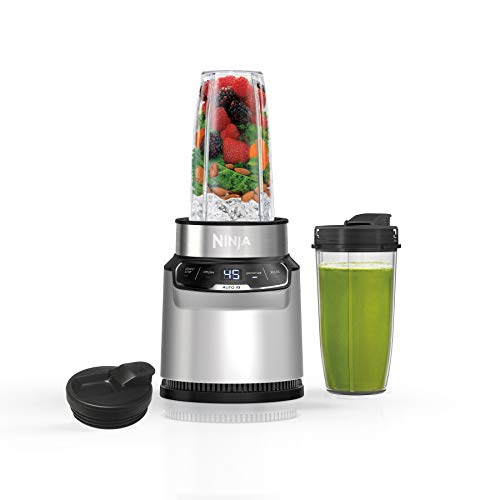
Ninja Nutri-Blender Pro BN401 with Auto-iQ, 1100 Peak Watts — Best Affordable with Smart Programs
The BN401 adds a small piece of intelligence to the personal blender formula. Its two Auto-iQ programs run timed patterns of pulsing and blending tuned for smoothies and for salsa and dips, so the machine manages the technique that makes personal blends smooth — breaking up the frozen layer, letting it settle, then finishing at full speed. Power is a strong 1100 peak watts, the two included cups are a generous 24 ounces, and everything is dishwasher-safe. For busy people who value a one-button routine, this is the affordable pick that feels modern.
Strengths
- Auto-iQ programs automate the pulse pattern for smoother results
- 1100 peak watts is strong power in the personal class
- Two large 24 oz cups suit bigger smoothies and meal-replacement shakes
Trade-offs
- Personal format only — no pitcher for family batches
- Programs reduce manual control for unusual recipes
- Peak-watt ratings flatter; sustained power is what it is — good, not premium
| Specification | Detail |
|---|---|
| Power | 1100 peak watts |
| Programs | 2 Auto-iQ programs |
| Cups | (2) 24-oz to-go cups |
| Cleaning | Dishwasher-safe |
What the BN401 really sells is consistency without attention. Left to manual pulsing, most people under-blend (gritty) or over-run (warm and frothy); the Auto-iQ pattern lands in the right place repeatably, which is worth a lot at 7 a.m. The cups are big enough for a serious breakfast smoothie with greens, frozen fruit and protein. It shares the class limits — single servings, short duty cycles — but within the personal format it is the most polished affordable option here.
Best for: busy users who want one-button, consistent smoothies / Not suited for: families or anyone needing a full-size pitcher

BLACK+DECKER Countertop Blender BL2010BG, 6-Cup Glass Jar — Best Affordable Classic Pitcher
BLACK+DECKER’s BL2010BG is the blender equivalent of a reliable sedan: a 6-cup glass jar, ten speeds, and a design that has changed little because it works. The capacity is the story for smoothie households — six cups covers a family round of smoothies or a full batch of shakes in one go — and the glass jar keeps flavours clean between uses. Ten speeds give honest manual control from a gentle stir to a full smoothie run, without presets pretending to be features. It is the affordable pick for buyers who want a pitcher, a dial’s worth of speeds, and nothing they have to learn.
Strengths
- Generous 6-cup glass jar for family smoothie batches
- 10 speeds give straightforward manual control
- Simple, proven design that anyone in the house can operate
Trade-offs
- No personal cup or to-go format for solo routines
- Modest power — frozen loads work best in reasonable pieces
- Fewer refinements than the newer designs on this list
| Specification | Detail |
|---|---|
| Jar | 6-cup glass jar |
| Speeds | 10 speed settings |
| Format | Countertop pitcher blender |
There is a real constituency for this machine: households that blend for several people, dislike plastic jars, and want controls a guest can figure out. Smoothies for the family, milkshakes, pancake batter, sauces and soups all sit comfortably in its ability. Frozen fruit smoothies come out well if the fruit is cut sensibly and liquid is adequate; it is not the machine for pulverising a cup of ice cubes dry. As the affordable classic pitcher pick, it earns its place on value and capacity rather than novelty.
Best for: families wanting an affordable, simple glass-jar pitcher blender / Not suited for: solo users wanting a personal cup format
Comparison Table
| Pick | Badge | Key spec | Best for |
|---|---|---|---|
| nutribullet Pro 900 (Special Edition, White) | Best Overall Affordable | 900W personal blender | solo drinkers and couples making one or two smoothies a day |
| Ninja Fit Compact Personal Blender QB3001SS, 700W | Best Compact Affordable | 700W, 2 × 16 oz cups | small kitchens, students, gym and office smoothie routines |
| Hamilton Beach Power Elite Blender 58148AG, 700W | Best Affordable Full-Size with Glass Jar | 700W, 40 oz glass jar | small families wanting an affordable pitcher blender with a glass jar |
| nutribullet Full-Size Blender Combo NBF50500, 1200W | Best Affordable for Families | 1200W, 64 oz + 24 oz cup | families who need both batch and personal blending affordably |
| Ninja Nutri-Blender Pro BN401 with Auto-iQ, 1100 Peak Watts | Best Affordable with Smart Programs | 1100 peak W, Auto-iQ, 2 × 24 oz | busy users who want one-button, consistent smoothies |
| BLACK+DECKER Countertop Blender BL2010BG, 6-Cup Glass Jar | Best Affordable Classic Pitcher | 6-cup glass jar, 10 speeds | families wanting an affordable, simple glass-jar pitcher blender |
How to Choose an Affordable Smoothie Blender
Format first. If smoothies are a solo ritual, a personal blender’s blend-in-cup design will get used twice as often as a pitcher, and a used blender beats a powerful one in a cupboard. If smoothies are a family event, buy the pitcher or the combo and accept the washing up as the price of batch size.
Power second, in context. For personal servings, 700–900 watts handles frozen fruit well; the 1100–1200W machines here add headroom for harder loads and bigger cups. For pitchers, look for circulation design (like Wave Action) as much as watts, because a cheap pitcher that leaves ingredients floating above the blades frustrates at any wattage.
The hidden costs of cheap
Cups, lids and blade bases are the wear parts of personal blenders. Established brands stock replacements cheaply and for years; obscure brands often do not, turning a small failure into a whole new purchase. When two machines look similar, the one with available spares is the genuinely cheaper buy.
Capacity honesty
A 24 oz cup makes a large smoothie; a 16 oz cup makes a standard one; a 64 oz pitcher makes a family round. Buy for the serving you actually drink — oversized cups tempt overfilled, under-blended smoothies, and undersized ones guarantee a second round of blending and washing.
What Affordable Blenders Can and Cannot Do
They can: daily smoothies with frozen fruit, protein shakes, milkshakes, iced coffee drinks, baby food purees, pancake batter, dressings and most sauces. That list covers the overwhelming majority of home blending, which is why the affordable tier is the rational default for most households.
They cannot, or should not: sustained nut-butter grinding, very hot soup blending in sealed cups, minutes-long heavy loads, or completely seed-free berry purees. If those jobs are weekly events in your kitchen, the honest advice is to save for the premium tier rather than burn out an affordable machine proving the point.
Setting Up a Smoothie Routine That Lasts
The households still blending in month six share a setup, not a secret. The machine lives where it is used — on the counter or in the easiest cupboard — the cups live beside it, and the freezer holds portioned fruit bags at eye level. Every step removed from the routine is a day the routine survives a busy week; every step added is a small tax paid daily. Design the tax down before you blame your discipline.
Prep in batches. One ten-minute session a week — washing greens, portioning fruit, freezing bananas — converts every weekday smoothie into a ninety-second assembly job. Affordable blenders pair perfectly with this rhythm because their ideal load is exactly one portioned bag plus liquid. The freezer bag system also ends the most common smoothie failure: opening the fridge, finding nothing ready, and skipping the whole idea.
Keep two or three house recipes on rotation rather than improvising daily. A default green, a default berry and a default shake cover moods and use up ingredients predictably, which keeps shopping simple and waste low. Novelty is for weekends. The machines on this list all handle those defaults without strain, which is precisely the point of the affordable tier: the routine should feel easy enough to be boring, because boring routines are the ones still running next year.
Clean as part of the recipe, not after it. The rinse-or-dishwasher step belongs inside the ninety seconds, while the cup is still wet and the residue has no grip. Every owner who abandons a blender traces the decision to a sink full of dried smoothie cups more often than to any failure of blending. The machines cannot do this part for you — but the formats on this list, cups that rinse in seconds and parts that go in the dishwasher, come as close as design can.
Storage of the finished drink matters on rushed mornings. Personal cups with proper lids travel in gym bags and car holders; pitcher batches pour into bottles for the fridge and keep well for a day, though they are always best fresh — a quick shake or stir revives a settled smoothie. If your routine involves blending the night before, choose recipes with banana or oats, which hold their texture overnight better than thin, icy blends that separate and melt.
Measure success at thirty days, not on day one. Every blender on this list will delight you on the first weekend; the question the affordable tier actually answers is whether you are still blending happily when the novelty is gone. That is why this guide spends as much space on routine design as on machines — the right format, prepped ingredients and a ninety-second cleanup are what convert a purchase into a habit, and the habit is where all the value lives.
How to Make a Perfect Smoothie in an Affordable Blender
Affordable machines reward good technique. This order and method get premium-feeling results from any pick on this list:
- Start with liquid: a cup or so of water, milk, yoghurt or juice goes in first (or first into the cup, remembering a personal blender is filled upside down — soft and liquid ingredients end up nearest the blade when inverted).
- Add soft ingredients next: banana, yoghurt, nut butter, protein powder, leafy greens.
- Add frozen fruit last and in pieces no bigger than a strawberry; whole frozen bananas are where small motors go to struggle.
- Blend in bursts if your machine lacks programs: ten seconds on, a pause to let the load settle, then a full thirty-to-forty-five-second run.
- Check texture, then adjust: too thick, add liquid a splash at a time; too thin, add frozen fruit or ice a few pieces at a time.
- Drink or rinse immediately. A cup rinsed now never needs scrubbing, and smoothie residue left to dry is the main cause of stale smells blamed on the machine.
The Real Economics of Affordable Blending
An affordable blender should be judged on cost per smoothie over its life, not the number on the box. A machine that costs a little more but survives three years of daily use, with replacement cups available cheaply, is far cheaper per drink than a bargain machine replaced annually. This is why this list sticks to established brands even at the budget end: the spare-parts shelf is a financial feature, not a detail.
The second economic factor is the habit itself. A smoothie routine replaces bought drinks, and a bought smoothie costs several times what the same drink costs at home even with premium fruit. A blender used daily pays for itself in weeks on that arithmetic; a blender used twice pays for itself never. That is why format fit — the machine matching your actual mornings — outranks specifications in this category. Buy the blender your routine will use, not the one that wins a comparison table.
Frozen fruit strategy is the third lever. Buying fruit in season, or frozen fruit in bulk, and pre-portioning it into smoothie bags transforms both cost and convenience: a bag goes from freezer to cup with a splash of liquid, no measuring, no washing boards, no half-used punnets softening in the fridge. Affordable blenders handle these bags perfectly provided the pieces were cut before freezing — the one preparation step that decides success with small motors.
There is also an honest ceiling to acknowledge. Affordable machines concentrate their engineering on the smoothie job, and their motors, seals and cups are specified for short, frequent runs. Owners who respect that brief — one or two cycles per session, sensible loads — routinely get years from them. Owners who treat a personal blender as a flour mill, nut grinder and ice crusher in one tend to meet the ceiling quickly. The machines are not fragile; they are specialised, and specialisation is exactly what makes them affordable.
Finally, consider the second-hand and refurbished angle carefully. Premium blenders refurbish well; affordable personal blenders generally do not, because their wear parts (cups, seals, blade bases) are most of the machine’s value. In this tier, new-with-warranty at a promotional price is usually the smart buy, and this category is promoted so frequently that patience of a week or two is often worth real money.
Energy and waste complete the economics. A personal blender draws modest power for under a minute per drink — a negligible running cost beside a kettle’s daily work — and a home smoothie routine quietly eliminates a stream of single-use cups and bottles from bought drinks. None of this requires premium equipment; it is the natural arithmetic of a simple machine used often, which is the entire philosophy of the affordable tier.
It is worth saying plainly what separates the affordable machines on this list from the truly cheap ones below them. The picks here come from brands that publish real specifications, honour warranties through US support channels, and stock the cups and seals that wear out. A listing that cannot tell you its wattage, or whose brand has no support presence, is not a bargain at any price — it is a disposable appliance with a blender’s shape. The affordable sweet spot is the floor of the reputable market, not the floor of the marketplace.
Seasonality is a final, underused saving. Affordable blending pairs naturally with buying fruit when it is cheap and freezing it: market gluts of berries, mangoes and bananas become smoothie stock at a fraction of year-round prices. A freezer shelf of portioned fruit bags is effectively a smoothie subscription you paid for once, at the best prices of the year, and every machine on this list is built to turn those bags into breakfast.
Where should the money you save actually go? Into ingredients and one or two quality-of-life extras. A set of spare cups for a personal blender — so one is always clean — improves the daily routine more than a model upgrade does. A freezer stock of good fruit improves every drink. A simple bench scraper and a bottle brush make cleanup faster. Affordable blending done well is a system of small, cheap decisions around a modest machine, and the system, not the machine, is what produces years of good smoothies.
It also helps to set expectations about noise and speed at this tier. Affordable motors are louder per second than premium ones and take a little longer on frozen loads — forty-five seconds instead of thirty. In exchange they are smaller, lighter and simpler, and the difference in the cup is far smaller than the difference in the showroom. Judge them at the breakfast table, not beside a Vitamix running at full song.
One more consideration for shared households: buy-in. A smoothie routine survives when everyone in the house can operate the machine without instruction. The picks here were chosen partly on that ground — twist-and-go cups, obvious buttons, dishwasher-safe everything. A complicated machine with a manual nobody reads becomes one person’s chore and then nobody’s habit. Simplicity is not a compromise in this category; it is the mechanism by which the value is delivered.
Common Buying Mistakes
Overfilling the cup
Blends need headroom to circulate. A cup filled to the brim blends slowly, leaks at the seal and strains the motor. Respect the max line.
Loading giant frozen pieces
Whole frozen bananas and rock-hard mango chunks defeat small blades. Cut fruit before freezing, in smoothie-sized pieces.
Skipping liquid
A smoothie with too little liquid cavitates — the blades spin in an air pocket while nothing moves. Add liquid until the vortex forms.
Running long, hot cycles
Personal blenders are sprinters. Repeated back-to-back maximum runs overheat motors. One good cycle, properly loaded, is the design brief.
Buying the cheapest no-name option
Unverifiable wattage and unavailable spare cups make the very cheapest machines the most expensive over two years. The affordable sweet spot is established brands on offer.
Smoothie Building Blocks: Recipes That Suit These Machines
A reliable green smoothie formula for this class of machine: liquid first, a large handful of spinach (it blends far more easily than kale in affordable machines), half a banana for body, a cup of frozen mango or pineapple to mask the greens, and a spoon of yoghurt or protein if wanted. The result is sweet, smooth and genuinely green without demanding premium power. Kale works too, but strip the stems and give it the first short cycle with the liquid alone.
For a berry breakfast smoothie, frozen mixed berries plus banana plus milk or oat drink plus oats is the classic — the oats make it a meal, and affordable blenders handle them completely if given the full cycle. A spoon of honey or a date adjusts sweetness without refined sugar. This is the smoothie most likely to become a household default, so it is worth dialling in to your taste and writing the proportions on the fridge.
Post-workout shakes are the easiest win: milk or a plant alternative, protein powder, a banana, a spoon of peanut butter and ice. Personal blenders exist for exactly this drink, and the cup-to-gym-bag format removes every excuse. Add the powder after the liquid, never first into a dry cup, or it will cake on the base and survive the blend as lumps.
For children, the affordable pitcher picks earn their place: a family batch of banana, frozen strawberries and yoghurt, poured small, with the sweetness coming from fruit. Freezing the same mixture in moulds makes smoothie pops that cost a fraction of bought ice lollies and contain nothing you did not put there. The glass-jar pitchers pour these batches cleanly and wash up in the dishwasher.
One technique upgrades every recipe here: freeze your base fruit at peak ripeness. Bananas bought cheaply when spotty, peeled and frozen in pieces, become the sweetest, creamiest smoothie base available at any price, and they spare you adding sugar or ice that dilutes flavour. Affordable blending rewards exactly this kind of preparation — the machine does the last, easy part of work you set up in advance.
A note on greens for beginners, since they cause most early disappointment: start with spinach, which disappears completely, before graduating to kale, chard or herbs. Use frozen fruit with strong flavours — mango, pineapple, berries — to carry the drink while your palate adjusts to the green base. Within a fortnight most people find they can increase the greens substantially; the blender was never the obstacle, only the recipe balance.
Thickness is a preference worth dialling in deliberately. Thick, spoonable smoothies want more frozen fruit and less liquid, plus a pause mid-blend to let the mixture settle onto the blades; drinkable smoothies want the opposite. Affordable personal blenders make thick blends well provided the load is modest and the pieces are small — overfilling a cup with frozen fruit and minimal liquid is the one combination that defeats them, and the fix is always a splash more liquid, not a bigger motor.
For households blending for children and adults together, the pitcher picks let you run one base batch and customise at the pour — extra protein in one glass, a spoon of cocoa in another — instead of running separate personal blends. That small workflow advantage is why many families keep a pitcher even after buying a personal blender, and why the combo machine exists. There is no rule that a kitchen must choose one format forever; the affordable tier makes owning the right format for each job a realistic option.
Finally, a word about ice: smoothies built on frozen fruit need little or no added ice, and they taste better for it, because ice dilutes. Reserve ice for drinks designed around it — iced coffee blends, slushies, frozen lemonades — where dilution is part of the recipe’s balance. Your affordable blender will also live longer, since frozen fruit is kinder to blades and motors than equivalent volumes of hard ice.
Final Recommendation
For most buyers, the nutribullet Pro 900 is the best and affordable smoothie blender to start with: proven, powerful enough, and built around the routine people actually keep. The Ninja Fit serves small spaces, the Hamilton Beach Power Elite and BLACK+DECKER cover glass-jar pitcher duty at two sizes, the nutribullet Combo equips a whole family, and the Ninja BN401 adds one-button polish.
Choose by format and household size, then check the current price on Amazon — this category is discounted often, and the gap between these picks narrows and widens with promotions. If two picks seem equally suited, choose the one whose cups, jar and controls fit the way your household already moves through the morning; that ergonomic fit, more than any specification, is what affordable smoothie blending success is made of, week after week and year after year.
Short on time? Start with our three most-bought picks: nutribullet Pro 900 (Special Edition, White), Ninja Fit Compact Personal Blender QB3001SS, 700W, Hamilton Beach Power Elite Blender 58148AG, 700W — each links to Amazon so you can check the current price on Amazon for the exact model.
Keep exploring: Best Blenders Best Smoothie Blenders Best Personal Blenders Best Budget Blenders Best Blenders For Smoothies Best Cheapest Blenders
Frequently Asked Questions
How many watts do I need for smoothies?
For personal servings, 700–900 watts handles frozen fruit well. Bigger cups and pitchers benefit from 1,000 watts or more. Technique — loading order and piece size — matters as much as the number on the box, and a well-loaded 700W machine will out-blend a carelessly loaded stronger one every single time.
Personal blender or pitcher for smoothies?
Personal if you blend for one or two and value zero washing up; pitcher if you blend for a family or make varied recipes. The combo format covers both if you genuinely do both weekly.
Can affordable blenders crush ice?
Yes, in smoothie context — ice blended with liquid and other ingredients. Dry-crushing a full load of cubes is harder on small machines; add liquid and work in reasonable quantities, and let the first few pulses break the cubes down before running a full cycle.
Why is my smoothie still chunky?
Usually overfilling, pieces too large, or too little liquid. Fill below the max line, cut frozen fruit smaller, ensure liquid reaches the blades, and give it a full cycle. If chunks persist, pause, let the load settle onto the blades, and run one more short cycle rather than one long strained one.
How long do affordable blenders last?
With daily smoothie use and rinsed-after-use care, expect years of service, with cups and seals as occasional replacements. Heavy grinding work shortens life considerably — match the machine to the job. The single most protective habit is also the simplest: never run repeated maximum cycles back to back, and let a hard-working motor rest for a few minutes between demanding sessions.
Are glass jars better than plastic cups?
Glass resists stains and odours and suits pitchers; personal cups are plastic by design for lightness and safety. For smoothies specifically, format matters more than jar material.
What should I check before ordering?
Confirm the exact box contents — cups, lids and blade bases vary between listings of the same model — and check the current price on Amazon for the configuration you want. Also measure your cupboard or counter space if you are choosing a pitcher model, and decide honestly whether your household drinks smoothies singly or in family batches, because that answer picks the format for you.

