Disclosure: airfryerkitchensupply.com is reader-supported. When you buy through links on our site, we may earn an affiliate commission at no extra cost to you.
The best american standard high flow toilets start with understanding what “high flow” means in this brand’s language, because it is not simply “uses more water”. American Standard built its modern reputation on flush engineering that moves water fast: oversized flush valves — the Champion line’s valve is the largest in the industry class — wide glazed trapways, and flush platforms tested to clear heavy loads in a single pass. A high-flow American Standard is therefore a toilet whose water arrives in the bowl with unusual speed and volume per second, whether its total is a full 1.6 gallons or an efficient 1.28 delivered through that oversized valve. This guide gathers the brand’s strongest-flushing models verified in Amazon’s catalog data: the Champion family at the top, the Cadet PRO line as the professional high-flow alternative, and the Yorkville pressure-assist route for buyers who want the brand’s most forceful flush of all. If your American Standard loyalty is really loyalty to never double-flushing, these are your six.
Where to buy
The confirmed picks in this guide are sold through Amazon, where you can check the current price on Amazon and verify each model’s configuration — bowl shape, height, lever side and seat inclusion — before ordering. We do not print fixed prices here. One pick, the Yorkville, is presented unlinked for a reason explained in its review. Start with the confirmed options:
- American Standard Champion 4 One-Piece Elongated 1.6 GPF — Best Overall: Check the current price on Amazon
- American Standard Cadet PRO Right Height Elongated 1.6 GPF — Best Two-Piece: Check the current price on Amazon
- American Standard Champion PRO Elongated Chair Height 1.28 GPF — Best Chair Height: Check the current price on Amazon
- American Standard Champion PRO Round Chair Height 1.28 GPF — Best Round Front: Check the current price on Amazon
- American Standard Cadet PRO Round 1.28 GPF — Best Standard-Height Value: Check the current price on Amazon
- American Standard Yorkville Pressure Assist — unlinked pick: the brand’s most forceful flush route; see the review for how to buy it correctly.
In this guide
Quick Picks
- Best Overall — Champion 4 One-Piece 1.6 GPF: the famous 4-inch flush valve in a one-piece Right Height body with slow-close seat included. Check price on Amazon
- Best Two-Piece — Cadet PRO 1.6 GPF: the Cadet engine at full volume in a Right Height elongated professional model. Check price on Amazon
- Best Chair Height — Champion PRO 1.28 Elongated: Champion flushing power at an efficient volume, in the trade line. Check price on Amazon
- Best Round Front — Champion PRO 1.28 Round: the same Champion engine in a compact round-front chair-height body. Check price on Amazon
- Best Standard-Height Value — Cadet PRO 1.28 Round: the most accessible route into the brand’s high-flow engineering. Check price on Amazon
- Most Forceful — Yorkville Pressure Assist: pressure-vessel force for heavy-duty installations, bought as a matched set.
How These Picks Were Chosen
This guide’s filter was flush performance within one brand’s catalogue, verified model by model in Amazon’s product data. It is worth adding that the filter was applied unsentimentally: American Standard sells many toilets, including attractive ones with ordinary flushes, and brand loyalty alone admitted none of them — every pick below is here because its valve, trapway and track record make the high-flow case in engineering terms a plumber would recognise. Priority went to the platforms American Standard itself engineers for power: the Champion family’s oversized flush valve and wide trapway, and the Cadet family’s large-valve siphon system with its long professional track record. Both 1.6-gallon full-flow models and 1.28-gallon high-velocity models were admitted, because the category’s honest definition of high flow is delivery rate and clearing power, not volume alone — but every 1.28 pick had to earn its place on the strength of its valve and trapway design rather than its badge. Configurations were spread across the decisions buyers actually face: one-piece versus two-piece, elongated versus round, Right Height and chair height versus standard height. The Yorkville is included unlinked because its verified retail listing is a tank rather than a complete toilet, and this programme does not link components as if they were fixtures. Models from the brand’s gentler, design-led lines were excluded — this guide is about flow, and it stays in its lane.
The 6 Best American Standard High Flow Toilets

American Standard Champion 4 One-Piece Elongated Toilet, 1.6 GPF — Best Overall
The Champion 4 is the toilet American Standard built its high-flow legend on, and this one-piece configuration is its most complete expression: the oversized 4-inch flush valve — the largest in its class, and the mechanism behind the line’s famous demonstrations of clearing power — a wide, fully glazed trapway, a full 1.6-gallon flush, a Right Height elongated bowl and a slow-close seat included in the box. The physics are simple and decisive: a bigger valve empties the tank faster, faster water builds a stronger siphon, and a stronger siphon through a wider trapway carries loads that defeat ordinary toilets. The one-piece body removes the tank-to-bowl seam, easing cleaning and modernising the profile. It suits households escaping a chronic clogger, larger families, and anyone who wants the brand’s maximum gravity flush in a finished, seat-included package. It is less suited to water-bill watchers — 1.6 gallons is the federal ceiling and some jurisdictions cap new installs below it — and one-piece weight demands a two-person install.
Strengths
- Oversized 4-inch flush valve delivers the fastest, strongest gravity flush in this guide.
- Wide glazed trapway and full 1.6-gallon volume maximise clearing margin.
- One-piece Right Height body with slow-close seat included.
Trade-offs
- Highest water use in the guide; verify local installation codes.
- Premium position within the brand’s range.
- Heavy one-piece body — plan the installation with a helper.
The Champion 4’s valve deserves its reputation explained rather than merely repeated. Conventional flush valves are substantially smaller, which throttles the tank’s discharge into a longer, weaker flow; the Champion’s valve removes that throttle, so the tank’s energy arrives in the bowl as a surge. Combined with the trapway’s width and glaze, the surge is why this platform anchors the brand’s clog-resistance claims and why plumbers reach for it when a customer demands an end to plunging. Ownership is conventional American Standard: the valve seal is the wear item, it is stocked everywhere, and replacing it is a short job. If you buy one toilet from this guide, this is the one that most completely embodies its title.
Best for: maximum gravity flushing power in a complete package / Not suited for: water-conservation priorities or 1.28-capped jurisdictions
Check the current price on Amazon

American Standard Cadet PRO Right Height Elongated, 1.6 GPF — Best Two-Piece
If the Champion is the brand’s flagship, the Cadet PRO at 1.6 gallons is its professional workhorse at full power: the Cadet flush engine — a large flush valve feeding a fully glazed trapway in a siphon design refined over generations — given the maximum legal volume to work with, in a Right Height elongated two-piece body. The PRO line is built for the trade channel, which means durability and serviceability outrank styling, the EverClean surface helps the bowl resist stain and build-up, and every internal component belongs to the most widely stocked parts family in American plumbing. It suits older homes whose drains reward volume, landlords and renovators fitting bathrooms that must simply never clog, and buyers who prefer two-piece handling and repair. It shares the 1.6 cautions — water use and local caps — and its seat is commonly a separate purchase in PRO configurations, so confirm the listing before ordering.
Strengths
- Cadet flush engine at full 1.6-gallon carrying power.
- Professional-grade build with the deepest parts support in the industry.
- Right Height elongated comfort in a serviceable two-piece format.
Trade-offs
- 1.6-gallon water use; check local codes.
- Seat commonly sold separately on PRO configurations.
- Utilitarian trade styling.
The Cadet PRO’s case is the total-cost one this programme keeps making because it keeps being true: the purchase is one day, the ownership is twenty years, and this model minimises the cost and drama of every one of those years. Its flush is a known quantity in the most demanding channel in the business — plumbers stake their callbacks on it — and at 1.6 gallons it brings the volume that older American drain lines were built around. Choose it over the Champion when you value the two-piece format, the trade pedigree and a slightly gentler purchase price over the one-piece flagship’s maximum surge.
Best for: older drains, rentals and professional-grade reliability / Not suited for: water savers or design-led renovations
Check the current price on Amazon

American Standard Champion PRO Two-Piece Elongated, Chair Height, 1.28 GPF — Best Chair Height
The Champion PRO elongated answers the obvious question about the flagship: how much of the Champion’s power survives at 1.28 gallons? Most of it — because the platform’s advantage was never raw volume but the oversized valve and wide trapway, which deliver the smaller volume at the same decisive speed. This trade-line two-piece pairs that engine with a chair-height elongated bowl, the format most adult households prefer, at an efficient volume that satisfies modern codes and water bills. It is the pick for buyers who want Champion clearing with a conservation conscience, and for professionals fitting bathrooms where 1.6 is not permitted. The trade-offs mirror its sibling below: PRO-line practicality over polish, and a seat that should be confirmed on the listing rather than assumed. On healthy modern drains, most owners will never detect the missing fraction of a gallon; on marginal drains, the 1.6 picks above remain the safer insurance.
Strengths
- Champion oversized-valve power at an efficient 1.28 gallons.
- Chair-height elongated comfort in the professional line.
- Code-friendly volume for jurisdictions capping flush at 1.28.
Trade-offs
- Slightly less carrying margin than the 1.6 Champion on difficult drains.
- Confirm seat inclusion on the listing.
- Trade styling rather than showroom finish.
Think of this model as the Champion translated for the WaterSense era: the same engineering argument — speed through a big valve into a wide glazed trapway — made at the volume modern plumbing is standardising on. Its presence in this guide is the proof of the guide’s thesis, that high flow is a rate, not a total. For the majority of homes with sound drains, it is arguably the smartest buy here: flagship clearing behaviour, adult comfort height, and a water figure your utility will approve of, in a body any plumber in America can service from stock.
Best for: Champion power with modern water efficiency / Not suited for: marginal old drains needing 1.6-gallon carry
Check the current price on Amazon
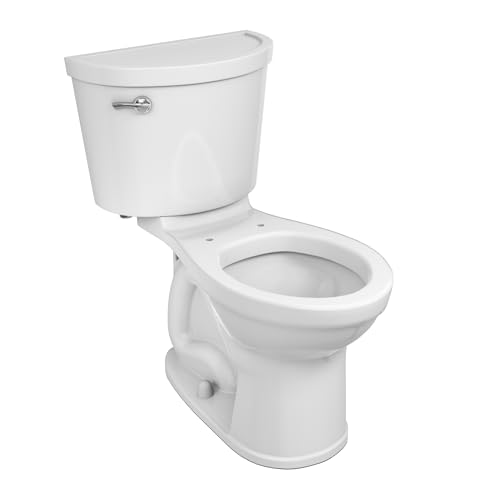
American Standard Champion PRO Two-Piece Round Front, Chair Height, 1.28 GPF — Best Round Front
Small bathrooms should not have to choose between fit and force, and this round-front Champion PRO is the proof: the full Champion flush platform — oversized valve, wide glazed trapway, 1.28-gallon efficiency — in a chair-height body whose round front returns roughly two inches of room compared with its elongated sibling. Those inches decide whether a door swings freely and whether knees clear the vanity in the compact bathrooms of older American homes, which are exactly the homes whose owners most often need a stronger flush than the one they are replacing. It suits small full bathrooms, older homes and guest baths where space is fixed and expectations are not. It is less suited to larger users who find round bowls confining, and it carries the same PRO-line notes as its elongated sibling: confirm the seat on the listing, and expect honest trade styling rather than a design moment.
Strengths
- Full Champion flush power in a space-saving round-front body.
- Chair height serves adults despite the compact footprint.
- Efficient 1.28-gallon volume satisfies modern codes.
Trade-offs
- Round bowl comfort is a compromise for some users.
- Seat confirmation needed on PRO configurations.
- Less carrying margin than the 1.6-gallon picks on bad drains.
The round-front Champion PRO is the guide’s most quietly useful pick, because it solves the compound problem — small room, weak old toilet, modern code — in a single model. Owners replacing a tired round toilet from a previous era get to keep their clearances while transforming their flush, and the chair height corrects the other anachronism of those bathrooms, the low standard rim. If your tape measure says elongated will not fit, this is not the consolation prize; it is the correct toilet.
Best for: compact bathrooms needing full Champion power / Not suited for: users who find round bowls confining
Check the current price on Amazon

American Standard Cadet PRO Two-Piece Round, Standard Height, 1.28 GPF — Best Standard-Height Value
The entry point to this guide is the Cadet PRO in its most accessible configuration: round front, standard height, 1.28 gallons, and the Cadet flush engine that gives this whole family its reputation. Standard height and round bowls have fallen from fashion, but they remain the right specification for shorter users, for children sharing the bathroom, and for the compact rooms of older homes — and in those rooms, this model delivers high-flow engineering at the guide’s most approachable position. The EverClean surface and fully glazed trapway carry over from its bigger siblings, as does the parts ecosystem that makes the Cadet line the default recommendation of the American trade. It suits budget renovations, rentals, and households whose users are not tall. It is less suited to taller adults, who will feel the standard height daily, and to anyone wanting chair-height comfort — step up to the Champion PRO round instead.
Strengths
- Cadet high-flow engine at the guide’s most accessible tier.
- Standard height and round front suit shorter users and small rooms.
- EverClean surface and the industry’s deepest parts support.
Trade-offs
- Standard height is low for taller adults.
- Round bowl, traditional two-piece styling.
- Seat commonly a separate purchase.
Value in this guide is measured in performance per dollar across twenty years, and by that measure the entry Cadet PRO is formidable: the same engine family as the flagship picks, the same serviceability, the same glaze discipline, at the price of the brand’s gentler models. It is the pick that lets a landlord or a first-home buyer standardise on real engineering instead of builder-grade porcelain, and feel the difference every day the plunger stays in the cupboard.
Best for: budget buyers wanting genuine high-flow engineering / Not suited for: taller users wanting chair height
Check the current price on Amazon
American Standard Yorkville Pressure Assist — Most Forceful
Beyond every gravity toilet in this guide sits the brand’s pressure-assist route: the Yorkville, a floor-standing elongated toilet whose sealed pressure vessel releases its flush with mains-pressure force, scouring the bowl and driving the trapway clear in about a second. For genuinely problem installations — heavy commercial-style use, difficult drains within a home, settings where a clog is a business problem — it is the strongest flush American Standard offers. We present it unlinked for the reason this programme applies everywhere: the verified Amazon listing for the Yorkville is its pressure-assist tank sold separately, a legitimate service part that is not a complete toilet, and linking it as one would mislead the very shoppers this guide serves. Buy the Yorkville as a matched bowl-and-tank set through a plumbing supplier, confirm both model numbers with the seller, and have it installed by someone who knows pressure systems. Its trade-offs are the category’s: real noise, proprietary vessel components with a service life, and a purchase process that rewards a plumber’s involvement.
Strengths
- The most forceful flush in the American Standard range.
- Commercial-grade design with a deep installed base.
- American Standard support behind the pressure system.
Trade-offs
- No verified complete-toilet retail listing — buy the matched set via plumbing channels.
- Pressure-flush noise and proprietary vessel maintenance.
- Professional specification and installation recommended.
The Yorkville closes this guide by marking the boundary of gravity. Everything above it is the best that falling water can do — and it can do a great deal, as the Champion proves — but where falling water has repeatedly failed a particular building, stored pressure is the brand’s own answer. Treat it as the specialist referral at the end of an honest guide: most readers should buy a Champion or a Cadet, and the few who need more now know its name and how to buy it properly.
Best for: problem installations and heavy-duty use / Not suited for: one-click DIY purchases or noise-sensitive homes
Comparison Table
| Pick | Badge | Key spec | Best for |
|---|---|---|---|
| Champion 4 One-Piece 1.6 | Best Overall | 4-inch flush valve, Right Height, seat included | Maximum gravity power |
| Cadet PRO 1.6 | Best Two-Piece | Cadet engine, 1.6 GPF, Right Height elongated | Old drains, rentals |
| Champion PRO 1.28 Elongated | Best Chair Height | Champion valve, 1.28 GPF, chair height | Power plus efficiency |
| Champion PRO 1.28 Round | Best Round Front | Champion valve, round front, chair height | Compact bathrooms |
| Cadet PRO 1.28 Round | Best Standard-Height Value | Cadet engine, standard height, round | Budget high-flow |
| Yorkville Pressure Assist | Most Forceful | Pressure vessel flush, matched set | Problem installations |
How to Choose an American Standard High Flow Toilet
Start with your drain, because it arbitrates the guide’s central choice: on long, old or shallow-sloped runs, the 1.6-gallon Champion 4 and Cadet PRO bring carrying power that no efficient model fully replaces; on sound modern drains, the 1.28 Champion PROs deliver the same valve-driven surge with a third less water, and the difference will never be felt. If you do not know your drain’s condition, the honest proxy is your current toilet’s behaviour: a toilet that clogs only on heavy loads in a new house is telling you about the toilet, while sluggishness across several fixtures is telling you about the line, and the two stories point to different purchases. Next, choose the platform: Champion for the maximum valve and the flagship clearing reputation, Cadet for the professional workhorse with the deepest service story — both are defensible, and the honest difference is surge versus ubiquity. Then fit the body to the room and the users: elongated where space allows, round where it does not; Right Height or chair height for most adults, standard height for shorter households. Cost the whole box — the Champion 4 one-piece includes its seat, while PRO configurations often do not — and confirm every inclusion on the listing. Finally, if gravity has already failed you twice in the same bathroom, stop iterating and price the Yorkville route with a plumber; high flow has a ceiling, and pressure lives above it.
What Makes a Flush “High Flow”: Valves, Trapways and Siphons
The engineering behind this guide’s title is worth one clear explanation, because once you understand where a flush’s force actually comes from, every toilet listing in the world becomes easier to read — the marketing adjectives fall away and three specification lines remain, telling you nearly everything about how the fixture will behave in your bathroom for the next twenty years. A gravity flush is powered by the tank’s water falling into the bowl; how much of that energy becomes clearing force depends on three components. The flush valve is the gate: its diameter sets how fast the tank can empty, and American Standard’s Champion valve — at four inches, the largest in its class — empties the tank in a surge rather than a pour. The bowl’s waterways and rim delivery shape that surge into a wash that covers the bowl while the siphon jet drives water into the trapway entrance. The trapway itself — wide, fully glazed, smoothly bent — either preserves the siphon’s pull or wastes it. When all three are engineered together, a toilet clears heavy loads at volumes that defeat lesser designs, which is why this guide admits 1.28-gallon Champions alongside 1.6-gallon models without apology: the flow that matters is measured in the second the flush happens, not only in the tank’s total. When you compare any toilets, from any brand, those three components — valve size, trapway diameter and glaze — are the specification lines that predict your daily experience.
How to Install and Set Up a High-Flow American Standard
Installation follows the standard sequence — flange inspection, fresh wax ring, level seating, alternating gentle bolt tension, new supply line, repeated test flushes before caulking — with two high-flow specifics. First, set the tank’s water level exactly to the line marked inside the tank: these flush engines are tuned around that level, and a low fill silently converts a high-flow toilet into an ordinary one. Second, if your model uses the Champion’s oversized valve, familiarise yourself with its tower-and-seal arrangement before you need it — the seal is the wear item, it lifts out by hand on most configurations, and knowing that in advance turns the only likely service event of the decade into a five-minute job. Keep the model’s documentation and the seat’s details with your home records, register the warranty, and your high-flow purchase is fully commissioned.
Champion vs Cadet: The Head-to-Head That Decides This Guide
Since five of the six picks divide between two platforms, the comparison deserves its own examination. On peak clearing force, the Champion wins: its four-inch valve is a genuine engineering differentiator, and in standardised bulk-clearing terms the Champion platform sits at the top of the brand’s range. On serviceability, the Cadet wins on points: its internals are the most conventional high-performance parts in the industry, stocked by every wholesaler and familiar to every plumber, including the ones who have never seen a Champion tower. On purchase position, Cadet PRO configurations generally sit below comparable Champions, though the one-piece Champion 4’s included seat narrows the real gap — always compare finished boxes, not headline prices. On format range, the two lines overlap heavily: both offer elongated and round, chair and standard heights, 1.28 and 1.6 volumes, which is why this guide can offer a Champion and a Cadet for most briefs. On longevity of the flush itself, both depend on one seal — the Champion’s valve seal, the Cadet’s flapper-or-tower equivalent — and both seals are cheap, stocked and DIY-replaceable. The honest summary: choose Champion when the flush is the whole point of the purchase, choose Cadet when the ownership is. Households that cannot decide should weight their drain: the worse the drain, the more the Champion’s surge earns its premium.
High Flow for Large Households and Heavy Use
Household size changes what “strong enough” means, and this guide’s ranking tilts with it. A couple in a modern home will never find the limit of the 1.28 Champion PROs; the flush is engineered well beyond their needs. A household of six with one main bathroom lives closer to every limit — heavier loads, back-to-back flushes, children whose paper discipline is a work in progress — and for them the margin of the 1.6 models, or the Champion platform generally, is not indulgence but specification. Rental and multi-generational homes should think the same way, with an added premium on the Cadet’s serviceability, because the person maintaining the toilet may not be the person who chose it. Guest-heavy homes — the holiday house, the in-law suite — benefit from the flush that forgives unfamiliar users. The pattern to notice is that high flow is really headroom: you are buying distance between the worst load your household will ever produce and the load that defeats the toilet. Size that distance to your household honestly, and any pick in this guide will feel, as owners put it, like the toilet simply stopped being a topic.
Water Use, Honestly: What the 1.6 Picks Cost You
This guide recommends two 1.6-gallon toilets in an era of 1.28 standards, and it should show its arithmetic. The difference between the volumes is roughly a third of a gallon per flush. In a household of four flushing twenty times a day, choosing 1.6 over 1.28 across the board costs on the order of two to three thousand gallons a year — real water, worth real money at high municipal rates, and worth nothing at all compared with a single service call for a drain problem the stronger flush would have prevented. That is the trade in its true proportions: the 1.6 picks are insurance, priced in gallons, against drain conditions that punish frugality. Where no such condition exists — sound modern drains, ordinary loads — the insurance buys nothing and the 1.28 Champions are the rational purchase, which is why they occupy half this guide. Where the condition does exist, agonising over the fraction while paying plumbers is the false economy. Read your own house, pick your side of the trade, and do not let either camp’s slogans pick for you.
Troubleshooting a Weak Flush on a High-Flow Model
If a toilet from this guide ever flushes below its reputation, the cause is almost always one of four mundane things, in this order. First, the tank’s water level: check it against the mark inside the tank, because a level set low — or dropped by a throttled fill valve — starves the surge these engines are tuned around. Second, the valve seal: a Champion or Cadet seal that is scaled, curled or seated imperfectly leaks the tank’s energy away silently; the dye test (colour in the bowl without flushing) exposes it, and the seal is a cheap, hand-swapped part. Third, rim and siphon-jet scale in hard-water homes, which scatters the bowl wash and weakens the siphon’s start; a vinegar treatment and gentle jet cleaning restore it. Fourth, the drain itself: if the flush looks strong but the bowl drains slowly, the restriction is downstream and no toilet part will cure it — that is the camera-inspection conversation. Work the list in order and you will almost always find your flush again for the price of a seal, which is the quiet economic argument underneath this entire guide: high-flow American Standards fail cheaply, obviously and at home, or they do not fail at all.
EverClean, Glazes and Keeping the Bowl as Strong as the Flush
High flow solves the trapway; the bowl’s surface is a second, slower battle, and American Standard’s answer across these picks is its EverClean surface treatment, a permanent additive in the glaze that inhibits the growth of stain- and odour-causing bacteria and mould on the ceramic. The practical effect owners notice is that the bowl resists the waterline ring and the under-rim shadowing that make a strong toilet look tired, and that routine cleaning restores it fully instead of chasing stains into the glaze. Protect the investment by cleaning as the maker intends: non-abrasive cleaners and a soft brush preserve the surface, while scouring powders and pumice — tempting on a stubborn ring — abrade the very smoothness that keeps the bowl clean, on any brand. In hard-water homes, the ring that does form is mineral, and it yields to an acidic bowl cleaner given dwell time, not to force. Pair the brand’s strongest flush with that modest discipline and the toilet presents at year ten the way it flushed at week one — which, for a guide about flow, is the only definition of performance that survives contact with real bathrooms.
Who Should Not Buy a High-Flow Toilet
An honest guide ends its persuasion with the exits. If your home is a small, quiet household on modern drains with a genuine water-conservation commitment — a desert postcode, a tight septic design, a household philosophy — the brand’s efficient standard models, or the dual-flush toilets in our 1.1 gpf guide, will serve you better than anything here, and the water saved is real. If your bathroom is a tiny ensuite beside a light sleeper, note that force and silence trade against each other even within gravity designs, and the gentlest adequate flush may be the kindest purchase. If your drain is failing structurally, no toilet in this guide is the next purchase — the camera inspection is. And if your budget is at the floor of the market, the entry Cadet PRO is this guide’s honest floor; below it, you leave the high-flow category, and our affordable-toilets guide is the better map. Everyone else — the clog-weary, the large households, the old-drain owners, the brand loyalists — is who these six were chosen for, and for them the recommendation stands without qualification.
Decoding American Standard Configurations Before You Order
American Standard sells each platform in a thicket of configurations, and the costliest errors in this category are configuration errors, not model errors. The variables to pin down, in order: bowl shape (elongated or round front — measure your room, not your preference), height (Right Height and chair height are the tall formats; standard height is the traditional low rim), rough-in (12 inches is standard for everything linked here, but confirm against your flange), lever position and handing (left-hand is standard; right-hand variants exist and a mismatched lever is a daily annoyance), colour (the brand’s white is a specific shade that should match an existing suite if the toilet shares a room with a tub or sink from another era), and inclusions (seat, supply line and hardware vary by configuration, with the PRO trade line the most likely to sell the seat separately). The model numbers in each listing’s title encode these choices, and the discipline is boring and absolute: read the full configuration string of the exact listing you are buying, compare it line by line with the specification you decided on, and only then order. Every pick in this guide was verified at the configuration level for exactly this reason — a Champion is only the right toilet when it is the right Champion.
Common Buying Mistakes
The first mistake is reading “high flow” as “high volume” and buying a 1.6 for a modern home whose drains never needed it — or the reverse, buying an efficient 1.28 for a marginal old drain to save water that a plunger then spends. A third version of the same confusion is assuming the brand’s design-led lines flush like these platforms because they share a logo; within any big brand, flush engineering varies by line, and the Champion and Cadet names are the ones that carry this category’s argument. The second is ignoring seat inclusion on PRO configurations and discovering the gap at installation. The third is choosing elongated for a room that cannot swing its door past it, when the round Champion PRO exists precisely for that room. The fourth is setting the tank’s water level carelessly and never experiencing the flush you paid for. The fifth is assuming the Yorkville’s tank listing is a complete toilet — in this brand’s high-end, components and fixtures share names, and the box contents are the truth. The last is forgetting local codes: several jurisdictions cap new installations at 1.28 gallons, which is a reason to choose the Champion PROs, not a reason to break the rule with a 1.6.
Final Recommendation
Buy the Champion 4 One-Piece if you want the brand’s maximum gravity flush in a complete package; the Cadet PRO 1.6 for professional two-piece reliability on older drains; the Champion PRO elongated or its round sibling for Champion power at 1.28 gallons; and the Cadet PRO round for high-flow value — with the Yorkville reserved for installations where gravity has already lost. Whichever you choose, commission it properly: set the tank level to its mark, test the flush and refill through a dozen cycles, register the warranty, and record the model number where a future parts run will find it. A high-flow toilet bought on this guide’s evidence and installed with that care should remove flushing from your list of household concerns for the next two decades — which is, in the end, the only verdict this category has ever really been about. Continue with Best American Made Toilets, Best Affordable Toilets No Clog, Best Air Assisted Toilets, Best 1.6 Gpf Toilets and Best Affordable Toilets.
Related guides
Frequently Asked Questions
What is the difference between the Champion and Cadet lines?
Champion is the flagship power line, built around an oversized 4-inch flush valve and the brand’s strongest clearing claims. Cadet is the professional line, built around a large-valve siphon engine and an installed base so large that its parts are effectively a public utility. The two lines are not rivals so much as answers to different questions — how hard can it flush, versus how easily can it be kept flushing forever — and this guide’s picks let you choose your question before you choose your toilet. Cadet is the professional workhorse line, with a large-valve siphon engine, an enormous installed base and the deepest parts availability. Both are high-flow by this guide’s definition; Champion maximises surge, Cadet maximises serviceability.
Is a 1.28-gallon toilet really “high flow”?
Yes, when its valve and trapway deliver the volume fast enough — flow is a rate. Think of the difference between emptying a bucket through a wide opening and through a narrow one: the totals are identical, the experience is not, and a toilet bowl responds to the surge, not the spreadsheet. The Champion PRO models move 1.28 gallons through an oversized valve in a surge that out-clears many lazy 1.6 designs. On difficult old drains, though, total volume still matters for carrying waste down the line, which is why this guide keeps both.
Why do some of these toilets not include a seat?
Professional-line (PRO) configurations are sold to the trade, where seats are chosen and stocked separately, so the seat is often a distinct purchase. This is a trade convention, not a defect, but it surprises retail buyers, which is why this guide repeats the warning at every PRO pick rather than once. The Champion 4 one-piece in this guide includes a slow-close seat. Always confirm the listing’s contents before ordering, and budget accordingly.
Can a high-flow toilet damage my plumbing?
No. A high-flow gravity flush simply delivers the tank’s water quickly into the bowl and drain as moving water; it does not pressurise your pipes. Drains in sound condition handle it as designed. If your line is already compromised, that is a drain repair, not a toilet problem. It is also worth knowing that the surge happens inside the toilet’s own waterways — by the time water reaches your drain it is a fast-moving flow of the same total volume a gentle toilet would send, merely better organised.
How do I maintain the Champion’s flush valve?
The valve’s silicone seal is the wear item: if the toilet begins to run briefly between flushes or the flush weakens, lift the seal out per the manual, rinse or replace it, and reseat it. Seals are inexpensive and stocked everywhere American Standard is sold. Keep in-tank bleach products out of the tank, as they degrade seals prematurely. While you are in the tank, glance at the fill valve’s screen and the water-level mark once a year; those two checks, plus the seal, are effectively the entire maintenance programme for a flush engine designed to be serviced by its owner.
When should I choose the Yorkville over a Champion?
When gravity has genuinely failed in that specific bathroom — repeated clogs on a verified-healthy drain, or heavy-duty use beyond a home’s normal pattern — and you are willing to buy a matched pressure-assist set through a plumber and accept its noise. For everyone else, the Champion’s surge solves the problem inside a conventional purchase.
Are replacement parts for these models easy to find?
Yes — that is half the point of buying this brand. Champion valve seals, Cadet flappers and fill valves, and seats in both bowl shapes are stocked by plumbing wholesalers and hardware stores nationwide, and the PRO lines share their internals with an enormous installed base. Keep your model number recorded and any service event becomes a shelf item, not a search.

