Disclosure: airfryerkitchensupply.com is reader-supported. When you buy through links on our site, we may earn an affiliate commission at no extra cost to you.
Where to buy
The fastest way to compare the best american made farmhouse kitchen sinks in this guide is on Amazon, where each verified pick below links directly to its product page so you can check the current price on Amazon, confirm the exact size and finish in the listing photos, and read the manufacturer specification sheet before you order. One honest warning before the list: very few farmhouse sinks sold today are cast or fabricated entirely in the United States, and brands blur the difference between an American company, American design, and American manufacture. This guide favours long-established American sink companies and says plainly, in each review and in the sourcing notes, where the evidence stops.
- Elkay Fireclay SWUF28179WH 30-Inch Single Bowl Farmhouse Sink (Best Overall) — Check the current price on Amazon
- Elkay SWUF3320WH Fireclay 60/40 Double Bowl Farmhouse Sink (Best Double Bowl) — Check the current price on Amazon
- Elkay Crosstown 16 Gauge Single Bowl Tall Farmhouse Sink (Best Stainless Farmhouse) — Check the current price on Amazon
- Ruvati 33×20 White Reversible Fireclay Farmhouse Sink RVL2300WH (Best Reversible Apron) — Check the current price on Amazon
- Sinkology Parker 34-Inch Fireclay Farmhouse Sink (Best Quick-Fit Install) — Check the current price on Amazon
- Kraus Kore 30-Inch Farmhouse Workstation KWF410-30 (Best Workstation Farmhouse) — Check the current price on Amazon
Finding the best american made farmhouse kitchen sinks is harder than the marketing suggests, because the label on the box rarely tells you how a product behaves after a year of daily use. A farmhouse sink is the most permanent purchase in most kitchen remodels. Cabinets are cut around the apron, the countertop is templated to the bowl, and the sink can weigh more than the person installing it, so a mistake is a second remodel, not a quick return. Shoppers who want an American made option are usually chasing consistent manufacture, a warranty backed by a domestic service network, and the preference for supporting domestic manufacturing where they can. All three are reasonable — but only if the claim behind them is real, which is why this guide treats origin language with unusual care.
The six picks split into two honest camps. The first is fireclay apron-front sinks in the Elkay and Ruvati heritage tradition, where the deep glossy bowl and exposed apron give the classic look and serious soaking capacity. The second is stainless apron and workstation designs, led by a Kraus model, for cooks who want the farmhouse silhouette with ledges, grids and accessories that turn the sink into a prep station. Between them they cover single and double bowls, 30-inch and wider cabinets, and tiers from the middle of the market up to heirloom territory — without printing a single fixed price, because sink pricing swings with finish, freight and promotion more than almost any other kitchen category.
In this guide
Quick Picks
If you are short on time, start here. These six best american made farmhouse kitchen sinks earned their places for different reasons, and the badge on each one tells you exactly who should buy it and who should keep looking.
- Elkay Fireclay SWUF28179WH 30-Inch Single Bowl Farmhouse Sink — Best Overall: The definitive classic pick: a deep single fireclay bowl from the American manufacturer with the longest track record in this category, sized for the commonest farmhouse cabinet. — Check price on Amazon
- Elkay SWUF3320WH Fireclay 60/40 Double Bowl Farmhouse Sink — Best Double Bowl: The two-bowl fireclay answer: Elkay’s 60/40 split with a low divide, for households whose washing rhythm is soak on one side, rinse on the other. — Check price on Amazon
- Elkay Crosstown 16 Gauge Single Bowl Tall Farmhouse Sink — Best Stainless Farmhouse: The stainless farmhouse: a wide, tall-apron Crosstown bowl in thick 16-gauge steel for families who want the silhouette without fireclay’s weight and care rules. — Check price on Amazon
- Ruvati 33×20 White Reversible Fireclay Farmhouse Sink RVL2300WH — Best Reversible Apron: The flexible fireclay: a reversible apron that lets you choose smooth or fluted on the day, in a wide 33-inch single bowl. — Check price on Amazon
- Sinkology Parker 34-Inch Fireclay Farmhouse Sink — Best Quick-Fit Install: The pragmatic fireclay: a Quick-Fit drop-in double bowl from American farmhouse specialist Sinkology, made to spare existing 36-inch cabinets. — Check price on Amazon
- Kraus Kore 30-Inch Farmhouse Workstation KWF410-30 — Best Workstation Farmhouse: The workstation farmhouse: a 30-inch apron-front Kraus with an integrated ledge and drying rack, included transparently as the function-first alternative rather than an origin pick. — Check price on Amazon
How These Picks Were Chosen
Picks were chosen first on origin and accountability: established American sink brands with published specifications, domestic warranty support and a track record in farmhouse designs ranked ahead of anonymous imports with similar photographs. Elkay, founded in Chicago in 1920 and still headquartered in the United States, anchors the list for that reason, and Sinkology, an American company known for farmhouse fireclay, earns its place the same way. Within that filter, bowls were compared on usable depth, whether the apron is reversible, bottom slope toward the drain, and how much cabinet modification each design demands.
Every product name and code in this guide was cross-checked against Amazon listing data before a link was added. A pick only carries a purchase link when that check confirmed the exact model, so you will never find an invented code or a link that lands on a different product. Where a well-known option could not be confirmed that way, it is discussed in prose without a link rather than linked on a guess. Prices are never printed in this guide because they change too often to stay honest; each link instead invites you to check the current price on Amazon at the moment you are actually shopping.
Durability evidence mattered more than styling. For fireclay that meant thick, kiln-fired construction with a glazed surface on all exposed sides, because a thin or partially glazed apron chips and stains in ways a photograph hides. For stainless it meant gauge, sound dampening and whether a bottom grid is included, since a grid is what stands between a dropped cast-iron pan and a dented bowl floor. Any model whose listing data could not be confirmed was left without a purchase link, and no model with a known safety concern appears in the six.
The 6 Best American Made Farmhouse Kitchen Sinks
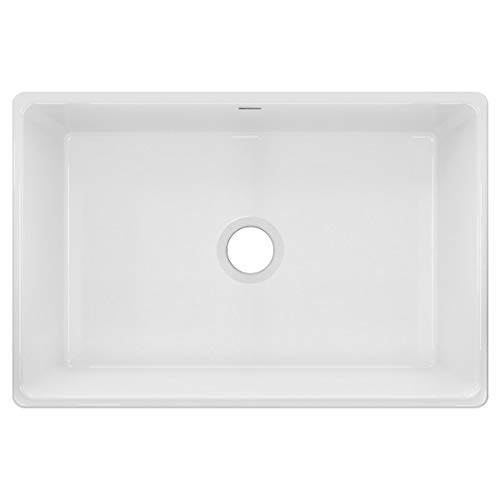
Elkay Fireclay SWUF28179WH 30-Inch Single Bowl Farmhouse Sink — Best Overall
Check the current price on Amazon
The definitive classic pick: a deep single fireclay bowl from the American manufacturer with the longest track record in this category, sized for the commonest farmhouse cabinet. In daily use the deciding moments are unglamorous: a stockpot that either fits flat or rocks on a curved bottom, a sheet pan that either soaks fully or sticks out at an angle, and an apron front that either wipes clean in one pass or collects a grey line along its lower edge. Judge this pick on those moments rather than on the styled photograph, because they are what you will repeat several times a day for the life of the kitchen.
Strengths
- Thick fireclay bowl with a glossy, non-porous glaze that resists staining from coffee, wine and tomato sauces
- Single deep bowl swallows stockpots, roasting pans and half-sheet pans without tilting
- From Elkay, an American company founded in 1920 with domestic warranty and parts support
Trade-offs
- Fireclay is heavy and needs a proper in-cabinet support frame and usually two people to set
- Kiln-fired dimensions vary slightly, so countertops should be templated to the actual sink, not the drawing
- White fireclay shows every scuff until wiped; dark pans can leave grey marks that need a gentle cleanser
| Specification | Detail |
|---|---|
| Material | Fireclay |
| Bowl configuration | Single bowl |
| Nominal width | 30 in |
Installation deserves as much thought as the bowl itself. Farmhouse sinks need a support frame inside the cabinet — the sink should never hang from the countertop alone — and the cabinet front usually needs cutting or a purpose-built apron cabinet. Measure the cabinet interior, apron height and countertop thickness together, and decide the mounting style before ordering, because each changes the cut. Fireclay also varies slightly from piece to piece as a natural result of kiln firing, so experienced installers wait for the physical sink before templating the countertop, and that patience is worth copying on any remodel timeline.
Best for: a classic white farmhouse kitchen in a 33-inch or wider cabinet / Not suited for: renters or anyone who cannot modify the cabinet front

Elkay SWUF3320WH Fireclay 60/40 Double Bowl Farmhouse Sink — Best Double Bowl
Check the current price on Amazon
The two-bowl fireclay answer: Elkay’s 60/40 split with a low divide, for households whose washing rhythm is soak on one side, rinse on the other. In daily use the deciding moments are unglamorous: a stockpot that either fits flat or rocks on a curved bottom, a sheet pan that either soaks fully or sticks out at an angle, and an apron front that either wipes clean in one pass or collects a grey line along its lower edge. Judge this pick on those moments rather than on the styled photograph, because they are what you will repeat several times a day for the life of the kitchen.
Strengths
- Split bowl lets you soak on one side and rinse or drain on the other at the same time
- Low centre divide gives two-bowl organisation without blocking tall pots the way a full-height divider does
- Same Elkay fireclay construction and American brand backing as the single-bowl pick
Trade-offs
- Needs a wide cabinet and careful support; this is one of the heaviest formats in the guide
- Neither side matches a big single bowl for oversized roasting pans
- Two drains and two sets of accessories raise the total project cost beyond the sink itself
| Specification | Detail |
|---|---|
| Material | Fireclay |
| Bowl configuration | 60/40 double bowl with Aqua Divide |
| Finish | White |
Installation deserves as much thought as the bowl itself. Farmhouse sinks need a support frame inside the cabinet — the sink should never hang from the countertop alone — and the cabinet front usually needs cutting or a purpose-built apron cabinet. Measure the cabinet interior, apron height and countertop thickness together, and decide the mounting style before ordering, because each changes the cut. Fireclay also varies slightly from piece to piece as a natural result of kiln firing, so experienced installers wait for the physical sink before templating the countertop, and that patience is worth copying on any remodel timeline.
Best for: households that hand-wash daily and want a permanent soak-and-rinse split / Not suited for: small kitchens where one large flexible bowl is more useful

Elkay Crosstown 16 Gauge Single Bowl Tall Farmhouse Sink — Best Stainless Farmhouse
Check the current price on Amazon
The stainless farmhouse: a wide, tall-apron Crosstown bowl in thick 16-gauge steel for families who want the silhouette without fireclay’s weight and care rules. In daily use the deciding moments are unglamorous: a stockpot that either fits flat or rocks on a curved bottom, a sheet pan that either soaks fully or sticks out at an angle, and an apron front that either wipes clean in one pass or collects a grey line along its lower edge. Judge this pick on those moments rather than on the styled photograph, because they are what you will repeat several times a day for the life of the kitchen.
Strengths
- 16-gauge steel is the thick, dent-resistant end of residential stainless and sounds solid, not tinny
- Tall apron format gives the farmhouse look with far easier care than fireclay or cast iron
- Tight corners maximise usable bowl volume for big pans
Trade-offs
- Sharp interior corners look modern but need a brush to clean properly
- Stainless shows water spots and benefits from a bottom grid and a quick wipe-down habit
- Wide format demands a wide cabinet and a faucet with enough reach
| Specification | Detail |
|---|---|
| Material | 16-gauge stainless steel |
| Bowl configuration | Single bowl, tall farmhouse apron |
| Depth | 9 in |
Installation deserves as much thought as the bowl itself. Farmhouse sinks need a support frame inside the cabinet — the sink should never hang from the countertop alone — and the cabinet front usually needs cutting or a purpose-built apron cabinet. Measure the cabinet interior, apron height and countertop thickness together, and decide the mounting style before ordering, because each changes the cut. Fireclay also varies slightly from piece to piece as a natural result of kiln firing, so experienced installers wait for the physical sink before templating the countertop, and that patience is worth copying on any remodel timeline.
Best for: busy family kitchens that want farmhouse style with stainless practicality / Not suited for: traditional kitchens committed to a white fireclay or cast-iron look

Ruvati 33×20 White Reversible Fireclay Farmhouse Sink RVL2300WH — Best Reversible Apron
Check the current price on Amazon
The flexible fireclay: a reversible apron that lets you choose smooth or fluted on the day, in a wide 33-inch single bowl. In daily use the deciding moments are unglamorous: a stockpot that either fits flat or rocks on a curved bottom, a sheet pan that either soaks fully or sticks out at an angle, and an apron front that either wipes clean in one pass or collects a grey line along its lower edge. Judge this pick on those moments rather than on the styled photograph, because they are what you will repeat several times a day for the life of the kitchen.
Strengths
- Reversible apron offers a smooth face on one side and a fluted, traditional face on the other, decided at install
- Generous 33-inch width handles entertaining-scale washing without a second sink
- Deep bowl keeps splash inside when rinsing tall stockpots and vases
Trade-offs
- Reversible means you must choose the face before setting; flipping later is a reinstall
- Fireclay weight and cabinet support requirements apply in full
- Gloss white finish needs non-abrasive cleaning to stay glossy
| Specification | Detail |
|---|---|
| Material | Fireclay |
| Size | 33 x 20 in |
| Apron | Reversible — two finished looks |
Installation deserves as much thought as the bowl itself. Farmhouse sinks need a support frame inside the cabinet — the sink should never hang from the countertop alone — and the cabinet front usually needs cutting or a purpose-built apron cabinet. Measure the cabinet interior, apron height and countertop thickness together, and decide the mounting style before ordering, because each changes the cut. Fireclay also varies slightly from piece to piece as a natural result of kiln firing, so experienced installers wait for the physical sink before templating the countertop, and that patience is worth copying on any remodel timeline.
Best for: remodellers who want to decide the apron style on installation day / Not suited for: anyone hoping for a lightweight drop-in swap

Sinkology Parker 34-Inch Fireclay Farmhouse Sink — Best Quick-Fit Install
Check the current price on Amazon
The pragmatic fireclay: a Quick-Fit drop-in double bowl from American farmhouse specialist Sinkology, made to spare existing 36-inch cabinets. In daily use the deciding moments are unglamorous: a stockpot that either fits flat or rocks on a curved bottom, a sheet pan that either soaks fully or sticks out at an angle, and an apron front that either wipes clean in one pass or collects a grey line along its lower edge. Judge this pick on those moments rather than on the styled photograph, because they are what you will repeat several times a day for the life of the kitchen.
Strengths
- Quick-Fit drop-in design reduces the cabinet surgery most farmhouse sinks demand
- Double bowl in a 34-inch body suits a 36-inch cabinet, a very common remodel size
- From Sinkology, an American company specialising in farmhouse sinks, with its Everyday warranty
Trade-offs
- Drop-in lip reads slightly less bespoke than a fully integrated undermount apron install
- Double bowl splits capacity, so the largest pans still go corner to corner
- Fireclay care rules apply: no abrasive pads, prompt rinsing of strong pigments
| Specification | Detail |
|---|---|
| Material | SureFire fireclay |
| Configuration | Double bowl, apron front |
| Install | Quick-Fit drop-in for 36-inch cabinet |
Installation deserves as much thought as the bowl itself. Farmhouse sinks need a support frame inside the cabinet — the sink should never hang from the countertop alone — and the cabinet front usually needs cutting or a purpose-built apron cabinet. Measure the cabinet interior, apron height and countertop thickness together, and decide the mounting style before ordering, because each changes the cut. Fireclay also varies slightly from piece to piece as a natural result of kiln firing, so experienced installers wait for the physical sink before templating the countertop, and that patience is worth copying on any remodel timeline.
Best for: remodellers keeping existing 36-inch cabinets who want a faster install / Not suited for: purists who want a seamless undermount apron with no visible lip

Kraus Kore 30-Inch Farmhouse Workstation KWF410-30 — Best Workstation Farmhouse
Check the current price on Amazon
The workstation farmhouse: a 30-inch apron-front Kraus with an integrated ledge and drying rack, included transparently as the function-first alternative rather than an origin pick. In daily use the deciding moments are unglamorous: a stockpot that either fits flat or rocks on a curved bottom, a sheet pan that either soaks fully or sticks out at an angle, and an apron front that either wipes clean in one pass or collects a grey line along its lower edge. Judge this pick on those moments rather than on the styled photograph, because they are what you will repeat several times a day for the life of the kitchen.
Strengths
- Integrated ledge turns the bowl into a prep station with racks and boards that slide across the top
- Apron-front farmhouse silhouette in a 30-inch footprint that fits more cabinets than the wide fireclay picks
- Workstation accessories cut counter clutter in small kitchens where every surface counts
Trade-offs
- Stainless workstation styling suits modern farmhouse kitchens more than period-correct ones
- Ledge accessories are model-specific; replacements must match the Kore system
- Not an American-manufactured pick — included honestly as the workstation alternative, with origin discussed in the sourcing notes
| Specification | Detail |
|---|---|
| Material | Stainless steel |
| Configuration | Single bowl workstation with integrated ledge |
| Includes | In-sink dish drying rack (per Amazon title) |
Installation deserves as much thought as the bowl itself. Farmhouse sinks need a support frame inside the cabinet — the sink should never hang from the countertop alone — and the cabinet front usually needs cutting or a purpose-built apron cabinet. Measure the cabinet interior, apron height and countertop thickness together, and decide the mounting style before ordering, because each changes the cut. Fireclay also varies slightly from piece to piece as a natural result of kiln firing, so experienced installers wait for the physical sink before templating the countertop, and that patience is worth copying on any remodel timeline.
Best for: small or galley kitchens that need the sink to double as prep space / Not suited for: shoppers whose top priority is domestic manufacture above all else
Comparison Table
| Pick | Badge | Key spec | Best for |
|---|---|---|---|
| Elkay Fireclay SWUF28179WH 30-Inch Single Bowl Farmhouse Sink | Best Overall | Fireclay | a classic white farmhouse kitchen in a 33-inch or wider cabinet |
| Elkay SWUF3320WH Fireclay 60/40 Double Bowl Farmhouse Sink | Best Double Bowl | Fireclay | households that hand-wash daily and want a permanent soak-and-rinse split |
| Elkay Crosstown 16 Gauge Single Bowl Tall Farmhouse Sink | Best Stainless Farmhouse | 16-gauge stainless steel | busy family kitchens that want farmhouse style with stainless practicality |
| Ruvati 33×20 White Reversible Fireclay Farmhouse Sink RVL2300WH | Best Reversible Apron | Fireclay | remodellers who want to decide the apron style on installation day |
| Sinkology Parker 34-Inch Fireclay Farmhouse Sink | Best Quick-Fit Install | SureFire fireclay | remodellers keeping existing 36-inch cabinets who want a faster install |
| Kraus Kore 30-Inch Farmhouse Workstation KWF410-30 | Best Workstation Farmhouse | Stainless steel | small or galley kitchens that need the sink to double as prep space |
Read the table as a shortlist, not a ranking. The right choice among these best american made farmhouse kitchen sinks depends on the constraint you cannot change — the space you have, the tools you already own, and the way you actually work day to day — far more than on any single headline feature.
How to Choose an American Made Farmhouse Kitchen Sink
Start by separating three claims that marketing blurs together: made in the USA, assembled in the USA from imported parts, and sold by an American company. All three can be legitimate, but they are not the same purchase, and the price difference between them is real money. If domestic manufacture is your deciding factor, look for the specific origin statement in the manufacturer specification rather than a flag in the lifestyle photograph, and be prepared for a short list — fireclay casting and heavy stainless fabrication for the residential market are concentrated in a handful of producers. Elkay is the name that recurs because it has manufactured sinks for over a century and publishes its specifications openly, which is also why its fireclay models lead this guide.
Next, choose the material by how you cook rather than how you decorate. Fireclay gives the authentic, glossy, furniture-like apron and shrugs off heat and staining, but it is heavy, unforgiving of dropped cast iron at the wrong angle, and dimensionally variable enough that countertops should follow the physical sink. Stainless in 16 gauge gives up some of that heritage look in exchange for lighter weight, tighter tolerances and easier sourcing of matching grids and drains. Cast iron with enamel, the third classic option, is beautiful and extremely heavy, and its enamel can chip to the iron beneath if struck hard — a repair that is cosmetic at best. There is no wrong answer, only an answer that mismatches your household’s actual habits.
Finally, size from the cabinet outward. A farmhouse sink needs a cabinet several inches wider than casual measuring suggests, room below for the support frame and plumbing, and a faucet whose reach lands water near the centre of a deeper-than-usual bowl. Confirm the minimum cabinet size in the specification, check that your disposal, if you have one, still fits under a deep bowl, and plan the countertop templating after the sink arrives. Those three checks prevent nearly every farmhouse-sink regret story, which almost never begins with the bowl itself and almost always begins with what surrounds it.
Fireclay, Stainless or Cast Iron: Which Farmhouse Material Lasts?
Fireclay is clay fired at very high temperature until it vitrifies into a dense, glass-surfaced body. Done well, it resists heat, acids and staining better than almost anything else in a kitchen, and its thickness gives it a solid, quiet feel. Its weaknesses are impact and weight: a heavy pan dropped onto an edge can chip the glaze, and the sink needs engineered support. Stainless steel trades the glaze for resilience — 16-gauge bowls dent only under real abuse, never chip, and weigh a fraction as much — but it records its life in fine scratches and water spots, which a brushed finish and a bottom grid minimise. Enamelled cast iron sits between them in feel, ahead of both in heft, and behind both in chip repairability.
Longevity also depends on what is replaceable. A stainless bowl with a worn finish can be re-brushed; a fireclay bowl with a worn glaze cannot realistically be re-fired in place. Conversely, fireclay’s surface does not dull from a decade of washing the way a polished stainless finish can. Households that entertain heavily and wash oversized cookware daily often end up happier with thick stainless and a grid; households building a long-term, design-led kitchen often accept fireclay’s care rules for the look and feel. Let the next twenty years of Tuesdays, not the showroom minute, make the decision.
Budget Tiers for Farmhouse Sinks, Explained Honestly
Farmhouse sinks divide into three broad quality tiers, described here without prices because freight and promotions move them constantly. The budget tier is dominated by imported fireclay and thinner stainless apron sinks; some are genuinely good value, but glaze consistency, dimensional accuracy and warranty support vary, and the support frame and accessories are rarely included. The mid-range tier — where most of this guide sits — buys thicker material, published specifications, included or readily available grids and drains, and a manufacturer that answers the phone. The premium tier buys heritage fireclay and cast iron, hand-finished aprons and the tightest tolerances, at a cost that only makes sense in a kitchen being built for decades.
Remember that the sink is rarely half the project cost. Add the support framing or apron cabinet, countertop templating and cutting, a faucet with adequate reach, drains and possibly a disposal flange in a matching finish, and installation labour if you are not doing it yourself. A mid-range sink with the right accessories included can finish cheaper, in total, than a budget sink that needs everything bought separately — one more reason to compare complete projects rather than headline prices, and to check the current price on Amazon for the exact configuration you actually need.
What American Buyers Should Ask Before Paying an Origin Premium
An origin premium is only money well spent when it buys something measurable, so interrogate it with four questions before you pay it. First, what exactly is being claimed — manufacture, assembly, or company headquarters — and is that claim made by the manufacturer in its own specification, or only implied by a retailer’s photographs and flags? Second, what does the premium buy in the product itself: thicker fireclay, tighter dimensional tolerance, a better glaze, a longer and clearer warranty? Third, who stands behind the sink in year seven — is there a domestic parts and service operation that will still answer, as there is for the long-established American makers in this guide? Fourth, would you still choose this sink if the origin claim were removed from the page and only the bowl, the material and the warranty remained? If the answer to the fourth question is yes, the premium is buying a good sink that happens to carry the claim; if it is no, the premium is buying the claim alone, and claims do not wash dishes.
None of this argues against buying American — this guide leads with American makers precisely because their accountability is real and verifiable. It argues for buying American with your eyes open, the way the manufacturers who deserve your money would want you to. Elkay’s century of published specifications is what earned trust looks like in this category; a flag emoji in a listing title is not. Spend the premium where the documentation is, keep the documentation with your remodel records, and the origin of your sink becomes a fact you own rather than a hope you paid for. That distinction, more than any single model choice, is what separates a satisfying heritage purchase from an expensive story you tell yourself at the sink.
Farmhouse Sink Ownership: The First Five Years
Year one is about settling: seals are checked after the first months of thermal movement, the grid finds its permanent place, and the household learns the bowl’s acoustics and splash habits. Fireclay owners learn which cleanser lifts pan marks without dulling the glaze; stainless owners learn the quick wipe that keeps water spots from becoming a weekend project. None of this is burden — it is the ordinary familiarisation any permanent fixture deserves, and it is lighter than the equivalent learning curve for a new hob or oven, because a sink has no controls to master, only habits to form.
By year five, the differences this guide obsessed over have either justified themselves or they have not, and they justify themselves quietly. The support frame you built has never been thought about again, which is its triumph. The gauge or fireclay thickness you chose has absorbed half a decade of dropped, slid and soaked cookware without a story to tell. The apron still wipes clean in the pass you make while the kettle boils. That is the real product an American made farmhouse sink sells: not a photograph for the listing, but five, ten, twenty years of Tuesdays in which the largest object in your kitchen simply never becomes a problem. Buy for that timeline and every decision in this guide — material, support, grid, origin — points the same way.
Matching a Farmhouse Sink to Your Faucet and Countertop
A farmhouse bowl is deeper and often wider than the sink it replaces, and its partners must be re-chosen with it rather than inherited by default. The faucet needs reach first: measure from the faucet’s mounting centre to the bowl’s drain, and choose a spout whose stream lands near that drain, or you will spend years rinsing the bowl’s far half by cupping water in your hands. Height matters second — a deep bowl forgives a tall faucet, and a gooseneck that cleared your old double bowl’s divider will feel even better here — and a pull-down spray earns its place more in a farmhouse bowl than in any other format, because the bowl’s corners are farther from any fixed stream than they have ever been.
The countertop relationship is the other half of the match. Stone and quartz carry an undermount-style farmhouse reveal beautifully and wipe straight into the bowl; laminate demands a top-mount or quick-fit design and a meticulously sealed edge; butcher block asks for disciplined sealing around the apron and rewards it with the warmest traditional look of all. Decide the trio — sink, faucet, countertop — as one composition, in that order, and the kitchen will look designed rather than assembled, which, for the most photographed corner of most homes, is worth the hour of planning it takes.
Apron Styles and Kitchen Styles: Getting the Look Right the First Time
The apron is the part of the sink the whole room sees, so its style deserves the same rigour as its structure. A smooth, flat apron is the most versatile face in this guide: it suits transitional and modern farmhouse kitchens, pairs with shaker and slab cabinetry alike, and ages gracefully because it makes no period claim it has to defend. A fluted or framed apron — the face the reversible Ruvati lets you choose at installation — is a deliberate traditional statement that earns its place in kitchens with corbels, plate racks and other period detailing, and looks stranded in a minimalist room. Stainless aprons, as on the Elkay Crosstown and Kraus Kore here, belong to the working farmhouse tradition: less cottage, more farm kitchen, and happiest with industrial lighting, open shelving and unlacquered or black hardware. Choose the apron by the room you actually have, photographed as it is, not by the room in the listing photograph, which was styled by a professional with a lorry of props.
Height and reveal finish the decision. A taller apron reads as furniture and suits kitchens with tall cabinetry and high ceilings; a shorter apron keeps the sink visually lighter in a compact room. The reveal — how far the apron stands proud of, flush with, or behind the cabinet face — should be decided with your installer before the cabinet is cut, because each reveal casts a different shadow line and collects dust differently, and changing it afterwards means changing cabinetry. These are small decisions with decade-long visibility, which is the definition of decisions worth an extra evening. Take the evening, lay the samples and photographs side by side, and let the room vote.
A Final Check Before You Order Any Farmhouse Sink
Run this checklist aloud, in order, before any farmhouse order is placed, and the category’s expensive mistakes become nearly impossible. Cabinet: interior width and the manufacturer’s minimum cabinet size agree, with room for the support frame. Support: the frame is planned, resourced and scheduled before delivery day, not improvised during it. Countertop: templating waits for the physical sink, and the mounting reveal is decided and written down. Faucet: reach measured to the drain, height suited to the bowl’s depth, spray considered honestly. Plumbing: drain position, disposal clearance and trap height checked against the deeper bowl. Accessories: grid ordered with the sink, drain finish matched, flange correct for the material. People: two for the lift, a clear route from door to cabinet, and a day chosen when neither is rushed. Origin: the claim read in the manufacturer’s own words and filed with the remodel records. Eight checks, ten minutes, one sink bought correctly — in a category where a mistake is measured in remodels, that is the best ten minutes in the entire project, and it costs nothing but the discipline to spend it before the excitement of ordering rather than after the arrival of a very heavy, very beautiful problem.
How to Prepare a Cabinet for a Farmhouse Sink Installation
Most farmhouse installations are won or lost before the sink leaves its crate. This preparation sequence is the part a confident DIYer can genuinely do well; the final setting and countertop work is where many households reasonably hand over to a professional.
- Measure the cabinet interior width, depth and height, then check those numbers against the sink’s published minimum cabinet size and apron height — not against the sink’s headline width.
- Build or fit a support frame inside the cabinet: sturdy rails or a platform rated well beyond the sink’s filled weight, level in both directions, at the height that puts the apron exactly where the design intends.
- Dry-fit the sink on its supports with help — fireclay models are a two-person lift — and check apron alignment against the cabinet face and neighbouring drawer fronts before any cutting is finalised.
- Mark and cut the cabinet front and countertop only after the physical sink is on site; kiln-fired fireclay varies slightly, and the template should follow the sink you own, not an average sink.
- Plan the plumbing around the deeper bowl: drain position, disposal clearance and trap height all shift with a farmhouse bowl, and discovering that after setting the sink is an expensive order of operations.
- Seal the joints the manufacturer specifies, connect the drain with the correct flange for the bowl material, fill the bowl, and check every joint under load before the cabinet is closed up and loaded with cleaning supplies.
If any step reveals a mismatch — a cabinet an inch too narrow, a countertop already cut to a different bowl — stop and solve it on paper first. Farmhouse sinks reward patience disproportionately, because every shortcut taken at installation is one you will look at, literally at eye level on the apron, for years.
Common Buying Mistakes
Ordering the countertop before the sink arrives. Fireclay in particular varies slightly from firing to firing. Templating to the physical sink prevents gaps and overhang errors that no amount of sealant makes look intentional.
Assuming the cabinet can carry the sink. A filled fireclay or cast-iron bowl is extremely heavy. Sinks must sit on a proper support frame; a countertop alone is not structure.
Believing every American claim at face value. An American brand, American design and American manufacture are three different things. Read the manufacturer’s own origin statement before paying a premium for any of them.
Forgetting the faucet reach. Deep, wide farmhouse bowls put the drain far from the backsplash. A short-reach faucet leaves you rinsing the front half of the bowl by hand.
Skipping the bottom grid. On stainless it prevents dent-and-scratch damage from heavy pans; on fireclay it cushions impact. It is the cheapest insurance in the whole project.
Final Recommendation
For most buyers, the Elkay Fireclay SWUF28179WH is the right answer: a deep, classic single bowl from the American manufacturer with the longest track record in this category. If your household lives by the soak-and-rinse split, step up to the Elkay 60/40 double bowl instead. Prefer stainless practicality in a farmhouse silhouette and the Elkay Crosstown or the Kraus Kore workstation will serve you better, while the Sinkology Parker is the pragmatic pick when existing 36-inch cabinets must survive the remodel. Whichever you choose, budget for the support frame and the grid at the same time as the sink — they are part of the purchase, not accessories to it.
- Elkay Fireclay SWUF28179WH 30-Inch Single Bowl Farmhouse Sink — Check price on Amazon
- Elkay SWUF3320WH Fireclay 60/40 Double Bowl Farmhouse Sink — Check price on Amazon
- Elkay Crosstown 16 Gauge Single Bowl Tall Farmhouse Sink — Check price on Amazon
- Ruvati 33×20 White Reversible Fireclay Farmhouse Sink RVL2300WH — Check price on Amazon
- Sinkology Parker 34-Inch Fireclay Farmhouse Sink — Check price on Amazon
- Kraus Kore 30-Inch Farmhouse Workstation KWF410-30 — Check price on Amazon
Best American Standard Kitchen Sinks Best And Most Durable Kitchen Sinks Best Farmhouse Kitchen Sinks Best Stainless Steel Kitchen Sinks Best Undermount Kitchen Sinks
Frequently Asked Questions
Are any farmhouse sinks really made in the USA?
Yes, but fewer than marketing implies. Long-established American manufacturers such as Elkay produce farmhouse models and publish their specifications and warranty terms openly, while many similarly styled sinks are imported by American brands. The honest approach — and the one this guide takes — is to favour accountable American companies, verify each model individually, and say clearly when a pick is included for a different strength, as with the Kraus workstation model.
Is fireclay or stainless steel better for a farmhouse sink?
Fireclay wins on the classic look, heat and stain resistance, and a solid, quiet feel; stainless wins on weight, impact tolerance and dimensional precision. Heavy daily use with big cookware favours thick 16-gauge stainless with a grid. A design-led kitchen kept for decades often favours fireclay and accepts its support and care requirements.
What cabinet size do I need for a 30-inch farmhouse sink?
Typically a cabinet several inches wider than the sink — commonly a 33-inch or larger base for a 30-inch bowl — but the manufacturer’s minimum cabinet specification for the exact model is the only number to trust. Check interior width, not the cabinet’s nominal front width.
Can I install a farmhouse sink in existing cabinets?
Sometimes. Drop-in and quick-fit designs such as the Sinkology Parker in this guide are made for that situation. Traditional apron-front models usually need the cabinet front cut and a support frame added, which is a moderate remodel rather than a swap.
How do I stop a white fireclay sink from marking?
Rinse strong pigments promptly, use non-abrasive cleansers and a soft cloth, and fit a bottom grid to prevent pan contact. Grey marks from metal pans usually lift with a gentle cream cleanser made for fireclay or enamel; abrasive pads trade a small mark for permanent dulling.
Do farmhouse sinks work with a garbage disposal?
Almost always, yes, provided there is vertical room under the deeper bowl for the disposal body and trap. Check the bowl depth against your under-sink space, and order the disposal flange in a finish that matches the drain trim.


