Disclosure: airfryerkitchensupply.com is reader-supported. When you buy through links on our site, we may earn an affiliate commission at no extra cost to you.
Where to buy
All stainless steel gas grills are sold by the manufacturers, outdoor kitchen dealers, major retailers, and Amazon. Every pick below with an Amazon link was verified against Amazon’s catalog before this guide was published; check price on Amazon from the links in each review. Freight delivery and assembly are part of this purchase — plan for both.
- Weber Genesis S-415 — available on Amazon. Check the current price on Amazon.
- Napoleon Prestige 500 RSIB — available on Amazon. Check the current price on Amazon.
- Weber Summit FS38 — available on Amazon. Check the current price on Amazon.
- Broil King Crown S 440 — available on Amazon. Check the current price on Amazon.
- Monument Grills M410MBZ — available on Amazon. Check the current price on Amazon.
- Blaze Premium LTE+ 32-Inch Built-In — available on Amazon. Check the current price on Amazon.
The Best All Stainless Steel Gas Grills, from patio to outdoor kitchen
Shoppers looking for the best all stainless steel gas grills are usually chasing longevity, and they are right to. A gas grill lives outdoors in rain, sun, salt air, and its own grease; the materials it is built from decide whether it is a three-year appliance or a fifteen-year fixture. Stainless steel — the right grades of it, in the right places — resists the rust that consumes painted steel fireboxes and carts, cleans back to a shine, and gives a grill the structural stiffness that keeps doors aligned and lids sealing year after year.
But “stainless” on a spec sheet needs interrogation, and this guide will teach you to interrogate it. Manufacturers use different grades — 304 stainless resists corrosion far better than the 430 grade common on budget grills — and they apply stainless unevenly: a stainless lid and doors over a painted steel frame is a different product from stainless construction throughout. The honest phrase in this category is “stainless where it counts”: the firebox, burners, cooking grates, and heat tents face the worst heat and moisture, and those are the components whose material decides the grill’s lifespan.
The six picks below span the category’s real range: freestanding patio grills from the mainstream premium brands, a value-priced stainless four-burner, and a built-in head for outdoor kitchens. Every one was chosen for construction quality first and features second, because features are what you notice in the store and construction is what you live with in year seven.
In this guide
Quick Picks
Six stainless gas grills, from the mainstream flagship to the outdoor-kitchen built-in.
- Weber Genesis S-415 — Best Overall: Four PureBlu burners, stainless grates, and the deepest support network in grilling. Check the current price on Amazon.
- Napoleon Prestige 500 RSIB — Best for Infrared Searing: Infrared side and rear burners plus stainless construction and wave grates. Check the current price on Amazon.
- Weber Summit FS38 — Best Premium: Weber’s flagship — infrared broiler, rotisserie, smoker box, and top-tier build. Check the current price on Amazon.
- Broil King Crown S 440 — Best Mid-Range: Four burners and a side burner in stainless, from a maker known for even heat. Check the current price on Amazon.
- Monument Grills M410MBZ — Best Budget Stainless: A stainless four-burner with a broil zone at a mainstream price tier. Check the current price on Amazon.
- Blaze Premium LTE+ 32 — Best Built-In: A 32-inch built-in head with rear infrared burner and lift-assist hood for outdoor kitchens. Check the current price on Amazon.
How These Picks Were Chosen
Construction audit came first. For each candidate we looked at what the verified listing and manufacturer information say about the firebox, burners, grates, and body materials, and we favored grills whose stainless extends beyond cosmetic panels into the components that determine lifespan. Burner quality mattered as much as body material — a stainless body around cheap burners is a long-lived cabinet for short-lived parts — as did the availability of replacement parts, which is where established brands quietly outclass anonymous ones.
Every product with an Amazon link was verified through Amazon’s own catalog data before publication: brand, model, fuel, and configuration had to match the grill described. Spec boxes use only listing-verified details; where a grade of stainless is stated in the verified listing, we say so, and where it is not, we do not invent it. This guide prints no prices and no fixed ratings, because both change constantly.
We also deliberately included the category’s two architectures. Most buyers want a freestanding cart grill, and four picks serve them across the price tiers. But a meaningful share of “all stainless” shoppers are building an outdoor kitchen, and for them the built-in head is the correct product — represented here by Blaze, with Napoleon’s built-in line acknowledged in the alternatives discussion. Judge the picks against your architecture first and your budget second.
The 6 Best All Stainless Steel Gas Grills

Weber Genesis S-415 — Best Overall
The Genesis line is the default recommendation of American grilling for reasons that compound: even heat, durable construction, and a parts-and-support ecosystem that keeps a grill cooking for a decade or more. The S-415 is the stainless four-burner configuration — four PureBlu burners under stainless-steel cooking grates, with the side tables and generous cooking area that make it a genuine family-and-guests machine rather than a weeknight-only grill.
Strengths
- Stainless-steel cooking grates — heavy, durable, and excellent at holding sear heat
- PureBlu burner design is engineered for consistent, even flame across the grate
- Weber’s parts availability and support network are the best insurance in the category
Trade-offs
- Premium mainstream tier — you pay for the ecosystem as well as the steel
- No dedicated infrared sear burner in this configuration; searing relies on the main burners’ high end
- Assembly is a real project; allow an afternoon and a second pair of hands
| Burners | 4 PureBlu burners per Amazon listing |
| Fuel | Propane |
| Grates | Stainless steel per Amazon listing |
| Verification | ASIN confirmed, 2026-11-20 |
The ownership case for the Genesis is written in year five, not week one. Burners, heat tents, igniters, and grates are wear items on every gas grill; on a Weber, each is orderable by model number and replaceable with hand tools, which converts failures from replacements into maintenance. The stainless construction protects the structure while the ecosystem protects the internals, and that combination is why Genesis grills accumulate the longest service lives in their class.
Cooking performance is the quiet, even kind. The grate area handles a full party load, the burners’ consistency means fewer hot-spot rituals, and the stainless grates sear with the authority of heavy metal that holds heat when cold food lands. It is not the flashiest grill in this roundup — the Summit and the Napoleon out-feature it — but it is the one we would hand to a friend who asked for a single, safe, long-lived answer.
Buy the S-415 if you want the mainstream flagship in stainless and intend to keep it for a decade. Its natural-gas sibling configuration exists for homes with a gas line, and it is worth choosing at purchase, because fuel conversions after the fact are always more hassle than ordering correctly once.
Best for: Most households wanting a durable, well-supported stainless grill for a decade of family cooking / Not suited for: Buyers who specifically want infrared searing hardware or a built-in format
Check the current price on Amazon

Napoleon Prestige 500 RSIB — Best for Infrared Searing
Napoleon’s Prestige 500 RSIB is the enthusiast’s freestanding stainless grill: a full stainless body, the brand’s signature wave cooking grids, and — the headline — infrared burners on both the side and the rear. The infrared side burner is a dedicated sear station that reaches steakhouse temperatures for crust formation, while the rear infrared burner pairs with a rotisserie for slow-roasted birds and roasts. It is a grill designed by people who cook ambitiously and often.
Strengths
- Infrared side burner delivers genuine high-heat searing without occupying the main grate
- Rear infrared burner enables proper rotisserie cooking
- Stainless construction with Napoleon’s distinctive wave grids that reduce food drop-through
Trade-offs
- Premium tier, priced against the flagship competition
- More burners and systems mean more components to maintain over the years
- The wave grid pattern is a love-it-or-clean-it proposition — more surface to brush than straight rods
| Configuration | Propane, stainless steel per Amazon listing |
| Key features | Infrared side and rear burners |
| Verification | ASIN confirmed, 2026-11-20 |
The sear station changes how a cook uses a grill. Instead of sacrificing half the main grate to a screaming-hot zone, you sear on the infrared side burner — two steaks at a time, at temperatures main burners cannot reach — while the main chamber roasts vegetables or holds finished food warm. For households whose grilling centers on steaks and chops, that division of labor is worth more than raw grate area.
The rotisserie system is the second act. Rear infrared heat is the correct way to rotisserie — radiant, even, self-basting as the food turns — and chickens and pork loins emerge with the kind of uniform bronzing that oven roasting approximates but rarely matches. If you entertain with roasts, the RSIB’s rear burner stops being a bullet point and becomes the reason for the purchase.
Napoleon’s build quality and warranty posture stand comfortably in the flagship tier, and the stainless body suits coastal and humid climates where lesser finishes suffer. Choose the Prestige 500 RSIB when searing hardware and rotisserie capability matter more to you than the Weber ecosystem’s parts ubiquity — a genuinely close call at the top of this category.
Best for: Enthusiasts who sear seriously and rotisserie regularly, in a freestanding stainless grill / Not suited for: Minimalists who want the fewest possible systems to maintain
Check the current price on Amazon

Weber Summit FS38 — Best Premium
The Summit FS38 is Weber’s flagship freestanding grill, and it reads like a checklist of everything the category has learned: stainless construction, PureBlu burners, a side burner, a top-mounted infrared broiler for finishing and searing, an integrated rotisserie, a smoker box for wood-chip flavor, and compatibility with the Weber Crafted grate system that swaps in griddles, baskets, and stones. It is the premium pick for the buyer who wants one grill that does not ask them to compromise anywhere.
Strengths
- Infrared broiler plus main burners gives both gentle control and violent finishing heat
- Integrated rotisserie and smoker box extend the grill into roasting and smoke-kissed cooking
- Flagship build quality and the full Weber support ecosystem behind it
Trade-offs
- The premium tier of this entire roundup — a considered purchase, not an impulse
- Size and weight demand a permanent patio position; this is not a grill you move seasonally
- Feature richness means a longer learning curve to use everything well
| Configuration | Propane, stainless steel per Amazon listing |
| Key features | Side burner, infrared broiler, integrated rotisserie, smoker box |
| Verification | ASIN confirmed, 2026-11-20 |
The infrared broiler deserves explanation, because it changes the grill’s top end. Mounted above the cooking area, it delivers the intense radiant heat of a restaurant salamander — the tool chefs use to finish a crust, bronze a gratin, or put the final char on a steak that has cooked gently below. Combined with the smoker box, which lets a handful of wood chips perfume anything in the chamber, the Summit narrows the gap between gas convenience and live-fire character more than any other pick here.
As a daily appliance, it behaves like the Genesis’s more talented sibling: even heat, authoritative grates, and controls that reward familiarity. The Crafted system is the versatility multiplier — a flat-top griddle insert for smash burgers and breakfast, a basket for delicate vegetables — and for the household that genuinely cooks outside several nights a week, those inserts get used rather than stored.
The Summit is the correct purchase for a specific buyer: the committed outdoor cook building a permanent patio setup, who will use the broiler, the rotisserie, and the inserts, and who values buying the flagship once over upgrading twice. If that is you, it is not an extravagance; it is the end of a search.
Best for: Committed outdoor cooks wanting the flagship freestanding stainless grill with every serious feature / Not suited for: Casual grillers, small patios, or anyone who will not use the extras
Check the current price on Amazon

Broil King Crown S 440 — Best Mid-Range
Broil King occupies the thoughtful middle of the stainless market: a Canadian maker with a reputation for even heat and honest construction, priced below the flagship tier. The Crown S 440 brings four burners and a side burner in a stainless body — the configuration most families actually need — without asking you to fund infrared systems or flagship badges.
Strengths
- Four main burners plus a side burner cover family cooking and side dishes simultaneously
- Broil King’s heat-evenness reputation is earned — fewer hot spots to manage
- Stainless body at a mid-range tier that undercuts the flagship pair
Trade-offs
- No infrared sear or rear burner at this tier
- Dealer and parts network is strong but less ubiquitous than Weber’s
- Styling is conservative next to the flagship designs
| Burners | 4-burner propane with side burner per Amazon listing |
| Body | Stainless steel per Amazon listing |
| Verification | ASIN confirmed, 2026-11-20 |
The Crown’s case is competence per dollar. Its burner and heat-distribution design — the part of a grill you experience at every cook — is where Broil King concentrates its engineering, and the result is a grate that cooks evenly enough that you stop thinking about rotation rituals. For weeknight family grilling, that evenness is worth more than a sear station you might use monthly.
The side burner earns its place in real households: corn, beans, a sauce, or a skillet of peppers while the main event grills. Buyers sometimes dismiss side burners as decoration; cooks who entertain know they are the difference between a patio that produces a whole meal and one that produces only the protein.
If the flagship pair’s pricing gives you pause and your cooking is the broad family repertoire rather than steakhouse specialization, the Crown S 440 is the intelligent middle — stainless, even, and complete. Its natural gas sibling, the Crown S 490 configuration, serves homes with a gas line.
Best for: Families wanting even heat and stainless construction without flagship pricing / Not suited for: Buyers who want infrared searing or rotisserie hardware included
Check the current price on Amazon

Monument Grills M410MBZ — Best Budget Stainless
Monument has built its name on delivering stainless-steel grills at prices that undercut the heritage brands, and the M410MBZ is the formula in four-burner form: a stainless outdoor grill with a dedicated broil zone for fast, high-heat searing, knob controls, and an easy-cleanup design brief. It is the pick for buyers who want the stainless look and a real sear zone without entering the premium tier.
Strengths
- Stainless construction at a mainstream, accessible tier
- Broil zone provides a genuine high-heat searing area — unusual at this level
- Four burners give family-scale capacity and zone flexibility
Trade-offs
- Long-term parts ecosystem and dealer support are thinner than the heritage brands
- Fit, finish, and material gauges are a step below the flagship tier — the price difference is real, and so is this one
- Assembly quality depends on your patience; check fasteners and alignment as you build
| Burners | 4-burner propane per Amazon listing |
| Key feature | Broil zone for fast heating |
| Verification | ASIN confirmed, 2026-11-20 |
Set the Monument’s expectations correctly and it satisfies. The cooking hardware is genuinely capable — the broil zone sears, the four burners zone well, and the stainless body shrugs off weather better than the painted grills at similar prices. Where the tier shows is in the details you touch: knob feel, door alignment, the weight of the grates. None of those decide a meal; all of them decide how premium the appliance feels across a decade.
The strategic question is lifespan planning. If you expect a five-to-seven-year horizon — a first house, a rental you manage, a placeholder before an outdoor kitchen — the Monument’s arithmetic is compelling. If you are buying the fifteen-year grill, the flagship tier’s parts support is the safer mathematics. Both are rational; they are answers to different timelines.
As the budget stainless pick, the M410MBZ is the one we would buy with our own money at its tier — and the one whose owners should be most diligent about covers and cleaning, since preventive care substitutes for the material margins it does not have.
Best for: Budget-conscious buyers wanting stainless construction and a sear zone now / Not suited for: Buyers planning a fifteen-year, parts-supported ownership
Check the current price on Amazon
Blaze Premium LTE+ 32-Inch Built-In — Best Built-In
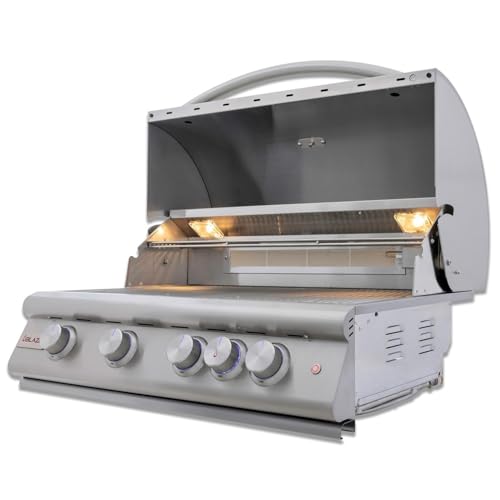
Outdoor kitchens need a different product: a grill head built to drop into an island, finished to a standard that matches stone and cabinetry, and warranted for that duty. The Blaze Premium LTE+ 32-inch is that product in this roundup — a four-burner built-in in stainless steel, with a rear infrared burner, LED-illuminated controls, interior lighting, and a lift-assist hood that makes the heavy lid a one-finger operation.
Strengths
- Purpose-built for outdoor kitchen islands, with the finish and warranty posture that duty requires
- Rear infrared burner for rotisserie work, plus illuminated controls and interior lights for evening cooking
- Lift-assist hood — a small feature you appreciate every single cook
Trade-offs
- Requires an island or cart solution — it is a grill head, not a freestanding grill
- Premium outdoor-kitchen tier, and the island around it is the larger investment
- Installation involves gas line work that belongs to licensed professionals in most jurisdictions
| Size | 32-inch, 4-burner built-in per Amazon listing |
| Fuel | Propane (this configuration) |
| Key features | Rear infrared burner, LED knobs, lift-assist hood |
| Verification | ASIN confirmed, 2026-11-20 |
Blaze’s reputation in the outdoor kitchen world rests on construction and warranty confidence — the “best in class warranty” language in its listings is the brand’s calling card — and on details that matter at dusk, which is when outdoor kitchens are actually used. Interior lights and illuminated knobs sound like garnish until the first October evening cook, when they become the difference between grilling and guessing.
The rear infrared burner completes the built-in brief: a permanent outdoor kitchen should rotisserie as confidently as it sears, and radiant rear heat is the correct tool. Paired with the main burners’ zone control, the LTE+ covers the full repertoire an island is built to host.
Choose the Blaze if you are building — or already own — an outdoor kitchen and want the grill head to be a fifteen-year fixture rather than the island’s weak point. Freestanding shoppers should look to the five picks above; this one is for the built-in life.
Best for: Outdoor kitchen owners wanting a premium, long-warranty built-in grill head / Not suited for: Anyone without an island or cart plan
Check the current price on Amazon
Comparison Table
Architecture first — freestanding or built-in — then tier. Every pick here is stainless where it matters; they differ in hardware ambition and support depth.
| Pick | Badge | Key spec | Best for |
|---|---|---|---|
| Weber Genesis S-415 | Best Overall | 4 PureBlu burners, stainless grates, propane | A decade of family cooking with top support |
| Napoleon Prestige 500 RSIB | Best for Infrared Searing | Infrared side and rear burners, stainless | Searing and rotisserie enthusiasts |
| Weber Summit FS38 | Best Premium | Infrared broiler, rotisserie, smoker box | Flagship freestanding cooking |
| Broil King Crown S 440 | Best Mid-Range | 4 burners + side burner, stainless | Even heat without flagship pricing |
| Monument M410MBZ | Best Budget Stainless | 4 burners, broil zone, stainless | Stainless on a mainstream budget |
| Blaze Premium LTE+ 32 | Best Built-In | 32-inch head, rear infrared, lift-assist hood | Outdoor kitchen islands |
How to Choose an All Stainless Steel Gas Grill
First, audit the stainless honestly. Ask where it is used: lid and doors are cosmetic; firebox, burners, grates, and heat management parts are structural and thermal. Ask the grade where the maker states it — 304 is the corrosion-resistant standard you want near coasts and pools, while 430 appears on budget bodies and shows surface rust sooner in harsh climates. A magnet test tells part of the story in a showroom — 430 is magnetic, 304 generally is not — but the components list tells more. The picks in this guide were chosen because their stainless extends into the working parts, not just the showroom surfaces.
Second, size by your largest regular cook, not your largest imaginable one. Four burners and a generous primary grate cover families and most entertaining; six-burner flagships earn their footprint only if you regularly cook for crowds or want multiple distinct heat zones working at once. Measure your patio position too — a grill this permanent deserves a level, accessible home with the gas supply, cover, and tools arranged around it.
Third, decide fuel at purchase. Propane offers placement freedom; natural gas offers freedom from tanks forever, at the cost of a fixed position and a professional line installation. Most models in this guide are offered in both fuels as separate configurations — choose deliberately, because conversions are parts, labor, and warranty complications you do not need.
Fourth, weight the support ecosystem as a feature. Burners, igniters, and heat tents are consumables on a five-to-ten-year horizon. Brands that publish parts diagrams and stock components turn those events into Saturday-morning maintenance; brands that do not turn them into a new grill. At the premium tiers, you are substantially buying that ecosystem — buy it knowingly.
How to Set Up and Break In a Stainless Gas Grill
Assembly and placement deserve the same care as the purchase. Build the grill on a flat surface, check door and lid alignment before the final tightening of fasteners — panels pulled into alignment by bolts stay aligned; panels forced stay sprung — and position the finished grill on level ground with clearance from siding and overhangs per the manufacturer’s clearances. Connect the fuel and perform the leak test the manual prescribes: soapy water on every fitting, looking for bubbles, before the first ignition. This is not optional theater; it is the step that makes the first cook boring, as it should be.
Season the grates before food ever touches them. Run the grill at a moderate-high heat to burn off manufacturing residues — expect some smoke and odor on this first burn — let it cool enough to handle safely, then wipe the grates with a thin film of high-heat oil on a folded paper towel held in tongs. Repeat the heat-and-oil cycle once or twice. Stainless grates do not season like cast iron, but the initial oil film and heat cycling settle the surface and make the first real cooks release more kindly.
The first cooks should be forgiving ones: burgers, sausages, chicken pieces — foods that teach you the grill’s hot spots without punishing the lesson. Map those zones deliberately by toasting a grid of plain bread slices and noting the browning pattern; every grill has a personality, and a bread test reveals it in four minutes. Record your findings mentally, adjust your placement habits accordingly, and your expensive grill will cook like you have owned it for years by the end of its first weekend.
Finally, establish the cover habit from day one. Stainless resists weather; it does not repeal it. A fitted cover, used whenever the grill is cool and idle, is the cheapest longevity insurance in this entire guide — it keeps water out of seams, pollen and sap off the finish, and the ignition system dry. The best time to buy the cover is with the grill.
Stainless Steel Grades and Care: Keeping the Finish
Because this category is bought for appearance as much as endurance, care deserves specifics. Stainless steel resists rust through a chromium oxide layer that heals itself in air — but chlorides (salt air, pool chemicals, some cleaners) and embedded iron particles from steel wool or carbon-steel brushes can breach it, producing the tea-staining and rust spots that panic new owners of coastal grills. The spots are usually surface contamination, not structural failure: a paste of baking soda or a dedicated stainless cleaner, rubbed with the grain using a non-metallic pad, removes most of them.
Brush choice matters for the same reason. Use brass or nylon grill brushes, or coiled stainless brushes designed to be bristle-free, rather than cheap carbon-steel bristle brushes whose shed bristles are both a contamination source and a genuine safety hazard if one reaches food. Clean grates while warm, wipe the exterior with the grain — never across it — and avoid chlorine-based cleaners on the finish. In coastal and poolside installations, a monthly wipe-down with a stainless protectant is the difference between a grill that gleams at year five and one that freckles at year two.
Internally, the enemies are grease and moisture. Empty the grease tray before it becomes a reservoir, keep the firebox floor scraped down seasonally, and store the grill covered but ventilated — a sealed, damp microclimate under a non-breathable cover in humid weather can be worse than honest rain. Stainless rewards owners who treat it as a maintained material rather than a maintenance-free one, and the maintenance is measured in minutes per month.
Freestanding vs Built-In: The Real Cost Picture
Because this guide contains both architectures, the honest comparison belongs here. A freestanding grill’s price is close to its total price: add a cover, a tank or a gas-line connection, and perhaps assembly, and you are cooking. A built-in head’s price is the beginning of its project’s price — the island structure, countertop, access doors, ventilation, and gas and electrical work typically multiply the grill’s cost several times over before the first burger. That is not an argument against built-ins; a well-built outdoor kitchen is a genuine extension of the home and is used like one. It is an argument for entering the project with open eyes and a total budget, rather than falling in love with a grill head and discovering the island’s arithmetic later.
The lifestyle question follows the money. Freestanding grills move — to a new patio arrangement, a new house, a sunnier corner — and their ownership is forgiving of changing plans. Built-ins are a commitment to a place and a layout, rewarded with permanence, workspace, and the social gravity of a true outdoor room. Households that entertain outdoors weekly for years recoup the commitment; households in transition rarely do. The Blaze in this guide is the right product for the committed project, and the five freestanding picks exist for everyone whose plans are still allowed to change.
One middle path deserves mention: several premium heads can start life on a manufacturer’s cart and migrate into an island later. If your five-year plan includes an outdoor kitchen but this year’s budget does not, ask whether your chosen grill family offers that migration before you buy — it is the rare case where a grill purchase can be staged rather than repeated.
Cooking on Stainless Grates: Technique Notes
Stainless steel grates behave differently from cast iron, and owners switching between them should recalibrate. Stainless heats quickly and releases food cleanly when properly preheated, but it holds less thermal mass than heavy cast iron, so its sear depends more on burner power and preheat discipline. The practical protocol: preheat with the lid down until the grate is fully heat-soaked — longer than you think, typically until the thermometer stabilizes — then oil the food rather than the grate, and give proteins undisturbed contact time. Food that is moved too early sticks to any grate; on stainless it releases a moment later than cast iron users expect, and patience is rewarded with intact crusts.
Zone cooking is where these multi-burner stainless grills justify themselves. Establish a hot zone for searing and a medium or off zone for finishing and holding, and move food between them rather than fighting flare-ups in place. Fatty items benefit from a brief sear over direct heat followed by indirect finishing, which renders fat without the sustained dripping that causes fires in the firebox — and keeps the stainless interior cleaner, which your future self will appreciate at cleaning time.
Finally, temperature honesty: the lid thermometer on any grill reads the air near the lid, not the grate. Serious cooks on these machines use an instant-read for food and, when precision matters, a grate-level probe for the cooking environment. The grill provides the power and the zones; measurement, as in all good cooking, is the cook’s contribution.
Warranty and Parts: Reading the Fine Print Before You Need It
Grill warranties are written in tiers, and the tiers tell you what the manufacturer expects to wear out. Burners typically carry the longest coverage on premium grills, fireboxes next, and igniters, heat tents, and cosmetic parts the shortest. Read the actual schedule for any grill you are considering — not the headline number in the advertisement, which describes the single longest-covered component — and you will learn more about the grill’s expected life than any review can tell you. A brand confident in its burners says so in years.
Then test the parts ecosystem before you need it: find the model’s parts diagram, confirm that burners, heat tents, grates, and igniters are listed and orderable, and note whether a human support channel exists. This five-minute check, done at purchase, is the difference between a grill that gets repaired at year six and one that gets replaced. The established brands in this guide pass it easily, which is a substantial part of what their pricing buys. Keep your model and serial numbers photographed in your phone, register the warranty when the grill arrives, and file the manual where the household can find it — the unglamorous paperwork that makes premium ownership actually premium.
Common Buying Mistakes
The stainless category has its own recurring errors:
- Assuming “stainless” means stainless everywhere — check the firebox, burners, and grates, not just the lid.
- Ignoring grade in coastal or pool environments, where 430-grade exteriors stain early and often.
- Buying six burners for a household of three and a patio that resents the footprint.
- Ordering propane when the house has a natural gas stub-out — or the reverse — and discovering conversion is a project.
- Skipping the cover and the leak test, the two cheapest safety and longevity steps in the whole purchase.
- Judging by features in the store and forgetting that parts support decides year eight.
- Parking the grill tight against siding or under a low overhang, ignoring the manufacturer’s clearances — heat and grease vapor are patient, and so is the damage they do to a house’s exterior.
Buy the construction first and the features second, and a stainless gas grill becomes what it should be: the last grill you purchase for a very long time. And when you comparison-shop in a showroom, bring a magnet and a critical eye: run the magnet over panels to sense where the steel grades change, open and close every door, and lift the grates to feel their weight. Your hands will confirm in five minutes what a specification sheet can spend a page obscuring.
Final Recommendation
The Weber Genesis S-415 is the default answer for most households — stainless where it counts, even heat, and the support network that turns a decade of ownership into routine maintenance. It is also the pick least likely to be regretted by the widest range of buyers, which in a category this permanent is a genuine form of excellence: nobody ever stood at a Genesis in year six wishing they had bought something more obscure.
Enthusiasts who sear and rotisserie should choose the Napoleon Prestige 500 RSIB and its infrared hardware, and the committed patio cook building a permanent setup should step to the Weber Summit FS38 without regret.
Value seekers are well served by the Broil King Crown S 440 in the middle and the Monument M410MBZ at the accessible end, while outdoor kitchen builders should anchor their island with the Blaze Premium LTE+. Whichever you choose, buy the cover with it, leak-test the connections, and learn its hot spots with a bread test — the rituals that turn a good grill into a long one. A stainless grill is a decade-scale decision made in an afternoon; the afternoon is well spent.
Related reading on this site: Best All Stainless Steel Gas Grills; Best All Stainless Steel Grills; Best American Gas Grills; Best Aluminum Gas Grills; Best Gas Grills; Best Grills.
Frequently Asked Questions
Is 304 stainless steel worth it over 430?
Near the coast, a pool, or in humid climates, yes — 304’s corrosion resistance is materially better and shows in years, not months. Inland and under a cover, 430-bodied grills can serve well for a long time with basic care. The components matter more than the badge: stainless burners and grates benefit every owner in every climate. If a listing does not state the grade, that silence is itself information — manufacturers who use 304 in meaningful places tend to say so, while vague “stainless steel construction” language usually means stainless panels over mixed materials underneath.
Why does my stainless grill have rust spots?
Usually surface contamination — iron particles from brushes or the environment, or chloride exposure — rather than the steel itself failing. Clean with the grain using a non-metallic pad and a stainless-safe cleaner, switch to a brass or bristle-free brush, and protect the finish. Deep pitting is rarer and is a warranty conversation with the manufacturer. Prevention is mostly habit: cover the grill, wipe it down after coastal storms or pool parties when chlorinated water has splashed around, and never let wet leaves or a damp cover sit against the finish for a season — stainless forgives weather, but it keeps receipts for neglect.
How long should a stainless gas grill last?
The structure of a well-built stainless grill should serve well beyond a decade. Burners, heat tents, igniters, and grates are wear items replaced along the way — which is why parts availability is a purchase criterion, not an afterthought. Budget grills shorten the timeline mostly through parts support, not through the body. Owners who keep a simple maintenance log — dates of burner checks, igniter battery changes, and deep cleans — consistently get the longest service, because small deteriorations get caught while they are still parts orders rather than failures discovered in front of guests.
Propane or natural gas?
Propane if you value placement freedom or lack a gas line; natural gas if you have a stub-out where the grill will live and want to end tank management forever. Buy the configuration you need at purchase — the models in this guide are sold in specific fuel configurations, and converting later is costlier than choosing correctly now. Propane owners should keep a spare tank as a standing habit; the most common grilling emergency in America is an empty tank discovered with guests in the driveway, and it is entirely solved by a second tank stored upright in a ventilated spot.
Do I need a sear burner?
Only if steaks and chops are central to your grilling and you cook them often. A powerful main-burner array with heavy stainless grates sears well; infrared sear hardware sears harder and faster, and frees the main grate while doing it. Occasional steak cooks will not miss it; weekly ones will use it constantly. There is a middle habit worth learning either way: letting steaks rest at room temperature briefly before cooking, patting them completely dry, and searing over the grill’s hottest mapped zone — technique recovers a surprising share of the gap between a standard burner and a dedicated sear station.
Should I buy a built-in or freestanding grill?
Built-in only if you are committing to an outdoor kitchen island — the grill head is one line item in a larger project that includes cabinetry, counters, and gas work. Freestanding serves everyone else with more flexibility and a lower total commitment, and the flagship freestanding picks here give up little in cooking capability. If the island is a someday project, buy the freestanding grill you need today rather than a built-in head that waits in a garage for its kitchen — someday projects have a way of slipping, and a grill in a box cooks nothing.


