Disclosure: airfryerkitchensupply.com is reader-supported. When you buy through links on our site, we may earn an affiliate commission at no extra cost to you.
The best all purpose cleaner for toilets comes with a definition worth stating plainly, because it decides whether you buy the right bottle: an all-purpose cleaner is the product that handles the toilet you touch — the seat, the lid, the tank, the exterior porcelain, the base, the flush handle and the floor and wall around it — plus the sink, counter and tub while you are in the room. The inside of the bowl, especially under the rim, is the one zone where a dedicated clinging bowl gel genuinely outperforms any spray, and this guide will not pretend otherwise. What follows is the best set of all-purpose cleaners for toilet duty, verified against Amazon’s catalog data, judged on disinfection claims, surface safety, scent, format and value — together with the cleaning method that makes any of them work, because technique is half of a clean toilet. If your goal is one or two bottles that keep a whole bathroom hygienic without a cupboard of specialists, you are in the right guide.
Where to buy
All six picks are sold through Amazon, where you can check the current price on Amazon, compare sizes and multi-packs, and stock up without a special trip. We do not print fixed prices here, as cleaner pricing shifts constantly with promotions and pack sizes. Start with the confirmed options:
- Lysol All Purpose Cleaner Spray, Lemon 32 oz — Best Overall: Check the current price on Amazon
- Method All-Purpose Antibacterial Cleaner, Citron 28 fl oz — Best Antibacterial Alternative: Check the current price on Amazon
- Clorox Disinfecting Cleaner Pack, 3 × 32 fl oz — Best Value Pack: Check the current price on Amazon
- Amazon Basics All Purpose Cleaner, Lemon, 2-Pack — Best Budget: Check the current price on Amazon
- Lysol Power Foaming Bathroom Cleaner 32 oz — Best Foaming Bathroom Cleaner: Check the current price on Amazon
- Scrubbing Bubbles Foaming Bleach Bathroom Cleaner 32 oz — Best for Stains and Mildew: Check the current price on Amazon
In this guide
Quick Picks
- Best Overall — Lysol All Purpose Cleaner Spray Lemon: the benchmark disinfecting spray for toilet exteriors and every hard surface around them. Check price on Amazon
- Best Antibacterial Alternative — Method Antibacterial Citron: an antibacterial all-purpose spray with a lighter scent profile and a design-conscious bottle. Check price on Amazon
- Best Value Pack — Clorox Disinfecting Cleaner Pack: a three-bottle set covering all-purpose and bathroom duty, bleach-free, built for stocking up. Check price on Amazon
- Best Budget — Amazon Basics All Purpose Cleaner: a straightforward lemon all-purpose cleaner in a two-pack for everyday wipe-downs. Check price on Amazon
- Best Foaming — Lysol Power Foaming Bathroom Cleaner: a foam that clings to the toilet exterior, sink, tub and shower, disinfecting as it works on soap scum. Check price on Amazon
- Best for Stains — Scrubbing Bubbles Foaming Bleach: bleach-powered foam for mildew stains and soap scum around the toilet’s wider bathroom territory. Check price on Amazon
How These Picks Were Chosen
Every candidate had to be a genuine all-purpose or multi-surface bathroom cleaner — not a bowl gel wearing a generalist’s label — with its identity, size and claims confirmed in Amazon’s catalog data. We weighted disinfecting and sanitising credentials heavily, because the toilet’s exterior and seat are high-touch, high-contamination surfaces where a pleasant smell is not the same as hygiene. Surface safety came next: a toilet-room cleaner meets porcelain, enamel, chrome, plastic seats, painted wood and stone counters, and anything that etches, yellows or strips finishes was excluded. Format mattered more than shoppers expect — trigger sprays for horizontal wipe-downs, foams where cling buys dwell time on vertical porcelain — and scent was judged as a livability factor, since a cleaner you dread smelling is a cleaner you stop using. Value was assessed per usable ounce across single bottles and packs, without printing prices. Finally, we required the kind of established brand support that keeps a product’s formula and safety data sheet findable — with cleaning chemicals, the maker’s documentation is part of the product. We also spot-checked each pick against the toilet-specific failure modes shoppers actually report: seats yellowed by harsh chemistry, finishes dulled by abrasives, scents so aggressive the bottle migrates to the back of the cupboard. A cleaner that damages the fixture or exiles itself has failed this brief however strong its formula, and several famous names were cut on exactly those grounds.
The 6 Best All Purpose Cleaner for Toilets Picks

Lysol All Purpose Cleaner Spray, Lemon 32 oz — Best Overall
Lysol’s all-purpose spray is the reference product in this category, and for toilet duty it earns the top spot on the strength of one fact: the surfaces around a toilet need disinfection, not just cleaning, and this is a disinfectant cleaner formulated for exactly the kitchen-and-bathroom circuit. It cuts grease and grime on contact, handles the tank top, seat, lid, handle and exterior porcelain in a single pass, and moves on to counters, sinks and floors without a bottle change. The lemon scent is the familiar, assertive kind — it reads as “cleaned” to most noses, which matters in a guest bathroom. Use it as directed on the label, respecting the stated contact time for disinfection: a spray wiped instantly is a cleaner, while a spray left for its directed dwell is a disinfectant, and the difference is the whole point of choosing this bottle. It suits households that want one proven bottle for the toilet’s exterior and the room around it. It is not a bowl-interior product — pair it with a clinging bowl gel for under-rim duty — and bleach-free it is not the strongest stain lifter for mildew-darkened grout, where the Scrubbing Bubbles pick takes over.
Strengths
- True disinfectant cleaner, not merely a scented detergent spray.
- One bottle covers toilet exterior, seat, tank and the whole bathroom’s hard surfaces.
- Large 32 oz format and wide availability, including multi-packs.
Trade-offs
- Not formulated for the bowl interior under the rim — that remains gel territory.
- Lemon scent is assertive; scent-sensitive households may prefer the Method pick.
- Requires label dwell time to disinfect; instant wipe-offs only clean.
The professional habit this bottle rewards is sequencing. Clean the bathroom from the least contaminated surfaces to the most — mirror and counter first, then sink, then the toilet’s tank and lid, seat, and finally the base and floor around it — with the spray doing disinfecting duty at each stop and a fresh section of cloth or paper towel for the toilet itself. That order, plus dwell time, is what separates a bathroom that looks clean from one that is clean, and it costs nothing but attention. In a household with children, the seat and flush handle deserve the full directed contact time every clean; they are the two surfaces every hand in the house touches.
Best for: households wanting one proven disinfecting spray for the whole bathroom / Not suited for: bowl-interior cleaning or scent-sensitive homes
Check the current price on Amazon

Method All-Purpose Antibacterial Cleaner, Citron 28 fl oz — Best Antibacterial Alternative
Method built its reputation on cleaners people do not mind looking at or smelling, and this antibacterial all-purpose spray matters in this guide because it refuses the usual trade-off: it carries a genuine antibacterial claim — formulated to kill the overwhelming majority of household germs on hard surfaces — inside the brand’s lighter, more considered scent and ingredient profile. For toilet duty, that means the seat, lid, tank and exterior get sanitised in the same pass that cleans them, with a citron fragrance that reads as fresh rather than medicinal. The bottle and trigger are the category’s most comfortable, which sounds trivial until you are on your third bathroom. It suits scent-sensitive households, design-conscious bathrooms where the bottle lives on the counter, and anyone who has abandoned stronger-smelling disinfectants because nobody in the house will use them — the best cleaner is the one that gets used. It is a mid-sized bottle at a design-brand position, so heavy users will feel the refill rhythm sooner than with the big Lysol format.
Strengths
- Antibacterial action in a lighter, more livable scent profile.
- Comfortable bottle and trigger for whole-bathroom sessions.
- Cleans and sanitises in one step on hard, non-porous surfaces.
Trade-offs
- Smaller 28 fl oz bottle than the 32 oz workhorses.
- Design-brand pricing sits above the budget tier.
- Still a spray — the bowl’s under-rim zone needs a gel partner.
Method’s real contribution to a toilet-cleaning routine is behavioural. Bathrooms get cleaned at the frequency the products invite, and a spray that smells pleasant, sits handsomely on the counter and works in one step gets reached for weekly instead of monthly. For the toilet specifically, keep the same discipline as with any sanitiser: visible soil first with a wipe, then spray, then respect the label’s contact time on the seat and handle. Households switching from harsher chemistry for everyday maintenance — reserving bleach products for periodic stain work — will find this the easiest bottle to build the habit around.
Best for: scent-sensitive and design-conscious households / Not suited for: bulk-buy budgets or bowl-interior duty
Check the current price on Amazon

Clorox Disinfecting Cleaner Pack, 3 × 32 fl oz — Best Value Pack
Clorox’s three-bottle pack is the stock-up pick: a combination of all-purpose and bathroom disinfecting cleaners, bleach-free, sized so that a household can keep a bottle in each bathroom instead of carrying one around. That distribution is a cleaning strategy in itself — the reason toilets get neglected is usually that the cleaner lives somewhere else — and the pack format prices the convenience sensibly. The formulas handle the toilet exterior circuit and the wider bathroom, cutting dirt and grime on most hard surfaces while disinfecting as directed. Bleach-free chemistry is the right default for homes with coloured grout, stone or septic considerations, reserving bleach for targeted stain work. It suits multi-bathroom homes, families standardising on one system, and anyone who cleans on a schedule and hates mid-job bottle hunts. It is less suited to a single small bathroom, where a three-pack is storage in search of a problem, and to shoppers who specifically want bleach power, which this pack deliberately omits.
Strengths
- Three full-size bottles enable one-per-bathroom distribution.
- Bleach-free disinfecting formulas suit stone, coloured grout and septic households.
- Covers all-purpose and bathroom-specific duty in one purchase.
Trade-offs
- No bleach, so heavy mildew staining needs the Scrubbing Bubbles pick.
- Pack quantity is overkill for a single small bathroom.
- Mixed pack means checking which bottle suits which task.
The deeper logic of the pack is consistency. A household that standardises on one disinfecting system learns its dwell times, its surface limits and its scent once, then cleans every bathroom the same way — and consistent method, again, is what turns products into hygiene. Label the bottles’ stations if your household includes helpers or teenagers, keep each with its own cloth or paper supply, and the weekly bathroom round becomes a ten-minute circuit per room. For the toilet, the bathroom-specific bottle in the set earns its place on the exterior porcelain and seat, while the all-purpose bottle covers counters and floors.
Best for: multi-bathroom homes and scheduled cleaners / Not suited for: single-bathroom minimalists or bleach seekers
Check the current price on Amazon

Amazon Basics All Purpose Cleaner, Lemon, 32 fl oz 2-Pack — Best Budget
The budget pick does one job and does it without ceremony: it is a lemon-scented all-purpose cleaner in a two-pack of full-size bottles, positioned for the everyday wipe-downs that constitute most of toilet maintenance. Not every cleaning pass needs a disinfectant’s full protocol — the midweek freshen of the seat, lid and tank top, the splash marks on the base, the fingerprints on the handle — and for that rhythm, an honest, inexpensive cleaner you can use liberally beats a precious bottle you ration. Keep expectations calibrated: this is the maintenance player in the line-up, and households should pair it with a true disinfectant (the Lysol or Clorox picks) for the weekly deep clean, and with a bowl gel for the interior. It suits rentals, large households that go through cleaner quickly, and anyone building a cleaning kit from zero on a tight budget. It is not the bottle to rely on during a household illness, when disinfecting claims and dwell times stop being fine print.
Strengths
- Two full-size bottles at a budget position encourage liberal, frequent use.
- Straightforward lemon cleaner for daily and midweek maintenance.
- Simple formula suits renters and cleaning-kit starters.
Trade-offs
- Position it as a cleaner for routine soil, with a disinfectant partner for deep cleans.
- No foaming action for vertical cling.
- Basic scent and presentation — function over experience.
There is a quiet truth in cleaning economics that this pick embodies: frequency beats intensity. A toilet exterior wiped twice a week with a basic cleaner stays in a state where no heroic scrubbing is ever required, while a monthly battle with a premium product is a war against accumulated soil. The two-pack format supports that frequency — one bottle at the main bathroom, one at the ensuite — and its price position removes the hesitation to spray generously. Build the system honestly: this for the rhythm, a disinfectant for the weekly standard, a gel for the bowl, and your bathroom never reaches the state that makes people search for stronger chemicals.
Best for: frequent maintenance cleaning on a budget / Not suited for: sole-bottle disinfection duty
Check the current price on Amazon
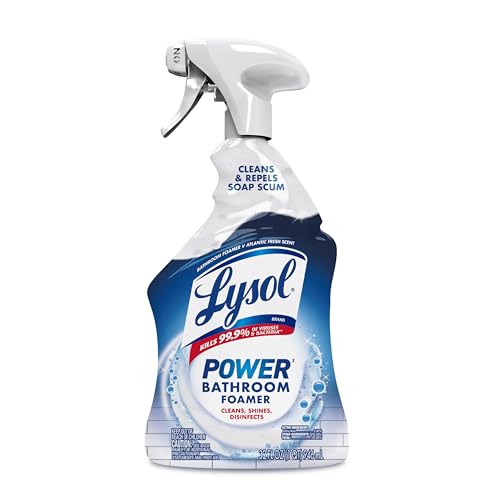
Lysol Power Foaming Bathroom Cleaner 32 oz — Best Foaming Bathroom Cleaner
Foam changes what a spray can do, and this Lysol bathroom formula is the pick for the toilet’s wider territory: a foaming, bleach-free disinfectant spray that clings to vertical porcelain, tub walls and shower surfaces instead of sheeting off, buying the dwell time that disinfection and soap-scum removal both require. Around the toilet, that cling is useful on the bowl’s exterior curves and the tank’s sides, and the same bottle then handles the sink, tub and shower — the multipurpose brief in its most literal form. It is formulated for the bathroom’s signature soils: soap scum, hard-water film and everyday grime, with a sanitising and disinfecting action when used as directed. It suits households that clean the bathroom as one room with one bottle, and anyone whose enemy is soap scum as much as germs. It is not the heavy mildew-stain weapon — that is the bleach pick below — and foam’s dwell advantage is wasted if you wipe instantly, so patience is part of the product.
Strengths
- Foam clings to vertical surfaces, extending contact time where sprays run off.
- Bleach-free disinfecting formula aimed at soap scum and bathroom soils.
- One bottle spans toilet exterior, sink, tub and shower.
Trade-offs
- Needs dwell time to deliver its advantage — spray-and-wipe wastes it.
- Not the strongest answer to established black mildew staining.
- Foam format goes through product faster on large areas.
The technique this bottle teaches is the professional’s: apply foam, leave the room, do something else, come back and wipe. On the toilet, spray the exterior and base and let the foam work while the bowl gel (its necessary partner) does its own dwell inside the bowl; the two products’ waiting periods overlap, and the whole fixture gets its full treatment in one visit. Households with hard water will particularly value the cling on the tank and bowl exterior, where mineral film builds invisibly until it dulls the porcelain. Used that way — as a system with a bowl gel, not a soloist — this is the most efficient single-bottle bathroom routine in the guide.
Best for: whole-bathroom cleaning with one foaming bottle / Not suited for: heavy mildew stains or impatient wipe-offs
Check the current price on Amazon

Scrubbing Bubbles Foaming Bleach Bathroom Cleaner 32 oz — Best for Stains and Mildew
Every bathroom eventually meets the problem the gentler picks cannot solve: mildew-darkened grout and caulk around the toilet’s floor line, soap-scum shadows on the tub, stains that laugh at bleach-free chemistry. This Scrubbing Bubbles foaming bleach cleaner is the periodic heavy weapon — a bleach-powered foam that erases mould and mildew staining and strips soap scum from tiles, grout, tubs, counters and sinks. Around the toilet, its territory is the base’s floor junction, the surrounding tile and the wider room, used occasionally and carefully rather than as a daily driver. Bleach discipline applies in full: ventilate the room, never mix with ammonia or acidic cleaners (including bowl gels — clean the bowl in a separate pass and flush before using bleach products nearby), keep it off fabrics and delicate finishes, and test coloured grout in a corner first. It suits periodic deep cleans, move-in and move-out rescues, and humid bathrooms where mildew is a standing enemy. It is not an everyday maintenance spray, and it is not for the bowl interior.
Strengths
- Bleach foam removes mildew staining and soap scum that bleach-free products cannot.
- Foam clings to grout lines, tile and vertical surfaces for working time.
- Restores the floor junction and surfaces around the toilet during deep cleans.
Trade-offs
- Bleach handling rules: ventilation, no mixing, care with fabrics and finishes.
- Periodic-use product, not a daily maintenance spray.
- Not for the bowl interior; keep bleach and acidic bowl gels in separate passes.
Used with respect, this bottle is the difference between a bathroom that is maintained and one that is periodically rescued — and most bathrooms need a rescue a few times a year, particularly at the toilet’s base where moisture, dust and mildew conspire. Work it into the grout and caulk lines with an old toothbrush after its foam dwell, rinse thoroughly, and let the room dry fully; mildew returns fastest to surfaces left damp. Then return to the gentler daily system. The mark of a well-run bathroom cupboard is that this bottle is present, rarely opened, and never mixed — literally or figuratively — with the rest of the routine.
Best for: periodic deep cleans and mildew-prone bathrooms / Not suited for: daily maintenance or the bowl interior
Check the current price on Amazon
Comparison Table
| Pick | Badge | Key spec | Best for |
|---|---|---|---|
| Lysol All Purpose Spray Lemon | Best Overall | Disinfectant spray, 32 oz | Whole-bathroom disinfection |
| Method Antibacterial Citron | Best Antibacterial Alternative | Antibacterial spray, 28 fl oz | Scent-sensitive homes |
| Clorox Disinfecting Pack | Best Value Pack | 3 × 32 fl oz, bleach-free | Multi-bathroom homes |
| Amazon Basics APC Lemon | Best Budget | All-purpose cleaner, 2 × 32 fl oz | Frequent maintenance |
| Lysol Power Foaming Bathroom | Best Foaming | Bleach-free disinfecting foam, 32 oz | Soap scum, whole room |
| Scrubbing Bubbles Foaming Bleach | Best for Stains | Bleach foam, 32 oz | Mildew and deep cleans |
How to Choose an All Purpose Cleaner for Toilet Duty
Decide first what job you are actually staffing, and be specific about which bathroom and which household the bottle has to serve, because a family bathroom with toddlers and a guest ensuite are different briefs wearing the same keyword. If the bottle must disinfect — and for the seat, handle and exterior of a family toilet, it should — choose a product with an explicit disinfecting or antibacterial claim and be willing to honour its dwell time. If the job is frequent light maintenance, a plain all-purpose cleaner used often will outperform a disinfectant used rarely, which is the budget pick’s whole argument. Match format to surface: sprays for the horizontal circuit of tank top, seat and counters; foams where vertical porcelain and tile need cling. Read the surface exclusions before the marketing — natural stone, in particular, excludes many bathroom formulas, and a cleaner that etches your marble vanity while polishing your toilet is a bad trade. Consider scent as a compliance feature: the household member who hates the smell will quietly stop cleaning. Finally, plan the partnership: no all-purpose cleaner in this guide replaces a clinging bowl gel inside the bowl, so the complete toilet kit is two products, and every pick here was chosen to be the exterior half of that pair.
How to Clean a Toilet Properly, Inside and Out
Technique turns these bottles into results, so here is the complete sequence a professional would recognise. Start by applying your bowl gel under the rim and let it dwell — its waiting time is when you do everything else. Ventilate the room and put on gloves. Work the room from clean to dirty: mirror, counter and sink first with your all-purpose spray, then the toilet’s exterior in order — tank top and lid, flush handle, seat top, seat underside and hinges, bowl exterior, and finally the base and the floor immediately around it, which collects more contamination than any surface in the room. Give the seat and handle their product’s full disinfecting dwell time before wiping; use separate cloths or paper towels for the toilet, and never carry the toilet cloth to another surface. Return to the bowl: scrub under the rim and around the water line with a bowl brush, flush, and check the rim jets’ streams for scale blockage. Dry the exterior with a clean cloth — porcelain left wet shows every mineral in your water. Wash your hands and the gloves, launder cloths hot, and store the bleach product, if you used it in a separate floor-and-grout pass, away from the bowl gel. Done weekly with the maintenance wipe-downs between, this routine keeps a toilet genuinely hygienic rather than cosmetically tidy. Time the whole circuit once and you will find it is shorter than its reputation — most of the minutes are dwell time, during which the products, not you, are working.
Cleaner Safety Rules That Are Not Optional
Cleaning chemicals are the one part of this programme where a mistake can hurt someone, so the rules get their own section, and they apply to every product mentioned anywhere in this guide without exception. Never mix bleach with ammonia or with acids — the gases produced are genuinely dangerous — which in practice means never using a bleach spray and an acidic bowl cleaner in the same pass, and always flushing and rinsing between chemistries. Ventilate small bathrooms; a running fan or open window is part of the product’s directions, not a suggestion. Wear gloves for disinfectants and bleach, both for your skin and to keep the routine honest. Keep every product in its original labelled bottle — decanting into unlabelled spray bottles is how households poison themselves — and store the cupboard’s chemicals away from children and pets. Read the dwell time and the surface exclusions on the actual bottle you bought, because formulas change and this guide’s generalities are no substitute for the label in your hand. Respect those five rules and cleaning chemistry is a safe, boring tool, which is exactly what it should be.
The Two-Product System: Why No Single Bottle Wins
Shoppers arrive at this search hoping one bottle does everything, and the honest answer shapes the whole guide: toilet cleaning is two jobs wearing one name. Job one is the interior — a wet, mineralising, bacteria-friendly bowl whose critical zone hides under the rim, where only a clinging, acidic-leaning gel can dwell long enough to dissolve scale and sanitise. Job two is the exterior and the room — dry and semi-dry hard surfaces where a spray or foam, a cloth and a disinfecting dwell do the work. A product formulated for job one is wasted and sometimes unsafe on job two’s surfaces; a product for job two physically cannot stay where job one needs it. This is not manufacturers upselling you; it is viscosity and chemistry. The economical conclusion is actually liberating: stop searching for the mythical single bottle, buy one excellent exterior cleaner from this guide and one bowl gel, and your system is complete — two bottles, every surface, no compromises. Households that internalise this stop overbuying specialists, because the pair covers the toilet, and the exterior bottle’s territory extends to the sink, tub, counter and floor as well.
Toilet Cleaning in Homes with Children and Pets
Households with small children and animals should adjust the routine in three practical ways. First, sequencing: clean when children are out of the room, ventilate well, and do not return a toddler to the bathroom until surfaces are dry and products are put away — the dwell time that disinfects is also the window to keep little hands off the seat. Second, storage: every bottle in this guide belongs in a closed or latched cupboard, in its original labelled container, never on the tank top where it doubles as an invitation. Third, product emphasis: the seat and the floor around the toilet’s base deserve the most rigorous attention in these homes, because that is where children’s hands and pets’ investigations actually go; a disinfecting pass there matters more than a sparkling mirror. Rinse pet bowls and keep animals out until floors are dry after any bleach work. None of this requires special “family” products — it requires the ordinary products in this guide, used with the label’s directions and a household routine that treats the cleaning cupboard with the same respect as the medicine cabinet.
Hard Water Film, Pink Staining and Other Things You Will Meet
Three recurring sights trouble toilet owners, and each has a correct response. Hard-water film — the dull, rough coating that creeps over porcelain and fixtures — is mineral, not dirt; all-purpose cleaners maintain against it, but established film needs the dwell of a foaming bathroom cleaner and, inside the bowl, the gel’s acidity, plus prevention in the form of drying exterior porcelain after cleaning. Pink staining in the bowl’s water line or on grout is a common airborne bacterium that thrives on moisture; it looks alarming, is generally a surface hygiene issue rather than a plumbing one, and yields to regular disinfecting cleaning — the weekly routine in this guide is the cure, and its return is a reminder the routine slipped. Black or dark staining at grout and caulk is typically mildew, and it is the bleach foam’s territory, used periodically with ventilation. Knowing which sight you are looking at prevents the classic error of escalating chemistry against a problem that wanted consistency, or wiping gently at a problem that wanted bleach.
Building the Complete Bathroom Cleaning Kit
For readers furnishing a bathroom from nothing, here is the whole kit this guide implies, in priority order. One exterior disinfecting cleaner — the Lysol spray or the Clorox pack. One clinging bowl gel for the interior. One foaming bathroom cleaner if soap scum and hard-water film are your local enemies. One bleach foam, kept for periodic stain work, if your bathroom is humid or mildew-prone. A bowl brush with a rim-cleaning profile, replaced when its bristles splay. Gloves, a stack of microfibre cloths laundered hot and separately, paper towels for the toilet’s dirtiest passes, and an old toothbrush for hinge and grout detail. That is the entire arsenal — notably shorter than the average under-sink archaeology — and every item earns its shelf by covering a job the others cannot. Maintain the kit’s discipline (original labels, latched storage, bleach never decanted) and the weekly sequence in this guide runs itself.
Spray, Foam or Wipe: Choosing a Format for the Way You Clean
The same chemistry behaves differently in different formats, and toilet duty uses all three. Trigger sprays are the generalists: fast over horizontal surfaces, economical, and precise enough for the seat-and-handle circuit — the Lysol, Method, Clorox and Amazon Basics picks all live here. Foams trade speed for dwell: the product stays where you put it on vertical porcelain and tile, working while you do something else, which is why both foaming picks earn places despite costing more per ounce. Pre-moistened wipes, the third format, are conspicuously absent from this guide’s picks, and the omission is deliberate: wipes are convenient for a quick seat pass but expensive per clean, weak on dwell, and — the point a toilet guide must make — they must never be flushed, whatever the packaging implies, because they are a leading cause of the blockages our other guides exist to prevent. A household that loves wipes should keep a bin beside the toilet and treat it as non-negotiable. For everyone else, the spray-plus-foam pairing covers the room, and the format question resolves into a rhythm question: sprays for the weekly circuit, foam for the surfaces that need time.
What “Antibacterial” and Label Claims Really Mean
Cleaning labels are regulated language, and a few translations make you a sharper buyer. When a product in this guide says it kills the overwhelming majority of household germs, that claim is registered, tested against named organisms, and conditional on the directions — surface pre-cleaned, product applied, dwell time observed. “All-purpose” describes surface range, not strength. “Bleach-free” is a compatibility feature, not a weakness: it means the formula is safe around coloured grout, many stones and fabrics in a way bleach is not. Conversely, a product with no disinfecting or antibacterial claim — our budget pick’s honest position — should be bought as a cleaner and judged on soil removal, not asked to do a disinfectant’s job during a stomach bug’s tour of the household. Reading labels this way explains the guide’s architecture: one true disinfectant for the weekly standard, honest cleaners for the rhythm between, and bleach held in reserve for the stains only it can move.
The Weekly Rhythm: Putting the Picks Into a Routine
Products become results inside a rhythm, so here is the week this guide’s picks were chosen to serve. Midweek, twice if the bathroom is busy: a maintenance pass with the budget cleaner or your main spray — seat up and down, handle, tank top, splash zone at the base, a quick wipe of the floor junction. It takes three minutes and prevents all accumulation. Weekly: the full sequence from our how-to section — bowl gel dwelling while the disinfectant works the room from clean to dirty, dwell times honoured, exterior dried. Monthly: inspect the territories that decay quietly — grout and caulk at the base, the hinge recesses, the tank’s rear edge — and give the foaming cleaner an extended session on film and soap scum. Quarterly, or when staining demands: the bleach pass on grout, caulk and tile, ventilated and unmixed, followed by a full dry. Households that adopt this rhythm discover the category’s open secret: the toilet stops being a cleaning event and becomes a cleaning habit, and the products — any of the six — simply take turns being the right tool at the right interval.
Renters, Landlords and Move-Out Cleans
Rental life gives this category a special case worth addressing directly. For tenants, the maintenance rhythm in this guide protects your deposit better than any end-of-lease heroics: bathrooms are judged at move-out on exactly the territories this guide covers — the toilet’s exterior and base, the grout at its floor line, the absence of mildew staining — and a year of weekly disinfecting passes leaves nothing for a final weekend to rescue. Keep the bleach foam away from any surface your lease makes you nervous about, test it in a hidden corner, and photograph the bathroom’s condition at both ends of the tenancy. For landlords and cleaners turning units, the Clorox pack’s one-system-many-bathrooms logic scales, the bleach foam handles the between-tenancy rescue, and standardising the kit across units means any cleaner on the team already knows the dwell times and the exclusions. One caution belongs to both sides: a toilet that smells of sewer at the base is a wax-ring failure, not a cleaning failure, and it belongs on a maintenance ticket, not in a spray bottle’s job description.
Common Buying Mistakes
The first mistake is expecting an all-purpose spray to do the bowl’s under-rim job and concluding the product failed; buy the gel partner. A companion error is the reverse snobbery — assuming a dedicated product must exist for every surface, and filling the cupboard with near-duplicates while the two bottles that matter run out. The second is ignoring dwell time — disinfectant wiped off instantly is just detergent with ambitions. The third is mixing products in one pass, especially bleach with anything acidic or ammoniated. The fourth is using a bathroom formula on natural stone or other excluded surfaces without reading the label. The fifth is buying the strongest chemistry for daily use, when frequency with a milder cleaner is both safer and more effective. The sixth is decanting products into unlabelled bottles. Avoid those, and any pick in this guide will serve you well.
Final Recommendation
For most households, the Lysol All Purpose Cleaner Spray is the bottle to build the routine on: proven disinfection for the toilet’s exterior and the whole room. Add the bowl gel partner, honour the dwell times, keep the bleach unmixed and in reserve, and the system described in this guide will keep any bathroom genuinely clean with two or three bottles instead of a cupboard of regrets. Scent-sensitive homes should start with the Method Antibacterial, multi-bathroom homes with the Clorox pack, budget maintainers with the Amazon Basics two-pack, soap-scum fighters with the Lysol foaming bathroom cleaner, and everyone should keep the Scrubbing Bubbles bleach foam for periodic rescues. For the fixtures themselves, continue with Best Affordable Toilets, Best Affordable Toilets No Clog, Best 1 Piece Toilets and Best Alternative Toilets.
Frequently Asked Questions
Can I use an all-purpose cleaner inside the toilet bowl?
You can wipe the bowl’s upper interior with it, but sprays cannot cling under the rim where the worst build-up forms, and they are not formulated for that zone. A clinging bowl gel is the right tool inside the bowl; the all-purpose cleaner owns everything outside it. The two together are the complete system.
What is the difference between cleaning, sanitising and disinfecting?
Cleaning removes soil. Sanitising reduces bacteria to levels considered safe. Disinfecting kills the organisms named on the label — the strongest claim, and the one that requires the stated dwell time on a pre-cleaned surface. For a toilet’s seat and handle, disinfecting is the appropriate standard for a weekly clean.
How often should I clean a toilet’s exterior?
A full disinfecting clean weekly suits most households, with quick maintenance wipes of the seat, handle and base between — daily in a busy family bathroom during illness. Frequency with a mild cleaner beats intensity with a harsh one, in results and in safety.
Are these cleaners safe for septic systems?
Normal household use of the bleach-free picks is generally compatible with septic systems; bleach products should be used sparingly and occasionally rather than as a daily habit, since heavy chlorine loads can disturb the tank’s bacterial balance. When in doubt, the label’s directions and your septic service’s guidance govern.
Can I use these sprays on a plastic or wooden toilet seat?
All-purpose sprays are generally suitable for plastic seats; for painted or wooden seats, check the product label and avoid prolonged soaking or bleach, which can lift finishes. When in doubt, spray the cloth rather than the seat, wipe, and dry — the method protects delicate finishes while still cleaning them.
Why does my toilet base smell even after cleaning?
Usually the wax seal beneath the toilet is failing, letting sewer gas and moisture escape at the floor line — no surface cleaner can fix a seal. If the smell persists after thorough cleaning of the base and floor junction, have the toilet lifted and the ring replaced; it is a small job that ends a problem chemicals only mask.
Should I keep a separate cleaner just for the toilet?
Keep a separate bowl gel for the interior, yes — that division is functional, not marketing. For the exterior, no: the all-purpose cleaners in this guide are formulated for exactly the toilet’s exterior surfaces and the room around them, and a dedicated “toilet exterior” product would duplicate what you already own.


