Disclosure: airfryerkitchensupply.com is reader-supported. When you buy through links on our site, we may earn an affiliate commission at no extra cost to you.
Where to buy
Home cooks shopping for the best air fryers for vegetables will find every pick in this guide on Amazon. Vegetable cooking is the purest test of an air fryer: produce enters wet, varies wildly in density, and rewards airflow, floor area and honest temperature control while punishing crowding instantly. Every pick below was chosen for how it roasts, crisps and caramelizes vegetables specifically, and all are sold on Amazon, where you can confirm basket size and shape before buying.
The six machines in this guide are: Ninja AF181 Air Fryer XL MaxCrisp 6.5 Qt, Ninja Crispi FN101GY Glass Air Fryer 4 Qt, Philips Premium Airfryer XXL HD9650/96, Gourmia Air Fryer 8 Qt 12 Presets, Chefman 8 Qt TurboFry Air Fryer, Instant Pot Vortex 5.7QT Air Fryer 4-in-1. Check the current price on Amazon for the model you choose, and check price on Amazon again before ordering if you are comparing configurations, because capacities, included accessories and finishes vary by listing.
Introduction: Where Vegetables Meet Hot Air
Choosing the best air fryers for vegetables is really choosing an airflow system for produce. Vegetables are mostly water, and an air fryer’s job is to remove surface water fast enough that the outside caramelizes before the inside turns to mush. That demands a wide single layer, strong fan power, and enough heat recovery to survive a basket full of zucchini releasing its moisture all at once. Machines that excel at frozen snacks can fail completely at a tray of fresh Brussels sprouts.
Density range is the second challenge. A vegetable dinner might combine potato wedges that need twenty-five minutes with green beans that need eight. The best vegetable machines help you manage that spread — with floor area to cook in stages in one load, dual baskets to run two densities in parallel, or simple honest controls that make staggered additions easy. Capacity claims in quarts matter less than the shape of the layer the basket actually holds.
Every pick here was verified by brand and model. We print no prices and no star ratings. Instead, each machine is matched to the vegetable cooking it does best — glass-basket visibility for delicate produce, dual baskets for mixed-density dinners, maximum wattage for full trays — so you can choose by how you actually cook vegetables.
In this guide
Quick Picks
Best Overall for Vegetables — Ninja AF181 Air Fryer XL MaxCrisp 6.5 Qt: 6.5 quarts, 1750 watts and a 450-degree Max Crisp ceiling: the widest, strongest single basket here for full trays of produce. Check the current price on Amazon.
Best for Watching Produce Cook — Ninja Crispi FN101GY Glass Air Fryer 4 Qt: PFAS-free glassware you can watch: a 4-quart and a 6-cup glass container that let you see vegetables brown without opening the basket. Check the current price on Amazon.
Best for Even Browning — Philips Premium Airfryer XXL HD9650/96: A 7-quart family basket with Rapid Air circulation and keep-warm mode, from the company that invented the category — even browning is its signature. Check the current price on Amazon.
Best Large-Capacity Value — Gourmia Air Fryer 8 Qt 12 Presets: Eight quarts and twelve presets with a 90-degree low end: sheet-pan quantities of vegetables at a value tier. Check the current price on Amazon.
Best for Frozen Vegetables — Chefman 8 Qt TurboFry Air Fryer: An eight-quart basket with a dedicated Frozen function and a 450-degree Hi-Fry finish — frozen vegetables emerge crisp, not soggy. Check the current price on Amazon.
Best Mid-Size All-Rounder — Instant Pot Vortex 5.7QT Air Fryer 4-in-1: EvenCrisp circulation and customizable programs in a 5.7-quart basket: balanced, guided vegetable roasting without the flagship size. Check the current price on Amazon.
How These Picks Were Chosen
We judged these machines on vegetable outcomes, in this order. First, single-layer floor area and basket shape, because caramelization happens at surfaces with air access. Second, heat recovery under wet loads, which tracks wattage and fan strength. Third, temperature control at both ends: high heat for charring peppers and crisping potatoes, gentle heat for drying herbs and slow-roasting garlic. Fourth, visibility and guidance — windows, shake reminders and presets that help a cook catch the narrow window between caramelized and burnt.
We excluded deep, narrow baskets that force produce into a pile, and any model we could not verify. Frozen-snack performance was treated as a bonus, never the criterion. Each review gives three strengths and three trade-offs, and the trade-offs are real: glass baskets need gentler handling, dual baskets split floor area, and the most powerful machines are the largest things on your counter.
The 6 Best Air Fryers for Vegetables

1. Ninja AF181 Air Fryer XL MaxCrisp 6.5 Qt — Best Overall for Vegetables
The Ninja AF181 takes the top spot for vegetables on the strength of the three specs produce cares about: the verified listing confirms 6.5 quarts, 1750 watts and a 450-degree maximum with Max Crisp, across six functions including dehydrate. That is the largest single-layer area in this guide backed by the joint-strongest power, which means a full tray of potato wedges, cauliflower florets or carrot batons crisps as one batch instead of steaming in shifts.
Strengths
- Largest single basket here at 6.5 quarts — whole trays of vegetables in one true single layer
- 1750W plus 450°F Max Crisp delivers charred edges on peppers, sprouts and potatoes
- Dehydrate included for herbs, tomatoes and vegetable chips at the gentle end
Trade-offs
- Big footprint; this is an oven-replacement appliance that needs oven-level counter space
- Max Crisp enthusiasm can scorch sugary vegetables like sweet potato if times are not watched
- Premium-tier machine, more than a side-dish-only household needs
| Specification | Detail |
|---|---|
| Capacity | 6.5 Qt |
| Functions | 6-in-1 including Max Crisp and dehydrate |
| Power | 1750W |
| Max temperature | 450°F |
| Cleanup | Dishwasher-safe |
Vegetable volume is where lesser machines quietly fail, and the AF181’s size-plus-power combination is the direct answer. A family tray of vegetables releases a lot of water in the first five minutes; a 1750-watt element with a strong fan keeps the basket air dry and hot through that phase, so surfaces move from steaming to roasting to caramelizing. In a weaker machine the same tray stews in its own juice and emerges soft and pale.
The dehydrate function rounds out the vegetable brief at the other extreme: slow-dried tomatoes, herb batches and zucchini chips run at gentle temperatures while the Max Crisp end handles the hard roasting. If vegetables are the center of your cooking rather than a side, this is the machine that treats them that way.
Best for: vegetable-centered households roasting full trays several times a week / Not suited for: small kitchens or cooks who only crisp the occasional side dish
Check on Amazon — check the current price on Amazon before you buy.

2. Ninja Crispi FN101GY Glass Air Fryer 4 Qt — Best for Watching Produce Cook
The Ninja Crispi answers the vegetable cook’s oldest frustration — not being able to see the food — with glass. The verified listing confirms a 4-in-1 system built around PFAS-free glassware in two sizes, a 4-quart and a 6-cup container, with a 450-degree maximum. Vegetables are the most visual food in an air fryer: the line between caramelized and burnt is a color, and the Crispi lets you watch that color develop instead of guessing through a closed drawer.
Strengths
- Glass containers eliminate blind cooking — watch browning on delicate vegetables in real time
- PFAS-free glassware suits cooks avoiding coated baskets entirely
- Two container sizes match the cook: 6-cup for a side, 4-quart for a full vegetable main
Trade-offs
- Glass needs gentler handling and no thermal-shock abuse; it is not a toss-in-the-sink basket
- Four functions is a lean menu — no dehydrate for herb and tomato drying
- 4-quart maximum caps batch size below the big tray roasters in this guide
| Specification | Detail |
|---|---|
| Capacity | 4 Qt and 6 Cup glassware |
| Functions | 4-in-1: max crisp, bake, air fry, recrisp |
| Max temperature | 450°F |
| Material | PFAS-free glass |
Visibility changes vegetable outcomes more than any preset. Asparagus, green beans, broccolini and peppers all pass through a short perfect window; in a closed basket you discover it by opening, losing heat each time. Through glass, the cook watches the edges color and pulls the container at the right moment, which is why delicate and high-sugar vegetables — the ones that punish guessing — cook better here than anywhere else in this guide.
The two-container system is quietly practical for vegetables: the 6-cup glass is a single side dish — a portion of green beans, a small tray of mushrooms — while the 4-quart handles the main event. Glass also stores and reheats gracefully, so a roasted vegetable batch can travel from fryer to table to fridge in the same vessel. Handle it like the bakeware it is, and it rewards you for years.
Best for: visual cooks, delicate-vegetable lovers and anyone avoiding coated baskets / Not suited for: high-volume tray roasters or dehydrating enthusiasts who need bigger, tougher baskets
Check on Amazon — check the current price on Amazon before you buy.

3. Philips Premium Airfryer XXL HD9650/96 — Best for Even Browning
Philips invented the air fryer, and the Premium Airfryer XXL shows the maturity that comes with it. The verified listing confirms a 3-pound, 7-quart family capacity, Rapid Air technology, five cooking presets, a keep-warm mode and app support. For vegetables, the headline is evenness: the star-shaped basket base that made Philips famous circulates air under the food, browning the underside of potato wedges and root vegetables that sit pale in lesser baskets.
Strengths
- Rapid Air circulation browns vegetables evenly, including the undersides other baskets leave pale
- 7-quart, 3 lb capacity handles the largest vegetable trays in this guide
- Keep Warm mode holds finished vegetables while the rest of dinner catches up
Trade-offs
- Fat Removal positioning is aimed at meats; vegetable cooks are paying for engineering, not that feature
- Family size is the joint-largest footprint here — measure before buying
- Premium tier; side-dish-only households will not use its capacity enough to justify it
| Specification | Detail |
|---|---|
| Capacity | 3 lb / 7 qt |
| Technology | Rapid Air Technology, Fat Removal Technology |
| Presets | 5 cooking presets |
| Extras (verified listing) | Keep Warm Mode, HomeID App |
Evenness is the Philips signature and vegetables expose it ruthlessly. A tray of mixed root vegetables — parsnip, carrot, beet, potato — has four densities and four sugar contents; a basket with dead spots produces scorched beet edges beside underdone potato. The XXL’s airflow design narrows that spread better than any conventional basket here, which is why mixed-vegetable roasting is its home ground.
Keep Warm is the second vegetable-relevant feature. Vegetables are usually the first dish finished and the first to suffer while waiting; holding them warm without continued aggressive cooking keeps a roast dinner synchronized. For households whose dinners center on big shared trays of produce, the Philips is the refined, even-handed choice.
Best for: mixed-vegetable roasters who value even browning and family-size trays / Not suited for: crisp-maximalists chasing 450-degree char or cooks with limited counter space
Check on Amazon — check the current price on Amazon before you buy.

4. Gourmia Air Fryer 8 Qt 12 Presets — Best Large-Capacity Value
The Gourmia 8 Qt is the capacity-per-tier champion of this vegetable guide. The verified listing confirms an eight-quart basket, twelve presets, a 90-to-400-degree range and dishwasher-safe basket and crisper tray in a stainless finish. Eight quarts of vegetables is a sheet pan’s worth — two cauliflowers, a week’s meal-prep trays, a holiday side for a crowd — and the 90-degree floor quietly adds gentle drying for herbs.
Strengths
- Eight quarts is the largest basket here — true sheet-pan vegetable volume
- 90°F low end supports herb drying and gentle slow roasting
- Twelve presets and dishwasher-safe parts keep big-batch cooking low-effort
Trade-offs
- 400°F ceiling will not hard-char like the 450°F picks
- Very large footprint; apartment kitchens should measure twice
- Value-tier fit and finish trail the premium brands over years of use
| Specification | Detail |
|---|---|
| Capacity | 8 Qt |
| Presets | 12 presets |
| Temperature range | 90–400°F |
| Cleanup | Dishwasher-safe basket & crisper tray |
| Finish | Stainless steel |
Meal-prep vegetable cooking is a volume business, and volume is what the Gourmia sells. Roasting four days of grain-bowl vegetables in one or two loads instead of four changes Sunday prep from a project into a task. The wide basket keeps those loads closer to a single layer than a deep six-quart design would, which protects the caramelization that makes prepped vegetables worth eating on day three.
Be honest about the ceiling: at 400 degrees, potatoes crisp well and peppers soften beautifully, but the hard char of a 450-degree Max Crisp machine is out of reach. Vegetable cooks whose style is roasted-and-tender rather than charred-and-crisp will not miss it, and they gain the largest, easiest-cleaning basket in the guide for the trade.
Best for: meal preppers and families roasting vegetables in sheet-pan quantities / Not suited for: char-seekers who judge vegetables by blackened edges and blistered skins
Check on Amazon — check the current price on Amazon before you buy.
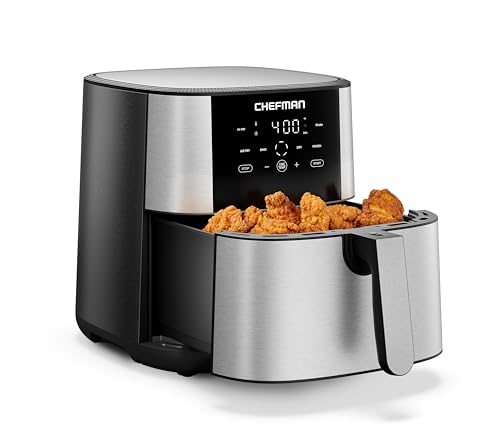
5. Chefman 8 Qt TurboFry Air Fryer — Best for Frozen Vegetables
Frozen vegetables are the weeknight reality in most homes, and they are an air fryer trap: ice crystals melt into surface water that steams the batch. The Chefman TurboFry 8 Qt is built for exactly that problem. The verified listing confirms a dedicated Frozen function among its four modes, a 450-degree Hi-Fry option for crispier results, dehydrate, and an XL nonstick dishwasher-safe basket. It is the frozen-vegetable specialist in this guide.
Strengths
- Dedicated Frozen function manages the ice-melt phase that ruins frozen vegetables elsewhere
- 450°F Hi-Fry finish restores crisp edges after the moisture phase
- Eight-quart XL basket plus dehydrate covers fresh trays and preservation too
Trade-offs
- Four functions is a focused menu; no roast or broil programs by name
- Hi-Fry finish needs watching on small or sugary items to avoid scorching
- Large stainless body needs real counter depth
| Specification | Detail |
|---|---|
| Capacity | 8 Qt |
| Functions | 4-in-1 including Frozen and Dehydrate |
| Max temperature | 450°F Hi-Fry option |
| Basket | XL nonstick, dishwasher-safe |
| Finish | Stainless steel |
The frozen vegetable workflow rewards a two-stage approach — drive off the melt water, then crisp — and the Chefman’s Frozen program plus Hi-Fry finish automates exactly that sequence. Frozen broccoli, green beans, corn and mixed vegetables come out with dry, browned edges instead of the boiled texture that gives frozen produce its reputation. For households whose vegetable cooking starts in the freezer most nights, that automation is the feature that matters most.
Fresh vegetables are not neglected: eight quarts roast family trays, and dehydrate handles the herb-and-chip end of the garden. The trade is menu breadth — four functions, plainly labeled — against machines with a dozen presets. If your vegetable cooking is frozen-first and volume-heavy, this is the most honest machine in the guide for it.
Best for: households whose weeknight vegetables come from the freezer, in family quantities / Not suited for: preset collectors or cooks wanting broil and proof style specialty modes
Check on Amazon — check the current price on Amazon before you buy.

6. Instant Pot Vortex 5.7QT Air Fryer 4-in-1 — Best Mid-Size All-Rounder
The Instant Vortex 5.7QT is the balanced pick: big enough for family vegetable trays, guided enough for cooks still learning produce timings. The verified listing confirms four functions — crisp, roast, bake and reheat — with EvenCrisp technology, customizable programs and an app with over 100 recipes. For vegetable cooking, the customizable programs are the draw: save your Brussels sprouts setting, your potato wedge setting, your green bean setting, and weeknight produce becomes one-touch.
Strengths
- Customizable programs save exact vegetable settings for one-touch repeat roasts
- EvenCrisp circulation gives balanced browning across mixed vegetable trays
- 5.7 quarts is a family-capable size without the largest footprint here
Trade-offs
- Four functions only — no dehydrate for herbs and dried tomatoes
- No viewing window; browning checks mean opening the basket
- App recipes lean general; vegetable specialists will adapt timings to taste
| Specification | Detail |
|---|---|
| Capacity | 5.7QT |
| Functions | 4-in-1: crisp, roast, bake, reheat |
| Technology | EvenCrisp Technology |
| Programs | Custom program options |
| Extras (verified listing) | 100+ in-app recipes |
Vegetable cooking is repetition: the same five vegetables, in the same cuts, week after week. A machine that remembers how your household likes them removes the nightly guesswork that makes air-fried vegetables inconsistent. Dial in sprouts once — halved, oiled, this many minutes with a shake — save it, and the machine reproduces it while you cook the rest of dinner.
EvenCrisp circulation keeps mixed trays honest, and the roast and bake functions cover the softer end of vegetable cooking: baked potatoes with crisp skins, roasted garlic, stuffed mushrooms. It lacks dehydrate, which dedicated preservers should note, but as a daily vegetable roaster for a family kitchen it is the most set-and-forget pick here.
Best for: families who roast the same vegetables weekly and want saved, repeatable settings / Not suited for: dehydrating enthusiasts or cooks who want to watch food through glass
Check on Amazon — check the current price on Amazon before you buy.
Comparison Table
| Pick | Badge | Key spec | Best for |
|---|---|---|---|
| Ninja AF181 Air Fryer XL MaxCrisp 6.5 Qt | Best Overall for Vegetables | 6.5 Qt, 1750W, 450°F Max Crisp | vegetable-centered households roasting full trays several times a week |
| Ninja Crispi FN101GY Glass Air Fryer 4 Qt | Best for Watching Produce Cook | Glass 4 Qt + 6 Cup, 450°F, PFAS-free | visual cooks, delicate-vegetable lovers and anyone avoiding coated baskets |
| Philips Premium Airfryer XXL HD9650/96 | Best for Even Browning | 7 qt, Rapid Air, Keep Warm | mixed-vegetable roasters who value even browning and family-size trays |
| Gourmia Air Fryer 8 Qt 12 Presets | Best Large-Capacity Value | 8 Qt, 12 presets, 90–400°F | meal preppers and families roasting vegetables in sheet-pan quantities |
| Chefman 8 Qt TurboFry Air Fryer | Best for Frozen Vegetables | 8 Qt, Frozen function, 450°F Hi-Fry | households whose weeknight vegetables come from the freezer, in family quantities |
| Instant Pot Vortex 5.7QT Air Fryer 4-in-1 | Best Mid-Size All-Rounder | 5.7QT, EvenCrisp, custom programs | families who roast the same vegetables weekly and want saved, repeatable settings |
The table’s key-spec column tells the vegetable story at a glance: ceiling temperature for char, capacity for tray size, and the specialist features — glass, window, frozen programming, saved programs — that map to how a household actually cooks produce. Match the specialist feature to your most common tray and the rest of the row will take care of itself.
A pattern hides in the table: the picks divide into witnesses and workers. The glass Crispi and the windowed Philips let you watch; the AF181, Gourmia and Chefman move volume; the Instant remembers your settings. Vegetable cooks tend to be one type — the watcher who judges by eye, or the prepper who judges by the tray count — and the table rewards choosing your own type honestly.
One more honest pattern from the table: price tier and vegetable happiness correlate weakly in this category. The mid rows roast a Tuesday tray of vegetables essentially as well as the flagship rows; what the top of the table buys is scale, ceiling and specialization. A household that roasts modest trays twice a week should feel entirely free to choose a middle row and spend the difference on better olive oil and fresher produce — the vegetables will not know, and the cook will taste where the money went.
And if two rows still tie after all of that, break the tie with your calendar: the machine whose strengths match the vegetables already on your weekly shopping list — not the ones you aspire to buy — is the machine that will be used in March exactly as it was in January. Aspiration is a poor appliance advisor; the shopping list never lies.
Cut Size Is the Real Temperature Control
Vegetables cook at the speed of their thickest piece. A tray of one-inch potato cubes and a tray of two-inch wedges are different dishes at the same temperature, and no preset can rescue mixed sizes in one load. Cut for the tray: uniform pieces, dense vegetables smaller than delicate ones when they share a basket, and wet vegetables like zucchini cut thicker than their reputation suggests, because they shrink as they dry.
Staggering is the second skill. In one basket, start potatoes and carrots, add peppers and onions midway, and finish with green beans or asparagus for the final minutes. In a dual basket the same logic runs in parallel. Every pick in this guide handles staggered cooking well; the cooks who master cut size and staggering get restaurant edges out of all of them.
Fresh vs Frozen: Two Different Vegetable Games
Fresh vegetables need surface drying and space; frozen vegetables need a moisture-management phase before crisping can start. For frozen produce, do not thaw first — the air fryer handles the melt better than a countertop does — and expect to add minutes, shake more often, and finish hot. The Chefman’s dedicated Frozen function automates this; in other machines, a moderate start followed by a high-heat finish reproduces it manually.
Seasoning timing differs too. Fresh vegetables take oil and salt before cooking. Frozen vegetables should be seasoned after the melt phase, when surfaces are dry enough for oil and spices to adhere instead of sliding off in a puddle at the basket’s base.
A Vegetable-by-Vegetable Field Guide to Air Fryer Timing Logic
Root vegetables — potatoes, carrots, beets, parsnips — want the longest cooks and reward a head start; cut them smallest and start them first. Brassicas — broccoli, cauliflower, Brussels sprouts — want high heat and dry surfaces, and they telegraph doneness through their edges: when the floret tips darken, they are done, whatever the timer says. Fruiting vegetables — peppers, zucchini, eggplant — carry the most water and need the most space; zucchini in particular should be salted and rested to draw water out before it meets hot air, or it will stew in any basket ever made.
Alliums and aromatics split by form: onion wedges roast sweet and soft in a moderate cook, while garlic confit-style wants gentle heat and patience. Leafy items — kale above all — are a low-heat, watch-closely specialty where glass and window models earn their keep, because kale passes from crisp to scorched in under a minute. Learning each family’s logic matters more than memorizing minutes, because cut size and load change the minutes every single time.
Seasoning Architecture: Before, During and After the Basket
Oil and salt belong before cooking — oil for heat transfer and browning, salt for seasoning that penetrates. Dry spice blends belong before cooking only if they contain no sugar and no delicate herbs; sugary rubs burn at air fryer temperatures and fresh herbs blacken into bitterness. The professional pattern for vegetables is a simple base before — oil, salt, pepper, garlic powder — and the character after: fresh herbs, citrus zest and juice, chili crisp, grated cheese or a tahini drizzle applied to hot vegetables at the table, where their aromatics survive.
Acid deserves special emphasis because air frying concentrates flavors and dries surfaces. A squeeze of lemon or a splash of vinegar over hot roasted vegetables restores the brightness the process removes, and it is the step that separates good home trays from the ones people describe as tasting like a restaurant’s. Build the habit: base before, character after, acid at the end.
The Garden Glut: When Vegetables Arrive Faster Than Dinners
Every vegetable cook meets the glut: the garden’s zucchini week, the farmers market bag that outran the meal plan, the beet bunch bought with more optimism than appetite. Air fryers answer the glut in two modes. Roasting concentrates surplus vegetables into freezer-friendly trays — roasted peppers, tomatoes and onions freeze as ready-made sauce bases — while dehydrating converts the truly perishable surplus into shelf-stable chips, dried tomatoes and herb stores. The picks with genuine low-temperature range turn a glut from a guilt problem into a pantry asset.
Batch rhythm matters here: work in family order, roasting the densest surplus first while the machine is fresh, and run the dehydrate load last, unattended, overnight if your machine and judgment allow. Label everything with the date — glut produce all looks identical by November. A vegetable household with a capable air fryer wastes measurably less food, and that quiet saving, compounded over seasons, is one of the strongest unadvertised arguments in this entire guide.
Storage, Reheating and the Second Life of Roasted Vegetables
Roasted vegetables are a meal-prep asset only if their second life is planned. Store them in shallow containers so they cool quickly and do not steam themselves soft in a deep pile, and keep sauced and unsauced batches separate — sauce is a serving decision, not a storage one. In the fridge, a well-roasted tray holds its character for three to four days, migrating through grain bowls, frittatas, sandwiches and soups in that order of freshness demand.
Reheating is where the air fryer defends its title a second time. A short, hot run restores edges that a microwave permanently surrenders — roasted potatoes re-crisp, sprouts regain their leaves’ shatter, peppers slump only slightly. Reheat in a single layer at a high setting for a few minutes, and season after, since reheating concentrates salt. Frozen roasted vegetables, stored from a glut batch, reheat from frozen with a few added minutes and the frozen-vegetable technique from earlier in this guide.
The cook who roasts with the second life in mind cuts differently — slightly larger pieces that survive two heatings, seasoning kept simple so the leftovers can travel between cuisines. That small foresight is what turns a vegetable air fryer from a side-dish appliance into the backbone of a household’s weekly cooking, and it is available from every pick in this guide, at every tier.
A Word on Oil, Smoke and Your Kitchen’s Air
Vegetable roasting at high heat produces less smoke than meat cooking — there is no rendering fat — but sugary vegetables and old oil residue can still haze a small kitchen. Fresh oil applied thinly smokes less than oil that has already been heated twice on a dirty basket, which is one more reason the wash-while-warm habit matters for vegetable cooks specifically. Position the machine so its vent does not fire directly at a smoke alarm, a mistake every renter makes exactly once.
Oil choice follows temperature: at the 450-degree end of these picks, use an oil comfortable at high heat, and apply it to the vegetables rather than the basket so none pools and smokes in the corners. The result is cleaner air, cleaner flavor and a basket that stays easy to wash — three small mercies that compound across the hundreds of trays a vegetable household roasts each year.
Frozen Vegetable Rescue: From Soggy Reputation to Weeknight Asset
Frozen vegetables carry an unfair reputation earned in microwaves and boiling water. In a capable air fryer their story reverses: the same ice that ruins them in a pan becomes a brief steaming phase the machine manages, after which the surfaces dry and brown like fresh produce. Broccoli florets develop the charred tips fresh broccoli gets, green beans blister, corn kernels caramelize at their edges, and mixed vegetables stop tasting like a compromise and start tasting like a plan.
The rescue technique is patience in the first phase: do not shake too early, when the melt water is still pooling, and do not season until surfaces look dry. Give the batch its minutes, then shake, season and finish hot. Households that master this sequence quietly stop apologizing for frozen vegetables — and since frozen produce is picked ripe, nutritionally sound and always in the freezer, that mastery is worth more weeknight dinners than any other skill in this guide.
How to Choose the Best Air Fryers for Vegetables
Judge the layer, not the liter
Vegetables caramelize at surfaces exposed to moving air. A wide six-quart basket outperforms a deep eight-quart one for a single tray, while dual baskets win when two densities cook together. Picture your most common tray of produce and choose the basket that holds it in one layer with gaps.
Power is moisture management
A full tray of fresh vegetables releases serious water in the first minutes. Wattage and fan strength decide whether that water leaves as steam or settles as a simmer. For tray-heavy cooking, favor the stronger machines in this guide; for a side dish twice a week, any pick here suffices.
Visibility and guidance prevent the burn window
Vegetables pass from caramelized to burnt faster than proteins. Glass baskets, windows, shake reminders and saved programs all exist to catch that window. Cooks who roast delicate or sugary vegetables often should weight visibility as heavily as capacity.
Fresh herbs, dried tomatoes and the preserving question
If your vegetable cooking includes preserving — drying a tomato glut, saving herbs, making vegetable chips for lunches — put dehydrate on your must-have list and choose among the AF181, Gourmia or Instant-class picks accordingly. If your vegetables are cooked and eaten the same day, dehydrate is a bonus you may never open, and visibility or floor area should take its place in your decision.
What about leafy greens and delicate herbs?
Leafy items are the specialist corner of vegetable air frying: kale chips succeed at low heat with constant attention, while fresh herbs belong to the dehydrate function rather than any roasting mode. Delicate items punish absence — this is where glass and window models, and the shake-and-check habit, earn their place. If greens and herbs are central to your cooking, weight visibility in your choice as heavily as capacity.
What about roasting a whole chicken’s worth of vegetables for a crowd?
Holiday and gathering trays exceed every home basket eventually, and the honest answer is hybrid cooking: the air fryer handles the vegetables that most reward it — sprouts, carrots, potatoes in their crisped glory — in successive batches held warm, while the oven’s sheet pan carries the bulk items that merely need roasting. Dividing by what each appliance does best produces a better table than forcing either to do everything, and the big-basket picks here minimize how often the split is needed at all.
A closing practical note before you decide
Before ordering, walk your most-cooked vegetable tray through the finalist’s basket in your imagination, piece by piece: does it lie flat, does it breathe, does the densest item have its head start? That thirty-second visualization catches more bad purchases than any spec comparison, because vegetable cooking is geometry before it is technology. Then commit, and spend your first month building the notebook of cues and timings for your own produce and your own cuts. The machine supplies heat and air; the notebook supplies the judgment, and together they are what a great vegetable kitchen actually runs on, season after season, glut after glut.
How to Roast Mixed Vegetables in an Air Fryer Without the Soggy Middle
Mixed vegetables fail when densities and moisture are ignored. This sequence produces caramelized edges and tender centers from a single mixed tray in any pick in this guide.
Step 1: Group by density and cut to equalize
Sort the tray into dense (potato, carrot, beet), medium (cauliflower, sprouts, peppers) and delicate (beans, asparagus, zucchini). Cut dense items smaller so their finish line matches the rest, and dry everything — especially washed greens and zucchini — before oiling.
Step 2: Oil, salt and season before the basket
Toss vegetables in a bowl with oil and salt so every surface is filmed; seasoning in the basket seasons the basket. Spread in a single layer with visible gaps. If the tray does not fit honestly, split it — two good batches beat one steamed pile.
Step 3: Stagger the additions
Start dense vegetables alone. Add medium vegetables when the dense ones have a head start equal to their extra cooking time, then add delicate items for the final stretch. Shake the basket at each addition to redistribute edges.
Step 4: Finish hot and rest briefly
Give the tray a final high-heat minute or two for edge color, then rest it for a few minutes so residual steam escapes instead of softening the crust at the table. Finish with fresh herbs, citrus or a sauce at serving, never in the basket.
Common Buying Mistakes
Washing vegetables and frying them wet
Surface water is the soggy tray’s first cause. Dry produce thoroughly after washing — a salad spinner or ten minutes on a towel — before oil ever touches it.
Cutting every vegetable the same size
Equal cuts guarantee unequal cooking across densities. Size the cut to the vegetable: dense small, delicate large, everything with its finish time in mind.
Salting frozen vegetables at the start
Salt draws moisture and, on frozen produce, joins the melt water at the basket’s base. Season frozen vegetables after the melt phase, when surfaces are dry.
Skipping the shake to save time
The shake is not optional garnish; it is how the bottom layer gets its turn at the hot air. Skipping it produces a tray that is crisp on top and steamed underneath.
Final Recommendation
If you want the shortest possible shortlist, start with these three: Ninja AF181 Air Fryer XL MaxCrisp 6.5 Qt, Ninja Crispi FN101GY Glass Air Fryer 4 Qt, Philips Premium Airfryer XXL HD9650/96. Each links to its Amazon listing, where you can check the current price on Amazon and confirm the exact configuration before deciding.
For most vegetable-centered kitchens, the Ninja AF181 is the pick: the largest strong single basket here, with the heat to caramelize full trays and dehydrate to finish the garden. Visual cooks should take the glass Ninja Crispi, even-browning purists the Philips XXL, volume preppers the Gourmia, frozen-first households the Chefman TurboFry, and repeat-routine families the customizable Instant Vortex 5.7QT.
Check the current price on Amazon for your choice, confirm the basket dimensions, and make your first cook a mixed tray using the stagger method above. The machine that caramelizes that tray will roast your vegetables all year.
Keep exploring the cluster: Best Air Fryers For Vegans Best Air Fryers For Wings Best Air Fryers For Two People Best Air Fryers For Families Best Air Fryers With Dehydrator
Frequently Asked Questions
What size air fryer is best for vegetables?
Vegetables need single-layer floor area more than raw volume. A wide 5.5-to-6.5-quart basket covers most households; families and meal preppers should look at eight-quart or dual-basket designs. Deep, narrow baskets are the ones to avoid for produce.
Why do my air-fried vegetables come out soggy?
Almost always moisture plus crowding: wet produce, a piled basket, or frozen vegetables seasoned too early. Dry fresh produce, cook in one layer with gaps, shake halfway, and season frozen vegetables after the melt phase.
Can I roast frozen vegetables in an air fryer without thawing?
Yes — cook from frozen, add a few minutes, shake more often, and finish at high heat. A dedicated frozen function, like the Chefman pick’s, automates the moisture phase; otherwise start moderate and finish hot.
Which vegetables air fry best?
Brussels sprouts, cauliflower, broccoli, potato and sweet potato wedges, carrots, peppers, green beans and chickpeas are the standouts. Delicate items like asparagus and broccolini cook beautifully but need watching — glass or window models help.
Do I need to use oil on vegetables in an air fryer?
A light film of oil is close to essential for caramelization and for seasoning to adhere. It is far less than deep frying uses. Apply it in a bowl before the basket so every surface is coated evenly.
Can an air fryer replace roasting vegetables in an oven?
For most household quantities, yes — faster, with better edges and less energy. Very large trays for crowds still belong on a sheet pan in the oven, which is why the eight-quart picks exist for the biggest home batches.