Disclosure: airfryerkitchensupply.com is reader-supported. When you buy through links on our site, we may earn an affiliate commission at no extra cost to you.
Where to buy
Every machine shortlisted for the best air fryers for family of 5 cooking is sold on Amazon, all six machines below are listed on Amazon, where the product pages carry the external dimensions and basket measurements that matter at this size. Measure your counter and your largest regular load before ordering — at family-of-five scale, a fryer that does not fit the counter or the chicken is an expensive ornament.
- Ninja DZ401 Foodi DualZone XL 10 Qt (Best Overall for Five) — check price on Amazon
- Ninja SL401 DoubleStack XL 10 Qt (Best Space-Saving Crowd Feeder) — check price on Amazon
- Philips 3000 Series Dual Basket NA351/00 9.5 Qt (Best Dual Basket for Even Cooking) — check price on Amazon
- DEIME Air Fryer 10.2 QT (Best Big Single Basket With a Window) — check price on Amazon
- Gourmia 10 Qt Dual Basket Air Fryer (Best Value Dual Basket) — check price on Amazon
- Ninja AF181 Air Fryer XL with MaxCrisp 6.5 Qt (Best Single Basket for Crisp Results) — check price on Amazon
The best air fryers for family of 5 cooking start where the family-of-four guides stop. Five people is the threshold at which the comfortable 5-to-6-quart basket begins to fail in practice: five chicken breasts crowd into a layer that steams at the contact points, a fries portion for five becomes two batches on the nights you least have time for two batches, and wings for five as a main course simply do not fit in one honest layer. The machines that serve five people well are the 8-to-10-quart class — big single baskets, dual baskets that combine into serious total capacity, and stacked designs that multiply layers without multiplying footprint. All six picks in this guide live in that class, and each was chosen for a different theory of how a five-person household actually eats.
Capacity at this size needs translating, because the numbers mislead in both directions. Ten quarts of dual basket is not ten quarts of cooking space for one food — it is two fives, which is wonderful for a main and a side and useless for a single whole chicken. Ten quarts of single basket is the opposite: one vast space that takes the bird, the traybake or the double fries load, but cooks a main and a side only in sequence. Ten quarts of stacked basket is a third idea again — multiple layers of flat food in a narrow body. The reviews below are explicit about which kind of ‘big’ each machine is, because buying the wrong kind of big is the most expensive mistake in this category.
There is also a fifth-person effect worth naming: five people rarely eat the same thing at the same time in the same amount. The fifth seat is often a teenager with a bottomless appetite, a grandparent who eats early and lightly, or a child whose food must be plain while the adults’ is spiced. Machines that can split their capacity — run one zone for the child’s portion, another for the rest — quietly solve problems that a single big basket cannot, and this guide weights that flexibility alongside raw volume.
In this guide
Quick Picks
Six verified large-format fryers for five-person households: dual baskets that sync, a stacked design that feeds a crowd from a narrow footprint, and big single baskets for whole birds and double batches.
- Best Overall for Five: Ninja DZ401 Foodi DualZone XL 10 Qt — Two 5-quart baskets with sync technology — the family-of-five dinner machine against which the rest are judged. Check the current price on Amazon.
- Best Space-Saving Crowd Feeder: Ninja SL401 DoubleStack XL 10 Qt — Stacks two cooking zones vertically, so 10 quarts of capacity stands in the footprint of a much smaller machine. Check the current price on Amazon.
- Best Dual Basket for Even Cooking: Philips 3000 Series Dual Basket NA351/00 9.5 Qt — Philips’ RapidAir in a 9.5-quart dual basket with Auto-Sync, for families who value even browning above raw size. Check the current price on Amazon.
- Best Big Single Basket With a Window: DEIME Air Fryer 10.2 QT — The largest single basket in this guide at 10.2 quarts, with a window so a five-person load can be watched, not guessed at. Check the current price on Amazon.
- Best Value Dual Basket: Gourmia 10 Qt Dual Basket Air Fryer — Ten quarts across two baskets with sync-style flexibility, positioned well below the premium dual machines. Check the current price on Amazon.
- Best Single Basket for Crisp Results: Ninja AF181 Air Fryer XL with MaxCrisp 6.5 Qt — The smallest machine here — but with 1750W and a 450°F MaxCrisp mode, it out-crisps the giants for five-person favourites. Check the current price on Amazon.
How These Picks Were Chosen
Every candidate was confirmed through Amazon’s catalogue data — exact model, total capacity, basket layout and function set verified against the listing, with unconfirmed models excluded. We then applied the five-person test: can this machine cook a main course for five in one run, in a single layer where the food demands it, without the cook resorting to stacking or a second appliance? Machines that only reached five portions by heaping were cut, however impressive their headline capacity.
Beyond capacity we scored the realities of scale. At 8 to 10 quarts, preheat times lengthen and heat recovery after opening matters more, because the thermal mass of five portions of cold food is substantial. Dishwasher-safe baskets stopped being a preference and became a requirement — nobody hand-washes a 10-quart basket nightly. Footprint was judged strictly, since these are the largest bodies in the category, and we favoured designs that spend their size on cooking space rather than on styling. Finally, each pick had to offer a distinct answer to the five-person problem, so the guide compares philosophies, not six versions of the same box.
The 6 Best Air Fryers for a Family of 5

Ninja DZ401 Foodi DualZone XL 10 Qt — Best Overall for Five
The DZ401 is the natural flagship for a family of five because its arithmetic matches the household’s arithmetic. Two independent 5-quart baskets mean a main for five in one side — five chicken thighs, five burgers — while the second side handles the fries, vegetables or the plain version for the picky eater, and Match Cook plus IQ Boost coordinate the two so everything lands together. Where the smaller DZ201 serves four by splitting an 8-quart total, the DZ401’s 10-quart total gives each side the full family-size basket, and that difference shows up every single night.
Strengths
- Two full 5 Qt baskets — a main and a side for five at once
- IQ Boost balances power between unequal loads
- Match Cook and sync finish end the staggered-dinner problem
Trade-offs
- No single item larger than one 5 Qt basket
- Wide body demands measured counter space
- Premium tier; two baskets to wash
| Capacity | 10 Qt total, two 5 Qt baskets |
| Functions | 6-in-1: air fry, roast, broil, bake, reheat, dehydrate |
| Sync features | Match Cook and IQ Boost |
IQ Boost is the feature to understand: when both baskets run, the machine can push extra power to the side that needs it, which matters when one basket holds a dense load of meat and the other a light load of vegetables that would otherwise finish at wildly different rates. The six functions per basket cover the family repertoire, and the sheer flexibility — two temperatures, two timers, one coordinated finish — absorbs the fifth-person complications described in the introduction better than any single cavity can. A teenager’s late portion can even run in one basket alone without heating the whole machine’s capacity.
The format’s limits are the familiar ones, stated plainly: neither basket takes a whole chicken or any single item wider than a 5-quart basket, the body is wide and must be measured, and two baskets mean two washing-up items after every dinner. It is also a premium-tier machine. But for the five-person household whose dinners are two components and whose schedules are chaos, this is the design that removes friction rather than adding capacity for its own sake.
Best for: families of five cooking two-component dinners with mixed schedules / Not suited for: households that cook whole chickens or single oversized items
Check on Amazon — check the current price on Amazon before you decide, since listings and included accessories change over time.

Ninja SL401 DoubleStack XL 10 Qt — Best Space-Saving Crowd Feeder
Counter space, not appetite, is the binding constraint in many five-person kitchens, and the DoubleStack XL is the only design here that attacks it directly. By stacking two cooking zones vertically instead of arranging them side by side, Ninja fits a 10-quart total capacity into a body with the counter footprint of a mid-size single basket. The listing notes it cooks four foods at once across its zones and racks, and fits a 5 lb chicken — a combination no side-by-side dual basket can offer in this width.
Strengths
- 10 Qt capacity in a narrow, stacked footprint
- Cooks up to four foods at once across zones and racks
- Fits a 5 lb chicken per the listing
Trade-offs
- Levels can brown unevenly without a halfway swap
- Layered format suits flat foods best
- Heavy body to move for deep cleaning
| Capacity | 10 Qt, stacked two-zone design |
| Functions | 6-in-1: air fry, broil, roast, bake, reheat, dehydrate |
| Load note | Cooks 4 foods at once; fits a 5 lb chicken per Amazon listing |
The stacked layout changes what a layer means. Flat foods — cutlets, fillets, fries spread on racks, vegetables — multiply across levels, so five portions of most weeknight foods cook simultaneously without the width penalty. For a galley kitchen feeding five, that is the difference between a fryer that lives on the counter and one that lives in a cupboard and dies there. The six functions mirror the rest of the Ninja line, so recipes and timings transfer from the brand’s other machines.
Layered cooking asks a little more of the cook: foods on different levels can brown at different rates, and a halfway swap of levels is a habit worth building for the most even results. Tall items remain the province of the chicken-sized main zone rather than every level. And as with all the big machines here, it is a serious body to move for cleaning. Judged on its own terms — maximum five-person capacity per centimetre of counter — nothing else in this guide competes.
Best for: space-poor kitchens feeding five people nightly / Not suited for: cooks who dislike managing multiple levels during a cook
Check on Amazon — check the current price on Amazon before you decide, since listings and included accessories change over time.
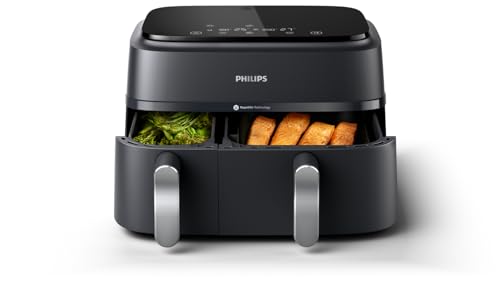
Philips 3000 Series Dual Basket NA351/00 9.5 Qt — Best Dual Basket for Even Cooking
The Philips NA351 brings the brand’s airflow expertise to the dual-basket format at 9.5 quarts total, and its argument for the family of five is quality of result rather than maximum volume. RapidAir is designed to circulate heat evenly through each basket, and in a dual machine that evenness matters twice — two different foods, two different loads, both expected to arrive properly browned at the same moment. Auto-Sync handles the arrival time, staggering the second basket’s start so both finish together without the cook doing clock arithmetic.
Strengths
- RapidAir evenness across both baskets
- Auto-Sync finishes two foods together
- Dishwasher-safe parts; refined, simple controls
Trade-offs
- 9.5 Qt total is split — no single large loads
- Premium tier
- Suits main-and-side pattern rather than two full mains
| Capacity | 9.5 Qt, dual basket |
| Technology | RapidAir |
| Sync feature | Auto-Sync finishes two foods together |
| Cleanup | Dishwasher-safe parts per Amazon listing |
Eight ways to cook keep the function list honest, and the dishwasher-safe parts acknowledge family reality. The baskets are sized for the main-and-side pattern rather than for two mains, so think of this as a five-person dinner machine for the classic plate — protein in the large basket, side in the other — rather than a device for cooking two separate family meals simultaneously. Within that pattern it is arguably the most refined option here: even browning, synchronised finish, and a brand with a long track record in exactly this airflow technology.
Buyers needing the largest possible loads should look at the 10-quart machines first, and the whole-chicken test fails here as it does for every split design. The tier is premium. What the premium buys is consistency — the fifth portion browning like the first, batch after batch — which for many families is worth more than an extra half quart they will use twice a year.
Best for: families of five who prize even, repeatable results for main-and-side dinners / Not suited for: maximum-volume cooks feeding five very large appetites at once
Check on Amazon — check the current price on Amazon before you decide, since listings and included accessories change over time.
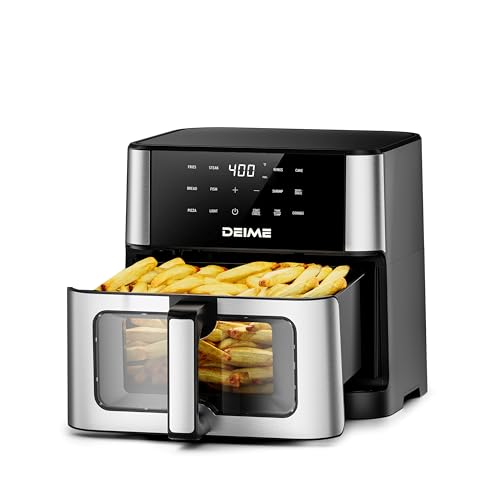
DEIME Air Fryer 10.2 QT — Best Big Single Basket With a Window
For the family whose five-person cooking is one big thing — a double batch of wings, a mountain of fries, a whole chicken with room around it — the DEIME 10.2 QT is the straightforward answer: the biggest uninterrupted basket in this guide, 1700W behind it, ten presets, and a visual cooking window. The window earns its place at this scale in particular, because opening a 10-quart basket to check a load dumps more heat and costs more recovery time than on any smaller machine; seeing through the glass keeps the heat in and the timing honest.
Strengths
- Largest single basket here — 10.2 QT of uninterrupted space
- Viewing window protects heat and timing on big loads
- 1700W and 10 presets cover family staples
Trade-offs
- Small loads cook inefficiently in the huge cavity
- Single basket — components cook in sequence
- Large in every dimension; measure first
| Capacity | 10.2 Qt |
| Power | 1700W |
| Presets | 10 |
| Extras | Visual cooking window, non-stick basket |
A single vast basket is also the most flexible format for irregular loads: the odd-shaped roasting joint, the batch of stuffed peppers, the five corn cobs that fit no dual basket’s halves. The non-stick basket handles the aftermath, and the preset list covers the family staples without forcing menu-diving on a weeknight. Silver finish aside, this is a utilitarian machine that spends its budget on space and power rather than on sync electronics.
The compromises follow from the format. One basket means main and side still sequence, and a small load in a 10-quart cavity is the least efficient cooking in this guide — the midweek snack for one will be slow and gently cooked. The body is large in every dimension. Families whose five-person meals are single-item feasts will love it; families whose meals are productions of many components should take a dual basket instead.
Best for: families of five whose dinners are one big load — wings, fries, whole birds / Not suited for: two-component dinner households or frequent solo snackers
Check on Amazon — check the current price on Amazon before you decide, since listings and included accessories change over time.

Gourmia 10 Qt Dual Basket Air Fryer — Best Value Dual Basket
The Gourmia 10 Qt Dual Basket exists for the family of five that has read the DZ401 review, nodded along, and balked at the tier. It offers the same basic architecture — two baskets, ten quarts in total, independent cooking for a main and a side — at a friendlier position, with seven presets and a wide 90–400°F range. The dishwasher-safe baskets and crisper trays keep the two-basket washing-up burden manageable, which at family-of-five usage rates is not a detail but a deciding factor.
Strengths
- Full 10 Qt dual-basket layout at a value tier
- Dishwasher-safe baskets and crisper trays
- Wide 90–400°F range covers gentle jobs too
Trade-offs
- No power-balancing sync intelligence
- Shorter preset list and utilitarian finish
- 400°F ceiling — no high-heat finish
| Capacity | 10 Qt dual basket |
| Presets | 7 |
| Temperature range | 90–400°F |
| Cleanup | Dishwasher-safe baskets and crisper trays |
What the friendlier tier gives up is refinement rather than function. The preset list is shorter, the power-balancing cleverness of the premium dual machines is absent, and the finish and controls feel more utilitarian. In exchange, the core five-person jobs all work: two components at once, a double batch split across baskets, a child’s plain portion separated from the adults’ spiced one. The wide temperature range even covers the gentle end — proofing and slow dehydrating — that the hotter-headed machines skip.
Judge it as the value route into dual-basket family cooking. If your five-person dinners are wings, fries, nuggets, roasted vegetables and reheated leftovers — which is to say, if they are like most families’ dinners — the Gourmia covers them without the premium. Cooks chasing the last degree of browning evenness or the smartest sync electronics should pay for the Ninja or Philips instead.
Best for: budget-conscious families of five wanting dual-basket flexibility / Not suited for: cooks who want the smartest sync features and hardest finish
Check on Amazon — check the current price on Amazon before you decide, since listings and included accessories change over time.

Ninja AF181 Air Fryer XL with MaxCrisp 6.5 Qt — Best Single Basket for Crisp Results
The AF181 is this guide’s deliberate counter-argument. At 6.5 quarts it is the smallest pick, and for a family of five whose fryer cooking is the crisp canon — fries, wings, nuggets, roasted potatoes — it can be the smartest buy, because what it lacks in volume it returns in violence: 1750W and a MaxCrisp mode at 450°F that browns a load faster and harder than any of the 10-quart machines. Five portions of fries in this basket, cooked in one fierce layer, will beat ten quarts of lukewarm capacity every time. The honest condition is that some five-person loads will run as a batch and a half.
Strengths
- 450°F MaxCrisp and 1750W — the hardest finish in this guide
- Fast preheat and recovery keep weeknights moving
- Leaves counter space the 10 Qt bodies consume
Trade-offs
- 6.5 Qt means some five-person loads run in two batches
- No whole chicken for five; no dual cooking
- Single basket sequencing for main plus side
| Capacity | 6.5 Qt |
| Power | 1750W |
| Max temperature | 450°F |
| Functions | 6-in-1: Max Crisp, air fry, roast, bake, reheat, dehydrate |
| Cleanup | Dishwasher-safe parts per Amazon listing |
Think of it as the quality-over-quantity pick. For the family’s most-cooked foods, results are simply better: faster preheat, faster recovery, harder finish. The six functions include dehydrate for the lunchbox economy, and dishwasher-safe parts keep it civilised. It also leaves counter room beside it — in a kitchen feeding five, the space for a second appliance or just for prep is a real benefit that the 10-quart bodies consume entirely.
The limits must be respected: a whole chicken for five is beyond it, a main and a side sequence rather than sync, and on the biggest nights — wings for five as the entire meal — you will run two batches while the first rests. Families whose five-person cooking is mostly big single productions should take the DEIME or a dual machine. Families whose cooking is the crisp canon, cooked nightly, may find this smaller, fiercer machine is the one that actually gets used.
Best for: families of five whose fryer food is the crisp canon, cooked nightly / Not suited for: households cooking whole birds or two components simultaneously
Check on Amazon — check the current price on Amazon before you decide, since listings and included accessories change over time.
Comparison Table
| Pick | Badge | Key spec | Best for |
|---|---|---|---|
| Ninja DZ401 Foodi DualZone XL 10 Qt | Best Overall for Five | 10 Qt total, two 5 Qt baskets, Match Cook and IQ Boost | Main-and-side dinners for five, synchronised |
| Ninja SL401 DoubleStack XL 10 Qt | Best Space-Saving Crowd Feeder | 10 Qt stacked two-zone, cooks 4 foods at once, fits 5 lb chicken | Feeding five from a narrow footprint |
| Philips 3000 Series Dual Basket NA351/00 9.5 Qt | Best Dual Basket for Even Cooking | 9.5 Qt dual basket, RapidAir, Auto-Sync finish | Two foods for five, browned evenly, finished together |
| DEIME Air Fryer 10.2 QT | Best Big Single Basket With a Window | 10.2 QT single basket, 1700W, 10 presets, viewing window | One huge load for five, watched through the window |
| Gourmia 10 Qt Dual Basket Air Fryer | Best Value Dual Basket | 10 Qt dual basket, 7 presets, 90–400°F | Dual-basket flexibility for five at a friendlier tier |
| Ninja AF181 Air Fryer XL with MaxCrisp 6.5 Qt | Best Single Basket for Crisp Results | 6.5 Qt, 1750W, 450°F MaxCrisp | Five-person crisp favourites in a powerful single basket |
Name your five-person dinner and the choice makes itself. Two components at once: the Ninja DZ401 on Amazon or the value Gourmia dual. One big load: the DEIME 10.2 QT listing. No counter width to spare: look at the Ninja DoubleStack XL on Amazon before anything else.
How to Choose the Best Air Fryers for Family of 5 Cooking
Decide first which kind of big you need, because the three architectures in this guide solve different problems. A big single basket (8–10+ quarts) takes whole birds, traybakes and double loads of one food, and cooks components in sequence. Dual baskets totalling 9.5–10 quarts cook a main and a side simultaneously and synchronise their finish, but cap single-item size at one basket. A stacked design multiplies flat layers in a narrow body. Write down your five most common five-person dinners and count how many need each architecture — the tally, not the marketing, should pick your machine.
Then sanity-check the capacity claim against a single layer. Five portions of almost any protein need roughly 20–25 square inches of basket floor each with air gaps; a load that only fits by stacking will steam, however many quarts the box advertises. Where a listing states a food capacity — a 5 lb chicken, a weight of fries — weight it more heavily than the volume figure. Finally, at this size, confirm the unglamorous specs: external dimensions, whether the basket fits your sink or dishwasher, and the preheat behaviour. A 10-quart machine that lives in the garage has a usable capacity of zero.
The Fifth Person Problem: Appetites, Schedules and Plain Food
Five-person households are less uniform than four-person ones. The fifth seat is disproportionately likely to be a teenager eating double, an elder eating early, or a child eating plain — and each pattern rewards split capacity. A dual basket lets the plain portion cook separately without contaminating or being contaminated, lets an early dinner run in one side while the main event waits, and lets a teenage second helping happen without reheating the whole machine. Single-basket households solve the same problems with sequencing and a small secondary appliance, which works, but the friction is nightly.
Appetite growth is the other fifth-person trap. A family of five with young children is a family of five with teenagers on a timer, and the correct purchase sizes for the household three years out. That usually means buying the top of the capacity class now — the 10-quart formats — even if today’s portions rattle slightly, because the alternative is a second purchase precisely when the grocery bill peaks.
Power, Preheat and Recovery at Family Scale
Big baskets full of cold food are thermal events. Five portions of chicken can weigh as much as a small roasting joint, and a weak element will spend the first minutes of the cook steaming that load in its own juices before browning begins. At this scale, wattage and cavity sealing stop being spec-sheet trivia: they decide whether the first batch’s timing matches the recipe’s promise. When comparing machines, treat strong wattage paired with a well-fitted basket as the practical proxy for recovery speed, and be suspicious of very large cavities paired with modest power.
Preheat discipline matters more as machines grow. A cold 10-quart cavity is a lot of air and metal to bring to temperature, and food loaded early sits in the warm-up. Build the preheat into your routine — start it when you start prepping, not when the food is ready — and prefer machines whose controls make preheating a one-touch habit. The window on the DEIME pick exists precisely because opening a big basket to check progress is the costliest interruption in this class.
Budget Tiers at the Large End
Large-format fryers spread across wide tiers, and the money buys different things at each level. The value tier — the Gourmia dual basket is its representative here — buys the architecture: two baskets, family capacity, honest presets. The mid tier buys power and finish quality, like the AF181’s MaxCrisp violence in a smaller body. The premium tier buys intelligence and evenness: power balancing between baskets, synchronised finishes, refined airflow. None of these is wasted money, but they are not interchangeable, and a family should fund the tier that matches its bottleneck — architecture, browning, or coordination.
One cost hides outside the price: counter space is a budget too. A premium dual machine that forces the kettle, toaster and knife block into exile has spent something real. Measure the counter, assign the fryer its permanent home on paper, and only then compare tiers. The best family-of-five fryer is the one that is still on the counter, plugged in, in month six.
Cleaning and Living With a 10-Quart Machine
Scale changes maintenance. A 10-quart basket is a sink-filling object; if it and its crisper tray are not dishwasher-safe, washing them nightly becomes the reason the machine falls out of use. Check dishwasher fit honestly — measure your dishwasher’s lower rack against the basket dimensions in the listing — and prefer designs whose cavity wipes clean without grease traps around the element. Families cooking fatty food for five generate more aerosolised fat per week than any other household type, and the machines that acknowledge that in their design stay pleasant longest.
Storage and movement deserve the same honesty. These bodies are heavy and awkward; a machine that must be lifted from a low cupboard twice a week will be left in the cupboard. Plan for permanent counter residence, keep the cord’s reach in mind, and leave the manufacturer’s recommended clearance behind and above the unit — big fans move big air, and a fryer suffocated against a wall cooks like it.
How to Use a Large Air Fryer to Feed a Family of Five
Feeding five from one machine is a workflow, not a recipe. This routine works across the single, dual and stacked formats in this guide.
- Start the preheat before you touch the food. Big cavities take minutes to come to temperature, and those minutes are free if they overlap with seasoning and loading prep.
- Season in a bowl, not in the basket. Five portions need even seasoning, and tossing in a large bowl coats everything without overcrowding the cooking space before the cook begins.
- Load by architecture. Single basket: the item that rests best goes first. Dual basket: the longer program starts first and the sync feature staggers the rest. Stacked: denser foods on the level nearest the element, delicate foods furthest away.
- Respect the single layer for anything that must crisp. Five portions spread across two zones or a batch and a half will always beat five portions heaped and steamed.
- Intervene once per basket at its halfway point — shake, turn or swap levels — then close and leave it. Big loads lose more heat per opening, so make each opening decisive.
- Rest proteins on a warm platter while sides finish. A five-person protein load rests beautifully in the time a final batch of fries needs, and rested meat carves and serves better.
- Serve crisp items last and directly. At family scale the temptation is to hold everything until all five plates are ready; crisp food should instead go from basket to plate in the final minute.
Keep a written card of your household’s standard loads — five burgers, wings for five, the Friday fries — with the times and settings that worked in your machine. At this scale every new load is expensive to experiment on, and the card turns the second attempt into a routine instead of another experiment.
Feeding Five on a Weeknight: Three Real Evenings
Evening one is the roast dinner that is not a roast: a whole chicken in the DEIME or the DoubleStack, with the oven — not the fryer — handling the potatoes, because five people plus a bird plus potatoes exceeds any single appliance honestly. The fryer still wins the evening: the bird cooks faster than in the oven, the skin crisps harder, and the oven is free for everything else. The lesson generalises — at family-of-five scale the fryer is a partner in a two-appliance dinner, and pretending it must do everything is how cooks end up disappointed with a machine that is doing its real job superbly.
Evening two is the split dinner: two adults eating spiced chicken, three children eating plain nuggets and fries, one grandparent eating early. In a dual basket this is a shrug — plain in one side, spiced in the other, early portion run first. In a single basket it is a sequence with two holdings and a mildly stressed cook. Neither evening is imaginary; most five-person households live some version of it weekly, and it is the strongest argument in this entire guide for split capacity.
Evening three is the snack flood: five people, a film, and a demand for wings, fries and onion rings in quantities no single basket holds at once. The correct technique is waves — cook in sequence, serve in waves, keep each finished wave on a rack in a low oven rather than in the closed fryer where it steams. Machines with fast recovery, like the AF181, shine here out of proportion to their size, because the evening is really four small cooks back to back. Plan the waves, and even the smallest pick in this guide feeds the room happily.
Across all three evenings the pattern is the same: the machine matters less than the match between its architecture and the evening’s shape. That is why this guide refuses to crown a single winner for every family of five, and why the reviews describe dinners rather than just specifications. Read them against your own last ten dinners and the right pick usually identifies itself.
One more scenario deserves naming because it decides many real purchases: the holiday overflow. At Christmas, birthdays and family gatherings, a five-person household becomes eight or ten, and the fryer turns into the oven’s relief valve — crisping the roast potatoes the main oven has no room for, reheating canapés in waves, keeping a side dish at temperature. No machine in this guide feeds ten as a main appliance, and none should be bought on that fantasy; but the large single baskets and the stacked design absorb overflow duties gracefully, and a family that hosts often should weight that secondary role when choosing between otherwise equal picks.
Common Buying Mistakes
Buying ten quarts of the wrong architecture. Dual baskets cannot take a whole chicken; a single basket cannot sync a main and a side. Match the format to your dinners before comparing capacities.
Trusting the quart number over the layer test. If five portions only fit by stacking, the machine does not feed five in one run, whatever the box says. Basket floor area is the honest measure.
Under-powering a big cavity. A large basket with a modest element steams big loads before it browns them. At this scale, wattage and recovery are primary specs, not fine print.
Forgetting the dishwasher test. A 10-quart basket that fits neither sink nor dishwasher will be washed resentfully and then not at all. Measure both before buying.
Cooking every component in the fryer because you can. The oven and hob still exist. The fryer should take the jobs it does best — crisp, fast, portioned — while bulk and wet dishes go elsewhere, or dinner becomes a queue.
Sizing for today’s children. Five young children become five teenagers, and they become them faster than the warranty expires. Buy the top of the class now or buy twice — the second purchase always lands in the most expensive grocery years of the household’s life.
Final Recommendation
For most families of five, the Ninja DZ401 is the complete answer: two genuine family-size baskets, power balancing, and a synchronised finish that dissolves the main-and-side problem nightly. The Philips NA351 is the evenness-first alternative, the Gourmia the same idea at a friendlier tier, and the DoubleStack XL the unique solution when counter width is the constraint. Single-basket households should choose between the DEIME’s vast windowed space and the AF181’s smaller, fiercer crisping — and be honest about which kind of cooking their five people actually eat.
If your household is still in the four-person band for now, Best Air Fryers For Family Of 4 covers the smaller machines in the same detail. For the foods that fill these baskets, see Best Air Fryers For Fried Chicken and Best Air Fryers For French Fries, and for the crisping principles every pick here relies on, Best Air Fryers For Crisping is the deeper read.
Frequently Asked Questions
What size air fryer does a family of five need?
Plan on 8 to 10 quarts of total capacity in a layout that matches your cooking: a single basket of 8 quarts or more for whole items and double loads, or dual baskets totalling 9.5 to 10 quarts for main-and-side dinners. Judge by whether five portions fit in a single layer, not by the headline number alone, and size for your children’s appetites a few years ahead.
Can these fryers cook a whole chicken for five people?
The big single baskets can — the DoubleStack XL lists a 5 lb chicken, and the DEIME’s 10.2-quart basket has room for a bird with air around it. Dual-basket machines cannot fit a whole chicken in either side; they would need the bird portioned first. If a whole roast chicken is a weekly ritual, choose a single or stacked format.
Is a dual basket or a single large basket better for five?
Dual baskets win when dinners are a main plus a side and when family members eat differently or at different times — the split capacity solves scheduling and plain-versus-spiced problems. A single large basket wins for whole items, traybakes and double batches of one food, and is simpler to clean. Count your last ten dinners and let the majority pattern decide.
Why does food steam instead of crisping in my large fryer?
Almost always load-related: five portions heaped or stacked trap moisture faster than the fan can remove it, and a large cavity started cold prolongs the steaming phase. Preheat fully, cook in a single layer even if it means two zones or a second quick batch, and shake once at halfway so trapped steam escapes and surfaces re-expose to the heat.
How much counter space do these machines need?
More than their footprints suggest: allow the body plus clearance behind and above for the fan’s exhaust, and permanent residence rather than cupboard storage, because a machine this size that must be lifted out will stop being used. The stacked DoubleStack XL is the exception that proves the rule — it was designed specifically to give 10-quart capacity a narrow footprint.
Are large air fryers expensive to run compared with an oven?
For family-size loads they are generally the thriftier tool: the cavity is far smaller than a full oven’s, preheats in minutes rather than tens of minutes, and cooks faster at temperature, so a five-person dinner typically uses notably less energy in the fryer than in a conventional oven heated for the same meal. The advantage shrinks if the fryer runs many consecutive batches — another reason to size it correctly in the first place.