Disclosure: airfryerkitchensupply.com is reader-supported. When you buy through links on our site, we may earn an affiliate commission at no extra cost to you.
Where to buy
Every linked pick in this guide to the best 800w microwaves was verified against Amazon’s catalog on 2026-11-21, so the model names and specifications below are the models you will actually land on. Start with Nostalgia Retro Countertop Microwave Oven 800-Watt (Ivory), GE Profile Countertop Microwave PCHK11S1WBB (Black), GE Profile Countertop Microwave PCHK11S1WSS (Stainless Steel). Any pick described without a link is flagged honestly as unlinked in our notes. Check the current price on Amazon from any pick’s link, because finishes, bundles and stock rotate often.
Finding the best 800w microwaves starts with an honesty problem: 800 watts is the forgotten middle of the microwave market, and many listings that surface for the term are 700- or 900-watt ovens in disguise. Every pick in this guide was verified as a genuine 800-watt model — that verification is the backbone of the ranking, because an 800W guide recommending 900W ovens would be no guide at all.
What survives the filter is a small, interesting field: Nostalgia’s retro line carries the class, GE’s Profile brings premium sensor automation at 800 watts, and Emerson adds a grill element nobody else here offers. The six picks below — counting finish variants of two platforms, which we flag openly — cover value, smart features, browning and style.
Key Takeaways
- Verify the wattage and capacity from the listing itself — every pick here was matched by brand and model.
- Run the dish test before buying: your largest regular plate must rotate freely.
- Power levels and standing time matter more to results than headline wattage.
- Mute, eco and child-lock features decide daily satisfaction in shared spaces.
In this guide
Quick Picks
- Best Overall: Nostalgia Retro Countertop Microwave Oven 800-Watt (Ivory) — a genuine 800W rating, 0.9 cu. ft. of plate room and 12 settings in ivory retro dress.
- Best Smart Features: GE Profile Countertop Microwave PCHK11S1WBB (Black) — sensor cooking and scan-to-cook automation in a 1.1 cu. ft. smart oven.
- Best Premium Finish: GE Profile Countertop Microwave PCHK11S1WSS (Stainless Steel) — the GE Profile platform in stainless, for built-in plans and stainless kitchens.
- Best with Grill Function: Emerson Retro Countertop Microwave Oven with Grill MWRG0901RD (Red) — an 800W oven with a real grill element for browning and crisping.
- Best White Retro with Grill: Emerson Retro Countertop Microwave Oven with Grill MWRG0901W (White) — the grill-equipped Emerson in white for bright retro kitchens.
- Best Retro in Black: Nostalgia Retro Countertop Microwave Oven 800-Watt (Black) — the Best Overall platform in the lowest-maintenance finish.
How These Picks Were Chosen
Every model in this guide was verified against Amazon’s catalog for airfryerkitchensupply.com on 2026-11-21: we searched by brand and model, matched the returned listing title word for word, and only then took the ASIN used in the links. That process matters in the microwave market because the same cabinet is often sold under several wattages and finishes, and a link that lands on the wrong variant is worse than no link at all.
Beyond verification, we ranked on the things that decide daily satisfaction: whether the stated wattage is the cooking power the listing actually claims, cavity size against the dishes a household really uses, the usefulness of the power-level range for delicate jobs, defrost behaviour, door design, and how much counter the footprint consumes. Preset counts were treated as a minor factor — a long menu of one-touch buttons nobody presses does not beat honest power control.
We also weighed ownership friction: turntables that lift out for washing, interiors that wipe clean, child locks that engage without a manual hunt, and mute or eco modes for shared living spaces. Where two models were effectively the same machine in different finishes, we kept the finish that best matched this guide’s brief and said so, rather than padding the list with duplicates.
The 6 Best 800W Microwaves

Nostalgia Retro Countertop Microwave Oven 800-Watt (Ivory) — Best Overall
True 800-watt countertop microwaves are rarer than the search results suggest — most listings that mention 800 watts turn out to be 700- or 900-watt machines. The Nostalgia retro is genuinely rated at 800 watts, pairs it with a 0.9 cu. ft. cavity and twelve pre-programmed settings, and wraps it in ivory retro styling. It suits buyers who want the middle-power step up from a compact without jumping to a full family oven.
Strengths
- A verified true 800W rating — the entire point of this guide
- 0.9 cu. ft. cavity takes full-size dinner plates the 700W class cannot
- 12 pre-programmed settings cover a wide daily rotation
Trade-offs
- Retro styling will not suit minimalist kitchens
- Ivory is a specific look — check it against your cabinets
- No sensor cooking at this level
| Capacity | 0.9 cu. ft. |
| Cooking power | 800W |
| Colour | Ivory |
| Notable features | 12 pre-programmed cooking settings, digital clock, retro styling |
The 800-watt step is more useful than it sounds. Against a 700-watt compact, the Nostalgia trims meaningful time off every reheat and handles frozen entrées closer to the pace package directions assume, while the 0.9 cu. ft. cavity removes the plate-size ceiling that frustrates compact owners. The twelve settings are sensibly spread across the jobs this oven will actually do. The retro cabinet is a matter of taste, but the ivory finish is the gentlest version of it — it reads as cream kitchenware rather than novelty appliance. Underneath the styling, this is simply the most complete true-800W package the listing-verified.
The Nostalgia’s twelve settings deserve a fair hearing: at 0.9 cu. ft. the oven is big enough for the settings to be meaningful — popcorn in a full bag, a baked potato, a plate dinner — rather than the aspirational menus printed on compact ovens. The ivory finish photographs as cream and sits comfortably in country and traditional kitchens where stainless looks industrial. Underneath, remember the core fact of this guide: the 800-watt rating is real, verified from the listing, and that honesty is rarer in this class than any feature.
Long-term ownership of the Nostalgia Retro Countertop Microwave Oven 800-Watt (Ivory) follows the class pattern: the turntable and roller ring are the wear items, the door latch is the safety item, and both are cheap exactly as long as the brand supports the model — a point this guide weighed in the ranking. Keep the vents clear, the cavity clean and the door seal wiped, and there is little else to go wrong; compact microwaves are among the most durable appliances in a kitchen when their clearances are respected.
Best for: Households stepping up from a 700W compact who want real mid-power pace and plate room / Not suited for: Buyers who want sensor cooking or smart features — see the GE Profile picks. Check on Amazon to check the current price on Amazon.

GE Profile Countertop Microwave PCHK11S1WBB (Black) — Best Smart Features
The GE Profile is the outlier of this guide: an 800-watt oven with the feature set of a premium machine — sensor cooking that judges doneness by steam, scan-to-cook that reads packaged-food barcodes, WiFi connectivity, and a 1.1 cu. ft. cavity that can also be built in with a trim kit. It suits technology-comfortable households that want automation rather than raw wattage.
Strengths
- Sensor cooking removes guesswork from reheating and vegetables
- Scan-to-cook sets time and power from packaged food barcodes
- 1.1 cu. ft. cavity is the largest in this guide
Trade-offs
- Premium positioning — this is not a budget buy
- WiFi and app features only pay off if you actually use them
- 800W pace in a big cavity means large loads still take time
| Capacity | 1.1 cu. ft. |
| Cooking power | 800W |
| Colour | Black |
| Notable features | Sensor cooking, scan-to-cook technology, WiFi connectivity, one-touch controls, child lock, built-in capable |
Sensor cooking is the feature that changes daily outcomes. Instead of guessing minutes, the GE watches humidity and stops when the food is done — leftovers reheat without dried edges, and vegetables cook without a waterlogged finish. Scan-to-cook extends the same logic to packaged meals. The trade is explicit: you are buying intelligence rather than brute power, and at 800 watts a full 1.1 cu. ft. load will never be fast. For households whose microwave work is varied reheating rather than bulk cooking, intelligence wins more often than wattage does. The built-in capability also future-proofs a kitchen refit.
Scan-to-cook sounds like a gimmick until a household eats packaged meals regularly, at which point the barcode quietly setting correct time and power — for an oven whose wattage differs from the package’s assumption — removes the commonest frozen-meal failure. The WiFi layer is optional garnish; the sensor is the substance. One practical note: the Profile is built-in capable with a trim kit, so measure for that future if a refit is planned, and keep the cabinet’s ventilation requirements in mind either way.
A year in, owners of the GE Profile Countertop Microwave PCHK11S1WBB (Black) judge it by the habits it enabled rather than the meals it cooked: whether the morning routine shortened, whether the defrost stopped being a negotiation, whether the beeping still annoys anyone. That is the correct standard for this class, and it is why the reviews above spend as much time on controls, noise and doors as on cooking power — the wattage is shared, but the daily experience is the product.
Best for: Tech-comfortable households that reheat varied foods and value automation / Not suited for: Budget buyers, and anyone who cooks large loads where raw power matters most. Check on Amazon to check the current price on Amazon.

GE Profile Countertop Microwave PCHK11S1WSS (Stainless Steel) — Best Premium Finish
This is the same GE Profile platform as the black model above, finished in stainless steel for kitchens built around that material. The case for it is identical — sensor cooking, scan-to-cook, WiFi, 1.1 cu. ft. — with the finish deciding between the two.
Strengths
- All the GE Profile automation in a stainless cabinet
- Matches stainless appliance suites and built-in trim kits
- Sensor cooking and scan-to-cook as per the black model
Trade-offs
- Stainless shows fingerprints and needs regular wiping
- Premium positioning, as with the black version
- Two near-identical picks exist only because finish matters — pick one
| Capacity | 1.1 cu. ft. |
| Cooking power | 800W |
| Colour | Stainless steel |
| Notable features | Sensor cooking, scan-to-cook technology, WiFi connectivity, one-touch controls, child lock, built-in capable |
We list the stainless Profile separately because finish is a legitimate deciding factor for an appliance that can also be built into cabinetry: a black unit in a stainless run looks like a placeholder, and vice versa. Mechanically and electronically this is the black model — the same sensor system, the same scan-to-cook library, the same 800-watt output in a 1.1 cu. ft. cavity. Choose between them purely on the kitchen it will live in. The analysis of the platform in the previous review applies in full: automation over wattage, with the pace caveat on very large loads.
For buyers torn between the two Profiles, decide with the kitchen, not the spec sheet — they are the same machine. Stainless suits a built-in installation and a stainless run of appliances; black suits a countertop in a modern scheme and hides wear better. Either way, the ownership proposition is identical: sensor-led reheating that outperforms manual timing, in the largest cavity this guide offers, at an honest 800 watts. It is the premium pick of a small class, and it knows it.
Long-term ownership of the GE Profile Countertop Microwave PCHK11S1WSS (Stainless Steel) follows the class pattern: the turntable and roller ring are the wear items, the door latch is the safety item, and both are cheap exactly as long as the brand supports the model — a point this guide weighed in the ranking. Keep the vents clear, the cavity clean and the door seal wiped, and there is little else to go wrong; compact microwaves are among the most durable appliances in a kitchen when their clearances are respected.
Best for: Stainless kitchens wanting the smartest true-800W oven available / Not suited for: Anyone for whom the black model is cheaper in the same configuration — they are the same machine. Check on Amazon to check the current price on Amazon.
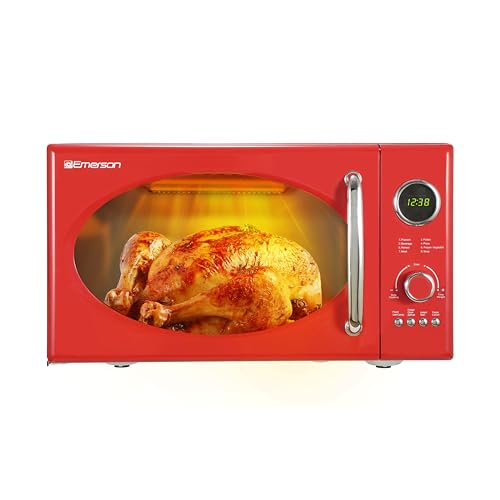
Emerson Retro Countertop Microwave Oven with Grill MWRG0901RD (Red) — Best with Grill Function
Emerson’s retro model adds the one trick no other pick here performs: a 1,000-watt grill element alongside 800-watt microwave cooking, so food can be browned and crisped after it is heated through. In red retro styling with eight auto menus, it suits small kitchens that miss having a grill and anyone reheating pizza, toasties or gratins.
Strengths
- Grill element browns and crisps — reheated pizza stops being soggy
- Combination cooking covers jobs a plain microwave cannot finish
- Retro red styling is a deliberate, cheerful accent
Trade-offs
- Only 5 power levels — the coarsest control in this guide
- Grill results are good, not oven-equal; manage expectations
- Red is the boldest possible finish choice
| Capacity | 0.9 cu. ft. |
| Cooking power | 800W cooking / 1,000W grill |
| Colour | Red |
| Notable features | Grill function, 5 power levels, 8 auto menus, LED display, glass turntable, child lock |
The grill changes the reheating conversation. Microwave-only pizza is hot and limp; microwave-then-grill pizza gets its top back. The same applies to cheese on toast, gratins and anything whose pleasure lives in a browned surface. The compromise is power-level granularity — five levels against the ten or eleven elsewhere — so delicate work like melting chocolate needs more supervision and shorter bursts. The eight auto menus and LED display keep daily use simple, and the child lock covers family duty. Buy it for the grill; accept the simpler power control as the price.
Grill technique matters with the Emerson: microwave first to heat through, grill second to brown, and give the food a minute’s stand between if it is thick — the same sequencing a combination oven in a professional kitchen would use. The red finish is unapologetic, and in a plain rental kitchen it may be the single cheerful object; in a designed kitchen it needs to be a deliberate choice. Either way, no other pick in this guide can put a browned top on a reheated lasagne, and for some households that settles the argument.
A year in, owners of the Emerson Retro Countertop Microwave Oven with Grill MWRG0901RD (Red) judge it by the habits it enabled rather than the meals it cooked: whether the morning routine shortened, whether the defrost stopped being a negotiation, whether the beeping still annoys anyone. That is the correct standard for this class, and it is why the reviews above spend as much time on controls, noise and doors as on cooking power — the wattage is shared, but the daily experience is the product.
Best for: Small kitchens without a separate grill, and devoted reheaters of pizza and toasties / Not suited for: Precision cooks who rely on fine low-power control. Check on Amazon to check the current price on Amazon.

Emerson Retro Countertop Microwave Oven with Grill MWRG0901W (White) — Best White Retro with Grill
The white version of Emerson’s grill-equipped retro oven brings the same combination cooking to bright kitchens where the red model would shout. If the grill concept appeals but the kitchen is white and calm, this is the one.
Strengths
- Grill browning in a white retro cabinet
- Combination cooking for crisped reheats
- White finish suits light, traditional kitchens
Trade-offs
- 5 power levels, as with the red model
- White shows grill splatter and needs prompt wiping
- Retro shape still will not please minimalists
| Capacity | 0.9 cu. ft. |
| Cooking power | 800W cooking / 1,000W grill |
| Colour | White |
| Notable features | Grill function, 5 power levels, 8 auto menus, LED display, glass turntable, child lock |
Everything said about the red Emerson’s cooking applies here: the grill element is a genuine functional addition, the power-level count is the genuine compromise, and the eight auto menus cover daily work. The difference is purely domestic — white retro reads as classic kitchenalia where red reads as statement. One practical note: a grill throws more splatter than microwave-only cooking, and a white interior surround shows it sooner, so the wipe-as-you-go habit matters more with this model. For a white kitchen that wants browning ability without a second appliance, it is the only pick in this guide that fits.
The white Emerson makes the strongest case for combination cooking in a traditional kitchen: nothing about the brief — white, retro, compact — suggests a machine that can also grill, which makes its party trick more useful, not less. Keep a small tray or rack routine for grill work, wipe the cavity promptly after browning fatty foods, and the oven will do a job that otherwise needs the main oven heated for a single portion — an energy argument as much as a culinary one.
Long-term ownership of the Emerson Retro Countertop Microwave Oven with Grill MWRG0901W (White) follows the class pattern: the turntable and roller ring are the wear items, the door latch is the safety item, and both are cheap exactly as long as the brand supports the model — a point this guide weighed in the ranking. Keep the vents clear, the cavity clean and the door seal wiped, and there is little else to go wrong; compact microwaves are among the most durable appliances in a kitchen when their clearances are respected.
Best for: White kitchens wanting grill capability in a compact retro oven / Not suited for: Buyers who dislike retro styling in any colour. Check on Amazon to check the current price on Amazon.

Nostalgia Retro Countertop Microwave Oven 800-Watt (Black) — Best Retro in Black
The black Nostalgia takes the guide’s Best Overall platform — true 800 watts, 0.9 cu. ft., twelve settings — and dresses it in the finish that hides daily wear best. It suits retro-curious buyers in modern black-accented kitchens who want the style without the upkeep of ivory or chrome-bright colours.
Strengths
- Same verified 800W platform as the ivory Best Overall
- Black finish hides splashes and fingerprints between cleans
- 12 settings cover the full daily rotation
Trade-offs
- Black retro can look heavy in a small, dark kitchen
- No sensor or grill extras
- Styling premium over plain-cabinet equivalents
| Capacity | 0.9 cu. ft. |
| Cooking power | 800W |
| Colour | Black |
| Notable features | 12 pre-programmed cooking settings, digital clock, retro styling |
Finish is the only decision between this and the ivory model, and it is a real one: black appliances recede in contemporary kitchens and forgive a busy week between deep cleans, while ivory brightens traditional spaces. The machine underneath is identical — the same honest 800-watt output, the same plate-friendly 0.9 cu. ft. cavity, the same twelve pre-programmed settings and digital clock. In a class where genuinely-800W models are scarce, having the same verified platform in three finishes is a luxury; choose by kitchen, not by spec sheet.
Black retro is a specific aesthetic — diner-modern — and the Nostalgia wears it well, with the practical dividend that black cabinets are the most forgiving between cleans of any finish in this guide. The platform underneath matches the ivory Best Overall exactly, so this choice costs nothing in function. If the kitchen is black-accented and the budget is mid-tier, this is the 800W oven that will look intentional rather than merely present, which for an appliance in permanent view is a legitimate form of value.
A year in, owners of the Nostalgia Retro Countertop Microwave Oven 800-Watt (Black) judge it by the habits it enabled rather than the meals it cooked: whether the morning routine shortened, whether the defrost stopped being a negotiation, whether the beeping still annoys anyone. That is the correct standard for this class, and it is why the reviews above spend as much time on controls, noise and doors as on cooking power — the wattage is shared, but the daily experience is the product.
Best for: Modern kitchens wanting retro shape with low-maintenance black finish / Not suited for: Buyers seeking sensor cooking or a grill — those are the GE and Emerson picks. Check on Amazon to check the current price on Amazon.
Comparison Table
| Pick | Badge | Key spec | Best for |
|---|---|---|---|
| Nostalgia Retro Countertop Microwave Oven 800-Watt (Ivory) | Best Overall | 800W | Households stepping up from a 700W compact who want real mid-power pace and plate room |
| GE Profile Countertop Microwave PCHK11S1WBB (Black) | Best Smart Features | 800W | Tech-comfortable households that reheat varied foods and value automation |
| GE Profile Countertop Microwave PCHK11S1WSS (Stainless Steel) | Best Premium Finish | 800W | Stainless kitchens wanting the smartest true-800W oven available |
| Emerson Retro Countertop Microwave Oven with Grill MWRG0901RD (Red) | Best with Grill Function | 800W cooking / 1,000W grill | Small kitchens without a separate grill, and devoted reheaters of pizza and toasties |
| Emerson Retro Countertop Microwave Oven with Grill MWRG0901W (White) | Best White Retro with Grill | 800W cooking / 1,000W grill | White kitchens wanting grill capability in a compact retro oven |
| Nostalgia Retro Countertop Microwave Oven 800-Watt (Black) | Best Retro in Black | 800W | Modern kitchens wanting retro shape with low-maintenance black finish |
How to Choose Among the Best 800w Microwaves
Confirm the wattage first, from the listing title or specification — not the search snippet that led you there. Then decide what the middle wattage is for in your kitchen: 800 watts trims time off every 700-watt job and takes full plates in a 0.9 cu. ft. cavity, but it will not match a 1000-watt oven on big frozen loads, so buyers whose cooking is mostly large frozen meals should skip the middle entirely.
Within the verified field, the branches are clear. Want automation? The GE Profile’s sensor cooking is a category above preset guessing. Want browning? Only the Emersons grill. Want the straightforward middle oven? The Nostalgia platform, in whichever finish suits the room. There is no wrong branch — only mismatched ones.
What Wattage Actually Changes at the Table
Wattage is the rate at which microwave energy enters the food, and its most visible effect is time. Package directions are typically written for a reference power, so a lower-watt oven needs added minutes and a higher-watt oven needs a watchful eye near the end. The subtler effect is evenness: very high power can boil the edges of a sauce while the centre is still cool, which is why power levels exist — dropping to half power lets heat conduct inward between bursts instead of scorching the rim.
The practical way to think about it is by job. Reheating a mug, melting butter and softening ice cream are gentle jobs where control matters more than speed. Frozen entrées, family-size casseroles and cooking raw ingredients are throughput jobs where every extra watt shortens the wait and reduces the rubbery texture that comes from long, slow reheating. Match the oven to the job you do most, not the job you do once a year.
Cavity Size, Turntable Diameter and the Dish Test
Cubic feet are a weak measure on their own; the dish test is stronger. Measure the largest plate, bowl or casserole you reheat weekly and compare its diameter with the turntable size in the listing — the plate must clear the cavity walls while rotating, or it will knock, stall the rotation and heat in stripes. Height matters too: a tall mug or a covered soup bowl needs clearance under the ceiling, especially with a splatter cover on top.
Footprint cuts the other way. A bigger cavity usually means a wider, deeper cabinet, and counter depth is the scarcest resource in most kitchens. Before ordering, measure the counter front-to-back, leave room behind the oven for the cord and ventilation, and check that the door swing clears anything stored beside it. The right oven is the largest one that passes both tests — dish inside, footprint outside.
Placement, Ventilation and Day-to-Day Care
Countertop microwaves vent from the sides, back or top depending on the model, and they all need breathing room — the manual’s clearance figures are not decoration. Keep the vents clear of bread bins and paper towel rolls, never run the oven empty, and avoid placing it where steam from a kettle or hob drifts straight into the control panel. On a shared circuit, remember a microwave is one of the heavier kitchen loads; running it alongside a kettle on the same outlet invites nuisance trips.
Cleaning is mostly a discipline of immediacy. Steam a bowl of water with a slice of lemon for a few minutes and dried splatter wipes off without scrubbing. Wash the turntable and roller ring like dishes, dry the cavity door seal, and never use abrasive pads on the interior coating. A clean cavity also heats more predictably, because heavy soil absorbs energy that should be reaching the food.
How to Set Up and Use an 800W Microwave Well
Measure before you unbox
Measure the counter space, the largest dish you plan to use, and the distance to the nearest outlet. Compare all three with the listing dimensions and turntable size so the oven fits the kitchen and the kitchenware fits the oven.
Position with clearance
Set the oven on a flat, stable surface with the ventilation clearances the manual specifies on the sides, back and top. Keep it level — a tilted turntable tracks badly and rotates unevenly.
Wash and fit the turntable
Wash the glass turntable and roller ring in warm soapy water, dry them, seat the ring in its track and centre the plate on the hub. Spin it by hand once to confirm it tracks smoothly.
Set the clock and preferences
Plug in, set the clock, and configure the options you will actually use: sound on or off where offered, child lock, eco or standby mode, and weight units for defrost. Doing this once, calmly, beats hunting menus mid-recipe.
Run a water test
Heat a mug of water for one minute. It should be steaming hot; if it is barely warm, check the power level setting before assuming the oven is faulty — many models remember a reduced level.
Learn the power-level habit
Practise reheating one familiar dish at a reduced power level for slightly longer. The improvement in evenness is the single biggest free upgrade a microwave offers, and it costs nothing but a button press.
Build a defrost routine
Defrost in short intervals, separate and turn pieces as they loosen, and rest the food before cooking. Write the timings that work for your regular items on a note inside a cupboard door.
Clean as you go
Wipe splashes while they are fresh, steam-clean weekly with water and lemon, and wash the turntable like a plate. A clean door seal keeps the latch positive and the cavity efficient.
Common Buying Mistakes
Buying wattage by headline alone
Two ovens with the same wattage can behave very differently depending on cavity design and power-level control. Read the full listing — capacity, turntable size and control layout matter as much as the watt figure.
Ignoring the dish test
The most common return reason in this class is a favourite plate or casserole that does not fit or cannot rotate. Measure the dish, not just the counter.
Blocking the vents
Pushing a countertop microwave flush into a corner or stacking items on top traps heat, shortens component life and can trigger thermal cut-outs mid-cook.
Treating defrost as set-and-forget
Walking away for the full defrost cycle is how you get cooked edges and a frozen core. Short bursts with turning and standing time fix it.
Running the oven empty
An empty cavity gives the microwave energy nowhere to go and stresses the magnetron. Even a test run should include a mug of water.
Skipping the child lock in family kitchens
Most models in this guide include a lock that takes seconds to enable. In a house with curious small children it is not an optional extra.
Trusting the search snippet’s wattage
Listings surface for ‘800W’ searches with 700W and 900W products among them. Verify the rating in the product title or specifications before buying — every pick in this guide passed that check.
The Middle Wattage, Judged After a Month of Dinners
Living with an 800W oven recalibrates expectations in both directions. Against the 700W compact it replaces, every daily job is a little quicker and the plate fits — a compound improvement that feels larger than the wattage gap because it removes two frictions at once. Against the 1000W oven at a relative’s house, big frozen loads still take visibly longer, and the household learns which jobs belong to the hob.
The GE Profile owners in this class report a different month: the sensor quietly takes over their reheating judgement, and the mental arithmetic of minutes-per-portion fades from their routine entirely. The Emerson owners report the grill becoming a habit — the Friday pizza ritual — rather than a novelty. Both reports underline this guide’s structure: at 800 watts, the feature branch you chose matters more than the wattage you bought.
Which is the final word on the forgotten middle: it is not a compromise class but a specialist one, containing the retro all-rounder, the smart sensor oven and the only grill-equipped compacts we verified. Buyers whose needs match a specialism will be delighted; buyers who simply wanted ‘a bit more power’ should take the 900W class and its wider, simpler field.
Energy Use and the Small-Oven Advantage
A microwave’s running cost is dominated by how long it runs, not by its badge wattage: a stronger oven that finishes in four minutes can use less energy than a weaker one that needs seven. This is the honest frame for the compact class — a 700-watt oven reheating a single mug or portion is thrifty because the load is small, not because the wattage is low. Where small ovens genuinely save is in not heating a large cavity, and a household, for one person’s lunch.
Standby is the other half of the ledger. An oven with an eco mode or a clock that can be dimmed sips power for the twenty-three hours a day it is not cooking, and over years that trickle rivals the cooking cost of a light user. If your oven will live in an office or dorm room used twice daily, standby behaviour deserves a line in your decision — it is why two of this guide’s classes feature eco-equipped picks prominently.
There is also an embodied saving in buying the right size once. The cheapest energy outcome is the oven that is neither returned for being too small nor replaced early for being inadequate, which loops back to this guide’s recurring advice: measure the dish, count the household, and buy the class that matches both.
When to Repair, When to Replace a Countertop Microwave
Most countertop microwave faults are mundane: a turntable motor, a roller ring, a door switch, a blown internal fuse after a surge. On a supported brand these are inexpensive parts, and a competent repair can return years of service — one reason this guide weights brand support networks as heavily as features in several picks.
Replacement wins when the cavity coating is damaged or rusting, when the door or its latches no longer close positively, or when the control board fails on an unsupported badge whose parts have vanished. A microwave’s safety depends on the door system and cavity integrity; those are not cosmetic issues, and no saving justifies cooking with a compromised door.
The middle case — a magnetron weakening so cooking slows — usually signals replacement at this end of the market, where the part and labour approach the cost of a new, warranted oven. If you do replace, recycle the old unit through an appliance scheme rather than general waste: the turntable plate, at least, often fits the new oven as a spare.
Is 800 Watts Your Wattage? Three Honest Tests
Test one: your current oven is a 700W compact and every reheat feels a beat too slow, but a full-size oven will not fit the counter. That is the precise gap the Nostalgia platform fills, with plate room as a bonus. Test two: your microwave work is packaged meals and varied leftovers, and your frustration is doneness, not speed — the GE Profile’s sensor answers a different problem than wattage, and this class happens to contain it.
Test three: you reheat pizza, toasties and gratins and mourn the browning every time. No wattage solves that; the Emersons’ grill does. If none of the three tests describes you, the honest advice is to buy the 900W class for pace or the 700W class for price — the middle wattage serves specific needs, and this guide’s job is to name them rather than inflate them.
Wattage, Evenness and the Standing-Time Habit
Two ovens of identical wattage can produce noticeably different results, because wattage describes energy delivered, not how evenly it is distributed. Cavity shape, turntable behaviour and the stirrer or mode patterns behind the door all shape the hot and cold spots in food. This is why experienced microwave cooks treat the first run of any dish in a new oven as calibration: note where the hot spots are, and adjust stirring and standing for that machine.
Standing time is the invisible half of microwave cooking. When the oven stops, the hot regions keep conducting heat into the cold ones, and a covered dish left for two minutes finishes more evenly than one served instantly. Restaurants build this into their process; home cooks who adopt it get professional results from ordinary ovens. Every pick in this guide rewards the habit equally — it is technique, not money.
Finally, remember that power levels and standing time are partners: a lower level for longer, plus a stand, will beat full power and impatience on almost any delicate or dense food. The ovens here all offer at least five, and mostly ten or eleven, levels — use the low half of the dial more than the marketing suggests and your results will improve more than any upgrade could achieve.
Final Recommendation
The full shortlist, for convenience: Nostalgia Retro Countertop Microwave Oven 800-Watt (Ivory), GE Profile Countertop Microwave PCHK11S1WBB (Black), GE Profile Countertop Microwave PCHK11S1WSS (Stainless Steel), Emerson Retro Countertop Microwave Oven with Grill MWRG0901RD (Red), Emerson Retro Countertop Microwave Oven with Grill MWRG0901W (White), Nostalgia Retro Countertop Microwave Oven 800-Watt (Black). Each link lands on the exact model verified for this guide; check the current price on Amazon there before you decide.
For the straightforward middle oven, take the Nostalgia in your finish — ivory for traditional kitchens, black for modern ones. For automation, the GE Profile in either finish is the smartest 800W oven we verified. For browning, the Emerson grill models stand alone.
If your shortlist is really about wattage steps, compare neighbouring classes in Best 700 Watt Microwaves and Best 900 Watt Microwaves; if it is about retro styling at other sizes, see Best 700 Watt White Microwaves for the compact white take on a similar brief.
Frequently Asked Questions
Is 800 watts noticeably faster than 700 watts?
Yes, modestly — roughly an eighth less time on comparable loads, which you feel most on repeated daily reheats rather than single long cooks. The bigger practical step in this class is the cavity: most true 800W models are 0.9 cu. ft., so full plates fit where compacts refuse them.
Why are there so few true 800W microwaves?
Manufacturers concentrate on the volume classes — 700W compacts, 900–1000W family ovens, and premium sensor models. The 800W middle survives in retro lines and in premium compact platforms like GE’s Profile, which is why this guide’s field is small but genuinely verified.
Can an 800W microwave follow 1000W package directions?
Closely, with a small addition — add roughly a fifth to the stated time and check before the end. For reheating and most frozen entrées the results are effectively equivalent; only very dense loads show the gap.
What does a grill function add to a microwave?
A grill element browns and crisps the top of food after microwave energy heats it through — pizza, toasties, gratins and anything whose pleasure is a browned surface. It does not turn the oven into a true grill or oven, but for reheating it is the difference between soggy and crisp.
Is sensor cooking worth paying for at 800W?
If your microwave work is varied reheating — different leftovers daily — yes: the sensor judges doneness instead of your guess, and it is the feature owners praise longest. If you heat the same mug and the same meal daily, presets and a timer serve you as well for less.
Are finish variants really different products?
Mechanically, no — the ivory and black Nostalgias, and the two GE Profiles, are the same platforms in different cabinets. We list them separately because the finish decides real purchases, and we say plainly in each review that the platform is shared.


