Disclosure: airfryerkitchensupply.com is reader-supported. When you buy through links on our site, we may earn an affiliate commission at no extra cost to you.
Where to buy
Every linked pick in this guide to the best 7 for dutch ovens — the 7-quart class, as explained below — was verified against Amazon’s catalog on 2026-11-20. The short list: the Le Creuset 7.25 qt Round Dutch Oven is the premium benchmark, the Staub 7-qt Round Cocotte is the browning specialist, and the Lodge Enameled 7 Quart Oval is where value starts. Check the current price on Amazon from any pick’s link — enameled cast iron pricing swings with color and season, and we do not print static prices that would be stale on arrival.
A quick word on the search itself, because honesty about search terms is this site’s habit: “best 7 for dutch ovens” is the 7-quart class asking to be found. Seven quarts (and its close sibling, 7.25) is the family-size tier of the Dutch oven world — big enough for a whole chicken with vegetables around it, a double batch of chili, a no-knead loaf with headroom, or a pot roast that feeds six with leftovers. It is also the size where the market splits cleanly into heirloom French enamel, serious mid-range enamel, and bare cast iron that will outlive its owner. This guide covers the best 7 for dutch ovens in exactly that spirit: six verified 7-quart-class pots, what each one is genuinely best at, and who should skip each one.
In this guide
Quick Picks
- Best Overall — Le Creuset Enameled Cast Iron Round Dutch Oven, 7.25 qt: the benchmark enamel, the benchmark warranty, the benchmark resale value — the one-pot answer for most kitchens. Check the current price on Amazon
- Best for Browning — Staub Cast Iron 7-qt Round Cocotte: matte black interior enamel that sears like bare iron and a self-basting lid that rains moisture back onto the braise. Check the current price on Amazon
- Best Value Enameled — Lodge Enameled Cast Iron Oval Dutch Oven, 7 Quart: real enamel, real capacity, family-friendly oval shape, at the tier where value starts. Check the current price on Amazon
- Best Budget Oval — Tramontina Bestow Enameled Cast Iron 7-Qt Oval: the big-box value champion, with a shape whole chickens and roasts prefer. Check the current price on Amazon
- Best Mid-Range Round — Cuisinart Chef’s Classic Cast Iron Dutch Oven, 7 Qt: porcelain-enameled, induction-compatible, and priced for cooks who want round-pot versatility without French pricing. Check the current price on Amazon
- Best Bare Cast Iron — Lodge Cast Iron Dutch Oven with Loop Handle, 7 Quart: pre-seasoned, campfire-to-stovetop, the indestructible option for searing, frying and open flame. Check the current price on Amazon
How These Picks Were Chosen
Size discipline came first: a pick had to be a genuine 7-quart-class pot — 7.0 to 7.5 quarts — confirmed in the listed listing title, because Dutch oven capacities are marketed loosely and a “7-ish” pot that is really 6 quarts changes what fits. Second, verification: every ASIN below came from a Amazon listing data search by brand and model on 2026-11-20, with the returned title matching the pot we describe, color variants noted where the listed them. Third, role coverage: the 7-quart buyer is not one buyer, so the list deliberately spans premium enamel (Le Creuset, Staub), value enamel (Lodge, Tramontina, Cuisinart) and bare iron (Lodge), in both round and oval shapes, because shape decides whether a whole chicken or a long roast fits gracefully.
We weighted four cooking realities. Heat behavior: cast iron’s mass is the point — it holds a sear when cold food lands and holds a braise at a murmur for hours. Lid seal: a heavy, well-fitted lid keeps braising liquid in the pot instead of on your stovetop. Interior surface: light enamel shows fond and cleans easily but can stain; dark matte enamel hides staining and browns harder; bare iron sears best and asks for seasoning care. And handles: at 7 quarts, a full pot weighs enough that handle design is a safety feature, not a styling note — every pick here has loop handles you can grip with mitts and confidence.
Excluded on principle: decorative mini cocottes riding the keyword, thin stamped-steel “Dutch ovens” that are stockpots in costume, and any pot whose capacity could not be confirmed from its listing. A 7-quart guide owes you 7-quart pots.
The 6 Best 7 Quart Dutch Ovens

Le Creuset Enameled Cast Iron Round Dutch Oven, 7.25 qt — Best Overall
There is a reason the Le Creuset round oven is the default answer in this category, and it is not the colors — though the listed this pot in Cerise, Flame, Marseille, Artichaut and Sea Salt, which tells you something about demand. The enamel is the benchmark: glass-smooth, light-colored so you can watch fond develop, resistant to staining and chipping across decades of thermal cycles, over a cast iron core with the heat retention the format promises. The 7.25 qt round is the family’s sweet spot — wide enough to brown a chicken in one layer, deep enough for the double chili batch.
Strengths
- Benchmark enamel quality: smooth, durable, and backed by the strongest warranty culture in the category.
- Light interior makes browning judgment easy — you can see the fond, so you can time the deglaze.
- Holds value like no rival; a Le Creuset is the rare kitchen purchase that behaves like an asset.
Trade-offs
- Premium tier pricing, full stop — this is the most expensive way to buy 7 quarts of iron and enamel.
- Heavy, and heavier full; two-handed, mitt-on handling is mandatory, not suggested.
- Light enamel will show cosmetic staining over years of tomato braises — harmless, but perfectionists should know.
| Spec | Detail |
|---|---|
| Capacity | 7.25 qt (per Amazon title) |
| Material | Enameled cast iron |
| Shape | Round |
| Color verified | Cerise (also returned: Flame, Marseille, Artichaut, Sea Salt) |
Cooking in it explains the reputation. The base sits dead flat and heats evenly on any burner, the walls carry heat up into the braise rather than letting the top layer lag, and the lid’s seal is good enough that a three-hour chuck roast loses almost no liquid. Bread bakers get a proven performer: the round shape and tight lid trap steam around a loaf for the crackling crust that made Dutch oven bread famous. If the budget allows exactly one heirloom pot, the category keeps giving the same answer because the answer keeps being right.
Who should skip it: anyone whose budget would force the rest of the kitchen to wait, and anyone who knows they will abuse a pot — metal utensils, thermal shock, campfire coals. Bare iron forgives abuse; French enamel merely survives most of it, at a price that makes survival expensive.
Best for: cooks who want the one-pot heirloom — braises, breads and roasts at the highest standard, for decades. / Not suited for: tight budgets, rough handling, or campfire cooking. Check the current price on Amazon

Staub Cast Iron 7-qt Round Cocotte — Best for Browning
Staub’s cocotte is the other French answer, built around two ideas Le Creuset does not pursue. The interior is a matte black enamel engineered to behave like seasoned iron — it browns harder and releases fond more willingly than glossy enamel, and it hides a decade of staining behind its dark finish. The lid carries Staub’s self-basting spikes: condensation collects and rains evenly back over the food instead of running down the walls, which braise cooks can taste in the difference between a good pot roast and a great one. The listed this 7-qt in Dark Blue and Grenadine among its colors, with the listing noting it serves five to seven — the honest headcount for this size.
Strengths
- Matte black interior sears and browns at a level glossy enamel cannot match.
- Self-basting lid spikes return moisture evenly across the surface of a braise.
- Made in France with the same heirloom intent — and warranty culture — as its great rival.
Trade-offs
- Premium tier pricing, shoulder to shoulder with Le Creuset.
- The dark interior hides fond as well as staining — browning judgment takes a few cooks to calibrate.
- Among the heaviest pots here; the lid alone is a two-hand commitment for some cooks.
| Spec | Detail |
|---|---|
| Capacity | 7 qt (per Amazon title) |
| Material | Cast iron, matte black enamel interior |
| Lid | Self-basting spike design |
| Origin | Made in France |
The Le Creuset-versus-Staub decision is the category’s classic, and at 7 quarts it comes down to cooking style. If your Dutch oven life is braises, stews and seared meats — short ribs, coq au vin, carnitas — Staub’s browning and basting advantages are not marketing; they compound over every hour a pot spends at a simmer. If your life is bread, beans and light-colored sauces where watching the pot matters, Le Creuset’s pale interior is the better instrument. Serious kitchens own both in different sizes; a one-pot kitchen should choose by the food it cooks most.
Best for: braise-first cooks who sear hard and simmer long, and anyone who hates visible staining. / Not suited for: bread-first bakers who monitor by eye, or budget shoppers. Check the current price on Amazon
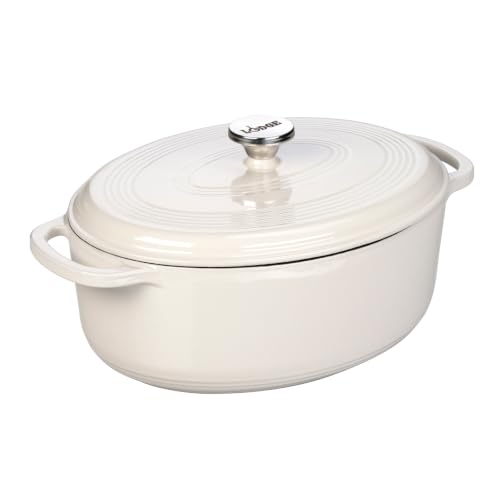
Lodge Enameled Cast Iron Oval Dutch Oven, 7 Quart — Best Value Enameled
Lodge’s enameled oval is where the value conversation starts, and its shape is the headline: an oval 7-quart pot takes a whole chicken, a pork shoulder or a long roast in a way a round pot of the same capacity cannot, because the food itself is oval. The Amazon title confirms the 7-quart capacity and the dual handles, in Oyster White. Lodge’s enamel is not French — it is applied overseas to Lodge’s designs — but it is real porcelain enamel over real cast iron mass, from the American company that has made cast iron cookware since 1896, at a tier that changes who gets to own a pot like this.
Strengths
- Oval shape fits whole birds and long roasts that round 7-quart pots squeeze.
- Genuine enamel-over-iron cooking at the value tier, from a brand with a century of foundry credibility.
- Dual loop handles sized for mitts and a full, heavy pot.
Trade-offs
- Enamel durability trails the French pots across years of hard use — chips at the rim are the known wear point.
- Oval pots heat less evenly on a round burner; the ends run cooler, so rotate the pot for even browning.
- Heavier in the hand than its price suggests — this is full cast iron, not a lightweight imitation.
| Spec | Detail |
|---|---|
| Capacity | 7 quart (per Amazon title) |
| Material | Enameled cast iron |
| Shape | Oval, dual handles |
| Color verified | Oyster White |
In daily use, the Lodge oval is the pot that gets weekday cooks into Dutch oven cooking: chili on Monday, a chicken on Sunday, a loaf in the round-ish center when the mood strikes (oval loaves bake up rustic and proud). The enamel cleans like enamel should, the lid seals well enough for proper braises, and if it chips in year six, the replacement math is painless in a way the French pots’ never is. Lodge also sells a 7.5-quart enameled round line (verified in the same API search) if you want Lodge value in a round shape with a touch more room.
Best for: families who cook whole birds and roasts and want real enamel at a value price. / Not suited for: buyers expecting French enamel longevity, or induction purists who need dead-flat oval heating. Check the current price on Amazon

Tramontina Bestow Enameled Cast Iron 7-Qt Oval — Best Budget Oval
Tramontina’s Bestow 7-quart oval is the big-box legend of this category: the pot that warehouse-store shoppers have been quietly braising in for years while the internet argued about French brands. The Amazon title confirms the essentials — enameled cast iron, 7-quart oval, sold for braising, roasting and bread baking, in red. Tramontina is a serious Brazilian manufacturer with real foundries, and this pot’s proposition is simple: the most cast iron and enamel your budget tier can buy, in the shape family cooks use most.
Strengths
- The value benchmark of the category — full-size enameled oval cooking at the lowest tier here.
- Oval format handles chickens, shoulders and roasts with room to baste.
- Heavy, tight-fitting lid that keeps braises honest over long simmers.
Trade-offs
- Enamel finish and edge durability are the tier’s compromise — treat rims kindly.
- Like all ovals, burner coverage is imperfect on round burners; rotate for even searing.
- Color and configuration availability rotates; buy the one you see if it is the one you want.
| Spec | Detail |
|---|---|
| Capacity | 7-Qt (per Amazon title) |
| Material | Enameled cast iron |
| Shape | Oval |
| Color verified | Red |
Head to head with the Lodge oval, the Tramontina trades a little finish refinement for a friendlier tier, and the cooking difference is smaller than the price difference — which is precisely its legend. Short ribs do not know what their pot cost. Where the French and Lodge pots pull ahead is the decade view: enamel that resists chipping longer, rims that survive more knocks. A careful cook — wooden utensils, no thermal shock, hand washing — closes most of that gap and keeps the change.
Tramontina also fields a 7-quart round and a tall 7-quart configuration (both surfaced in our API search), so the family gives shape choices at the same value tier if your cooking leans round.
Best for: budget-first families who want a full-size enameled oval and will treat it with basic care. / Not suited for: rough handling, or buyers who want heirloom-grade enamel guarantees. Check the current price on Amazon

Cuisinart Chef’s Classic Cast Iron Dutch Oven, 7 Qt — Best Mid-Range Round
Cuisinart’s Chef’s Classic 7-quart is the round-pot answer for the cook who wants enamel versatility without French pricing or oval compromises. The Amazon title confirms the 7-quart cast iron build, and the wider Cuisinart listing family for this pot specifies the porcelain-enameled interior and induction compatibility that make it a modern-stovetop citizen. Round is the baker’s shape and the soup-maker’s shape — even burner contact, even stirring, a loaf that rises in a circle — and this is the round pick for the middle of the market.
Strengths
- Round format: the most even stovetop heating and the best bread shape in the guide.
- Porcelain enamel interior releases food and cleans without seasoning rituals.
- Induction-compatible base covers the stovetops value rivals sometimes forget.
Trade-offs
- Whole long roasts fit less gracefully than in the ovals — shape is destiny.
- Mid-tier enamel: better than budget, short of French, exactly as priced.
- Cuisinart’s cookware support is solid but the pot lacks the French brands’ heirloom resale story.
| Spec | Detail |
|---|---|
| Capacity | 7 Qt (per Amazon title) |
| Material | Cast iron, porcelain enameled interior (line spec) |
| Shape | Round |
| Model | CI670-30 (Chef’s Classic) |
The Cuisinart is the pick we hand to the undecided: it braises respectably, bakes bread properly, simmers soup for a crowd, and asks for nothing exotic in care. Its fond development sits between glossy budget enamel and Staub’s matte black — good browning, easy release, honest cleanup. If your 7-quart life is varied rather than specialized, the mid-range round is the statistically correct pot, and this is its best representative at the tier.
Best for: all-round cooks — soups, breads, braises — who want a round enameled pot in the middle tier. / Not suited for: whole-bird specialists (go oval) or heirloom buyers (go French). Check the current price on Amazon

Lodge Cast Iron Dutch Oven with Loop Handle, 7 Quart — Best Bare Cast Iron
The last pick has no enamel at all, on purpose. Lodge’s pre-seasoned 7-quart in bare cast iron — Amazon title confirms the capacity, the loop handle and the PFAS-free bare-iron build — is the pot for the cooking enamel cannot do: screaming-hot sears, shallow frying with splatter confidence, campfire coals above and below, and a lifespan measured in generations rather than warranty periods. It arrives pre-seasoned, improves with every fatty cook, and shrugs off metal utensils, high broiler heat and the occasional drop in a way that would end an enameled pot’s good looks forever.
Strengths
- Indestructible in any way that matters: no enamel to chip, no coating to fail, reseasonable forever.
- The best searing surface in this guide, and the only pick welcome over open flame and coals.
- Value-tier pricing for a pot your grandchildren can argue over.
Trade-offs
- Acidic long braises (tomato, wine) strip seasoning and can taste of iron until the seasoning matures.
- Care is a ritual: dry on the stove, oil lightly, no soaking, no dishwasher, ever.
- The heaviest full-pot lift here, with no enamel’s easy cleanup to console you.
| Spec | Detail |
|---|---|
| Capacity | 7 Quart (per Amazon title) |
| Material | Pre-seasoned bare cast iron, PFAS-free |
| Handle | Loop handle |
| Use range | Stovetop, oven, grill and campfire |
Every kitchen that cooks seriously eventually wants both kinds of Dutch oven, and the bare Lodge is the correct second pot: it takes the frying, the searing, the camping trips and the abuse, leaving the enamel for the acidic braises and the table. Lodge also sells a bail-handle camp version of this 7-quart (verified in the same search) for tripod and fire cooking. Bought as a first pot, it rewards cooks who enjoy the cast iron ritual and punishes — gently, with rust spots that scrub out — those who wanted appliances, not hobbies.
Best for: searing, frying, campfire cooking and cast iron devotees who want a forever pot at a value price. / Not suited for: tomato-braise devotees or anyone who wants dishwasher-easy care. Check the current price on Amazon
Comparison Table
| Pick | Badge | Key spec | Best for |
|---|---|---|---|
| Le Creuset Round 7.25 qt | Best Overall | Enameled cast iron, round | The heirloom all-rounder |
| Staub Cocotte 7-qt | Best for Browning | Matte black enamel, self-basting lid | Braises and hard sears |
| Lodge Enameled Oval 7 Quart | Best Value Enameled | Enameled cast iron, oval | Whole birds and roasts, value tier |
| Tramontina Bestow 7-Qt Oval | Best Budget Oval | Enameled cast iron, oval | Lowest-tier full-size enamel |
| Cuisinart Chef’s Classic 7 Qt | Best Mid-Range Round | Porcelain enamel, round, induction-ready | Varied everyday cooking |
| Lodge Bare Cast Iron 7 Quart | Best Bare Cast Iron | Pre-seasoned iron, loop handle | Searing, frying, campfire |
How to Choose a 7 Quart Dutch Oven
Shape first, because shape is fit. Round pots heat most evenly on round burners, stir without corners, and bake round loaves — the default for soups, beans, bread and stovetop braises. Oval pots fit the food that is itself oval: whole chickens, pork shoulders, lamb legs, long roasts, and they present beautifully at the table. If your 7-quart dreams star whole birds, buy oval and accept the burner-coverage quirk (rotate the pot a quarter turn during searing and the quirk mostly vanishes). If your dreams star bread and chili, buy round.
Surface second. Light glossy enamel (Le Creuset, Lodge, Tramontina, Cuisinart) is the generalist: non-reactive with tomato and wine, easy to clean, honest about its fond. Dark matte enamel (Staub) is the browning specialist that hides its working stains. Bare iron (Lodge) is the searing and survival specialist that asks for seasoning care and keeps acidic long-cooks at arm’s length until its seasoning is deep. There is no wrong surface — there is only a surface matched or mismatched to your menu.
Third, be honest about weight and storage. A 7-quart cast iron pot is a serious object empty and a genuinely heavy one full of stew; if lifting is a consideration, the correct move is to cook in place — braise on the stovetop back burner or in the oven on a low rack — and to store the pot where it lives, not on a high shelf. Fourth, budget by tier in this search’s terms: bare iron and budget enamel occupy the value tier, Lodge and Cuisinart the middle, and the French pots the premium tier, with the premium buying enamel longevity, warranty culture and resale value rather than better Tuesday chili. The Crock-Pot Artisan 7-quart round (verified in our API search and noted in this article’s sources) is one more legitimate value-tier option if its colors suit your kitchen better than the picks above.
How to Use a 7 Quart Dutch Oven: The Core Techniques
Four techniques unlock this pot. For braising: sear the protein in batches — never crowd, or you steam instead of brown — then soften the aromatics in the drippings, deglaze with wine or stock while scraping the fond, return the meat with liquid a third to halfway up its sides, lid on, and hold the gentlest possible simmer in a low oven for hours. The lid and the iron do the work; your job is patience and not peeking more than hourly. For bread: preheat the pot with the oven, lower the dough in on its parchment sling, bake lidded for the steam phase, then unlidded for color — the 7-quart round gives a standard loaf room to spring without touching the lid.
For soups and beans: the iron’s mass forgives the occasional boil-over of attention, holding a bare simmer that extracts flavor without breaking beans apart. For searing and frying in the bare-iron pick: preheat longer than feels necessary, oil after the pot is hot, and let the crust release itself — food stuck at minute two is food that lets go at minute four. Across all four: preheat enameled pots gradually and never empty over high heat, add liquid to a hot pot in stages to avoid thermal shock, and let a screaming-hot pot cool a little before it meets cold water in the sink. Those three habits are the entire difference between enamel that lasts decades and enamel that crazes in a year.
Enameled vs. Bare Iron: The Decade View
Most Dutch oven advice compares the first month of ownership. The honest comparison is year ten. Enameled pots at the premium tier look close to new at year ten if their owner avoided thermal shock and metal utensils; budget enamel usually shows its working life by then — a chip at a rim, a stain that became patina — while cooking exactly as well as the day it arrived. Bare iron at year ten is better than new, its seasoning deepened into a surface that releases eggs and shrugs at sauce, provided its owner kept it dry. The failure modes are asymmetric: enamel fails cosmetically first and functionally almost never; bare iron fails only through neglect, and the neglect is reversible with steel wool, oil and an afternoon.
Cost of ownership follows the same shape. The French pots ask the most on day one and the least thereafter, and they retain resale value to an extent that makes their lifetime cost genuinely competitive. The value enamels ask little on day one and offer a painless replacement if the worst happens. Bare iron asks little and then asks for minutes — drying, oiling — forever, which is either a ritual or a tax depending on the cook. None of these is the wrong answer; they are three different contracts, and this guide’s picks were chosen so that each contract is represented by its best signer.
Size Neighbors: When 5.5 or 9 Quarts Is the Real Answer
Seven quarts is the family sweet spot, not a religion. Drop to the 5.5-quart class if your household is two people who cook four-person meals — the smaller pot heats faster, stores easier, lifts kinder, and still bakes a full loaf; Le Creuset’s 5.5 qt round surfaced in our API search alongside its bigger sibling for exactly this buyer. Step up toward 9 quarts if your cooking is batch cooking — freezer chili by the gallon, stock from two carcasses, holiday crowds — and accept that the pot becomes a two-person lift and a permanent stovetop resident. The mistake is not choosing a neighbor size; it is choosing 7 quarts for a life that is visibly 5.5 or visibly 9, because capacity mismatches tax every single cook, while the right size disappears into the routine.
One more sizing truth: a Dutch oven cooks best between half and two-thirds full. A 7-quart pot asked to simmer two cups of sauce will scorch it around the edges; the same pot asked to braise a double batch purrs. Households that cook small most days and big on Sundays are the natural two-pot kitchens — a 3.5-to-5.5 for the week, the 7 for the weekend — and this guide’s value picks make that pairing affordable in a way the French-only era never did.
Care and Feeding: Routines That Take Minutes
For enameled pots, the routine is: cook, let the pot cool until warm, soak briefly in warm soapy water if the meal was ambitious, wash with a soft sponge, dry, and store with the lid ajar or a cloth between lid and pot to protect the rim enamel. Stains yield to a baking-soda paste and patience. Never steel wool, never cold water into a ripping-hot pot, never a knife inside it. For bare iron: wash hot with a stiff brush and the minimum of soap, dry it on a warm burner until the water is truly gone, wipe in the thinnest possible film of oil, and store it dry. Rust, when it appears, is a scrub and a reseasoning away from forgiveness — three thin coats of oil baked on upside-down in a hot oven rebuild the surface completely.
Storage deserves one sentence of its own, because 7-quart pots die by storage as often as by cooking: keep them on a low shelf or the stovetop, never stacked with other cookware nested inside unprotected, and never on a high shelf you must lift them down from with your wrists. The pot you can reach is the pot you will use, and using it is the entire point of the purchase.
How We Would Spend at Each Tier
On the strictest budget, the Tramontina oval or the bare Lodge — the first if your menu is braises and birds, the second if it is sears and fires. In the middle, the Lodge enameled oval for families and the Cuisinart round for generalists are the two best-value contracts in the guide. At the premium tier, the choice is temperament: Le Creuset for the visible, versatile benchmark, Staub for the browning specialist. And the connoisseur’s move, if the budget ever allows a second pot, is one of each kind — enamel for the acidic and the elegant, bare iron for the violent and the elemental — in the same 7-quart class, sharing one lid-sized footprint in the cupboard and every job in the kitchen between them.
Common Buying Mistakes
The first mistake is buying by headline capacity without checking the shape’s fit: a 7-quart round that cannot take your Sunday chicken is the wrong 7 quarts. The second is ignoring the full weight — pot, lid, food — until the first time you carry it across the kitchen in mitts. The third is using metal utensils and high empty heat on budget enamel, then blaming the tier for chips that care would have prevented. The fourth is putting any cast iron, enameled or bare, into a dishwasher or a long soak and calling the consequences a defect.
The fifth mistake is buying premium enamel as a first pot for campfire and frying duty — the two jobs bare iron exists for — and the mirror-image mistake is buying bare iron for a tomato-braise life and fighting its seasoning forever. The sixth is forgetting the knob and handle question: phenolic knobs have oven temperature limits that metal knobs do not, and at bread-baking temperatures that detail matters, so check your chosen pot’s knob rating before the first 500-degree bake. And the seventh is skipping the lid fit test on arrival: a lid that rocks or gaps steams your braise dry, and the time to exchange it is week one, not year two.
Final Recommendation
Buy the Le Creuset 7.25 qt if you want the heirloom and the budget allows it; buy the Staub 7-qt if your cooking is braise-and-sear first. Buy the Lodge enameled oval or the Tramontina oval if whole birds and value lead your list, the Cuisinart 7 Qt for mid-range round versatility, and the bare Lodge 7 Quart for searing, frying and fire. Seven quarts is the size that feeds a family and a freezer at once — whichever badge you choose from this list, you are buying the most useful pot shape in the kitchen. Check the current price on Amazon, pick your shape honestly, and put something on to braise.
Keep going in this category with Best Affordable Dutch Ovens, Best Cast Iron Dutch Ovens, Best Dutch Ovens For Baking Bread, Best Bread Dutch Ovens, Best Dutch Ovens For Sourdough, and Best Dutch Ovens For Camping.
What to Cook First in a New 7 Quart Dutch Oven
Break a new pot in with food that teaches you its character. Cook one: a simple chicken and vegetable braise, which tests the lid seal (the liquid level should barely drop), the simmer control (a murmur, not a boil) and the cleanup (an honest first impression of the enamel or the seasoning). Cook two: a no-knead loaf, which teaches you the pot’s oven personality — how dark the crust runs against the recipe’s timing — and leaves the kitchen smelling like a bakery instead of a foundry. Cook three: a big pot of beans or chili, the volume test, which confirms the 7-quart promise in the only currency that matters, which is servings.
By the end of those three cooks you will know your pot’s hot spots, its lid’s honesty and its handles’ manners, and you will have three dinners to show for the education. Owners who run this small curriculum keep their pots for decades; owners who start with a five-hour French braise on day one sometimes blame the pot for a recipe’s ambition. The pot is a tool with a long memory — start it on food that makes good memories.
A Short Pre-Purchase Checklist
Before ordering any 7-quart Dutch oven: one, measure your oven’s interior and your stovetop’s burner layout against the pot’s diameter — ovals especially need a burner plan. Two, lift something of comparable weight in a store if you can; a full 7-quart pot is a serious carry, and honesty here prevents a beautiful pot becoming a shelf ornament. Three, check the lid knob’s oven temperature rating if you bake bread at high heat. Four, decide your surface by your menu — acidic braises say enamel, searing and fire say bare iron — and do not let a sale reverse the decision. Five, confirm the exact capacity and color on the listing itself; this class is sold in near-identical 6, 7 and 7.5-quart siblings, and the wrong sibling is the most common ordering error in the category.
Frequently Asked Questions
What does 7 quarts actually cook for a family?
Plan on six to eight servings of soup, stew or chili, a whole chicken with vegetables, a 5–6 lb pot roast with its braising vegetables, or a double batch of beans. Staub’s own listing for this size puts it at serving five to seven generously, which matches real kitchens: dinner for six with leftovers, or dinner for four with a freezer container to spare.
Is round or oval better for a 7 quart Dutch oven?
Round heats more evenly on the stovetop, stirs without corners and bakes round loaves — the better default. Oval fits whole birds and long roasts that a round pot squeezes. Choose by your signature dish: bread and chili say round; Sunday chicken and pork shoulder say oval.
Can enameled cast iron go under the broiler and into a hot oven?
The pots themselves handle high oven heat; the limiting part is usually the lid knob. Stainless knobs are effectively unlimited for home ovens, while some phenolic knobs carry temperature ratings you should check in the manual before bread-baking at maximum heat. When in doubt, the manufacturer sells metal replacement knobs for the premium brands.
How do I stop enamel from chipping or crazing?
Heat enameled pots gradually, never boil them dry or heat them empty on high, add cold liquid to a hot pot in stages, use wood or silicone utensils, and let the pot cool before washing. Hand washing with a soft sponge preserves the gloss; a paste of baking soda lifts most stains without abrasion. Thermal shock and metal impacts cause nearly all enamel damage — both are habits, not fate.
Is bare cast iron better than enameled?
Better at searing, frying, high heat and surviving abuse; worse at acidic long braises and effortless cleanup. Most serious kitchens end up with one of each in complementary sizes. If you can only own one and your menu is varied, enameled is the safer single choice; if your menu is sear-and-fire heavy, bare iron is the honest one.
Will a 7 quart Dutch oven work on induction and glass-top stoves?
Cast iron is naturally induction-friendly — a magnet sticks, so the stove works — and enameled cast iron adds a smooth, scratch-gentle base that glass-top owners prefer. The Cuisinart pick in this guide lists induction compatibility explicitly, and the bare Lodge works on induction by material. Two cautions apply everywhere: never drag a heavy iron pot across a glass top (lift it), and on any smooth top, check the base is free of grit before setting it down. Oval pots on induction bridge zones perform best when the zone covers the base; a small single element under a big oval will heat the middle and leave the ends to the iron’s conduction, which patience mostly forgives.
Why does my braise dry out in a Dutch oven?
Almost always the lid, the heat, or the liquid level — in that order. A lid that gaps lets steam escape for hours; test the fit and, for a stubborn lid, a layer of parchment under it seals the gap. Heat that is a rolling simmer instead of a bare murmur boils liquid away; cast iron holds heat so well that the lowest setting is usually the right one. And braising liquid should start a third to halfway up the food — less invites drying, more turns a braise into a soup. Fix those three and a 7-quart pot’s braises stay succulent for the full cook.
What is the difference between a Dutch oven and a braiser at this size?
A Dutch oven is tall-sided: its depth holds braising liquid around large cuts, fits a whole chicken under its lid, and contains the swell of a rising loaf. A braiser is its shallow sibling — wide and low, built for browning and reducing rather than submerging — and at family volumes the two overlap less than their marketing suggests. For the 7-quart shopper, the tall Dutch oven is the versatile buy: it braises, boils, bakes and deep-fries safely, while a braiser’s party trick is surface area. Kitchens that sear and sauce daily may eventually want both; kitchens buying one should buy the tall pot in this guide.
How do I choose between the two French brands?
Choose by interior and by menu. Le Creuset’s light glossy enamel is the better instrument when you monitor browning visually, cook pale sauces, or bake bread and want to see the loaf’s color through the process; its interior also releases sticky foods with the least persuasion. Staub’s matte black interior is the better instrument when searing is the main event and braises run dark and long; it browns harder, hides its working stains, and its spiked lid bastes continuously. Both are lifetime purchases with serious warranties, so the honest tiebreaker is the food you cook most — and, frankly, the color you want to see on your stove for the next thirty years.
Can a 7 quart Dutch oven replace a slow cooker?
For flavor, yes — a lidded Dutch oven in a low oven or at a bare stovetop simmer produces deeper browning and better texture than a slow cooker, because the food was seared in the same pot. What it cannot replace is the slow cooker’s unattended, set-and-leave convenience and its gentler energy profile. Many cooks keep both: the Dutch oven for weekends, the slow cooker for workdays.


