Disclosure: airfryerkitchensupply.com is reader-supported. When you buy through links on our site, we may earn an affiliate commission at no extra cost to you.
Where to buy
Every linked pick below was verified against Amazon’s catalog before this guide was published. Use these links to check the current price on Amazon, confirm the exact configuration (fuel type and trim), and read the full specification before you order:
- Best Overall — Weber Spirit E-425 (Liquid Propane): Check the current price on Amazon
- Best for Steak Nights — Kenmore 4-Burner with Searing Side Burner: Check the current price on Amazon
- Best for Lid-Lifters — Monument Grills Mesa 400MF 4-Burner: Check the current price on Amazon
- Best Open-Shelf Value — Royal Gourmet OK4002T 4-Burner: Check the current price on Amazon
- Best Cabinet Grill — Char-Broil Performance Series 4-Burner Cabinet: Check the current price on Amazon
- Best for Hosts — Monument Grills 4+2 Burner Cabinet: Check the current price on Amazon
The best 4 burner grills share a layout — four burners under a family-size grate — and almost nothing else. Within that single phrase live stainless fast-heaters, searing side-burner specialists, six-burner-in-disguise maximalists and tidy cabinet grills, at every tier from value to premium. This guide is the broad survey: six four-burners chosen because each represents a different answer to the same question, so you can find the one that matches your patio and your menu.
If our companion guide to 4 burner gas grills is organized by burner technology, this one is organized by household. The Weber Spirit E-425 is the balanced default. The Kenmore sears from its side burner. The Monument Mesa 400MF watches your food through glass so you stop lifting the lid. The Royal Gourmet OK4002T keeps everything on open shelves. And the Monument 4+2 is for hosts who want every burner type at once.
All six were verified against Amazon’s catalog as complete current grills before inclusion. Read the badges as household descriptions — the best four-burner is the one whose trade-offs you will never notice because they are the ones you do not care about.
Each review in this survey ends with a verdict written as a household description — ‘Best for’ a kind of cook, ‘Not suited for’ another. In a category this broad, those two lines are the fastest honest filter we can give you; if a verdict’s second line describes you, believe it and move to the next pick.
In this guide
Quick Picks
Six four-burners for six households: balanced Weber, searing Kenmore, see-through Monument, open-shelf Royal Gourmet, cabinet Char-Broil, and Monument’s six-burner maximalist. Match the household first; the grill follows.
- Best Overall — Weber Spirit E-425 (Liquid Propane): Four burners, a boosted Sear Zone and cast-iron grates in Weber’s manageable Spirit footprint — the balanced default. Check the current price on Amazon
- Best for Steak Nights — Kenmore 4-Burner with Searing Side Burner: The searing side burner handles two steaks at full intensity while the cast-iron main box does everything else. Check the current price on Amazon
- Best for Lid-Lifters — Monument Grills Mesa 400MF 4-Burner: The Clearview window lets you watch the cook without dumping heat — a small feature with daily returns. Check the current price on Amazon
- Best Open-Shelf Value — Royal Gourmet OK4002T 4-Burner: 512 square inches, electronic ignition and everything stored in the open, at a value position. Check the current price on Amazon
- Best Cabinet Grill — Char-Broil Performance Series 4-Burner Cabinet: Char-Broil’s Performance hides the tank and tools behind doors, with a side burner for full meals. Check the current price on Amazon
- Best for Hosts — Monument Grills 4+2 Burner Cabinet: Four main burners plus infrared sear and standard side burners — the whole outdoor kitchen in one cart. Check the current price on Amazon
How These Picks Were Chosen
We cast widely for this survey: every major four-burner philosophy with a complete, current, verified listing was eligible, and the final six were chosen for maximum contrast rather than maximum similarity. Two Monument models appear because they answer genuinely different briefs — the glass-lidded everyday grill and the everything-included host’s grill — and no other brand’s pair differed as much.
Ranking weighed everyday cooking quality — grate material, output, ignition — then the lived experience: storage format, lid behavior, shelf design and how the grill fits a real patio routine. Specification-sheet winners that solve problems nobody has lost out to grills that solve the lid-lifting, shelf-space and side-burner problems people actually complain about.
The 6 Best 4 Burner Grills

Weber Spirit E-425 (Liquid Propane) — Best Overall
Four burners, a boosted Sear Zone and cast-iron grates in Weber’s manageable Spirit footprint — the balanced default.
The E-425 is the Spirit for people who outgrew three burners but do not want a grill that dominates the patio. The fourth burner is not just extra width — it changes how you cook. You can run the Boost Burners hard on the left for steaks while vegetables finish over indirect heat on the right, a workflow that is cramped on any three-burner. Weber’s grate and burner quality carry over from the smaller Spirit, and the Weber Works rails accept the clip-on prep trays and tool systems Weber sells for this line. It lacks the E-435’s side burner, which matters if you make pan sauces outside, but as a pure grilling surface it is the balanced middle of the current Spirit range.
In daily service the E-425’s virtues compound. The four burners sip propane reasonably when run as two working zones — which is how the grill should be run most of the time — and the Weber Works rails turn the side shelves into a genuine prep system with the clip-on accessories Weber sells for the line. The open cart keeps the tank swap a thirty-second job, though it also means a cover matters for anything stored beneath. Parts support mirrors the rest of the Spirit range: burners, bars and grates are catalog items, not special orders. Families upgrading from a two-burner will feel the space immediately; families downsizing from a five-burner will be surprised how rarely they miss the fifth burner.
Strengths
- Four burners create a genuine two-zone setup: sear on the boosted side, finish gently on the other.
- Cast-iron grates deliver the heat retention and marks that thin steel grates cannot match.
- It keeps the Spirit’s manageable footprint while adding party-capable capacity.
Trade-offs
- No dedicated side burner on this configuration, unlike the E-435 trim.
- Four-burner appetite means a propane tank empties faster than on the three-burner Spirit.
- The cart is open rather than a closed cabinet, so storage is exposed.
Key specs (from the verified listing):
- 4 burners
- Sear Zone with Boost Burners
- Porcelain-enameled cast-iron cooking grates
- Weber Works side rails
- Fuel: liquid propane
Check the current price on Amazon
Best for: Families of four to six who cook mixed loads — proteins plus vegetables — and want real two-zone control. / Not suited for: Cooks who need a side burner for sauces, or very small patios where even a mid-size four-burner crowds the space.
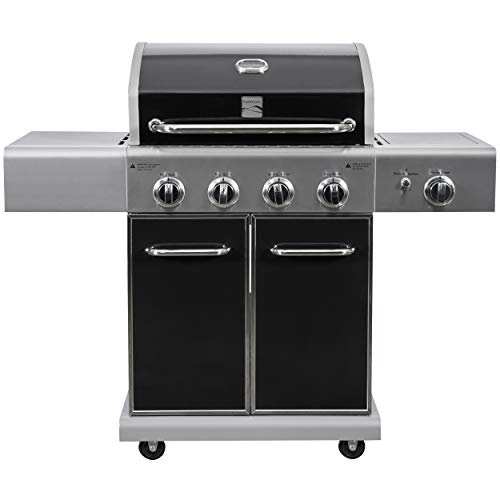
Kenmore 4-Burner with Searing Side Burner — Best for Steak Nights
The searing side burner handles two steaks at full intensity while the cast-iron main box does everything else.
Putting the sear capability in the side burner is an efficient design: two steaks get extreme heat from a small burner while the main box stays off, saving fuel and preheat time. The main four-burner grate is cast iron, so the everyday cooking — chicken, burgers, vegetables — is not a compromise either. The 52,000 BTU total includes the side sear burner, and the warming rack covers resting and buns. For steak-leaning households of four to six, this layout matches how people actually cook better than a plain four-burner does.
The sear-burner layout reshapes weekly habits: steak for two no longer means preheating a four-burner box, and the main grate stays clean for the next day’s chicken. Keep the sear burner’s mesh or plate free of debris — infrared-style components lose their edge when neglected — and the cast-iron grates on their light oiling rhythm. The warming rack handles the resting that good steak cooking requires, conveniently beside the sear station. Support runs through the seller, so records matter. Steak households that adopt this grill tend to use the side burner more than the main box in summer, which is the strongest evidence the design is right.
Strengths
- The searing side burner delivers steakhouse heat without firing the whole grill for two steaks.
- Cast-iron main grates keep everyday cooking quality high.
- A warming rack and electronic ignition round out a complete feature set.
Trade-offs
- The sear burner occupies the side shelf, so pot space is limited while searing.
- Cast iron needs light oiling discipline in humid climates.
- Support runs through retail channels rather than a dealer network.
Key specs (from the verified listing):
- 4 burners, 52,000 BTU total (per listing)
- Searing side burner
- Cast-iron cooking grates
- Warming rack
- Electronic ignition
Check the current price on Amazon
Best for: Steak lovers who sear small batches often and want cast-iron grates for daily cooking. / Not suited for: Cooks who need a big side burner for stockpots, or who dislike maintaining cast iron.

Monument Grills Mesa 400MF 4-Burner — Best for Lid-Lifters
The Clearview window lets you watch the cook without dumping heat — a small feature with daily returns.
The Mesa 400MF’s headline is a pane of glass, and it is more useful than it sounds. Every lid lift costs a gas grill a chunk of its preheat; a window lets you check color on chicken skin or cheese melt without paying that tax ten times per cook. Around the window sits a competent stainless four-burner with the Mesa line’s usual fast-heating character and a folding shelf for storage. It will not out-sear a dedicated broil-zone model, and the window is a maintenance item, but for cooks who hover — and most of us hover — it fixes a real inefficiency in everyday grilling.
Living with the Clearview lid changes cooking behavior measurably: fewer lid lifts mean steadier temperatures, juicier chicken and less propane burned re-heating the box. The window needs a wipe with a degreasing cleaner every few cooks to stay transparent in smoky sessions — a two-minute habit. The rest of the Mesa routine is standard: stainless panels that clean easily, a folding shelf that keeps the parked footprint honest, and parts ordered through Monument’s channels with the model number kept on file. It is a grill designed around how people actually behave at a grill — hovering, checking, adjusting — rather than how manuals imagine they should.
Strengths
- The Clearview window lets you watch food without opening the lid and dumping heat.
- Stainless construction at a mid-tier position is the Mesa line’s calling card.
- One folding shelf trims width for storage while keeping a full prep side.
Trade-offs
- The glass window needs periodic cleaning to stay see-through in smoky cooks.
- Only one shelf folds; the other side is fixed.
- Brand history is shorter than the legacy names, so long-term parts depth is still being proven.
Key specs (from the verified listing):
- 4 burners
- Clearview glass lid window
- Stainless-steel construction
- One foldable shelf
- Fuel: liquid propane
Check the current price on Amazon
Best for: Lid-lifters who want to monitor food without losing heat, in a stainless mid-tier grill. / Not suited for: Set-and-forget cooks who rarely check food, or buyers wanting maximum sear specialization.

Royal Gourmet OK4002T 4-Burner — Best Open-Shelf Value
512 square inches, electronic ignition and everything stored in the open, at a value position.
The OK4002T is Royal Gourmet’s open-shelf take on the value four-burner. The 512-square-inch surface and 49,000 BTU output cover the family use case — a dozen burgers, or chicken pieces with room to breathe — and the side burner extends it to full meals. Open shelves are a deliberate trade: everything is visible and reachable, nothing is weather-sealed. Electronic ignition removes the click-click-click ritual of budget piezo starters. It is a practical, unpretentious grill for households that grill weekly in season and store the grill under a cover between sessions.
The OK4002T’s open shelves define its ownership: everything you need is visible and grabbable, and everything stored there weathers with the grill — so store tools that tolerate it, and keep the cover on between cooks. Electronic ignition is the quiet luxury here, starting the grill with a button instead of a clicking ritual. The 512-square-inch grate and moderate output suit the family rhythm of weekly cooks in season. Royal Gourmet’s parts channel covers burners and grates when they tire. It is an honest, unpretentious tool, and households that value function over furniture will find it easy to live with.
Strengths
- 512 square inches is honest four-burner capacity for family-plus cooking.
- Open storage shelves keep tools and trays reachable instead of locked behind doors.
- Electronic ignition is a small quality-of-life step up from piezo clicks at this tier.
Trade-offs
- Open shelves expose stored items to weather, unlike a cabinet.
- Output per burner is moderate; full-grate searing needs a patient preheat.
- Value-tier panel weight and finish, as expected at this position.
Key specs (from the verified listing):
- 4 burners, 49,000 BTU total (per listing)
- 512 sq. in. cooking area
- Side burner
- Storage shelves
- Electronic ignition
- Fuel: liquid propane
Check the current price on Amazon
Best for: Weekly family grillers who prefer open, accessible storage and electronic ignition at a value position. / Not suited for: Anyone needing weather-tight storage at the grill, or heavy searing performance.

Char-Broil Performance Series 4-Burner Cabinet — Best Cabinet Grill
Char-Broil’s Performance hides the tank and tools behind doors, with a side burner for full meals.
The Performance 4-Burner Cabinet is Char-Broil’s argument that a mid-tier grill should look finished on the patio. The cabinet swallows the tank and the clutter, the side burner handles corn and sauces, and the four-burner grate gives real two-zone room for family cooking. It does not pretend to Genesis-class materials — the grates are porcelain-coated and the panels are mid-weight — but the overall package covers the features households actually use, in a presentable form. For buyers stepping up from an entry grill who want the tidier look and the side burner without jumping to premium brands, this is the natural landing spot.
The Performance’s cabinet is its ownership story: the tank disappears, tools live behind doors, and the patio looks deliberate. That tidiness costs assembly time up front and a little discipline — cabinets collect moisture if the grill is covered wet, so let it dry before covering after rain. The side burner proves its worth for corn and beans more often than owners expect. Grates are the wear item to watch; when the porcelain coating tires in a few seasons, replacements are standard Char-Broil catalog parts. As the step-up from entry grills, the Performance’s balance of looks, features and support is why it anchors so many mid-tier shortlists.
Strengths
- The enclosed cabinet hides the propane tank and stores tools out of the weather.
- A side burner is included, which many four-burners at this tier skip.
- Performance-series construction is a step up from the Classic line in lid and cart solidity.
Trade-offs
- Still porcelain-coated grate territory rather than cast iron; sear intensity is moderate.
- Cabinet doors and hardware are functional rather than heavy-duty.
- Assembly is a meaningful project — set aside an unhurried afternoon.
Key specs (from the verified listing):
- 4 burners
- Side burner
- Enclosed cabinet design
- Model 463253925
- Fuel: liquid propane
Check the current price on Amazon
Best for: Families wanting a tidy cabinet grill with a side burner at the mid tier. / Not suited for: Sear-focused cooks, or anyone wanting cast-iron grates and premium-gauge steel.

Monument Grills 4+2 Burner Cabinet — Best for Hosts
Four main burners plus infrared sear and standard side burners — the whole outdoor kitchen in one cart.
Monument’s 4+2 is the maximalist answer: four main burners for the crowd, an infrared sear burner for the steaks, and a standard side burner for the pot of beans. Few grills at any tier bundle both side-burner types, and the cabinet keeps the whole operation tidy. The Clearview lid, built-in thermometer and knob-controlled layout follow the Mesa formula. The honest caveats are size and complexity — this is a destination grill for a settled patio, and each added burner is a component to maintain. For households that host often and cook entire meals outside, it replaces a grill plus two accessories with one footprint.
Owning the 4+2 is owning a small outdoor kitchen, with a kitchen’s maintenance surface: six burners to keep clean, an infrared sear burner whose mesh needs gentle handling, and a cabinet to keep dry. The reward is consolidation — no separate sear station, no camp stove for sides, no second grill for the big party. Hosts who run it weekly will find the systems pay for their upkeep; occasional grillers will find it is a lot of appliance to keep ready for rare use. Monument’s parts channel handles the burners and igniters; keep records as with any younger brand. Buy it as the patio’s permanent cooking station and it makes sense; buy it as a casual upgrade and it is simply large.
Strengths
- Six total burners including an infrared sear burner and a conventional side burner — a full outdoor kitchen in one cart.
- The cabinet format stores the tank and gear behind doors.
- Clearview lid reduces heat-losing lid lifts during long cooks.
Trade-offs
- It is a large, heavy unit; measure the patio and the gate it arrives through.
- More burners and features mean more parts to clean and eventually service.
- Sits above the budget tiers despite Monument’s value positioning.
Key specs (from the verified listing):
- 4 main burners plus 2 side burners
- Infrared side sear burner
- Side burner
- Clearview lid
- Enclosed cabinet design
- Fuel: liquid propane
Check the current price on Amazon
Best for: Frequent hosts who want sear burner, side burner and four-burner capacity in a single cabinet grill. / Not suited for: Small patios, minimalists, or budget-tier shoppers.
Comparison Table
| Pick | Badge | Key spec | Best for |
|---|---|---|---|
| Weber Spirit E-425 (Liquid Propane) | Best Overall | 4 burners | Families of four to six who cook mixed loads — proteins plus vegetables — and want real two-zone control. |
| Kenmore 4-Burner with Searing Side Burner | Best for Steak Nights | 4 burners, 52,000 BTU total (per listing) | Steak lovers who sear small batches often and want cast-iron grates for daily cooking. |
| Monument Grills Mesa 400MF 4-Burner | Best for Lid-Lifters | 4 burners | Lid-lifters who want to monitor food without losing heat, in a stainless mid-tier grill. |
| Royal Gourmet OK4002T 4-Burner | Best Open-Shelf Value | 4 burners, 49,000 BTU total (per listing) | Weekly family grillers who prefer open, accessible storage and electronic ignition at a value position. |
| Char-Broil Performance Series 4-Burner Cabinet | Best Cabinet Grill | 4 burners | Families wanting a tidy cabinet grill with a side burner at the mid tier. |
| Monument Grills 4+2 Burner Cabinet | Best for Hosts | 4 main burners plus 2 side burners | Frequent hosts who want sear burner, side burner and four-burner capacity in a single cabinet grill. |
Reading the table: the six picks line up as follows — Weber Spirit E-425 (Liquid Propane) (4 burners); Kenmore 4-Burner with Searing Side Burner (4 burners, 52,000 BTU total (per listing)); Monument Grills Mesa 400MF 4-Burner (4 burners); Royal Gourmet OK4002T 4-Burner (4 burners, 49,000 BTU total (per listing)); Char-Broil Performance Series 4-Burner Cabinet (4 burners); Monument Grills 4+2 Burner Cabinet (4 main burners plus 2 side burners). The Key spec column shows each model’s headline verified specification from its listing; the reviews above carry the full spec boxes, and the guide sections below explain which of these numbers actually change what lands on the plate. Badges, not raw specifications, are the fastest route through this table: find the badge that describes your household, then read that model’s full review before deciding.
How to Choose a 4 Burner Grill
Start with the household, not the specification
Four-burner shopping goes wrong when it starts with BTU tables. Start instead with three honest answers: how many people eat from this grill weekly, what dishes recur monthly, and where the grill will live. A couple-plus-two household searing steaks weekly needs the Kenmore’s layout; a family of six doing mixed loads needs grate area and zones; a host needs the 4+2’s burner arsenal. Every specification becomes obvious once the household is described accurately.
Then let the specification confirm, not decide. Check that the grate material suits your maintenance temperament, the output suits your searing ambitions, and the footprint — shelves up and down — suits the patio’s measured reality.
Side burners: standard, searing, both, or none
This guide contains the full spectrum, which makes it a useful comparison. A standard side burner (Char-Broil, Royal Gourmet) boils and simmers — a pot tool. A searing side burner (Kenmore) is a steak tool: extreme heat, small area, minimal fuel for small batches. Monument’s 4+2 includes both, plus the four main burners, for households that genuinely run an outdoor kitchen. And the Weber E-425 includes neither, investing everything in the main box and its Sear Zone.
The pattern to notice: each design spends the same money differently. There is no free side burner — its cost comes out of the main box, the materials or the price. Choose the allocation that matches your menu rather than the longest list.
The underrated features: lids, shelves and ignition
A glass lid window sounds like a gimmick until you count lid lifts in a normal cook — each one costs temperature the burners must rebuild. The Mesa 400MF’s Clearview lid is the rare feature that changes behavior. Folding shelves decide whether a four-burner fits a small patio’s storage reality. Electronic ignition decides whether starting the grill is a non-event or a ritual of clicking and hoping.
None of these appear in BTU comparisons, and all of them are felt weekly. When two grills tie on cooking hardware, let these lived details break the tie — they are what owners praise and curse in year two.
Reading a 4 Burner Grill Like an Engineer
Strip the marketing and a four-burner is four systems: a gas train (tank, regulator, valves), a burner box (burners, tents or bars, grates), a structure (cart, lid, shelves) and a grease path (pan, cup, drainage). Evaluating any model in this guide means asking one question per system. Gas train: is ignition electronic and are valves smooth through their range, or on-off-ish? Burner box: what are the grates made of, and do the burners have individual tents or bars protecting them?
Structure: does the lid feel balanced at half-open, do the shelves flex under a full tray, and do the casters lock? Grease path — the system nobody markets and everybody needs: is the pan full-width and slide-out, or a foil cup that overflows into the cabinet? Grease management is where cheap grills quietly fail, causing the flare-ups and cabinet fires that get blamed on cooking.
Run this four-system check on any four-burner, in this guide or out of it, and the specification sheet becomes a supporting document instead of the decision. It is also the fastest way to compare a value model against a premium one: the premium price usually shows up as a better answer in all four systems, and when it does not, the value model wins honestly.
Grease Management: The System That Decides Grill Longevity
Ask a grill technician what kills grills and the answer is rarely burners — it is grease, unmanaged. Every cook sends fat somewhere: vaporized on the bars, caught in the pan, or pooled in the firebox and cabinet. The pooled fraction is the problem. It feeds flare-ups, corrodes firebox floors from above while weather attacks from below, and eventually becomes the cabinet fire that ends a grill’s life in one bad evening. Every model in this guide has a designed grease path; the owner’s job is simply to keep it flowing.
The routine is short. Empty or replace the drip cup or pan before it is full — on a four-burner in season, check it weekly. Scrape the grease tray that funnels drippings to the pan monthly, because a clogged funnel redirects grease into the firebox. Once a season, with the grill cold, scrape and vacuum the firebox floor itself. None of this takes more than minutes, and together it is the difference between a grill that ages gracefully and one that flares at every burger.
Cooking technique shares the load. Trimming excess fat, letting very fatty items start on the gentle zone, and keeping a spray-free flare-up response — move the food, close the lid briefly — all reduce what reaches the grease system in the first place. Good grease management is invisible when it works, which is exactly the point.
The Hosting Playbook: Feeding Twelve on a Four-Burner
Twelve people is the four-burner’s honest hosting ceiling, and reaching it comfortably is a planning exercise, not a capacity one. The menu should be designed in waves: a first wave of forgiving items that hold well — sausages, chicken pieces, corn — cooked early and held warm on the gentle zone and warming rack under foil; a second wave of fast, hot items — burgers, steaks, skewers — cooked to order as guests are ready. Trying to land twelve people’s everything in one simultaneous wave is how hosts end up serving half of it cold.
The side burner, where fitted, is the playbook’s secret weapon: it holds the beans, the sauce or the sautéed onions at a simmer indefinitely, removing them from the grate-space negotiation entirely. Drinks and salads should live nowhere near the grill’s working zone; set the hosting layout so the cook’s triangle — grill, landing surface, serving table — is never crossed by a guest with a plate asking questions. That sounds ungenerous; it is actually how the food arrives hot.
Finally, sequence yourself, not just the food. Light the grill before guests arrive, complete wave one as they settle, and let wave two be the show — people enjoy watching the fast cooking, and the cook gets to be part of the party instead of its kitchen prisoner. A four-burner run this way feeds twelve with less stress than a six-burner run chaotically, which is the recurring theme of this entire guide: layout and method beat raw size.
The Two-Appliance Patio: Pairing a Four-Burner With a Second Cooker
Many households eventually discover that one appliance, however good, covers about eighty percent of their outdoor menu brilliantly and the rest awkwardly. The four-burner gas grill is the best anchor for that ecosystem — fast, zoned, family-sized — and the second appliance should be chosen to cover its genuine gaps rather than duplicate its strengths. Knowing the gaps precisely is what makes the pairing work, so name them: no true smoking, no flat-top surface, and a practical limit on very large roasts.
The most common pairing is a kettle or pellet cooker for smoke and slow work, which takes over ribs, brisket and pulled pork while the gas grill keeps the weeknight and hosting duties. The second most common is a griddle — a stand-alone station if volume justifies it, an insert if it does not — which takes over breakfast, smash burgers and fried rice. Both pairings follow the same logic: the gas grill remains the daily driver, and the specialist handles the dishes the driver was faking.
What not to pair: a second gas grill. Duplication adds maintenance without adding capability, and the patio fills with two appliances aging in parallel. Also resist pairing by bargain — a cheap second appliance bought because it was cheap becomes the thing stored in front of the grill you actually use. The right second cooker is bought for a named dish list, the way the picks in this guide were chosen for named households.
Sequencing matters financially as well as spatially. Live with the four-burner for a full season first; the gap that actually bothers you in month eight is the correct second purchase, and it is rarely the one you would have guessed in month one. Ecosystems built by experience outperform ecosystems built by imagination, on patios as elsewhere.
Placement, Fuel and Safety Essentials
Where a gas grill sits decides both its safety and its cooking quality. Place it on a level, non-combustible surface with clear space above and behind — never under a low eave, tree canopy or patio umbrella — and keep it well away from siding, railings and anything that can melt or catch. Wind is the invisible variable: a grill backed into a corner sheltered from the prevailing breeze lights more reliably and holds temperature more evenly than one parked in a wind tunnel, so a little placement thought pays off at every cook.
Propane discipline is simple and non-negotiable. Tanks live upright, outdoors, and never in a closed garage or basement; the spare belongs in the shade, not beside the grill’s firebox. Open the tank valve slowly, and if you ever smell gas with the burners off, close the tank, skip the lighting attempt and have the connections checked. Transport tanks upright and secured in a ventilated vehicle, never loose in a sealed trunk on a hot day.
Finally, treat the grease system as safety equipment. Most grill fires are grease fires, and they are prevented by boring habits: empty the drip pan before it fills, scrape the grease management tray in season, and keep a lid-down smother as your first response — close the lid and the burners, and let oxygen starvation do the work. Water on a grease fire spreads it; a household fire extinguisher rated for kitchens, kept within reach but away from the grill itself, is the correct backup.
How to Grill a Mixed Load on a 4 Burner Grill
The mixed load is the four-burner’s reason to exist. This worked sequence — chicken, burgers, vegetables and buns for six — shows the zones doing their jobs.
- Set three zones. Left two burners medium-high (direct), third burner medium-low (gentle), fourth burner off (resting). Preheat 12 minutes, lid closed.
- Chicken first, direct then gentle. Bone-in pieces sear skin-down on the direct zone for five minutes, flip, then move to the gentle zone to finish without burning — they will take the longest, so they start first.
- Vegetables on the gentle zone’s edge. Peppers, onions and zucchini cook beside the chicken, turned often, where the heat is kind but present. Glazed or sugared items stay off direct heat entirely.
- Burgers on the direct zone, last and fast. Four to five minutes per side at full direct heat while the chicken rests on the off zone under loose foil. Cheese goes on in the final minute, lid down.
- Buns on the warming rack or resting zone. Sixty to ninety seconds is all they need; they are the final thirty seconds’ job, not a background task.
- Serve from the grill in one pass. Chicken from the gentle zone, burgers from the rest, vegetables and buns behind them. Everything is hot, nothing waited, and the zones — not luck — did it.
Write your own household’s mixed-load sequence once you have run it twice. Every family’s menu has a longest item and a fastest item; ordering the cook around those two facts is the entire skill, and the four-burner simply gives it room to work.
Common Buying Mistakes
Treating all four burners as one heat. A four-burner run uniformly is a big two-burner with extra fuel bills. Zones are the product; use them from the first cook.
Buying a sear burner for a household that never sears. Side sear burners are brilliant for steak households and dead weight for everyone else. Menu first, features second.
Ignoring the grease path when comparing models. A foil cup that overflows will cause more grief than any grate material saves. Check how the pan removes and how much it holds.
Parking a four-burner by its cooking dimensions. Shelves-up width and lid swing decide patio fit. Measure the working footprint, not the box it shipped in.
Letting the side burner become a shelf. If it will never hold a pot, its lid stays down and it is a shelf you paid burner money for. The Weber E-425’s honesty — no side burner, better main box — is a legitimate design answer.
Final Recommendation
Start with the Weber Spirit E-425 unless your household has a specific flag: steak nights point to the Kenmore, lid-lifting to the Monument Mesa 400MF, open-shelf value to the Royal Gourmet, tidy cabinets to the Char-Broil Performance, and serious hosting to the Monument 4+2. That is the whole guide in one sentence, and every route through it lands on a grill that does its job well.
Confirm your pick’s configuration on the product page, measure the patio once more, and check the current price on Amazon. Then cook the mixed load in the how-to section and let the zones convince you.
A closing observation from across this whole survey: the four-burner category rewards buyers who describe their households accurately more than any other in outdoor cooking, because the format is a platform that brands bend toward genuinely different lives — the searing couple, the hovering cook, the tidy cabinet household, the twelve-guest host. The specifications in this guide are the vocabulary, but the household description is the sentence. If you read every review and found one whose ‘Best for’ line sounds like your actual Tuesday and your actual Saturday, you have found your grill, and the remaining work is only measurement, fuel and a current-price check. Trust the match; it was the point of the survey.
Related guides in this series: Best 4 Burner Gas Grills; Best 4 Burner Gas Grills Under $500; Best 4 Burner Grills Under $300; Best 3 Or 4 Burner Gas Grills; Best 3 Burner Weber Grills
Frequently Asked Questions
What is the best all-around 4 burner grill?
The Weber Spirit E-425: four burners, a Sear Zone, cast-iron grates and Weber’s support, in a footprint that suits most patios. Households with special needs — searing, hosting, storage — have their own picks in this guide.
Are glass lid windows actually useful?
For most home cooks, yes. Chicken skin color, cheese melt and vegetable char can all be judged through the Mesa 400MF’s Clearview window without a heat-dumping lid lift. The glass needs periodic cleaning to stay clear, which is the honest trade.
How much cooking space does a 4 burner grill have?
Primary grate area typically runs from about 450 to over 600 square inches across this guide’s picks. Compare primary area, not the total figures that include warming racks, when capacity is your priority.
Is a 4+2 burner grill worth it over a standard 4 burner?
For hosts who run sear, side and main cooking simultaneously, the Monument 4+2 replaces separate appliances and earns its size. For weekly family cooking it is capacity and complexity that will mostly idle.
Which 4 burner grill is easiest to store?
Designs with folding shelves — the Monument Mesa 400MF folds one side — park noticeably smaller. Cabinet models are the largest commitment. Measure your storage spot with the shelves in their parked state before choosing.
How often should burners be cleaned?
Brush grates after every cook, scrape tents or bars monthly in season, and give the burners themselves a brush and port check at the season’s start and end. That rhythm keeps flames even and prevents the weak-burner spiral that ends grills early.
What causes flare-ups and how do I stop them?
Flare-ups are dripping fat meeting open flame. Prevent them with zone cooking (a cool refuge to move food to), trimmed fat, and a clean grease path. During a flare-up, move the food and close the lid briefly — never spray water on it.
Should the drip pan be lined with foil?
A foil liner makes cleanup easier and is fine if it does not block drainage or touch burners. Many owners instead scrape the bare pan; either works if the pan is emptied before it fills.


