Disclosure: airfryerkitchensupply.com is reader-supported. When you buy through links on our site, we may earn an affiliate commission at no extra cost to you.
Where to buy
If you are comparing the best 13 x 24 countertop microwaves, start here: all six microwaves below were verified in Amazon’s catalog data before being included, and each listing is the place to confirm the exact exterior dimensions of the specific configuration you are ordering, because brands sell near-identical models in slightly different cabinets. Our Best Overall in this footprint class is the Toshiba 2.2 Cu.Ft Inverter. The value end of the class is the Frigidaire 2.2 Cu.Ft, the premium end is the Panasonic NN-SN97JS, and the traditional turntable crowd is well served by the Sharp SMC2266KS, the Farberware Professional FMO22ABTBKC and the Farberware 2.2 Cu.Ft Stainless. Appliance pricing shifts constantly, so check price on Amazon at the listing rather than trusting any number printed elsewhere.
What “13 x 24” Actually Means When You Are Shopping
People searching for the best 13 x 24 countertop microwaves are almost never shopping for a size for its own sake. They are shopping for a fit. A countertop microwave that is roughly 24 inches wide and roughly 13 inches tall is the full-size class: the biggest countertop format that still sits under standard upper cabinets, and the footprint that pairs with a cavity of about 2.2 cubic feet. That combination — full-size outside, family-size inside — is what this guide is about.
Two honest warnings before the picks. First, “13 x 24” is a class description, not a promise. Exact exterior dimensions vary by brand and even by finish, typically landing within about an inch of 24 inches wide and 13 to 14 inches tall, and depth — the dimension nobody searches for and everybody should — runs deep on these machines because a 2.2 cu ft cavity needs room behind the door. Always confirm the exact width, height and depth, plus the door-swing clearance, on the listing of the specific model you order, and measure your space including the gap your upper cabinets allow. Second, every model in this footprint class is a full-power family machine. If you are furnishing a dorm room or a tiny studio, this class will eat your counter; our smaller-size guides linked at the end will serve you better.
Within the class, the real choices are about power delivery and cooking systems. You will find inverter and conventional power supplies, sensor cooking of varying quality, and turntables around 16.5 inches across the board. The six picks below are the models that combine the right footprint with the best cooking hardware at each budget tier, and each one earned its badge for a distinct reason.
In this guide
Quick Picks
- Best Overall: Toshiba 2.2 Cu.Ft Inverter — 1200 inverter watts, sensor cook and a 16.5-inch turntable in the classic full-size footprint. Check the current price on Amazon
- Best Budget: Frigidaire 2.2 Cu.Ft — the full-size cavity and 1200 watts at the friendliest tier in this class. Check the current price on Amazon
- Best Premium: Panasonic NN-SN97JS — Cyclonic Inverter power at 1250 watts with Genius Sensor, and a countertop/built-in convertible design. Check the current price on Amazon
- Best Classic Turntable Oven: Sharp SMC2266KS — a straightforward, powerful 1200W family oven from a brand that has built microwaves for decades. Check the current price on Amazon
- Best Sensor Value: Farberware Professional FMO22ABTBKC — sensor cooking and 1200 watts in a brushed stainless cabinet at a mid-tier position. Check the current price on Amazon
- Best Stainless Alternative: Farberware 2.2 Cu.Ft — smart sensor cooking, multi-stage programs and a clean stainless look. Check the current price on Amazon
How These Picks Were Chosen
We began with the footprint: only full-size countertop models in the roughly 24-inch-wide, 13-inch-tall class with family-size cavities around 2.2 cu ft qualified. Built-in-only and over-the-range models were excluded even when their dimensions looked similar, because this guide is for a machine that sits on a counter and plugs in. Within that frame we verified every candidate’s capacity and wattage against catalog data, then ranked by cooking hardware: inverter power supplies and genuine humidity-sensor cooking first, conventional power and preset-driven models second. We also weighed turntable size, because in this class the whole point is fitting big dishes, and a 16.5-inch turntable is the difference between a casserole rotating freely and a casserole wedged diagonally. Ownership factors — child locks, mute options, interior cleanability, control layout — broke the remaining ties. The result is six machines that share a footprint but serve six different buyers.
The 6 Best 13 x 24 Countertop Microwaves

Toshiba 2.2 Cu.Ft Inverter — Best Overall
Toshiba’s big inverter model is the most complete machine in this footprint class. You get a 2.2 cu ft cavity, a 16.5-inch turntable, 1200 watts delivered through an inverter supply, and sensor cooking, in the standard full-size cabinet that fits the 13 x 24 brief. It suits families who cook and reheat at family scale and want the gentler, steadier power delivery for defrosting and delicate work. It is more oven than a single person needs, and its depth deserves a tape measure before you commit.
Strengths
- Inverter power keeps low settings honest, so big defrost jobs thaw evenly instead of cooking at the edges.
- The 16.5-inch turntable rotates full-size casseroles and large dinner plates without contact with the walls.
- Sensor cook with auto menus plus a child lock covers the family checklist.
Trade-offs
- Full-size depth; shallow counters will feel crowded.
- Heavier than compact classes, so plan its spot once and leave it there.
- Capacity is wasted on a household that only reheats mugs and bowls.
| Spec | Detail |
|---|---|
| Capacity | 2.2 cu ft |
| Power | 1200W inverter |
| Turntable | 16.5 inch removable |
| Class footprint | Approx. 24″ W x 13″ H full-size countertop |
The reason this model tops the list is balance. Many full-size microwaves pair a big box with a basic pulsing power supply, and the results show it on anything delicate. Here the inverter supply scales with the cavity, so a family-size frozen lasagna defrosts and cooks through without a raw center, and the sensor programs have the headroom to manage large portions. If your kitchen has the counter for exactly one big microwave, this is the one that does the most things well. Check the current price on Amazon
Best for: families wanting the best all-round full-size countertop microwave / Not suited for: small households or shallow counters

Frigidaire 2.2 Cu.Ft — Best Budget
Frigidaire’s 2.2 cu ft model is how you get the full-size footprint and a genuine 1200 watts without paying for premium power electronics. It is a programmable, multi-function family oven in stainless, aimed at buyers whose priority list starts with capacity and ends with capacity. It suits large households on a budget, rental kitchens and anyone replacing a dead full-size unit quickly. Buyers who defrost meat several times a week and care about low-power finesse should look at the inverter Toshiba or Panasonic instead.
Strengths
- Full 2.2 cu ft cavity at the most accessible tier in this class.
- True 1200-watt output, so cooking times match package directions written for full-power ovens.
- Straightforward programmable controls that anyone in the house can use without a manual.
Trade-offs
- Conventional power delivery; low settings pulse rather than flow, which shows in delicate defrosting.
- Fewer refinement features than the premium picks — this is a capacity-first machine.
- Stainless finish needs regular wiping to stay smart in a busy kitchen.
| Spec | Detail |
|---|---|
| Capacity | 2.2 cu ft |
| Power | 1200W |
| Type | Countertop, multi-function programmable |
| Class footprint | Approx. 24″ W x 13″ H full-size countertop |
There is no trick to this recommendation: at the budget tier of a niche size class, most shoppers are one dead appliance away from needing a big oven today, and this Frigidaire delivers the size and the watts without charging for an inverter badge. Everyday jobs — family popcorn, big bowls of soup, reheating a full plate — are exactly what it is built for, and it does them at full speed. Treat it as the sensible default for capacity-driven buyers. Check the current price on Amazon
Best for: large households that need full size and full power on a budget / Not suited for: cooks who prioritize inverter defrosting quality
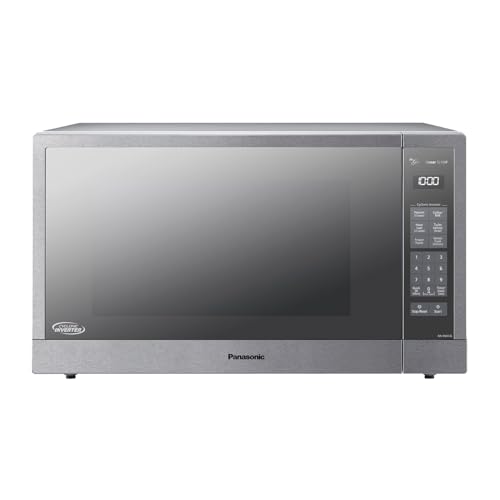
Panasonic NN-SN97JS — Best Premium
The NN-SN97JS is Panasonic’s flagship approach to this size: a 2.2 cu ft Cyclonic Inverter oven at 1250 watts with Genius Sensor cooking, designed to work on the counter or convert to a built-in installation with a trim kit. It suits buyers who want the most even heating technology in the class and the option to integrate the oven into cabinetry later. The premium positioning is real, and if you will never use sensor cooking or care about defrost quality, the cheaper picks will serve you just as happily.
Strengths
- Cyclonic Inverter distributes energy more evenly than standard inverter designs, reducing hot and cold spots in large dishes.
- Genius Sensor handles reheating and cooking by steam detection rather than guesswork times.
- Countertop or built-in flexibility protects the purchase if you remodel.
Trade-offs
- Premium tier pricing within this group.
- At 1250 watts it is the most powerful here; delicate tasks need the lower levels used thoughtfully.
- Built-in conversion needs a separately purchased trim kit and proper ventilation planning.
| Spec | Detail |
|---|---|
| Capacity | 2.2 cu ft |
| Power | 1250W Cyclonic Inverter |
| Sensor | Genius Sensor cooking |
| Install | Countertop / built-in convertible |
Panasonic’s cyclonic system exists to solve the big-cavity problem: the larger the box, the harder even heating becomes, and this is the brand’s most serious answer. In practice it means family-size dishes come out uniformly hot with fewer stir-and-rotate interventions, and the Genius Sensor takes over the timing for the foods you cook most. If you are buying a full-size microwave as a long-term appliance rather than a stopgap, this is the one engineered like it. Check the current price on Amazon
Best for: buyers wanting the best heating technology in the full-size class / Not suited for: budget-first shoppers

Sharp SMC2266KS — Best Classic Turntable Oven
Sharp has been building microwaves since before most of its competitors existed, and the SMC2266KS is the classic formula executed at full size: 2.2 cu ft, 1200 watts, a 16.5-inch Carousel turntable and controls that make sense at a glance. It suits households that want a proven, no-drama family oven and trust a specialist brand. If built-in conversion or inverter bragging rights matter to you, the Panasonic above is the more ambitious machine.
Strengths
- Large 16.5-inch Carousel turntable handles the biggest dishes in the class.
- Full 1200 watts with the straightforward control logic Sharp owners expect.
- Stainless design that sits comfortably in most kitchen suites.
Trade-offs
- Conventional power supply, so low-power work is less refined than the inverter picks.
- Feature set is classic rather than cutting-edge; no flatbed or convertible tricks.
- Same full-size depth as the rest of the class — measure first.
| Spec | Detail |
|---|---|
| Capacity | 2.2 cu ft |
| Power | 1200W |
| Turntable | 16.5 inch Carousel, removable |
| Class footprint | Approx. 24″ W x 13″ H full-size countertop |
There is a real market for the microwave that simply does the job at full size, and Sharp serves it better than anyone. The Carousel system has decades of refinement behind it, the cavity takes the largest cookware in the class, and nothing about the controls requires a learning curve for guests, grandparents or teenagers. For a family replacing a beloved old Sharp, this is the natural successor. Check the current price on Amazon
Best for: families wanting a proven, full-size classic / Not suited for: buyers seeking inverter or flatbed technology

Farberware Professional FMO22ABTBKC — Best Sensor Value
The Farberware Professional brings sensor cooking to the full-size class at a mid-tier position: 2.2 cu ft, 1200 watts, brushed stainless and a green LED display that is easy to read across a kitchen. It suits buyers who want the oven to make more of the timing decisions without paying flagship prices. Heavy defrost users should still note that sensor convenience and inverter power delivery are different things; this model offers the first, not the second.
Strengths
- Sensor cooking adjusts time automatically for the foods families actually reheat.
- Full-size 2.2 cu ft cavity and full 1200 watts at a mid-tier position.
- Brushed stainless finish resists the fingerprint parade better than polished steel.
Trade-offs
- Conventional power supply beneath the sensor smarts.
- The green LED aesthetic divides opinion in modern monochrome kitchens.
- Brand support network is thinner than Panasonic’s or Sharp’s.
| Spec | Detail |
|---|---|
| Capacity | 2.2 cu ft |
| Power | 1200W |
| Cooking | Sensor cooking |
| Finish | Brushed stainless steel |
Sensor cooking is the feature that most improves weeknight reheating, and getting it in a full-size cavity without stepping to flagship money is this model’s whole argument. Leftovers, frozen meals and vegetables come out closer to right on the first try, which is the outcome busy households actually buy a microwave for. If your cooking is reheat-led rather than defrost-led, this is a smart place to spend. Check the current price on Amazon
Best for: reheat-heavy families wanting sensor help at a mid-tier price position / Not suited for: inverter purists

Farberware 2.2 Cu.Ft Stainless — Best Stainless Alternative
Farberware’s other full-size entry pairs the same 2.2 cu ft, 1200-watt formula with smart sensor cooking, multi-stage cooking programs and an LED display in a clean stainless cabinet. Multi-stage cooking — defrost, rest, then cook in one programmed sequence — is the detail that separates it from simpler models, and it suits organized cooks who batch-prep and want the oven to run a plan. Shoppers who want the absolute simplest controls should look at the Sharp instead.
Strengths
- Multi-stage cooking runs defrost-to-cook sequences without babysitting.
- Smart sensor cooking plus ten power levels covers both automatic and manual styles.
- Full-size capacity and wattage in a tidy stainless design.
Trade-offs
- Programming multi-stage sequences has a small learning curve.
- Conventional power delivery, like the other non-inverter picks here.
- Overlaps heavily with its Professional sibling; choose on finish and feature emphasis.
| Spec | Detail |
|---|---|
| Capacity | 2.2 cu ft |
| Power | 1200W |
| Cooking | Smart sensor, multi-stage |
| Display | LED with child safety lock |
Think of this model as the planner’s full-size microwave. The household that defrosts tonight’s chicken in the same session it cooks it, or that runs a two-stage program for a casserole while doing something else, will use features here that sit idle on other machines. Combined with genuine full-size capacity, that makes it a legitimate alternative rather than a duplicate of its sibling. Check the current price on Amazon
Best for: organized cooks who use programmed, multi-stage cooking / Not suited for: buyers who want the simplest possible controls
Comparison Table
| Pick | Badge | Key spec | Best for |
|---|---|---|---|
| Toshiba 2.2 Inverter | Best Overall | 2.2 cu ft, 1200W inverter, sensor | All-round family use |
| Frigidaire 2.2 | Best Budget | 2.2 cu ft, 1200W | Capacity on a budget |
| Panasonic NN-SN97JS | Best Premium | 2.2 cu ft, 1250W Cyclonic Inverter | Even heating, remodel flexibility |
| Sharp SMC2266KS | Best Classic | 2.2 cu ft, 1200W, 16.5″ Carousel | Proven simplicity |
| Farberware Professional | Best Sensor Value | 2.2 cu ft, 1200W, sensor cook | Reheat-heavy households |
| Farberware 2.2 Stainless | Best Stainless Alternative | 2.2 cu ft, 1200W, multi-stage | Programmed cooking |
How to Choose a Full-Size Countertop Microwave
Measure three dimensions, then measure the fourth nobody mentions. Width and height get you to the 13 x 24 class, depth decides whether the machine swallows your counter, and door swing decides whether you can actually use it in a corner. Write down your available width, the clearance under your upper cabinets, your counter depth, and whether a wall or appliance sits beside the planned spot. Compare those four numbers with the exact dimensions on the listing of the model you choose — not the class average — because a half inch is the difference between “fits beautifully” and “back it goes.”
Decide what your cooking actually is. In this size class, households split into three camps. Reheat-led households should prioritize sensor cooking, which is why the Farberware models and the Panasonic sensor systems rank so well here. Defrost-led households should prioritize inverter power, which points at the Toshiba and Panasonic. Capacity-led households — big dishes, big families, big appetites — should prioritize turntable size and cavity height, where all six picks are strong and the budget Frigidaire becomes entirely rational.
Understand the tier structure. Full-size countertop microwaves sell in three broad tiers. The budget tier buys size and watts with conventional power. The mid tier buys sensor systems and better finishes. The premium tier buys inverter or cyclonic power delivery and, in the Panasonic’s case, built-in convertibility. Heating speed for simple jobs is similar across tiers; the money buys finesse, automation and longevity of satisfaction rather than raw pace.
Check the electrical and ventilation basics. These are 1200-watt-class appliances that draw heavily while running; a dedicated or lightly shared kitchen circuit is ideal, and the manufacturer’s clearance numbers around the vents are requirements, not suggestions. A full-size oven crammed into a sealed nook will run hot, cook unevenly and age early.
How to Set Up a Full-Size Microwave Safely
Unbox on the floor, not the counter, and lift with two people if the unit is at the heavy end of the class. Remove all packing materials from inside the cavity, including any cardboard or foam protecting the waveguide cover, and confirm the turntable ring and glass tray are seated before the first run. Place the oven on a level, heat-safe surface with the specified clearances on all sides, plug it directly into a wall outlet, and set the clock so the control panel wakes up fully. Run a first test with a mug of water for one minute: it should be hot, the turntable should rotate smoothly without grinding, and the door should latch with a firm, even close. Register the warranty while the box is still in the room, and keep the manual’s clearance page — if you remodel later, especially if you convert the Panasonic to a built-in, those numbers become the plan. Finally, teach the household the two rules that protect any microwave: nothing metal inside, and never run it empty.
Why Depth Matters More Than the Size in the Search Box
Search behavior in this category is a small lesson in how people actually buy appliances. Shoppers type the two dimensions they can see — the width across the front and the height under the cabinet — because those are the measurements their kitchen shows them. Depth stays invisible until delivery day, when a full-size oven projects further toward the counter edge than the compact model it replaced, sometimes far enough to change how the whole counter works. The fix is simple and worth the two minutes: measure from the wall to your counter’s front edge, subtract the clearance the manual wants behind the unit, and compare what remains with the depth on the listing. Do the same for the door: a full-size door swings wide, and on a counter run that ends at a refrigerator or a wall, the swing arc is part of the appliance’s real footprint. Every model in this guide is a good machine; the ones that get returned are usually the ones whose depth and swing were never measured, not the ones that cooked badly.
Full-Size vs Mid-Size: An Honest Trade
It is worth asking whether you need this class at all. A mid-size 1.2 to 1.6 cu ft microwave handles dinner plates, mugs, popcorn and most meal-prep containers, costs less counter space, and in inverter form cooks small portions more efficiently than a big cavity does. The full-size class earns its footprint in specific lives: families cooking in large dishes, households defrosting whole birds or family packs, hosts reheating party quantities, and anyone whose favorite casserole physically cannot rotate in a smaller oven. If none of those sentences describes your week, buy the smaller machine and enjoy the counter space — our guides to the 1.6 cu ft and 1.2 cu ft classes are linked below. If two or more of them do, the 13 x 24 class is not an extravagance; it is the correct tool, and the six picks above are where to choose it.
Common Buying Mistakes
- Measuring width and height but not depth or door swing. The number one cause of returns in this class.
- Assuming the class size is exact. “13 x 24” describes a family of footprints; the listing for your specific model carries the real dimensions.
- Buying full-size for a small household. A big cavity reheating one mug is slower to justify and harder to place than a mid-size oven.
- Ignoring the circuit. Full-power ovens on shared, loaded circuits trip breakers; know your kitchen’s layout.
- Blocking the vents to make it “fit.” Clearances are functional. A starved oven cooks worse and dies sooner.
- Choosing by preset count. Sensor quality and power delivery change more meals than a longer menu of one-touch buttons.
Final Recommendation
Start with the Toshiba 2.2 Inverter unless a specific need points elsewhere: it is the most balanced full-size machine here. Whichever model you choose, do the unglamorous work first — measure the space in all three dimensions, check the door swing, and confirm the exact dimensions on the listing — because in this class the right fit is half the purchase, and a great oven in the wrong footprint helps nobody. Budget-driven buyers should take the Frigidaire 2.2 and spend the savings elsewhere in the kitchen. Buyers who want the best heating technology and remodel flexibility should choose the Panasonic NN-SN97JS. Traditionalists will be happiest with the Sharp SMC2266KS, reheat-heavy households with the Farberware Professional, and programmed-cooking fans with the Farberware 2.2 Stainless. Still deciding on size? Compare this class with Best 2.2 Cu Ft Microwaves, Best 1200w Microwaves, Best 1.6 Cu Ft Microwaves, Best 1.6 Cu Ft Counter Top Microwaves and Best 1.5 Microwaves before you commit the counter space.
Inside the Cavity: What Actually Fits in a 2.2 Cu Ft Oven
Cubic feet are a marketing number; dishes are the reality. In this class the working measurements are a turntable of about 16.5 inches and interior height generous enough for tall mugs, baby bottles and most mixing bowls. A standard 9 x 13 casserole is the benchmark dish for this size, and it is worth being precise about what “fits” means: the dish must not only enter the cavity, it must rotate a full circle without its handles kissing the walls, because a dish that cannot turn cooks unevenly no matter how good the oven is. All six picks here rotate that class of dish, which is the entire justification for the footprint. A whole chicken for defrosting, a family pack of chicken breasts spread flat, a 3-quart bowl of soup, two standard dinner plates’ worth of food in one wide dish — these are the loads this class exists for.
Height is the second test people forget. Popcorn bags need room to expand without jamming against the top; tall travel mugs need to clear the door frame on the way in; and a big bowl of pasta water needs headroom so it does not boil over onto the turntable. When you compare models in this class, treat any published interior dimensions as more useful than the headline capacity, and if a listing does not publish them, the turntable diameter is the most honest proxy: it tells you the largest round load the oven was designed around.
Power Delivery in a Big Cavity: Why the Supply Type Matters More Here
A large cavity spreads the same wattage across more food and more air, which makes the quality of power delivery more important, not less. Conventional supplies pulse full power on and off to simulate lower settings. In a small oven heating a small portion, the pulses average out quickly. In a 2.2 cu ft oven defrosting a family pack of ground beef, each full-power pulse has time to start cooking the outer layer before the pause lets the cold center catch up, and the bigger the load, the wider the gap between edge and center becomes. This is the physics behind the familiar big-microwave complaint of scorched rims and frozen middles.
Inverter supplies answer it by delivering a continuous reduced flow, which is why the Toshiba inverter and the Panasonic Cyclonic Inverter sit at the top of this guide. The cyclonic system goes a step further in distributing energy through the cavity, which matters most exactly where this class is used: large, dense, family-scale loads. Sensor cooking complements both by ending the cycle based on the steam the food is actually producing, rather than a time estimate that cannot know whether your casserole was fridge-cold or room temperature. If your household’s microwave use is dominated by big reheats and big defrosts, spend on the power supply before you spend on anything else in this category; it is the component that decides whether the size you bought performs like it.
Cleaning and Living With a Full-Size Oven, Week After Week
Big ovens get dirty at family scale, and the cleaning routine is part of the purchase whether it appears on the spec sheet or not. The turntable and roller ring on every pick here are removable, which is the single most useful cleaning feature in the category: lift them out, wash them in the sink, and the cavity floor wipes flat. For baked-on splatter, steam is the tool — a bowl of water with lemon, run for a few minutes, loosens everything so a cloth finishes the job without abrasive pads that damage interior coatings. Wipe the door seal and the latch area as part of the same routine, because food film there is both a hygiene issue and, over time, a sealing issue.
Living with the size has its own small disciplines. Keep the vents clear of the cookbook-and-mail drift that accumulates on kitchen counters, because a full-size oven moves a lot of cooling air. Teach younger users the child lock if your model has one, and use the mute function if the oven shares a wall with a bedroom. Expect the fan to run briefly after cooking on many models; that cool-down is normal behavior that protects the electronics, not a fault. And once a month, give the exterior stainless a proper wipe with the grain — it takes a minute and it is the difference between an appliance that looks cared for in year five and one that looks tired in year two.
Cooking for a Crowd in a Full-Size Microwave: Sequencing Big Loads
The full-size class proves itself on the days the kitchen is under load — holidays, game days, family gatherings — and using it well is mostly about sequencing. Start with the longest, densest item first, because it benefits most from standing time: while the casserole rests and equalizes, the oven is free for the fast jobs. Defrost in the morning rather than at the deadline, using the sensor or weight defrost, then let the protein finish equalizing in the refrigerator; a 1200-watt full-size oven thaws family packs evenly enough that this is a plan rather than a gamble. Reheat in shallow, wide dishes instead of deep ones whenever you can move food between containers, because microwave energy enters from the top and sides and a shallow layer heats through in a fraction of the time with far less stirring. Work in batches with a holding strategy: a low oven or a covered dish with a towel over it keeps finished items warm while the microwave runs the next round, and the full-size cavity means each round is a family-size portion rather than a single plate. Finally, stagger the electrical load. A 1200-watt microwave plus a kettle plus a toaster oven on one circuit is how breakers trip mid-party; spread the heavy appliances across circuits before the guests arrive, not after the lights flicker.
Noise, Energy and the Everyday Running Reality
Two practical questions follow this class home and rarely appear in listings. The first is noise. A full-size oven has a substantial cooling fan and a turntable motor, and while none of the picks here is unusually loud, none is silent either; the fan may also run on briefly after cooking as a cool-down, which is protective and normal. If the microwave will live near a bedroom or a home-office wall, the mute function that silences beeps on several of these models is worth more than it sounds, and placing the unit on a solid, level surface reduces the vibration hum that thin counters amplify.
The second is energy. A 1200-watt oven draws a lot for the minutes it runs, but microwave cooking is short and targeted — you heat the food, not an oven box full of air — so for reheating and steaming tasks it is typically the most efficient appliance in the kitchen per meal. The efficiency case collapses only when the big cavity is used for tiny loads all day; a mug of water does not care which oven heats it, but a household that mostly heats mugs should revisit whether it needs this class at all, which is the same honest conclusion as the sizing section above. Used for the family-scale work it was built for, a full-size 1200-watt microwave earns its electricity every single day.
Doors, Controls and Accessibility in the Full-Size Class
Everyday usability in this class comes down to three interfaces. The door first: full-size doors are wide and the latches are firm, which is good for sealing and safety, but anyone with limited grip strength should pay attention to whether a model uses a push-button release or a pull handle, and how much force the button needs. The control panel second: membrane keypads wipe clean and resist spills, while raised buttons and dials are easier for users with low vision or wet hands; several picks here use one-touch express cooking, which is the feature elderly users and teenagers alike actually use. The display third: a bright, high-contrast readout — the Farberware Professional’s green LED is a love-it-or-hate-it example — matters more than panel styling when the oven sits under cabinets in shadow. None of these details appears in a capacity figure, and all of them decide whether the household’s least technical member can use the oven confidently, which in a family appliance is not a side consideration.
Warranty, Support and When to Buy
Full-size microwaves are mature appliances, and the established brands in this guide — Panasonic, Toshiba, Sharp, Frigidaire, Farberware — all support their ovens through standard warranty and parts channels, with the magnetron typically covered longer than the rest of the machine. Two buying habits protect you regardless of brand. Keep the purchase record and register the product, because warranty service on a heavy countertop appliance is far easier with paperwork in hand. And buy on your kitchen’s schedule rather than the retail calendar: this class is a need-driven purchase, most often replacing a failed unit, and the model range changes slowly enough that last season’s flagship at a discount is usually a smarter buy than this season’s cosmetic refresh. If your current oven is showing the classic end-of-life signs — uneven heating that cleaning does not fix, a door that needs a hip-check to latch, a turntable motor that grinds — replacement on your own timing beats an emergency purchase on the oven’s timing, and any of the six picks above can be in your kitchen within days.
Full-Size Countertop vs Over-the-Range: Which Big Microwave Belongs in Your Kitchen?
Shoppers in this size class often cross-shop over-the-range models, because both formats deliver family capacity. The trade is installation versus flexibility. An over-the-range oven frees the counter and adds a vent hood, but it is a semi-permanent installation with electrical and venting requirements, a higher purchase and fitting cost, and a cavity that sits at face height — convenient for some cooks, awkward for shorter users and for anyone lifting a heavy, hot casserole down from above shoulder level. A full-size countertop model like the six here keeps the hot dish at counter height, plugs into a standard outlet, moves with you when you move, and can be replaced in an afternoon without tools. Kitchens with generous counters and no appetite for installation almost always land on the countertop side, and renters have no real choice at all. The countertop class also ages more gracefully: when it eventually fails, the replacement decision is a purchase, not a project. Choose over-the-range when counter space is truly scarce and you are renovating anyway; choose the 13 x 24 countertop class when you want the capacity without the commitment.
Frequently Asked Questions
Are all 13 x 24 microwaves exactly 13 by 24 inches?
No. The term describes the full-size countertop class — roughly 24 inches wide and 13 to 14 inches tall. Exact dimensions differ by model and finish, so always confirm width, height and depth on the specific listing before ordering.
Will a microwave this size fit under standard upper cabinets?
Generally yes: standard cabinet clearance above a counter is about 18 inches, and this class is roughly 13 to 14 inches tall. What usually causes trouble is depth and door swing, not height, so measure those carefully.
What capacity matches this footprint?
About 2.2 cubic feet in current models, with turntables around 16.5 inches. That is enough for large casseroles, family-size frozen meals and full dinner plates with room to rotate.
Is 1200 watts standard for this size?
It is the common full-power rating for the class, with some premium models at 1250 watts. Lower-wattage full-size models exist but give up the speed that makes the size worthwhile.
Can I install one of these in a cabinet opening?
Only models designed for it, with the manufacturer’s trim kit and ventilation plan — the Panasonic NN-SN97JS in this guide is the convertible example. A standard countertop model should not be sealed into cabinetry.
How much counter depth do I need?
Plan for the unit’s full depth plus the rear clearance its manual specifies, and check that the door can open fully in the spot you choose. If your counter is shallow, measure twice; this class is the deepest of the countertop formats.
Does a bigger microwave cook a small portion worse?
Slightly, and honestly: a large cavity spreads its energy over more space, so a single small portion can heat a touch less evenly than it would in a compact oven designed around it. Centering the dish, using a cover, and choosing a mid power level with a short standing time closes most of the gap. If nearly everything you heat is a single mug or bowl, that is a sign to buy the mid-size class instead; if small portions are the exception in a family kitchen, the full-size oven handles them perfectly well with those small habits.
What is the difference between the two Farberware models in this guide?
Both are full-size 2.2 cu ft, 1200-watt Farberware ovens, and they overlap deliberately because they emphasize different strengths. The Professional model leads with sensor cooking and a brushed finish with a green LED display, aimed at reheat-heavy households that want the oven to judge doneness. The stainless model leads with multi-stage programmable cooking, aimed at organized cooks who run defrost-to-cook sequences. Choose by which style of cooking sounds like your week; the capacity and power are the same.
How long will a full-size countertop microwave last?
A quality model in this class, kept clean with its vents unobstructed and its door treated gently, should give many years of daily service. The parts that typically age first are the door latch, the turntable motor and the control panel — one more reason the established brands in this guide, with real parts and support channels behind them, are safer long-term purchases than anonymous alternatives at the same size. When heating becomes noticeably uneven and a thorough cleaning of the cavity and turntable ring does not restore it, the oven is telling you its service life is ending.


