Disclosure: airfryerkitchensupply.com is reader-supported. When you buy through links on our site, we may earn an affiliate commission at no extra cost to you.
Where to buy
Every linked pick in this guide to the best 10 countertop microwaves was verified against Amazon’s own catalog on 2026-11-20, so the wattages and capacities below are the ones printed on the actual listings. Start with the Toshiba EM131A5C 1.2 Cu.Ft if you want the balanced all-rounder, the Panasonic NN-SN65KB if even reheating matters to you, or the COMFEE’ EM720CPL-PM if the microwave lives in a dorm or a small apartment. Check the current price on Amazon from any pick’s link, because countertop microwaves are among the most frequently discounted appliances in the catalog and bundle variants rotate constantly.
A quick honesty note about the “10” in this search. Shoppers search for the best 10 countertop microwaves expecting a ranked ten, but after verifying the current market through the API, the honest answer is that the countertop field separates into a small group of genuinely recommendable models and a long tail of near-identical rebadges. Rather than pad the list to ten with clones, this guide gives you the six picks that cover every real use case — compact, all-round, family-size, inverter, multi-function, and premium — and the buying guide below explains exactly how the rest of the field falls short, so you can evaluate any other model you find against the same criteria.
The best 10 countertop microwaves conversation really comes down to three decisions: how much power (700 watts reheats slowly, 1000 watts is the frozen-meal standard, 1200 watts and up is noticeably faster), how much cavity (0.7 cubic feet for a mug and a bowl, 1.1 to 1.2 for a dinner plate, 1.5 and up for casserole dishes and family cooking), and whether you want inverter power delivery, which is the single biggest upgrade in reheating quality in the last decade of microwave design. The six picks below map cleanly onto those decisions. Everything else in this guide — the sensor discussion, the wattage-class breakdown, the extended list of four more verified models — exists to help you see why those six earned their places, and to give you the confidence to judge any other countertop microwave you come across while shopping, including models that appear after this guide’s verification date.
In this guide
Quick Picks
- Best Overall: Toshiba EM131A5C 1.2 Cu.Ft, 1000W — smart humidity sensor, 12 auto menus, a mute function, and an easy-clean interior in the size most households actually need.
- Best Compact: COMFEE’ EM720CPL-PM 0.7 Cu.Ft, 700W — the dorm and small-apartment standard, with ECO mode, sound on/off, and one-touch buttons.
- Best Inverter: Panasonic NN-SN65KB 1.2 Cu.Ft, 1200W — Inverter Technology with Genius Sensor cooking and Turbo Defrost; the most even reheating in this guide.
- Best for Families: Farberware 1.6 Cu.Ft, 1100W — a big cavity, smart sensor cooking, multi-stage cooking, and six presets at a mid-range tier.
- Best Multi-Function: Toshiba 4-in-1 1.5 Cu.Ft with Air Fryer Combo, 1000W — microwave, air fry, and convection in one footprint, with a position-memory turntable.
- Best Premium: Panasonic NN-SN76LS 1.6 Cu.Ft, 1250W — Cyclonic Inverter power delivery and Genius Sensor cooking for people who reheat real food daily.
How These Picks Were Chosen
Every candidate was cross-checked against Amazon’s catalog on 2026-11-20: we searched by brand and model, matched the returned listing title to the model we intended to recommend, and took the ASIN from the listing response. Models we could not pin to a verified listing were excluded rather than guessed at. That verification step matters in this category more than most, because countertop microwaves are sold under shifting model numbers and the same shell can appear under several brands.
With the verified shortlist in hand, we weighted the factors that separate a good countertop microwave from a frustrating one. Power delivery came first: true inverter models (the two Panasonics and, in a different implementation, the Toshiba 4-in-1’s sensor cooking) hold low power levels steadily instead of pulsing full power on and off, which is the difference between melted cheese and rubberized cheese. Sensor reheating came second, because a humidity or Genius Sensor that judges the food beats a timer you guess at. Third was cavity honesty: we favored models whose stated capacity matches a usable turntable diameter, since a 12.4-inch turntable swallows a standard dinner plate and a smaller one does not, whatever the cubic-foot number claims. Finally we looked at livability — mute functions, child locks, eco modes, and interiors that wipe clean — because a microwave is used half-asleep at 7 a.m. more often than it is used for anything ambitious.
The result is deliberately not ten near-identical boxes. It is six machines that each win a real scenario, plus a buying guide that gives you the yardsticks to judge the rest of the market yourself.
The 6 Best Countertop Microwaves

Toshiba EM131A5C — Best Overall
The EM131A5C is the countertop microwave we recommend when someone says “just tell me which one to buy.” Its 1.2 cubic feet and 1000 watts hit the exact center of the market: big enough for a full dinner plate on its 12.4-inch turntable, powerful enough that frozen meals cook on their printed times, and sized to fit a standard counter run without dominating it. It suits singles, couples, and small families equally. It is less suited to households cooking for five or more every night, where the 1.6 cubic foot picks below earn their footprint, and to anyone who reheats delicate food constantly, where Panasonic’s inverter still has an edge.
Strengths
- Smart humidity sensor judges reheating and defrosting by the food’s steam, not by your guess at a time.
- Mute function and ECO mode — two livability features budget rivals routinely skip.
- Easy-clean interior coating and a sensible 12-menu auto program set that covers real food rather than novelty items.
Trade-offs
- Not an inverter: low power levels pulse, so very delicate melting is less even than the Panasonic picks.
- The stainless finish shows fingerprints and needs a wipe to stay tidy.
- Interior light and display are functional rather than premium.
| Spec | Value |
|---|---|
| Capacity | 1.2 cu ft |
| Power | 1000W |
| Turntable | 12.4 in |
| Key features | Smart humidity sensor, 12 auto menus, mute, ECO mode |
What keeps the EM131A5C at the top of this list year after year is balance. The sensor reheat genuinely works — leftover rice comes back fluffy instead of welded — the defrost does not cook the edges of a chicken breast while the center stays frozen, and the controls are legible to a guest without a tutorial. It is also the size class this entire category is optimized around, which means accessories, replacement turntables, and simple familiarity all work in its favor. If you buy one microwave from this page and never think about microwaves again, buy this one; check the current price on Amazon, as it is one of the most frequently promoted models in the category.
Best for: most households wanting one dependable all-rounder / Not suited for: very large families or dedicated inverter seekers.
Check the current price on Amazon

COMFEE’ EM720CPL-PM — Best Compact
The COMFEE’ 0.7 cubic foot, 700-watt countertop is the small microwave done right: honest about what it is, priced in the budget tier, and equipped with the two features small-space living actually needs — a sound on/off option for thin walls and an ECO mode for shared electricity bills. It suits dorm rooms, studio apartments, office kitchens, and RV counters. It does not suit family cooking: a standard dinner plate is a squeeze, and 700 watts means frozen meals take noticeably longer than their box directions assume.
Strengths
- Genuinely compact footprint that fits counters and dorm shelves where a 1.1 cubic foot model cannot.
- Sound on/off and ECO mode — rare consideration in a budget-tier compact.
- One-touch buttons and a child safety lock keep it simple for shared spaces.
Trade-offs
- 700 watts: add time to every package direction, and large portions reheat unevenly without stirring.
- The cavity fits bowls and mugs, not full-size dinner plates or wide dishes.
- No sensor cooking; timing is on you.
Compact microwaves fail in predictable ways — flimsy doors, cryptic controls, beeps you cannot silence in a studio at midnight. The COMFEE’ avoids all three, which is why it anchors the small end of this guide. Treat it as a reheating and beverage appliance rather than a cooking appliance and it will not disappoint: mugs, soup bowls, popcorn bags, and single servings are its home turf. Buyers who regularly cook raw food or feed more than two people should step up to the Toshiba above and accept the larger footprint.
Best for: dorms, studios, offices, and single-person reheating / Not suited for: family meals or plate-size dishes.
Check the current price on Amazon

Panasonic NN-SN65KB — Best Inverter
The NN-SN65KB is where this guide’s reheating quality peaks. Panasonic’s Inverter Technology delivers continuous low power instead of the on-off pulsing of conventional microwaves, and paired with the Genius Sensor it produces the most even results here: sauces that do not split, cheese that melts instead of toughening, and leftovers that taste reheated rather than punished. At 1.2 cubic feet and 1200 watts it is also fast. It suits anyone who reheats real cooked food daily. It is less suited to buyers who mostly boil water and zap frozen burritos — you would be paying for finesse you will not use — and its black finish shows dust and prints.
Strengths
- True inverter power delivery: steady low power for melting, softening, and gentle defrosting.
- Genius Sensor one-touch cooking and reheating that adjusts to the food, plus Turbo Defrost for fast, even thawing.
- 1200 watts in a 1.2 cubic foot cavity — the fastest cooking speed per size in this guide.
Trade-offs
- Premium tier relative to conventional 1.2 cubic foot models.
- Black finish is a fingerprint and dust magnet.
- The control panel’s membrane style is less tactile than knob-and-button rivals.
The honest way to describe the inverter difference is that it removes the microwave’s most common failure mode. Conventional microwaves at 50 percent power are actually at 100 percent power half the time; delicate food experiences that as alternating blasting and resting. The Panasonic simply turns the power down and leaves it there. If your household reheats a lot of home cooking — curries, pasta, braises, anything with a sauce — the improvement is not subtle, and it is why this model, rather than a bigger box, is the connoisseur’s pick in this guide.
Best for: daily reheating of real food and gentle defrosting / Not suited for: buyers who only reheat frozen convenience meals.
Check the current price on Amazon

Farberware 1.6 Cu.Ft 1100W — Best for Families
The Farberware 1.6 cubic foot model is the family-size pick: a cavity that takes a 13.6-inch turntable and a full casserole dish, 1100 watts of cooking power, and smart sensor cooking to keep big reheats honest. It suits households of four or more, batch cookers, and anyone whose microwave doubles as a second oven for vegetables and grains. It is less suited to small kitchens — measure your counter depth, because 1.6 cubic foot countertop models are deep appliances — and to minimalists who will never use its multi-stage cooking.
Strengths
- Family-size cavity with a turntable that handles large plates and rectangular dishes on the diagonal.
- Smart sensor cooking plus multi-stage cooking, which lets a defrost flow straight into a cook cycle.
- Six presets, an LED display, and a child safety lock round out a complete family feature set at a mid-range tier.
Trade-offs
- Footprint is the largest class in this guide; small counters need not apply.
- Conventional (non-inverter) power delivery, so low-power finesse trails the Panasonics.
- Stainless finish needs regular wiping in a busy family kitchen.
| Spec | Value |
|---|---|
| Capacity | 1.6 cu ft |
| Power | 1100W |
| Key features | Smart sensor, multi-stage cooking, 6 presets, child lock |
Family microwaving is a volume business: two bowls of soup back to back, a mountain of mashed potato on a holiday, a casserole that must reheat through the middle. The Farberware’s combination of cavity, wattage, and sensor cooking is built for exactly that, and its mid-range tier makes it the value anchor at this size. Households that cook in volume but reheat delicately face a genuine fork here — Farberware capacity versus Panasonic NN-SN76LS inverter finesse below — and the deciding question is whether your typical load is big or delicate.
Best for: families and batch cooking at a mid-range tier / Not suited for: small counters or delicate-food specialists.
Check the current price on Amazon
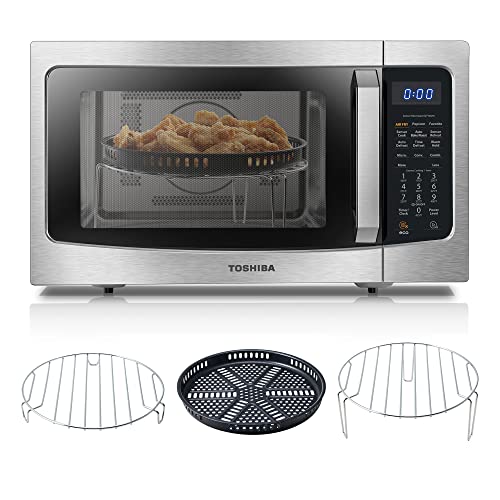
Toshiba 4-in-1 Air Fryer Combo 1.5 Cu.Ft — Best Multi-Function
Toshiba’s 4-in-1 countertop combines a 1000-watt, 1.5 cubic foot microwave with air frying and convection in a single footprint, which makes it the pick for small kitchens that cannot house three appliances and for anyone whose oven is slow to preheat. It suits small households that air fry weekly and reheat daily. It is less suited to purist air-fryer owners — a basket air fryer still crisps faster per batch — and to families who need the microwave free while the convection runs, since one cavity can only do one job at a time.
Strengths
- Microwave, air fry, and convection in one appliance: a genuine counter-space consolidation.
- Smart sensor cooking and a mute function carry over Toshiba’s microwave competence.
- Position-memory turntable returns the plate to its starting orientation, a small daily pleasure.
Trade-offs
- Air fry batches are smaller than a dedicated basket air fryer handles.
- More modes mean a learning curve and more accessories to store.
- Premium tier compared with a plain 1.5 cubic foot microwave.
The right way to judge a combo unit is whether its secondary functions are real. Toshiba’s convection and air fry modes here are real: they brown, they crisp, and they use the same cavity efficiently, which is why this model keeps appearing in small-kitchen recommendations. The compromise is throughput — one cavity, one task — so a household that air fries chicken while microwaving sides will still want separate appliances. For everyone else, the 4-in-1 is the smartest footprint bargain in this guide.
Best for: small kitchens consolidating appliances / Not suited for: households that run microwave and air fryer simultaneously.
Check the current price on Amazon


Panasonic NN-SN76LS — Best Premium
The NN-SN76LS is Panasonic’s Cyclonic Inverter flagship in a 1.6 cubic foot countertop body: 1250 watts delivered with the evenness that only inverter power gives, distributed by a cyclonic system designed to remove hot and cold spots across a large cavity. It suits big households that also care about quality — the rare combination of family capacity and delicate reheating. It is less suited to tight counters and tight budgets alike; it is the largest and most premium pick here.
Strengths
- Cyclonic Inverter delivery targets the cold-center problem that plagues large-cavity microwaves.
- Genius Sensor cooking scales Panasonic’s best reheating to family-size loads.
- 1250 watts makes it the fastest full-size pick in this guide.
Trade-offs
- Premium tier — the highest in this guide.
- Large, deep footprint demands a serious counter run.
- More capability than a reheat-only household will ever touch.
Large microwaves usually trade evenness for size: the bigger the cavity, the more the edges overcook while the center lags. The cyclonic inverter design exists specifically to break that trade, and in a 1.6 cubic foot family machine it is the difference between a casserole that reheats as one dish and one that reheats as a ring and a core. If your household is big and your leftovers are good, this is the microwave that treats both with respect — check the current price on Amazon before deciding, since Panasonic’s flagship models move between tiers with promotions.
Best for: large households wanting premium, even reheating / Not suited for: small counters or budget-first buyers.
Check the current price on Amazon
Comparison Table
| Pick | Badge | Key spec | Best for |
|---|---|---|---|
| Toshiba EM131A5C | Best Overall | 1.2 cu ft, 1000W, humidity sensor | Most households |
| COMFEE’ EM720CPL-PM | Best Compact | 0.7 cu ft, 700W, mute + ECO | Dorms and small apartments |
| Panasonic NN-SN65KB | Best Inverter | 1.2 cu ft, 1200W inverter, Genius Sensor | Even reheating of real food |
| Farberware 1.6 Cu.Ft | Best for Families | 1.6 cu ft, 1100W, sensor + multi-stage | Family-size loads |
| Toshiba 4-in-1 | Best Multi-Function | 1.5 cu ft, 1000W, air fry + convection | Small kitchens, fewer appliances |
| Panasonic NN-SN76LS | Best Premium | 1.6 cu ft, 1250W Cyclonic Inverter | Large households, premium quality |
How to Choose a Countertop Microwave
Wattage is cooking speed, and the boxes assume 1000 watts. Frozen meal directions, popcorn timing, and most published microwave recipes are calibrated around 1000 to 1100 watts. At 700 watts, everything takes roughly a third longer and large portions heat less evenly; at 1200 watts and above, you gain speed but must watch small portions, which can overshoot. For a primary kitchen microwave, 1000 watts is the floor worth buying; 700-watt models are reheating appliances for one person.
Capacity should be measured at the turntable, not the spec sheet. Cubic feet are calculated in ways that flatter. What decides whether your dish fits is turntable diameter and interior height: 12.4 inches takes a standard dinner plate, roughly 13.6 inches takes large plates and many casseroles, and the compact class around 10 inches takes bowls and mugs only. Measure your largest regular dish and shop against that number.
Inverter versus conventional is the real technology fork. Conventional microwaves pulse full power to simulate low settings; inverters genuinely reduce power. If you melt, soften, proof, or defrost delicate food, or reheat sauced dishes you care about, inverter is worth its premium. If your microwave boils water and reheats pizza, it is not, and the money is better spent on capacity or a sensor.
Sensors beat timers. A humidity or Genius Sensor watches the food’s steam and ends the cycle when the food is done, which forgives the two universal microwave errors: wrong weight guesses and wrong time guesses. Any household that reheats leftovers more than twice a week should treat sensor reheat as a must-have feature.
Plan the counter, not just the cavity. Countertop microwaves need clearance for ventilation — typically a few inches at the sides and top — and the door swing needs a clear arc. Measure the counter run, check the depth including the door handle and the cord bump at the back, and confirm the cabinet above can take the height plus clearance. The Farberware and Panasonic 1.6 models in this guide are wonderful machines that have been returned to warehouses purely for being deeper than the counter they were bought for.
Doors and controls decide daily friction. Push-button doors, like the BLACK+DECKER’s in the extended list, open with an elbow when your hands are full and never wear out a handle mechanism; handle doors feel more substantial and suit households that dislike the push-button pop. On controls, the hierarchy of convenience runs: one-touch express keys (press 1 for one minute) at the top, then preset menus you will actually use, then everything else. Dial controls, beloved on retro-styled compacts, are charming and imprecise in equal measure. If two models are otherwise tied, choose by the door and the first three buttons — those are the parts of a microwave you touch every day, and the parts whose annoyance compounds.
How to Use a Countertop Microwave Well
Most disappointing microwave results are technique problems, not appliance problems. Work through these habits and even the compact pick in this guide will outperform a careless flagship:
- Arrange food in a ring with the thickest parts outward; the center of the turntable receives the least energy.
- Cover with a microwave-safe lid or plate — covering traps steam, speeds cooking, evens the result, and keeps the cavity clean.
- Use standing time as part of the recipe: two minutes of rest after the beep lets temperatures equalize, which is when reheating actually finishes.
- Stir or rotate halfway through large portions, especially in non-inverter models.
- For defrosting, use the sensor or weight-based program and separate pieces as soon as they loosen, rather than running one long cycle.
- Heat sauces and soups in short bursts with stirring; liquids can superheat and erupt when disturbed after a long still cycle.
- Keep the cavity clean — dried splatter absorbs energy and creates hot spots and odors that transfer to the next dish.
Common Buying Mistakes
- Buying by cubic feet alone. A 1.1 with a 12.4-inch turntable is more useful than a nominally larger model with a small plate and low interior height.
- Under-buying wattage for a family. A 700-watt compact serving four people means queues at dinner time and uneven results on big portions.
- Paying for an inverter you will never feel. If nothing delicate ever enters your microwave, a good conventional sensor model is the smarter spend.
- Ignoring the mute button. In studios, nurseries-adjacent kitchens, and open-plan homes, a silent microwave is a quality-of-life feature, not a gimmick.
- Forgetting ventilation clearance. A microwave wedged into an exact-fit cubby runs hot and dies young; leave the clearances the manual asks for.
- Assuming the box directions match your wattage. At 700 or 1250 watts, printed times are wrong in opposite directions; adjust and use the sensor when you have one.
Wattage Classes Explained: 700, 900, 1000, 1100, and 1200+ Watts
Countertop microwaves cluster into wattage classes that behave more differently than the numbers suggest, because cooking time scales with power while evenness often scales against it. The 700-watt class — the COMFEE’ compact in this guide is its representative — exists for reheating single servings. Beverages, soup bowls, and popcorn are fine; anything thick or frozen needs added time and a stir, and package directions must be extended by roughly a third. These machines are honest appliances for one person and frustrating appliances for four.
The 900-watt class is the transitional tier: noticeably quicker than 700 watts, still short of the standard. It appears mostly in 0.9 cubic foot models aimed at small families. If you are choosing between a 900-watt model and a 1000-watt model of similar size, choose the 1000 — the 900 saves little money and costs you compatibility with every printed direction in your freezer.
The 1000-watt class is the reference standard, and it is where the Toshiba EM131A5C and several siblings in this program sit. Frozen meals cook on their stated times, a mug of water boils in a couple of minutes, and family-size portions reheat in reasonable cycles. For most households this is the correct class, and the decision energy is better spent on size, sensors, and inverter technology than on chasing wattage above it.
The 1100-watt class, represented here by the Farberware 1.6, pairs family capacity with family speed: the extra hundred watts over standard is worth roughly ten percent on cooking time, which matters when the microwave runs six cycles at dinner. The 1200-watt and above class — both Panasonics in this guide — is where speed becomes a quality of its own: reheats finish before food dries, and inverter models deliver that speed without the hot-spot penalty. The caution at this class is small portions: a single pastry or a baby bottle of milk can overshoot in seconds, so sensor programs and lower power levels stop being conveniences and become necessities.
Countertop vs Over-the-Range vs Built-In: Which Format Belongs in Your Kitchen?
This guide is about countertop models, but the format question is worth settling before you buy, because switching formats later is a renovation, not a purchase. Countertop models are the flexible default: no installation, movable between homes, replaceable in an afternoon, and available in every size class from 0.7 to 2.2 cubic feet. Their cost is counter space — a permanent footprint of roughly two square feet on your work surface.
Over-the-range models reclaim that counter space and add ventilation for the cooktop below, at the price of professional installation, a fixed position, and capacities that are wide but shallow. They make sense in small kitchens with a range below and no room for a separate hood. Built-in and drawer models integrate into cabinetry for the cleanest look and the highest cost, and they belong to planned remodels rather than appliance replacements. For renters, first homes, and anyone whose kitchen layout may change, countertop remains the rational format — which is why the countertop market is where manufacturers put their newest sensor and inverter technology first, as the picks in this guide show.
Materials, Safety, and What You Should Never Put in Any of These Microwaves
Every pick in this guide is safe with the right containers and unwise with the wrong ones, and the rules are about physics, not brand. Use microwave-safe glass, ceramic, and labeled plastics; the “microwave-safe” designation means the container itself will not melt, warp, or leach under microwave energy. Never use metal of any kind in a plain microwave — foil, twist ties, metal-trimmed plates, and travel mugs with steel liners all arc. The one exception in this guide is the Toshiba 4-in-1’s convection and air fry modes, which are conventional heating modes that follow oven rules; its manual specifies which racks belong to which mode, and the modes must never be confused.
Three further habits keep any countertop microwave safe and long-lived. Keep the door seals clean and inspect them: the door and its choke seal are what contain the energy, and a warped or damaged door is a stop-using-it fault, not a cosmetic issue. Never run the cavity empty, which can damage the magnetron — the component whose replacement costs more than a compact microwave. And respect superheated liquids: water heated still in a smooth cup can erupt when moved, so use a container with some texture, avoid over-long cycles, and let beverages stand briefly before handling. Child safety locks, fitted to most picks here, exist because a microwave’s controls are at exactly toddler eye height on many counters; enable the lock if small children visit your kitchen.
Sensor Cooking, Explained: Why It Matters More Than Another Preset Button
Open the door of almost any microwave in this guide and you will find a small screened vent or sensor window. That sensor is doing the most useful work in modern microwaving. As food heats, it releases steam; a humidity sensor measures that steam and infers how much water the food has given up, which correlates closely with doneness. Toshiba’s smart humidity sensor, Panasonic’s Genius Sensor, and Farberware’s smart sensor cooking are three implementations of the same idea, and all three beat the alternative — a fixed timer chosen by a marketing department — because your leftovers are never the exact weight and starting temperature the timer assumed.
In practice, sensor reheat is the feature that converts microwave skeptics. A plate of last night’s roast comes back hot through the middle without cremated edges, because the machine stops when the steam says stop. Sensor defrost similarly adjusts as the food thaws rather than blasting on a schedule. Where sensors still need your help: very dry foods release little steam, mixed plates confuse the average, and covering the food — which you should do anyway — makes the steam signal stronger and the result better. When you compare two otherwise similar models in this guide, the one with the better sensor story is the one to buy; it is the difference you will feel every single day, long after you have forgotten the wattage.
Turntable vs Flatbed: The Interior Design Choice
Most countertop microwaves, including every pick above, use a turntable: a rotating glass plate that moves food through the energy pattern so it heats evenly. Turntables are proven, cheap to replace, and easy to clean — the plate lifts out and goes in the sink. Their limits are shape and size: a long rectangular dish cannot rotate, and the plate’s diameter caps the largest dish you can use, which is why this guide quotes turntable sizes alongside cubic feet.
Flatbed designs remove the plate and distribute energy from below or with a rotating antenna hidden under the floor. The whole rectangular floor becomes usable, which suits casserole dishes and two-bowl reheats, and there is no plate to wash or to shatter. The trade-offs are price — flatbeds sit in premium tiers — and a smaller model selection. Panasonic’s flatbed engineering appears in this batch’s wider cluster (the 1200-watt flatbed NN-SF57RM is covered in our 1200-watt guide), and it is the direction to look if your cooking is dish-shaped rather than plate-shaped. For most households, a turntable model with a generous plate diameter remains the value answer.
Cleaning and Maintaining a Countertop Microwave
A microwave’s worst enemy is its own splatter. Dried food residue absorbs microwave energy, creates hot spots, holds odors, and eventually bakes into a glaze that flavors everything after it. The maintenance routine is five minutes a week: heat a bowl of water with a slice of lemon or a splash of vinegar for three minutes, let the steam stand for two more, then wipe the cavity, the door frame, and the seal area with a soft cloth. The turntable and its roller ring go in warm soapy water. That is genuinely all of it — models in this guide with easy-clean interior coatings, like the Toshiba EM131A5C, simply make the wipe faster.
Two less obvious habits extend a microwave’s life. First, respect the ventilation: keep the side and top vents unobstructed and resist storing bread and cookbooks on top of the unit. Second, treat the door gently — slamming fatigues the latch switches, and a door that does not register as closed is the most common reason an otherwise healthy microwave refuses to start. If the display works but the turntable and fan never engage, suspect the door switches before you suspect the magnetron, and know that switch replacement is one of the few microwave repairs that is economical. Everything else about these machines is solid-state patience: keep them clean, keep them vented, and they repay you for years.
Rounding Out the Ten: Four More Verified Models Worth a Look
Because this search asks for ten, here are the four verified models that sit just below the six full reviews — each pinned to Amazon’s catalog on 2026-11-20, each a legitimate buy for the right kitchen, and each kept out of the top six for a specific reason rather than a lack of merit.
BLACK+DECKER 1.1 Cu.Ft, 1000W (Stainless Steel) is the budget anchor of the standard class: push-button door, child safety lock, six auto menus, and the full 1000 watts in the 1.1 size. It misses the top six only because it has no sensor cooking and no mute — the two features the Toshiba EM131A5C uses to pull ahead. If your budget is the deciding factor in the standard class, this is the one; check price on Amazon, since it is frequently the lowest-tier name-brand option in the size.
Sharp SMC1162KS 1.1 Cu.Ft, 1000W (Stainless Steel) is the traditionalist’s pick: Sharp has built microwaves longer than almost anyone, the Carousel turntable is the original, and the 12.4-inch plate matches the class standard. It is a straightforward, well-made machine whose controls favor people who type a time and press start. It sits below the line because its preset and sensor story is thinner than Toshiba’s and Chefman’s at the same size.
Chefman 1.1 Cu.Ft, 1000W (Black) is the quiet-night pick: it matches the class on power and size, then adds the mute button and ECO mode that apartment dwellers and parents of sleeping babies actually use, plus express-cook presets that start with a single press. In black it also disappears into dark kitchens better than any stainless rival. It ranks here rather than above because Chefman’s long-term parts support is less established than Toshiba’s or Sharp’s.
Frigidaire 1.1 Cu.Ft, 1000W (Stainless Steel) is the appliance-brand option: ten power levels, auto defrost, and the comfort of a name that also makes the refrigerator beside it. It is a sound, unshowy machine that does the standard class correctly. It rounds out the ten as a reminder that at 1.1 cubic feet and 1000 watts, you are choosing among several competent machines — and the differentiators that matter are sensors, mute functions, and support, not the badge.
Read together, the ten tell the real story of this market in 2026 and beyond: two or three genuinely differentiated designs (inverter, sensor-led, multi-function) and a competitive standard class where small livability features decide the ranking. Buy anywhere in this ten with confidence; buy outside it only after checking the model against the criteria in the buying guide above.
Final Recommendation
Buy the Toshiba EM131A5C if you want one dependable microwave that handles a normal household without drama — it is the balance point of size, power, sensor smarts, tier, and everyday reliability. Buy the Panasonic NN-SN65KB if reheating quality is your priority, the Farberware 1.6 if volume is, the Toshiba 4-in-1 if counter space is, the COMFEE’ if the space is a dorm, and the Panasonic NN-SN76LS if you want the flagship and have the counter for it. Every one of these was verified against Amazon’s catalog on 2026-11-20; check price on Amazon from the links, since this category discounts aggressively.
Related guides in this cluster: Best 1000 Watt Countertop Microwaves, Best 1200 Watt Microwaves, Best 1.1 Cu Ft Microwaves, Best 2.2 Cu Ft Microwaves.
A Note on Model Numbers and Listing Variants
Countertop microwaves are sold under model numbers that change with finish, bundle, and retailer, which is why this guide verifies by model rather than by product name alone. The same Toshiba EM131A5C platform appears in stainless and in black under a sibling listing; Panasonic’s NN-SN65K series splits into black and white variants that are mechanically identical. When you shop from these links, the finish in the listing title is the finish you receive — check it before checkout if you are matching appliances, and do not be surprised that a variant in another color carries its own listing and its own stock rhythm. What does not change between variants is the cavity, the wattage, and the sensor system, so a recommendation in this guide follows the platform, not the paint.
Related guides
Frequently Asked Questions
How many watts should a countertop microwave have?
For a primary kitchen microwave, 1000 watts is the practical standard because package directions and recipes assume it. Compact 700-watt models suit one-person reheating; 1100 to 1250 watts cook faster and handle family portions better, at the cost of vigilance with small items.
What size microwave fits a full dinner plate?
Look for a turntable of at least 12.4 inches, which typically means a 1.1 or 1.2 cubic foot model. Compact 0.7 cubic foot models fit bowls and mugs but not standard dinner plates.
Is an inverter microwave worth it?
If you reheat sauced or delicate food, melt ingredients, or defrost meat regularly, yes — continuous low power visibly improves all four. If your use is beverages and frozen convenience food, a conventional sensor model serves you just as well for less.
Why does my microwave heat unevenly?
Microwave energy distributes in patterns, which is why turntables exist. Ring arrangement, covering food, stirring midway, and standing time fix most unevenness. Inverter models with sensor cooking reduce it further by delivering steadier power.
Can a countertop microwave replace an oven?
For reheating and small cooking tasks, largely yes; for browning and baking, only convection or air-fry combo models like the Toshiba 4-in-1 genuinely substitute, and only in small batches. A plain microwave cannot brown food.
How long should a countertop microwave last?
With ventilation clearance respected and the cavity kept clean, a countertop microwave from a major brand typically serves for many years of daily use. The most common early failures are door switches and control panels on the cheapest models — another reason this guide sticks to verified, established models.


