Disclosure: As an Amazon Associate, airfryerkitchensupply.com earns from qualifying purchases. Links on this page are affiliate links; they cost you nothing extra. Prices and availability change often, so check the current Amazon listing before you buy.
If you are weighing an air fryer vs convection toaster oven decision, you are not really choosing between a good appliance and a bad one. You are choosing between two different shapes of fast, fan-driven cooking, and the right answer depends on what lands on your counter most often. A basket air fryer is a compact, focused crisping machine. A convection toaster oven is a small, versatile oven that happens to crisp very well. Both use a fan to move hot air around food. Both can roast vegetables, reheat leftovers, and cook frozen snacks far better than a microwave. Where they part company is capacity, versatility, footprint, and how forgiving they are when dinner is not just one tray of fries.
This guide works through that choice honestly. It starts with a quick verdict, puts the two formats side by side in an early comparison table, and then judges them criterion by criterion, with a clear winner named in each section. After that you will find six concrete models worth considering — three basket air fryers and three convection toaster ovens — each checked against the manufacturer’s current Amazon listing, followed by a decision guide, practical how-to advice for getting the best from whichever format you buy, the mistakes that make people regret their purchase, and answers to the questions readers ask most.
Air Fryer vs Convection Toaster Oven: The Quick Verdict
Choose a basket air fryer if most of your countertop cooking is crisping: fries, wings, nuggets, roasted vegetables, reheated pizza slices, and weeknight proteins for one to four people. Nothing in its price class crisps quite as fast or as evenly in a small batch, cleanup is usually a single basket and drawer, and the appliance itself takes up the least counter space of the two formats.
Choose a convection toaster oven if your countertop cooking is broader: toast in the morning, a tray of cookies or a whole pizza at lunch, a casserole or sheet-pan dinner in the evening, and only sometimes a batch of wings. The oven format does more jobs, holds more food in a single layer, and replaces more of what a full-size oven does. Its air-fry mode is genuinely good, even if a dedicated basket still edges it for pure crisping speed on small loads.
Choose both only if you cook a lot and have the counter and storage to justify it. Many households do end up with a small basket fryer for snacks and sides alongside an oven for baking and family meals, but buying both on day one is rarely necessary. Pick the format that matches the meals you actually repeat, live with it for a few months, and add the second only if a real gap keeps showing up.
Key takeaways
- Both formats cook with fan-circulated hot air; the difference is chamber shape, size, and how many other jobs the appliance can do.
- Basket fryers crisp small batches faster and clean up more easily; convection toaster ovens hold more, toast and bake properly, and handle mixed meals better.
- Capacity numbers mislead: usable single-layer space matters more than headline quarts or cubic feet.
- If toast, pizza, and baking matter weekly, lean oven. If crisping is the daily job, lean basket.
- Counter depth and cabinet clearance rule out more purchases than cooking performance ever does, so measure first.
In this guide
The Two Formats at a Glance
| Criterion | Basket air fryer | Convection toaster oven |
|---|---|---|
| Core strength | Fast, intense crisping of small to medium batches | Versatility: toast, bake, roast, broil, and air fry in one box |
| Typical capacity | Roughly 4 to 6 quarts in a deep basket | Roughly 0.6 cubic feet and up, with a wide flat rack |
| Best batch shape | Piled or shaken foods: fries, wings, vegetables | Flat, single-layer foods: pizza, toast, fillets, cookies |
| Preheat | Very short, often just a few minutes | Short to moderate, longer than a basket, far shorter than a full oven |
| Toast and baking | Limited; small bakes only, no real toast function in most models | A genuine strength, including multi-slice toast and full trays of baked goods |
| Cleanup | Basket and drawer, usually dishwasher-safe | Rack, tray, and crumb tray; more surfaces, more splatter area |
| Footprint | Tall and narrow | Wide and deep |
| Learning curve | Shake or flip halfway; watch the first batches closely | Rack position and mode selection matter more |
Read the table as a map, not a scorecard. The sections that follow explain where each row comes from, because a household that reheats two slices of pizza a week and a household that bakes bread every weekend should read the same table and reach opposite conclusions.
What Each Appliance Actually Is
How a basket air fryer works
A basket air fryer is a small, powerful convection chamber built around a single job. A heating element sits above a perforated basket, a fan drives hot air down and around the food at high speed, and the tight chamber means that air has nowhere to go except across the food’s surface. That intensity is the whole secret. Moisture is stripped from the surface quickly, browning follows, and foods that would need a large oven and a long preheat crisp in a fraction of the time. The basket shape encourages shaking, which re-exposes surfaces and evens out the result, and the drawer’s small volume is why preheating is almost an afterthought.
The same focus explains the limits. A deep, narrow basket is a poor home for a whole pizza, a tray of cookies, or anything that needs to lie flat and stay put. Most basket models bake respectably in a small pan, reheat well, and roast proteins beautifully, but they do those jobs inside a space designed first for crisping. When a manufacturer lists a basket fryer as a many-in-one appliance, the extra functions are real, yet they all share that one small chamber.
How a convection toaster oven works
A convection toaster oven is a miniature oven in the full sense: heating elements above and below a wide, flat cavity, a rack that slides at different heights, and a fan that can be switched on to circulate air for roasting and air frying. Without the fan it behaves like a conventional small oven, which is exactly what toast, casseroles, and gentle baking want. With the fan running and a mesh basket or tray in place, it becomes an air fryer with a larger, flatter stage. Food spreads in a single layer, which is ideal for fillets, chops, and anything breaded that should not be piled up.
The trade is intensity. A bigger cavity with the same general class of heating power moves more air over more food, but the blast per piece is gentler than in a small basket. That is why the same wings often take a little longer in an oven, and why the oven rewards cooks who preheat properly and resist crowding the tray. In exchange you get a true second oven: holiday side dishes while the main oven holds a roast, summer baking without heating the whole kitchen, and breakfast toast without a separate appliance.
Why the names cause so much confusion
Marketing has blurred the line from both directions. Many toaster ovens now lead with their air-fry mode, and many basket fryers advertise oven-like functions, so shoppers reasonably ask whether the two have merged. They have not. The useful question is not what a product calls itself but what its chamber looks like: a deep perforated basket in a compact tower, or a wide cavity with racks, elements top and bottom, and a door. Chamber shape predicts your experience far better than the function count printed on the box, and every criterion below traces back to that shape.
countertop ovens with convection worth considering
Crisping Power: Where the Basket Still Wins
For a single layer of fries or a pound of wings, the basket fryer remains the crisping champion, and the reason is simple physics rather than brand magic. The small chamber concentrates hot, fast air; the perforated basket lets that air reach the underside without a flip in many cases; and shaking halfway redistributes pieces so every side takes a turn in the stream. Frozen foods in particular show the gap: they go from icy to shattering with less fuss, and the margin for error is wider because the intense airflow forgives a slightly crowded basket better than an oven tray forgives a crowded sheet.
The oven is not far behind, and for some foods it is better. Anything flat and delicate — breaded fish fillets, schnitzel, tofu planks, a tray of nachos — crisps more evenly when it can lie still in one layer instead of tumbling in a basket. Oven air-fry modes paired with a mesh tray produce excellent results, provided you preheat, leave gaps between pieces, and accept a few extra minutes. Where ovens lose ground is piled food: a heaped tray of fries steams itself, while the same heap in a basket, shaken twice, comes out crisp.
Verdict: basket fryer for piled, frozen, and snack-style crisping; a draw for flat foods cooked in a disciplined single layer. If crisping is ninety percent of what you will do, this section should carry the most weight in your decision.
Capacity and Batch Cooking: Where the Oven Pulls Away
Headline capacity is the most misleading number in this category. Basket quarts describe a deep container, but crisping quality collapses when food is stacked more than a couple of pieces deep, so the usable crisping surface of a mid-size basket is roughly one generous layer plus a modest second. Oven cubic feet sound abstract, yet the wide rack tells the truth at a glance: a large pizza fits, a quarter sheet pan fits in bigger models, six slices of toast fit, and a family pack of chicken thighs can spread out instead of queuing for a second batch.
Second batches are the hidden cost of the basket format. Cooking fries in two rounds while chicken rests is fine once; doing it three times a week for a family of five becomes the reason an appliance gathers dust. Households of one or two rarely hit that wall, and for them the basket’s smaller batches are a virtue — less energy, less preheat, less washing up. Households of four or more, anyone who meal-preps on Sundays, and anyone who cooks two components at once should weight this section heavily toward the oven, or toward the largest basket formats and dual-basket designs.
Verdict: oven, clearly, for families, entertainers, and batch cooks; basket for singles, couples, and side-dish duty alongside a main oven.
large-capacity air fryers for bigger households
Versatility: Toast, Baking, and Everything Beyond Crisping
Ask what else the appliance will do on an ordinary Tuesday and the oven’s case becomes hard to argue with. It toasts bread and bagels properly, with elements on both sides and room for several slices. It bakes muffins, cookies, and small cakes in real pans. It broils cheese on soup, reheats a casserole without drying the edges, keeps plates warm, and in larger models roasts a whole chicken or a holiday side dish while the main oven is occupied. Each of those jobs is unglamorous, and together they are why oven owners tend to use their appliance daily.
A basket fryer covers a narrower band, but covers it well: crisping, roasting small items, reheating fried foods and pizza slices back to life, and cooking frozen convenience foods better than any other method. Some models dehydrate, bake a small cake in a fitted pan, or proof dough, and resourceful cooks do surprising things in them. Still, there is no honest way to toast four slices of bread in a basket, and a batch of cookies becomes an exercise in patience. If your kitchen lacks a working toaster and your oven is slow or unreliable, the convection toaster oven consolidates three appliances into one footprint.
Verdict: oven, by a wide margin. Versatility is its defining advantage, just as focused crisping is the basket’s.
Speed and Preheating
Both formats beat a full-size oven comfortably, because neither has to heat a large steel box before cooking can start. Between themselves, the basket is quicker off the mark: its chamber is so small that a brief preheat, or none for many foods, gets cooking underway almost immediately, and total times for snacks and sides are typically the shortest available. The oven needs a real preheat to bake and toast evenly, and its larger cavity takes a few minutes longer to reach temperature, though it remains far faster than a conventional oven and often finishes family-size loads sooner overall because everything cooks at once instead of in rounds.
Judge speed by the meal, not the stopwatch on a single fry. A basket wins a race to one portion of wings. An oven wins the race to dinner for five, because the second and third basket batches erase the head start. Weeknight cooks who value walking away should also note that both formats benefit from a midway check: shake the basket, or rotate the tray, and either appliance repays the ten seconds it takes.
Verdict: basket for single-batch speed; oven for whole-meal speed once batches multiply.
Counter Space, Storage, and Kitchen Fit
More purchases fail on measurements than on cooking. Basket fryers grow upward: a modest square footprint with significant height, which suits narrow counters but can clash with low upper cabinets when the drawer opens and steam escapes. Convection toaster ovens grow outward: a wide, deep rectangle that demands a proper stretch of counter, clearance behind and above for heat, and room for the door to swing or drop without meeting the counter edge. Manufacturers publish exterior dimensions, and you should compare them against your actual space with a tape measure, including the often-forgotten depth added by a handle and a rear cord.
Storage changes the picture for renters and small kitchens. A basket fryer can live in a deep cabinet or pantry and come out for use, which makes its footprint part-time. Most ovens are heavy and awkward enough that they effectively become permanent counter residents, so the honest question is whether you are willing to give that counter away forever. If the answer is no, a basket you store happily beats an oven you resent. If the counter is available, the oven’s permanent presence is exactly why it gets used for toast every morning.
Verdict: basket for scarce or flexible space; oven only when a permanent, properly cleared home exists for it.
oven-style air fryers compared
Energy Use and Running Costs in Plain Terms
Both formats use considerably less energy than heating a full-size oven for a small or medium load, simply because the heated volume is so much smaller and cooking times are shorter. Between the two, the basket generally uses the least for a small batch — fewer watts drawn for fewer minutes in many typical models — while the oven draws more and runs longer but may still win per portion when it cooks a whole family meal in one pass instead of three. Exact figures vary by model and load, so treat any single wattage number as a description of that appliance, not a promise about your bill.
The running costs that owners actually notice are consumables and replacements: parchment liners or foil for trays, replacement baskets and racks over years of use, and the small but real cost of cooking sprays that damage nonstick coatings and then get bought again. Buy the format whose accessories you will genuinely maintain, and factor a fitted pan or spare tray into an oven purchase and a spare basket or liner habit into a fryer purchase.
Verdict: basket for the smallest loads, oven for per-portion efficiency at family scale; both comfortably ahead of a full oven for everyday jobs.
Cleanup and Day-to-Day Living
A basket fryer concentrates the mess. Grease and crumbs land in one drawer and one basket, most of which are dishwasher-safe in the models recommended below, and the interior wipes down in moments because there is barely any interior. The habits that matter are emptying crumbs before they bake on and washing the basket before the next use rather than the next day. Ovens spread the same mess across a rack, a tray, a crumb tray, and the cavity walls, and their air-fry trays in particular hold onto baked-on residue. None of it is difficult, but there is more of it, and the crumb tray is the most neglected component in the entire category — empty it weekly and the oven stays pleasant; forget it for a month and every preheat reminds you.
Smell and smoke deserve a mention. Fatty foods in any small, hot appliance can smoke if fat pools and overheats; a clean basket, a tray placed to catch drips in an oven, and a pause to drain excess fat solve nearly every case. Ventilation helps both formats, and neither should run tucked under a cabinet where steam and heat have nowhere to go.
Verdict: basket, for the simple reason that there is less of it to clean.
The Picks: Three Basket Fryers and Three Convection Toaster Ovens Worth Buying
The six models below were chosen to represent each format fairly rather than to crown one brand. Every linked model was checked against its current Amazon listing on 2026-11-23, and the specification boxes use only facts stated in those listings or universally true of the category. Read the basket picks if you have leaned that way, the oven picks if you have leaned the other way, and both if you are still undecided — the contrast between individual models often settles what the general argument could not.
Basket pick — the straightforward starter fryer

Ninja Air Fryer AF101, 4 Qt, 4-in-1
Badge: Best simple basket fryer for one to three people
- Format: basket air fryer, 4-quart capacity
- Functions: air fry, roast, reheat, dehydrate (4-in-1, per listing)
- Power: 1550W, per listing
- Listing note: fits 2 lbs of fries; dishwasher-safe parts
The AF101 is the argument for the basket format in its purest form: a compact tower, a single basket, four functions that all make sense in a small chamber, and no attempt to be an oven. Fries, wings, and roasted vegetables come out with the deep, even crisping this format is known for, reheated leftovers revive instead of steaming, and the dehydrate function handles herbs and fruit snacks without tying up a big oven for hours. For a first air fryer, or a household of one to three, it covers the daily jobs with the least counter commitment of any pick here.
Strengths
- Focused design that does the core crisping jobs very well
- Small footprint and quick starts suit everyday side dishes and snacks
- Dishwasher-safe parts keep cleanup to a few minutes
Trade-offs
- Four quarts means second batches for larger families
- No toast or true baking capacity beyond small pans
- Single basket, so two foods at different settings cook in sequence
Best for: singles, couples, and small households whose main wish is faster, crisper snacks and sides. / Not suited for: families cooking full meals in one pass or anyone wanting to retire a toaster oven.
Basket pick — the roomier everyday fryer

COSORI Air Fryer Pro LE, 5 Qt, 9-in-1
Badge: Best basket fryer for families of three to four
- Format: basket air fryer, 5-quart capacity
- Functions: 9-in-1 including air fry, roast, bake, dehydrate, broil, frozen, and reheat, per listing
- Details from listing: ceramic coating, shake reminder, maximum 450°F, 1500W
- Controls: touch control with LED glass panel, per listing
One step up in size changes the basket experience more than the numbers suggest. Five quarts holds a family portion of vegetables or a generous batch of wings with enough room for air to do its work, the shake reminder prompts the midway toss that separates good results from great ones, and the higher maximum temperature gives skin and edges the finish that lower-powered baskets sometimes miss. The function list is longer than the Ninja’s, and while the extras share the same chamber, having bake, broil, and frozen presets tuned in saves guesswork on weeknights.
Strengths
- Family-useful capacity without an oven-size footprint
- Shake reminder builds the habit that improves every batch
- Wide temperature range up to the listing-stated maximum suits both gentle reheating and hard crisping
Trade-offs
- Still a single deep basket, so flat foods and pizzas are not its game
- Nine functions can invite more menu-diving than some cooks want
- Family-of-five loads will still sometimes need a second round
Best for: families of three to four who crisp most days and want one basket to handle nearly all of it. / Not suited for: cooks who need toast, sheet-pan space, or simultaneous cooking of two dishes.
Basket pick — the larger stainless option

Instant Vortex Plus 6QT XL Air Fryer, 6-in-1
Badge: Best larger basket for bigger batches
- Format: basket air fryer, 6-quart XL capacity
- Functions: 6-in-1 — crisps, broils, roasts, dehydrates, bakes, and reheats, per listing
- Finish: stainless steel, per listing
- Listing note: dishwasher-safe basket
If you like everything about the basket format except the batch size, this is the natural landing spot. Six quarts is the point where a whole family portion of fries or a large batch of wings cooks in one confident round for many households, and the broil function adds a finishing blast that smaller lineups sometimes lack. The stainless finish suits kitchens where appliances live on display, and the six functions stay sensibly chosen — nothing here pretends to toast, and everything here benefits from the big basket.
Strengths
- The largest basket here, reducing second batches for most families
- Broil adds a useful finishing option for cheese and glazes
- Straightforward function set that matches what a basket does best
Trade-offs
- Larger body needs more counter and storage room than the smaller baskets
- Even at six quarts, very large or flat items belong in an oven
- One chamber still means one temperature at a time
Best for: bigger households committed to the basket format and tired of cooking in rounds. / Not suited for: tiny counters, or cooks whose wish list starts with toast, pizza, and baking trays.
air fryer and toaster oven combinations explained
Oven pick — the full second oven
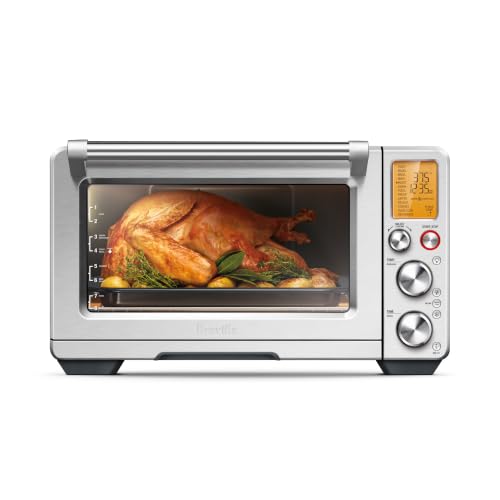
Breville Smart Oven Air Fryer Pro BOV900, Brushed Stainless Steel
Badge: Best convection toaster oven for keen cooks
- Format: countertop convection oven with air fry
- Functions: 13 functions including roast, bake, and dehydrate, per listing
- Listing note: convection setting reduces cooking time by up to 30 percent, per listing
- Finish: brushed stainless steel
This is the oven format at full stretch: thirteen functions, a cavity that behaves like a genuine second oven, and convection power that makes its air-fry mode a serious tool rather than a badge. It roasts a chicken, bakes through the weekend, dehydrates a harvest, and still crisps a tray of wings on Friday. Cooks who enjoy dialing in a method rather than pressing a single preset will get the most from it, and households that host will feel the benefit every time the main oven runs out of room.
Strengths
- The broadest cooking range of any pick in this guide
- Real second-oven capacity for baking, roasting, and holiday overflow
- Strong convection performance for tray-style air frying
Trade-offs
- The largest commitment of counter space among these picks
- More modes and rack positions to learn than a basket fryer
- Cleanup covers rack, tray, and cavity rather than one drawer
Best for: keen cooks, bakers, and hosts who want a true second oven that also air fries. / Not suited for: minimal counters or anyone who only ever crisps small snacks.
Oven pick — the balanced family oven

Cuisinart Air Fryer Toaster Oven TOA-70, 8-in-1
Badge: Best all-round convection toaster oven for most families
- Format: countertop air fryer toaster oven, 0.6 cubic feet
- Functions: 8-in-1 with air fry, convection, broil, and warm, per listing
- Power and timer: 1800W; 60-minute timer, per listing
- Finish: stainless steel (TOA-70NAS, per listing)
For many households this is the sweet spot of the whole comparison: big enough for a family pizza night and a tray of roasted vegetables, straightforward enough that nobody needs a manual after the first week, and honest about covering the daily jobs — toast, bake, broil, warm, and air fry — in one appliance. Its air-fry results on tray foods are exactly what most families ask for, and the warm function quietly rescues late dinners and second helpings. If the versatility section of this guide sounded like your kitchen, start your shortlist here.
Strengths
- Covers the full daily range from morning toast to evening roasts
- Family-size cavity without the footprint of the largest ovens
- Simple, familiar oven logic that every household member can use
Trade-offs
- Basket fryers still crisp piled fries and wings a touch faster
- Several parts to wash after a full roast dinner
- Needs permanent, well-cleared counter space
Best for: families replacing a toaster and gaining an air fryer and second oven in one move. / Not suited for: single-snack cooking in the smallest kitchens.
Oven pick — the high-capacity smart oven

Ninja Prestige Smart XL Countertop Oven DT501, 10-in-1
Badge: Best large oven for big, mixed meals
- Format: countertop oven, Smart XL size
- Functions: 10-in-1 including air fry, bake, toast, pizza, and reheat, per listing
- Power: 1800W, per listing
- Listing notes: bakes 20 cookies; fits a 12 lb turkey
Ninja built its name on basket fryers, and this oven shows what happens when that crisping know-how moves into a wide cavity. The listing’s own benchmarks — a full batch of cookies, a turkey-size bird — describe the intended user: someone cooking complete meals, not just sides. Ten functions cover the family repertoire, toast and pizza have dedicated modes rather than workarounds, and the air-fry performance benefits from a brand that treats crisping as the headline act. It asks for serious counter space and gives serious capacity in return.
Strengths
- Meal-scale capacity, including large roasts per the listing
- Dedicated toast and pizza functions alongside strong air frying
- One appliance that can carry a full family dinner alone
Trade-offs
- Among the widest footprints here; measure carefully before ordering
- Overkill for a household that mostly reheats for one
- More tray and rack washing than any basket pick
Best for: large families and meal-focused cooks who want oven capacity with fryer-grade crisping. / Not suited for: small apartments or snack-only use.
How to Choose: A Decision Guide in Five Questions
Question one: what will you cook in week three?
Ignore the aspirational answer and list what you cooked in the last three ordinary weeks. If the list is fries, wings, vegetables, nuggets, and reheated slices, a basket will serve nearly all of it brilliantly. If it includes toast most mornings, a weekly pizza, biscuits, casseroles, or sheet-pan dinners, the oven is already your answer. Most regret in this category comes from buying for an imagined cooking life — the bread baker you might become — instead of the repeat meals that actually fill your weeks.
Question two: how many mouths, honestly?
Count regular eaters, not holiday guests. One or two people live happily inside a four- or five-quart basket. Three or four stretch it pleasantly with the larger baskets or a mid-size oven. Five or more, or regular batch cooking for the week ahead, points firmly at an oven or the largest basket formats, because batch fatigue is the number one reason mid-size fryers get replaced within a year.
Question three: where will it live?
Measure the counter, the cabinet height above it, and the depth from backsplash to edge, then compare those numbers with the manufacturer’s exterior dimensions and clearance guidance. Decide whether the appliance is a permanent resident or a stored guest, and be honest: a stored oven is an oven you will stop using, while a stored basket remains convenient. Renters with one clear stretch of counter should protect it fiercely.
Question four: which appliances could it replace?
An oven that genuinely retires a tired toaster and supplements a slow main oven earns its footprint twice over. A basket replaces nothing except perhaps a deep fryer, but it does its narrower job so well that replacement is the wrong test — ask instead how often the crisping job arises. If the answer is most days, the basket earns its space on frequency alone.
Question five: who cleans, and how do they feel about it?
Put the person who washes up in front of both formats. A single dishwasher-safe basket is a two-minute promise; racks, trays, and crumb trays are a ten-minute routine done cheerfully by some households and resented by others. Appliances that are annoying to clean get used less, whatever their cooking scores, so let the cleaner’s vote count double.
countertop toaster convection ovens compared
How to Get the Best From Whichever You Buy
Getting basket-fryer results right
Start with dry surfaces. Pat proteins and vegetables dry before seasoning, because surface moisture must evaporate before browning can begin, and a small chamber rewards every shortcut you give it. Use a light, even coating of oil on most foods — enough to help seasoning cling and heat transfer happen, not so much that it pools in the basket. Spread food in a loose layer with gaps wherever the batch allows, and treat the halfway shake or flip as part of the recipe rather than an optional flourish. Finally, pull food a minute early the first few times you cook a new item and check it; basket fryers run hot and fast, and your own notes from three test batches will teach you more than any chart.
Getting convection-oven results right
Preheat properly, especially for baking and for air frying on a tray, because the larger cavity needs those minutes to deliver even heat from the first moment. Learn your rack positions: higher for broiling and finishing, middle for most roasting and air frying, lower for gentle baking. Use the mesh tray or basket accessory for air-fry mode so air reaches the underside, rotate the tray front to back halfway through larger loads, and leave space around the tray for circulation instead of sealing it edge to edge with foil. For toast and baked goods, remember the fan is optional in most models — delicate batters and cheeses often prefer still air, which is a freedom basket owners do not have.
Converting your favourite oven recipes
As a starting point, fan-assisted cooking usually wants a modestly lower temperature or a shorter time than a conventional oven recipe, and small appliances amplify that effect because the food sits closer to the heat. Begin conservatively, check earlier than the recipe suggests, and judge by colour, texture, and a thermometer for proteins rather than by the clock alone. Keep a short conversion notebook for your five most repeated dishes; after two or three cooks each, the settings will be yours and the guesswork disappears. Frozen packaged foods are the easy entry point in both formats — follow the pack’s fan-oven guidance if it gives one, then adjust by your own results.
Food safety and sensible habits
Use a food thermometer for poultry, ground meats, and reheated leftovers, whatever the appliance, and let rested proteins actually rest so juices settle. Keep the appliance on a heat-safe surface with the clearance its manual specifies, never run it under low cabinets where steam collects, and unplug before deep cleaning. Wash baskets, racks, and trays while they are still warm when you can, and descale your habits rather than the appliance: a quick wipe after fatty cooks prevents the baked-on film that makes any small oven smoke and smell later.
air fryer toaster models for combined duty
Common Mistakes When Choosing Between Them
Buying capacity by the headline number
Quarts and cubic feet describe volume, not usable cooking surface. Shoppers who buy a basket by quarts alone discover that crisping space is one layer deep; shoppers who buy an oven by its largest roast claim discover it swallows their counter. Judge by what fits in a single sensible layer for your most common meal, and let that test overrule the biggest number on the box.
Expecting one appliance to be best at everything
Every pick in this guide involves a genuine trade. Expecting basket-level crisping speed, oven-level capacity, toaster-level browning, and microwave-level convenience from a single purchase guarantees disappointment with an otherwise excellent appliance. Decide which two strengths matter most, buy the format that owns them, and let the rest be good enough.
Ignoring the toast test
Households underestimate breakfast. If bread, bagels, or English muffins appear most mornings, an appliance that cannot toast properly will annoy you daily, while its weekend crisping heroics fade from memory. Run the toast test honestly before choosing a basket-only kitchen, or budget counter room for keeping a small toaster alongside.
Forgetting clearance, cords, and doors
Heat needs somewhere to go. Ovens vent, baskets vent, and both dislike being boxed in by cabinets, walls, and clutter. Measure depth with the door open, check where the cord falls, and confirm that an oven door or a fryer drawer can open fully without striking anything. These checks take five minutes at home and prevent the most common returns in the category.
Judging by the first frozen snack
Both formats improve with three or four cooks of practice: seasoning levels, batch sizes, rack positions, and timing all settle in. A first batch of fries is a lesson, not a verdict. Give your chosen appliance a fair fortnight of ordinary meals before deciding it was the wrong format — most early disappointments trace back to crowding, skipped preheats, or unshaken baskets rather than to the machine.
Head-to-Head: Four Ordinary Meals, Judged Honestly
Frozen fries for two, on a tired weeknight
The basket wins without a contest worth staging. It starts almost immediately, the fries can be shaken rather than turned piece by piece, and the whole job finishes before a sauce is mixed and a salad is dressed. The oven makes good fries too, but it asks for a preheat, a tray, and a rotation, which is three more decisions than a tired cook wants to make for a side dish. Multiply this scene by two hundred evenings a year and you understand why basket owners describe their fryer as the most-used appliance they own.
Sunday baking while the main oven roasts lunch
The oven wins just as clearly. A tray of scones, muffins, or biscuits bakes in real pans at a steady, fan-optional temperature while the main oven is busy, and the results look like baking rather than improvisation. A basket can produce a small batch in a fitted pan, and determined bakers do it, but the shape fights the task at every step. If your weekends smell of baking, this scenario alone can settle the purchase.
Chicken thighs and vegetables for four, one appliance only
This is the closest contest of the four. In a large basket, the thighs crisp beautifully, but the vegetables either crowd in beside them or wait for a second round, and timing the two to finish together takes practice. In an oven, everything spreads across a tray in one layer, the vegetables roast in the drippings, and the whole dinner lands at once, with skin a shade less shattering than the basket’s best. Families who cook this meal weekly tend to prefer the oven’s calm; couples cooking a half portion tend to prefer the basket’s intensity.
Reheating yesterday’s pizza and fried chicken
Both formats redeem leftovers far better than a microwave, which steams crusts and skins into sadness. The basket revives one or two portions fastest, bringing fried coatings back to a genuine crunch. The oven reheats a whole pizza or a family spread of chicken in one pass, with the cheese melting as the base re-crisps. Call this one a draw decided by portion size, and note that either purchase will quietly end your household’s tolerance for soggy reheated food.
Noise, Heat, and Living With the Machine
Two practicalities rarely appear on specification sheets. The first is fan noise: both formats are audible, with smaller baskets often sounding busier because their fans work harder in a tighter space, while ovens tend toward a lower, steadier hum. Neither rivals a range hood, and neither is silent enough to ignore in a studio flat during a late-night snack run. The second is kitchen heat. Both appliances vent warm air and both will warm a small kitchen noticeably during a long roast, though either heats the room far less than a full-size oven running for the same meal — a difference that summer cooks feel immediately and appreciate all season.
Longevity follows care more than format. Nonstick baskets last for years when they are washed rather than scoured and when aerosol sprays, whose additives bake onto coatings, are kept away from them. Oven interiors stay pleasant when crumbs and splatters are wiped while fresh, and racks and trays survive best when they are not left soaking overnight as a habit. In both cases the appliance that gets a thirty-second tidy after dinner is the one still earning its counter in five years, so buy the format whose cleaning routine your household will actually keep.
Final Recommendation
If your kitchen life is crisping — snacks, sides, frozen foods, and quick proteins for a small household — buy the basket fryer and enjoy being right. The COSORI Pro LE suits most families in this camp, the Ninja AF101 is the cleanest starting point for one to three people, and the Instant Vortex Plus answers the call when batches keep outgrowing smaller baskets. You will cook faster, clean less, and give up the least counter to get it.
If your kitchen life is broader — toast at dawn, trays at noon, roasts and bakes in the evening, with crisping as one important job among many — buy the convection toaster oven. The Cuisinart TOA-70 is the balanced default for most families, the Breville Smart Oven Air Fryer Pro rewards keen cooks with true second-oven range, and the Ninja Prestige Smart XL carries the biggest mixed meals. You will replace more appliances, feed more people in one pass, and still crisp very well indeed.
And if you are genuinely split down the middle, choose by the tie-breakers in order: the toast test, the headcount, and the counter measurement. Those three facts, honestly faced, have settled this decision in more kitchens than any specification sheet ever will.
Frequently Asked Questions
Is a convection toaster oven the same thing as an air fryer?
Not quite, though they share the same core technology of fan-circulated hot air. A convection toaster oven is a wide, flat mini oven that can run with or without its fan, so it toasts, bakes, and broils like an oven and air fries when the fan and a suitable tray are used. A basket air fryer is a compact chamber designed only around fan-driven crisping. Think of the oven as a generalist that crisps well and the basket as a specialist that crisps fastest.
Which one makes crispier fries and wings?
For piled and frozen foods in small to medium batches, the basket fryer usually wins on both crispness and speed, because its small chamber concentrates hot air and the basket can be shaken midway. The oven matches it closely on flat foods spread in a single layer on a mesh tray, such as fillets or a single row of wings, provided you preheat and leave gaps between pieces. Crowding is the biggest variable in either format — an unhurried single layer in an oven beats an overstuffed basket.
Can a basket air fryer replace my toaster oven entirely?
Only if your toaster oven was mostly reheating and crisping small items anyway. A basket cannot toast several slices of bread, bake a tray of cookies in one round, or hold a casserole dish, so households that use those functions weekly will miss the oven quickly. If your oven’s real job has been frozen snacks, leftovers, and roasted vegetables for one or two people, a basket can take over completely and free the counter.
Which format is better for a family of five?
Usually the convection toaster oven, because family cooking is about cooking enough food in one pass: a full pizza, a sheet of vegetables, or a tray of chicken pieces without queuing batches. The largest basket fryers, including six-quart models, serve big families well for crisping duty specifically, especially alongside a main oven. If one appliance must carry whole family dinners alone, choose the oven; if it only handles sides and snacks while the main oven works, a large basket is enough.
Do I need to preheat either appliance?
A basket fryer needs little or no preheating for most crisping jobs, which is part of its speed advantage, though a brief warm-up helps delicate batters set. A convection toaster oven benefits from a proper preheat for baking, toasting evenly, and tray air frying, because its cavity is larger and its results depend on stable heat from the start. In both cases the preheat is measured in minutes, not the long wait of a full-size oven.
What if I have room for only one and I still cannot decide?
Write down your last ten countertop-cooking occasions and sort them into crisping versus everything else. If crisping is seven or more, buy the basket. If everything else is six or more, buy the oven. If the split is even, let toast decide: daily toast means oven, rare toast means basket. Then measure your counter against the specific model before ordering, because a perfect format in an impossible footprint helps nobody.
Related Guides
Keep exploring with these guides from the same kitchen collection: