A small convection oven uses a fan to move hot air around the food, which can speed up cooking and help browning. On a countertop it is a handy second oven for baking a small batch of cookies, roasting vegetables or reheating leftovers without heating the whole kitchen. Because the fan helps even out the heat, many people find the results more consistent than from a basic toaster oven.
The six ovens below range from a compact smart oven to wider models that hold a pizza. We lean toward baking and roasting rather than gadget features. Check the interior dimensions on the listing, since the shape of the cavity matters more than the outside. If you also like toast and snacks, a model with a toast shade control can serve double duty. We have not used these products ourselves, so confirm the details on the current listing before buying.
As an Amazon Associate we earn from qualifying purchases. Links below are affiliate links, and they do not change the product information we give.
What to Look For
| Feature | Why it matters |
|---|---|
| Interior size | A pan or pizza size you cook often should fit |
| Rack positions | More levels give more flexibility |
| Controls | Dials are simple; digital panels offer presets |
| Fan | A convection fan helps browning but adds noise |
| Cleanup | A nonstick interior and a removable crumb tray save time |
| Power | A strong element helps with browning, but check your circuit |
In this guide
Specs at a Glance
| Model | Type | Size class | Notes |
|---|---|---|---|
| Breville BOV450XL | Smart oven | Compact | Element IQ, per the maker |
| Hamilton Beach 31103DA | Convection | Mid | Dial controls |
| Panasonic NB-G110P | Compact oven | Small | Flash Xpress design |
| Oster Digital Convection | Convection | Mid to large | Digital panel |
| Nuwave Bravo XL | Smart oven | Mid to large | Presets and air fry |
| Black+Decker TO3250XSB | Convection | Large | Extra wide |
The 6 Best Small Convection Ovens
Top pickBest for small kitchens that bake
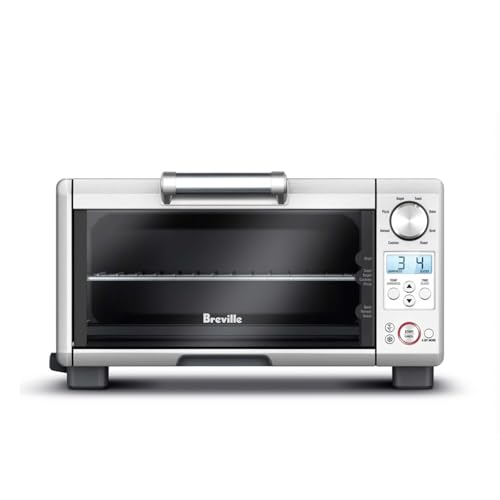
1. Breville BOV450XL Mini Smart Oven
A compact countertop oven from Breville with convection and several cooking presets. The maker says its element control adapts power during cooking. Review the listing for the exact presets and rack positions.
Suits: small kitchens that bake. Strengths: precise controls. Weaknesses: higher cost than basic models. Skip it if you want a simple dial.

Best for everyday baking
2. Hamilton Beach 31103DA Countertop Oven
A countertop convection oven from a familiar brand. It holds a small pizza or a pan of roasted vegetables. Check the current listing for the interior size.
Suits: everyday baking. Strengths: simple dial controls. Weaknesses: larger than tiny ovens. Skip it if you want a digital panel.
View Hamilton Beach 31103DA Countertop Oven on Amazon
Best for quick small jobs
3. Panasonic NB-G110P Flash Xpress Toaster Oven
A compact oven from Panasonic that uses a quick-heating design. It handles toast, small pizzas and reheating. Look at the listing for the dimensions and capacity.
Suits: quick small jobs. Strengths: speedy heating. Weaknesses: modest interior. Skip it if you need a big baking space.
View Panasonic NB-G110P Flash Xpress Toaster Oven on Amazon
Best for family-size small batches
4. Oster Digital Convection Countertop Oven
A digital convection oven from Oster with a larger interior. It suits those who want presets and enough room for a casserole dish. Confirm the interior and rack details on the listing.
Suits: family-size small batches. Strengths: digital presets and room. Weaknesses: a large body. Skip it if you have limited counter space.
View Oster Digital Convection Countertop Oven on Amazon

Best for crisp foods and baking
5. Nuwave Bravo XL Smart Oven
A smart oven that combines convection and air frying. It targets those who want one appliance for crisp food and baking. Review the listing for the accessories included.
Suits: crisp foods and baking. Strengths: many modes. Weaknesses: more features to learn. Skip it if you want only a basic oven.


Best for larger pans
6. Black+Decker Extra Wide Convection Oven
A wide convection oven that fits a large pizza or a 9-by-13 inch pan on some versions. Check the interior size on the listing. Check the exact interior width on the current listing.
Suits: larger pans. Strengths: wide interior. Weaknesses: a large footprint. Skip it if your counter is small.

Care and Setup
- Let the oven cool before cleaning.
- Use the crumb tray regularly.
- Check that pans fit with space around them.
- Avoid foil that blocks airflow.
- Give the oven room to vent.
- Wipe spills right away to avoid baked-on residue.
Mistakes to Avoid
- Using oversized pans that touch the heating elements.
- Blocking the fan with foil.
- Ignoring the manual’s preheat guidance.
- Expecting a full-size oven’s capacity.
- Skipping the manual’s safety clearance guidance.
- Letting grease build up around the fan.
How Convection Changes Baking Results
A convection fan keeps hot air moving across the food, which strips away the layer of cooler, moist air that surrounds it. The result is faster, more even browning and crisper edges. Cookies on a sheet bake more uniformly, roasted vegetables caramelize, and chicken skin crisps. Cakes and delicate pastries can be more sensitive, because the moving air can dry the top or set it before the center rises.
Because convection speeds things up, recipes written for conventional ovens often need adjusting. Many cooks lower the temperature a little or shorten the time and check early. Your oven’s manual may offer guidance, and your own experience will fill in the rest. Keep notes on what works in your specific oven, since small ovens vary in how their elements and fans are arranged.
It also helps to know when to switch the fan off. Some ovens let you choose between convection and standard bake. Custards, souffles and some quick breads often do better without strong airflow. If your oven does not allow this, use covered pans or lower racks to soften the effect. Choose a model with a clear way to select the mode you want.
Interior Dimensions and Pan Fit
The size that matters most is inside the cavity, not the outside of the oven. Measure the pans you use, then compare them with the interior width, depth and height on the listing. A quarter sheet pan, a round pizza, an eight-inch square dish or a standard loaf pan may fit one oven and not another. Remember that pans need room around them so air can circulate and nothing touches the heating elements.
Height is easy to overlook. A casserole, a tall loaf or a small whole chicken needs headroom between the rack and the top elements. Check how many rack positions the oven has and how far apart they are. Closer rack spacing gives more choices, but you also need to leave space for browning.
A deeper oven allows longer pans, while a wider oven suits baking sheets and pizza. Door design matters too: a door that drops down can be awkward on a crowded counter, and a big handle that gets hot can burn you. Make sure there is enough clearance for the door to open fully, and check that the oven fits under your cabinets with space above for heat to escape.
Heating Elements and Evenness
Small ovens use quartz or metal elements above and below the food. How these are arranged affects evenness. Ovens with elements near the food can brown quickly but may leave hot and cool spots, so rotating the pan halfway through is common practice. A good fan reduces but does not eliminate this.
Some models use more elements or have extra power for faster preheating. Higher wattage can help with browning but may require a dedicated circuit, so check your outlet and avoid plugging in other large appliances at the same time. Preheat times are shorter than in a full-size oven, one of the main reasons to use a countertop model for small meals.
- Preheat and let the temperature settle before baking sensitive items.
- Use light-colored pans for even browning, and dark pans for crispier bottoms.
- Place the rack in the middle for most baking.
- Use an oven thermometer to see how accurate the dial is.
Oven thermometers are inexpensive and reveal whether the dial reads high or low, which often explains puzzling results.
Controls, Cleaning and Daily Use
Dial ovens are simple and durable, with separate knobs for temperature, function and time. Digital ovens add presets and fine adjustments but may have more parts that can fail. Look for controls that are easy to read, with markings that do not fade. If you will use the oven often for toast or quick snacks, a toast shade control and a bell at the end of the timer are practical.
Cleaning determines whether the oven stays a joy to use. A removable crumb tray, a smooth interior and racks that slide out cleanly make a difference. Nonstick interiors are easy to wipe but should not be scoured. Clean spills while the oven is cool, and wipe the door glass and fan cover, since grease can bake on and smoke. Do not line the bottom with foil in a way that blocks airflow or touches the elements, unless the manual allows it.
Think about the whole routine. Where will you put hot pans? Where will the oven live when not in use? Is the cord long enough? Is there a risk of the door striking something when opened? Choosing a model that fits your routine matters more than any single feature on the spec sheet.
Safety, Clearances and Replacement Signs
Countertop ovens get hot on the outside. Leave the clearance the maker lists on the sides, back and top, and keep the oven away from curtains, paper and anything flammable. Do not place it under low cabinets, which can be damaged by heat. Plug it directly into a wall outlet and avoid extension cords, and use oven mitts when you handle pans and the door.
Check for wear periodically. Signs that it is time to replace the oven include a door that does not close or seal, a cracked glass door, heating elements that glow unevenly or fail, a fan that rattles or stops, a burning smell not caused by food residue, inaccurate temperatures even after checking with a thermometer, and damaged cords or plugs. If you see sparks, stop using it and unplug it.
When shopping, ask whether replacement racks and trays are sold, how long the warranty lasts, whether the door glass is double-pane, and how the oven shuts off if you forget it. Think about what you will use it for. If you want to bake more than toast and reheat, prioritize interior size, even heating and reliable controls over extra presets.
What Convection Does Differently
A convection oven has a fan that moves hot air around the cooking chamber. Moving air carries heat to food faster and more evenly than still air, which can shorten cooking times and encourage browning. In a small countertop oven, the effect is noticeable because the chamber is close to the food.
The fan also changes how recipes behave. Many recipes written for a standard oven suggest reducing the temperature or the time when using convection, and the manual for your oven may offer guidance. Start by checking food a little earlier than usual, and note what works.
- Good for: roasting vegetables, baking cookies, reheating crisp foods.
- Less ideal: delicate batters that can be disturbed by moving air.
- Adjusting recipes: follow the maker guidance and check early.
- Pan choice: shallow pans allow better air circulation.
Choosing Capacity by What You Bake
Capacity affects what fits. A small oven might hold a quarter sheet pan or a medium baking dish, while larger countertop models fit a half sheet pan or a whole chicken. Measure the interior width, depth and height, and compare them with the pans you own. Remember to allow room for air to move around the food, and for the heating elements.
| You cook | Check |
|---|---|
| Cookies and small bakes | Rack size and number of rack positions |
| Roast chicken or small roasts | Interior height and a deep pan |
| Frozen snacks and reheated food | Fan power and rack design |
| Pizza | Width of the interior, and whether a round pan fits |
| Family meals | Overall capacity and ease of use |
If your kitchen has a full-size oven, a small convection oven can serve as a second cooker for side dishes or quick meals.
Controls and Presets
Controls vary from simple dials to digital panels with presets. Dials are straightforward and easy to see, while digital controls offer precise timing. Presets for toast, bake, broil and roast can save time, though it helps to learn how they behave.
Temperature range
Check the minimum and maximum temperatures the maker states. Some small ovens run hotter than the dial suggests, so an oven thermometer is a handy check.
Timers and shutoff
A timer with an automatic shutoff is a useful feature. Read the manual to see how it works.
Interior light
A light lets you check food without opening the door.
Placement and Ventilation
Countertop ovens get hot on the outside. The manual lists the clearance needed above, behind and beside the oven, and it should be followed. Place the oven on a heat-resistant surface, away from walls, cabinets and curtains. Do not place it under wall cabinets unless the maker allows it, because heat can damage them.
- Keep the required clearance on all sides.
- Use a stable, heat-safe counter.
- Plug directly into a wall outlet, not an extension cord, unless the maker permits it.
- Keep flammable items away from the oven.
- Let the oven cool before cleaning.
Electrical questions belong with a licensed electrician.
Cleaning and Care
Crumb trays and racks need regular cleaning. Remove the tray, empty it and wash it with warm soapy water. Wipe the interior when cool, following the maker advice for cleaners. Avoid abrasive materials on nonstick interiors. Do not use foil in a way the maker warns against, such as covering the crumb tray, since it can block airflow and cause damage.
More on Mistakes to Avoid
- Overcrowding the oven, which blocks airflow.
- Using pans that touch the heating elements.
- Ignoring clearance rules around the oven.
- Assuming the dial temperature is exact.
- Leaving the oven unattended when cooking something that can burn.
Glossary for Oven Listings
- Convection: cooking with a fan that circulates hot air.
- Broil: cooking with high heat from the top element.
- Crumb tray: a removable tray that catches crumbs.
- Rack position: one of several heights at which the rack can sit.
- Preheat: bringing the oven to temperature before adding food.
Adapting Recipes for a Countertop Convection Oven
Recipes are usually written with a full-size oven in mind. A few adjustments help you adapt without guessing blindly. Always follow the manual for the settings your model supports.
- Check the recipe’s pan size and compare it with your oven’s interior.
- Consider lowering the temperature or shortening the time if the manual suggests it for convection mode, then watch the food.
- Choose shallow pans for crisping and deeper ones for moist dishes.
- Rotate the pan halfway through if your oven heats unevenly.
- Keep food away from the heating elements by following the maker’s rack positions.
- Use an oven-safe thermometer for meats and rely on official safe cooking temperatures.
Placement Checklist
- Leave the gaps around the oven that the maker lists.
- Place it on a heat-resistant, stable surface.
- Keep it away from curtains, paper and wall hangings.
- Plug it directly into a wall outlet if the manual says so, and avoid overloaded extension leads.
- Make sure the door can fully open and the tray can slide out safely.
Small Oven or Full-Size Oven
| Situation | Better choice |
|---|---|
| Single portion or small batch | A small oven, which can heat quickly |
| Large roast or several trays | A full-size oven |
| Hot summer kitchen | A small oven, to avoid heating the whole room |
Cleaning Routine
- Unplug the oven and let it cool before you clean anything.
- Empty the crumb tray often and wipe it dry.
- Wipe the interior with a soft cloth and mild cleaner as the manual allows.
- Avoid harsh scrubbing on heating elements.
Regular light cleaning is easier than a deep scrub after months of buildup, and it keeps smoke and odors down the next time you bake. Check the manual for approved cleaners.
Small Convection Oven FAQ
Is a convection oven the same as an air fryer?
They are similar. Air fryers circulate hot air in a smaller basket, while ovens bake on racks.
Do I need to adjust recipes?
Convection can cook faster, so check food earlier than the recipe suggests.
Can I roast a chicken in one?
Small chickens may fit in larger models, but check the interior size.
Do convection ovens dry food out?
The fan can brown faster, so watch timing. Many foods benefit from the crisp surface.
Can I bake cookies in a small oven?
Yes, in small batches. Rotate the tray for even browning.
Should I lower the temperature when using convection?
Many recipes suggest lowering the temperature or shortening the time with a fan. Start by checking food earlier than the recipe says, and follow the manual for your oven.
Can I use any baking pan in a small convection oven?
Only pans that fit with space around them. Pans that touch the elements or block the fan can cause uneven cooking or damage. Measure before you buy.
Is a small convection oven good for roasting vegetables?
Yes. The circulating air helps browning, and a single layer on a pan gives the best results. Turn or stir them partway through for even color.
Why is the top of my food browning faster than the bottom?
Elements sit close to the food in a small oven. Move the rack lower, rotate the pan, or cover the top loosely with foil if the manual allows it.
Can I bake a cake in a countertop convection oven?
Many can, using a pan that fits. Cakes may brown faster with a fan, so check early and consider turning off convection if the oven lets you.
How do I clean baked-on grease?
Wait until the oven is cool and unplugged, then wipe with a damp cloth and mild soap. Avoid harsh abrasives on the interior and follow the manual for cleaning the fan cover.
Does a small oven use less energy than a full-size oven?
Often it does for small meals, since it heats a smaller space. The exact savings depend on the model and how you use it.
The Short Version
For smart control, the Breville. For simple baking, the Hamilton Beach. For quick tasks, the Panasonic. For presets, the Oster. For air frying, the Nuwave. For wide pans, the Black+Decker.
Choosing for Small kitchens that need a real oven without a full-size range
This guide is written for small kitchens that need a real oven without a full-size range. A compact convection oven earns its counter space by doing oven work properly: roasting, baking and reheating with moving air, in a cavity sized for small households. The decision turns on your dishes, your rack habits and how honestly the oven’s controls suit your cooking. Measure first, think about heat and clearance second, and only then compare the finer points between the picks.
That focus shapes how to read everything that follows. When a section describes a trade-off, weigh it against your own week rather than against an ideal kitchen: your space, your schedule, your tolerance for cleaning and the people you actually cook for. A convection oven that fits that reality will be used constantly and without resentment, which is the only definition of a good buy that matters once the novelty wears off.
How the Picks in This Guide Compare, Side by Side
With the criteria above in mind, the picks in this guide separate more clearly than a feature list suggests. Each convection oven below was already reviewed on its own terms earlier in this guide; what follows compares them only on what the original reviews themselves state, so you can match a pick to your own priorities without re-reading the whole page.
Breville BOV450XL Mini Smart Oven. The original review positions this pick for small kitchens that bake. Its stated strength is precise controls, and its honest limitation is higher cost than basic models. That combination makes it the natural choice when the strength answers your main problem, and a poor fit when the limitation touches something you do every day. The review’s own advice is to skip it if you want a simple dial.
Hamilton Beach 31103DA Countertop Oven. Choose this one for everyday baking, according to the review above. What it does best is simple dial controls; what it does least well is larger than tiny ovens. In practice that trade-off is worth accepting if your routine plays to the strength, and worth avoiding if your routine runs straight into the weakness. The review’s own advice is to skip it if you want a digital panel.
Panasonic NB-G110P Flash Xpress Toaster Oven. This pick suits quick small jobs. The review credits it with speedy heating, while noting modest interior as the drawback to weigh. Read against the other picks, it is the option for a buyer who values the strength highly enough to plan around the drawback. The review’s own advice is to skip it if you need a big baking space.
Oster Digital Convection Countertop Oven. The original review positions this pick for family-size small batches. Its stated strength is digital presets and room, and its honest limitation is a large body. That combination makes it the natural choice when the strength answers your main problem, and a poor fit when the limitation touches something you do every day. The review’s own advice is to skip it if you have limited counter space.
Nuwave Bravo XL Smart Oven. Choose this one for crisp foods and baking, according to the review above. What it does best is many modes; what it does least well is more features to learn. In practice that trade-off is worth accepting if your routine plays to the strength, and worth avoiding if your routine runs straight into the weakness. The review’s own advice is to skip it if you want only a basic oven.
Black+Decker Extra Wide Convection Oven. This pick suits larger pans. The review credits it with wide interior, while noting a large footprint as the drawback to weigh. Read against the other picks, it is the option for a buyer who values the strength highly enough to plan around the drawback. The review’s own advice is to skip it if your counter is small.
Two patterns are worth noticing across the list. First, the picks rarely differ by being better or worse overall; they differ by which job they put first, which is why the right choice follows from your routine rather than from any ranking. Second, the limitations are mostly about fit: size against your space, capacity against your batch, or a missing method against a dish you cook often. If a limitation does not touch your life, it is not a reason to reject the pick, and if a strength does not serve your routine, it is not a reason to choose it. Buy for the life you have, and the convection oven will feel well chosen every time you use it.
What the Fan Actually Changes in a Small Oven
Convection means a fan moves hot air around the cavity, and in a compact oven that circulation is the whole point: it evens out hot spots, browns surfaces more consistently and often shortens cooking compared with still air. It also means recipes written for a conventional oven may need a small adjustment, either in temperature or in time, and the maker’s own guidance is the right starting point for your model. Until you know your oven, check food a little early, because a small cavity with moving air can move from golden to dark quickly.
The fan also changes what cooks well. Roasted vegetables, pastry, tray bakes and reheated foods that should stay crisp all benefit. Delicate items that can dry out or blow around, such as light meringues or loose grated cheese, need a watchful eye or a different setting if your model offers one.
Racks, Trays and the Geometry of a Compact Cavity
In a small oven, the distance between the food and the heating elements is short, so rack position is a real cooking decision. The middle is the safe default; higher positions brown tops faster, and lower positions suit bases that need more heat. Check what trays and racks are included and whether they slide smoothly and sit level, because a wobbly rack in a hot small oven is a genuine nuisance. Also check the interior shape against your dishes: a favorite baking dish that does not fit, or fits only with the door ajar, rules a model out no matter how good its other features look on paper.
- Measure your most-used dish, including its handles, before you buy.
- Leave space around trays so air can circulate; a tray that walls off the cavity defeats the fan.
- Dark pans brown food faster than pale ones, which matters more in a compact oven.
- Confirm which accessories can go under a broiler element if your model has one.
Controls You Will Touch Every Day
Judge the controls by your busiest evening, not by the feature list. Dials are quick and glove-friendly; touch panels wipe clean and can be precise. Either is fine if the markings are legible, the timer is easy to set, and you can tell at a glance whether the oven is on. A clear interior light and a window you can actually see through are worth more than an extra preset, because small ovens reward checking by eye. Presets help only if they match foods you cook; a long list of modes you never use is not a benefit.
Heat in a Small Kitchen: Clearance and Surfaces
Compact ovens get hot on the outside as well as the inside. Follow the maker’s clearance guidance for the top, sides and back, keep the cord away from hot surfaces, and place the oven on a stable, heat-resistant surface with nothing stored on top while it runs. In a small kitchen, plan its working position before it arrives: near enough to a socket to avoid extension cords, far enough from walls and curtains, and with landing space beside it for hot trays.
Cleaning the Cavity Without Damaging It
Crumbs and grease build up fast in a small cavity, and baked-on residue is the usual source of smoke and stale smells. Remove and wash the crumb tray, racks and trays regularly as the manual directs. Wipe the interior when it is cool with a damp cloth and a mild cleaner the maker allows, and avoid abrasive pads and harsh sprays on coated interiors and on the elements. If your model has a self-cleaning or steam function, follow its instructions exactly rather than improvising. A clean small oven heats more evenly and makes its window worth looking through.
More Convection oven Questions, Answered
Do I need to adjust recipes for a small convection oven?
Usually a little. Moving air cooks and browns faster, so follow the maker’s conversion guidance for your model, and check food earlier than the recipe’s stated time until you learn your oven’s habits. Keep notes on dishes you repeat, because your own adjusted times quickly become your most reliable cookbook.
Why does food brown unevenly in my countertop oven?
Common causes are a tray that blocks circulation, food crowded into one area, or a rack position that puts one side too close to an element. Rotate the tray partway through, leave gaps between items, and use the middle rack as your default. If one corner always runs hot even with rotation, note it and arrange delicate items away from it.
Can I bake in a small convection oven, or is it only for reheating?
A compact convection oven can bake genuinely well, including cakes, tray bakes and bread rolls, as long as the dish fits with room for air to move and you adjust for the fan. Delicate bakes may prefer a gentler setting if your model offers one. The honest limits are size and height, not capability.
What should I cook first in a new countertop oven?
Choose something forgiving and familiar, such as roasted vegetables or a simple tray bake, and stay nearby. That first cook teaches you the hot spots, the real preheat time and how the timer and controls behave. Write down what you observe; it will save several later meals.
How do I stop the oven from smoking?
Smoke usually means grease or crumbs are burning inside. Clean the crumb tray, racks and interior, avoid excess oil at high settings, and use a tray under foods that drip. If a thoroughly clean oven still smokes or smells of hot electrics, stop using it and contact the maker.
When Something Goes Wrong: A Calm Troubleshooting Order
Every convection oven misbehaves eventually, and the order in which you check things decides whether you find a simple cause or chase a phantom fault. Start with the unglamorous basics, because they explain most problems: the plug, the socket, the power switch, and whether the appliance is assembled exactly as the manual shows, with every part seated and every lid, door or basket properly closed. Many modern appliances refuse to start when one part sits slightly wrong, and that refusal is a safety feature doing its job, not a breakdown.
Next, check cleanliness and placement. Blocked vents, crumb-filled trays, greasy seals, overfilled chambers and appliances pushed tight against a wall all produce symptoms that look like faults: weak performance, odd smells, unexpected shut-offs, uneven results. Clean and reposition the convection oven, let it cool or rest as the manual directs, and try the simplest job you know well. If it performs that job correctly, the appliance is probably fine and the earlier problem was in the setup, the load or the recipe.
Only then consult the manual’s troubleshooting section, which is written for your exact model and often lists the cause in one line. Keep a note of what you tried and what changed, because that note is gold if you later contact the maker or a repairer. And know the stopping rules: a damaged cord, a cracked safety part, sparks, a strong electrical smell, or a fault that repeats after cleaning and resetting are all reasons to stop using the convection oven and contact the maker, not reasons to try once more with your fingers crossed.
- Change one thing at a time, so you learn which change fixed the problem.
- Test with a familiar, simple job before judging the appliance on a new recipe.
- Check whether the problem follows the food, the setting or the appliance itself.
- Keep proof of purchase and the model details with the manual for any support conversation.
Settling In: The First Month of Ownership
The first month with a new convection oven sets the pattern for its whole life in your kitchen. In the first week, use it for familiar jobs and stay nearby, learning its sounds, its timing and the way its controls behave when your hands are full. In the second week, try the job you actually bought it for, with your notes from the first week open. By the third and fourth weeks, most owners have a short list of regular uses and a realistic sense of what the appliance will not be asked to do again, and both lists are valuable.
Resist two early mistakes. The first is judging the convection oven by an ambitious first attempt: an unfamiliar recipe in an unfamiliar appliance has two chances to go wrong, and neither proves much. The second is neglecting the small maintenance the manual describes because everything is new; habits formed in the first month, such as wiping, drying and storing parts properly, are the ones that keep the appliance pleasant in its second year. A modest routine, repeated, beats an occasional deep effort every time.
Buying Mistakes This Guide Can Help You Avoid
Some mistakes repeat across every category of kitchen appliance, and convection oven buyers make all of them. The first is buying for an imagined life: the daily bread baker, the weekly host, the batch cook, when the real life is quicker and simpler. The second is treating the largest or most featured option as the safest choice, when in a small kitchen the safest choice is the one that fits the space, the routine and the washing up. The third is ignoring the manual until something goes wrong, when ten minutes with it on the first day would have prevented the problem entirely.
The fourth mistake is subtler: keeping an appliance that does not suit you because returning or replacing it feels like admitting defeat. A convection oven that fights your routine will be used less each month until it is furniture. It is better to recognize a mismatch early, while your options are open, than to spend years working around the wrong tool. The reviews and comparisons in this guide are written to surface those mismatches before the purchase, in plain language about who each pick suits and who should skip it, so take those lines seriously: they are the most honest sentences on the page.
A Short Decision Worksheet Before You Order
Before you order any convection oven, spend five minutes on paper with the questions that actually decide satisfaction. First, write down the three jobs you will ask of it most often, in order. Second, write down the space it will live in, with the measurements or limits that space imposes, including access, clearance and any rules your building or household sets. Third, write down the cleaning you are honestly willing to do after a normal use, not after a special occasion. Those three short lists eliminate more wrong purchases than any amount of feature comparison.
Then read the reviews in this guide again with your lists open. For each pick, ask whether its stated strength serves your first job, whether its stated limitation collides with your space or your cleaning tolerance, and whether anything in its description assumes a habit you do not have. The right convection oven is usually obvious after that exercise, and if two picks remain tied, choose the one that is simpler to live with: simpler controls, fewer parts, easier cleaning. In small kitchens and busy households, the convection ovens that get used for years are the ones that ask the least of you on an ordinary day.
- Keep the manual and your own notes together, in the kitchen, not in a drawer in another room.
- After the first week, write down the one thing that surprised you; it is usually the thing a listing never mentioned.
- If a pick needs an accessory to do your main job, count that accessory as part of the decision from the start.
- Check the maker’s returns and support information before you buy, while you still have the choice.
Companion Tools: What Helps, and What You Can Skip
A new convection oven often triggers a basket of accessories, most of which a small kitchen does not need. The genuinely useful companions are boring and cheap: a reliable food thermometer for any cooking appliance, heat-resistant gloves or pads sized for your hands, a trivet or board that protects your worktop, and containers that suit the leftovers your household actually produces. For cold appliances, a simple appliance thermometer is the companion that matters, because it turns temperature from a dial position into a fact you can check.
Everything else should earn its place by solving a problem you have already met. Buy the extra rack, basket, liner or lid only after the basic setup has frustrated you in a specific way, not in anticipation of a frustration a listing predicts for you. Accessories bought for a routine you do not have become cupboard clutter, and in a small kitchen clutter is a real cost: it buries the tools you use daily. One careful addition after a month of ownership is worth five speculative ones on the first day.
Living With It Long Term: Care, Spares and Knowing When to Replace
The difference between a convection oven that serves for years and one that fades in a season is usually a handful of small habits rather than luck. Keep it clean little and often, dry parts fully before storage, treat seals, coatings and moving parts gently, and fix small issues while they are small: a tired gasket, a wobbling foot, a lid that has started to sit oddly. Check occasionally whether the maker sells the spares your model will eventually need, because a convection oven with available spares is a repairable appliance, while one without them is a disposable one waiting for its first worn part.
Replacement has clear triggers, and they are mostly about safety and trust rather than age. Retire a convection oven whose cord or plug is damaged, whose safety parts no longer work as the manual describes, whose temperature or timing has become unreliable in ways cleaning does not fix, or whose damaged surfaces shed material or harbor grime you cannot remove. When that day comes, your notes from ownership are the best buying guide for its successor: you will know exactly which of the convection ovens in a guide like this one suits the life you actually lived with the old one.
Three Habits That Pay Off Immediately
Whatever convection oven you choose from this guide, three habits improve results from the very first week. First, read the manual’s safety and cleaning pages before the first use, not after the first problem. Second, keep a small notebook or phone note for settings, times and results, because your own records for your own model beat any general chart. Third, clean and dry the parts you used on the same day, while the job takes a minute, rather than at the weekend, when it takes a soak and a scrub.
A Final Note on Expectations
No convection oven does everything, and the honest reviews above say so plainly, pick by pick. Set your expectations by the job you bought it for, judge it after a fair first month of ordinary use rather than after one ambitious attempt, and let your own notes, not novelty, decide whether it has earned its place. An appliance that does its main job well, cleans without a fight and fits the space you have is a successful purchase, even if another model somewhere does a different job better.