Where to buy
Check the latest price, availability and delivery on Amazon. Orders are placed on Amazon. We may earn a commission from qualifying purchases.
- Best overall: Aheaplus Closet System with 12 Drawers, 8.5–11.5 Ft — Check on Amazon
- Easy Track Deluxe Starter Closet Kit, 4–8 Ft — Check on Amazon
- Aheaplus Closet System with 6 Drawers, 92.6-Inch L-Shaped — Check on Amazon
- ClosetMaid SuiteSymphony 25-Inch Starter Kit, Pure White — Check on Amazon
See 2 more Amazon options
- VIPEK X3 Expandable Closet Rack — Check on Amazon
- VIPEK V5 Portable Closet Wardrobe — Check on Amazon
Read the full guide ↓
Disclosure: As an Amazon Associate, airfryerkitchensupply.com earns from qualifying purchases. Links to Amazon on this page are affiliate links; they cost you nothing extra. Listing details such as price and availability change often, so check the current Amazon listing before you buy.
The best closet organizers under $1,000 are not custom closets, and this guide will not pretend otherwise. A professional closet company — the kind with a designer, a showroom and an installation crew — typically starts well above this guide’s budget for a modest reach-in and climbs steeply from there; even the solid-wood kit maker’s own walk-in designs run well past this budget before anyone lifts a drill. One thousand dollars buys something different, and it is genuinely the top of a different market: the self-installed kit. At this level the kits stop being single rods with ambitions and become furniture — multi-tower systems with a dozen real drawers, rail-hung panel systems that mimic built-ins, and expandable steel racks wide enough to dress a whole walk-in wall.
So this guide covers the three honest ways to spend up to $1,000 on Amazon: one big multi-tower kit that arrives as a complete walk-in in three boxes, a premium rail-and-panel starter system you build out with matching drawers and doors over time, and heavy freestanding racks that need no drilling at all. For most people we would begin with the Aheaplus 12-drawer system, because twelve enclosed drawers across three towers is the thing cheaper kits simply do not offer, and it sits in the middle of this guide’s budget, spent in one box — check the current price on Amazon. If you would rather grow a system piece by piece, the ClosetMaid SuiteSymphony starter is the ecosystem play. Below you will find a quick picks table, detailed notes on each of the six systems, a comparison table, a buying checklist, an honest account of where the kit market ends and the custom market begins, the mistakes shoppers make most at this price, and answers to the questions that come up again and again.
In this guide
Quick Picks
Short on time, or comparing several options at once? Each row below names a buyer type and the product that suits it, with a link to the listing.
| Buyer type | Pick | Why it stands out | Link |
|---|---|---|---|
| Best overall | Aheaplus Closet System with 12 Drawers, 8.5–11.5 Ft | Three towers and twelve wooden drawers in one set | Check on Amazon |
| Best premium rail system | Easy Track Deluxe Starter Closet Kit, 4–8 Ft | Rail-hung panels with a maker-rated 1,200 lb run | Check on Amazon |
| Best for corners | Aheaplus Closet System with 6 Drawers, 92.6-Inch L-Shaped | A corner tower turns dead space into the anchor | Check on Amazon |
| Best system to build out | ClosetMaid SuiteSymphony 25-Inch Starter Kit, Pure White | The deepest add-on ecosystem in laminate closets | Check on Amazon |
| Best freestanding expandable | VIPEK X3 Expandable Closet Rack | Stretches 5.2 to 8 ft, straight or L-shaped, no drilling | Check on Amazon |
| Best freestanding value | VIPEK V5 Portable Closet Wardrobe | Four rods and eight shelves at a mid-tier price | Check on Amazon |
How These Picks Were Chosen
The first filter was the budget itself, applied to the configuration you would actually buy. Every product below is a real Amazon listing whose relevant configuration — the full set, not a single tower photographed like a system — sells at or under $1,000 in the United States. Prices in this category move constantly, so this guide does not print static figures for individual products; for any pick that catches your eye, check the current price on Amazon before you plan around it. Anything that called itself a closet system but turned out to be a single hanging shelf, a fabric cubby tower or a replacement part was left out, however good it might be, because it does not answer the search you actually made.
We did not use these products ourselves. We read the maker listings and specification pages, compared width ranges, tower and drawer counts, shelf depths and load figures, and favored systems where the layout can genuinely change after installation: towers that split into standalone units, rods that telescope, panels that slide along a rail. We also tried to cover the three jobs shoppers at this price are really hiring for — a complete walk-in in a box, a built-in look that grows by add-ons, and a no-drill wardrobe for walls you cannot touch — so that readers with different closets and different leases have a real choice.
One thing we looked at closely was the load numbers, because they are the most abused figures in this category and the abuse scales with price. A headline like “2,000+ lb capacity” is a whole-system maker claim that assumes the weight is spread perfectly across every shelf and rod; the numbers that decide whether your winter coats sag are the per-rod and per-shelf ratings, and where a listing publishes those we print them, and where it does not, we say so. The buying checklist below tells you exactly what to measure before ordering, because at this tier a closet kit is a furniture purchase, and furniture purchases are fit products before they are anything else.
The 6 Best Closet Organizers Under $1,000
Aheaplus Closet System with 12 Drawers, 8.5–11.5 Ft
Who it suits: Anyone dressing a real walk-in — or a long reach-in wall — who wants the dresser gone and everything behind wooden drawers.
Drawers are the expensive feature in every closet system, which is why this set leads the guide: three towers, four hanging rods and twelve wooden drawers in a single purchase, arranged as one straight run of 8.5 to 11.5 feet or split into an L-shape with 4-foot and 6-foot legs around a corner. The towers can also stand alone as separate units, so one set can dress a walk-in now and two reach-ins later. It is the most complete single-box closet in this guide, sitting in the middle of the guide’s budget — check the current price on Amazon.
That price buys a specific kind of freedom: the layout decision happens in the room, not on a website configurator. Straight wall, corner wrap, or towers separated by rods — the same boxes cover all three, which matters in walk-ins, where the catalog photo never matches your walls. The drawers are wood, not the fabric bins that pass for drawers in cheaper sets, and twelve of them genuinely retire a bedroom dresser: underwear, knitwear, gym clothes and valuables all disappear behind fronts instead of sitting in open stacks. The honest framing is that this is engineered-wood furniture, assembled by you, at furniture scale — expect multiple heavy boxes, a two-person afternoon, and wall anchoring as part of the job, because three towers of drawers are a tip risk until they are fixed.
- Twelve wooden drawers across three towers — the most enclosed storage in this guide.
- Builds straight at 8.5–11.5 ft, as a 4 ft + 6 ft L-shape, or as standalone tower units.
- A full walk-in in one set, mid-budget for this tier — check price on Amazon.
Honest limitation: Aheaplus does not publish per-drawer or per-shelf load ratings for this set that we could verify, so plan drawer loads by common sense — clothes, not books — and the listing’s mounting and dimension details have shifted between versions, so confirm the current configuration on the live listing before ordering.
Choose it if you want one purchase that finishes a walk-in, drawers included. Skip it if you rent and cannot anchor furniture, or your closet is a standard 6-foot reach-in — the smaller sets below fit it better and cost less.

Easy Track Deluxe Starter Closet Kit, 4–8 Ft
Who it suits: Homeowners who want the closest thing to a professionally installed closet that still arrives in boxes — a rail, panels, and a system that grows for years.
Easy Track is the premium name in rail-hung kits, and the Deluxe Starter is its entry point: a steel rail screws across the wall into the studs, vertical panels hang from it, and shelves, rods and a tower arrange along the run to fit closets from 4 to 8 feet. Everything is off the floor, everything can slide and re-hang when the wardrobe changes, and the panel construction reads as built-in furniture in a way wire never will. The starter sits in the lower-middle of this guide’s budget — check the current price on Amazon — and it is deliberately the more affordable part of this system.
The number Easy Track publishes, and almost nobody else does, is a load figure with a definition attached: the company rates an 8-foot run on its rail, anchored into studs, at 1,200 lb shared across the whole run. That is still a maker claim, and it still assumes the weight is spread rather than stacked on one shelf — but it is the most honestly specified rating in this guide, and it reflects the real advantage of a rail: the load goes into the studs, not into the furniture. What the starter price does not include is the finished closet. Drawers, doors, shoe shelves and extra towers are all separate purchases in the same system, and Easy Track’s own range shows where that road leads — its larger complete kits run past this guide’s budget on the maker’s site, and its biggest shared configurations sit well above it. Buy the starter as the foundation of a system you intend to finish, not as a finished closet in a box.
- Rail-hung panel system: everything off the floor, everything rearrangeable.
- Maker rates an 8 ft stud-anchored run at 1,200 lb shared — a defined figure, not a slogan.
- Lower-middle of this guide’s budget for the white finish — check price on Amazon.
Honest limitation: The starter kit is a foundation, not a finished closet — drawers and doors are add-ons, and a fully built-out Easy Track walk-in can pass this guide’s budget. It is also a laminate panel system with four fixed finishes; if you want solid wood you can sand and stain, this is not it.
Choose it if you own your walls, think in systems, and plan to add drawers and doors over time. Skip it if you want the closet finished the weekend it arrives, or you cannot anchor a rail into studs.
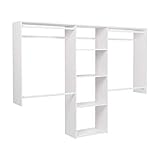
Aheaplus Closet System with 6 Drawers, 92.6-Inch L-Shaped
Who it suits: Walk-ins with a corner worth using — the set built around a corner tower, for rooms where the straight kits waste the turn.
Most closet kits are straight lines looking for a straight wall. This set of three is designed around the corner instead: a corner tower anchors the turn, four hanging rods and six wooden drawers run off it, and the whole arrangement spans 92.6 inches in an L, at 80 inches tall and about 31.5 inches deep at the corner. It sits in the middle of this guide’s budget — check the current price on Amazon. The maker rates the set at 2,000+ lb, a whole-system figure we print because the listing leads with it — read it the way every total in this category deserves, as a ceiling for a perfectly distributed load, and plan your actual loading shelf by shelf.
The corner is the argument. In a small walk-in, the corner is where straight systems leave a dead wedge of unreachable space or a rod that ends in a wall; a tower built for the turn converts it into the most useful vertical storage in the room, with the rods radiating into double-hang on one leg and long-hang on the other. Because the set is freestanding furniture rather than a rail system, it also suits rooms where the walls are not yours to drill — though at this size, use the anti-tip hardware the maker supplies, full stop. Against the 12-drawer set above, the trade is six fewer drawers for a shape the bigger set only approximates: if your walk-in is square rather than long, this is the Aheaplus that fits it.
- A corner tower anchors a true L — the dead corner becomes the storage hub.
- Six wooden drawers and four hanging rods across a three-piece set.
- Mid-budget for this tier — check price on Amazon; freestanding, no rail to anchor.
Honest limitation: The 2,000+ lb figure is a maker total with no per-part breakdown we could verify, and the corner footprint — about 31.5 inches deep at the turn — needs a genuinely square walk-in corner; in a narrow reach-in it simply does not fit.
Choose it if your walk-in has a corner and a need for drawers. Skip it if your closet is one straight wall — the 12-drawer set covers that shape with twice the drawers for similar money.
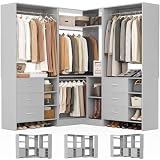
ClosetMaid SuiteSymphony 25-Inch Starter Kit, Pure White
Who it suits: Anyone who wants a laminate system with a furniture finish and the freedom to finish it in stages — starter now, drawers and doors as the budget allows.
SuiteSymphony is the most-reviewed wood closet system on Amazon for a reason: the starter kit is a genuinely small first step into a genuinely large system. The box holds a 25-inch tower — about 82.5 inches tall and 14.7 inches deep, 74 lb of laminated wood — with five interior shelves, two of them adjustable, plus three expandable hang rods that run 30 to 48 inches and can be trimmed or hung on one side only, fitting closets from 5 to 10 feet wide. The Pure White kit sits in the lower part of this guide’s budget — check the current price on Amazon — and even a complete SuiteSymphony walk-in built out in components stays comfortably inside this tier, which is exactly this guide’s point: at a $1,000 budget, this is the pick that lets you buy the whole closet, in pieces, without ever buying a second system.
The ecosystem is the product. Matching drawers, doors, shoe shelves, top shelves and additional towers all clip into the same dimensions, so the starter you install this year is still the foundation in five years — a claim the one-box sets cannot make, because their expansion path is “buy another set and hope the finish matches.” ClosetMaid rates the system at 175 lb in comparison roundups, a modest whole-system figure that deserves the same reading as every total here: fine for clothing distributed across rods and shelves, not a license to stack one shelf with books. The laminate itself is the honest trade: it looks like furniture and wipes clean, but it is a finish over engineered wood, and a chipped edge shows it in a way solid wood never would.
- A 25-inch tower, five shelves and three expandable rods fit closets 5–10 ft wide.
- The deepest add-on line in laminate closets: drawers, doors, shoe and top shelves.
- Lower part of this guide’s budget — check price on Amazon; full builds stay in-tier.
Honest limitation: The starter kit contains no drawers and no doors — the finished-closet photos require the add-ons, bought separately — and the 175 lb system figure is the lowest headline rating in this guide, so heavy, dense storage belongs on the rail and rack systems instead.
Choose it if you want to build a finished-looking closet in stages and stay in one ecosystem for years. Skip it if you need drawers on day one at a fixed total price — the Aheaplus sets include them in the box.
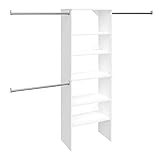
VIPEK X3 Expandable Closet Rack
Who it suits: Renters and no-drill households with a wide wall — the freestanding system that stretches to fit the space instead of demanding the space fit it.
Every other pick in this guide is furniture or a wall system; the X3 is a steel frame, and its party trick is width. The shelves and rods telescope from 62 inches out to 96 — 5.2 to 8 feet — with locking collars on the telescoping sections, and the frame builds as one straight run or turns into an L for a corner. Four expandable wire shelves and four hanging rods ride on a carbon-steel frame the maker rates at 1,210 lb in total. It sits in the lower-middle of this guide’s budget — check the current price on Amazon. As always, the total is a maker sum across every part; the useful planning fact is simpler — this is the heaviest-duty freestanding frame in the guide, and it asks nothing of your walls.
That last point is why an expandable rack belongs in a $1,000 guide at all. A walk-in with plaster walls, a rental with a no-drill lease, a room with no closet whatsoever — the wall systems and tower sets all assume a wall you own and can anchor into, and the X3 assumes nothing. It also travels: collapse the width, and the same rack that dressed an 8-foot wall fits a 5-foot wall in the next apartment, which no cut-to-fit panel system can say. The trades are the familiar freestanding ones, sharpened by size. At 76.4 inches tall on a 15.7-inch-deep footprint, it wants its included anti-tip devices used and its heavy loads kept low; the wire shelves let small items slip in a way solid shelves do not; and an open steel frame, however tidy, never reads as built-in furniture. You are buying capacity and freedom, not a finish.
- Telescopes from 5.2 to 8 ft wide; builds straight or as an L-shape.
- Four expandable shelves and four rods on a carbon-steel frame, 1,210 lb maker total.
- Lower-middle of this guide’s budget — check price on Amazon; no drilling, moves when you do.
Honest limitation: The 1,210 lb figure is a whole-frame maker claim, not a per-shelf rating, and a tall, 15.7-inch-deep frame must be loaded low and even — the anti-tip devices are part of the product, not an accessory. Wire shelves also need liners for small items.
Choose it if you cannot drill, your wall width is awkward, or the system has to move house with you. Skip it if the closet is a showpiece you look into all day — the tower sets look like furniture and this looks like equipment.

VIPEK V5 Portable Closet Wardrobe
Who it suits: The no-drill buyer who wants maximum hanging and shelving per dollar — and would rather spend the rest of the $1,000 somewhere else.
The V5 is the value end of serious freestanding storage: 68.9 inches long, 15.7 inches deep and 76.4 inches tall, with four hanging rods and eight wire shelves in a powder-coated steel frame. The maker rates the whole rack at 890 lb, with up to 60 lb on a single hanging rod — the per-part figure worth planning around, and a realistic one: a rod of winter coats is roughly that load. It sits at the value end of this guide’s budget — check the current price on Amazon. In a guide about spending up to $1,000, the V5 is the honest reminder that capacity alone does not cost anywhere near the full budget — two of these dress two walls of a walk-in while leaving most of the budget untouched.
What the money you save gives up is everything the tower sets sell: no drawers, no doors, no solid shelves, no furniture finish — clothes hang in the open and folded stacks sit on wire. For a dressing room behind a closed door, that trade is often correct; for a bedroom corner that doubles as the wardrobe, it usually is not. Assembly is the slip-sleeve, no-tools kind, typically well under an hour, and the frame disassembles flat enough to move in a car. Load it the way tall racks demand — heavy shelves low, weight spread across both sides, anti-tip strap on if your floor is carpet — and it will hold a full wardrobe without complaint. Buy it as infrastructure, and spend the difference on the parts of a closet a rack cannot be: drawers, lighting, a door.
- Four hanging rods and eight shelves in a 68.9-inch freestanding frame.
- Maker rates a single rod at 60 lb under an 890 lb whole-rack claim.
- Value end of this guide’s budget — check price on Amazon; two dress a walk-in with budget to spare.
Honest limitation: No drawers, no doors, no solid surfaces — everything is open wire, and the 890 lb headline is a maker total, not a working load. Tall and narrow-deep, it needs even loading and its anti-tip strap on soft floors.
Choose it if you need a lot of hanging and shelving, cannot drill, and do not need the closet to look like furniture. Skip it if you want enclosed drawers or a finished look — that is what the Aheaplus and SuiteSymphony picks are for.

Comparison Table
| Product | Type | Best use | Link |
|---|---|---|---|
| Aheaplus Closet System with 12 Drawers | Multi-tower furniture set | A complete walk-in with twelve drawers, straight or L-shaped | Check on Amazon |
| Easy Track Deluxe Starter Kit, 4–8 Ft | Rail-hung panel system | A built-in foundation that grows with add-ons | Check on Amazon |
| Aheaplus Closet System with 6 Drawers, L-Shaped | Corner furniture set | Square walk-ins with a corner worth using | Check on Amazon |
| ClosetMaid SuiteSymphony 25-Inch Starter Kit | Laminate tower system | Building a finished closet in stages, comfortably in-tier all-in | Check on Amazon |
| VIPEK X3 Expandable Closet Rack | Freestanding steel rack | Wide or awkward walls with no drilling allowed | Check on Amazon |
| VIPEK V5 Portable Closet Wardrobe | Freestanding steel rack | Maximum capacity per dollar, no drilling | Check on Amazon |
How to Choose a Closet Organizer Under $1,000
- Measure three numbers first. Wall width, closet depth and ceiling height decide which family you are even shopping in. At this tier the sets are furniture — an 80-inch tower and a 31.5-inch corner depth either fit your room or they do not, and no amount of budget changes that.
- Decide what the $1,000 is for. One complete walk-in in a box, a premium foundation you will finish with add-ons, or two walls of freestanding capacity with money left over are three different purchases wearing the same budget. Name yours before you compare products.
- Count drawers honestly. Drawers are the most expensive feature per inch in this category, and the reason the Aheaplus sets lead this guide. If your folded clothes currently live happily in bins, a rail or rack system plus bins is the cheaper closet; if the bins are the problem, buy the drawers in the box.
- Read load figures per part, not per headline. A 2,000 lb maker total assumes a perfectly distributed wardrobe that does not exist. Plan around per-rod and per-shelf figures where they are published, and treat unpublished ones as a reason to load drawers and shelves with clothes, not books.
- Match the system to your walls. Rail systems need studs. Tower sets need anchoring. Freestanding racks need floor space and a level floor. Renters usually start from the lease, not the catalog — and a landlord’s permission for anti-tip anchors is a smaller ask than a full rail install.
- Check the depth, not just the width. Tower shelves here run about 14.7 to 16 inches deep and the Aheaplus corner runs 31.5 inches at the turn. A standard hanger is about 17 inches wide, so in a shallow closet, rods on shallow towers leave shoulders brushing the doors — normal, but know it before you buy.
- Price the whole project, not the kit. Add the drawers, doors, top shelves, lighting and bins the catalog photo includes but the box does not. A starter that needs a stack of add-ons and a complete set that includes everything in the box can end up as the same purchase at different speeds — choose the speed deliberately.
- Mind the edges of the width range. Expandable rods and shelves overlap at a kit’s minimum width, so a wide-range set used at its smallest gives you less distinct storage than the photo suggests. If your wall sits at a system’s minimum, consider the smaller configuration.
- Plan the install like furniture. Multi-tower sets ship in several heavy boxes and want two people and an afternoon. Rail systems want a drill, a level and a stud finder. Freestanding racks trade all of that for assembly time and an anti-tip strap. None of them install themselves while the closet is still full — emptying and sorting is the longest part of every project here.
What $1,000 Actually Buys: The Top of the Kit Market
It is worth being precise about where this budget sits, because closet marketing works hard to blur it. Under $200 — the tier our companion guide covers — buys a complete wire kit or a first wood-look system for one reach-in closet. In the middle bands of the kit market, the kits become furniture: multi-tower sets with real drawers, laminate systems with doors, the Aheaplus sets and finished SuiteSymphony builds in this guide. At $1,000 you are at the ceiling of what Amazon’s kit market sells in a box: the biggest multi-tower configurations, a premium rail system with most of its add-ons, or two mid-size systems dressing two walls of a walk-in. There is no kit near the top of this budget that is secretly a custom closet. There are only bigger, heavier, better-finished kits.
The spending pattern that works at this level is allocation, not maximization. A walk-in rarely needs its most expensive wall twice: put the drawer towers where the folded clothes and valuables live, run simpler hanging and shelving on the second wall, and keep a reserve for the unglamorous parts — lighting, bins, a valet rod, a mirror — that decide whether the finished closet feels finished. Two of the picks in this guide exist precisely to make that arithmetic easy: the SuiteSymphony starter, whose whole ecosystem is priced in stages, and the VIPEK V5, which delivers a wall of capacity at the value end of the tier and leaves the budget for the wall that needs drawers. The shoppers who regret a $1,000 closet are rarely the ones who bought the wrong brand; they are the ones who spent the whole budget on one wall and left the other three to improvisation.
Kit vs. Custom: Where the Real Price Cliff Is
Above this guide’s budget, the market changes species. The solid-wood route is real and genuinely lovely — John Louis Home builds its systems from kiln-dried solid pine with metal hardware, and its Deluxe organizer is the product every kit in this guide is quietly imitating. We have named it here without a link on purpose: its Amazon listing exists, but across repeated checks we could not verify a current featured offer or a live Amazon price for it, and this series does not guess at either. At other retailers the same system sits in the premium part of the kit market, and on the maker’s own site, designed walk-in layouts — an 8-by-6-foot L-shape, a 9-by-6 U-shape — run well past this guide’s budget, for the kit, before installation. Elfa, the other premium name, is not sold on Amazon at all; it lives at The Container Store, where even a small reach-in in its wood line costs more than the systems here.
Beyond the premium kits sit the closet companies, and their quotes add the things no box contains: a designer who measures your room, components cut to your walls rather than adjusted to them, soft-close everything, doors that close flush, an installation crew, and a warranty on the labor. Quotes for that service typically start well above this guide’s budget for a small reach-in and run far higher for a walk-in. What the money buys is surfaces, services and certainty. What it does not buy is more organization: the layout logic — double-hang where the shirts are, a tower where the folded things are, one long drop for dresses, drawers where the dresser used to be — is identical in a mid-tier kit and in a high-end custom install, and a well-planned kit holds the same wardrobe. Cross the cliff when the closet is a room you dress inside every day, when the house is yours for a decade, or when your walls are so irregular that adjustable kits genuinely cannot fit them. Until then, the top of the kit market is not the compromise version of the real thing. It is the real thing, self-installed.
Planning a Two-Wall Walk-In on a Kit Budget
Most walk-ins are two walls that matter and a corner that decides between them, so here is the allocation this guide’s picks make possible. The anchor wall takes the Aheaplus 12-drawer set: three towers, twelve drawers, four rods, the dresser retired — check the current price on Amazon. The second wall takes capacity instead of furniture — a VIPEK X3 stretched to the wall’s width for double-hang and open shelving, or, where the second wall is shorter, the SuiteSymphony starter as the beginning of a build-out. Either way the two walls sit comfortably inside the budget, leaving a healthy reserve for the parts no kit includes: lighting that makes the drawers usable, bins that make the shelves honest, and the anti-tip and anchoring hardware fitted properly rather than eventually.
Run the same plan in the other order and it still works, which is the test of a sane budget. Anchor with the corner instead — the Aheaplus L-shaped set — and the straight wall takes the Easy Track starter as a rail foundation you finish next year, for a two-wall spend still inside the budget and a system with a future. What does not work, at any ordering, is symmetry bought for its own sake: two identical premium sets on two walls is how a $1,000 budget produces a closet that is impressive on one side and unfinished on the other. Spend where the clothes are, economize where the wall is simple, and let the corner — the space every straight kit wastes — be somebody’s product decision rather than your leftover problem.
Common Buying Mistakes
- Buying by the headline load total instead of the per-rod and per-shelf figures, then loading one drawer bank with the densest things in the house.
- Spending the entire budget on one wall of a walk-in and leaving the other walls to improvisation.
- Measuring the closet’s width and forgetting its depth — then discovering the corner tower or the doors will not close over hangers.
- Ordering a starter kit and expecting the catalog photo: drawers, doors and top shelves are separate purchases in every ecosystem here.
- Skipping the anti-tip anchors on tall tower sets because the unit “felt steady” empty. It is steadiest empty; that is the problem.
- Assuming every listing with the same brand name is the same system — Aheaplus, VIPEK and ClosetMaid all sell lookalike variants at different widths, drawer counts and depths.
- Cutting rods and shelves before the towers are in their final positions. Adjustable systems forgive a lot, but not a rod cut two inches short.
- Throwing away the extra brackets, collars and shelf clips. Systems at this tier rearrange for years; the spares are the system.
Final Recommendation
- Most buyers: Aheaplus Closet System with 12 Drawers, 8.5–11.5 Ft.
- A built-in foundation that grows: Easy Track Deluxe Starter Closet Kit, 4–8 Ft.
- Square walk-ins and corners: Aheaplus Closet System with 6 Drawers, 92.6-Inch L-Shaped.
- Building in stages: ClosetMaid SuiteSymphony 25-Inch Starter Kit.
- No drilling, wide walls: VIPEK X3 Expandable Closet Rack.
- Maximum capacity per dollar: VIPEK V5 Portable Closet Wardrobe.
Our top two are the Aheaplus 12-drawer set for anyone who wants the walk-in finished in one purchase and the Easy Track Deluxe Starter for anyone who would rather build the best foundation and finish it over time, because between them they cover the two searches that bring most people to this budget: the complete closet in a box, and the system that imitates the custom installers. If your lease says no holes, skip both without regret and take the VIPEK X3 — capacity you can expand, collapse and carry to the next home. None of these systems will give you the designer’s walk-in of a renovation show, and they do not try to. They are the top of an honest market: measure the walls, count what hangs, what folds and what needs a drawer, check the per-part load figures on the listing, and spend the $1,000 where the clothes actually are.
Frequently Asked Questions
Can you really organize a whole walk-in closet for under $1,000?
Yes — with kits, self-installed. The multi-tower sets in this guide dress a full walk-in wall with drawers from the middle of this budget, and a two-wall plan built from this guide’s picks lands comfortably inside it, leaving room for lighting and bins. What $1,000 does not buy is a professionally designed and installed custom closet: those quotes typically start well above this budget for a small reach-in and climb from there, and even premium solid-wood kit layouts on the maker’s own site run well past this budget before installation.
Is a premium kit really better than a budget kit, or just bigger?
Both, and the difference is mostly drawers. The under-$200 tier buys an excellent wire or starter system for one reach-in — rods, shelves, a layout you can rearrange. The step up buys enclosed wooden drawers in quantity, solid rather than wire surfaces, deeper towers and configurations — corners, L-shapes, 11-foot runs — that the smaller kits cannot build. If your closet is one straight reach-in wall and your folded clothes live happily in bins, the cheaper tier is not a compromise; it is the right size of answer.
Do these systems have to be anchored to the wall?
The tall ones, yes — and this is the least optional sentence in the guide. Rail systems carry their load on a stud-anchored rail by design. Tower sets are freestanding furniture, but an 80-inch tower full of drawers is a tip risk until it is fixed with the anti-tip hardware the maker supplies, especially in a house with children. Freestanding racks are the exception: they are built to stand alone, and even they ship with anti-tip straps you should use on carpet.
How much weight can these systems actually hold?
Plan by the part, not the headline. The verified per-part figure in this guide is the VIPEK V5’s 60 lb per hanging rod; Easy Track publishes the most defined system figure, rating an 8-foot stud-anchored run at 1,200 lb shared across the whole run. The four-figure totals on the Aheaplus and VIPEK X3 listings are maker sums of every part at once, not working loads. A full rod of winter coats is the heaviest normal load in a closet, and every rod here is built for it; a drawer of hardback books is not a normal closet load, and no drawer here is built for that.
My walk-in is 7 feet on one wall and 5 on the other. What fits?
That is the two-wall plan in this guide. The 7-foot wall takes the Aheaplus 12-drawer set run below its maximum, or the L-shaped set if the corner between the walls is yours to use; the 5-foot wall takes the SuiteSymphony starter with its rods on one side, or a VIPEK rack collapsed toward its minimum width. Measure both walls at two heights — walk-ins are rarely square — and check the corner depth before committing to a corner tower.
How long does installation take?
Realistically: under an hour for the freestanding VIPEK racks, one to two hours for a rail-and-panel starter once the closet is empty, and a two-person afternoon for either Aheaplus set — several heavy boxes, three towers, and drawers to hang level. Every estimate assumes the closet starts empty. Emptying, sorting and refilling is usually the longest part of the project, and no kit can do it for you.
What should I measure before ordering?
Five things: the wall width at two heights (closets are rarely square), the depth from the back wall to the door or opening, the ceiling height against 80- to 82.5-inch towers, the corner’s true angle if you are buying an L-shaped set, and the swing or slide path of the doors. Then check the system’s width range against your width — aiming for the middle of the range, not the edge — and its depth against your hangers. Ten minutes with a tape measure is the entire difference between a system that fits and a return label.
- Best Closet Organizer Under $200
- Best Closet Organizer Under $400
- Best Closet Organizer Under $700
- Best Dresser Under $500
- Best Blackout Curtains Under $200
Related Guides
- Best Closet Organizer Under $30
- Best Closet Organizer Under $75
- Best Closet Organizer Under $100
- Best Closet Organizer Under $200
- Best Closet Organizer Under $400