A grilling knife set brings together the blades you need at the table and the carving board, usually steak knives, a carving knife and a fork. The best sets feel balanced, hold a good edge and stay in good shape after years of dinners. If you roast and smoke large cuts as well, a matching carving knife and fork round out the table.
The six sets below cover steak knife sets and carving sets from established knife makers. We have not used these products ourselves, so please confirm the piece count, blade style and care instructions on the current listing before buying. Edge and steel claims are the makers’ own.
As an Amazon Associate we earn from qualifying purchases. Links below are affiliate links, and they do not change the product information we give.
What to Look For
| Feature | Why it matters |
|---|---|
| Piece count | Four to eight steak knives suit most tables |
| Blade style | Serrated edges hold up longer; straight edges slice cleaner |
| Handle | Comfortable, grippy handles stay secure when slippery |
| Care | Hand washing keeps good knives sharper for longer |
In this guide
Specs at a Glance
| Set | Contents | Blade style | Notes |
|---|---|---|---|
| Henckels Statement Steak Set | Steak knives | Straight edge | Modern handle |
| Victorinox Rosewood Steak Set | Steak knives | Serrated or straight | Rosewood handles |
| Wusthof Classic Steak Set | Steak knives | Forged blade | Premium tier |
| Cuisinart Triple Rivet Carving Set | Carving knife and fork | Straight edge | Triple rivet handle |
| Mercer Genesis Steak Set | Steak knives | Forged blade | Non-slip handle |
| Chicago Cutlery Insignia Set | Steak knives | Serrated edge | Stainless steel |
The 6 Best Grilling Knife Sets
Top pickBest for everyday steak dinners
1. Henckels Statement Steak Knife Set
A set of steak knives from J.A. Henckels with a modern, riveted handle design. The stainless blades are meant for tableside use.
Suits: everyday steak dinners. Strengths: a clean look and reliable steel. Weaknesses: not forged. Skip it if you want forged knives.
View Henckels Statement Steak Knife Set on Amazon
Best for a classic table look
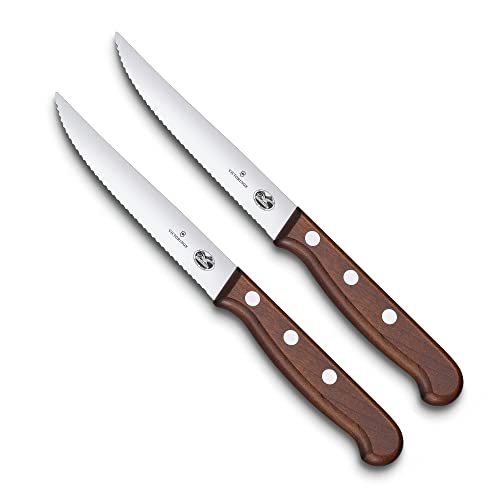
2. Victorinox Rosewood Steak Knife Set
A steak knife set from Victorinox with wood handles and an edge that the brand says is made for tabletop use. It balances value and good materials.
Suits: a classic table look. Strengths: a wood-handle aesthetic. Weaknesses: wood handles need hand washing. Skip it if you want a dishwasher-safe knife.

Best for serious steak lovers
3. Wusthof Classic Steak Knife Set
A premium set of steak knives from a famous German knife brand, forged and finished for a durable life at the table.
Suits: serious steak lovers. Strengths: premium forged construction. Weaknesses: a premium-tier cost and care. Skip it if you want an inexpensive set.
View Wusthof Classic Steak Knife Set on Amazon
Best for carving a roast at the table
4. Cuisinart Classic Triple Rivet Carving Set
A knife and fork carving set with triple rivet handles, made for roasts, poultry and large cuts. It is a staple for holiday grilling.
Suits: carving a roast at the table. Strengths: a matching knife and fork. Weaknesses: only two main pieces. Skip it if you want steak knives too.
View Cuisinart Classic Triple Rivet Carving Set on Amazon

Best for cooks who value grip
5. Mercer Culinary Genesis Steak Knife Set
A forged steak knife set with non-slip handles from a brand that supplies professional kitchens. Check the listing for the exact piece count.
Suits: cooks who value grip. Strengths: forged steel and good grip. Weaknesses: a plain look. Skip it if you prefer wood handles.

Best for casual dinners
6. Chicago Cutlery Insignia Steel Steak Knife Set
A set of stainless steel steak knives with serrated edges and a classic look. Serrated knives suit a casual table.
Suits: casual dinners. Strengths: an easy-care serrated edge. Weaknesses: serrations are harder to sharpen. Skip it if you want fine straight edges.
View Chicago Cutlery Insignia Steel Steak Knife Set on Amazon
Care and Setup
- Hand wash and dry knives soon after use.
- Store them in a block, roll or drawer tray that protects the edges.
- Hone straight-edge knives and have serrated ones sharpened professionally.
- Cut on wood or plastic boards, never glass or stone, and avoid slicing straight on a ceramic plate if you can help it.
Mistakes to Avoid
- Putting good knives in the dishwasher.
- Buying serrated knives when you want clean straight cuts.
- Choosing a set by piece count alone, without checking the steel, the handle and the care needs.
- Leaving knives in the sink where edges can chip.
What a Good Set Should Actually Contain
Sets are sold on piece count, but the useful question is what each piece does. A steak knife set typically offers four, six or eight matching knives, enough for a table. A carving set pairs one long knife with a two-pronged fork that holds a roast steady while you slice. Some larger sets add a slicer, a utility blade or a block, though the extras vary, so read the contents list on the listing carefully.
Think about what you serve. If steaks and chops are your main dishes, a steak knife set with enough knives for your usual guests is the core purchase. If you roast poultry, hams or large smoked cuts, a carving knife and fork will do more for you than extra steak knives. A cook who does both may buy two separate sets and get better quality in each than a single giant set would offer.
Watch for padding. A big count can include small items you will rarely use. It is better to have fewer, well-made knives than a block full of mediocre ones. Check whether the set includes a storage option such as a box, tray or block, and whether the knives are all the same style. If you want a gift, a presentation box is a plus. Verify the exact count and the pieces on the current listing before ordering, since versions and bundles can differ.
Straight Edge Versus Serrated at the Table
The edge style decides how the knife feels on the plate and how much upkeep it needs. A straight, or plain, edge works like a tiny razor: it cuts cleanly through a well-cooked steak and leaves a smooth surface, which holds in juices. It does dull with use, though, particularly when it meets a ceramic plate, and it must be sharpened to keep performing.
A serrated edge has small teeth that grip and saw through the crust of a seared steak. Because only the tips of the teeth touch the plate, a serrated knife often feels sharp for longer, and it can handle tough or crusty exteriors with less effort. The trade-off is that it can shred the meat fibers a bit more, and sharpening needs a special tool or a professional.
- Choose straight edges if you value clean slices and are willing to hone and sharpen.
- Choose serrated edges if you want low maintenance and cook casual meals.
- Consider micro-serrations if a listing describes fine teeth, which some makers present as a middle path; check the description.
Whichever you choose, remember that the plate matters. Ceramic and stoneware plates wear edges down faster than wood boards or plastic. Some diners serve steak on wooden boards to preserve the knives.
Steel, Construction and Budget Tiers
Knife sets span a wide range, and what you pay for is mostly construction and steel. At the entry level you find stamped stainless blades, light in the hand, simple to maintain and fine for casual use. In the middle are sets with thicker blades, better handles and sometimes forged construction. At the premium end are forged blades from well-known knife makers, with full tangs, bolsters and refined finishing.
Steel hardness involves a trade-off. Harder steels generally hold an edge longer but can chip if abused and may be harder to sharpen. Softer steels are tougher and quick to sharpen but need more frequent honing. The listing may name the steel type or describe it in marketing terms, and these claims are the maker’s own, so treat them as a starting point rather than proof of performance.
Handles are part of the tier too. Riveted handles are durable, molded handles are easy to clean, and wood handles look elegant but need hand washing and drying. Check how the handle joins the blade, since gaps can trap food. Think about the whole cost of ownership: a pricier knife that you hand wash and sharpen for years can be better value than a cheap one that dulls quickly. Match the tier to how often you will use the knives and how willing you are to care for them.
Handling and Storing Knives Safely
Knives that are used at the table and cleaned at the sink need a safe home. A block, in-drawer tray or knife roll protects the edges and your fingers. A loose drawer is the worst option, because blades knock together and dull. Magnetic strips work well if they are mounted securely and out of reach of children.
Check that a block has slots sized for the knives you own, especially a long carving blade. If the set includes a block, look at the slot arrangement and the material, since some blocks are hard to clean inside. Keep blocks dry, and store knives clean and dry to prevent rust and bacterial growth.
At the table, hand knives to guests handle first, and never leave them in a sink full of soapy water where someone may reach in blindly. Wash each blade individually, spine-side toward your palm, and dry it immediately. For outdoor dinners, carry the knives in a tray or roll rather than loose. Keep sharp knives away from children, and consider storing carving knives separately if there are curious hands around.
If you carry the set to events, a hard case or rolled sleeve protects both the edge and your bag.
Sharpening and Knowing When to Replace
Even good knives dull. Straight-edge knives benefit from regular honing with a steel or ceramic rod, which realigns the edge, and from sharpening with a stone or guided sharpener when honing no longer restores bite. Many makers give an angle in the manual, so follow it. Serrated knives are different: sharpen them with a tapered rod that fits the scallops, or have a professional do it.
A simple test is how the knife behaves on a steak. If you need to saw or press hard, or the meat tears rather than parting, the edge is tired. Also notice nicks, rolled edges, and a blade that leaves a trail of gray metal on the plate. A professional sharpening service can often revive a set for a modest fee, which may be cheaper than replacing it.
Replacement becomes the better option when handles crack or loosen, rivets lift, blades are bent, or the steel is deeply pitted with rust. A single damaged knife in a matched set is a reason to check if the maker sells replacements individually. Look at warranty details on the listing, since some makers cover defects in materials and workmanship but not misuse or dishwasher damage. Treat the care rules in the manual as part of the purchase, and your set should serve you for many dinners.
Which Tools a Grilling Set Should Contain
Grilling sets bundle knives with forks, tongs and sometimes a carrying case, but not every piece earns its place. Before you choose, picture a typical cookout and think about each step: trimming meat, moving it onto the grates, turning it, checking it and slicing it for serving. The tools you need follow that order.
- A carving or slicing knife: a long, narrow blade for slicing cooked brisket, roast or poultry cleanly.
- A boning or trimming knife: a shorter, flexible blade for removing silver skin and excess fat.
- A chef’s knife: useful for cutting vegetables and portioning large pieces.
- A carving fork: holds the meat steady while you slice, and should not be used to pierce meat while it cooks on the grill.
- Tongs and a spatula: for moving food on the grates.
- A case or roll: protects blades and makes it simple to carry them to a backyard table or a campsite.
Compare the contents of each set with what you already own. If your kitchen has a good chef’s knife, a set with a carving knife and a fork may be all you need outdoors. Read the listing for the length of the blades, the handle material and whether the pieces can be washed in a dishwasher.
Handle Materials and Grip in Wet, Greasy Conditions
Outdoor cooking is messy, and slippery hands make knives harder to control. The handle matters as much as the blade. This table compares common materials in general terms.
| Handle material | Grip | Care notes |
|---|---|---|
| Textured synthetic | Stays secure when wet or greasy | Usually easy to wash; check dishwasher guidance |
| Wood | Warm and comfortable but can get slick | Hand wash and dry quickly to avoid swelling |
| Stainless steel | Durable but can be slippery | Look for ridges or a textured pattern |
| Rubber-like overmold | Cushioned and grippy | Avoid harsh cleaners that may degrade the material |
Test the grip with a damp hand if you can. A handle with a guard or a slight lip can also help keep fingers away from the blade.
Carving Technique for Better Slices
A sharp knife helps, but technique matters too. After cooking, let meat rest as the recipe or official food guidance suggests, so juices settle before you cut. Use a stable board with a groove or a tray to catch liquid.
- Identify the direction of the muscle fibers, or the grain, in the cut of meat.
- Slice across the grain for a more tender bite.
- Use long, smooth strokes instead of sawing back and forth.
- Keep the fork steady and away from the path of the blade.
- Cut thinner slices from larger cuts such as brisket, and thicker ones from tender cuts.
- Wipe the blade between cuts if it becomes slick.
Practice on an inexpensive roast before a big gathering, so you feel confident at the table.
Outdoor Safety and Handling
Knives and hot grills are a risky combination, so a few habits help. Keep blades covered when not in use, store them out of reach of children and never leave a knife on the edge of a table. Cut on a stable surface, not in your hand. Keep raw and cooked foods apart, using separate boards and utensils, and wash tools between tasks as official food safety guidance recommends.
If you transport knives to a campsite or park, use a case designed for the purpose and check local rules about carrying blades in public spaces.
Cleaning and Sharpening After the Cookout
Wash knives soon after use, by hand, with warm soapy water, then dry them straight away. Grease left on the blade can trap flavors and attract dirt. Check the care guide to see whether your set is dishwasher safe. Even when it is, hand washing usually keeps edges sharper for longer.
Hone the edge when it starts to feel dull, and have it sharpened by a professional or with a tool the maker approves. Store the knives dry in the case or on a rack so moisture does not cause spots.
Knife Care Routine After the Cookout
Good knives last longer with simple care. Follow the care sheet from the maker for your set.
- Wipe blades soon after use so juices do not dry on them.
- Wash by hand with mild soap and a soft sponge, unless the maker says the set is dishwasher friendly.
- Dry the blade and handle right away.
- Store knives in a block, sheath or drawer insert so edges do not knock together.
- Use a cutting board of wood or plastic, not stone or glass.
- Have the edges honed or sharpened as the maker advises.
Always cut away from your body and hold knives by the handle.
Set Size Decision Guide
| Situation | What to look for |
|---|---|
| Dinner for two | A small set of two to four knives |
| Family table | Six or more matching knives |
| Carving a roast | A carving knife and fork |
| Gift giving | A boxed set with a case |
| Small drawer | A slim case or magnetic strip |
Pick the set that matches the number of people you usually serve.
Questions to Ask Before Buying a Set
A knife set is a lasting purchase. Think about how you will use it, and read the care and warranty notes from the maker.
- How many people do you serve at the table?
- Do you want a simple matching set or a mix with carving tools?
- How does the handle feel in a hand that may be wet or greasy?
- Does the set include a case, block or sheath?
- Does the maker explain how to maintain the edge?
If possible, compare handle shapes and weights in a shop before choosing.
Grilling Knife Set FAQ
Are serrated steak knives better?
They stay sharp longer between sharpenings, but they can tear meat slightly more than a fine straight edge. Which is better comes down to how much you value low upkeep versus clean cuts.
How many steak knives do I need?
Match the set to the number of guests you usually serve.
Do I need a carving set too?
If you roast or smoke large cuts, a carving knife and fork make serving easier.
Can I mix brands?
Yes. Many cooks buy a steak set from one brand and a slicer from another. Matching handles are a nicety, not a requirement, so choose what feels best in your hand.
How many steak knives should I buy?
Match the set to how many people you usually seat, then add a couple more if you host occasionally. Four or six suits most households.
Is forged always better than stamped?
Not always. Forged blades tend to be heavier and more balanced, while stamped ones are lighter and often cost less. Both can cut well if the edge is good.
Can steak knives go in the dishwasher?
Many makers advise against it, because heat, detergent and contact with other items can damage edges and handles. Check the manual and hand wash when in doubt.
What is a carving fork for?
It steadies the roast while you slice, keeping your hand clear of the blade. Some forks have a guard that protects your fingers.
Do I need matching knives?
No. Matching sets look neat, but comfort and edge quality matter more. Many cooks buy steak knives and a carver separately.
How do I know if a set will make a good gift?
Look for a presentation box or block, a recognizable maker and care that suits the recipient. Check return policies on the listing in case the size or style is not right.
What cutting surface protects knives best?
Wood or plastic boards are gentle on edges. Glass, stone and ceramic surfaces dull blades quickly.
Choosing Grilling Knife Sets With More Care: The Details That Decide
The picks above give you the shortlist. This section slows the decision down and looks at the details that separate grilling knife sets you will enjoy for years from the ones that quietly end up at the back of the cupboard. None of these points require specialist knowledge; they ask you to match the product to your grill, your food and your habits, which is where good purchases are actually made. Work through them with your own cooking in mind, especially brisket, ribs, chicken and grilled vegetables, and the right pick usually identifies itself.
The Right Roster of Blades
A useful set covers trimming, portioning and slicing: typically a slicer, a chef’s or santoku-style blade, a boning or trimming knife and a utility knife. Sets padded with near-duplicate blades waste money. Lay the roster against your menu: whole briskets demand a slicer; chicken work demands a boning blade. To judge it on a listing, look past the headline claim and find the detail that proves it: a stated dimension, a named material, or a clear photo of the part you will actually handle. If the page stays vague on this point, treat that as information in itself and weigh the grilling knife sets that explain it clearly more heavily.
One Steel, One Standard Across the Set
A set should share a steel philosophy so every knife sharpens and maintains the same way. Mixed mystery steels make care a guessing game. The maker should state the steel plainly, and your existing sharpening gear should suit it. In daily use this matters most on the third or fourth cook, not the first. The first session with new grilling knife sets almost always goes well; it is the repeated heating, washing and storing that reveals whether this detail was designed properly or just described well. Buy for the routine you will repeat all season, not for the unboxing.
Handles Matched Across Grips and Tasks
Trimming grips differ from carving grips, but the set’s handles should all stay secure with wet hands and clean up easily. Gaps and ornate bolsters trap barbecue residue. Wash a display set mentally: anywhere sauce can hide, it will. A practical way to test the claim before you commit is to compare it against the grilling knife sets you already own or have used. Note what frustrated you there, then check whether this option genuinely fixes that frustration or simply moves it somewhere else. Improvements you can point to concretely are worth more than long feature lists.
Storage That Protects Edges and People
Block, roll, case or magnetic strip: the set needs a home that keeps edges apart and hands safe, ideally one that travels between kitchen and grill. A set stored loose in a drawer is a set being slowly destroyed while endangering the household. There is usually a trade-off hiding inside this point, and honest listings make it visible. More of one quality tends to mean less of another, whether that is weight, space, speed or simplicity. Decide which side of the trade-off suits your cooking before you shop, so the comparison between grilling knife sets stays anchored to your priorities.
Value Distribution Within the Set
In cheap sets, one decent knife subsidises several poor ones. Judge the set by its weakest essential blade, usually the slicer, since that is where quality shows. Sometimes two individual knives beat a five-piece set at the same spend; compare honestly before choosing the box. Match this criterion to the foods you cook most, which here means brisket, ribs, chicken and grilled vegetables. A feature that shines with one kind of food can be irrelevant, or even a nuisance, with another. The strongest choice is rarely the one with the longest specification list; it is the one whose strengths line up with your regular menu.
Grilling Knife Sets in Real Life: Four Situations Worth Planning For
Product pages describe features; households live in situations. Here is how grilling knife sets behave in the situations that actually come up around a grill-side board and a kitchen, and what to do in each so the equipment helps rather than hinders.
Brisket Day: Trim to Slice
One set carries the whole cook: trimming knife shapes the raw brisket, the slicer portions it fourteen hours later, the utility knife handles everything between. A set that covers a flagship cook end to end, without borrowing from the kitchen drawer, has proven its roster. The routine that makes this work is preparation: have everything cut, seasoned and within reach before the heat is on, because once cooking starts there is rarely a spare moment to go back inside. A small tray or board beside the grill turns a scramble into a sequence you can repeat.
Ribs, Chicken and Portioning Work
Boning and utility blades earn their keep breaking down chickens and trimming ribs, while the slicer handles serving. If your grilling is mostly portioned meats, weight your choice toward the smaller blades’ quality rather than the slicer’s length. Timing is the skill to practise here. Foods finish at different speeds, so start the slowest items first and add the quicker ones in stages rather than loading everything at once. That single habit does more for the result than any accessory, and it is free.
Serving at the Table
A handsome set that travels to the table in its roll or case turns carving into part of the meal’s theatre. Sharpness still matters more than looks, but a set you are proud to bring out gets maintained better. Pride is a legitimate maintenance strategy. Keep notes the first few times, even if only mentally: what the heat felt like, how long each item took, and what you would move earlier or later next time. Grilling Knife Sets reward cooks who adjust in small steps instead of changing everything at once.
Gifting or Building a First Serious Kit
For a cook levelling up, a set removes the guesswork of matching individual knives and guarantees one care routine. It is also a natural milestone gift. Choose the roster for the recipient’s actual grilling, not for the photograph on the box. For serving, plan the landing zone before you start: a clean platter, resting space and somewhere safe for hot tools. Good results are often lost in the last two minutes, when cooked food waits around getting cold or overcooks in its own residual heat because nothing was ready for it.
Using, Cleaning and Storing Your Grilling Knife Sets: A Working Routine
Long life from grilling knife sets is mostly routine, not luck. The steps below follow the order of a real cook, from before the heat goes on to the moment everything goes away, and they apply whichever pick from the list above you choose. Adapt the details to your model’s manual where the two differ, since the maker’s instructions always win on safety and warranty questions.
One Sharpening System for the Whole Set
Adopt a single routine, steel for upkeep, stone or guided system for restoration, that suits the set’s steel, and keep it where the knives live. A set maintained uniformly stays uniformly sharp; knives sharpened by different improvisations drift apart in feel. Make it a habit rather than a project: two minutes of attention straight after cooking replaces an hour of soaking and scrubbing later, and it keeps every part working the way it did on day one.
Wash, Dry, Store: Every Time
Hand-wash each knife after use, dry it immediately, and return it to its slot or roll. Barbecue sauces and marinades are acidic and salty; an hour soaking in them marks blades. The routine takes two minutes and is the set’s entire pension plan. Always let hot parts cool enough to handle safely before you start, and keep water away from anything electrical or still holding serious heat. A cracked surface or a warped part often traces back to one impatient cleaning session.
Assign Raw and Cooked Roles
Knives that trim raw meat get washed before any cooked-food work, without exception. In a set, it is easy to grab the same blade twice; build the wash into the workflow, or dedicate blades per session and wash the family together afterwards. Dry everything fully before it goes away. Trapped moisture is the quiet cause of rust, odours and sticking, and it does its damage in storage where nobody notices until the next cook.
Inspect Handles and Edges Seasonally
Loose scales, cracked handles and chipped edges appear gradually. A seasonal check with tightening, professional repair or retirement keeps the set safe. Knives fail by neglect in drawers more than by work on boards. Use the mildest tool that does the job first, and step up only if residue survives. Aggressive scrubbing solves today’s mess by creating tomorrow’s sticking problem, especially on coated or seasoned surfaces.
Travel With the Roll, Not the Block
If the set moves between kitchen and garden, a roll or case protects edges and people in transit. Blocks are furniture; rolls are luggage. Choose storage for the set’s actual movements, and never carry loose knives in a bag of tools. Store the piece where air can move around it and where it will not be knocked, stacked under heavy pans or left at the damp end of a cupboard or garage. Storage conditions decide lifespan as much as build quality does.
How the Picks Above Compare When You Cook Side by Side
Read as a group, the six picks in this guide are not six attempts at the same product; they are six answers to six slightly different questions. The comparison that matters is therefore not which one is best in the abstract, but which one’s strengths land on the cooking you do most. The guide’s own summary positions them as follows, and it is worth translating those positions into everyday terms before you decide.
The Henckels is the pick put forward for modern design. In practice that makes it the natural shortlist-topper if that description sounds like your household, and the one to pass over if it clearly does not, however strong its other qualities are.
The Victorinox is recommended for wood handles. Treat that as a statement about fit rather than rank: it will feel like the best product on this page to the cook it was chosen for, and like an odd compromise to anyone else.
The Wusthof covers the case for premium steel. If that case is your default weeknight rather than an occasional event, weight this pick heavily; if it happens twice a year, let one of the more general picks win instead.
The Cuisinart is the answer for a carving pair. Notice that this is a different promise from the picks around it, which is exactly why the guide keeps all six: most households recognise one of these descriptions immediately as their own situation.
The Mercer is positioned for grippy forged knives. The honest way to use that is as a filter: say yes to it if the description matches your grill, your space and your menu, and do not let a feature you will never use argue you out of the match.
The Chicago Cutlery rounds out the list for easy care. For the right buyer it is not a consolation choice at all but the most sensible one here, because buying capacity, size or toughness you never use is its own kind of waste.
When two picks still tie, decide with three questions. Which one fits the equipment you already own without adapters, workarounds or wishful thinking? Which one will you clean without resentment on an ordinary evening? And which one’s main strength addresses the frustration that sent you shopping in the first place? The pick that answers all three is the right one, and it is rarely decided by a single headline feature.
More Mistakes That Trip Up Owners of Grilling Knife Sets
The mistakes section earlier in this guide covers the classics. These four are the quieter ones, the habits that do not ruin a single meal but steadily shorten the life of grilling knife sets or make them less pleasant to use.
Buying Two Sets’ Worth of Duplication
A second set bought because the first lacked one blade doubles your storage and halves your per-knife quality. Identify the missing role and buy that single knife well. Sets are a starting system, not a collecting category. The fix costs nothing: slow down at this one step and check before the heat, the guests or the hunger make the decision for you. Most equipment problems that get blamed on build quality turn out to be this exact moment, repeated.
Putting the Set in the Dishwasher for Convenience
One household member’s shortcut can dull and damage the whole set in a month: heat, detergent and rattling are a triple assault. Agree the hand-wash rule with everyone who washes up, and make the sink routine easy so the rule survives. If you recognise your own habit here, change the routine rather than the product. A written or mental checklist at the grill sounds excessive until the first time it saves a meal; after that it just becomes how you cook.
Using the Slicer for Every Job
The longest blade is not the universal tool: it is clumsy for trimming and dangerous for small work. Reaching for the right-sized knife is a safety habit as much as a quality one. Sets exist precisely so each job has its blade. This mistake also compounds. One rushed session leaves residue, damage or bad seasoning behind, and the next session starts from a worse position, which makes the same shortcut tempting again. Breaking the cycle once, with a proper reset, is usually enough.
Storing the Set Near the Grill’s Weather
Knives stored outdoors in a damp island cabinet corrode at the edge first. Keep the set indoors or in genuinely dry storage, and carry it out for cooks. Steel this personal deserves a dry home. It is worth saying out loud to anyone you share the equipment with, too. Shared grilling knife sets suffer most from inconsistent habits, where one careful owner undoes another person’s shortcut, or the other way round.
More Grilling Knife Sets Questions, Answered
Buyers ask a second round of questions once the first cook is done and the equipment has to earn its place week after week. Here are the ones that come up most often for grilling knife sets, answered in the same spirit as the rest of this guide: practical, and honest about what depends on your model.
How many knives does a grilling set really need?
Most cooks thrive with three or four: a slicer, a trimming or boning knife, a versatile mid-size blade and perhaps a utility knife. Beyond that, additional pieces serve specialities. Count the roles in your cooking, then count the blades; the numbers should roughly match.
Are sets better value than individual knives?
At the same quality level, a set often costs less than its parts bought separately, and guarantees matched steel and handles. But a set with two blades you will never use is worse value than three individual knives you will. Do the honest roster test first.
What steel should a beginner look for?
A steel that sharpens readily on home equipment and tolerates a learning curve in technique, even if it needs honing more often. Forgiving steel plus regular maintenance outperforms exotic steel plus neglect, and the beginner’s skills grow with the routine.
How do I keep the whole set sharp evenly?
Hone each knife briefly before its session, and schedule a sharpening session for the set together when the steel stops restoring bite. Working through the set at one sitting keeps edges consistent and turns maintenance into a satisfying ritual rather than a chore per knife.
Can a grilling set double as the kitchen set?
For many households, yes, and one excellent set serving both beats two mediocre sets. Choose storage that lets it move, and a roster that covers your kitchen work too. Purists keep separate sets; practical cooks often merge happily.
When should a set be replaced?
Piece by piece, almost never all at once: retire individual knives for damage, looseness or edges beyond restoration. A set’s advantage is that replacements can join the family as needed. Wholesale replacement is for changing cooking styles, not for age.
Ownership Notes: Getting More From Your Grilling Knife Sets
One underrated step before buying any of the grilling knife sets above is to measure the space it has to live in, not just the space it cooks on. Check the working area, the storage spot and the path between them, because equipment that is awkward to reach for gets used less, whatever its merits on paper. A tape measure and five honest minutes prevent the most common return reason of all: it simply did not fit the way the household actually works.
Read the manual that comes with your pick, even if you have owned similar grilling knife sets before. Makers differ on seasoning, maximum heat, dishwasher safety and which parts can be immersed, and the warranty usually assumes you followed their version. Ten minutes with the booklet protects both the equipment and your claim if something fails early, and it often reveals a small feature or warning that the product page never mentioned.
Plan a low-stakes first cook with your new purchase. Choose forgiving foods, keep the group small and treat the session as calibration: learning how this piece behaves with heat, timing and cleanup in your own a grill-side board and a kitchen. A relaxed trial run teaches more than any guide, and it means the first important meal, the one with guests and expectations, is cooked with knowledge instead of hope.
Think about the season as a whole when you judge value. Grilling Knife Sets that get used weekly for months should be chosen for durability and easy cleaning above almost everything else, while a piece bought for one annual event can reasonably trade some toughness for price or compact storage. Matching the purchase to the real frequency of use is the simplest way to spend the right amount in the right place.
Keep a simple ownership routine on the calendar: a quick inspection at the start of the season, a proper clean before storage, and a mid-season check of the parts that wear, loosen or corrode. Small checks catch small problems while they are still cheap and easy, and they mean the equipment is ready on the first warm weekend instead of needing rescue work.
Safety deserves a line of its own. Work on a stable, level surface, keep handles and cords where nobody brushes past them, and give hot equipment a clear landing zone away from children, pets and paper or cloth clutter. None of this is complicated, but it has to be arranged before the cooking starts, because mid-cook is the worst moment to improvise it.
If you are choosing between two finalists among the grilling knife sets above and going in circles, decide by cleanup. When cooking performance is close, the piece you will happily wash on a tired weeknight is the one that gets used, and used equipment is always better value than excellent equipment that lives in a cupboard. Honest self-knowledge about your own habits is a legitimate buying criterion.
Before you buy, check that replacement parts and accessories for the model are easy to find: the wear items specific to grilling knife sets, such as the parts that heat, move, seal or take the scrubbing. A product whose consumables are unavailable becomes disposable the first time a small part fails, however solid the rest of it is. Five minutes checking parts availability has saved more good equipment than any warranty.
The Short Version
For modern design, the Henckels. For wood handles, the Victorinox. For premium steel, the Wusthof. For a carving pair, the Cuisinart. For grippy forged knives, the Mercer. For easy care, the Chicago Cutlery.