A charcoal chimney starter is a metal cylinder that lights charcoal with crumpled newspaper or a fire starter cube, no lighter fluid needed. Hot air rises through the stack and ignites the coals evenly in about fifteen to twenty minutes, so you can pour them straight onto the grill. It is a simple tool, but the handle and heat shield make the difference between a safe pour and a hot-hand surprise.
The six chimney starters below range from classic full-size models to compact ones. We have not used these products ourselves, and we avoid exact capacities and dimensions. Sizes and handle designs vary, so confirm details on the current listing before buying, including how many briquettes the starter holds.
As an Amazon Associate we earn from qualifying purchases. Links below are affiliate links, and they do not change the product information we give.
What to Look For
| Feature | Why it matters |
|---|---|
| Capacity | A full-size starter suits a kettle or big grill; compact ones suit small grills |
| Handle | A heat-shielded, sturdy handle keeps your hand safe |
| Dump control | A second handle or trigger helps pour coals safely |
| Base | Vented bases hold the fire starter and let air in |
| Material | Steel with a heat-resistant finish lasts longer |
In this guide
Specs at a Glance
| Starter | Material | Size class | Notes |
|---|---|---|---|
| Weber Rapidfire Chimney Starter | Aluminized steel | Full size | Heat shield; dual handles |
| Weber Rapidfire Compact | Aluminized steel | Compact | For smaller grills |
| Kingsford Charcoal Chimney Starter | Steel | Full size | Simple design |
| Char-Broil Chimney Starter | Steel | Standard | Check size on the listing |
| Napoleon Charcoal Chimney Starter | Steel | Standard | Check size on the listing |
| Cuisinart Chimney Starter | Steel | Standard | Check size and handle type |
The 6 Best Charcoal Chimney Starters for Grilling

Top pickBest for kettle and larger grills
1. Weber Rapidfire Chimney Starter
The classic full-size chimney starter from the kettle grill maker. It has a heat shield, a main handle and a second grip for dumping the coals. It is one of the most recognized starters on the market.
Suits: kettle and larger grills. Strengths: a proven design and safe handling. Weaknesses: bulky to store. Skip it if you use a tiny grill.
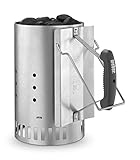
Best for small charcoal grills
2. Weber Rapidfire Compact Chimney Starter
A smaller version of the Rapidfire for portable and small grills, using the same idea in a more compact build. Check the listing for the exact capacity.
Suits: small charcoal grills. Strengths: a smaller footprint. Weaknesses: lights fewer coals. Skip it if you cook for crowds.
View Weber Rapidfire Compact on Amazon
Best for everyday grillers
3. Kingsford Charcoal Chimney Starter
A straightforward chimney starter from the best-known U.S. charcoal brand. It is a simple, no-frills stack that does the job at a budget-friendly level.
Suits: everyday grillers. Strengths: a plain, easy design. Weaknesses: fewer extras. Skip it if you want a heat shield.
View Kingsford Charcoal Chimney Starter on Amazon
Best for casual charcoal use
4. Char-Broil Chimney Starter
Char-Broil sells a charcoal chimney starter aimed at its own grill buyers and other charcoal users. Check the listing for the capacity and handle style, as designs have changed over time.
Suits: casual charcoal use. Strengths: a familiar grill brand. Weaknesses: fewer details to compare. Skip it if you want a well-documented model.
View Char-Broil Chimney Starter on Amazon
Best for napoleon charcoal owners
5. Napoleon Charcoal Chimney Starter
Napoleon, a grill maker, offers a chimney starter for charcoal grills. Check the listing for capacity and handle features before ordering.
Suits: Napoleon charcoal owners. Strengths: a grill brand pick. Weaknesses: less widely reviewed. Skip it if you want the most common option.
View Napoleon Charcoal Chimney Starter on Amazon

Best for general grilling
6. Cuisinart Chimney Starter
Cuisinart sells grilling accessories, including a charcoal chimney starter. Confirm the size and the handle style on the listing, because several designs exist.
Suits: general grilling. Strengths: a familiar kitchen brand. Weaknesses: versions differ. Skip it if you want a known grill-maker design.

Care and Setup
- Set the starter on a fireproof surface, not on wood or a deck.
- Use a fire starter cube or crumpled newspaper under the stack.
- Pour the coals once the top ones show gray ash.
- Let it cool fully before storing.
- Wear a heat-resistant glove when you lift and pour a loaded chimney.
- Set the starter on the grill grate or a fireproof surface, never directly on a deck.
Mistakes to Avoid
- Using lighter fluid in the chimney.
- Pouring hot coals without gloves.
- Overfilling the stack.
- Leaving the starter on a wooden or plastic table.
- Pouring the coals before they are lit through, which gives uneven heat.
- Leaving a hot chimney where a child or pet can reach it.
How a Chimney Starter Actually Works
A chimney starter uses a simple physical principle: heat rises. When you light fuel under the cylinder, hot air travels up through the stack and pulls fresh air in through the vents at the bottom. That draft feeds the coals evenly, which is why a chimney lights a full load without lighter fluid and without the uneven patches you often get from piling charcoal in a heap.
The design has three working parts. The cylinder holds the charcoal in a tall column, so the coals warm each other. The vents or holes at the base let air in. A grate or base plate keeps the coals above the lighting material so that flame and airflow can pass beneath them. Understanding these parts helps you judge a model: more and better-placed vents usually mean quicker, more even lighting.
You will see that the coals at the top are the last to ignite. When flames lick over the top and the upper coals show a light layer of gray ash, the load is ready to pour. Timing varies with the weather, the charcoal type and how tightly you pack the stack, so rely on appearance rather than a fixed clock.
This is also why a chimney is a safer method than lighter fluid. There are no fumes to burn off and no flare-up risk from spraying a lit grill.
Capacity and Grill Size Matching
Choose a chimney that matches the size of your grill and the way you cook. A full-size chimney holds enough charcoal to start a standard kettle or a large grill in one go. A compact one is easier to store and suits a small portable grill, but it lights less charcoal at a time, so you might need to add fresh coals during a long cook.
Think about how much fuel your usual cook needs. For quick weeknight burgers, a partial load may be enough. For high-heat searing, a full load spread evenly gives you a hot cooking zone. For long cooks on a smoker or a large grill, you might light a chimney and use it to start a larger bed or keep a second batch ready to add.
The handy rule is to avoid overfilling. A stack packed to the very top is harder to light and heavy to lift, which increases the chance of spills. Fill to the level where you can carry it comfortably and where air can still circulate. Check the product listing for capacity, which may be described by volume or by briquette count, and compare that with the amount you normally use.
If you own more than one grill, one larger chimney can serve them all, and it is rarely a mistake to size up slightly.
Handles, Heat Shields and Safe Pouring
A chimney holds a column of burning charcoal, so the handle design is where safety lives. A heat shield between your hand and the cylinder keeps radiant heat away. A handle made of a heat-resistant material or with an air gap stays cooler than bare metal. Look for a sturdy attachment, since a loose or flimsy handle is a hazard when the cylinder is full of hot coals.
A second grip or a dump control makes pouring safer. With one hand on the main handle and another on an auxiliary grip, you can tilt the cylinder with more control and less wrist strain. Even with these features, wear a long, heat-resistant glove, and keep your face and arms back from the opening as the coals tumble out.
Pour in a steady motion near the grate rather than from a height, to keep sparks and ash low. Watch the wind, and avoid dry grass or leaves nearby.
Think about where the cylinder rests while it heats and after you pour. A heavy-duty grate or a stable rim helps keep the empty hot chimney from tipping. Check that the base legs or feet are stable. Place the hot, empty cylinder on a heat-safe surface and keep it away from children, pets and anything flammable until it has cooled.
Lighting Methods and Fuel Tips
Several methods start the fire under the chimney, and the best one is the one that gives you a reliable result. Crumpled newspaper is inexpensive and works for many people, but loose sheets can float up and burn unpredictably in a breeze. Fire starter cubes made for charcoal are tidier and burn for a steady period. Either way, place the lighting material on the grate or base and put the chimney on top, then light from the side through the vents.
Avoid lighter fluid in or around the chimney. It defeats the purpose and can leave fumes in your food. Skip anything not designed for cooking fires.
The fuel itself matters. Briquettes burn steadily and are predictable, while lump charcoal lights faster and burns hotter, but pieces vary in size and burn out sooner. Mixing the two is possible, but expect uneven results. Make sure the charcoal is dry, because damp fuel lights slowly and smokes. Store bags sealed and off the ground.
- Do not pack the stack so tightly that air cannot pass through.
- Light from the bottom vents, not the top.
- Be ready to pour when the top coals show light gray ash.
If lighting seems slow, check that the vents are clear and that the chimney is not sitting on a surface that blocks airflow.
Care, Storage and When to Replace a Chimney
Chimney starters are simple and durable, but a little care extends their life. After use, let the cylinder cool fully and empty any leftover ash. Do not quench it with water while hot, because sudden cooling can warp the metal and cause rust. Knock out loose ash and store the chimney in a dry place. A cover or a spot in a shed helps keep rust away.
Check the cylinder, handles and base before each season. Look for these signs that a replacement is due:
- Handles that are loose, cracked or wobbling.
- Rust that has weakened the metal or created holes.
- A heat shield that has come loose or is warped.
- A base or grate that is bent so the stack tips.
- Vents that are choked with rust or distorted.
Surface rust on a steel chimney is common and is not always a problem. A little discoloration from heat is normal, too. But structural damage is a safety risk, because the cylinder is lifted while full of burning coals.
If you grill often, it can be worth keeping a spare handle-ready glove, a fireproof landing spot and a steady habit of storing the chimney where children cannot reach it. Replace it promptly if you doubt its stability.
A Step-by-Step Light Sequence for Beginners
A chimney is simple, yet small mistakes can leave you with half-lit coals or a cloud of smoke. Always read your maker’s directions first, then use this general flow as a reminder of the order things happen.
- Set up on a safe surface. Place the chimney on the bottom grate or on a bare, non-flammable spot, never on wood, grass or a plastic table.
- Add paper or a fire cube under the base. Loose crumpled sheets work, and a cube gives a longer flame.
- Fill the canister with charcoal. Fill as much as your recipe calls for, since a half load heats a small area and a full load covers a larger one.
- Light the paper in several places. Flames climb through the holes and heat the first layer of coals.
- Wait for ash to form. When the top coals turn gray and glow around the edges, they are ready for the grill.
- Pour with protection. Use heat-resistant gloves and a steady hand, and keep your face turned away from the rising heat.
Timing varies with charcoal type, weather and canister size, so judge by the look of the coals rather than the clock. Lump charcoal often lights faster than dense briquettes, while a windy day can speed things up or blow out the flame.
Briquettes Versus Lump: How Each Behaves in a Chimney
Both fuels work in a chimney, but they do not feel identical. Knowing the differences helps you set expectations and plan your grilling time.
| Trait | Briquettes | Lump charcoal |
|---|---|---|
| Shape | Uniform pillows that stack neatly | Irregular chunks that leave gaps |
| Burn pattern | Steady and predictable for long cooks | Hot and quick, often with more ash flying around |
| Loading | Fills a canister evenly | Larger pieces may need breaking to fit |
| Ash left behind | Usually more | Usually less |
Whichever you pick, store the bag somewhere dry. Damp charcoal is slow to light, can spit and gives off more smoke. If a bag has absorbed moisture, spread the pieces in a dry place and let them air out before use.
Heat-Resistant Habits Around a Hot Canister
The metal body of a chimney becomes very hot, and handles can warm up too. Treat it the way you would a pan straight from the oven.
- Keep children and pets well away from the lighting area.
- Use gloves that are made for grilling, not thin cloth that can scorch.
- Never carry a lit chimney across a deck or lawn. Light it where you plan to pour.
- Set it down only on a heat-proof surface and give it plenty of room.
- Let it cool fully before moving it, and keep it dry afterward.
When coals have been poured, the empty chimney will stay hot for a long while. A designated resting place, such as a spare corner of the grill grate or a metal stand, keeps people from touching it by accident.
When a Chimney Is Not the Right Tool
Chimneys are meant for lighting charcoal in a grill or similar fuel box. They are not suited to indoor use, to enclosed porches or garages, or to places with no ventilation. Follow local fire rules, especially during dry spells or when open flames are restricted in your area. If your maker’s manual states a recommended method for lighting your grill, treat that as the primary guide.
Sizing a Chimney to Your Grill and Your Cooking Style
Capacity is the main difference between models, and the right size depends on the grill you own and what you plan to cook. A compact chimney holds fewer coals, which suits small kettles, portable grills and quick weeknight meals. A full-size canister holds enough fuel to fill a larger kettle or to build a two-zone fire, where coals are piled on one side so the other side stays cooler for gentle cooking.
- Small grill or camping use: a compact body is easier to pack and quicker to fill.
- Everyday family grilling: a standard size covers burgers, chicken pieces and vegetables.
- Long smoking sessions: a large canister lets you add fresh coals to a running fire without waiting long.
Also look at the handle design. A heat shield between your hand and the metal is a real comfort, and a second assist handle helps when you pour a heavy load. A bottom air gap or raised base keeps the canister from scorching the surface underneath, though you should still place it on a safe, bare area.
Finally, think about storage. A canister with a hook or a hanging loop is simple to keep beside the grill, while a larger body may need a shelf or a dry corner of the garage. Keep it indoors during wet seasons so the metal stays free of rust.
Choosing Charcoal Chimney Starters For Grilling With Confidence: A Deeper Look
The reviews above give you the short version of each pick: what it is, who it suits and where it compromises. This added section slows down and looks at charcoal chimney starters for grilling the way ownership actually feels — choosing between close options, setting up well, building a routine, cleaning and caring for what you buy, and avoiding the mistakes that make good products disappoint. Nothing here changes the reviews themselves; it is the thinking that helps you choose between them and get the best from whichever one comes home with you.
Fit with your existing grill comes before everything else
Accessories for charcoal cooking only earn their place if they fit the grill you already own and the way you already cook. Measure the cooking grate, the charcoal grate and the clearance under the lid before ordering anything, and compare those measurements with the dimensions on the current listing. An accessory that forces you to rearrange every cook, blocks the lid from closing or leaves no room for food has failed at its one job, however well it is made.
Material and heat tolerance decide how long it lasts
These accessories live in the harshest spot in the grill, in direct contact with lit charcoal. Thicker, well-finished metal shrugs off repeated heat cycles, while thin or poorly finished pieces warp, rust or shed their coating into the fire. You cannot judge thickness from a photograph, so read the guide above for the construction notes it gives on each pick, and treat any accessory as a consumable with a lifespan rather than a lifetime purchase.
How it changes your fire is the real feature
The point of a basket, holder or starter is control: keeping coals banked for indirect cooking, concentrating heat for searing, or lighting fuel evenly without liquid aids. Judge each pick by the specific fire arrangement it makes easier, and whether that arrangement matches your cooking. If you mostly cook directly over a full bed of coals, a divider you never use is just clutter in the grill.
Cleaning and storage are part of the design
Charcoal accessories come out of the grill covered in ash and grease, and they get stored somewhere between cooks. Pieces that brush clean easily, nest or hang for storage and do not have sharp edges or fiddly parts will be used constantly. Pieces that are awkward to clean quietly stop being used, which is why the simplest designs in this category often outlast cleverer ones in real households.
Value means cost per season, not cost per purchase
A cheap accessory replaced every season costs more, in money and in frustration, than a sturdier one kept for years. At the same time, there is no virtue in over-buying for a grill you use six times a year. Match the accessory to your actual cooking frequency, store it dry, and it will repay you in easier fires and more predictable results.
Charcoal Chimney Starters For Grilling in Day-to-Day Life
For indirect cooking — a whole chicken, a joint of meat or anything that needs time rather than searing — keeping the coals banked neatly to one or both sides is the whole technique. That is the scenario these accessories were invented for: the food sits in the calm middle zone, the lid stays on, and the fire behaves like an oven rather than a bonfire.
For searing, the opposite arrangement applies. Concentrating lit coals into a smaller, deeper bed gives you a fiercely hot zone for steaks and chops, with the rest of the grate as a resting area. An accessory that holds that concentrated bed together stops coals spreading and thinning out just when you need the heat most.
For long, slow sessions, the benefit is consistency. A tidy, contained fire burns down predictably, is easier to top up, and leaves the rest of the charcoal grate clear for ash to fall away instead of choking the fire. Over several hours, that tidiness is the difference between a cook you manage and a cook that manages you.
For smaller grills and portable cooking, space discipline matters even more. Every accessory must justify the grate area it occupies. In a compact kettle, one well-chosen holder used on one side often beats a pair used symmetrically, because it preserves a genuinely useful indirect zone instead of two cramped ones.
Getting Set Up and Into a Routine
Start by fitting the accessory to the cold, empty grill. Place it on the charcoal grate, check the lid closes fully, and confirm you can still lift and move it with the tools you own before any fuel is involved. This dry run takes two minutes and prevents the classic first-use problem of discovering a fit issue with a fire already lit.
For the first cook, keep the menu simple and the fire modest. Light less charcoal than you think you need, arrange it in the accessory, and watch how the arrangement burns: where the heat concentrates, how quickly the coals ash over, and how the food zone responds. Take a mental note of the timing, because the contained fire will behave differently from the loose bed of coals you are used to.
Build from that baseline one change at a time. More fuel for a hotter sear, a different bank for a longer cook, a drip pan under indirect food to keep the grill cleaner. Changing a single variable per cook is slower in theory and much faster in practice, because you actually learn what each change did.
Cleaning, Care and Keeping It at Its Best
Let the accessory cool in the grill before handling it, then empty ash into a metal container once everything is completely cold. Brush off residue with a stiff brush; avoid soaking coated or plated pieces for long periods, and dry everything thoroughly before storage, since ash residue plus moisture is what corrodes these parts fastest.
Store accessories dry, ideally hanging or nested inside the closed grill or in a covered box nearby. A light check before each season — looking for warping, cracked welds or flaking surfaces — tells you whether a piece is still fit to sit in a fire. Retire anything that is shedding material or no longer sits flat and stable.
Keep the grill itself in the same routine: ash out after every cook, grates brushed while warm, and the whole setup covered once cool and dry. Accessories last noticeably longer in a grill that is itself kept clean and dry, because they are not sitting in damp ash between weekends.
How the Picks in This Guide Compare With Each Other
Read side by side, the six picks in this guide are less a ranking than a set of answers to different questions. Each review above names a role, a strength and a reason to skip, and those three things together are the honest comparison. The notes below restate that positioning in one place, so you can match each pick against the situations described earlier in this section and see which answer sounds like your household.
Weber Rapidfire Chimney Starter. The classic full-size chimney starter from the kettle grill maker. In the review above, it is presented as suiting kettle and larger grills. Treat the description above as the promise and the current listing as the contract: confirm the version, the included parts and the maker's guidance there before ordering, and this pick should behave exactly as the review leads you to expect.
Weber Rapidfire Compact Chimney Starter. A smaller version of the Rapidfire for portable and small grills, using the same idea in a more compact build. In the review above, it is presented as suiting small charcoal grills. This is also the pick to measure your space against most carefully, because its strengths only count if it fits your counter, your storage or your routine without a daily workaround. A tape measure and five honest minutes now prevent the most common disappointment in this whole category.
Kingsford Charcoal Chimney Starter. A straightforward chimney starter from the best-known U.S. In the review above, it is presented as suiting everyday grillers. Come back to this one after reading the rest of the list; its value usually becomes clearer in contrast. Several picks in this guide will look similar at first glance, and the differences that matter are the ones this review names — role, strengths and the reason you might skip it.
Char-Broil Chimney Starter. Char-Broil sells a charcoal chimney starter aimed at its own grill buyers and other charcoal users. In the review above, it is presented as suiting casual charcoal use. Shortlist this one if that description matches your household, and check the current listing for the details that decide fit — dimensions, what is included and the care it needs — because versions under similar names can differ in ways that matter once the box is open.
Napoleon Charcoal Chimney Starter. Napoleon, a grill maker, offers a chimney starter for charcoal grills. In the review above, it is presented as suiting Napoleon charcoal owners. Where this pick earns its place is in that specific role; where it asks for compromise, the review above is candid about it. Weigh the compromise against how often you will actually use it that way, rather than against an ideal product that does not exist at any point in this guide.
Cuisinart Chimney Starter. Cuisinart sells grilling accessories, including a charcoal chimney starter. In the review above, it is presented as suiting general grilling. If you are torn between this pick and the next one, decide by the meal or task you repeat most often. The right answer is the one that makes your most common day easier, not the one that wins on the day you cook for the most people or buy the most ambitious ingredients.
Putting It Together: How Different Readers Decide
Abstract criteria become clearer when they are attached to real situations. The examples below take situations described earlier in this section and pair them with the picks in this guide that the reviews position for them. Use them as starting points rather than verdicts: your space, your habits and your tolerance for upkeep still have the final say, but a concrete starting point beats staring at six similar options.
Starting point 1. For indirect cooking — a whole chicken, a joint of meat or anything that needs time rather than searing — keeping the coals banked neatly to one or both sides is the whole technique. In the reviews above, the first is presented as suiting kettle and larger grills, while the second is presented as suiting small charcoal grills. If that sounds like your household, compare Weber Rapidfire Chimney Starter and Weber Rapidfire Compact Chimney Starter first, reading both reviews again with your own space and routine in mind. Notice which compromise you would mind less after a month of ownership, because that instinct — checked against the details on the current listing — is a better guide than any ranking. These picks were positioned for different households, and choosing well means matching the position to your life, not crowning an overall winner.
Starting point 2. For searing, the opposite arrangement applies. In the reviews above, the first is presented as suiting everyday grillers, while the second is presented as suiting casual charcoal use. If that sounds like your household, compare Kingsford Charcoal Chimney Starter and Char-Broil Chimney Starter first, reading both reviews again with your own space and routine in mind. Notice which compromise you would mind less after a month of ownership, because that instinct — checked against the details on the current listing — is a better guide than any ranking. These picks were positioned for different households, and choosing well means matching the position to your life, not crowning an overall winner.
Starting point 3. For long, slow sessions, the benefit is consistency. In the reviews above, the first is presented as suiting Napoleon charcoal owners, while the second is presented as suiting general grilling. If that sounds like your household, compare Napoleon Charcoal Chimney Starter and Cuisinart Chimney Starter first, reading both reviews again with your own space and routine in mind. Notice which compromise you would mind less after a month of ownership, because that instinct — checked against the details on the current listing — is a better guide than any ranking. These picks were positioned for different households, and choosing well means matching the position to your life, not crowning an overall winner.
Final Checks Before You Order
Work through these checks in order, for the one or two picks that survived the comparison above. They revisit the criteria from the start of this section as questions to verify, because the gap between a good decision and a disappointing one is usually a detail that could have been confirmed in five minutes before ordering.
Fit with your existing grill comes before everything else. Accessories for charcoal cooking only earn their place if they fit the grill you already own and the way you already cook. Finally, check this point against the version actually being sold today. Products in this category are revised, bundled and renamed more often than their listings suggest, and the gap between the reviewed version and the delivered version is where most avoidable disappointment begins.
Material and heat tolerance decide how long it lasts. These accessories live in the harshest spot in the grill, in direct contact with lit charcoal. Before you order, turn that point into a question you can actually answer from the current listing and the maker's information: what does this specific version include, what does it require from your space, and what will it ask of you each week? If the answer is unclear, that is a reason to pause, not to guess, because this is exactly the kind of detail that decides satisfaction a month later.
How it changes your fire is the real feature. The point of a basket, holder or starter is control: keeping coals banked for indirect cooking, concentrating heat for searing, or lighting fuel evenly without liquid aids. Write your answer down next to the other candidates you are comparing, in plain words rather than scores. A shortlist compared on the same few honest questions produces a decision you can defend to yourself later, and it stops a single eye-catching feature from outweighing the qualities you will live with every day.
Cleaning and storage are part of the design. Charcoal accessories come out of the grill covered in ash and grease, and they get stored somewhere between cooks. If two picks still tie after this check, choose the one whose demands you are more willing to meet — the cleaning, the storage, the routine, the installation — because ownership is mostly demands met happily or resented quietly. The product itself rarely changes after purchase; your willingness is the variable that decides whether it feels like a good buy.
Value means cost per season, not cost per purchase. A cheap accessory replaced every season costs more, in money and in frustration, than a sturdier one kept for years. Revisit this after reading the comparison section below, not before. The reviews give each pick a role, and this criterion means something different for each role: what is essential for one kind of household is optional for another. Judged in context, the right priority usually becomes obvious without forcing it.
Common Mistakes and How to Avoid Them
- Buying before measuring: The most common failure in this category is an accessory that almost fits. Measure the grates and lid clearance first, and check the listing dimensions for the exact model, every time.
- Overfilling the fire: A contained bed of coals is more efficient than a loose one, so the amount of charcoal that used to be right will now run hotter. Start with less and add if needed.
- Using liquid lighter fluid out of habit: A contained, well-aerated fire lights easily with a starter cube or chimney. Liquid aids add off-flavours and are unnecessary once the fire is properly arranged.
- Leaving the accessory sitting in ash: Ash plus overnight moisture corrodes metal quickly. A ten-second brush-off after the cook, once cool, doubles the useful life of these parts.
- Expecting one arrangement to suit every cook: Banked, concentrated and spread fires are different tools. Rearrange the accessory to the meal instead of forcing every meal onto one setup.
Think of these accessories as a way of giving one grill several personalities. The same kettle that sears steaks over a concentrated bed on Friday can roast a chicken gently between two banked fires on Sunday, and the accessory is what makes the changeover take a minute instead of a rearrangement of hot coals with tongs. If you cook in more than one style, that flexibility is worth more than any single feature.
It also helps to keep the rest of the kit consistent: the same fuel, the same lighting method and the same thermometer, so the accessory is the only new variable. Owners who change everything at once rarely learn which change helped. Owners who change one thing can feel the difference in a single cook.
Before ordering, re-read the review of your chosen pick in the guide above and check the current listing for dimensions, material and what is included. Accessories in this category are frequently sold in different pack sizes and versions under similar names, and the cheapest misunderstanding is assuming the listing matches the review without looking.
Charcoal Chimney Starter FAQ
How long does it take to light coals?
Often around twenty minutes, depending on the charcoal and weather.
Do I need lighter fluid?
No. That is the main reason to use a chimney.
Can I use it with lump charcoal?
Yes, though lump burns differently from briquettes.
Which size should I get?
Full size for most grills, compact for small portable ones.
How full should I fill the chimney?
Fill it to a level you can lift comfortably, while leaving enough space for air to flow. Many people fill it to the top for a hot grill and use less for gentle cooking.
Why are my top coals not lighting?
The stack may be packed too tightly or the vents blocked. Make sure the base has airflow, use enough lighting material and give it a few more minutes. Dry charcoal also lights better.
Can I use a chimney on a gas stove or indoors?
No. Charcoal produces carbon monoxide and should only be lit outdoors in an open, ventilated area, away from buildings and anything flammable.
Do I need to wait for the coals to turn completely gray?
Not completely. When the top coals show light gray ash and flames are visible, they are usually ready to pour. Check the charcoal bag's instructions too.
Can I reuse the unburned coals?
Yes, you can often reuse partly burned charcoal. Spread it on the grate with fresh coals, and shake out the ash so air can circulate.
Is a chimney starter better than an electric starter?
They serve different tastes. A chimney needs no power and works anywhere outdoors, while an electric starter needs an outlet and a safe place to rest. Many cooks prefer the chimney for its simplicity.
How do I put out the leftover coals?
Close the vents and lid on the grill, and let them burn out. Dispose of cold ashes in a metal container, and never put hot coals in a plastic or paper bin.
Do I need one accessory or a pair?
It depends on the fire you want. A pair lets you bank coals on both sides with food in the middle, while a single piece suits one-sided indirect cooking and leaves more room on the grate. Start with the arrangement you will use most; you can always add the second later.
Can I use lump charcoal as well as briquettes?
Most holders and baskets work with both, but lump pieces vary in size and small fragments can fall through wider gaps. Briquettes give the most predictable contained fire, while lump gives a faster, hotter one. Check the guide above for any fuel notes on your specific pick.
How do I clean it without damaging the finish?
Brush it once cool, knock out ash, and wipe it dry. Avoid harsh soaking and abrasive scouring on coated surfaces, and never put a still-hot piece into water, which can warp it.
Will it work in a smaller or larger kettle?
Only if the dimensions suit. These accessories are made for particular grate sizes, so compare the measurements on the current listing with your grill before ordering, and check that the lid still closes with the accessory in place.
Why does my contained fire burn out faster on one side?
Uneven burning usually means uneven loading or uneven airflow. Load the charcoal evenly, check that ash is not blocking the vents beneath one side, and rotate the food rather than fighting the fire.
When should I replace it?
Replace the piece when it is warped enough to sit unevenly, when welds or joints fail, or when the surface is flaking. Until then, dry storage and regular brushing keep it serviceable for a long time.
The Short Version
For a classic, the Weber Rapidfire. For small grills, the Rapidfire Compact. For a plain budget-friendly stack, the Kingsford. For a grill-brand option, the Char-Broil. For a Napoleon owner, the Napoleon. For a kitchen-brand pick, the Cuisinart. Whichever you choose, the handle design and the capacity are the details most worth checking on the listing.