Hard and soft boiled eggs need different timing, and a good egg cooker takes the guesswork out. Most steam eggs with a measured amount of water, so a smaller pour gives a runny yolk and a larger pour gives a firm one.
The six picks below include dedicated electric egg cookers and one multi-cooker that handles eggs well. We have not used these products ourselves, so please confirm the capacity, water chart and accessories on the current listing before buying. Cooking times differ between models.
As an Amazon Associate we earn from qualifying purchases. Links below are affiliate links, and they do not change the product information we give.
What to Look For
| Feature | Why it matters |
|---|---|
| Water chart | A clear chart or a marked cup sets soft, medium or hard results |
| Capacity | Six to twelve eggs is common; larger units suit meal prep |
| Shutoff | A buzzer or auto shutoff stops the cooking on time |
| Extras | A poaching or omelet tray adds other breakfast options |
| Cleanup | A removable tray and a nonstick plate save scrubbing |
In this guide
Specs at a Glance
| Cooker | Style | Capacity class | Notes |
|---|---|---|---|
| Dash Deluxe Rapid | Electric steamer | Larger batch | Check the listing |
| Hamilton Beach egg cooker | Electric steamer | Several eggs | Common household pick |
| BELLA rapid egg cooker | Electric steamer | Several eggs | Check the model |
| OVENTE electric egg cooker | Electric steamer | Several eggs | Check the model |
| Cuisinart Egg Central | Electric steamer | Several eggs | Poaching and omelet trays |
| Presto egg cooker | Electric steamer | Several eggs | Check the listing |
The 6 Best Egg Cookers for Hard and Soft Boiled Eggs
Top pickBest for bigger batches of boiled eggs
1. Dash Deluxe Rapid Egg Cooker
A larger Dash egg cooker built for bigger batches, with a water cup and a tray for boiled, poached or omelet-style eggs. Check the listing for the capacity of the version you pick.
Suits: bigger batches of boiled eggs. Strengths: an easy water-based setup. Weaknesses: bulkier than the small Dash models. Skip it if you only cook one or two eggs.
View Dash Deluxe Rapid Egg Cooker on Amazon
Best for everyday kitchen use
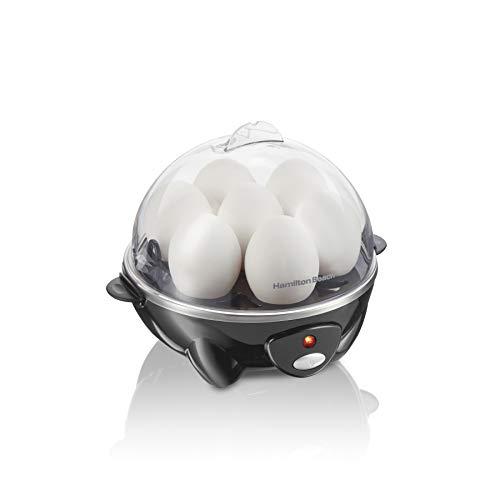
2. Hamilton Beach Electric Egg Cooker
Hamilton Beach sells electric egg cookers that steam eggs to the doneness you choose with a measured water pour. Many include extra trays for poaching, so read the listing.
Suits: everyday kitchen use. Strengths: a familiar brand and simple use. Weaknesses: features vary by version. Skip it if you want a stainless body.


Best for quick breakfast prep
3. BELLA Rapid Electric Egg Cooker
BELLA offers a rapid egg cooker with a measuring cup and a see-through lid. Confirm the capacity and the poaching tray on the current listing before ordering.
Suits: quick breakfast prep. Strengths: a quick cook and simple controls. Weaknesses: details differ by listing. Skip it if you need a large capacity.

Best for small households
4. OVENTE Electric Egg Cooker
OVENTE sells compact egg cookers that steam hard and soft eggs. Read the listing to confirm the capacity, since the brand offers more than one size.
Suits: small households. Strengths: a compact build. Weaknesses: limited capacity. Skip it if you want a poacher-first tool.
View OVENTE Electric Egg Cooker on Amazon
Best for cooks who want extra trays
5. Cuisinart Egg Central Egg Cooker
Cuisinart’s Egg Central steams eggs and adds trays for poaching and omelets. The brand tends to build solid small appliances, though you should confirm the details on the listing.
Suits: cooks who want extra trays. Strengths: a known brand and extra trays. Weaknesses: takes up more counter space. Skip it if you want the smallest cooker.
View Cuisinart Egg Central Egg Cooker on Amazon
Best for simple breakfast routines
6. Presto Egg Cooker
Presto is a long-running small appliance brand with egg cookers aimed at straightforward breakfast use. Check the listing for the capacity and the model.
Suits: simple breakfast routines. Strengths: a trusted old-school brand. Weaknesses: specs vary by model. Skip it if you want a modern, smart cooker.
View Presto Egg Cooker on Amazon
Care and Setup
- Add the water amount shown on the chart for your doneness.
- Let the unit cool before wiping the base.
- Remove mineral spots from the heating plate with a little vinegar.
- Cool the cooked eggs in cold water to stop the cooking.
Mistakes to Avoid
- Using the wrong water amount for the doneness.
- Cooking eggs straight from a very cold fridge without checking the chart.
- Skipping the piercing pin and cracking shells.
- Leaving the cooked eggs in the warm tray.
How Steam Cooking Controls Yolk and White
An electric egg cooker works by heating a small, measured amount of water on a plate in the base. The water boils away into steam, the steam fills the closed lid and cooks the eggs, and the unit signals or shuts off once the water is gone. Because the water volume decides how long the cooker runs, a smaller pour gives a shorter cook and a softer yolk, and a larger pour gives a longer cook and a firmer yolk. This is why the measuring cup that comes with the unit matters so much, and why it helps to keep it with the cooker.
The eggs themselves set in stages. The white firms up first, and the yolk thickens later as the temperature climbs. A soft-boiled egg has a set white and a runny or jammy yolk, a medium egg has a thick, creamy center and a hard-cooked egg is firm all the way through. Because steam is a gentle, even heat, many cooks find results are fairly repeatable from batch to batch, though they depend on the cooker, the size of the eggs and the starting temperature.
Be aware of what can change the outcome. Large and extra-large eggs take longer than small ones, and eggs straight from a cold fridge take longer than room-temperature ones. Cooking at high altitude can change timing. Water hardness can leave mineral deposits on the plate that affect heating. The chart on your cooker is the right starting point, and you can nudge the water amount by a small step up or down after your first batch to match your taste. Keep a note of the amounts that work.
Choosing Capacity for Your Routine
Egg cookers are described by how many eggs fit in the tray, and the right capacity depends on how you cook. A small cooker, with room for a few eggs, suits one or two people and keeps the footprint small. A mid-size unit handles a family breakfast or a few days of meal prep. Larger models hold many eggs at once and suit big households, packed lunches or batch cooking for egg salad and deviled eggs. Check the listing for the stated capacity and for the size of egg that was used.
Consider how you will use the cooker across the week. If you boil eggs on Sunday for the week, a larger capacity saves time. If you cook one or two eggs each morning, a large unit may be wasteful, since the cooker uses the same heating plate, and the water chart for a small batch may differ from the chart for a full tray. Some cookers let you cook fewer eggs by following the chart for the number you add, while others work best when full. Read the instructions for a partial load.
Also think about size and storage. A large cooker takes up cupboard or counter space, and a tall lid can be awkward in a small cabinet. Look at the cord length and whether it stores neatly. If you also want poached eggs or omelets, check whether the cooker includes extra trays and how many eggs they cook at once. If you rarely cook anything but boiled eggs, a simpler model with fewer parts is easier to clean and less likely to be misplaced.
Peeling, Cooling and Food Safety
Many people buy an egg cooker to get eggs that peel cleanly. The most reliable habit is to cool eggs promptly after cooking. Move them from the cooker into a bowl of cold or ice water for several minutes, which stops the cooking so the yolk does not overset and helps the egg shrink slightly away from the shell. Crack the shell gently all over, then peel under a little running water or in the bowl, starting at the wide end where there is an air pocket.
Egg age influences peeling too. Very fresh eggs can cling to the shell, while eggs that have been in the fridge for a week or so often peel more easily. This is a general kitchen observation and not a guarantee. Many cookers include a piercing pin to make a tiny hole in the shell before cooking, which lets air escape and reduces cracking. Use it as the manual instructs, and handle eggs gently when loading the tray.
Food safety matters with eggs. Keep eggs refrigerated until you cook them, and refrigerate cooked eggs soon after cooling. Follow guidance from your local food safety authority on how long hard-cooked eggs can be kept, and keep them in a covered container. Soft-boiled and runny yolks carry more risk than fully cooked ones, particularly for young children, pregnant people, older adults and anyone with a weakened immune system, so check official advice and cook eggs fully when serving these groups. Do not leave cooked eggs sitting in the warm cooker for long, since lingering warmth can continue cooking them and is not a safe holding temperature.
Extra Trays and Other Uses for the Cooker
Many egg cookers come with accessories that expand what they can do. A poaching tray holds beaten or cracked eggs in small cups, which sit above the steaming water and cook gently. An omelet bowl lets you cook a small omelet, scrambled-style eggs or a custard-like dish with added cheese, vegetables or herbs. Some units also come with a lid that has a vent and a clear window so you can watch the progress. Check what the listing includes, how many eggs each tray holds and whether the trays are nonstick or need a light coat of oil.
The steam heat can cook other small foods as well. People use egg cookers to steam a few vegetables, warm small items or cook dumplings, but results depend on the model, and the instructions may not cover these uses. If you try something new, use small amounts, watch the first run closely and make sure the lid fits and vents properly. Avoid anything that can block the steam vent or overflow into the base. Do not use the cooker for anything the maker warns against.
Keep the accessories organized. Small parts such as the measuring cup and piercing pin are easy to lose, and the water chart may be printed on the cup, so note it somewhere handy. If you find that you rarely use the extra trays, a simple unit with a single boiled egg tray may suit you better. If you like variety, a model with poaching and omelet trays adds options without a second appliance. Think about what you will really cook before paying for extras.
Descaling, Cleaning and Knowing When to Replace
Because the cooker boils off small amounts of water each time, minerals gradually build up on the heating plate. If your water is hard, you may see a white or gray film after a few uses. That scale can slow heating and change cooking times, so remove it regularly. Unplug the unit and let it cool, then add a small amount of white vinegar or a mild descaling solution to the plate as the manual recommends, let it sit, wipe it clean and rinse. Do not use abrasive pads on the plate. Using filtered or softened water can reduce buildup.
Wash the lid and trays by hand with warm soapy water, or place them in the dishwasher only if the listing says they are dishwasher safe. Dry everything well before storing. Wipe the base with a damp cloth, taking care that no water enters the electrical parts, and never submerge the base. If egg has cracked and leaked, clean it up promptly, because dried egg is harder to remove and can leave odors.
Signs it is time to replace the cooker include a heating plate that no longer boils the water, a buzzer or shutoff that fails to work, eggs that are repeatedly under or overcooked despite the correct water amount, a cracked lid, a worn cord or a plate whose coating is flaking. Because these appliances are inexpensive relative to many kitchen items, replacement is often more practical than repair, but check the warranty first. When you replace one, note what you wanted that the old one lacked, such as more capacity, easier cleaning or extra trays, and choose accordingly.
Egg Cooker Buying Checklist
Egg cookers look alike at first glance, so a short list helps you sort out what matters in your kitchen.
- Count how many eggs you cook in a typical morning, and whether you ever batch a dozen for the week.
- Check the counter or cabinet space the machine will need, including the height with the lid on.
- See whether the cooker has a measuring cup and whether the cup marks for soft, medium and hard are easy to read.
- Look for an automatic shut-off or a buzzer so you are not watching the clock.
- Find out whether the tray is meant for eggs only or can also hold other foods.
It is worth remembering that every machine comes with its own instructions for water amounts and timing. Follow those directions first, then adjust to taste once you know how your cooker behaves.
A Simple Guide to Matching a Cooker to Your Household
The right model depends far more on who is eating than on any feature list. Use these situations as a rough guide.
| Situation | What to look for |
|---|---|
| One person, a couple of eggs most days | A compact unit with a small footprint |
| Family breakfast | A larger tray and a clear lid so you can see progress |
| Weekly meal prep | High capacity and room to cool eggs quickly afterward |
| Small kitchen or dorm | A light body that stores in a cabinet |
| Interest in omelets or poached eggs | A model that includes extra trays |
A cooker that holds many eggs is not always the better pick. Running a big machine for a single egg wastes counter space, and a tiny one slows down anyone who feeds a crowd.
Reading the Fine Print on an Egg Cooker Listing
Marketing copy tends to dwell on speed and ease, but the useful details are quieter. Look at the stated capacity and ask whether it counts a full tray or only a single layer. Read the power description and the cord length, since a short cord can limit where you place the machine. Note what the lid is made from and whether the base is removable for rinsing.
Check also what the box includes. A piercing pin, a cup and a tray may all be present, or the listing may leave one out. If a part is missing or unclear, ask the seller before you order rather than assuming it is inside. Finally, keep the manual after setup. Descaling steps and care notes differ from one maker to the next, and the booklet is the dependable place to find them.
What to Do When Results Surprise You
Even with a good cooker, a batch can come out differently than you hoped. A few quick checks usually explain why.
- Measure the water with the cup that came with the unit, and use the line for the doneness you want.
- Make sure the eggs are the size the manual expects, because very large or very small eggs behave differently.
- Pierce the shell only as the instructions describe, and place each egg the right way up.
- Let the machine finish its cycle and cool before you handle the hot plate or lid.
If a texture is not what you like, change one thing at a time, such as the water amount or the time the eggs sit afterward, and note the outcome. Over a few batches you will learn what suits your taste.
For storage and safe handling of cooked eggs, follow the guidance from your local food safety authority. The manual is the best place to find the care steps for the heating plate and lid.
Choosing a Egg cooker Around How You Really Cook
The real choice with an egg cooker is how much of the job you want the machine to do for you whether you like your eggs hard boiled, soft boiled, or somewhere in between. At the simplest end, a basic cooker steams a batch of eggs with measured water and switches off when the water is gone. More flexible models add trays or settings for poaching, omelettes, or different levels of doneness. Neither approach is automatically better. If your routine is a predictable batch of boiled eggs for breakfasts and packed lunches, simplicity is a virtue. If your household argues about yolks, the models that make doneness easier to control earn their place.
Capacity deserves honest thought. Count the eggs your household actually eats in a sitting and across a week of meal preparation. A compact cooker that handles a modest batch suits a single person or a couple and stores easily. A larger household, or anyone who prepares a tray of devilled eggs or a week of salad toppings at once, will find a small cooker frustrating because it forces batch after batch. Remember that the stated capacity in the picks above refers to eggs cooked at once, so match that number to your biggest regular occasion rather than your average day.
Doneness control is the other big divider. With water-measured cookers, the amount of water decides how long the eggs steam, which means your own consistency matters: use the measuring cup provided, fill it the same way each time, and note what worked. Models with more guided controls take some of that guesswork away. Either way, expect a short learning curve with any new egg cooker. Cook one test batch, adjust the water or setting slightly, and write down your preferred result. After two or three batches, most people can reproduce their favourite yolk reliably.
Finally, consider what happens after cooking. Piercing tools, poaching trays, and measuring cups are small parts that are easy to lose in a busy drawer, so a model whose accessories store together is easier to live with. Think about where the cooker will live, too. A unit that fits in a cupboard will be used less than one that earns counter space, and the cord length and footprint in the listings above are worth a quick check against your kitchen layout.
Where a Egg cooker Earns Its Keep
Weekday breakfasts on a schedule
For households that eat eggs before work or school, the value of an egg cooker is that it asks for almost no attention. Load it, add water, and get on with everything else while the eggs cook. Pair it with toast and fruit and breakfast is handled. This is the use case where a simple, fast model beats a feature-heavy one, because the whole point is removing decisions from a rushed morning.
Meal preparation for the week
Boiled eggs are a staple of prepared lunches, salads, and snacks, and cooking them in batches is where a larger egg cooker pays off. Peel them once they have cooled enough to handle, store them in the refrigerator in a covered container, and they are ready for the week. Many people find eggs cooked a day ahead peel more easily than very fresh eggs cooked the same day, which is another reason batch cooking suits this routine.
Soft yolks and gentler cooking
Not everyone wants a firm yolk. For soft boiled eggs with set whites and runny centres, timing and water measurement need to be more precise, and cooling the eggs promptly stops carryover cooking from firming the yolk. If soft eggs are your main goal whether you like your eggs hard boiled, soft boiled, or somewhere in between, favour the picks whose descriptions emphasise control over sheer capacity, and run a test batch before cooking for guests.
Small kitchens, dorms, and offices
A compact egg cooker is one of the few cooking appliances that genuinely suits a tiny kitchen, a student room, or an office kitchenette, because it needs no hob and produces little mess. Check the rules of your building for small appliances, keep the unit on a stable heat-safe surface while it runs, and let it cool fully before it goes back into storage.
Setup, Placement and Safety Basics
Setting up an egg cooker takes minutes, but a few habits established on day one pay off for years. Wash the cooking parts that the manual identifies as washable before the first batch, and run the unit once with water alone if the instructions suggest it. Find the measuring cup and piercing tool and give them a permanent home with the cooker, because the measuring cup is calibrated to the machine and substituting a random cup is the fastest route to inconsistent results.
Placement matters more than people expect. Steam escapes from the lid during cooking, so position the cooker away from the underside of low cabinets where the steam would condense, and keep it on a flat, stable, heat-resistant surface with the cord kept clear of the sink and the hob. Give the unit a little breathing room rather than wedging it between other appliances, and never run it pushed back where you cannot see the indicator or reach the switch comfortably.
Safety is straightforward but worth stating. The steam and the cooking plate are hot, so open the lid away from your face and hands, and use a mitt or cloth if you need to move the tray straight after cooking. Keep the appliance and its cord away from water even though water is part of how it works, and unplug it once you have finished rather than leaving it connected on the counter all day.
Getting the Best From It Day to Day
Consistent results come from a consistent routine. Use eggs of a similar size within a batch, because a mix of small and large eggs in the same steamer will finish at slightly different levels of doneness. Bring the water measurement to the mark for the result you want, arrange the eggs as the tray directs, and resist opening the lid mid-cycle to check, since escaping steam changes the cooking environment and stretches the timing.
Piercing the shell, where the design calls for it, helps prevent cracking during cooking by giving expanding air a way out. Pierce the end the instructions indicate, gently, and do not skip the step just because a batch survived without it once. If cracking is a recurring problem, check whether the eggs are going in fridge-cold against very hot steam, and whether you are overfilling the water, both of which can contribute.
Cooling is part of the recipe, not an afterthought. Moving eggs into cold water when the cycle ends stops the cooking at the doneness you chose, keeps the yolks from developing a grey-green ring from overcooking, and makes peeling easier. For hard boiled eggs destined for storage, cool them fully before refrigerating. For soft eggs being served immediately, a brief cool is enough to let you handle and open them neatly.
Cleaning, Care and Storage
An egg cooker stays pleasant to use if it is wiped down after each session rather than deep-cleaned occasionally. Once the unit has cooled and been unplugged, empty any remaining water, wipe the heating plate, and wash the lid, tray, and accessories in warm soapy water unless the manual says they can go in the dishwasher. Dry everything before reassembly so no moisture sits in the base between uses.
Mineral scale is the one maintenance issue almost every owner meets, especially in hard-water areas. A pale crust on the heating plate is normal and is dealt with by the descaling method in the manual, typically involving a mild vinegar solution run or wiped through the unit. Do not use abrasive scourers on the plate, because scratches give scale and residue more grip next time. If your tap water is very hard, using filtered water for the measuring cup slows the buildup noticeably.
Storage is simple: keep the accessories inside or on the unit as the design allows, coil the cord loosely rather than wrapping it tightly around a warm base, and store the cooker dry. If it will sit unused for a long stretch, a quick wipe before its next use removes any cupboard dust from the cooking surfaces.
How the Picks in This Guide Compare
The six picks above are not six versions of the same idea, and comparing them well means comparing them against your own routine rather than against each other in the abstract. Work through them in the order presented, and for each one ask the same three questions: does its style and size fit my space, does the way it works fit the food I cook most, and would its cleaning and storage routine fit my patience? A egg cooker that scores well on all three for your household is a better buy than one that wins on a single headline feature.
Consider the Dash Deluxe Rapid Egg Cooker. Its description above sets out who it suits and where its limits lie, so measure it against your biggest regular cooking occasion and your smallest everyday one. If it handles the big occasion comfortably but feels oversized for the everyday, decide which of those two days matters more to you, because that judgement, not the feature list, is what owners end up living with.
Consider the Hamilton Beach Electric Egg Cooker. Its description above sets out who it suits and where its limits lie, so measure it against your biggest regular cooking occasion and your smallest everyday one. If it handles the big occasion comfortably but feels oversized for the everyday, decide which of those two days matters more to you, because that judgement, not the feature list, is what owners end up living with.
Consider the BELLA Rapid Electric Egg Cooker. Its description above sets out who it suits and where its limits lie, so measure it against your biggest regular cooking occasion and your smallest everyday one. If it handles the big occasion comfortably but feels oversized for the everyday, decide which of those two days matters more to you, because that judgement, not the feature list, is what owners end up living with.
Consider the OVENTE Electric Egg Cooker. Its description above sets out who it suits and where its limits lie, so measure it against your biggest regular cooking occasion and your smallest everyday one. If it handles the big occasion comfortably but feels oversized for the everyday, decide which of those two days matters more to you, because that judgement, not the feature list, is what owners end up living with.
Consider the Cuisinart Egg Central Egg Cooker. Its description above sets out who it suits and where its limits lie, so measure it against your biggest regular cooking occasion and your smallest everyday one. If it handles the big occasion comfortably but feels oversized for the everyday, decide which of those two days matters more to you, because that judgement, not the feature list, is what owners end up living with.
Consider the Presto Egg Cooker. Its description above sets out who it suits and where its limits lie, so measure it against your biggest regular cooking occasion and your smallest everyday one. If it handles the big occasion comfortably but feels oversized for the everyday, decide which of those two days matters more to you, because that judgement, not the feature list, is what owners end up living with.
If you are torn between two of the picks, choose by the routine you will repeat most often: the setup you will do weekly, the parts you will wash, and the space the egg cooker will occupy when it is not in use. Features impress on the first day; routines decide satisfaction in the sixth month.
Problems Worth Knowing About
Eggs come out underdone or overdone
This is almost always a water measurement or consistency issue rather than a fault. Fill the measuring cup carefully to the intended line, use eggs of similar size, and change only one variable at a time between batches. Keep a short note of the water level and result until you have your preferred setting dialled in.
Shells crack during cooking
Check that you are piercing the shells if your model provides a piercing tool, that the eggs sit properly in the tray rather than touching the lid, and that the water level is not excessive. Very cold eggs meeting sudden steam can also crack, so avoid taking eggs straight from the coldest part of the refrigerator into a preheated unit.
The cooker switches off too early or not at all
Most basic models switch off when the water has evaporated, so too little water ends the cycle early. If the unit keeps running with no water, unplug it, let it cool, and consult the manual rather than using it again. Mineral scale on the plate can also affect heat transfer, so descale before assuming the worst.
Peeling is difficult
Hard peeling usually relates to the eggs themselves and the cooling step rather than the cooker. Very fresh eggs are famously stubborn. Cooling thoroughly in cold water and peeling under a gentle stream of water helps, and eggs that have been in the refrigerator for some days generally peel more willingly than brand-new ones.
Two Habits That Make the Biggest Difference
One small habit separates people who love their egg cooker from people who abandon it in a cupboard: they standardise. Same eggs from the same shop, same water line, same cooling routine. Egg cooking is sensitive to small changes because the eggs themselves are small, so removing variables is worth more than any extra feature. Once your routine is fixed, the appliance becomes genuinely thoughtless to use, which is exactly what a breakfast tool should be.
If you are choosing between two similar picks above, look at the accessories and how they store, the shape of the tray, and whether the controls suit the least technical person who will use the cooker. In shared households the best model is the one everyone can operate half-asleep, not the one with the longest feature list. The descriptions above note the trays and functions each model includes, so compare those details against your household’s real routine.
A Slower, More Careful Way to Decide
There is a slower way to choose a egg cooker that works better than comparing feature lists, and it starts with a week of honest observation. Notice what you cook, how many people you cook for, and where the friction appears: the pan that never fits, the breakfast that takes three batches, the cleanup that puts you off starting. Write those moments down, because they are the specification that matters. A egg cooker chosen against your real friction points will satisfy you in a way that one chosen against an idealised version of your cooking never will, and the picks above can then be read as answers to specific problems rather than as a league table.
Next, walk the physical reality of your space with a tape measure and your phone camera. Record the dimensions, the position of sockets, the clearance above and around the counter, and anything that would complicate delivery or installation. Photograph the area where the measuring cup, piercing tool and tray will need attention, because that is where ownership is won or lost: the part you must clean, fill, empty, or store decides whether the appliance stays pleasant. Compare those photographs and measurements against the descriptions in this guide before you order, and most of the classic disappointments in this category simply never happen.
Then think about the second year, not the first week. In the second year the novelty has gone, and what remains is the routine: how long setup takes when you are tired, whether spare parts and replacement pieces for the measuring cup, piercing tool and tray are easy to obtain, and whether the appliance still suits a household that may have changed around it. Designs that age well share a pattern: few parts, obvious controls, cleaning that does not need special products, and a manual that answers questions plainly. When two picks above look equal, the one with the calmer second year is usually the right choice.
Making the First Sessions Count
For your first sessions, keep the stakes deliberately low and cook a batch of eggs for the week rather than the most ambitious dish you know. The first outings teach you the appliance’s temperament: how it heats, how it responds when you adjust it, and what its normal sounds and smells are. Treat anything unexpected as information, check it against the manual, and adjust one thing at a time on the next attempt. Cooks who rush to a celebration meal on day one often blame the appliance for what is really unfamiliarity, while a couple of low-pressure practice runs turn the same appliance into a trusted tool.
Finally, build the small routine that keeps the appliance ready: a fixed home for it and its accessories, a two-minute tidy after each use rather than a monthly excavation, and a note of the settings and timings that worked for your regular dishes. Readiness is the hidden feature in this whole category. A egg cooker that is clean, complete, and where you expect it to be gets used on ordinary Tuesdays, and ordinary Tuesdays are where good kitchen equipment quietly earns back its cost many times over.
Boiled Egg Cooker FAQ
How do I get a soft yolk?
Use less water so the cooker shuts off sooner. Check the chart that comes with the cooker for the right amount.
Does egg age matter for peeling?
Steamed eggs often peel more easily than boiled, but very fresh eggs can still be harder to peel.
Can I cook just one or two eggs?
Yes, though you should follow the water chart for a smaller batch.
How do I make a jammy yolk?
Use a water amount between the soft and medium marks on your cooker's chart and test one batch. Adjust slightly up or down to match your taste.
Why did my eggs crack in the cooker?
Eggs can crack from rapid heating or rough handling. Use the piercing pin as directed, load them gently and avoid eggs with existing hairline cracks.
How long do hard-boiled eggs keep?
Guidance varies by authority, so check your local food safety advice. Keep cooked eggs refrigerated in a covered container and do not leave them out.
Why are my eggs rubbery?
They may be overcooked, so reduce the water amount a little, and cool the eggs quickly in cold water to stop cooking.
Can I cook eggs from room temperature?
Yes. Room-temperature eggs may cook a bit faster than cold ones, so you may want slightly less water. Test a batch and adjust.
How do I clean the heating plate?
Unplug it, let it cool and wipe it with a little white vinegar on a cloth to dissolve mineral spots. Rinse and dry, and avoid abrasive pads.
Do I need to add oil to the poaching tray?
Many trays are nonstick, but some recipes call for a light coat of oil or butter. Check the manual for your model.
Can I cook eggs straight from the refrigerator?
Yes, and most routines assume fridge-cold eggs, but be consistent. If you sometimes use room-temperature eggs and sometimes cold ones with the same water measurement, the results will vary. Pick one habit and calibrate your water level or setting around it.
How do I get the same doneness every time?
Use the measuring cup that came with the cooker, fill it to the same line, cook eggs of a similar size, and cool them the same way each time. Once you find the combination that gives you the yolk you like, note it down so you are not relying on memory.
Is it safe to leave the cooker unattended?
These appliances are designed to switch off or signal when the water is used up, but like any heating appliance they deserve respect. Set the cooker up on a stable surface, keep the area around it clear, and stay within earshot rather than leaving the house while it runs.
Why do my yolks have a grey or green ring?
That ring appears when eggs cook too long or cool too slowly, and it is harmless but avoidable. Stop the cooking promptly at the end of the cycle and cool the eggs in cold water so the heat leaves the yolk quickly.
Can I use an egg cooker for other foods?
Some models include trays for poaching or steaming small items, and the picks above describe any extra trays or functions they offer. Stay within what the manufacturer describes for your model rather than improvising, because the water levels and timings are designed around eggs.
How often should I descale the heating plate?
It depends on your water. If you see a pale mineral crust forming or cooking times seem to drift, descale using the method in the manual. In hard-water areas this becomes a regular habit; with soft or filtered water it may rarely be needed.
How long should a egg cooker last?
That depends far more on use and care than on the badge. Appliances in this category that are cleaned as the manual directs, used within their intended job, and stored dry and complete generally serve for years, while neglected ones fail early regardless of quality. Treat the care routine in this guide as part of the purchase, and judge any pick above by whether you will actually keep that routine.
What should I do on the first day I use my new egg cooker?
Read the manual’s setup and safety pages, wash the parts it identifies, and run the simplest version of the job the appliance exists for. Keep the session short, note what surprised you, and resist judging the purchase on a single first attempt. Familiarity over the next few sessions is a fairer test, and most early frustrations turn out to be technique that a little practice fixes.
The Short Version
For big batches, the Dash Deluxe Rapid Egg Cooker. For everyday use, the Hamilton Beach Electric Egg Cooker. For quick prep, the BELLA Rapid Electric Egg Cooker. For small households, the OVENTE Electric Egg Cooker. For extra trays, the Cuisinart Egg Central Egg Cooker. For a simple routine, the Presto Egg Cooker.