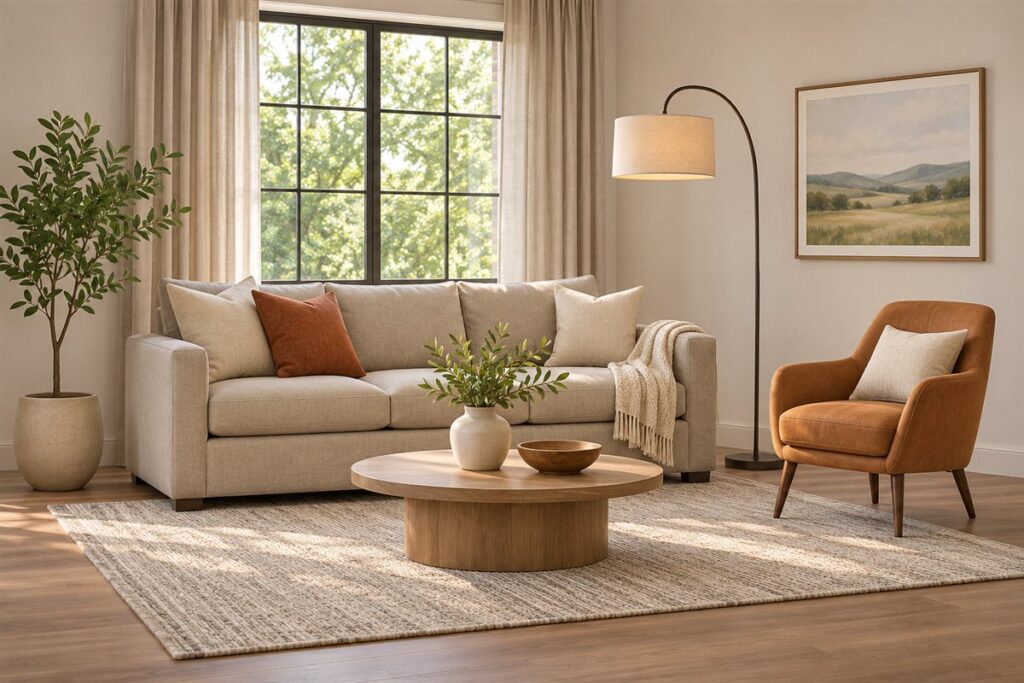
Overall depth, as listed for a sofa, includes the back and frame. It is not the space you actually sit on. Two sofas with the same overall depth can feel very different, because seat depth, cushion thickness and back angle decide how much room you have and how well you are supported.
What to do
Compare the manufacturer’s seat measurement where one is given, along with the cushion arrangement and the back angle. If a showroom or a suitable sample is available, test it both sitting upright and relaxing, and see how your legs and lower back are supported.
In this guide
What affects usable depth
- Frame thickness: the front rail and back panel take up space that is not seat.
- Back cushions: loose cushions reduce the usable depth when placed upright.
- Seat cushion firmness: soft cushions compress and change how deep the seat feels.
- Back angle: a more reclined back suits lounging, an upright back suits conversation.
- Arm design: wide arms can narrow the seat, which changes how you sit.
A mistake to avoid
Do not select a sofa from outside dimensions alone. A large frame can still have a shallow seat, and loose cushions change usable space. Compare seat depth when it is listed, and ask for it when it is not.
A detail worth checking
Measure usable depth with the back cushions in their normal position. Removing them for a product photograph can make the seating area seem larger than it will be during everyday use. If you plan to take the cushions off, check how that changes the seat and whether the sofa is comfortable without them.
Try this practical check
Measure a chair or sofa you already find comfortable and note how you sit in it: upright, curled up or reclined. Use that as a personal comparison, not a universal ideal, since the best depth depends on your height and habits. Compare the figure with the seat depth of the sofas you are considering.
Reading a Listing Line by Line
Product pages for sofas often list several depth figures, and the labels are not always consistent. Learning to read them carefully is the quickest way to avoid a disappointing delivery.
Look for any measurement described as overall depth, seat depth, or inside depth. Overall depth runs from the very back of the frame to the front edge of the arms or seat, and it tells you how much floor the sofa occupies. Seat depth, where it is given, measures only the part you sit on. If a listing shows only overall depth, you will need to estimate the seat by subtracting the back thickness and any front rail or roll.
Questions to ask when a figure is missing
- Is the measurement taken with or without the cushions compressed?
- Does the number include a rolled arm or a curved back?
- Is there a diagram, and does it show where the tape would be placed?
If the details are unclear, the seller or the listing questions section can often clarify. Keep a note of the answer in case you need to refer to it later.
Working Out Usable Depth Yourself
A simple calculation gets you close. Begin with the overall depth, then take away the parts you cannot sit on: the back cushion at its thickest, the frame behind it, and any padding at the front edge that curves away.
Imagine a sofa with a listed overall depth. The back frame and cushion together might take a large share of that figure, leaving the remainder as the real seat. Two sofas with identical overall depth can therefore give very different seats, because one has a slim back and the other a plump one. This is why the title of this guide asks you to compare usable space.
| Part to subtract | Where to find it | Effect on seat |
|---|---|---|
| Back cushion thickness | Listing photo or diagram | Thick cushions reduce usable space |
| Frame behind the cushion | Cross-section drawing if shown | Rarely listed, so estimate |
| Front roll or rail | Close-up photos | Can shorten the flat sitting area |
Treat the result as a rough guide and check it against any figure the maker supplies.
Matching Seat Depth to Different Uses
How you plan to use the sofa should influence what you aim for. A sofa for upright conversation has different needs from one for stretching out with a film.
Upright sitting
If your household mostly sits with feet on the floor, a shallower seat keeps your back supported without pushing your knees against the front edge. This suits dining-room settees, reading corners and shared family spaces where people sit and stand often.
Lounging and napping
For curling up or lying back, a deeper seat gives room to pull your legs onto the cushions. The trade-off is that sitting upright may need extra pillows to keep your back supported.
Mixed use
Many homes need both. In that case look for firm back cushions that can be rearranged, since moving them forward or back lets one sofa serve two roles.
Room Layout and Clearance
Seat depth is only part of the story; the sofa also has to fit the room. Overall depth determines the walking space in front of it, the distance to a coffee table and whether doors and drawers can open.
Measure the floor area with masking tape or sheets of newspaper laid out at the full overall depth. Walk around the shape for a day or two. This reveals tight spots that a tape measure alone does not, such as a path to the kitchen that suddenly feels narrow.
- Leave enough room in front for people to pass comfortably.
- Check the swing of nearby doors and cupboards.
- Consider where a footstool or side table will sit.
- Remember that a deep sofa pushed against the wall may still project far into the room.
Also measure doorways, stairwells and corridors on the delivery route. A sofa that fits the room but not the entrance is a common and avoidable problem.
A Short Checklist Before You Choose
Pull the main points together with this quick list. It works whether you are shopping online or visiting a showroom.
- Find both overall depth and, if available, seat depth.
- Estimate usable depth by subtracting back and frame thickness.
- Think about who will use the sofa most and how they sit.
- Check the firmness and removability of the back cushions.
- Mark out the footprint on the floor and test the clearance.
- Confirm the delivery route and any return rules.
A few extra minutes of checking pays off every day afterward. When the numbers, the layout and your own habits line up, the sofa tends to feel right from the first evening, and you avoid the common regret of discovering that a generous overall figure hid a seat that never quite suited you.
Glossary of Sofa Measurements
- Overall depth: back to front measurement of the whole piece.
- Seat depth: the sitting surface from the back cushion to the front edge.
- Seat height: distance from the floor to the top of the seat cushion.
- Arm height: distance from the floor to the top of the arm.
- Clearance: the space under the frame or around the sofa.
Use these terms when asking a seller for clarification, and your questions will get clearer answers.
Worked Example: Two Sofas, One Overall Depth
Picture two sofas that both list the same overall depth. The first has a slim, upright back with a thin cushion and a straight front edge. The second has a deep, plump back cushion, a thick frame and a rolled front rail. On paper they match, yet when you sit down the first gives you far more flat seat to use.
Now imagine a tall person trying each. On the first, their thighs rest along the cushion and their knees sit near the front edge, which feels natural. On the second, the thick back pushes them forward, and the roll under the knees can feel like a bump. A shorter person might have the opposite experience on a deep seat: their back never reaches the cushion, so they either perch at the edge or slide back with their feet dangling.
What this teaches
- Overall depth alone cannot predict comfort.
- Back thickness and front shape change the seat more than people expect.
- Your own leg length decides what feels right.
When you compare options, line up the photos side by side, look at the profile view if one is offered, and ask for the seat figure directly. Taking an extra moment at this stage prevents the awkward discovery that a handsome sofa suits nobody in the household.
Questions to Settle Before Buying Online
Without a showroom visit, you rely on information, so ask for as much as you can. A good seller will answer plainly, and the answers help you compare listings on equal terms.
- Is the seat depth given, and how was it measured?
- Are the back cushions loose, and can they be removed or repositioned?
- What is the cushion fill, and does it hold its shape?
- Can you return the sofa, and who pays for collection?
- Are fabric samples available so you can judge colour and texture?
Write down the answers and keep the messages. If a figure on delivery differs from what was promised, you will have a record to point to. Take your time, because a sofa is a large purchase that you will use every day for years.
Finally, ask others who share your home to sit in a similar sofa in a shop or at a friend’s house, and note what they like. Real opinions from the people who will use it are worth more than any single measurement on a page.
Products Worth a Look
As an Amazon Associate, Air Fryer Kitchen Supply earns from qualifying purchases. These picks come from our guide: Best Shallow Depth Sofas That Free Up Floor Space Guide.
-
IKEA KLIPPAN Loveseat
-
IKEA GLOSTAD Loveseat
-
Signature Design by Ashley Bladen Loveseat
Quick Answers
Is a deeper seat always more comfortable?
No. A deep seat suits lounging but can leave shorter people without back support, and may make it harder to stand up.
What can I do if the seat is too deep?
Firm back cushions or lumbar cushions can help. Whether this is enough depends on the sofa.
Should I test a sofa before buying online?
If possible, try a similar model in a shop, and check the return policy for the online purchase.
Body Height and the Right Seat Depth
There is no single ideal seat depth, because the right figure depends on your body. A useful rule of thumb is that you should be able to sit with your back supported while your knees bend comfortably over the front edge, with a small gap between the back of your knee and the seat. If the front edge presses on the back of your legs, the seat is too deep for you. If your thighs feel unsupported, it may be too shallow.
Taller people often prefer deeper seats because their legs reach further, and they may find shallow seats cramped. Shorter people may find that a deep seat pushes them forward, leaving their back unsupported or their feet dangling. Leg length, torso length and any back or hip issues all matter, so the seat that suits a partner may not suit you.
Think about the people in your home. If several people of different heights will share the sofa, a medium depth with adjustable cushions may be the best compromise. Children and older relatives may want a firmer seat that is easier to get out of. Use your measurement of a comfortable chair as a starting point, as suggested in the post, and note how your legs and back feel in it.
- Back supported, knees clear of the front edge.
- Feet reach the floor or a footrest comfortably.
- Easy to stand up without pushing hard.
How You Sit Shapes What You Need
Seat depth is partly about habit. Someone who sits upright to read or work on a laptop will want a seat that supports the back without forcing them to lean far forward. Someone who curls up with legs folded will often prefer more depth, so that knees and feet fit on the cushion. A person who reclines to watch films may want a deeper seat with a back that slopes.
Think about the most common ways you sit and how long you stay there. Short sessions are forgiving, while hours of television or work need good support. If you often sit sideways with legs along the sofa, you need width as well as depth, so check the seat width per person too.
The sofa’s role in the room matters. A formal sitting room used for conversation suits a shallower seat, since people sit upright and talk. A family room used for lounging may suit a deeper seat. If the sofa serves several roles, think about whether loose cushions and throw pillows can adapt it. A deep seat with firm back cushions can work for upright sitting, while a shallow seat cannot be made deeper without changing the sofa.
Also think about getting up. A low, deep sofa can be harder to rise from, particularly for older people or anyone with joint concerns. Test this if you can.
Cushion Construction and How It Changes the Feel
Two sofas with identical seat depth can feel different because of how the cushions are built. A firm foam seat holds its shape and keeps the usable depth consistent. A softer fill compresses and may let you sink in, which changes how the seat meets the back. Cushions that combine a foam core with a softer wrap try to give support and comfort together.
Back cushions deserve close attention. Loose back cushions can be pushed back to gain seat space or pulled forward to give lumbar support. Fixed backs keep the angle constant, which makes seat depth more predictable but less adjustable. Some sofas have attached cushions that cannot be removed, so check whether the cushions are loose, attached or zipped to the frame.
Ask how the cushions behave over time. Softer fills can flatten with use, which reduces support and changes the feel. Some cushions can be turned or rotated, and some need regular plumping. Read the care notes and the maker’s description of the filling.
- Firm foam: stable depth, less give.
- Soft fill: more sink, may need plumping.
- Loose back cushions: adjustable depth and support.
- Fixed back: consistent angle, less flexibility.
Where the listing gives limited detail, ask the seller about the filling and whether cushions can be replaced.
Buying Without a Showroom Visit
Many people buy a sofa online and cannot sit on it first. In that case, work with the information you can collect. Look for a seat depth figure in the specification, and if it is not given, ask the seller. Check seat height too, since depth and height work together for comfort. Compare each figure with a sofa you already know.
Read the listing’s description of cushions, back angle and arms, and look at side-on photographs if they are available. They can show how far the back leans and how thick the cushions are. Be cautious about photographs that show the sofa with back cushions removed or arranged for display, as the post notes.
Use tape to mark the sofa’s footprint on your floor, then use a chair at the same depth to imagine the arrangement. For seat depth itself, mark the figure on a sturdy chair or stool with tape and sit to see how it would feel. This is a rough guide, but it is better than relying on overall depth.
Review the return and exchange policy before ordering. Check who pays for return shipping, whether the sofa must be unused, and how long you have to decide. Large items can be costly to send back, so understand the terms in advance. If a similar model is available in a shop, try it, then compare the specifications with the online version.
Adjusting a Sofa You Already Own
If your current sofa is too deep or too shallow, you have options before replacing it. For a seat that is too deep, firm back cushions or a lumbar cushion fill the gap and bring the back closer. A cushion should support the lower back without pushing the pelvis forward. Choose one that suits the sofa’s fabric and fits without slipping.
A seat that is too shallow is harder to correct. You can reduce the thickness of back cushions, or remove them if the sofa remains comfortable without them. Check that this does not leave exposed frame or fixings. A thicker seat cushion can change seat height, so make sure your feet still reach the floor.
Footrests, ottomans and stools change how you sit and can make a deep sofa more comfortable by giving the legs somewhere to rest. They also make a shallow sofa less cramped by supporting the legs at a different angle. Check the footrest height against the seat.
- Too deep: firm or lumbar cushions, upright back cushions.
- Too shallow: slimmer back cushions or none, a footrest.
- Too soft: a firmer insert, if the maker allows replacement.
If changes do not help, note what is wrong, such as back strain or difficulty rising, so you can look for specific features when you next shop. Those notes are more useful than a general sense that the sofa is uncomfortable.
Common Questions
What is a typical seat depth?
It varies a lot between makers and styles, so there is no single standard to rely on. Check the product's own specification, and compare it with a seat you already find comfortable.
Does seat height matter as much as depth?
Yes, the two work together. A seat that is too low or too high changes how your knees and back are supported, so compare both measurements.
How do I measure seat depth myself?
Measure from the front edge of the seat cushion to the point where the back cushion or back panel meets it, with cushions in their normal position. Do not include the frame behind the back.
Are loose back cushions better than fixed ones?
Loose cushions let you adjust support and usable depth, but they need plumping and repositioning. Fixed backs are tidier and more consistent. Choose by how you like to sit.
Can a deep sofa suit small rooms?
It can if you measure the footprint and walkways carefully. A deep seat takes up more floor space, so check clearance before buying.
What if someone in my home finds it hard to stand from the sofa?
Look at seat height, firmness and arm design. A firmer seat and sturdy arms can make rising easier, and a shop visit helps you test this.
Should I choose firm or soft cushions for a deep seat?
Firmer cushions tend to hold their shape and keep the usable depth consistent. Softer cushions feel relaxed but may need more plumping and can compress with use.
Do sectionals have different seat depths from regular sofas?
Depths vary between models, and a chaise or ottoman section may be different from the main seats. Check each section in the specification.
Related reading
6 Best Cloud Sectional Couches: Modular L-Shaped Picks (2026)
Reference and further practice
IKEA product support: assembly and product-specific requirements
Going Deeper: What The usable seat depth from the front edge to where the back cushions actually meet your back Really Tells You
Most guides stop at the headline measurement, but the usable seat depth from the front edge to where the back cushions actually meet your back is really a bundle of smaller judgements working together. There is the figure itself, the reference points you took it between, the condition of the space on the day you measured, and the way the item will actually be used once it is in place. Treating those as separate things, and checking each one deliberately, is what separates a purchase that settles in quietly from one that needs adjusting, returning or working around for years.
Start by asking what the measurement is protecting you from. In the case of sofa seat depth, the honest answer is rarely the object itself; it is the routine around the object. Doors still need to swing, people still need to pass, light and air still need to move, and cleaning still needs to happen underneath, behind and between things. When you measure with those routines in mind, the number you write down represents the space as it is lived in, not the space as it appears in an empty room on the day you happen to measure it.
It also helps to separate the figures you cannot change from the ones you can. Walls, doorways, fixed fittings and the footprint of furniture you are keeping are facts. The position of the new item, the direction it faces, and how much clearance you leave around it are choices. A good plan for sofas respects the facts completely and spends the choices wisely, instead of hoping a tight fact will somehow become flexible once the delivery arrives.
Finally, remember that measurements age. Rooms get repainted, floors get covered, furniture moves and households change. The figures you record today are a snapshot, and the most useful habit you can build is to re-check the critical one, the usable seat depth from the front edge to where the back cushions actually meet your back, whenever the room changes in a way that touches it. That single re-check, which takes minutes, protects every decision that was based on the original set of numbers.
A Careful Second Pass: Checking Sofa seat depth Step by Step
The first pass through this guide gives you a working set of figures. This second pass is about turning those figures into ones you would trust with an order you cannot easily undo. Work through it in order, with the item or the space in front of you, and do not skip a step because an earlier one went well; each step below catches a different kind of error, and the errors that cause returns are usually the ones nobody thought to look for.
Measure from the front edge to the back cushion’s face
Usable depth is measured to the face of the back cushion as it sits in place, not to the sofa’s frame behind it. Cushions occupy real depth, and a sofa whose frame depth sounds generous can offer a surprisingly shallow seat once its plump back cushions are counted. Write the figure down as soon as you take it rather than trusting your memory, and note which point it came from, because the later steps build on these early numbers and a swapped figure is hard to spot once you are comparing listings.
Sit and measure your own requirement
Sit on a chair or your current sofa with your back supported and your feet comfortably placed, and note the depth that arrangement uses. Your body, not a catalogue, defines the depth you need; measure the sitter before judging the sofa. If the number surprises you, take it once more before moving on. A second reading that agrees gives you confidence, while a different reading tells you the tape slipped, the surface was not square, or something in the way distorted the first attempt.
Test with cushions compressed
Back cushions compress when leaned on, which adds a little usable depth, while seat cushions compress downward rather than backwards. Judge the depth with the cushions in their working, sat-on state, because the showroom figure taken on firm, fresh cushions flatters the real seat. Keep the tape or ruler in the same orientation for every reading in this step. Changing how you hold it halfway through a set of measurements introduces small differences that add up and can make two matching items look as though they do not match.
Check each seat on the sofa separately
Corner seats, chaise sections and seats beside arms can all offer different usable depths on the same sofa. Measure or sit in each position you are actually buying, especially the corner of a sectional, which often looks generous and sits shallow, or the reverse. Note any obstruction, slope or soft surface that affected this reading next to the number itself. When you come back to your notes days later, that short comment explains why one figure differs from the others and stops you discarding the wrong one.
Relate depth to seat height
Depth works with height: a deep seat with a high front edge leaves shorter legs dangling, while the same depth at a lower height can feel like a lounge. Take the two figures together and judge them against the household’s leg lengths, not in isolation. Compare this figure with the one from the previous step before you continue. The two should tell a consistent story about the space; if they contradict each other, it is far easier to re-check now, while everything is still in place, than after an order arrives.
Rehearse with cushions on a bed or floor
Arrange cushions or a folded duvet on a bed to imitate a candidate depth and sit against it for a chapter or a programme. It is a rough rehearsal, but it reveals within minutes whether a depth lets you sit upright, forces a slouch or demands a cushion behind your back. Take a quick photograph of the tape in position if you can. A picture settles arguments with your own notes later, shows a partner or housemate exactly what you measured, and gives you a reference if you need to ask a seller a question.
When you finish, read the full set of figures aloud once, in order. Hearing them as a list makes inconsistencies obvious in a way that scanning a page does not, and it gives you a natural moment to ask whether the numbers describe the space you are standing in. If anything sounds wrong, it probably is, and now is the cheapest possible time to find out.
How Sofa seat depth Plays Out in Everyday Situations
Measurements become real when they meet a routine. The situations below are the ones readers describe most often when a choice about sofas either proves itself or starts to annoy, and each one tests the usable seat depth from the front edge to where the back cushions actually meet your back in a slightly different way. Read them against your own household and note which of them resembles your busiest, least tidy day, because that is the version of life your decision has to survive.
A household of mixed heights
Where a tall and a short person share a sofa, depth is a negotiation: what cradles one leaves the other’s feet floating and back unsupported. The honest answers are a middle depth plus a firm cushion for the shorter sitter, or different seats with different depths on the same sofa, chosen deliberately rather than discovered. The lesson from situations like this is that the usable seat depth from the front edge to where the back cushions actually meet your back only makes sense in context. A figure that looks generous on paper can feel tight once real life fills the space around it, and a figure that looks modest can work well when the layout supports it. Work through your own version of this scenario with your actual numbers before you commit, and pay attention to the moments of the day when the space is busiest, because that is when a poor fit stops being a minor irritation and starts changing how you use the room.
A sofa mainly for film nights
A sofa bought for long, reclined viewing can honestly take more depth than one used for conversation and laptops, because its sitters intend to curl, sprawl and use cushions as architecture. Match the depth to the dominant use, and be honest if the dominant use is actually upright tea and talk. What helps most here is rehearsing the routine rather than imagining the object on its own. Walk through the movements involved, in the order you would really make them, and notice where you turn, pause, set things down or reach past something else. If a rehearsal feels awkward with nothing in place, it will feel worse once the real item arrives, so treat that awkwardness as useful information and adjust the plan, the position or the size while changing your mind is still free.
An older relative who must rise easily
Getting up from a deep, low seat is genuinely hard for anyone with weak knees or hips, because the sitter starts far back with feet poorly placed for leverage. For a household that includes them, usable depth is a safety and dignity question, and the shallower, higher seat is not a compromise but the correct specification. Households differ, and this is where a choice that suits one home quietly fails in another. Think about who else uses the space, how often, and what they bring with them, from bags and coats to toys, laptops and laundry. A decision about sofa seat depth that accounts for the busiest realistic day, rather than the tidiest possible day, tends to keep working long after the novelty has worn off and the space has settled into everyday use.
Care, Cleaning and Storage That Protect the Fit
A good fit is not permanent by default. Dust, moisture, heat, sunlight and ordinary wear all change how sofas sit, hang, slide or stand over time, and many problems that look like buying mistakes are actually care problems that developed slowly. The habits below protect the result you measured for, and they are deliberately simple, because a routine you keep beats an elaborate one you abandon by the second month.
Rotate and plump cushions to keep the depth honest
Back cushions slump and seat cushions hollow with use, quietly changing the usable depth you chose. Regular plumping, rotating and swapping cushions between seats keeps the depth even across the sofa, so the seat you tested is the seat you still have in a year’s time. Build this into a routine tied to something you already do, such as a seasonal clean or the start of a new term, rather than relying on noticing a problem. Small, regular attention of this kind protects the fit you worked to achieve and catches wear while it is still cheap and simple to deal with.
Support a deep seat properly
If you add cushions to make a deep seat shallower, choose firm ones that stay where they are put rather than soft ones that migrate. A support cushion that slides down behind the sitter recreates the slouch it was bought to fix, and becomes one more thing fished out of the sofa’s depths. Always check the care label or the maker’s instructions for the specific item before using any product or method on it, because materials that look similar can react very differently. Test anything new on a hidden area first, and stop if the surface changes colour, texture or smell.
Check feet and castors for level sitting
A sofa that is not level, because of a compressed foot, a castor off its cup or an uneven floor, tilts its sitters and distorts how the depth feels. If one seat suddenly feels wrong, check the sofa’s level before blaming the cushions; the fix may be under the sofa, not in it. When you store or move the item, protect the edges, corners and surfaces that decide how it sits and fits. Damage usually happens in cupboards, lofts and hallways rather than in daily use, and a few minutes of padding or careful stacking prevents the slow distortion that later shows up as a poor fit.
Once or twice a year, do a short fit audit: stand back, look at how the item sits compared with the day it arrived, and re-check the usable seat depth from the front edge to where the back cushions actually meet your back if anything has shifted, sagged, swollen or shrunk. Catching a small change early usually means a small correction; leaving it means the same correction later, plus whatever the poor fit has been doing to the floor, the wall or the item itself in the meantime.
Comparing the Options in This Guide Against Each Other
Once your shortlist is down to the options discussed in this guide, the temptation is to choose by appearance and be done. Resist it for ten more minutes and compare those options on the points that decide daily satisfaction with sofas. The criteria below are the ones that most often separate the pick that keeps pleasing from the pick that merely looked right on the screen, and each one can be checked from the details already given in this guide and in the listings themselves.
Usable depth, not overall depth
Compare sofas by the usable figure, front edge to back cushion face, measured or sat in the same way for each. Overall depth includes arms, frame and recline mechanisms that nobody sits on, and two sofas with identical overall depths can offer seats that differ by a hand’s breadth. Put the figures for this point side by side for every option on your shortlist, using the same units and the same reference points. Listings describe things in different ways, so the honest comparison is the one you build yourself from your own worksheet rather than the one assembled from marketing headings.
Fixed versus loose back cushions
Loose cushions can be plumped, moved or removed to tune the depth; fixed backs give one depth forever. Compare the designs against your household’s variety: a mixed-height household benefits from adjustability, while a household of similar sitters may prefer the tidier fixed line. Treat this as a pass-or-fail check rather than a matter of taste. An option that fails here will not be rescued by a colour you love or a finish that matches the room, because you will meet this limitation every single day, long after you have stopped noticing how the item looks.
Chaise and corner sections on their own merits
Compare each section of a sectional by its own usable depth rather than assuming the sofa’s headline figure applies throughout. The chaise is a different piece of furniture from the upright seats, and it should be chosen as one, with its own sitting and lying test. If two options look equal on this point, let it go and move to the next criterion instead of forcing a difference that is not really there. Shortlists are decided by the two or three points where options genuinely differ, and those are the points worth your time and questions.
Write your comparison down as a simple grid, one row per option and one column per criterion, and mark only clear wins rather than inventing scores. The right choice usually identifies itself in that grid: it is the option with no failures on the points you cannot compromise, even if another option beats it on a point you care about less.
Mistakes That Only Show Up After a Few Weeks
The mistakes that matter most with sofa seat depth rarely appear on the first day. On the first day everything is new, the room is tidy, and you are paying attention. The problems arrive later, disguised as small daily frictions: the thing that has to be moved before something else can be used, the corner that never gets cleaned because access is awkward, the item that is always slightly in the way of a door, a drawer or a person. Each friction is trivial alone; together they are how a reasonable purchase turns into a quiet regret.
One common pattern is measuring for the object but not for its life. Sofas get opened, pulled out, sat on, walked around, cleaned under and bumped into, and each of those actions needs room that a footprint measurement does not show. When you review your figures, add a mental rehearsal of the object’s busiest hour and ask where everyone and everything stands during it. If the rehearsal needs someone to hold something, move something or wait for something, the plan, not the household, should change.
Another pattern is trusting a single measurement taken once, in a hurry, in an empty room. Floors slope, walls wander, cushions compress and fabrics relax, and a figure that was accurate for the object alone can still be wrong for the object in use. The defence is boring but effective: measure twice, at the points of greatest stress, and keep the least forgiving figure as the one you plan around. Planning around the tightest honest number feels cautious; living with the result feels easy, which is the point.
The last pattern is forgetting that other people use the space differently. The person who measured imagines their own routine and, without meaning to, plans for a household of one. Children, partners, guests, pets and future occupants all bring their own heights, habits and belongings. A decision about sofa seat depth that has been tested against at least one other person’s routine, ideally the person least like you, survives contact with real life far better than one tested only against your own.
More Questions Readers Ask
The common questions earlier in this guide cover the essentials. The questions below come up once people have measured, ordered or lived with the result for a while, and they are answered here in the same spirit: from your own figures first, and from general product claims last.
What seat depth suits most people?
There is no figure that suits most people well, which is the point of this guide: the right depth is the one that lets your back rest against the support while your feet reach the floor or a footstool comfortably. Sit in your current furniture, measure what works for your body, and shop from that figure rather than from an average.
Can I fix a seat that is too deep?
Usually, yes: a firm back cushion or a well-chosen lumbar cushion brings the support forward and converts surplus depth into comfort. The fix works when the surplus is modest. A seat that is far too deep for its sitter stays a problem wearing a cushion costume, so judge the size of the gap honestly before relying on accessories.
Does a deeper seat always feel more luxurious?
It feels more luxurious for lounging and less comfortable for everything upright: eating, working, conversation and rising. Luxury in seating is the match between the depth and the activity, and many people who buy the deepest seat discover they live on its front edge, which is the sofa telling them the depth was wrong.
How does seat depth affect a small room?
Deep sofas usually come with deep frames, so the room loses floor at both sides of the equation: the sofa takes more, and its sitters’ legs need the same. In a small room, a moderate usable depth in a compact frame often sits more people more comfortably than a sprawling depth that crowds the coffee table into their knees.
Should both ends of the sofa have the same depth?
They usually do by construction, but corner units, chaise ends and daybed sections break the rule deliberately. If your household has different needs, a sofa whose sections differ can be the answer rather than a problem, provided each section was chosen for the person who will claim it. If two people in the household disagree, let the measurements arbitrate: test both ideas against the figures you recorded, and choose the one that works on the busiest day, not the quietest.