A big air fryer is one with enough cooking space to handle a family meal in a single batch, such as a whole chicken, a full tray of fries or two different foods at once. The extra room comes from a larger basket, a dual-zone layout or an oven-style cavity.
The six models below cover those three approaches. We have not used these products ourselves, so treat the descriptions as general. Capacity claims vary by brand, so confirm the quart size, footprint and features on the current listing before buying.
As an Amazon Associate we earn from qualifying purchases. Links below are affiliate links, and they do not change the product information we give.
What to Look For
| Feature | Why it matters |
|---|---|
| Capacity class | Larger baskets feed more people but need more counter space |
| Basket layout | Dual zones cook two foods at once; single baskets are simpler to clean |
| Footprint | Big fryers are tall and wide, so measure your counter and cabinet gap |
| Controls | Presets and shake reminders help with even browning |
In this guide
Specs at a Glance
| Air fryer | Style | Basket | Notes |
|---|---|---|---|
| Ninja Foodi DualZone | Dual-basket | Two baskets | Roughly 8-quart class |
| Philips XXL | Single basket | One basket | XXL class |
| Instant Vortex Plus | Oven-style | Racks and trays | 10-quart class |
| COSORI Dual Blaze | Single basket | One basket | Large class |
| Ninja Max XL | Single basket | One basket | 5.5-quart class |
| Chefman TurboFry | Single basket | One basket | Check listing for size |
The 6 Best Big Air Fryers
Top pickBest for families that cook two items at once
1. Ninja Foodi DualZone 2-Basket Air Fryer (DZ201)
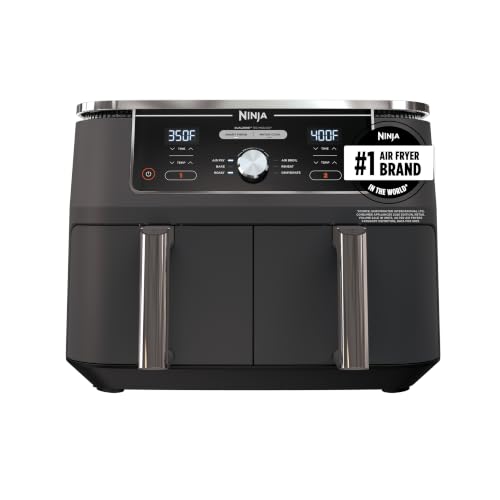
A two-basket air fryer in the 8-quart class that lets you cook two foods with separate settings, with a sync option so both finish together. It is one of the best-known large air fryers.
Suits: families that cook two items at once. Strengths: independent baskets and a Match Cook function. Weaknesses: a wide footprint on the counter. Skip it if you have little counter space.
View Ninja Foodi DualZone 2-Basket Air Fryer on Amazon

Best for big single batches
2. Philips Premium Airfryer XXL (HD9650)
A single-basket, fan-driven model from the company that popularized the category, built for bigger batches than a standard Philips unit. It is known for a tall basket with a removable divider.
Suits: big single batches. Strengths: a long-running brand and a roomy basket. Weaknesses: its size and a tall frame. Skip it if you want two zones.

Best for roasting and multi-rack meals
3. Instant Vortex Plus 10-Quart Air Fryer Oven
An oven-style unit with a front door and rotisserie-capable design, aimed at whole chickens, trays of wings and multi-rack meals. Check the listing for the accessories included.
Suits: roasting and multi-rack meals. Strengths: an oven door and rack cooking. Weaknesses: its height needs clearance. Skip it if you only cook for one.
View Instant Vortex Plus 10-Quart Air Fryer Oven on Amazon
Best for even browning in one batch
4. COSORI Dual Blaze Air Fryer
COSORI’s larger single-basket model uses a dual heating design intended to cook food evenly from the top and bottom. It is sold as a family-size unit with a digital control panel.
Suits: even browning in one batch. Strengths: a recognized air fryer brand. Weaknesses: capacity is shown in quarts only. Skip it if you want two baskets.
View COSORI Dual Blaze Air Fryer on Amazon
Best for a mid-large single basket
5. Ninja Max XL Air Fryer (AF161)
A single-basket Ninja air fryer built for a bigger batch than the brand’s smaller units, with a max crisp mode for fast browning. It is a step up in size from entry-level fryers.
Suits: a mid-large single basket. Strengths: max crisp mode and a simple dial layout. Weaknesses: not as large as the dual-basket line. Skip it if you need the largest capacity.
View Ninja Max XL Air Fryer on Amazon

Best for budget-friendly large capacity
6. Chefman TurboFry Touch Air Fryer
Chefman sells large-capacity versions of its touchscreen air fryer, often with a shake reminder and a viewing window on some models. Confirm the quart size on the listing, since versions differ.
Suits: budget-friendly large capacity. Strengths: touch controls and a shake reminder. Weaknesses: sizes differ, so check the listing. Skip it if you want a name-brand oven.

Care and Setup
- Wash the basket and trays by hand or follow the maker guidance for dishwasher use.
- Leave space behind the unit so hot air can vent.
- Shake or flip food halfway through for even browning.
- Wipe the heating area once the unit has cooled.
Mistakes to Avoid
- Overfilling the basket so food steams rather than crisps.
- Buying by quart size alone without measuring cabinet height.
- Spraying aerosol oils that can damage nonstick coatings.
- Assuming every large model is dual-zone.
Reading Capacity Claims in Quarts
Quarts describe the volume of the cooking chamber, not how much food you can cook well. An air fryer works by moving hot air around food, so a basket packed to the brim will steam rather than crisp. In practice you can only fill it to a fraction of its stated volume, and the usable fraction depends on the food. Fries and wings need space for air to flow around each piece, while a roast chicken fills the cavity but needs clearance from the heating element.
Compare capacity across designs with caution. A dual-basket model’s total volume is split into two compartments, so each side may be smaller than the headline number suggests. An oven-style unit has racks, so its capacity is spread across levels, which helps for multiple trays but does not mean one very deep basket. A single large basket is best when you want one big batch, such as a pound or two of fries or a whole chicken. Look for the listing’s description of the largest item the maker says it will fit, rather than relying on the quart number.
Think in terms of your household. A couple who occasionally cooks for guests may be happy with a mid-large single basket, whereas a family of five with a weeknight routine could use two zones or an oven design. Ask what you cook most: frozen snacks, chicken pieces, vegetables, reheated leftovers, baking small items. Be skeptical of any listing that gives a capacity in people without saying how it is measured, and check the basket or tray dimensions when they are available.
Counter Space, Power and Placement
Large air fryers are big in all directions, and the footprint is easy to underestimate. Measure the width, depth and height of the unit, then add clearance for hot air to escape, usually at the back and sides, and enough room above to open the lid or door. Check whether you will place the fryer under wall cabinets, since heat and steam rising from the top vent can damage the underside of cabinetry. If you plan to store the unit between uses, think about whether you can lift it. Many big models are heavy, and an oven-style one can be awkward.
Power matters because large fryers use heating elements that draw significant current. Check the wattage on the listing and the electrical rating of the circuit and outlet you intend to use. Avoid running a big air fryer on the same circuit as a microwave, kettle or toaster at the same time, which can trip a breaker. Plug the unit directly into the wall outlet when the manual says to, and avoid extension cords unless the maker allows them. Also check the cord length so that you do not stretch it across a walkway.
Stability and surface are the last piece. Place the fryer on a heat-tolerant, level surface, and keep it away from the edge of the counter. Some models have feet that leave a gap for airflow; do not block it with towels or mats. Keep the area around the unit free from paper, plastic bags and anything lightweight that can be pulled in by the fan. After use, let it cool before you move it, and empty the basket or tray carefully because the grease can be hot.
Dual-Zone, Single Basket or Oven-Style
The three designs differ in workflow. A dual-basket model gives independent timers and temperatures, so you can cook a protein and a side at once, and many have a function to finish both at the same time. The compartments are smaller than a single large basket, so a big item may not fit. Cleaning means washing two baskets, though they are usually simple pieces.
A single large basket is the most direct design. It is easy to load, easy to shake, and generally easy to wash. It suits those who cook one thing at a time and want the most room for that one thing. Some include a divider so you can split the basket if needed, but both foods will share a single temperature and time. For households that cook different items with different requirements, that restriction matters.
An oven-style unit has a door, racks or trays, and often a rotisserie or dehydrating option. It suits roasting, baking and cooking in several layers, and it lets you see the food without opening the cavity. The trade-offs are height and depth, more parts to clean, and a sense that it behaves like a small convection oven. Preheating and even results on multiple racks may take adjusting, and you may need to rotate trays. Check the listing for the accessories included, and think about where you will store the racks and trays when they are not in use.
Cooking Technique for Big Batches
Large batches need slightly different handling than small ones. Spread the food in a single layer where you can, and avoid stacking it more than a little. If you have too much for one load, cook in two rounds rather than crowding. Pat food dry before cooking, since surface moisture slows browning, and toss with a small amount of oil so seasoning sticks and the surface crisps. Many cooks use a pump or brush to apply oil instead of aerosol sprays, which the maker may warn against for nonstick coatings.
Shake or turn food partway through the cooking time, and rotate trays or racks on oven-style models. Food closest to the heating element browns fastest, so pieces at the edges may need moving. Check for doneness with a thermometer for meat and poultry rather than guessing by color; follow food safety guidance for the correct internal temperatures. For a whole chicken, pat it dry, place it as the maker recommends, and allow it to rest after cooking so the juices settle.
Adapting oven recipes takes a little judgment. Air fryers cook faster than a conventional oven because the hot air is concentrated, so reduce the time and temperature slightly and check early. Wet batters can drip and may not crisp, so use breaded or coated foods designed for air frying. Frozen foods usually cook well without thawing, but check packages for suggested adjustments. Keep a notebook of settings that work in your model, since time and heat vary across brands and sizes, and the manual is the best starting point.
Cleaning, Durability and Replacement Signs
Cleaning a big air fryer is easier if you do it after every use. Let the unit cool, remove the basket or trays, and wash them with warm water and mild soap, using a soft sponge to protect the nonstick surface. Check the manual before using the dishwasher, since some parts are dishwasher-safe and others are not, and the large pieces may not fit on the rack. Wipe the inside of the cooking chamber and the area around the heating element with a damp cloth once it is cool, because built-up grease can smoke and smell.
Durability is partly about the coating and partly about how you treat the unit. Avoid metal utensils that scratch the basket, and do not use abrasive pads. Flaking or peeling coating is a sign that the basket should be replaced, and you should contact the maker for replacement parts. Check whether the maker sells replacement baskets, trays, racks and crisper plates before you buy; a large model with a hard-to-find basket is less appealing in the long run.
Signs it is time to replace the unit include persistent smoke or burning smells even when clean, a fan that makes loud grinding noises, a heating element that no longer heats evenly, a cord or plug that is damaged, a door or lid that no longer seals, or a control panel that fails. Questions to ask before buying: what is the warranty, what is the size of the largest item it fits, how easy are the parts to clean, and how loud is it in typical use. Check the listing and manual for each, instead of relying on assumptions.
Fitting a Big Air Fryer Into a Weeknight Routine
A large air fryer shines when it takes on the main job of a meal rather than a side snack. The challenge is working it into a rhythm that suits the way your household eats. Think about how many people sit down together, how often you cook from scratch and whether the cooking time lines up with when everyone is hungry. A big basket that sits unused because it feels like too much effort is wasted space.
Begin by writing down the three meals you cook most often. For each, ask whether the food would fit in one layer or need stacking, and whether it can share a basket with a side dish. This exercise often reveals that one machine can take over two or three recurring dinners, which is the real test of whether the extra capacity earns its place on your counter.
Matching Capacity to Household Size
| Household | Typical need | Layout worth considering |
|---|---|---|
| One or two people | Occasional batches, leftovers | Single basket, mid to large size |
| Family of three or four | Main dish plus side at once | Dual-zone or large single basket |
| Five or more | Big proteins, multiple trays | Oven-style cavity with racks |
| Regular hosts | Appetizers in rounds | Dual-zone with sync features |
Use this as a rough guide, then compare the actual interior dimensions in each listing rather than relying on the quart figure alone.
Meal Planning Around Two Cooking Zones
Dual-basket models change how you plan, because two foods can finish together even when they need different settings. Pair items that suit similar cooking patterns, such as chicken pieces in one drawer and vegetables in the other, and use the match or sync option, if your model has it, to align the finish time. When both drawers hold foods with very different needs, you may still choose to stagger them.
Single-basket and oven-style machines call for a different approach. Cook the item that benefits from resting first, wrap it loosely to hold warmth, and finish the quicker side while the table is being set. Shake or flip food partway through when the maker suggests it, and avoid packing the basket so tightly that air cannot move around the food.
Handling Space and Storage Beyond the Counter
Big machines are tall, wide and often heavy, so think about where they live between uses. If you plan to move the fryer in and out of a cabinet, measure the shelf, the door clearance and the depth, then compare those figures to the product dimensions. A heavy unit pulled from a high shelf is awkward, so a low, accessible spot is easier on your back.
Leave the cord arrangement and ventilation clearances to the maker’s manual, and place the fryer on a heat-tolerant, level surface away from walls and cabinets while it runs. Wipe down the exterior after each use, allow the unit to cool fully before storing it, and keep the manual somewhere easy to find in case a question comes up later.
How to Judge big air fryers by the Meals You Cook
A big air fryer is bought for capacity, but capacity only counts if it matches your food. Think in terms of your largest regular cook: a whole chicken for Sunday, two trays’ worth of wings for a family film night, a batch of roast vegetables that used to need the oven in shifts. The picks in this guide earn their size in different ways, some with one generous basket, some with divided zones that cook two foods at once, and the right answer depends on whether your big cooks are one large item or several different ones. Judge the shape of the space, not just its volume, because a tall, narrow basket and a wide, shallow one hold the same litres and utterly different dinners.
Air circulation is what an air fryer is, so in a large model it matters even more. More food means more moisture in the air and more chances for crowded corners to steam instead of crisp. As you compare the picks, favour designs that move air convincingly around a full load and baskets that let you spread food in a shallow layer or shake it easily midway. The honest test of any big air fryer is not a handful of fries; it is a full basket on a busy evening, and the designs above were chosen with that load in mind.
Controls and presets deserve a practical eye. In a family-sized machine, you will cook the same favourites repeatedly, so controls you can set half-distracted, and temperatures and times you can adjust mid-cook without cancelling the programme, matter more than a long list of exotic functions. Look for a display you can read across the kitchen and alerts you can hear from the next room. None of this sounds technical, but the air fryer you operate confidently is the one that gets used nightly instead of admired weekly.
Big Air Fryers in Family Life
For a family, the big air fryer’s real job is replacing the oven for everyday cooking: faster to heat, easier to clean, and kinder to a kitchen that is already warm. Weeknight dinners of chicken pieces, sausages, frozen staples and roasted vegetables all move faster in a machine that holds the whole meal’s worth at once. The divided designs in this guide add the ability to run two foods on different settings and have them finish together, which is the difference between a coordinated dinner and a juggling act with one dish keeping warm and drying out.
Batch cooking is the second family pattern worth planning for. A large basket turns out meal-prep quantities of chicken, vegetables or potatoes in a couple of runs, and because each run is quick, a Sunday hour stocks the fridge for days. If that is your plan, weight the picks whose baskets wash easily and whose shape suits the flat, spread-out loads batch cooking prefers. Think about storage for the cooked food as well; the air fryer’s speed moves the bottleneck to your containers and fridge shelves, which is a pleasant problem to have.
Feeding teenagers and guests is the third pattern, and it is about throughput under pressure. Wings, fries and party food disappear at a rate that makes a small fryer a full-time job for the cook. A big model lets you serve the first generous batch and start the second while people are still on their first drinks, rather than rationing the first round into sadness. Place the fryer where the cook is not trapped in a corner during those sessions, with counter room for a tray on each side, and the machine becomes part of the party instead of a backstage exile.
Getting Crisp Results From a Large Basket
The physics of air frying rewards space. Food crisps where hot air touches it, so a single layer with gaps beats a mound every time, even in a big basket; the extra capacity should buy you a wider layer, not a deeper pile. When you must stack, shake or turn the food more often and accept that the cook will run longer. Load the basket, set the timer a little shorter than you expect, and check early; you can always add minutes, but you cannot un-crisp a chip that went too far while you were setting the table.
Dry surfaces crisp; wet surfaces steam. Pat chicken skin, vegetables and marinated items dry before they go in, use oil as a light coating rather than a bath, and give frozen foods no extra oil at all until you see how they behave. In a large fryer the temptation is to season everything in the basket; season in a bowl instead, where coatings distribute evenly and excess flour or crumbs fall away rather than gathering in the basket’s corners to burn during the next cook.
Use temperature as two gears rather than one setting. Many foods reward a moderate start that cooks the centre through, followed by a fierce finish that crisps the outside, and a large air fryer with responsive controls makes that two-stage approach easy. Rest meat briefly after cooking as you would from an oven, because the juices redistribute in the same way. Keep notes on your three or four most-cooked dishes, time, temperature and load size, because a big basket behaves differently full than half-empty, and your own log is the only manual written for your kitchen.
Cleaning and Care for Large Air Fryers
A big air fryer used daily collects grease in proportion to its popularity, and the cleaning routine decides whether it stays pleasant. Wash the basket and crisper plate after every cook in hot soapy water, or in the dishwasher where the maker allows, because yesterday’s oil film becomes tomorrow’s smoke and stale flavour. Wipe the interior cavity while it is still slightly warm, and check the area around the heating element for splashes that bake on silently. Five minutes after dinner is the cheapest maintenance this appliance will ever ask for.
Once a week, look closer. Clean the air inlet and outlet vents of dust and flour, wash the drip areas under the basket, and inspect the basket’s coating for damage, because food sticks and burns first where the surface is compromised. Never use abrasive pads or metal tools on coated parts, and let everything dry fully before reassembling, since a basket put away damp will smell of it at the next preheat. The exterior, especially around the controls, needs only a damp cloth; keep water away from the vents and the electrical areas as a matter of routine.
Odours in a hard-working air fryer come from grease that has travelled. If a clean basket still perfumes the kitchen, the residue is usually on the cavity walls or near the element, and a careful wipe-down with a cloth wrung out in warm water with a little bicarbonate of soda reaches most of it. Run the empty fryer for a few minutes afterwards to dry and freshen the interior. Persistent smoke at normal temperatures is information, not character: it means oil is sitting somewhere it should not, and finding it is a cleaning task, not a repair bill.
Troubleshooting Large Air Fryer Results
If food cooks unevenly, with crisp edges and pale centres, the load is the first suspect. Too much food in one layer blocks the airflow the machine depends on, and in a large basket the temptation to fill every corner is strong. Cook slightly less at once, shake or turn more deliberately, and arrange thicker pieces toward the hotter zones you have mapped in your own machine. Uneven results that appear only with full loads are a loading lesson; uneven results with small loads, in the same spots every time, are worth reporting while the fryer is new.
Soggy results usually mean moisture won the contest. Wet batters, un-dried vegetables and frozen items cooked at too gentle a temperature all steam themselves. Dry the food, raise the heat, preheat the basket so food lands on a hot surface, and avoid saucing until after cooking. If fries crisp beautifully but chicken skin stays flabby, the difference is the skin’s own fat and water, which need a drier start and a hotter finish; the two-gear approach in the cooking section exists precisely for this case.
When a large air fryer seems slower than expected, check the simple physics before the electronics: a very full basket, a low starting temperature from frozen, and frequent opening to check progress all stretch the clock. Judge a cook by the whole pattern rather than one ambitious evening. A machine that handles your normal loads well is performing; a machine that suddenly changes its behaviour on identical loads, with new noises or smells, is telling you something has changed, and that change, described clearly, is what any support conversation needs.
How the Picks in This Guide Compare
With several strong options above, the useful comparison is not a league table but a matching exercise: each pick suits a slightly different household, and the sections you have just read give you the criteria to match them. Use the notes below alongside the individual reviews earlier in this guide, where the details of each model are set out in full.
Consider the Ninja Foodi DualZone 2-Basket Air Fryer (DZ201) the considered choice for buyers who value the qualities its section of this guide emphasises. Its natural comparison is with the picks nearest to it in this lineup: read those reviews side by side, note where their approaches differ, and let your own pattern of use arbitrate. A difference that looks small on paper, in layout, in operation or in care, becomes large when it is repeated every day for years.
The Philips Premium Airfryer XXL (HD9650) earns its place here by serving a particular kind of owner especially well, and its review above names that owner plainly. If you recognise yourself there, it deserves to be a finalist; if you do not, the honest move is to pass it by for a pick whose strengths point at your life instead. Guides can rank features, but only you can rank your own habits, and this pick rewards the buyer who does that ranking before ordering rather than after delivery.
For the Instant Vortex Plus 10-Quart Air Fryer Oven, the deciding questions are the practical ones this guide returns to throughout: does it fit the space you measured, does it suit the load you described, and does its care routine match the time you will genuinely give it. Where the answer to all three is yes, it is very likely the right choice, whatever its position in the running order above, because position reflects the order of presentation, not a verdict on your particular home.
The COSORI Dual Blaze Air Fryer suits readers whose priorities line up with the strengths set out in its review above, and it is worth placing high on your shortlist if that description sounds like your household. Compare it against the alternatives on the criteria that matter most in daily use, how it fits your space, how it behaves under your typical load, and how easily it lives alongside your existing routine, rather than on any single headline feature.
Consider the Ninja Max XL Air Fryer (AF161) the considered choice for buyers who value the qualities its section of this guide emphasises. Its natural comparison is with the picks nearest to it in this lineup: read those reviews side by side, note where their approaches differ, and let your own pattern of use arbitrate. A difference that looks small on paper, in layout, in operation or in care, becomes large when it is repeated every day for years.
The Chefman TurboFry Touch Air Fryer earns its place here by serving a particular kind of owner especially well, and its review above names that owner plainly. If you recognise yourself there, it deserves to be a finalist; if you do not, the honest move is to pass it by for a pick whose strengths point at your life instead. Guides can rank features, but only you can rank your own habits, and this pick rewards the buyer who does that ranking before ordering rather than after delivery.
If you are torn between two picks, decide by the week rather than the occasion: picture an ordinary Tuesday with each one in your home, at the hour you will actually use it, and the right answer usually becomes obvious. Special occasions can be adapted to almost any good equipment, but ordinary days cannot be adapted at all, and it is ordinary days, repeated for years, that decide whether a purchase was wise. That is the standard every pick in this guide was chosen against, and it is the standard worth holding your final choice to as well.
Ownership Notes Worth Keeping
Place a big air fryer where its size helps rather than dominates. It needs clearance above and behind for hot air to escape, a heat-safe surface, and enough counter in front for the basket to open fully and land safely. If counter space is tight, measure a cupboard or cart honestly before buying, including the height with the basket open, because a fryer that must be dragged out and plugged in elsewhere for every use quietly becomes a fryer that is used twice a month.
Keep a short house list of proven settings on the fridge door: the family’s top dishes with their load sizes, temperatures and times in your machine. It saves the nightly negotiation with memory, helps other cooks in the house reproduce your results, and turns a large air fryer from one person’s gadget into shared kitchen infrastructure, which is when it truly earns its counter space.
Keep the manual, in paper or digital form, somewhere you can find it on a difficult day rather than in the packaging that left with the delivery. Most ownership questions, from cleaning sequences to what a particular sound means, are answered in those pages in the maker’s own words, and they are answered there first because the maker knows the design’s intentions. A photograph of the model plate, stored with the manual, saves an awkward contortion behind or beneath the appliance if you ever need to identify the exact version you own.
Register the purchase and keep the receipt with the same small discipline. If a question of warranty or a replacement part ever arises, the household that can produce a date and a model in one minute starts the conversation several steps ahead. This is unglamorous administration, but it takes less time than one search through a chaotic email inbox, and it only ever needs doing once, on the day the appliance arrives and everything is still to hand.
Build your judgement of any new appliance over a month, not a day. First impressions catch the obvious virtues and irritations, but the real character of a machine emerges in the second and third week, when the novelty has gone and the routines have formed around it. If something still bothers you then, it is a genuine mismatch worth acting on; if the early irritation has faded into habit, it was learning curve rather than flaw, and knowing the difference saves both money and regret.
When you shop for a replacement or a companion appliance later, return to your own notes before any guide, including this one. What you recorded about sizes, habits and annoyances in your own home is more specific than any general advice, and it turns the next purchase into a correction of known issues rather than a fresh gamble. Good buying is mostly good remembering, and the households that equip themselves well are usually the ones that wrote a few honest lines down at the right moments.
Think about the room the appliance serves as a whole system rather than a backdrop. Lighting for evening use, a place to set things down within reach, and a route that does not cross the household’s busiest path all change how the same machine feels in service. Small rearrangements of the room often deliver more daily satisfaction than an upgrade of the appliance itself, because most friction in a home is friction of place rather than of equipment, and place is free to change once you notice it.
Teach the household the machine’s few real rules and write them where the machine lives. Every appliance in this guide has two or three habits that protect it, keeping a seal clean, running water cold, leaving air its path, and a household that shares those habits gets the long, quiet service the design promises. Rules kept in one person’s head fail on the day that person is away; rules on a small card inside a nearby cupboard door survive holidays, guests and new housemates without a single argument.
Big Air Fryer FAQ
What counts as a big air fryer?
There is no fixed rule, but most people mean about 6 quarts and up, or a dual-basket or oven-style unit that cooks more at once.
Is a dual-basket model better?
It is better for cooking two foods at once. A single large basket is simpler and often easier to clean.
Do big air fryers use a lot of power?
They use more than small ones. Check the wattage on the listing and the circuit you plan to plug into.
Can I cook a whole chicken in a big air fryer?
Some oven-style and XXL models are made for it. Check the listing for the stated size and weight limit.
Can I cook two different foods in a single-basket air fryer?
Yes, if they need the same temperature and similar time, and you separate them with a divider if the unit includes one. If they differ, a dual-zone model is easier.
Do I need to preheat a big air fryer?
Some recipes and makers recommend it, while others do not. Check the manual, and preheat for foods that need a strong initial sear.
Why is my food not crisping?
The most common causes are overcrowding, wet food and too little oil. Dry the food, cook in a single layer, and shake partway through.
Can I use foil or parchment in a large air fryer?
Many makers allow them if they do not block airflow and are weighted down by food. Check the manual first, and never let paper touch the heating element.
Are big air fryers noisy?
They have a fan, so there is some noise. How loud it feels depends on the model and the room, so check the listing for sound notes and reviews of the exact model.
Can I bake in an air fryer?
Many oven-style models and some baskets handle small bakes in suitable pans. Check the maker's guidance on pan size and material.
Where should I put the fryer while it is running?
On a heat-tolerant, level surface with space around the vents and away from the edge of the counter and from cabinets overhead.
Can a big air fryer really replace my oven for family meals?
For most everyday meals, yes: it heats faster, cooks quicker at the same temperatures you are used to, and handles everything from roast chicken to baked potatoes in family quantities. The limits are shape and occasion rather than ability; a very large turkey or a multi-tray baking project still belongs to the oven. Most households find the oven becomes the specialist tool for feasts and baking days, while the air fryer quietly takes over the other six evenings a week, which is exactly the division of labour the picks in this guide are sized for.
Should I preheat a large air fryer?
A short preheat pays off for foods where the first contact matters: chips, skin-on chicken and anything you want to sear rather than slowly warm. For reheating and for frozen convenience foods, you can often start from cold and add a minute instead. Consistency matters more than dogma; pick one approach per dish, note the timing that works in your machine at your typical load, and repeat it. Your own log beats any generic chart because basket size and load change everything.
How full can I fill the basket and still get crisp food?
Fill it to a single, loose layer for best results, with small gaps for air to move. A large basket tempts you to heap, and heaped food steams in its own moisture no matter how powerful the fan is. If you need more, cook in two batches and keep the first warm in a low oven, or use a divided model to run two foods at once. Two crisp batches served together beat one large soggy batch every time, and the second batch always cooks faster in a hot machine.
Why does my air fryer smoke sometimes?
Smoke means oil is overheating somewhere: usually excess oil pooled in the basket, fatty food cooking at a fierce temperature, or residue from earlier cooks burning off near the element. Use less oil, clean the basket and cavity, and lower the temperature slightly for very fatty items, finishing with a short hot blast if you want more colour. Smoke from a clean machine with a modest load and fresh oil is unusual and worth investigating rather than tolerating.
Do I need to flip food in a big air fryer?
Turning or shaking helps almost everything cook evenly, because the hottest air and the closest heat are not distributed perfectly in any basket. Small items need a shake; larger pieces need a proper turn with tongs. The exception is delicate items with coatings that need to set first; give those a few undisturbed minutes before moving them. Build the shake into your timing habit, at the halfway point, and evenness stops being something you hope for and becomes something you schedule.
How do I stop delicate coatings falling off?
Dry the food, coat it evenly, and let the coated pieces rest briefly before cooking so the crumb hydrates and clings. Preheat the basket, oil the crisper surface lightly if sticking is a habit in your machine, and do not move the food until the coating has set in the heat. Crowding is the other enemy, because pieces steaming against each other soften the crust you worked to build. Space, patience and a hot start fix most coating failures without any change of recipe.
The Short Version
For dual-basket cooking, the Ninja Foodi DualZone. For a premium single basket, the Philips XXL. For a roasting-style fryer, the Instant Vortex Plus. For a big single-zone fryer, the COSORI Dual Blaze. For a mid-large fryer, the Ninja Max XL. For a value large fryer, the Chefman TurboFry.