An electric kettle heats water on its own base and switches off when it boils. Models differ in capacity, body material and controls: some only boil, while others offer temperature presets for tea and coffee, or a gooseneck spout for pour-over.
The six kettles below run from a 0.8 liter gooseneck to 1.8 liter glass models. Capacity, wattage, materials and presets come from each product’s listing page. We have not used these kettles ourselves. Boil times and feature claims are the makers’ own.
As an Amazon Associate we earn from qualifying purchases. Links below are affiliate links, and they do not change the product information we give.
What to Look For
| Feature | Why it matters |
|---|---|
| Capacity | 0.8 to 1 liter for one or two cups, 1.7 to 1.8 liters for a household |
| Material | Glass shows the water level, stainless steel hides it |
| Temperature presets | Useful for green tea and French press, not needed for plain boiling |
| Spout | A gooseneck gives pour-over control, a standard spout fills mugs |
| Keep warm | Some models hold the temperature for a set time |
In this guide
Specs at a Glance
| Kettle | Capacity and power | Material | Notes |
|---|---|---|---|
| Cosori Gooseneck | 0.8 L; 1200 W | Stainless steel | 5 presets; 1 hour keep warm |
| Hamilton Beach 1 L | 1 L; 1500 W | Plastic and stainless steel | Mesh filter; concealed element; water level indicator |
| Cuisinart PerfecTemp | 1.7 L; 1500 W | Stainless steel | 6 presets; 30 minute keep warm; backlit water window |
| COMFEE’ 1.7 L | 1.7 L; 1500 W (title) | Stainless steel | Removable nylon filter; water level indicator |
| Chefman Glass | 1.8 L; 1100 W | Borosilicate glass | Presets (see text); removable tea infuser |
| MEGAWISE 1.8 L | 1.8 L; 1800 W | Borosilicate glass | Blue LED; cordless serving; cord storage |
The 6 Best Electric Kettles
Top pickBest for pour-over coffee and loose tea
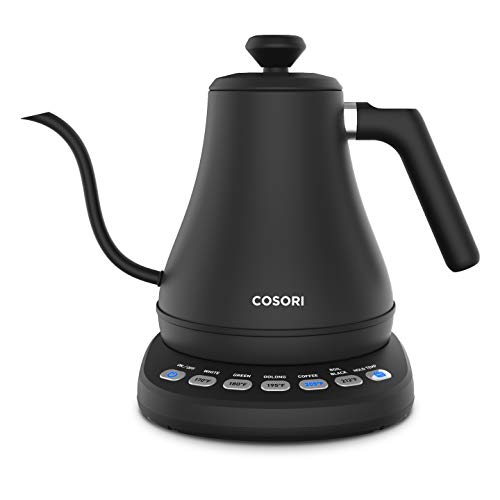
1. Cosori Gooseneck Electric Kettle 0.8L
A 0.8 liter stainless steel gooseneck kettle at 1200 watts with five one-touch temperature presets and a one hour keep warm function. The maker lists a Strix controller and describes the spout as built for pour-over flow control.
Suits: pour-over coffee and loose tea. Strengths: a gooseneck spout and temperature presets. Weaknesses: the smallest capacity here. Skip it if you fill a large teapot.
View Cosori Gooseneck Electric Kettle 0.8L Temperature Control on Amazon
Best for one or two mugs and dorm-size use
2. Hamilton Beach 1 Liter Electric Kettle
A 1 liter, 1500 watt kettle in plastic and stainless steel with a concealed heating element, a drip-less spout, a removable mesh filter and a water level indicator. It has automatic shut-off per the listing.
Suits: one or two mugs and dorm-size use. Strengths: a simple boil-only design and a filter. Weaknesses: no temperature presets. Skip it if you brew green tea.
View Hamilton Beach 1 Liter Electric Kettle 40998 on Amazon
Best for a tea drinker who wants presets
3. Cuisinart PerfecTemp 1.7L CPK-17P1
A 1.7 liter, 1500 watt stainless steel kettle with six presets from 160 F to a full boil, a 30 minute keep warm option, a swivel base and a blue backlit water window. The maker maps presets to tea types and French press coffee.
Suits: a tea drinker who wants presets. Strengths: labeled one-touch presets. Weaknesses: a larger body. Skip it if you only boil water.
View Cuisinart PerfecTemp 1.7L Programmable Electric Kettle CPK-17P1 on Amazon

Best for a full-size steel kettle
4. COMFEE’ Stainless Steel Electric Kettle 1.7L
A 1.7 liter stainless steel kettle that the title lists at 1500 watts, with a removable nylon filter, a water level indicator and automatic shut-off. The maker says it boils up to 1.7 liters in 5 to 7 minutes. The detail table gives no wattage figure, so the 1500 watts comes from the title only.
Suits: a full-size steel kettle. Strengths: a removable filter and a steel inner pot. Weaknesses: no presets. Skip it if you want temperature control.

View COMFEE’ Stainless Steel Electric Kettle 1.7L 1500W on Amazon
Best for loose-leaf tea in a glass body
5. Chefman Glass Kettle 1.8L With Temperature Control
A 1.8 liter, 1100 watt borosilicate glass kettle with a removable tea infuser, tri-color LED lights and a 360 degree swivel base. Data conflict: the title says 5 presets, while the description says seven presets from 160 to 212 F, so confirm before buying.
Suits: loose-leaf tea in a glass body. Strengths: an infuser and presets. Weaknesses: an unclear preset count. Skip it if you want a stainless body.
View Chefman Glass Electric Kettle 1.8L with Temperature Control and Infuser on Amazon

Best for a large glass kettle for a household
6. MEGAWISE 1.8L Glass Kettle
A 1.8 liter, 1800 watt borosilicate glass kettle with a stainless steel base and lid, blue LED lighting, automatic shut-off, a one-touch lid with a wide opening and built-in cord storage.
Suits: a large glass kettle for a household. Strengths: the highest wattage listed here and cord storage. Weaknesses: boil-only controls. Skip it if you want presets.

View MEGAWISE 1.8L Electric Glass Kettle with Blue LED on Amazon
Care and Setup
- Rinse and boil a first batch of water as the manual directs.
- Descale the kettle as the maker advises.
- Never fill past the maximum line.
- Empty leftover water after use.
Mistakes to Avoid
- Buying presets you will never use.
- Ignoring wattage differences between models.
- Choosing a large kettle for a single cup.
- Skipping regular descaling.
Capacity, Power and Boil Speed
Two numbers on every kettle listing, capacity and wattage, tell you most of what you need to know about how it will fit into your day. Capacity is the volume of water the kettle holds, and it is worth matching to how you use it. A small kettle suits a single mug or two, heats quickly because there is less water, and takes little space. A larger kettle suits a household, a teapot or a French press, and saves refills when several people want hot drinks. Heating a large kettle for one cup wastes some energy, and a small kettle becomes frustrating if you often brew several cups.
Wattage describes how much power the element draws, and higher wattage generally brings water to a boil faster. In practice, boil time also depends on the amount of water, the starting temperature and the design, so treat boil-time claims as the maker’s own. Remember that kitchen circuits have limits. A high-wattage kettle running on a circuit shared with a microwave or toaster may trip the breaker, so think about what else is plugged in nearby. Check the voltage as well if you buy a kettle designed for a different region.
- Single drinkers and dorms: a small capacity is usually enough.
- Couples and families: a mid to large capacity avoids refilling.
- Check the minimum fill level, as some kettles need a minimum amount to work properly.
Look at the maximum fill line, and never fill above it, since boiling water can spit out of the spout.
Body Materials and How They Affect Taste and Safety
Kettles come in glass, stainless steel and plastic bodies, often in combination, and the material affects looks, weight and care. Glass lets you see the water level and the boil, and it does not hold flavors, though it is breakable and can show scale. Stainless steel is durable, hides scale and resists dents, but you cannot see inside unless there is a water window. Plastic bodies are light and inexpensive, but check the listing to see where plastic touches the water, since some people prefer to avoid it, and some kettles use plastic only on the outside.
Taste matters most when you make tea or coffee. New kettles sometimes give water a faint taste at first, which is why makers advise boiling and discarding a first batch or two. If an odor persists, repeat the process and check the manual. Interior parts, such as the lid, spout filter and element cover, affect both taste and cleaning. A concealed heating element under the base is easier to clean than an exposed coil, and a wide opening makes it easier to reach inside.
- Check that the interior water-contact surfaces are described, such as stainless steel or glass.
- Look at the lid, hinge and handle, since these wear out with daily use.
- Note the exterior heat: double-walled kettles stay cooler to the touch than single-walled ones.
Whatever the material, follow the maker’s instructions for the first use.
Temperature Control for Tea and Coffee
Water temperature changes how tea and coffee taste, and temperature-control kettles let you choose it instead of boiling every time. Delicate green and white teas are often brewed with cooler water, because very hot water can bring out bitterness. Black tea and herbal infusions generally suit water at or near boiling. Coffee brewing methods, such as pour-over and French press, call for hot water just below boiling. Exact numbers differ by tea type and by coffee method, so check the packaging or the recipe you follow rather than relying on a single rule.
A kettle with presets saves guesswork, and many include a keep-warm setting that holds the temperature for a period. Look for how the temperature is controlled and what the range is, because some kettles offer only a few fixed steps while others allow fine adjustment. Accuracy varies, and a kettle that shows a temperature may not match the actual water temperature closely. If you care about precision, test with a thermometer. If you mostly make boiling drinks, instant noodles, oatmeal or hot chocolate, a boil-only kettle is simpler and often more durable.
- Choose presets if you drink several kinds of tea or brew coffee by hand.
- Choose boil-only if you want simplicity and low cost.
- Check that the keep-warm function shuts off after a set time.
Remember that more electronics can mean more parts that wear out.
Spouts, Pouring and Gooseneck Design
How a kettle pours matters as much as how it heats. A standard spout is built for filling mugs, pots and cups quickly, with a wide flow. A gooseneck spout has a long, narrow, curved neck that lets you control the flow rate and aim, which is important for pour-over coffee, where you wet the grounds in a slow, steady stream. Gooseneck kettles usually have a smaller capacity and a balanced handle to support the pouring motion. If you do not brew by hand, a gooseneck adds little and can be slower to fill a large pot.
Look at the details that affect everyday use. A drip-free spout prevents puddles on the counter, and a spout filter catches scale. A comfortable handle and a balanced weight matter when the kettle is full of hot water. The lid should open easily and stay open for filling, and a wide opening makes filling and cleaning easier. A swivel base lets you pick up and replace the kettle from any angle, and cordless operation, where the kettle lifts off the base, is standard on most models.
- Pour-over fans: look for a gooseneck and a stable base.
- Teapot and French press users: a standard spout with a wide flow is fine.
- Left-handed users: check the handle shape and the water window position.
- Check the lid and handle for heat protection.
Try to compare how the weight sits in your hand when full, if you have a chance to hold one.
Descaling, Safety Features and Replacement
Hard water leaves limescale inside kettles, which shows up as white or gray deposits on the element and walls. Scale slows heating, uses more energy, affects taste and can clog filters. Descale regularly, with the product or method the maker approves, often a mixture of white vinegar or citric acid and water that you boil, let sit and rinse. How often you need to do it depends on your water, so check the kettle monthly at first and adjust. Rinse thoroughly after descaling, and boil and discard fresh water to remove any lingering taste. Do not use abrasive tools inside, and do not descale with chemicals not approved by the maker.
Look for the safety features: automatic shut-off when the water boils, boil-dry protection that turns the kettle off if it is empty, and a lid lock or a cool-touch exterior. Always set the kettle on a dry, stable surface, keep the cord clear of the hot spout and never immerse the base in water. Empty leftover water after each use to reduce scale and stale taste.
Signs it is time to replace:
- It does not switch off at boil, or it switches off early.
- It leaks around the base, the lid or the water window.
- The cord, plug or base is damaged.
- Scale or rust cannot be removed, or the interior coating is flaking.
- The kettle gives water an off taste after cleaning.
A kettle that fails to shut off is a safety risk, so stop using it right away.
A Quick Guide to Reading Kettle Specifications
Kettle listings are full of numbers, and a few of them tell you more than the rest. Capacity in liters tells you how much water the kettle holds at its maximum fill line, though everyday use is usually a little less. Wattage shows how much power the heating element draws, which links to how fast it boils but also depends on how full it is. Cord length and base design affect where you can put the kettle on a crowded counter.
| Specification | What it tells you |
|---|---|
| Capacity | How many cups or mugs one fill can make |
| Wattage | How strong the heating element is |
| Cord length | How far the base can sit from the outlet |
| Minimum fill line | The least water the kettle needs to work properly |
| Auto shutoff and boil-dry cutoff | Whether the unit switches itself off at the boil or when empty |
The Cosori 0.8L, the Hamilton Beach 1 liter and the larger Cuisinart, COMFEE’, Chefman and MEGAWISE models give different mixes of these details. Read the dimensions in the listing too, because a large kettle can be too tall to fit under a low cabinet.
Pick a Kettle by Your Morning Routine
The best kettle is the one that fits the way you actually drink. A single cup of tea in the morning asks for a small kettle that heats a little water quickly and sits neatly on a shelf. A household where several people drink tea, coffee and instant soups needs more capacity and perhaps a keep-warm function. If you pour over coffee by hand, a narrow gooseneck spout makes pouring easier and calmer.
- One person, one mug: a compact kettle with a small footprint.
- Shared kitchen: a larger body and a wide opening for filling and cleaning.
- Tea variety: adjustable temperature settings.
- Pour-over fans: a gooseneck spout with good control.
Be realistic about counter space, and picture where the cord will run. Having a kettle that sits close to a sink makes filling easy, but keep the base and cord dry according to the maker’s instructions.
Using the Manual for Safe Everyday Habits
A kettle is simple, but it deals with boiling water and electricity at once, so a quick read of the manual is worthwhile. Follow the fill lines, keep the lid closed while heating, and do not overfill. Place the kettle on a flat surface, lift it by the handle, and keep the spout pointed away from you when opening the lid. Do not use a kettle with a damaged cord or base, and do not immerse the base in water. For any cleaning or descaling directions, follow the steps given by the maker for your model.
Kettle Vocabulary You Will Meet While Shopping
A few terms show up repeatedly on kettle pages, and they are easy to confuse. Keep this short list in mind when comparing listings.
- Gooseneck: a long, curved spout that gives a slow, steady stream.
- Cordless base: a power base the kettle sits on, so you can lift and pour without a trailing cord.
- Hold function: keeps the water warm for a set period after heating.
- Boil-dry protection: shuts the kettle off if it is switched on with little or no water.
- Removable filter: a mesh at the spout that catches loose bits when pouring.
- Wide mouth: a large opening that makes hand cleaning simpler.
Terms like these are helpful only if the listing explains how they work on that model, so read the description rather than relying on a single label. If two kettles seem similar, compare how each one handles filling, pouring and cleaning, since those are the things you will do every single day.
Choosing Electric kettles With a Clear Head: A Practical Decision Worksheet
The picks above give you the shortlist. This section is about matching one of them to your home, because most disappointment with electric kettles has very little to do with the product itself and a great deal to do with a mismatch nobody checked: the wrong size for the space, the wrong format for the routine, or a feature list bought for a household that does not exist. Work through the points below in order, with a tape measure and your phone for photographs, and you will narrow the list in this guide to one obvious answer surprisingly quickly.
Start with the space itself. Before you compare a single model, check the counter space and cupboard clearance where the kettle will live, think about the distance to the sink for filling, and consider how much water you boil at once for your household’s drinks and cooking. Write the numbers down rather than holding them in your head, and take a photograph of the spot in its ordinary state, not tidied for the occasion. Everyday clutter, the things that genuinely live in your kitchen counter, are part of the fitting problem your new electric kettle has to solve.
Capacity against your routine
a kettle sized for one mug wastes time if you make rounds of drinks, while a huge kettle wastes energy boiling water nobody uses, so match capacity to your real rounds. Score each pick in this guide against this point honestly. A model can be excellent in general and still be the wrong choice for your household if it fails on the one factor your routine depends on every day.
Pouring style and spout
gooseneck spouts pour slowly and precisely for pour-over coffee, while standard spouts fill pans and teapots fast, so let your main use choose the shape. This is also the factor most likely to be glossed over in a listing, because photographs show the product at its best rather than in your space. Re-read the relevant details in the descriptions above with your own situation in mind before you decide.
Temperature control
variable temperatures suit green tea, coffee and delicate drinks, while a simple boil-only kettle suits households that only ever want boiling water and fewer things to set. If you are choosing between two otherwise similar picks, let this be one of the tie-breakers. Small daily frictions compound: something slightly awkward in week one becomes the reason a product is barely used by month three.
Speed, noise and the base
a kettle is used half-asleep, so a clear water gauge, a base that the kettle settles onto easily and noise you can live with in an open-plan space all matter. Think about how this factor behaves over time as well as on day one. Households change, rooms get rearranged and products age, and a choice that still works after those changes is the one that represents real value.
Limescale and cleaning access
a wide opening and a filter at the spout make descaling and cleaning realistic in hard-water areas, which decides how the kettle ages. Ask the awkward version of the question too: what happens on the busiest day, the coldest week, the visit from grandchildren or the evening when you are tired and everything must simply work without fuss.
Finally, decide what good looks like before the item arrives. One sentence is enough: the job this electric kettle must do, for whom, and how often. Keep that sentence beside you while you read the product descriptions above. Any pick that serves that sentence is a candidate; any pick that mainly serves a different, more glamorous sentence is a distraction, however well it is made.
Electric kettles in Real Life: Matching the Pick to Your Situation
Guides talk about average households, but nobody lives in one. Your electric kettle will serve a particular household, in a particular building, on a particular routine. The three situations below cover the most common reasons people shop for electric kettles; find the one closest to yours and let it steer which of the picks above deserves your closest attention.
A tea and coffee household
Several hot drinks a day, different types at different temperatures. Prioritise temperature control you will actually use, a gauge you can read at a glance and a routine for descaling before scale flavours the drinks. It also helps to plan the small supporting details at the same time: where things will be stored, who will operate or clean the item, and what happens on the days when the routine breaks down. Those details, decided early, are what make a purchase feel settled rather than improvised.
A small kitchen with one plug near the counter
The kettle shares space and sockets with everything else. Prioritise a compact footprint, a short tidy cord arrangement and a size that stores in a cupboard if counter space is contested. If your household contains two different scenarios at once, choose for the one that happens most often and check that the other is still workable, rather than compromising so evenly that neither use is properly served.
A household boiling water for cooking as well
Pans filled from the kettle most days, plus drinks. Prioritise capacity and a fast, confident pour that fills a pan without splashing or dribbling down the side. Work through the picks above with that situation in front of you rather than shopping in the abstract. The right choice usually becomes obvious once the scenario is specific, because the features that matter for this use separate themselves from the features that merely sound impressive.
How the Picks in This Guide Compare When You Line Them Up
Read side by side, the six picks above are less a ranking than a set of trade-offs. Each one gives something up to be better at something else, and the comparison below is a way of reading the descriptions in this guide against your own priorities rather than a verdict that one model beats the rest for everyone.
Cosori Gooseneck Electric Kettle 0.8L. Put this one on your shortlist if the description above matches the sentence you wrote down for the job this electric kettle must do. Check it first against the measurements of your space and the factor you scored as most important, then against the practical questions of cleaning, day-to-day operation and how it will sit alongside what you already own. If it passes those checks, its remaining differences from the other picks are matters of taste rather than suitability, and you can choose it with confidence.
Hamilton Beach 1 Liter Electric Kettle. Put this one on your shortlist if the description above matches the sentence you wrote down for the job this electric kettle must do. Check it first against the measurements of your space and the factor you scored as most important, then against the practical questions of cleaning, day-to-day operation and how it will sit alongside what you already own. If it passes those checks, its remaining differences from the other picks are matters of taste rather than suitability, and you can choose it with confidence.
Cuisinart PerfecTemp 1.7L CPK-17P1. Put this one on your shortlist if the description above matches the sentence you wrote down for the job this electric kettle must do. Check it first against the measurements of your space and the factor you scored as most important, then against the practical questions of cleaning, day-to-day operation and how it will sit alongside what you already own. If it passes those checks, its remaining differences from the other picks are matters of taste rather than suitability, and you can choose it with confidence.
COMFEE’ Stainless Steel Electric Kettle 1.7L. Put this one on your shortlist if the description above matches the sentence you wrote down for the job this electric kettle must do. Check it first against the measurements of your space and the factor you scored as most important, then against the practical questions of cleaning, day-to-day operation and how it will sit alongside what you already own. If it passes those checks, its remaining differences from the other picks are matters of taste rather than suitability, and you can choose it with confidence.
Chefman Glass Kettle 1.8L With Temperature Control. Put this one on your shortlist if the description above matches the sentence you wrote down for the job this electric kettle must do. Check it first against the measurements of your space and the factor you scored as most important, then against the practical questions of cleaning, day-to-day operation and how it will sit alongside what you already own. If it passes those checks, its remaining differences from the other picks are matters of taste rather than suitability, and you can choose it with confidence.
MEGAWISE 1.8L Glass Kettle. Put this one on your shortlist if the description above matches the sentence you wrote down for the job this electric kettle must do. Check it first against the measurements of your space and the factor you scored as most important, then against the practical questions of cleaning, day-to-day operation and how it will sit alongside what you already own. If it passes those checks, its remaining differences from the other picks are matters of taste rather than suitability, and you can choose it with confidence.
If two picks still look equal after that process, choose the one whose everyday routine is simpler for your household: the one that is easier to clean, easier to operate when you are tired and easier to live around. In our experience of household products generally, long-term satisfaction follows daily convenience far more reliably than it follows the longest feature list.
Setting Up Your Electric kettle: Getting the First Day Right
Setup day decides more about long-term satisfaction than most people expect. Begin by unpacking everything in the room where the electric kettle will live, checking every part against the contents list in the manual before any packaging leaves the house. Photograph the unboxing if the item is large or has many parts; if anything is missing or damaged, those photographs and an intact box make resolving it straightforward.
Read the manual’s setup section fully before you start, not as a reference to dip into when stuck. Manuals for electric kettles are usually written in the order the work should happen, and the steps people skip, such as levelling, spacing, charging, seasoning, fixing or allowing something to settle, are exactly the steps whose absence causes the problems described later in this guide. Keep every tool, spare fixing and leftover part in a labelled bag stored with the manual.
Once the electric kettle is in position, test it gently and completely before the packaging goes: every control, every moving part, every setting you expect to use, in the conditions closest to real use you can create. Check clearances with doors opening, people passing and the room arranged as it normally is, not as it was during installation. Small position adjustments are easy on day one and strangely permanent-feeling a month later, so make them now.
Finish by setting up the routine, not just the product: decide where its accessories, cleaning items and instructions will live, tell the household anything they need to know about using it, and put any recurring care task into your calendar while the intention is fresh. A electric kettle that arrives with its routine attached settles into the home; one that does not becomes a small recurring puzzle.
Care, Cleaning and Storage: Keeping Electric kettles at Their Best
None of the care below is difficult, and almost all of it is quick. What matters is regularity: electric kettles rarely fail from one dramatic neglect, they decline through small things left undone until performance, appearance or safety has quietly slipped. Keep the kettle on a stable surface away from the counter edge, do not overfill past the maximum mark, and keep the cord and base away from water and hot hobs.
Descale regularly with the method the maker recommends for your water hardness, because scale slows boiling, adds noise and eventually flakes into drinks. Use only the tools and cleaners the maker allows for the materials involved. The wrong product can do more damage in one enthusiastic clean than months of ordinary use.
Wipe the exterior with a damp cloth, keep the base contacts dry and never immerse the kettle or its powered base in water. While you do it, look the item over generally: small changes noticed early, such as a loose fitting, a worn edge or a strange smell, are almost always cheaper and easier to deal with than the same issue noticed late.
Empty stale water rather than reboiling it all day, and rinse the kettle if it has stood unused for a while. If several people share the item, agree who owns this job. Shared products age fastest when everyone assumes someone else is doing the maintenance.
Clean or rinse the spout filter periodically so scale and debris do not slow the pour. Build this into a routine tied to something you already do, such as a weekly clean or a seasonal changeover, so it happens automatically rather than relying on noticing a problem.
Seasonally, give the electric kettle one slower, fuller check: a deeper clean, a look at every fixing, seal, surface and moving part, and an honest decision about anything that is wearing out. Doing this at a natural turning point, such as the start of the season the item works hardest, means it enters its busiest period in its best condition rather than failing in the middle of it.
Troubleshooting: The Problems Owners of Electric kettles Meet Most
When a electric kettle disappoints, the cause is usually ordinary and fixable. Work through the relevant entry below before concluding the product is at fault, and before spending money on replacements or repairs.
The kettle is loud and slow
Scale on the element is the usual cause in hard-water areas; descale properly and the improvement is usually immediate. It is also worth re-reading the relevant part of the manual at this point, because many products have a specific reset, adjustment or cleaning step for exactly this symptom, described in more precise terms than any general guide can offer.
Water tastes odd
Check for scale flakes, clean the filter and start with fresh water; a new kettle may also need its first boils discarded as the manual advises. Note when the problem started and what changed around then: a moved item, a new routine, different weather or a heavier load explains a surprising share of sudden faults.
The kettle switches off too early or not at all
Steam needs to reach the switch, so check the lid closes fully and the kettle is not underfilled or overfilled beyond the marks before seeking a repair. Work through the simple checks in order and change only one thing at a time, so you know what actually fixed it. If the problem persists after the basics, or anything involves damaged electrical parts, water where it should not be or fixings that no longer hold, stop and get qualified help rather than improvising.
One general mistake deserves its own warning: judging a electric kettle in its first hour. Many products settle, soften, season, charge, acclimatise or simply reveal their routine over the first week of use. Set things up properly, live with them fairly and then judge, while keeping your notes and paperwork in case a genuine fault does need raising with the seller.
A Few More Practical Points Before You Decide
Thinking about the whole cost of ownership
The purchase is only the first cost. Running costs, replacement parts, cleaning products, accessories and your own time all belong in the real total, and they differ more between models than headline features suggest. A slightly simpler product that is cheap to run, easy to clean and easy to repair will often serve a household better over five years than a feature-packed one that demands special products and constant attention.
Planning for the people who did not choose it
Most household purchases are used, cleaned or walked around by people who had no say in choosing them: partners, children, guests, cleaners and relatives. Before you commit, run the choice past that reality. Controls a guest cannot understand, a surface a child cannot reach safely or a routine only you will maintain are all small design failures that show up within the first month.
A note on measuring twice
Manufacturers measure products in ideal conditions and round numbers in helpful directions. Your own tape measure, applied to your own space with doors opening, drawers sliding and people moving, is the authority. Measure the route into the room as carefully as the final position, because a surprising number of returns and frustrations are really delivery-route problems discovered too late.
Electric Kettle FAQ
Glass or stainless steel?
Glass shows the water level and the LED glow. Steel hides the interior. Both are listed above.
Do I need temperature presets?
Only if you brew delicate teas or pour-over coffee at set temperatures.
How often should I descale my kettle?
It depends on how hard your water is and how often you use the kettle. Check it regularly, and descale when you see scale on the element or walls. The manual explains the approved method.
Is it safe to leave water in the kettle?
It is better to empty it after use, since standing water can leave stale taste and encourage scale. Refill with fresh water for each boil.
Why does my new kettle smell or taste odd?
New materials can give water a faint taste at first. Boil and discard a few full kettles as the manual advises. If the taste persists, descale and rinse the kettle, and contact the maker.
Can I boil anything other than water?
Generally no. Milk, soup and other foods can burn on the element, damage the kettle and are not covered by the manual. Use the kettle only for water unless the maker states otherwise.
What temperature should I use for green tea?
Many green teas suit cooler water than black tea, but exact guidance varies by tea. Check the tea packaging for the recommended temperature.
Does a keep-warm function use a lot of power?
It uses power to hold temperature, and the amount varies by model. Most limit the period automatically, so use it only when you need to keep water hot.
Why does my kettle shut off before the water boils?
Scale buildup, a faulty sensor or too little water can cause early shut-off. Descale the kettle, fill it to the minimum line and check the base contacts for dirt. If it persists, the kettle may need replacing.
How long should a good electric kettle last?
There is no honest single figure, because lifespan depends on how heavily it is used, how well it is maintained and how it is stored or installed. A well-chosen electric kettle that is looked after as this guide describes should give years of ordinary household service. The practical signs that replacement is approaching are declining performance that cleaning and adjustment do not restore, wear or damage to parts that affect safety, and repairs becoming frequent enough that a new purchase is the calmer option.
Is it worth paying more for a premium electric kettle?
Only when the extra money buys something your household will actually use: better materials where wear happens, a format that fits your space properly, easier cleaning, or parts that can be replaced rather than a product that must be thrown away. Extra features you will not touch add cost and complexity without adding value. Decide your must-haves from the factors in this guide first, then let those, not the range’s ceiling, set your spending.
What should I check before ordering online?
Confirm your own measurements of the space and the route into the room, re-read the product description in this guide for the format and features you are relying on, and check the delivery and returns arrangements for an item of this size. Photograph your space and keep your measurements with the order details. Most failed purchases of electric kettles fail on fit and expectations, both of which are checkable in ten minutes before you order.
Can I buy a electric kettle second-hand?
You can, and it can be a sensible way to get a better-made item for your budget, but inspect with more care than you would a new one. Check every moving part, fixing, surface and control, ask how it was used and stored, and make sure the manual and any essential accessories are included or obtainable. Avoid second-hand items where safety parts, electrical condition or hygiene cannot be verified to your satisfaction.
How do I know if a electric kettle is the wrong size for my space?
The signs show up in daily use: it crowds movement, blocks light, doors, drawers or access, dominates the room visually, or forces workarounds in your routine. Prevention is better than cure, so mark the footprint out with tape on the floor or wall before ordering and live with the outline for a day. If the taped outline already annoys you, the real item will annoy you more.
What is the most common mistake people make with electric kettles?
Buying for an imagined household instead of the real one: the larger size for guests who rarely come, the advanced features nobody learns, or the delicate finish in the busiest spot in the house. The second most common mistake is skipping the setup and care basics in the manual, then blaming the product for problems those basics exist to prevent. Both mistakes are easy to avoid with the worksheet approach in this guide.
When should I repair and when should I replace?
Repair when the item is otherwise sound, the fault is in a replaceable part and the fix restores full, safe function. Replace when the structure, safety features or core performance are compromised, when parts are no longer obtainable, or when you find yourself repairing the same item repeatedly. If you are unsure, a reputable local repairer will often give an honest opinion, and that opinion is worth more than guessing either way.
The Short Version
For pour-over, the Cosori Gooseneck. For a small simple kettle, the Hamilton Beach. For labeled tea presets, the Cuisinart. For a plain steel kettle, the COMFEE’. For glass with an infuser, the Chefman. For glass with the highest wattage, the MEGAWISE.