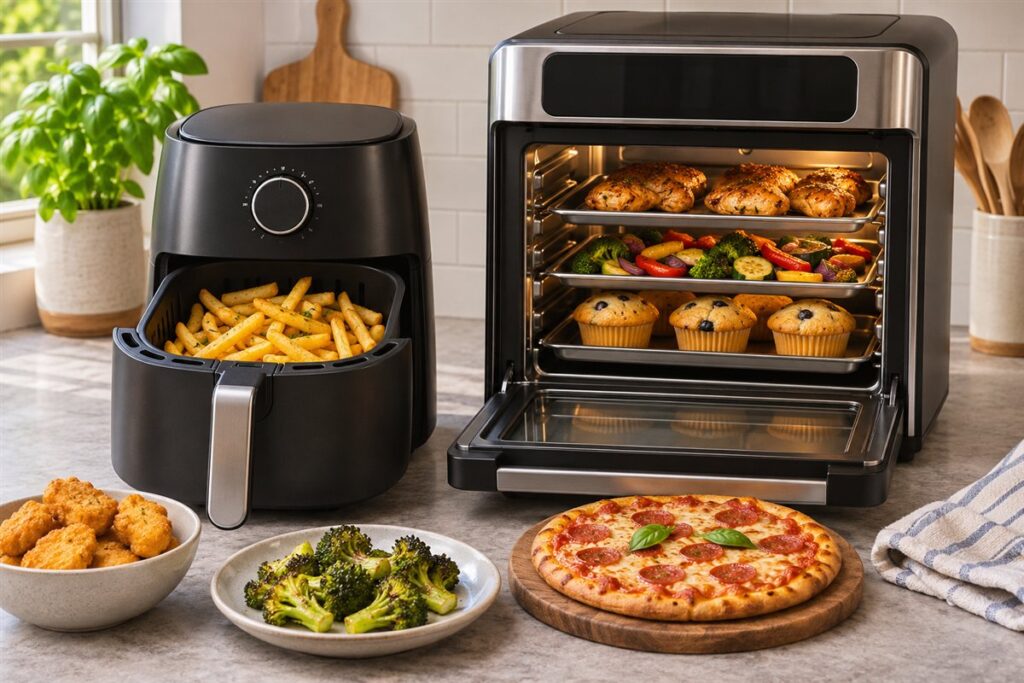
Basket-style air fryers are compact and good for small batches that you shake and turn. Tray or oven-style models give more flat space and suit larger batches, baking and several foods at once. Choose a basket for quick snacks and small households, and a tray model if you cook for more people or bake often.
How Basket Cooking Works
A basket sits in a drawer and holds food in a deep, small space. Hot air circulates around it, and you shake or turn the food partway through. This design is simple, takes up little counter space and works well for fries, nuggets, wings and vegetables in small amounts.
How Tray Cooking Works
Tray models usually look like a small oven. Food rests on a flat tray or rack, and some units support several levels. The flat layout means less piling, so the food can spread out. It suits sheet-style cooking, toast, pizza and baking, and often handles larger items that would not fit in a basket.
Key Differences
| Feature | Basket | Tray or oven style |
|---|---|---|
| Counter space | Smaller footprint | Larger footprint |
| Batch size | Small to medium | Medium to large |
| Turning food | Shake or flip by hand | Often less needed on a flat tray |
| Baking | Limited by basket shape | Usually more flexible |
| Cleanup | Basket and drawer | Trays, racks and cavity walls |
Cooking Tips for Each Style
- Basket: do not overfill, and shake halfway to separate pieces that stick together.
- Tray: spread food in one layer and rotate trays between levels if browning is uneven.
- For both: pat food dry, use a light coat of oil and leave gaps for air.
Choosing by Use Case
- Cooking for one or two and wanting fast snacks: a basket model is usually enough.
- Cooking for a family or hosting guests: a tray model gives more room.
- Baking, roasting or toasting often: a tray model has the flatter space for it.
- Small kitchen with limited counters: check the footprint of any model before choosing.
Whatever style you use, follow the maker’s manual and safety instructions, keep the vents clear and allow space around the unit.
Space and Placement
Before choosing either style, look at where it will sit. Basket models need room to pull the drawer out, and tray models need room to open the door. Keep clear space around the vents on every side and follow the clearance advice in the maker manual. Think about storage too, since a bulkier unit may not fit under a cabinet or in a cupboard when you are not using it.
Capacity and Household Size
Capacity is where the two styles diverge most, and it is easy to misjudge. Basket models are usually listed by volume, but the real question is how much food fits in a single layer. Food cooks best when air can reach each piece, so a basket that looks large may only hold a modest amount of properly crisped food. Tray models spread food across a flat area and sometimes across several levels, which can give more usable room.
Think about the largest meal you cook regularly, not the average one. If you often cook for a family, a basket may mean two or three rounds, which adds time. If you mostly cook for one or two people, a tray model may be more machine than you need and take up more counter space than it deserves.
Check the listing for the capacity figure and, if possible, the interior dimensions. Compare those with the foods you cook most, such as a whole chicken, a baking dish or a full tray of fries. Remember that stated capacity is a maximum, and loading to the limit often reduces crispness. A model that comfortably fits your usual meal is better than one that only fits it when packed full.
Heating, Airflow and Browning Differences
The shape of the cooking space affects how food browns. In a basket, hot air circulates in a compact space and food tends to cook quickly, but items on the bottom may brown less unless you shake them. In a tray model, heat often comes from above and the fan moves air across a larger area, so browning can be more even on flat foods but may vary between levels.
Models differ in element placement, fan power and preset programs, so rely on the product listing and manual rather than assumptions. If you use multiple levels in a tray model, expect that you may need to swap trays partway through for even results. In a basket, shaking or turning food halfway helps.
- Basket: good for foods that benefit from tossing, such as fries and florets.
- Tray: good for items that should stay flat, such as fish fillets, toast and sheet-style meals.
- Both: preheating, if recommended, helps with consistent browning.
Test a new unit with a simple food first, so you learn how it browns before cooking an important meal.
Features and Controls to Compare
Beyond the basic shape, look at the features that shape daily use. Presets can be convenient, but manual temperature and time controls give flexibility. A window or interior light lets you check food without opening the unit, which helps keep heat in. Digital controls tend to offer finer adjustment than dials, while dials can be simpler and more durable.
Tray and oven-style models often include extra functions such as baking, toasting or dehydrating, though the exact list varies and should be confirmed in the listing. Some basket units offer a pause or reminder to shake food. Think about whether you will actually use each function, since additional features can add cost and complexity without adding value.
Also compare the noise and the heat given off by the unit. A larger oven-style model may radiate more heat into the kitchen. Check the cord length and where the controls sit, as this affects where you can place the unit. Finally, read about the warranty and what the maker offers for support, and keep your receipt in case you need it.
Accessories and Compatibility
Accessory choices differ by style. Basket models usually take round or square pans, silicone liners and small racks that fit the drawer. Tray models can often accommodate standard-sized baking dishes and extra racks, though dimensions still vary. Before buying anything, measure the inside space and check the manual for what is permitted.
Some tray models come with several racks and trays, while some basket models include only the basket itself. Compare what is included in the box, since buying accessories separately adds up. Make sure replacement parts, such as extra trays or baskets, are available from the maker if you want a spare.
Keep in mind that loose or lightweight items can be pulled by the fan, so liners and paper should be weighed down by food. Avoid placing anything that blocks vents or touches the heating element. If you plan to use pans for baking, choose ones with a stated heat rating, and confirm that they do not restrict airflow around the food.
Budget Tiers and Long-Term Value
Basket models generally sit at the more affordable end because they are simpler and smaller, while tray and oven-style models tend to cost more because of their size and extra functions. Within each style, simpler units cover the basics, mid-range ones add presets and better build, and premium ones add larger capacity, more functions and sometimes sturdier materials.
Value depends on use, not price. A basic basket model that you use several times a week may serve you better than a feature-rich tray model that sits unused because it is hard to clean or store. Think about how long you want the unit to last and whether parts such as the basket, tray and coating look durable.
Before buying, ask yourself a few questions. Will it fit your counter and storage? Can you clean every part easily? Does it match the amount of food you cook? Is the warranty clear? Signs it is time to replace a unit include a peeling coating, a loose or damaged door or drawer, heating that no longer works evenly, or any smell or smoke that persists after cleaning.
FAQ
Can a basket model bake a cake?
Often yes, in a small pan that fits the basket. A tray model usually has more room for larger bakes.
Which is easier to clean?
Baskets are compact and simple to wash. Tray models have more parts, but flat trays are easy to wipe.
Which style cooks faster?
It depends on the model and the food. Compact baskets often heat quickly, while larger tray units may take longer to preheat but cook more at once. Check the manual for guidance on times.
Do tray models need more counter space?
Usually yes, since they have a larger footprint and need room to open the door. Measure your counter and the clearance above and around before choosing.
Can I cook frozen food in either style?
Yes, in general, as long as you follow the package guidance and adjust for your unit. Spread food in a single layer for the best results.
Is a tray model better for baking?
A flat, open space is often more suited to baking, but results depend on the specific model. Check what the maker says about baking functions and suitable pans.
How often do I need to shake food in a basket?
Once or twice during cooking is typical for loose foods like fries or vegetables. Foods that stay flat may not need it.
Which style is better for a small household?
A basket is often enough for one or two people and takes less space. Choose based on how much you cook at once and where it will be stored.
How do I know whether a model suits my cookware?
Measure the interior and compare it with the dimensions of your pans. Confirm that the maker permits using them and that they are rated for the temperatures you plan to use.
The Short Version
Choose a basket for small, quick jobs and a tray model for bigger batches and baking. Your household size and the dishes you make most should lead the decision.