
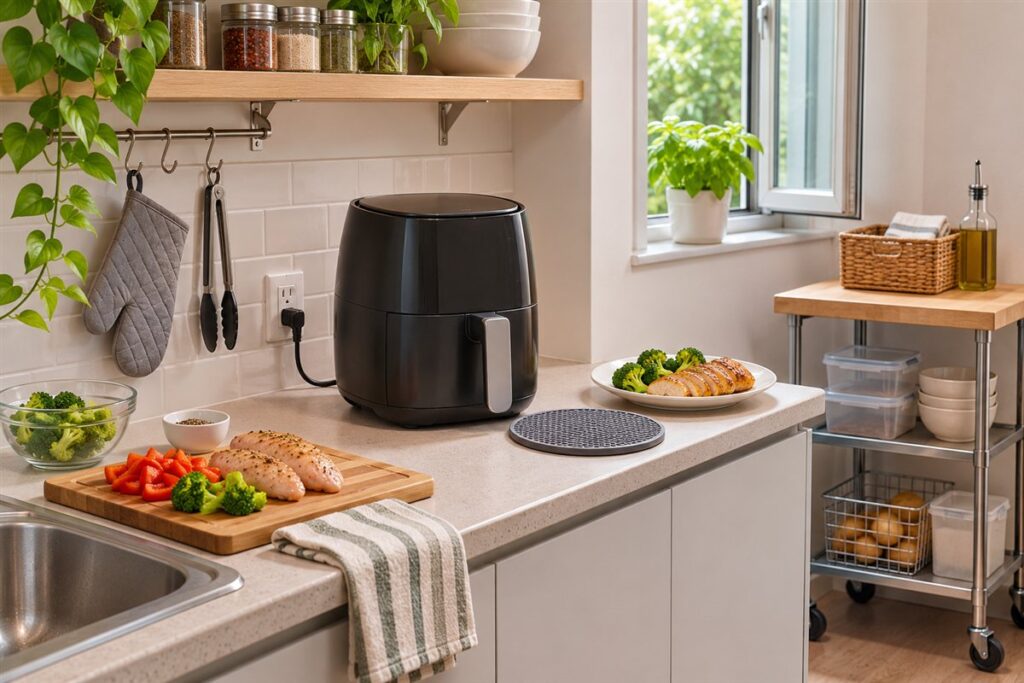
A small kitchen can still handle air fryer cooking if you plan where the unit sits, where it lives between uses, and how you move through a meal. The goal is to keep counters usable and to leave the airflow space your maker’s guide asks for. These habits come from general kitchen logic, not from any one model.
Find a Working Spot
Because the unit needs open space around it while running, the counter spot matters more than people expect. Look for a flat, heat-resistant surface with clearance above and on the sides.
- Avoid placing it directly under a low cabinet, since hot air rises.
- Keep it away from the edge so the cord cannot be pulled.
- Place it near an outlet, and avoid long extension cords.
- Keep it away from the sink and from curtains or paper towels.
If the counter spot is not ideal, consider using a nearby table or cart, as long as it is stable and heat-resistant.
Storage Between Uses
Many cooks leave the unit out if they use it often. If you do not, store it where lifting is easy and the cord does not tangle.
- Let the unit cool fully before putting it away.
- Wrap the cord loosely and tuck it in, following the manual.
- Store it at waist height if possible, not on a high shelf.
- Keep the basket and any accessories nested together to save room.
Workflow in Tight Quarters
A small kitchen rewards a simple routine. Prepare food at one end of the counter, cook at the other, and keep a landing spot for the hot basket. A trivet or heat-resistant mat gives you a safe place to set it down.
| Problem | Small-space fix |
|---|---|
| Not enough counter | Use a cutting board over the sink for prep |
| Cord clutter | Use a short cord and a nearby outlet |
| Grease splatter | Wipe the unit and nearby wall after cooking |
| Smells linger | Open a window or run a vent fan |
| Heat near cabinets | Pull the unit forward with clearance |
Cook Smart With Less Space
Choose meals that need few tools. One-basket dinners, sheet-style meals, and frozen foods all cut down on dishes. Cook in batches and keep finished food warm in an oven, a covered dish, or an insulated container. Clean the basket as you go, since a small sink fills up quickly.
Choosing a Compact Model for Limited Space
If you are still deciding what to buy, size should be one of your first filters. Capacity is usually given in volume, but the footprint on the counter and the height with the lid or drawer closed matter just as much in a tight kitchen. Measure the spot where it will live, then add room for the vents and for opening a drawer or door. Check the listing for outer dimensions, not only capacity.
Basket and drawer styles generally take less counter area than oven-style units, though they hold less. Think about how many people you cook for and how often you need a large batch. A compact unit that you cook with twice may be better than a large one that stays in a cupboard because it is a hassle to lift.
- Check the weight if you will carry it between storage and counter.
- Look at the cord length and where the cord exits the body.
- See whether the handle or drawer sticks out and needs extra clearance.
- Consider whether you want a simple control panel that is quick to learn.
If you share a small kitchen, make sure everyone knows where the unit goes and how to keep the vents clear.
Using Vertical and Multi-Use Space
Small kitchens often have more wall and shelf space than counter space, so think upward. A sturdy cart with a heat-resistant top can act as a dedicated cooking station that rolls away when you are done. A wall shelf can hold accessories, mitts and spices so they are close without taking up the counter.
Avoid putting the air fryer on a shelf that is not designed to hold its weight or on a surface that could be damaged by heat. Keep it away from walls and cabinets by the clearance your manual advises, because hot exhaust air needs somewhere to go. Never run it in a closed cupboard or on a soft surface.
Use over-the-sink cutting boards, folding trays and stacking containers to create temporary workspace. Store frequently used accessories inside the basket when the unit is cool and not in use, if the manual allows it. A small hook under a cabinet can hold oven mitts and tongs. The aim is to make the cooking routine feel natural, so you are not shuffling things around every time.
Managing Heat, Steam and Cooking Smells
In a small space, heat and smells linger. An air fryer gives off warm exhaust air, and strong-smelling foods such as fish or bacon can fill a small room quickly. Run an extractor fan if you have one, or open a window to create airflow. Position the exhaust side away from walls, cabinets and anything that could be damaged by warm, moist air.
Wipe the unit and the nearby surfaces after greasy cooking, because film builds up and can hold odors. Empty the drawer or basket between batches and wash it soon after cooking. A light mist of grease from fatty foods can settle on nearby walls and shelves, so keep paper, cloth and decorations clear.
- Cook strongly flavored foods when you can ventilate well.
- Do not place the unit under smoke alarms or directly beneath a low shelf.
- Keep curtains, towels and paper products well away from the vents.
- Check that the room is not so enclosed that heat builds up.
If smoke appears, switch the unit off, unplug it once safe to do so and let it cool before investigating.
Planning Menus That Need Few Dishes
When storage and sink space are tight, the number of pots and pans matters. Choose meals that use one basket and a few simple tools. Foods that can be cooked together, such as a protein with vegetables cut to similar sizes, reduce both time and washing. Frozen foods and pre-cut vegetables are practical in a small kitchen.
Plan the week with overlap in ingredients so you do not need to store many different items. A few staples, such as potatoes, eggs, frozen vegetables, a protein and a simple spice mix, can form the base of many meals. Cook extra and use it in later meals to save effort.
Use reusable silicone liners or well-fitting cups to catch drips, if your manual permits them, because they save scrubbing a basket. Rinse the basket immediately after use while the sink is still clear. For entertaining, cook in rounds and keep finished food warm in a covered dish. A simple written plan helps you avoid reaching the middle of a meal and realizing you have nowhere to put things.
Safety Habits When Space Is Tight
Tight spaces raise the risk of bumped cords, knocked-over pans and accidental contact with hot surfaces. Keep the cord short and out of the walkway so it cannot be snagged. Set the unit at the back of the counter, away from the edge, and make sure children and pets cannot reach it.
Always use a stable, level, heat-resistant surface. Do not run the unit on a stack of items or on a surface that might shift. Use oven mitts or tongs to handle baskets and trays, and set hot items on a trivet. Allow the unit to cool before moving it or putting it away.
Do not plug the air fryer into an extension cord unless the manual explicitly allows it, and avoid running other high-power appliances from the same outlet at the same time. Keep the area around the unit free of clutter while it is running. Check the cord and plug occasionally for damage. If you notice fraying, discoloration or a burning smell, stop using the unit and contact the maker.
FAQ
What if my kitchen has no spare outlet?
Use an outlet that can handle the load, and avoid sharing it with other high-power appliances at the same time. Check your manual for electrical guidance.
Will it fit on a shelf?
Only if there is enough clearance for vents and heat. Never run the unit in an enclosed space.
How much clearance does an air fryer need?
It varies by model, so check the manual for the exact distances. As a rule, keep the vents and the top clear of walls and cabinets so hot air can escape safely.
Can I keep it on a cart or trolley?
Yes, if the cart is stable, level and heat resistant, and the cord can reach an outlet safely. Lock the wheels while cooking and keep the vents clear.
Is it okay to store the basket inside the unit?
Many people do this to save space, but only once the unit is clean, dry and cool. Check your manual in case it advises otherwise.
How do I reduce cooking smells in a small kitchen?
Ventilate with a fan or open window, clean the basket promptly, and wipe nearby surfaces. Strongly flavored foods benefit most from good airflow.
What is the best surface to place it on?
A flat, stable, heat-resistant counter or cart with space around it. Avoid soft surfaces, tablecloths and anywhere close to water.
Can I use it under a cabinet?
Generally not directly under one, because hot air rises. Pull it forward or move it so the exhaust has room, following the manual's clearance guidance.
How can I cut down on washing up?
Cook one-basket meals, use liners if permitted, and rinse parts right after cooking. Fewer separate dishes means less to clean.
The Short Version
Give the air fryer a stable, open spot with clearance, store it where lifting is easy, and cook with a simple routine. Follow your maker’s guide for placement and electrical use.









