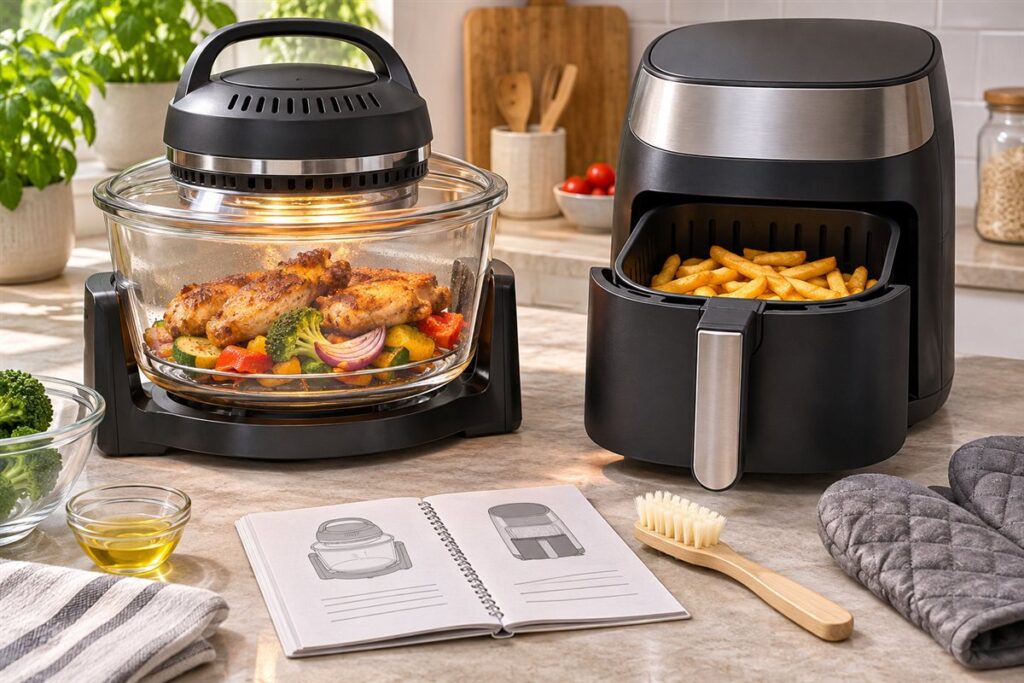
A glass bowl air fryer lets you watch food cook and has a smooth, easy-to-wipe surface, while a metal basket model is lighter and usually simpler to handle. Your choice depends on whether you value visibility or ease of lifting and storing.
How the Designs Differ
In a glass bowl design, a clear bowl sits on a base and a lid with the heating parts sits on top. You can look through the sides to see browning. In a metal basket design, food goes in a pull-out tub that slides into a closed housing, so you cannot see inside unless the model has a window.
The cooking method is the same idea in both: hot air moves around the food. The differences are in handling and daily use.
Everyday Trade-Offs
| Factor | Glass bowl | Metal basket |
|---|---|---|
| Visibility | See food at all times | Open to check |
| Weight | Heavier bowl and lid | Lighter tub |
| Cleaning | Smooth glass, parts to separate | Coated or plain metal surfaces |
| Impact risk | Glass can chip or crack if dropped | Can dent or scratch |
| Hot handling | Lid and bowl need care | Handle and tub need care |
Care Tips for Each
If you choose glass
- Avoid sudden temperature changes, such as placing a hot bowl in cold water.
- Inspect the glass for chips before each use. If it is damaged, stop using it and contact the maker.
- Store it where it will not be knocked.
If you choose metal
- Use soft sponges to protect any coating.
- Skip metal utensils that can scratch the surface.
- Dry fully before storing.
Who Should Choose Which
Choose glass if you like to watch your food and want to avoid opening the unit often. It can feel reassuring when you are learning how fast things brown.
Choose metal if you want a lighter appliance, plan to move it often, or have a busy kitchen where a glass bowl might get bumped. A model with a viewing window can also give some visibility without a glass bowl.
Always follow the maker’s manual for cleaning, heat limits and parts that can go in a dishwasher.
Storage Considerations
A glass bowl model often has a separate lid that holds the heating parts, so you must store two pieces. Metal basket models tend to be one compact unit. If cabinet space is tight, think about which shape you can store without stacking heavy items on top.
Visibility and Monitoring While Cooking
The main appeal of a glass bowl is that you can watch food cook without opening anything. That helps with items that brown fast, such as nuts, breadcrumbs and sugary glazes, because you can see color changes in real time. It can also help beginners learn how their food behaves and how long it takes to cook on that particular unit.
With a metal basket, you usually pull out the drawer to check. Opening it lets heat escape, and the cooking pauses on many models when the drawer comes out. That is not a major drawback for most dishes, but it means you rely more on timers, sound and smell. Some metal designs have a window in the lid or door, so check the listing.
Visibility does have limits. Steam, grease and spatter can cloud the glass, and food stacked high may hide the pieces below. It also does not tell you if the center of a thick cut is done, so a thermometer remains important for meat and poultry. Think about whether watching your food is worth any trade-offs in handling, weight or storage. If you tend to cook the same few things, you may learn the timing quickly and care less about the view.
Heat Handling and Thermal Shock
Glass behaves differently from metal when temperatures change. Heat-resistant glass is made to handle high temperatures, but sudden shifts, such as moving a hot bowl into cold water, can crack some types. Follow the maker’s instructions about cooling and cleaning, and let a hot bowl rest on a heat-safe surface rather than a cold, wet counter.
Metal baskets heat and cool quickly, and typically do not crack, though they can warp if they are mistreated or if the coating suffers. Metal handles can get hot, and glass bowls may be heavy to carry when full. Always use oven mitts if the maker advises, and avoid placing hot parts on plastic or delicate surfaces.
- Inspect glass for chips or cracks before each use, and stop using damaged parts.
- Avoid hitting the bowl against hard surfaces or stacking other items on top.
- Check the manual for the maximum temperature and any limits on liquids.
- Keep metal baskets away from sharp utensils that scratch the coating.
Whichever you choose, treat the container as a part you should replace if it is damaged. Check whether replacement bowls or baskets are sold for the model.
Food Types That Suit Each Container
The container shape affects how air and food interact. Metal baskets usually have perforations or a grate so air can pass beneath and around food, which suits crisping fries, wings and breaded items. Glass bowls are typically solid, so airflow is different and food may sit closer to the surface. Many glass designs use a rack or stirring paddle to deal with this, so check the listing for how food is positioned.
Glass often suits foods that benefit from being contained, such as stir-fry style dishes, chopped vegetables and items you want to toss often. Some models are paired with an automatic stirrer. Metal baskets suit foods that need airflow all around, and allow fat to drain away from the food.
Both designs have limits with wet or saucy food. Excess liquid can splatter, produce steam or make crisping hard. Pat food dry, avoid overfilling, and follow the maker’s guide for liquids and marinades. Treat the container as a tool, not a promise of a particular result. If you cook mostly fries, nuggets and wings, metal is the more common route. If you cook varied one-bowl meals, glass may appeal.
Durability and Everyday Wear
Over time, each material shows wear in its own way. Metal baskets with nonstick coatings can lose the coating if scratched, scrubbed hard or washed with harsh cleaners. A worn coating can cause sticking and, in some cases, flaking, so check the condition regularly. Uncoated metal can be sturdier but may need more oiling to prevent sticking.
Glass does not have a coating to wear out, and it resists staining and odors. It is, however, vulnerable to impact. A drop onto a hard floor or a knock against a faucet can chip or break it. If you have a busy household, a clumsy cook or small children, factor this in. Also consider the weight, since a full glass bowl can feel heavy.
Look at the whole assembly as well. Seals, lids, handles and locking parts can be wear points regardless of material. Check the warranty to see whether the container is covered. Ask how long replacement parts remain available, and whether they are sold separately. A cooking vessel that is cheap to replace changes the calculation, so look into that before buying.
Questions to Settle Before You Buy
Run through a short checklist so you know what matters. How do you usually cook: mostly frozen snacks, mixed meals, or batch cooking? How important is it to see inside? Are you comfortable handling a heavier, breakable part? Where will the unit live, and how will you store extra parts? Do you wash dishes by hand or use a dishwasher, and does the container fit?
Then check the product details. Look at the listed capacity, the usable surface area, the temperature range and the cooking modes. Read what the maker says about cleaning, including whether the container, lid and accessories are dishwasher safe. See whether the listing mentions any limits on oil, liquids or specific foods.
- Is there a way to stir or shake food during cooking?
- What happens when you open the unit mid-cook?
- Are spare containers available?
- What does the warranty say about breakage or coating wear?
If most answers point to one design, choose it. If you are torn, think about which downside you can live with more easily: occasional care with glass, or maintenance of a coated metal basket.
FAQ
Is glass harder to clean?
It is smooth, so sticky food wipes off well, but you still need to handle heavy parts with care. Check which pieces can be washed in a dishwasher.
Does glass change how food cooks?
The cooking relies mainly on heat and airflow, so results depend more on the model than on the material. Follow the maker’s guide for timing.
Can I put a glass bowl straight into cold water after cooking?
Avoid sudden temperature changes, as some glass can crack. Let it cool on a heat-safe surface first and follow the maker's cleaning instructions.
Do glass bowl air fryers cook as crisply as basket ones?
Results depend on the model and the airflow design. Basket styles with perforations are often chosen for crisping, but check the listing for how each unit handles air circulation.
Is glass heavier than a metal basket?
Typically yes, especially when full. Check the listed weight and think about whether you will carry it to the sink often.
What if a glass bowl gets a chip?
Stop using it and contact the maker or seller about a replacement. A chipped bowl can crack further under heat.
Does a metal basket coating wear out?
It can with scratching, harsh scrubbing or damage over time. Use soft tools, avoid metal utensils and replace the basket if the coating flakes.
Can I use metal tongs with either type?
Silicone-tipped or wooden tools are safer for coated baskets and glass. Metal tongs can scratch coatings and may chip glass.
Are replacement parts available?
It varies by maker and model. Check the listing or contact the seller before buying so you know whether a spare is available.
The Short Version
Glass bowls offer visibility and easy wiping but add weight and need gentle handling. Metal baskets are lighter and more forgiving. Choose by how you cook, how you store the unit and how much you want to see.