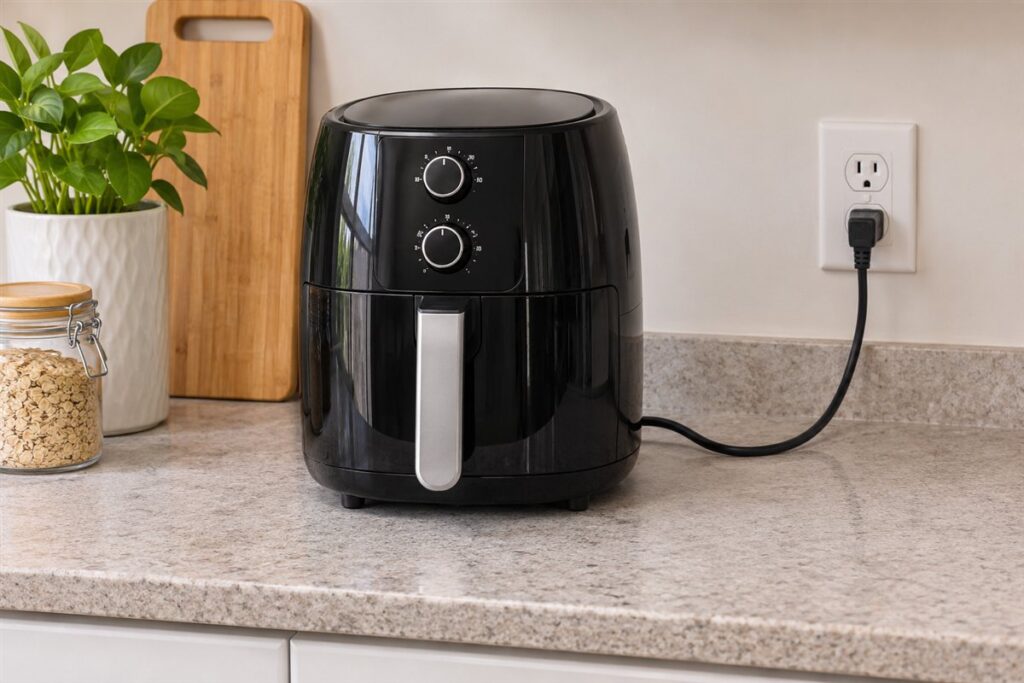
Air fryer cords are usually fairly short on purpose, so plan to place the appliance near a suitable wall outlet rather than stretching the cord. Keep the cord clear of hot surfaces and walkways, and follow the maker’s manual for every power question. This guide covers why cords are short, how to plan the spot, a step-by-step setup, and when to call a licensed electrician.
Why Cords Are Often Short
A shorter cord reduces the chance that someone trips over it or pulls the appliance off the counter. It also encourages you to plug straight into the wall instead of using extra cords, which the maker may advise against for heating appliances.
The manual states how the appliance should be powered. Check it before you decide where to place the unit.
Planning Where It Goes
| Question | Why it matters | What to check |
|---|---|---|
| Is an outlet close by? | Avoid stretching the cord | Distance from the spot to the outlet |
| Is the cord near heat? | Heat can damage insulation | Keep it away from vents and hot surfaces |
| Is it near water? | Moisture and electricity do not mix | Keep clear of sinks and spills |
| Can it be knocked? | A pulled cord can tip the unit | Keep the cord from hanging over the edge |
Simple Habits
- Place the air fryer on a flat counter near the outlet before you load food.
- Run the cord along the back of the counter, not across a walking path.
- Make sure the plug sits fully in the outlet and does not hang loose.
- Do not let the cord touch the hot housing or rest on the vent.
- When finished, let the unit cool, then unplug by gripping the plug, not by pulling the cord.
- Store the cord loosely coiled rather than tightly wrapped around the body.
A Setup Walkthrough
Use this sequence the first time you place the unit, and again if you rearrange the kitchen.
- Read the electrical and safety section of the manual, including any note about outlets and extension cords.
- Choose a counter spot with open space around the unit and an outlet within easy reach of the cord, with no stretching.
- Check that the cord can reach the outlet while hanging down behind the counter, not across the front.
- Look at the outlet itself. It should be dry, undamaged and hold the plug firmly.
- Place the unit, then plug it in with dry hands once it is in position.
- Run a short empty test if the manual advises it, and watch that the cord stays clear of the vents.
- After cooking, wait for the unit to cool, unplug it, and return the cord to its resting place.
Common Scenarios
The outlet is behind the stove
That is not a good place to plug in a countertop heating appliance. Choose another counter area, or ask a licensed electrician about a more convenient outlet.
The cord does not reach the spot you want
Move the unit nearer the outlet. If you still think an extension is needed, read the manual first, since many makers advise against it for heating appliances.
Several appliances share one outlet
Kettles, toasters and air fryers all draw a lot of power. Avoid running several at once from the same outlet, and ask a licensed electrician if the circuit trips.
Children or pets are around
Keep the cord out of reach, with no loops hanging over the edge, and keep the unit back from the counter edge.
Mistakes to Avoid
- Pulling the plug by the cord: repeated tugging can loosen the wires inside the plug.
- Wrapping the cord tightly around the unit: heat and bending can damage the insulation.
- Letting the cord drape over the edge: a snag can pull the hot unit off the counter.
- Using damaged cords: cracks and frays expose wires and are a shock and fire risk.
- Chaining power strips: this adds load and extra connections, which makers of heating appliances often warn against.
Quick Troubleshooting
| Symptom | Likely cause | What to try |
|---|---|---|
| Unit will not power on | Plug not seated, outlet off or a tripped circuit | Check the plug and the manual; ask a licensed electrician if the outlet is the issue |
| Plug or outlet feels warm | Loose connection or heavy load | Stop using it and have the outlet checked by a licensed electrician |
| Circuit trips while cooking | Too many appliances on one circuit | Unplug other appliances and ask a licensed electrician |
| Cord looks worn | Age, bending or heat | Stop using the unit and contact the maker |
When to Stop and Ask for Help
If the cord is frayed, cracked, unusually warm, or the plug looks damaged, stop using the appliance and contact the maker. If an outlet feels warm, shows marks, or trips often, ask a licensed electrician. Do not repair cords, plugs or other electrical parts yourself.
Kitchen Layout Ideas
If the only outlet is behind the stove or the sink, look for a different counter area or a wall outlet that is easier to reach. Some kitchens have outlets just above the counter, which work well. Avoid placing the appliance where you must reach over it to plug it in, since the housing can be hot after cooking. A tidy cord path makes every use calmer.
Checking the Cord and Plug Over Time
A quick look every few weeks takes seconds. With the unit unplugged and cool, run your eye along the cord for cuts, kinks, flattened sections or discoloured patches. Check the plug for bent pins, cracks or any sign of scorching. Check that the cord enters the unit smoothly and is not pulled sideways. If you see anything unusual, stop using the unit and contact the maker rather than trying a repair or taping the damage.
Also notice how the unit behaves. A cord or plug that is warm to the touch after a short cook, a smell of hot plastic, or flickering lights elsewhere in the room when the unit runs are all reasons to stop and seek help. These can point to a problem with the appliance, the outlet or the wiring behind it, and sorting out which needs a licensed electrician or the maker.
Glossary
- Outlet: the wall socket that supplies power.
- Circuit: the wiring path serving one or more outlets, protected by a breaker or fuse.
- Extension cord: a lead that extends the reach of a plug; many makers advise against its use with heating appliances.
- Insulation: the protective cover around the wires in a cord.
- Load: the amount of power an appliance draws.
FAQ
Can I use an extension cord?
Many makers advise plugging heating appliances directly into a wall outlet. Check your manual and follow its instructions.
Does a longer cord help?
It may add convenience, but only if the maker supplies it or approves it. Placing the unit closer to the outlet is usually simpler.
Can I leave it plugged in all the time?
Many people do, but it is safest to unplug it after use and before cleaning. Follow the manual for your model.
What if my kitchen has few outlets?
Rearrange where you cook, and ask a licensed electrician about adding or relocating an outlet. Do not rely on stacked adapters.
Is it a problem if the plug is loose in the socket?
Yes. A loose fit can heat up, so stop using that outlet and have it checked by a licensed electrician.
The Short Version
Place the unit near a suitable outlet, keep the cord away from heat, water and edges, and follow the manual. Contact the maker for damaged cords, and a licensed electrician for outlet concerns.