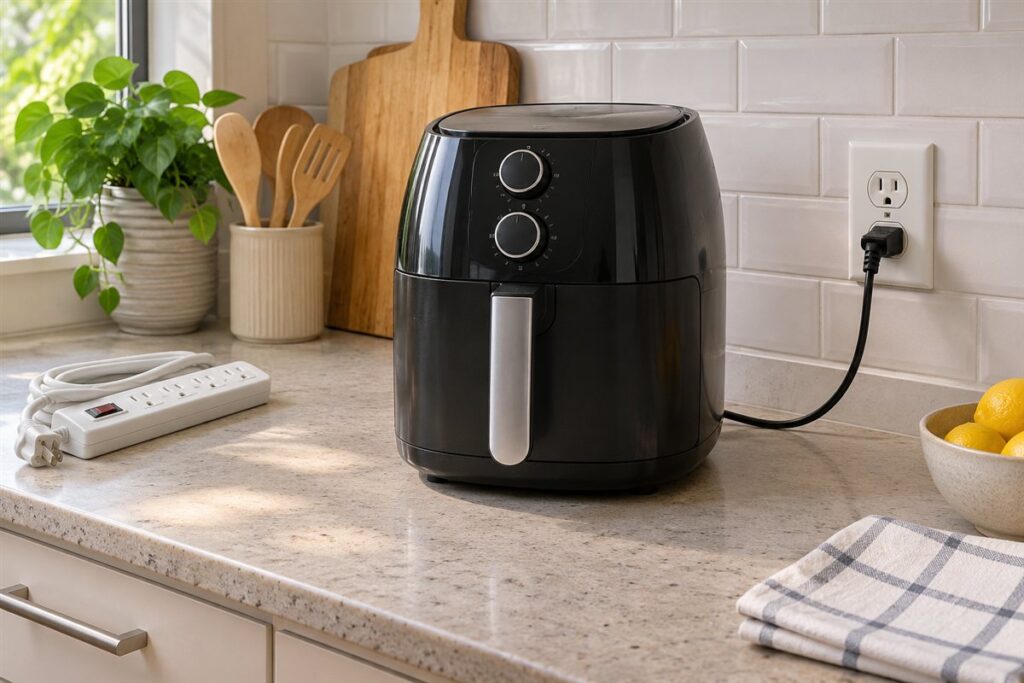
Air fryers draw a lot of power for a countertop appliance, so makers often advise plugging them straight into a wall outlet instead of a power strip. Read the manual for your unit, and ask a qualified electrician about any concerns with your circuits.
Why Power Matters
An air fryer uses a heating element and a fan. The heating element needs far more electricity than devices such as lamps or chargers. When several high-power appliances share one circuit, the breaker may trip to protect the wiring.
Power strips are usually designed for lighter loads. Many are not intended for heating appliances, so check both the strip’s label and the air fryer’s guide.
Good Practices
- Plug the air fryer directly into a wall outlet if the manual says to.
- Avoid running it at the same time as other heating appliances on the same circuit, such as a kettle, toaster or microwave.
- Do not daisy-chain strips or extension cords.
- Check that the plug fits snugly and the outlet is in good condition.
- Keep outlets away from sinks and spills.
Signs to Take Seriously
| Sign | What it may mean | What to do |
|---|---|---|
| Breaker trips repeatedly | Circuit is carrying too much | Stop using the appliance on it, and ask an electrician |
| Warm plug or outlet | Poor connection or heavy load | Unplug and ask an electrician |
| Burning smell from the outlet | Possible electrical fault | Unplug if safe, stop use, and get professional help |
| Appliance cuts out | Power supply issue or appliance fault | Check the manual, then contact the maker |
Where to Find Your Appliance’s Needs
- Find the power label on the unit or in the manual.
- Check the power information against the outlet and circuit you plan to use.
- If you are unsure how your circuits are arranged, ask a qualified electrician.
- Follow any instructions in the manual about extension cords and strips.
Do not open the appliance or alter plugs, cords or wiring. Electrical repair belongs to a qualified professional or the maker.
A Worked Example: Mapping a Kitchen Morning
Think of a busy morning. The kettle is boiling, the toaster is going, and you want to warm some pastries in the air fryer. All three are heating appliances, and in many homes the kitchen outlets share a small number of circuits.
- Write down which outlets you use for each appliance during a normal morning.
- Check whether any of them are close together on the same wall, since neighboring outlets are often on the same circuit.
- Read the power label on each appliance so you know which ones are high-power heaters.
- Spread them out. Put the air fryer on one wall outlet and the other heaters on a different run, if your kitchen has one.
- If you cannot tell which outlets share a circuit, do not guess. Ask a licensed electrician to identify and label the circuits.
- If a breaker still trips, run the appliances one after the other instead of together.
The aim is not to calculate loads at home. It is to avoid stacking several heaters on one circuit and to recognize when to ask a professional.
Planning Your Cooking Around Your Circuits
If your kitchen shares one circuit between several outlets, stagger your cooking. Run the air fryer first, let it finish, then use the kettle or toaster. That simple habit reduces the chance of a trip. In older homes, outlets may be worn or loose, so be extra careful and consider asking a qualified electrician to check them.
Common Scenarios
- A rented flat with few outlets: arrange cooking in sequence rather than adding strips to reach more sockets.
- A kitchen island with a single outlet: confirm with the manual and a professional that it suits a heating appliance before you rely on it.
- A garage or workshop outlet: outlets there may be on different protection than the kitchen. Ask an electrician before using one for an air fryer.
- A long cord that will not reach: move the appliance closer to a suitable outlet instead of adding a cord.
- A camper or holiday home with unfamiliar wiring: check the appliance label against what the site or owner states, and ask if unsure.
Mistakes to Avoid
- Using a strip because it is handy. Strips are built for lighter loads, and a heating appliance may overload one.
- Resetting a tripped breaker again and again. A repeated trip is a message from the circuit, not a nuisance.
- Ignoring a warm plug. Warmth at the plug means resistance somewhere, and it can worsen with each use.
- Assuming a surge protector is a heavy-duty cord. They solve different problems.
- Covering the outlet or the cord with cloths or paper. Heat needs room to escape.
A Simple Checklist Before You Cook
- The plug is pushed in fully and does not wobble.
- The cord is not stretched, pinched or lying across a hot surface.
- No other heating appliance is running on the same outlet run.
- The outlet looks clean, undamaged and dry.
- The vents of the air fryer have open space around them.
- You know where the breaker panel is, in case you need to switch a circuit off.
This takes under a minute and costs nothing but attention. Share the checklist with anyone else who uses the kitchen, so the habits do not depend on one person. After a week or two it becomes automatic. Pay special attention after moving house or rearranging the counter, since a new layout often brings a new outlet and new habits.
After the cook, a quick touch of the back of the plug, once the unit is switched off and unplugged, tells you whether anything ran warmer than usual. A plug that feels mildly warm after a long cook may be normal for your model, and the manual is the place to check. A plug that is hot, discolored or smells of heat is not normal, and the outlet needs professional attention before you use it again.
Glossary
- Circuit: a run of wiring protected by one breaker.
- Breaker: a switch that cuts power when a circuit carries more than it is built for.
- Daisy-chaining: plugging one strip or cord into another, which the guide above advises against.
- Surge protector: a device that guards electronics against short voltage spikes.
- Heating appliance: any device whose main job is making heat, such as a kettle, toaster or air fryer.
FAQ
Is a surge protector the same as a heavy-duty cord?
No. A surge protector guards electronics against spikes, but it may not be built for heating appliances. Read its label and the air fryer manual.
Can I use any kitchen outlet?
Use a properly installed outlet in good condition, and follow the manual. If an outlet seems worn or loose, ask an electrician.
What should I do if the breaker trips only sometimes?
An occasional trip when several heaters run at once points to a shared circuit. Run appliances one at a time, and ask a qualified electrician if it keeps happening or happens with the air fryer alone.
Should I add a new outlet for my air fryer?
That is a job for a licensed electrician. Do not attempt wiring work yourself, and follow local rules for any changes.
Can a timer plug or smart plug control an air fryer?
Only if the maker allows it and the plug is made for that load. Most manuals advise connecting heating appliances directly, so check yours first.
The Short Version
Plug your air fryer in as the manual directs, avoid sharing a circuit with other heating appliances, and treat repeated trips or warm outlets as a reason to call a qualified electrician. Never alter wiring or plugs yourself.