Greek yogurt makers come in two kinds. Strainer sets turn plain yogurt into a thicker, Greek-style one by draining off liquid in the fridge. Electric makers hold milk at a set temperature so it cultures into yogurt, and some of those come with a strainer bag or jars.
The six below include two fridge strainers, one 2-quart electric maker with a strainer bag, two 8-jar electric units and a 3-in-1 stainless bowl model. Capacities, ranges and parts come from each product’s listing page. We have not used these yogurt makers ourselves, and temperature and timer figures are the makers’ own.
As an Amazon Associate we earn from qualifying purchases. Links below are affiliate links, and they do not change the product information we give.
What to Look For
| Feature | Why it matters |
|---|---|
| Type | A strainer thickens ready-made yogurt; an electric maker cultures milk |
| Capacity | One large container or several small jars |
| Temperature and timer | Adjustable ranges give more control over each batch |
| Materials | Glass jars, stainless bowls and mesh baskets clean differently |
| Warranty | Only some listings state one |
In this guide
Specs at a Glance
| Maker | Type and capacity | Controls | Notes |
|---|---|---|---|
| Euro Cuisine GY50 | Strainer; up to 2 quarts of yogurt | None; no heating | Bowl, strainer and lid; 3-year warranty |
| Euro Cuisine GY60 | Strainer; up to 2 quarts of yogurt | None; no heating | Stainless steel mesh basket; 10 x 10 x 5.25 in |
| Euro Cuisine YM260 | Electric; one 2-quart glass jar | 78 to 132 F; up to 99 hours | Cotton strainer bag and thermometer; 3-year warranty |
| Suteck 8 jars | Electric; eight 6 oz glass jars | 68 to 131 F; 0 to 48 hours | Stainless steel shell; auto shutoff |
| GDOR 8 jars | Electric; eight glass jars | 68 to 131 F; 48 hour timer | Stainless body; auto shut-off; 14.3 x 7.3 x 5.5 in |
| DIDIMO 3-in-1 | Electric; stainless bowl about 1.3 L | Timer and temperature control | Also listed for other fermented foods |
The 6 Best Greek Yogurt Makers
Top pickBest for thickening yogurt you already have
1. Euro Cuisine GY50 Greek Yogurt Maker
A fridge strainer set with a bowl, an ultra fine mesh strainer basket and a lid that converts up to 2 quarts of regular yogurt into a thicker Greek style, with a patented stackable design and a 3-year warranty.
Suits: thickening yogurt you already have. Strengths: no power needed and a stated 3-year warranty. Weaknesses: it does not make yogurt from milk. Skip it if you want to culture your own.
View Euro Cuisine GY50 Greek Yogurt Maker on Amazon
Best for a metal strainer basket
2. Euro Cuisine GY60 Greek Yogurt Maker
The same 2-quart strainer idea with a stainless steel mesh basket in place of the standard one, in a 10 by 10 by 5.25 inch footprint that fits a fridge shelf.
Suits: a metal strainer basket. Strengths: a stainless basket. Weaknesses: the listing’s weight of 0.01 ounces is clearly wrong, so check specs before ordering. Skip it if you want a heated maker.
View Euro Cuisine GY60 Greek Yogurt Maker on Amazon
Best for one large batch with a strainer bag
3. Euro Cuisine YM260 Yogurt Maker
An electric maker with a 2-quart glass jar, adjustable temperature from 78 to 132 F, up to 99 hours of run time, a thermometer and a 12 by 12 inch cotton strainer bag for making Greek style yogurt, with a 3-year warranty.
Suits: one large batch with a strainer bag. Strengths: the widest time range here. Weaknesses: one big jar only. Skip it if you want individual cups.
View Euro Cuisine YM260 Yogurt Maker 2 Quart on Amazon

Best for several flavors at once
4. Suteck Yogurt Maker With 8 Jars
A stainless steel shell holding eight 6 oz glass jars, with time set from 0 to 48 hours, temperature from 68 to 131 F and auto shutoff.
Suits: several flavors at once. Strengths: eight jars and a wide temperature range. Weaknesses: the listing gives no warranty. Skip it if you want one big container.

Best for a second 8-jar option
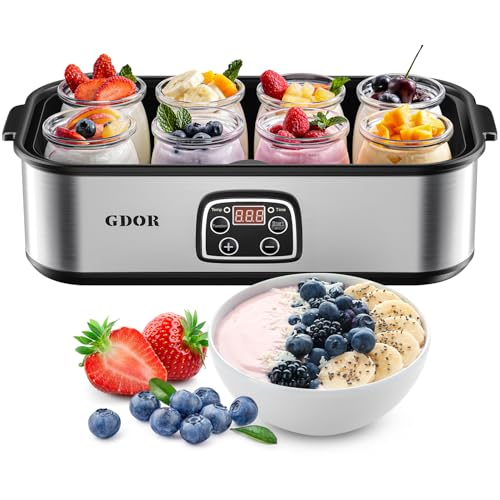
5. GDOR Yogurt Maker With 8 Jars
A stainless steel body, 14.3 by 7.3 by 5.5 inches, with eight glass jars, a temperature range of 68 to 131 F, a 48 hour timer and auto shut-off.
Suits: a second 8-jar option. Strengths: a 48 hour timer and a stainless body. Weaknesses: the details list the included part as only “body”. Skip it if you need a clear parts list.

Best for one stainless bowl for several uses
6. DIDIMO 3-in-1 Yogurt Maker
An electric maker with a stainless steel inner bowl, a timer with auto shut-off, temperature control and a listing that also names other fermented foods.
Suits: one stainless bowl for several uses. Strengths: a stainless bowl that avoids plastic. Weaknesses: the listing shows 1.4 qt and 1.3 L (1.37 qt), and a 16 to 24 hour timer in the title but 24 hours in the text. Skip it if you want exact figures.
View DIDIMO 3-in-1 Yogurt Maker 1.4 Qt on Amazon
Care and Setup
- Wash jars, bowls and baskets before each batch.
- Follow the maker’s temperature and time guidance in the manual.
- Keep a thermometer handy where one is not included.
- Rinse mesh strainers right after use so they do not clog.
Mistakes to Avoid
- Buying a strainer when you want to make yogurt from milk.
- Picking eight small jars when you want one large batch.
- Trusting listing dimensions without cross-checking them.
- Skipping the manual’s cleaning steps.
What Makes Yogurt Greek-Style
Greek-style yogurt is thicker and tangier than regular yogurt because much of the liquid whey has been drained off. Fermentation turns milk into yogurt: live cultures consume the milk sugar and produce acid, which thickens the milk proteins into a gel. Straining then removes whey, concentrating the protein and leaving a denser texture. The longer you strain, the thicker the result, from creamy to cheese-like.
This distinction matters when you buy equipment. A machine that only keeps milk warm for fermentation produces ordinary yogurt, and a separate strainer turns it into the Greek style. Some electric makers include a strainer bag or basket, while others leave straining to you. A strainer on its own does nothing unless you have yogurt to strain.
Understand what you want to make. If you already buy plain yogurt and want it thicker, a strainer is the simple solution. If you want to start from milk, you need a heated, temperature-controlled maker. Think about milk type, too. Whole milk gives a creamier result, while lower-fat milk produces thinner yogurt with more whey. Straining also yields whey, which you can use in baking or smoothies, so do not discard it automatically. Knowing the basic process helps you judge which features matter.
Strainer Sets Versus Incubating Makers
Strainer sets are inexpensive and simple. A bowl holds the liquid whey while a mesh basket or cloth holds the yogurt. They sit in the fridge, where the cool temperature slows spoilage while the whey drains. They need no electricity, take little space and are easy to clean. They cannot make yogurt from scratch, though, and results depend on the yogurt you start with.
Incubating makers keep milk at a steady warm temperature for hours so cultures can work. They range from a single large container to several small jars. A single container makes a big batch that you scoop out as needed. Multiple jars let you make different flavors or portions, and the jars can go straight into the fridge. The trade-off is that you manage several containers and a larger footprint.
Which is right depends on how often you will use it. If you eat yogurt daily and want control over ingredients, an incubating maker pays off. If you only want a thicker texture occasionally, a strainer is enough. Some people buy both. Think about space in your fridge, because a strainer set takes up a shelf for hours. Consider cleaning too, since small mesh baskets must be rinsed promptly to avoid clogging. Matching the tool to your habits avoids buying something that sits unused.
Temperature, Time and Starter Basics
Yogurt making depends on temperature control. Milk is typically heated to a set temperature and then cooled to a range where the cultures thrive. Too hot and the cultures die; too cool and fermentation is slow or fails. Follow the instructions in your machine’s manual, and use a thermometer if the unit does not have one. Do not guess.
The starter provides the live cultures. You can use a small amount of plain yogurt with live cultures or a freeze-dried starter. Make sure the yogurt you use has live active cultures, and avoid heavily flavored or sweetened versions as starters. Add the starter to milk that has cooled to the proper temperature, mix gently and incubate.
Time affects tartness and thickness. Longer incubation produces a tangier yogurt, while shorter times are milder. Many machines offer timers and temperature ranges, which allow you to adjust. Avoid moving or jostling the jars during incubation, since this can break the gel. After incubating, chill the yogurt to firm it up before eating or straining. Keep notes on your batches, including milk type, starter, time and result, so you can repeat successful runs. If a batch fails, check the temperature, the freshness of your starter and the cleanliness of your equipment.
Batch Size, Jars and Lids
Batch size affects convenience and waste. A large container is efficient if you eat a lot of yogurt, but a big batch can spoil if you do not finish it. Small jars let you portion and grab one at a time, and they are easy to take to work. However, you will wash more containers.
Glass jars do not hold odors or stain easily and can go in the dishwasher in most cases, but they are heavy and can break. Plastic jars are lighter but may absorb smells or scratch over time. Check that lids fit well and seal enough to protect the yogurt in the fridge. Some lids are designed for storage and others for incubation only.
Think about how you will use the finished yogurt. Strained Greek yogurt is thick enough for dips, sauces and breakfast bowls, but it takes more milk to make a given amount. Plan on getting less finished yogurt than the starting quantity. Check the maker’s description for capacity per batch and whether the stated capacity refers to milk or finished yogurt. Look at whether extra jars are sold separately, in case one breaks. Label jars with the date, and eat yogurt within the time the recipe or food safety guidance suggests.
Food Safety and Cleaning
Yogurt is a living food, so cleanliness is critical. Wash jars, lids, strainers and utensils with hot, soapy water before every batch, and rinse well. Some people sterilize jars with boiling water or a dishwasher cycle. Avoid cross contamination by using clean spoons and keeping other foods away from the work area.
Watch for signs of spoilage. Pink or orange discoloration, fuzzy mold, a foul smell or an off taste mean you should throw the batch out. A little clear liquid on top is whey and is normal. Yogurt that did not set may still be safe but thin; check the smell and appearance, and when in doubt, discard it.
Store finished yogurt in the fridge at a safe temperature and keep it covered. Set a time limit for eating it, and follow general food safety advice for dairy. Use fresh milk and check its date. For electric makers, clean the base with a damp cloth and never immerse electrical parts. Descale if your water leaves deposits, and dry everything thoroughly. For mesh strainers, rinse them as soon as you finish and use a soft brush to clear the holes. With good habits, homemade yogurt is a simple, rewarding routine.
Yogurt Making Terms in Plain Language
Making yogurt at home introduces a few terms that may be new. The glossary below explains them, so you can read machine listings and recipes with more confidence.
- Culture: a small amount of live yogurt or a packaged culture that begins the process. Follow the culture maker’s instructions.
- Incubation: the period during which milk is kept at a steady, warm temperature so the culture can do its work.
- Greek-style straining: removing whey from finished yogurt so it becomes thicker. Some machines include a strainer, while others rely on a separate cloth or sieve.
- Whey: the thin liquid that separates from the curds during straining.
- Jars or a single container: some makers use several small jars, others use one large vessel.
- Temperature control: a feature that keeps the machine at a set temperature for the time you choose.
- Timer: a setting that shows how long the batch has been incubating, or shuts the machine off.
For food safety, hygiene and timing, follow the maker’s instructions and official food safety guidance.
Choosing a Machine by How You Eat Yogurt
You eat a cup or two a day
Individual jars are handy for grab-and-go portions. A machine with several jars lets you flavor each one differently.
You make yogurt for a family
A larger single container yields more per batch. Check the capacity and the space it will take in your refrigerator after making it.
You love thick Greek-style yogurt
Look for a model with a strainer, or plan to strain with a cloth or sieve. Think about where the whey will go and how you might use it.
You like to experiment with flavors and milk types
Check what the maker says about suitable milks and cultures. Some machines offer adjustable temperatures for different recipes.
Jar Style and Single Container Compared
| Question | Several jars | One large container |
|---|---|---|
| Portioning | Ready-made servings | Scoop as needed |
| Flavor variety | Different flavors per jar | One flavor per batch |
| Cleaning | More small parts | One vessel to wash |
| Refrigerator space | Jars stack neatly | One bulky container |
Hygiene and Process Notes
Yogurt making depends on clean equipment. Wash the jars, lids and tools with hot, soapy water and rinse them well before each batch, following the maker’s instructions. Use fresh milk and a culture that is within its date, and keep the temperature steady as the machine’s manual directs. Avoid moving the machine during incubation, since vibration may affect texture.
Once the yogurt has set, chill it in the refrigerator, and follow the maker’s guidance and official food safety recommendations for storage times. If a batch smells or looks wrong, discard it and clean the equipment thoroughly before trying again. Keep notes on the milk, culture and time you used, so you can repeat successful batches and adjust unsuccessful ones.
Troubleshooting Thin or Tangy Yogurt
Thin yogurt usually points to temperature or timing issues. If the milk was too hot or too cool when the culture was added, or if the machine did not hold a steady temperature, the set can be soft. Straining can thicken it, but check the recipe and the maker’s guidance. Yogurt that tastes sharper than you like may have incubated too long, so shorten the time in the next batch.
If you see clumps or strange separation, it may be due to adding culture to milk that was too hot, or stirring too hard. Follow the recipe and the manual closely, and change only one variable at a time. Small adjustments can make a noticeable difference.
Reading a Yogurt Maker Listing
Check the capacity, the number and size of jars, and whether a strainer is included. Look at the temperature settings and timer features, and read what the maker says about compatible milks and cultures. Note the power draw and the dimensions, and confirm that the unit fits your counter. See whether the jars and lids are dishwasher safe, and check the warranty and return terms. If the listing makes bold claims about taste or thickness, treat them as general statements and rely on the maker’s instructions for real guidance.
Finally, picture your routine. A yogurt maker is easy to use, but it works best when you build it into your week, for example by beginning a batch in the evening and chilling it in the morning. A machine that fits your rhythm is one you will use often.
A last practical note: label each jar with the date it was made, and keep a small notebook of what worked. Over time that record becomes your own recipe book.
Choosing Greek yogurt makers and strainers With Confidence: A Deeper Look
The picks above give you the shortlist. This section is about what to do with it: how to weigh the differences that actually matter for Greek yogurt makers and strainers, how they behave in real homes, and how to look after them so the choice still feels right years from now. None of this changes the facts in the reviews above, and where a listing was unclear there, it remains unclear here. What follows is the decision-making layer that sits on top of those facts, the questions experienced buyers ask before they commit, and the habits that separate a purchase that settles in happily from one that never quite does.
A useful starting point is to separate three kinds of consideration. The first is fit: whether the Greek yogurt maker suits your space, your existing fittings and the people who will use it. The second is daily behaviour: how it feels, sounds and works on an ordinary Tuesday, not in a showroom moment. The third is ownership: cleaning, care, storage and the small routines that decide whether it stays pleasant. Work through the three in that order, because a failure of fit cannot be rescued by good daily behaviour, and good daily behaviour cannot rescue something you will hate cleaning.
The Criteria That Matter Most, In Detail
Every category has a long list of possible features and a short list of things that genuinely decide satisfaction. For Greek yogurt makers and strainers, the short list is the one below. Read it with your own home in mind, and use it to interrogate the picks above rather than to collect more facts for their own sake.
Maker, strainer, or both: what you are buying
Some products in this category make yogurt from milk, while others simply strain bought or homemade yogurt to thicken it. These are different jobs. Be clear which you need, because a strainer cannot ferment milk and a basic maker may not strain as thick as you expect.
There is a useful test for maker, strainer, or both: what you are buying: imagine the Greek yogurt maker has been in your home for six months and the novelty has worn off. What remains is the daily reality of this decision, and it is that reality you are really choosing between the picks above. Options that look similar at first glance often separate clearly once you think about the tenth or fiftieth use rather than the first. If you are buying with someone else, discuss this point together before ordering, because mismatched expectations about it are a common and avoidable source of regret.
Capacity against your weekly yogurt habit
Yogurt making is a batch rhythm. A maker or strainer sized for your household’s weekly consumption keeps the fridge supplied without constant batches, while an oversized setup ties up fridge space and milk you may not use before it turns.
There is a useful test for capacity against your weekly yogurt habit: imagine the Greek yogurt maker has been in your home for six months and the novelty has worn off. What remains is the daily reality of this decision, and it is that reality you are really choosing between the picks above. Options that look similar at first glance often separate clearly once you think about the tenth or fiftieth use rather than the first. If you are buying with someone else, discuss this point together before ordering, because mismatched expectations about it are a common and avoidable source of regret.
Jars, one large batch, or a straining basket
Individual jars suit packed lunches and varied flavours; a single large container suits plain yogurt eaten at home; a straining basket or mesh decides how thick Greek-style results become and how much whey you collect. Match the format to how your household actually eats yogurt.
Shoppers often treat jars, one large batch, or a straining basket as a minor detail and then discover it is the thing they notice every single day. Give it more weight than the headline features when you build your shortlist. Write down, even if only mentally, what good looks like for your kitchen and fridge on this point, and measure each pick in the list against that standard rather than against each other in the abstract. Where a listing is vague on this point, treat the vagueness itself as information, and favour the option whose maker explains this aspect clearly and without exaggeration.
Temperature control and timing
Fermentation is a warm, slow process, and consistent warmth is what separates reliable yogurt from a runny surprise. If a maker offers control over time or temperature, judge it by whether you will genuinely use that control for different styles, or simply set one routine and repeat it.
There is a useful test for temperature control and timing: imagine the Greek yogurt maker has been in your home for six months and the novelty has worn off. What remains is the daily reality of this decision, and it is that reality you are really choosing between the picks above. Options that look similar at first glance often separate clearly once you think about the tenth or fiftieth use rather than the first. If you are buying with someone else, discuss this point together before ordering, because mismatched expectations about it are a common and avoidable source of regret.
Greek yogurt makers and strainers in Real Homes: Matching the Pick to the Pattern
Most disappointment in this category comes not from bad products but from good products bought for the wrong pattern of use. The scenarios below describe the households and moments that Greek yogurt makers and strainers most often serve. Find the one closest to your life, and let it tell you which of the criteria above deserve the most weight in your decision.
A household that eats yogurt daily
For daily eaters, a dependable batch routine pays for itself in consistency: make, strain, chill, and portion through the week. In this pattern, capacity and easy washing matter more than extra features.
What makes this work is matching the Greek yogurt maker to the rhythm of the occasion rather than forcing the occasion to suit the product. Think about timing, about who else is in the room, and about what happens immediately before and after. Those surrounding details, far more than any single feature, decide whether the pick you choose feels like it was made for your home or like something you are constantly working around.
Making yogurt for children
For family batches, individual jars make portioning and lunchboxes simple, and flavours can be added per jar after fermenting. Hygiene matters doubly here, so jars and lids that wash thoroughly are a priority.
If this is your main scenario, let it lead your choice between the picks above and be ruthless about features that serve other households better than yours. It also helps to rehearse the routine once, soon after the Greek yogurt maker arrives, while adjustments are still easy and returns are still possible. A small change made in the first week, of position, of accessories or of habit, usually prevents a long, low-level dissatisfaction.
Straining bought yogurt to Greek thickness
If you already buy plain yogurt and simply want it thicker, a strainer alone may be the whole answer. It takes fridge space and time, but no fermentation, and the whey can be saved for baking or smoothies.
What makes this work is matching the Greek yogurt maker to the rhythm of the occasion rather than forcing the occasion to suit the product. Think about timing, about who else is in the room, and about what happens immediately before and after. Those surrounding details, far more than any single feature, decide whether the pick you choose feels like it was made for your home or like something you are constantly working around.
Setup, First Use and Getting the Details Right
Start with the maker’s basic recipe and a plain batch before experimenting with flavours or sweeteners, which belong after fermenting and straining in any case. Warm, ferment, strain and chill in that order, and resist judging thickness until the yogurt is fully cold, because chilled yogurt sets noticeably firmer than warm. Note the milk you used, the culture or starter, the fermenting time and the straining time; yogurt making rewards small notes because the difference between good and excellent is usually one variable. Give the setup a clear fridge shelf for straining so the basket cannot be knocked or contaminated.
Before the Greek yogurt maker arrives, work through a short verification list drawn from the mistakes buyers in this category actually make. Confirm whether the product ferments, strains, or does both. Confirm batch capacity against your weekly consumption. Confirm jar or container format and how lids seal. And confirm how the strainer or mesh is washed. None of these checks takes long, and every one of them is far easier before a delivery than after it. Photographing the space and any existing fittings, and keeping those photographs beside the listing while you order, is the simplest version of this discipline and the one most likely to catch a mismatch in time.
Keep the paperwork that comes with the Greek yogurt maker: the manual, any care guidance and your proof of purchase, together in one place. It sounds like a small thing until the first question arises months later, about cleaning, about a part, about what the maker actually promised, and the answer is sitting in a drawer rather than lost. The first week of ownership is also the time to be observant: use the Greek yogurt maker as you normally would, notice anything that differs from the description, and raise genuine problems promptly while your options are widest.
Cleaning, Care and Storage That Keep Greek yogurt makers and strainers at Their Best
Yogurt making is a hygiene task as much as a cooking one. Wash jars, lids, strainers and utensils thoroughly before each batch and let them dry fully, because residues and old cultures are the usual cause of off flavours. Strainers and fine meshes need particular attention: rinse them straight after use before yogurt dries into the mesh, and wash with a brush if the maker allows. Keep the finished yogurt refrigerated in clean, covered containers, label batches with the date you made them, and discard any batch that smells sharp, looks mouldy or has been kept too long rather than tasting hopefully.
Build care into a routine you already have rather than treating it as a separate project. A quick wipe or check attached to an existing habit, after use, at the end of the day, during a weekly clean, happens reliably; a special monthly effort tends to slip until a problem forces it. When you clean, work gently and start with the mildest method the maker allows, because most surfaces in this category are damaged by enthusiasm rather than neglect: abrasive pads, harsh chemicals and excessive force do more harm in a minute than ordinary dirt does in a year. If you are ever unsure whether a cleaning product is safe for the finish in front of you, test it in an inconspicuous place and wait, rather than discovering the answer across the most visible surface.
How the Picks in This Guide Compare in Practice
Readers often ask for a simple ranking, but the more useful exercise is to understand what each pick in the list above is really for. The notes below revisit each one in turn, using only what this guide has already said about it, and frame the question each pick asks you. If a pick’s question sounds like your household, it belongs on your shortlist; if it does not, cross it off without regret, however strong it may be for somebody else.
The first pick, the Euro Cuisine GY50 Greek Yogurt Maker, asks you to weigh what this guide has already set out about it: the role it was included to fill, the strengths named in its review and the limitation the review is honest about. Compare it directly with the picks either side of it in the list, because neighbours in a shortlist are usually the real alternatives to each other. Ask which limitation you would rather live with, since every option here has one, and which strength you would actually use weekly. That pair of answers, answered honestly, separates this pick from its neighbours more reliably than any further research.
The second pick, the Euro Cuisine GY60 Greek Yogurt Maker, asks you to weigh what this guide has already set out about it: the role it was included to fill, the strengths named in its review and the limitation the review is honest about. Compare it directly with the picks either side of it in the list, because neighbours in a shortlist are usually the real alternatives to each other. Ask which limitation you would rather live with, since every option here has one, and which strength you would actually use weekly. That pair of answers, answered honestly, separates this pick from its neighbours more reliably than any further research.
The third pick, the Euro Cuisine YM260 Yogurt Maker, asks you to weigh what this guide has already set out about it: the role it was included to fill, the strengths named in its review and the limitation the review is honest about. Compare it directly with the picks either side of it in the list, because neighbours in a shortlist are usually the real alternatives to each other. Ask which limitation you would rather live with, since every option here has one, and which strength you would actually use weekly. That pair of answers, answered honestly, separates this pick from its neighbours more reliably than any further research.
The fourth pick, the Suteck Yogurt Maker With 8 Jars, asks you to weigh what this guide has already set out about it: the role it was included to fill, the strengths named in its review and the limitation the review is honest about. Compare it directly with the picks either side of it in the list, because neighbours in a shortlist are usually the real alternatives to each other. Ask which limitation you would rather live with, since every option here has one, and which strength you would actually use weekly. That pair of answers, answered honestly, separates this pick from its neighbours more reliably than any further research.
The fifth pick, the GDOR Yogurt Maker With 8 Jars, asks you to weigh what this guide has already set out about it: the role it was included to fill, the strengths named in its review and the limitation the review is honest about. Compare it directly with the picks either side of it in the list, because neighbours in a shortlist are usually the real alternatives to each other. Ask which limitation you would rather live with, since every option here has one, and which strength you would actually use weekly. That pair of answers, answered honestly, separates this pick from its neighbours more reliably than any further research.
The sixth pick, the DIDIMO 3-in-1 Yogurt Maker, asks you to weigh what this guide has already set out about it: the role it was included to fill, the strengths named in its review and the limitation the review is honest about. Compare it directly with the picks either side of it in the list, because neighbours in a shortlist are usually the real alternatives to each other. Ask which limitation you would rather live with, since every option here has one, and which strength you would actually use weekly. That pair of answers, answered honestly, separates this pick from its neighbours more reliably than any further research.
When two picks remain tied after that exercise, decide on ownership rather than performance: which will be easier to clean, to store, to live with in your kitchen and fridge, and to get help with if something goes wrong. Ties in this category are common because the shortlist above is already filtered; the tie-breaker that ages best is the one based on your routine, not on a marginal difference in a listing. And if no pick survives your criteria, that is a useful result too: it means the right Greek yogurt maker for your home is not in this list yet, and waiting or widening the search beats forcing a compromise you will notice daily.
Problems, Mistakes and When to Rethink
Off flavours, slimy textures and failed sets almost always trace back to hygiene, temperatures or an old starter, in that order, rather than the machine. A strainer that drains painfully slowly usually has mesh clogged with dried residue from a previous batch. The buying mistake is purchasing a strainer expecting it to ferment, or a maker expecting it to produce very thick yogurt without straining; knowing which half of the job you are buying prevents both disappointments.
A general troubleshooting habit serves every product in this category: when something seems wrong, return to the simplest explanations first and change one thing at a time. Check placement, check cleanliness, check that every part is seated, fitted or connected as the manual describes, and check that you are using the Greek yogurt maker in the way it was designed to be used. Most problems that reach a maker’s support line are resolved by one of those checks. Keep a brief note of what you tried; if you do need help, that note turns a frustrating conversation into a short one, and if the problem turns out to be a genuine fault, you will have the evidence ready while your purchase is still recent.
Living With the Choice: Habits, Changes and Knowing When to Replace
Households change around a purchase like this one. Children grow, routines shift, rooms get rearranged and tastes move on, and a Greek yogurt maker that was right for one pattern may be merely adequate for the next. That is not a failure of the original decision. The practical response is to reassess honestly every few years: is the Greek yogurt maker still serving the pattern you actually live now, and is any dissatisfaction about the product itself or about a routine that no longer fits around it? Often a change of position, of accessories or of habit restores satisfaction at no cost at all.
Value in this category is best judged over the whole period of ownership rather than at the checkout. A Greek yogurt maker that is used daily, cleaned willingly and suited to its home repays its place many times over, whatever shelf it came from, while one bought for a life you do not live is poor value at any point. That is why this guide keeps returning to fit, routine and care: those unglamorous considerations, honestly assessed, are the difference between a purchase that disappears into happy daily use and one that stays a mild regret in the corner of the kitchen and fridge.
When replacement genuinely is due, let the old one’s history write the brief for the new one. Note what wore, what annoyed, what you cleaned reluctantly and what you loved without thinking, and carry that list into the criteria above. Buyers replacing a Greek yogurt maker they have lived with are the best-informed buyers in the category, provided they use the experience rather than simply buying the same thing again or swinging to the opposite extreme. And when the old one still has life in it, passing it on to another household keeps it in use and out of the waste stream, which is a better ending than the back of a cupboard.
More Questions About Greek yogurt makers and strainers
Why did my yogurt stay runny?
Common causes are milk that was too hot or too cool when the culture was added, too short a ferment, or judging it before chilling. Strain for longer for a thicker result, and check your temperatures against the recipe rather than guessing.
How long should I strain for Greek style?
Long enough to reach the thickness you like, checking periodically, because straining continues to firm the yogurt the longer it drains. Keep it refrigerated while straining and note your preferred time for the next batch.
Can I reuse some yogurt as the next starter?
Many home makers do for a few generations, though cultures can weaken or drift in flavour over time. If a batch tastes off or fails to set, start again with fresh starter rather than propagating a problem.
How do I decide between two picks that seem almost identical?
Return to the criteria in this guide and find the one point where they genuinely differ, then ask which difference touches your daily routine. If they differ only on paper, choose on ownership: cleaning, storage, the clarity of the maker’s guidance and how confident you feel about help if something goes wrong. A coin toss between two well-matched picks is rarely regretted; a mismatch with your routine is regretted daily.
What should I check in the first days after my Greek yogurt maker arrives?
Check that everything the listing said would be included is present, that nothing is damaged, and that the Greek yogurt maker fits and behaves as described in your kitchen and fridge. Use it normally rather than saving it, because the first days are when genuine problems are easiest to raise and when your impressions of fit are most honest. Keep the packaging until you are sure, and keep your proof of purchase somewhere you will find it again.
Is it worth paying attention to the maker’s care instructions?
Yes, more than to any general advice, including the general advice in this guide. The maker knows the materials and finishes in front of you, and where this guide speaks generally and the manual speaks specifically, follow the manual. Most premature wear in this category comes from a cleaning product or a habit the manual quietly warned against.
Greek Yogurt Maker FAQ
Do the strainers heat anything?
No. The two Euro Cuisine strainers sit in the fridge and drain liquid from yogurt you already have.
Which models come with several jars?
The Suteck and the GDOR both come with eight glass jars.
Can I make Greek yogurt without a special maker?
Yes. You can strain regular yogurt through a fine mesh or cloth in the fridge. A maker mainly helps with consistent temperature when culturing milk.
What do I do with the leftover whey?
Whey can be used in baking, smoothies or soups. Store it in the fridge and use it within a few days.
Why is my yogurt runny?
Common causes are incorrect temperature, weak starter, low-fat milk or too short an incubation. Check each factor and try again.
How long does homemade yogurt last?
It depends on the recipe and storage. Keep it cold and covered, and discard it if it smells or looks off.
Can I use plant-based milk?
Some people do, but results vary and may need added thickeners or special cultures. Check your machine's manual and the culture instructions.
Can I reuse yogurt as a starter?
Yes, for a limited number of batches, as long as it is fresh and clean. Cultures can weaken over time, so refresh with a new starter now and then.
Do I need to heat the milk first?
Many recipes call for heating milk to change its proteins and help a thicker set. Follow the instructions for your machine and starter.
The Short Version
For a basic fridge strainer, the GY50. For a stainless basket, the GY60. For one big jar and a strainer bag, the YM260. For eight jars, the Suteck or the GDOR. For a stainless bowl, the DIDIMO.

