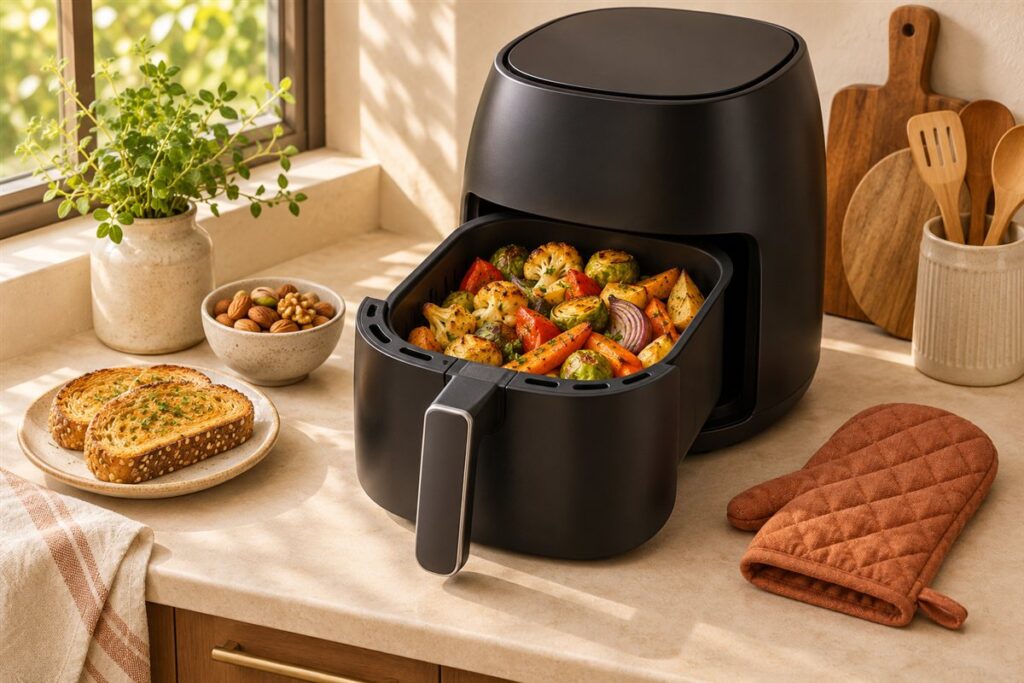
Frozen chicken nuggets are ready in about 8-12 minutes in an air fryer at roughly 360-400 F, with no thawing and usually no extra oil. Package directions come first, since coatings and sizes differ, and the nuggets should be hot all the way through before you serve them.
The Basic Routine
- Read the package. Note the maker’s suggested time and temperature for an air fryer or oven.
- Preheat the air fryer for a few minutes if your manual suggests it.
- Put the nuggets straight from the freezer into the basket.
- Spread them in one layer. A little overlap is fine, but they should not be piled up.
- Cook for about 5 minutes, then shake or turn them.
- Cook for 3-7 more minutes, until golden and hot in the middle.
Checking That They Are Ready
Do not rely on color alone. Break one open to check that the center is steaming hot and there is no cold or pink area. For a more exact check, use a food thermometer and compare the reading to the heating guidance on the package or in official food-safety advice. Let them cool for a minute before serving, as the filling can be very hot.
Time by Shape
| Shape | General range | Note |
|---|---|---|
| Small bite-size | 6-9 minutes | Shake once |
| Standard nuggets | 8-12 minutes | Turn halfway |
| Large strips or tenders | 10-14 minutes | Check the thickest piece |
| Dinosaur or novelty shapes | 7-10 minutes | Thin parts brown fast |
Getting a Crisper Result
- Cook in smaller batches so the air can reach every side.
- Skip the oil unless the package suggests it. The coating often has enough already.
- Shake the basket or turn nuggets by hand at the halfway mark.
- Serve straight away. Resting them in a closed container makes the coating soft.
Dips and Sides
Nuggets pair with many dips, such as ketchup, barbecue sauce, or honey-flavored dipping sauces from your pantry. Fries, carrot sticks and salads all go well on the side. If you cook sides in the same basket, add them at a time that lets everything finish together.
Cooking With Other Frozen Foods
Nuggets often go in with frozen fries or vegetables, but different foods need different times. Begin with the item that needs longest, add the nuggets later, and keep everything in a loose layer. If the basket is full, cook in rounds. Check each product label for the maker’s directions.
Reading the Package Before You Cook
The bag or box in your freezer holds the most reliable starting point. Manufacturers print cooking directions, often for an oven and sometimes for an air fryer, along with safety information such as the internal temperature to reach. Use those details as a baseline and adjust only gradually, since every air fryer heats differently.
Look at the product type too. Some nuggets are fully cooked and only need reheating, while others are partially cooked or raw and must be fully cooked. The label should say. Check the ingredients if allergies are a concern: breading commonly contains wheat, and some products include egg, milk, or soy. Compare the nutrition panel if you are choosing between brands, but do not assume one type cooks differently from another without checking.
Pay attention to the format. Classic nuggets, breaded tenders, popcorn-style bites, and shaped novelty pieces each have their own sizes and thicknesses. The directions may differ for each. Also note whether the package recommends flipping, shaking, or leaving as is. If directions are missing, start with a shorter time than you think you need, then extend in small steps. Keep the package, or snap a photo of the directions, so you can repeat a successful batch.
Portion Size and Batching
Frozen nuggets cook best in a single layer with small gaps between pieces. Piling them up traps moisture and leaves some pieces pale and others overdone. A basket can feel large, but spreading nuggets out takes more room than expected. For a family meal, plan two rounds rather than forcing everything into one.
When cooking in rounds, you have two choices. You can keep the first batch warm in a low oven, uncovered or loosely tented, so it stays crisp. Or you can cook the second round while the first one rests, then serve all at once. Reheating the first batch for a minute at the end can revive the crust, but avoid doing this repeatedly.
- Small appetite or single serving: Cook a handful and check early, since small loads cook faster.
- Family portions: Use two or more rounds and rotate the pieces partway through.
- Parties: Stagger batches so a fresh round comes out as the previous round is eaten.
Note that a nearly empty basket can heat faster, while a full basket can take longer. Adjust timing to the load rather than copying numbers blindly. If the pieces sit on top of each other, shake or rearrange them midway.
Preheating and Basket Prep
Preheating can help frozen breading set quickly and brown more evenly, but not all models need it. Check your manual. If your air fryer has a preheat setting, a few minutes is usually enough; if not, simply run it empty briefly before loading the food.
Basket preparation affects sticking and cleanup. Frozen breaded products usually have enough fat in the coating that they do not require extra oil, though a light spray can improve color if the pieces look dry. Avoid heavy oil, which can leave the breading greasy. If crumbs have collected in the bottom of the drawer from past cooking, clean them out first, because old crumbs smoke and burn.
Frost on frozen nuggets can lead to soggy spots. Shake off loose ice crystals before loading them, but do not rinse or thaw them. Arrange the nuggets with their flat sides down when possible, which increases contact with the basket and promotes browning on the underside. A perforated parchment liner made for air fryers can reduce sticking, but only use one if your manual allows it, and make sure it cannot lift toward the element. After loading, close the drawer fully and let the machine do the work.
Serving for Kids and Groups
Nuggets are popular with children, so a few safety habits are worth keeping. Let them cool for a few minutes before serving; the interior stays hot after the surface feels warm. Break or cut one open to release steam, especially for small children, and cut larger pieces into smaller portions if needed.
Build a meal around the nuggets by adding fresh or cooked vegetables. Carrot sticks, cucumber slices, cherry tomatoes (cut for small kids), or steamed green beans fit well. For something heartier, serve with rice, mashed potatoes, or wraps. Dips create variety without extra cooking, and letting children choose their own sauce often helps picky eaters.
For groups, think about different tastes and dietary needs. Offer a mix of mild and spicy sauces, label any that contain common allergens, and keep a few extra nuggets on hand for those who want more. If you serve a buffet-style setup, keep cooked nuggets warm in a low oven, spread out, and avoid leaving them out for long periods. Plain nuggets also work well as an ingredient: tuck them into sandwiches, slice them over salads, or use them in wraps with lettuce and a favorite sauce.
Storing, Refreezing, and Leftovers
Store the unused portion of the bag properly. Press out the air, seal it tightly, and return it to the freezer quickly to limit frost and freezer burn. A bag that has been left open can dry out the pieces. Keep nuggets in the coldest part of the freezer, and avoid leaving the bag out on the counter while you cook.
Do not refreeze nuggets that have thawed on the counter. If you removed too many from the bag, cook them all and refrigerate the extras rather than putting them back raw. Cooked leftovers should be cooled promptly and kept in a covered container in the refrigerator for a short time, generally a few days.
To reheat, use the air fryer at a moderate setting for a few minutes until the pieces are hot all the way through. This brings back crispness far better than a microwave, which softens the breading. Check the middle of a piece to confirm it is hot. Discard nuggets that have been left out for long, smell unpleasant, or look slimy. If you cook nuggets frequently, a small scoop or tongs makes it easier to remove only what you need.
FAQ
Can I cook a big bag at once?
Only if they fit in a loose layer. Two smaller batches give better color than one crowded basket.
Why are the nuggets pale?
They may be crowded, or the heat may be low. Add a minute or two and shake the basket again.
Do I need to add oil to frozen nuggets?
Usually not, since the coating contains fat. A light spray can help if the pieces look dry or pale.
Should I shake the basket during cooking?
A gentle shake or flip partway helps even browning. Use tongs if the pieces are delicate.
Can I cook nuggets and fries together?
Yes, if they fit in a single layer or use a divider. They may need different times, so start the one that takes longer first.
How do I know the nuggets are fully cooked?
Check that the center is hot and no longer pink, and use a thermometer if you have one. Follow the temperature stated on the package.
Why do the nuggets stick together?
Frost or crowding can make them stick. Separate them before cooking and leave small gaps.
Can I use foil under nuggets?
Only if your manual allows it, and never block the airflow. Perforated parchment is often a safer option.
Are plant-based nuggets cooked the same way?
Often similar, but check the package since timing may differ. Plant-based pieces can brown faster or dry out sooner.
Why do my nuggets taste greasy?
Too much oil or a crowded basket can cause this. Use less oil and give the pieces space.
The Short Version
Cook frozen nuggets without thawing, in a loose layer, for about 8-12 minutes with one shake. Follow package directions, make sure they are hot all the way through, and check your maker’s manual.