
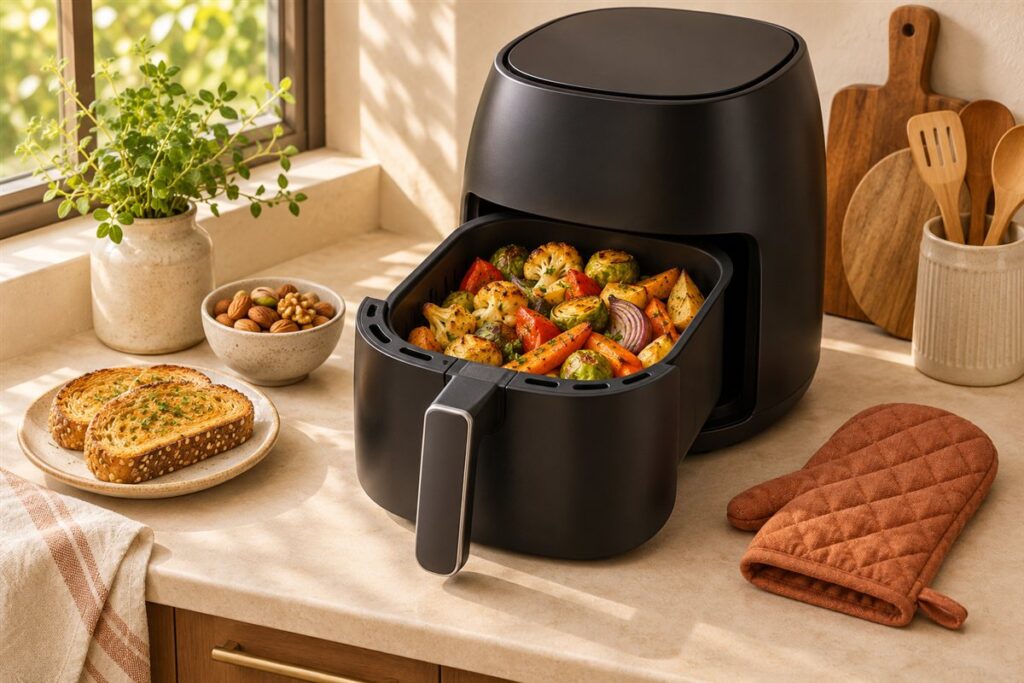
You can bake small cakes, muffins, cookies, and brownies in an air fryer if you use smaller portions, a lower temperature, and a pan that fits. Because the fan browns tops quickly, check early and cover the top if it darkens before the middle sets.
What You Need
- A pan or mold that fits inside the basket with room around it for air. Check your manual for dishes it allows.
- Paper or silicone liners meant for air fryers, if you use any.
- A wooden skewer to test the center.
- A small recipe, since most baskets hold only a few cups of batter.
Baking Steps
- Choose a recipe sized for a small pan, or cut a larger one down.
- Prepare the pan by greasing it or lining it.
- Lower the oven temperature in the recipe a little, since air fryers cook fast.
- Preheat if your manual suggests it.
- Place the pan in the basket, away from the heating element, and begin the timer on the short side of the recipe.
- If the top browns too quickly, lay a small piece of foil loosely over it, only if your manual allows foil and the foil is held down so it cannot lift in the airflow.
- Test with a skewer. It should come out clean or with a few moist crumbs.
- Cool the pan for several minutes before you remove the bake.
What Bakes Well
| Item | Why it works | Watch for |
|---|---|---|
| Muffins and cupcakes | Small and quick | Light liners lifting in the fan |
| Brownies | Dense and forgiving | Dry edges |
| Cookies | Cook in minutes | Crowding and spreading |
| Small cakes | Fit in a round pan | Domed tops, uncooked centers |
| Bread rolls | Brown nicely | Crust before the inside is done |
Troubleshooting
A raw center with a dark top means the heat is too high or the pan too deep. Lower the temperature and extend the time. A dry result usually means the bake stayed in too long, so check earlier next time. A batter that rises and hits the heating element needs a smaller amount in the pan. Fill pans only about halfway to two-thirds.
Tips for Better Bakes
Use room-temperature eggs and butter for smoother batter, and do not overmix. Leave a gap between muffin cups so air can reach the sides. Rotate the pan halfway if one side browns faster. Let the bake cool on a rack, since steam trapped in the pan can make the bottom soggy.
Scaling Recipes Down for a Small Basket
Most baking recipes are written for full-size pans and ovens, so they need scaling before they fit an air fryer. Start by comparing the volume of the recipe’s pan to your pan. If the recipe makes a large cake and your pan is much smaller, divide the ingredients by a simple fraction, such as half or a third, and bake the leftover batter in another round.
Scaling eggs can be awkward. If a recipe calls for one egg and you want half, whisk the egg and use about half by weight or volume. Leavening agents and salt can be scaled in proportion, though very small amounts may be hard to measure, so a small measuring spoon set helps. Weighing ingredients is more accurate than measuring by volume.
Tips for scaling:
- Choose recipes with a simple ingredient list for your first tries.
- Write down the new amounts so you can repeat the result.
- Do not fill the pan beyond the level the recipe allows for rising.
- Expect to adjust time and temperature after the first attempt.
Some people prefer recipes written for air fryers, which already have sizes and times that suit small baskets. These can be good starting points. Check that the pan size listed matches yours, and adapt the instructions to your manual’s guidance.
Batters and Doughs That Suit the Air Fryer
Some mixtures cope better with strong airflow than others. Thick batters, such as brownie, muffin, and dense cake mixtures, hold their shape and set well. Very thin batters can ripple and spill if the pan is too full, and light mixtures like sponge can set unevenly if the fan is strong. Stiff doughs, like cookie dough and biscuit dough, work well because they keep their shape.
Yeast doughs can work too, but the rise needs a warm, draft-free place before baking, not inside the fryer unless the manual says it is safe. Delicate pastry and puff pastry can be blown around by the fan, so weigh them down or cover them loosely, and choose recipes made for air fryers if you want reliable results.
Points to match mixture to method:
- Brownies and dense cakes: forgiving and well suited.
- Cookies and biscuits: bake quickly, so watch carefully.
- Muffins and cupcakes: use sturdy liners or silicone cups.
- Light sponges and meringues: more difficult, so expect trial and error.
If a batter is too runny, it may leak from the pan. Thicken it slightly or use a pan with a tight base. Keep notes on the thickness that worked for you.
Preventing Burnt Tops and Raw Centers
The heating element sits close to the food, so the top of a bake can brown long before the center sets. Several habits help. Lower the temperature slightly and extend the time, so heat reaches the middle. Use a pan with lower sides, which lets heat spread, or a thinner layer of batter. Rotate the pan halfway if one side cooks faster.
A loose cover can slow browning, but anything that covers the top must be held down, since the fan can lift it into the element. Check your manual about foil, and use a lightweight cover only if it is allowed. Some people place the pan on a rack to lift it slightly, but do not raise it close to the element.
When troubleshooting:
- Dark top with a raw middle: lower the heat and bake longer.
- Dry edges and moist middle: use a lower temperature and a lower rack position.
- Sunken center: the oven door was opened too early or the leavening was off.
- Sticky bottom: bake a little longer or use a rack to let steam escape.
Test with a skewer or toothpick in the center, and wait for it to come out clean or with moist crumbs. A thermometer can also confirm that cakes and breads are cooked through, according to the recipe’s target.
Liners, Greasing, and Releasing Bakes
Getting a bake out of the pan in one piece takes some preparation. Grease the pan with butter, oil, or a baking spray that your pan’s care instructions allow, then dust with flour if the recipe calls for it. Parchment cut to fit the base helps cakes and brownies release cleanly. For muffins, use paper or silicone cups sized for your basket.
Light liners can lift in the fan, so place the batter in them before the fan starts and weigh them down with the batter. Perforated parchment made for air fryers allows airflow and is easier to use. Avoid liners that overhang the pan edges, since loose paper may rise toward the element.
Release tips:
- Let the bake cool in the pan for several minutes before turning it out.
- Run a thin plastic knife around the edge if it sticks, avoiding damage to coatings.
- Use a rack for cooling so steam can escape.
- Wash the pan soon after use so sugar does not harden.
Silicone molds release by flexing, so wait until the bake is firm enough to hold its shape. Cooling fully before cutting helps keep neat slices and reduces crumbling.
Cleaning Up After Baking
Baking leaves sugary and buttery residue that can burn on the next use, so clean the air fryer after baking. Let the unit and the pan cool, then remove the basket and wash it with warm, soapy water and a soft sponge. Crumbs and batter drips collect in the bottom of the drawer and under the basket, and these can smoke if left behind.
Wipe the interior of the main body when it is unplugged and cool, following the manual. Take extra care around the heating element and fan cover, and never put water on them. If a sticky spot resists, soak removable parts rather than scraping with metal tools.
To keep cleanup easy:
- Use a liner or pan to contain drips.
- Wipe spills as soon as the unit is cool enough.
- Dry all parts completely before reassembling.
- Check the basket coating for wear from scraping.
Sweet bakes often leave a lingering smell, so airing out the kitchen and washing parts promptly helps. If you bake often, a deep clean of the basket and drawer once in a while keeps performance steady.
FAQ
Can I use my regular cake recipe?
You can, but scale it down and expect to adjust. Keep notes on each attempt so your next bake needs fewer changes.
Do I need a special pan?
Not necessarily. Any oven-proof pan that your maker allows and that fits with space around it will work. Avoid anything that touches the element.
Do I need to preheat the air fryer for baking?
Some manuals recommend it for baking, and others do not. Check yours. Preheating helps cakes and cookies start cooking evenly.
Can I bake cookies directly on the basket?
Place them on a perforated liner or a small tray that fits, so they do not fall through. Leave gaps for spreading.
Why did my cake sink in the middle?
It may have been underbaked, the leavening may have been old, or the unit was opened too early. Test with a skewer and avoid opening before the set time.
Can I bake in a silicone muffin cup?
Yes, if the cup is rated for the temperature. Place it in a sturdy tray or a pan so it stays level, and do not overfill.
How do I stop muffin liners from flying around?
Fill them with batter before the fan starts, and use sturdy liners or silicone cups. Do not run the unit with empty paper liners.
How long should baked goods cool before cutting?
Let them rest in the pan for several minutes, then cool further on a rack. Cutting too early can make the crumb gummy or crumbly.
The Short Version
Bake small, lower the heat, test early, and shield the top if needed. Keep notes, since every air fryer behaves a little differently.









