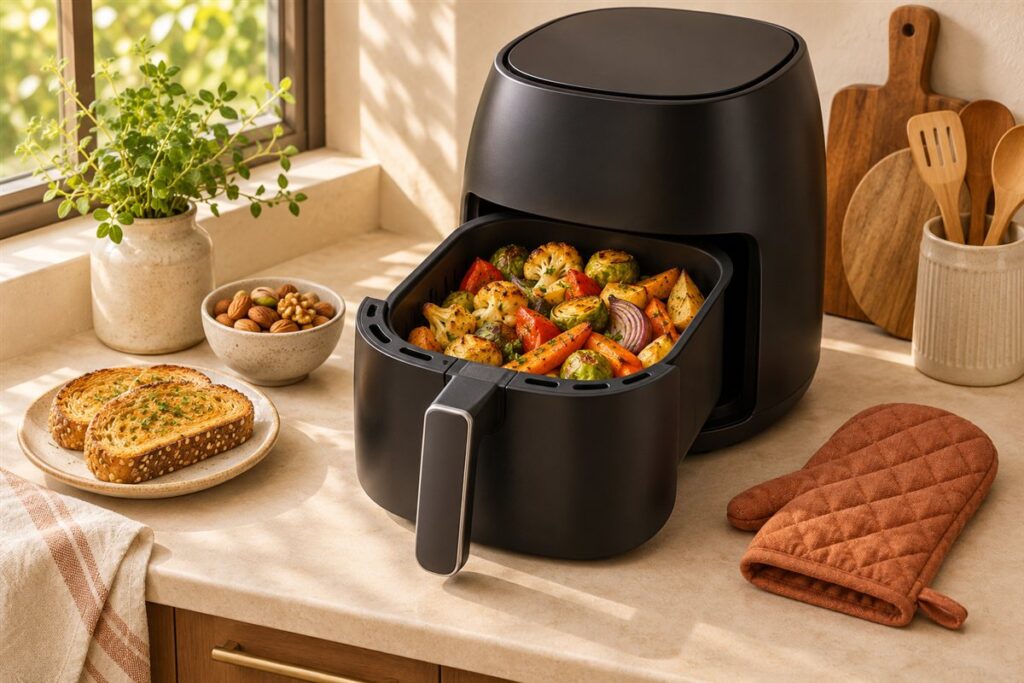
The features that matter most are the ones you touch every day: capacity and shape, temperature control, a clear timer, easy cleaning, and a size that fits your counter. Extra modes and preset buttons are nice but often go unused. Use this list to focus on what counts.
Features Worth Checking
| Feature | Why it matters | What to check |
|---|---|---|
| Capacity and shape | Decides how much you cook at once | Floor size, not just volume |
| Temperature range | Limits what recipes you can follow | Lowest and highest settings in the manual |
| Timer and controls | Used every time you cook | Dials or buttons that are readable and responsive |
| Shake or turn alerts | Helps even cooking | Whether the reminder can be turned off |
| Removable parts | Makes cleaning faster | Dishwasher-friendly notes in the guide |
| Cord and footprint | Affects where it can sit | Cord length and vent clearance |
Nice Extras
- Preset buttons for common foods. They can be a helpful first guide, though many cooks end up adjusting times by hand.
- A window or light to check food without opening the basket.
- Preheat and keep-warm modes.
- Connected controls through an app.
These are convenient, not required. A simple dial model can cook just as well for plain recipes.
Features That Affect Daily Life
Noise, fan placement, and how the basket slides in and out are small things that show up daily. If you can, look at photos and the manual to see how the unit opens, where the hot air exits, and how much space it needs behind it. Hot air vents should face open space and not a wall or cabinet.
Cleaning is another everyday factor. A smooth basket with few corners tends to be easier to wash.
What You Can Often Skip
- A long list of presets you will not use.
- A capacity bigger than your usual batch.
- Extras that need special accessories.
- Complicated menus if you prefer simple dials.
How to Weigh Your Options
Write down the three things you do most with an air fryer, then check each feature against that list. If a feature does not help any of the three, it is a bonus, not a need. Also read the manual online before buying, since it shows the real controls, the care steps, and any limits on accessories or oils.
Basket and Chamber Designs Compared
The shape of the cooking space affects how you use an air fryer more than any button on the front. A drawer-style unit with a pull-out basket is compact and common, and it suits snacks, sides, and small mains. A larger oven-style unit with a door and trays offers more surface area and can hold several layers, but it takes more counter space and can be heavier to move. A dual-zone design splits the space into two baskets, so you can cook two foods at once, sometimes with different settings.
Each layout has strengths. A single basket is simple to load and clean, and a wider, shallower floor lets food spread out in one layer, which is what air frying likes. Deep, narrow baskets look roomy on paper but force you to stack food, so results may be uneven. Oven-style trays are good for batches of identical items, while dual zones are good for households that cook a main and a side together.
When you compare models, look at the dimensions of the cooking floor and the height of the chamber, not just the capacity number. Check how the basket or tray comes out, how heavy it is when loaded, and whether you can see the food. A layout that fits the way you cook will matter more than a long list of settings.
Temperature Range and Control Steps
The range of available temperatures decides which recipes you can follow. A model that runs low enough can handle dehydrating, gentle reheating, or proofing dough, while a high maximum helps with crisping and searing. The manual lists the lowest and highest settings, so read it before you buy if you have specific uses in mind.
Also look at how finely you can adjust the temperature. Some models change in small steps, while others jump in larger increments or have just a few marked positions. Small steps are handy for baking and delicate foods, but for everyday cooking larger steps are usually fine. Remember that the number you set is a target for the air in the chamber, and real heat can vary, so use the setting as a starting point and judge by the food.
- Check whether the temperature can be changed during a cook without restarting the timer.
- See whether the unit displays the temperature in both Celsius and Fahrenheit, or lets you switch.
- Look for notes on preheating, since some models expect it and others skip it.
Use a food thermometer for meat, poultry, and fish, because a temperature setting does not tell you when the food itself is safe to eat.
Cleaning Design and Materials
An air fryer that is easy to clean gets used more often. Look for a basket and drawer that lift out in one piece, with a smooth surface and few crevices where grease can hide. Rounded corners are easier to wipe than sharp ones. Check whether the coating is described as nonstick and read the care notes, because harsh scrubbing can wear it down over time.
Think about the parts you cannot remove. The inside of the chamber, the area around the heating element, and the fan cover all collect splatter. If you can reach them with a damp cloth when the unit is cool, cleaning is simple. If they are tucked away, grease may build up and smoke later. A manual that explains how to clean these areas is a good sign.
Dishwasher claims need reading carefully. Some parts are designed to go in the dishwasher, and others should be washed by hand, so check the guide for each piece. Also consider the size of your sink, because a large basket may not fit flat. Lastly, look at how the lid, window, or handle is attached, since these can trap moisture and grime if not wiped regularly. Cleaning is the feature people notice most after the first month, so give it real weight.
Safety and Build Features
Safety features are easy to overlook until you need them. Look for a cool-touch handle, a stable base with non-slip feet, and a clear way to shut the unit off. Many models turn off the heat when the basket is pulled out, which prevents hot air from blowing at you while you check the food. Read the listing to see whether the unit has overheat protection or an automatic shutoff, and what the maker says about each.
Cord length and plug position are practical details. A short cord can limit where you place the unit, while a long cord can dangle over the counter edge and be tugged by accident. Check whether the cord can be stored neatly. Rubber feet help stop the unit sliding, and a solid build matters when you are lifting a loaded basket.
Look at the vents too. Hot air leaves through slots on the back or top, so the unit needs open space around it. If you have a tight kitchen, a model with vents at the rear and top might need more clearance than one with different placement. Read the clearance guidance and follow it, and make sure you can reach the controls without leaning over hot steam.
Warranty, Support, and Spare Parts
A kitchen appliance is used often, so after-sales support deserves a look. Read the warranty terms and see what is covered, for how long, and what the process is for making a claim. A clear warranty suggests the maker stands behind the product, though it does not guarantee a particular experience. Check whether the warranty requires you to register the unit or keep the receipt.
Spare parts matter more than they seem. Baskets, trays, and racks are the parts that wear out first, and being able to buy a replacement can extend the life of the machine. Look at the maker’s support information to see whether parts are sold separately and how to order them. Also check that the manual is easy to download and covers cleaning and troubleshooting.
Finally, consider how your needs might change. If you may start cooking for more people, or want to try baking, a model with a slightly larger chamber or a wider temperature range could last longer for you. Do not pay for features you will not use, but do think a little ahead, and keep your own list of must-haves in front of you as you compare. Keep the receipt and the model number together in one place for easy reference.
FAQ
Is a digital display better than a dial?
Not necessarily. Digital displays show exact numbers, while dials are simple and durable. Choose what you find easier to use.
Do I need an app-connected model?
Most home cooks do not. It may help if you like remote alerts, but the cooking itself is the same.
Is a bigger capacity always better?
No. A larger unit takes more space, is harder to clean, and can be wasteful for small meals. Choose a size that matches your usual batch.
What is a dual-zone air fryer?
It has two separate cooking spaces, so you can cook two foods at once, sometimes with different settings. Check how the zones share power and whether you can sync the finish times.
Do I need a window on the unit?
It is optional. A window lets you check browning without opening the basket, but most cooks manage by pulling the drawer out and looking.
How can I tell if a model is easy to clean?
Look for removable parts with smooth surfaces and clear care notes in the manual. Fewer corners and an accessible chamber usually mean less scrubbing.
Should I worry about the length of the cord?
It affects where you can put the unit. Make sure it reaches a wall socket without stretching or hanging over the counter edge.
Is a temperature display necessary?
Not necessarily. Dial models work well for simple cooking, while a display helps with precise recipes. Pick the one that suits how you cook.
The Short Version
Focus on size, temperature control, easy cleaning, and a layout that suits your kitchen. Treat presets and connected features as bonuses, and read the manual for your model.