A stainless steel sink looks clean for about a day after it is installed, and then real life starts: hard water leaves white marks around the drain, fingerprints collect near the faucet, and the dull film of daily washing builds up until the steel looks grey rather than bright. A stainless sink cleaner is the product that reverses that, and this guide compares six of them, every one verified through the site’s own product lookup as a cleaner made for stainless steel and safe for sink use. The picks cover sprays, wipes, and kits, from the sink-specific Therapy formula to the hard-water focus of CLR, so households with soft water, hard water, and everything between can find a fit.
This site may earn an affiliate commission when readers buy through links on this page, at no extra cost to the reader. The selections below come from research: manufacturer documentation, stated formulas and uses, and the practical differences between a spray, a wipe, and a kit. We have not tested these cleaners in a lab; the comparisons rest on published specifications and the chemistry of what hard water, grease, and fingerprints do to stainless steel.
One distinction matters before the picks. A stainless sink cleaner is not the same product as a general kitchen cleaner, and it is not the same as a cookware cleanser. General cleaners can leave a film on steel, and cookware cleansers are made for pots rather than for a sink that holds drinking water and food. Every pick below is a stainless steel cleaner and polish whose listing covers sink use, and the sections say plainly where each one is strongest.
In this guide
Quick picks: best stainless sink cleaner
| # | Product | Where to buy |
|---|---|---|
| 1 | Therapy Stainless Steel Cleaner and Polish | Check on Amazon |
| 2 | Bar Keepers Friend Stainless Steel Cleaner and Polish Spray | Check on Amazon |
| 3 | Weiman Stainless Steel Cleaner and Polish Kit | Check on Amazon |
| 4 | Zep Plus Stainless Steel Cleaner | Check on Amazon |
| 5 | CLR Spot Free Stainless Steel Cleaner | Check on Amazon |
| 6 | Weiman Stainless Steel Cleaner and Polish Spray | Check on Amazon |
How the picks were chosen
The shortlist started with type. A product only made the list if its listing named it a stainless steel cleaner and polish and its stated uses covered sinks or stainless surfaces generally. That filter removed cookware cleansers, washing machine cleaners, and calcium removers that share keywords with sink cleaners but serve different jobs. The API search for stainless steel cleaner returns hundreds of results, and most of them are either the wrong type or a duplicate listing of the same product in a different pack size, so the type check did the real work.
After type came format and focus. The list needed sprays for deep cleaning, wipes for quick daily use, and at least one complete kit, because households clean differently: some want a 30-second wipe after dinner, others want a thorough weekly clean. It also needed different focuses, because a household with hard water needs a water-mark formula while a household with soft water needs a fingerprint formula, and no single product is best at both.
Nothing here rests on a popularity score. The comparisons use stated formula, stated uses, pack contents, and the practical consequences of those facts, such as how fast a small bottle runs out in a household that cooks daily. For the sink itself, see the guide to 16-gauge stainless steel kitchen sinks on this site.
The six best stainless sink cleaners
Six products, three formats, five brands. The table after the picks puts the format, size, and focus side by side; the sections below explain what each one is actually like to use.

Therapy Stainless Steel Cleaner and Polish
Therapy is the only pick in this roundup whose listing names the sink outright: the title calls it a sink cleaner, not just a stainless steel polish. That matters, because a sink is not a fridge door. A sink is wet half the day, it collects limescale around the drain and the faucet base, and it needs a cleaner that can cut water spots without leaving a greasy film that makes the next wash harder. Therapy answers that with a lavender-scented spray built on a plant-based formula, and the listing states it is 100 percent USDA Biobased, which is the pick for households that want a gentler product around food preparation areas.
Verified short specs: spray cleaner and polish for stainless steel, lavender scent, listing names sink use, 100 percent USDA Biobased formula.
Strengths:
- The only pick whose listing explicitly names sink cleaning.
- Plant-based formula suits households that prefer gentler products near food.
- Lavender scent leaves the sink area smelling fresh rather than chemical.
Trade-offs:
- Lavender scent will not suit households that prefer unscented products.
- A spray alone does not include a cloth, so a separate microfiber cloth is needed.
- Gentler formulas may need a second pass on heavy limescale.
Best for: households that want a sink-specific cleaner with a gentler formula. Not suited for: buyers who want an unscented product or a kit with a cloth included.
Check price on Amazon: Therapy Stainless Steel Cleaner and Polish

Bar Keepers Friend Stainless Steel Cleaner and Polish Spray
Bar Keepers Friend has cleaned stainless steel since long before any of the other brands on this list existed, and the Stainless Steel Cleaner and Polish Spray is the modern form of that work: a spray that cleans, shines, and protects in one pass. The formula is built to remove oily fingerprints, hard water stains, grime, and food debris without scratching or dulling the surface, and it leaves a thin protective layer that slows the next round of spots. The listing sells it as a two-pack of 25.4-ounce bottles, so the household gets a spare bottle with the first order. It is the pick for households that want the established name and a spray that does the whole job without a separate polish step.
Verified short specs: spray cleaner and polish, 2 x 25.4 oz bottles, removes oily fingerprints, hard water stains, grime and food debris, cleans, shines, and protects.
Strengths:
- Long-established brand with a formula made for stainless steel.
- One spray cleans, shines, and protects, so no second product is needed.
- Two bottles in the pack mean the spare is already on the shelf.
- Handles hard water stains and oily fingerprints in the same pass.
Trade-offs:
- No cloth is included, so a microfiber cloth must be bought separately.
- The protective layer can feel slick if too much product is used.
- A two-pack costs more up front than a single bottle, even though it lasts longer.
Best for: households that want the classic brand and a one-step spray. Not suited for: buyers who want a complete kit with cloths included.
Check price on Amazon: Bar Keepers Friend Stainless Steel Cleaner and Polish Spray
Weiman Stainless Steel Cleaner and Polish Kit
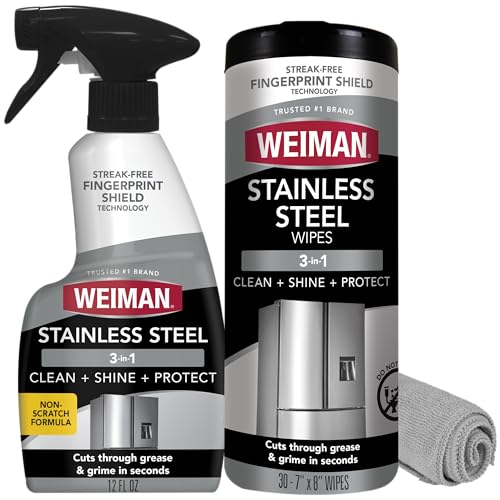
The Weiman kit is the only pick that arrives as a complete system: a spray, a pack of wipes, and a cloth in one box. That completeness is the reason to buy it. A sink cleaner is only as good as the cloth it is wiped with, and a household that buys a spray alone often ends up wiping with a paper towel or a dish rag that leaves lint and streaks. The kit removes that failure mode entirely, and the wipes make it the pick for quick daily wipe-downs between deeper cleans.
Verified short specs: 3-piece kit with spray, wipes, and cloth; anti-fingerprint formula; removes grease and water spots.
Strengths:
- Complete kit: spray, wipes, and cloth in one purchase.
- Wipes make a 30-second daily wipe-down realistic.
- Anti-fingerprint formula keeps the sink looking clean between washes.
Trade-offs:
- The wipes run out and need replacing, which adds a recurring cost.
- A kit costs more up front than a single spray bottle.
- Households that already own good cloths pay for a cloth they do not need.
Best for: households that want everything in one box and a fast daily routine. Not suited for: buyers who already own cloths and only need a spray.
Check price on Amazon: Weiman Stainless Steel Cleaner and Polish Kit

Zep Plus Stainless Steel Cleaner
Zep Plus is the workhorse pick: a 32-ounce bottle of stainless steel cleaner that cleans while preventing future fingerprints and smudges. The larger bottle is the point. A sink is cleaned several times a week, and a 12-ounce can disappears quickly in a household that cooks daily. Zep’s formula is a two-in-one cleaner and protectant, so each cleaning leaves a layer that makes the next cleaning easier, and the larger size means fewer reorders over a year.
Verified short specs: 32 fl oz bottle, 2-in-1 cleaner and protectant, prevents future fingerprints and smudges.
Strengths:
- Large 32-ounce bottle lasts longer than the smaller sprays.
- Two-in-one formula cleans and protects in a single pass.
- Protective layer slows fingerprints and smudges between cleans.
Trade-offs:
- No cloth or wipes are included.
- A large bottle is heavier and harder to store under a small sink.
- The protective layer needs an even wipe or it can streak.
Best for: households that clean the sink often and want a large bottle. Not suited for: buyers who want a kit with cloths or a small bottle for occasional use.
Check price on Amazon: Zep Plus Stainless Steel Cleaner

CLR Spot Free Stainless Steel Cleaner
CLR is known for hard water, and the Spot Free Stainless Steel Cleaner brings that strength to the sink: a 12-ounce spray can built to remove water marks, fingerprints, and residue from stainless surfaces. In a house with hard water, the sink is where limescale shows first, around the drain, the faucet base, and the line where the water sits. CLR’s formula targets exactly those marks, and the spot-free claim is the reason to pick it over a general polish when the water leaves white traces after every wash.
Verified short specs: 12 oz spray can, removes water marks, fingerprints, and residue; spot-free finish.
Strengths:
- Built for hard water marks, the most common sink complaint.
- Spot-free finish suits households whose tap water leaves white traces.
- Spray can format is easy to aim at the drain and faucet base.
Trade-offs:
- 12 ounces is the smallest bottle in this roundup.
- No cloth is included.
- Focused on water marks rather than heavy grease, so a greasy sink may need a second product.
Best for: households with hard water that leaves white marks on the sink. Not suited for: buyers who need a large bottle or a grease-cutting formula first.
Check price on Amazon: CLR Spot Free Stainless Steel Cleaner

Weiman Stainless Steel Cleaner and Polish Spray
The Weiman spray closes the list as the generalist: a streak-free stainless steel cleaner and polish whose listing names sinks alongside refrigerators, dishwashers, range hoods, and barbecue grills. That breadth is useful, because a household rarely has only a stainless sink; the fridge, the dishwasher front, and the hood are usually stainless too, and one spray that serves all of them is simpler than a shelf of single-purpose bottles. The formula is streak-free and anti-fingerprint, and it is the pick for households that want one bottle for every stainless surface in the kitchen.
Verified short specs: spray cleaner and polish, streak-free shine, 22 fl oz, listing names sinks, refrigerators, dishwashers, range hoods.
Strengths:
- One bottle serves the sink and every other stainless appliance.
- Streak-free formula suits large flat surfaces like fridge doors.
- Anti-fingerprint finish keeps the whole kitchen looking clean.
Trade-offs:
- A generalist is less targeted than the sink-specific Therapy pick.
- No cloth or wipes are included.
- Households with only a stainless sink pay for versatility they will not use.
Best for: households with several stainless appliances and one cleaning shelf. Not suited for: buyers who want a sink-specific formula or a complete kit.
Check price on Amazon: Weiman Stainless Steel Cleaner and Polish Spray
The six stainless sink cleaners side by side
| Product | Format | Size | Focus |
|---|---|---|---|
| Therapy Stainless Steel Cleaner | Spray | Not stated in title | Sink-specific, gentle formula |
| Bar Keepers Friend Spray | Spray | 25.4 oz | Clean, shine, protect |
| Weiman Kit | Spray + wipes + cloth | Kit | Complete system |
| Zep Plus | Spray | 32 fl oz | Large bottle, protectant |
| CLR Spot Free | Spray can | 12 oz | Hard water marks |
| Weiman Spray | Spray | Not stated in title | All stainless appliances |
The table makes the choice simple. Hard water points to CLR, a complete routine points to the Weiman kit, a large household points to Zep Plus, a sink-specific formula points to Therapy, and a single bottle for the whole kitchen points to the Weiman spray. Bar Keepers Friend sits in the middle as the established one-step spray.
How to clean a stainless steel sink without scratching it
Always wipe with the grain. Stainless steel has a visible grain direction, fine lines running one way across the surface, and wiping across the grain drags grit over those lines and leaves scratches that catch the light. Wipe along the grain with a soft microfiber cloth, never with a scouring pad or steel wool, and the sink will keep its finish for years. The same rule applies to the faucet and the drain surround, which are usually the same steel.
Use the cleaner sparingly. A stainless cleaner works as a thin film, and more product does not mean a cleaner sink; it means a greasy layer that attracts dust and fingerprints. Spray lightly, let it sit for the time the maker states, wipe with the grain, and then buff with a dry cloth. Two light passes beat one heavy pass, and the second pass is where the streaks disappear.
Rinse after cleaning. A sink holds water that touches food, so any cleaner residue should be rinsed away before the sink is used for washing vegetables or filling a pot. Rinse with warm water, wipe dry with the grain, and the sink will stay bright until the next wash. Households that skip the rinse often blame the cleaner for a film that is really dried residue.
Hard water, fingerprints, and grease: matching the cleaner to the problem
Three problems make a stainless sink look dirty, and they need different answers. Hard water leaves white mineral marks around the drain and the faucet base, and it needs a formula built for water marks, like the CLR pick. Fingerprints and smudges collect where hands touch the steel, and they need an anti-fingerprint polish, like the Weiman picks. Grease from cooking leaves a dull film across the whole basin, and it needs a degreasing cleaner with a dwell time long enough to lift the film.
Most households have two of the three problems at once, which is why the kit and the two-in-one formulas exist. A household with hard water and heavy cooking should clean with the water-mark formula first, then finish with a protective polish, rather than expecting one spray to do both jobs in a single pass. The order matters: remove the minerals, then protect the surface, and the protection will last longer because it is bonding to clean steel rather than to a mineral layer.
For the broader sink question, the guide to bathroom sink cleaners on this site covers the same cleaning routine for a different room, and the products there are not interchangeable with the stainless formulas here.
Spray, wipes, or kit: which format fits which household
The six picks come in three formats, and the format decides how the cleaner is actually used, which matters more than the brand on the bottle. A spray is the most flexible format: it covers a large area quickly, it can be aimed into corners and around the drain, and the amount used is controlled by how many pumps are pressed. A spray is the right format for the weekly deep clean, when the whole basin needs an even coat and time to dwell. Its weakness is that it needs a cloth, and a household that buys a spray without owning a good microfiber cloth will wipe with whatever is at hand, which is often a paper towel that leaves lint or a dish rag that spreads grease.
Wipes are the opposite: they are the fastest format and the least flexible. A wipe is ready the moment the pack is opened, it needs no cloth and no dwell time, and it is the format that makes a 30-second wipe after dinner realistic. Wipes suit households that clean little and often, because the barrier to starting is zero. Their weakness is cost and waste: each wipe is used once, the pack runs out, and a deep clean of a neglected sink takes several wipes. Wipes are maintenance, not rescue, and a household that only owns wipes will struggle with a sink that has been left for a month.
A kit is the answer for households that want no decisions at all. The Weiman kit in this list pairs a spray for the deep clean with wipes for the daily wipe and a cloth for the buff, so every part of the routine has the right tool. A kit costs more than a single spray, but it removes the two most common failure modes of sink cleaning: wiping with the wrong cloth and having no wipe at hand when a quick clean is needed. Households that are setting up a new kitchen, or that have just fitted a new stainless sink and want to keep it bright from day one, should start with a kit and then buy refills of whichever part runs out first.
The practical test is honest: if the sink is wiped daily, wipes are the format that will actually get used. If the sink is deep-cleaned weekly, a spray is the format that does the job. If the household wants both without thinking about it, a kit is the format that covers both. The cleaner inside the bottle matters less than the routine it supports, and the routine that survives is the one with the lowest friction.
Buying guide: what else to check before ordering
Check the storage. Stainless cleaners live under the sink, and the space under a kitchen sink is crowded with pipes, bins, and cleaning supplies. A 32-ounce bottle needs more shelf height than a 12-ounce can, and a kit needs room for the spray, the wipes, and the cloth together. Measure the under-sink space before ordering the large bottle, and keep the cleaner upright and away from heat, because a bottle stored on its side can leak and a bottle stored near a hot pipe can lose its seal. Keep every cleaner out of reach of small children, and keep the cap closed between uses so the formula does not dry out in the nozzle.
Check the pack contents, not just the brand. The same brand sells a spray, a spray with a cloth, a kit, and a multi-pack, and those are different orders at different prices. The listing title usually states the pack, so read it before ordering, and check whether the cloth is included or must be bought separately. A spray without a cloth is a false economy if the household has no microfiber cloths.
Check the scent. Stainless cleaners come scented and unscented, and the scent lingers in the sink area after cleaning. Households with scent sensitivity should choose an unscented formula or a plant-based one with a light scent, and should test a small area first. The lavender scent of the Therapy pick is pleasant to most households and too much for a few, so the choice is personal rather than technical.
Check the size against the cleaning frequency. A household that wipes the sink daily will use a 12-ounce can in weeks, while a household that deep-cleans weekly will make the same can last months. The 32-ounce Zep bottle is the economical choice for daily cleaning, and the multi-packs are the economical choice for households that have already settled on a brand. Buying the smallest size first is the sensible way to test a new cleaner before committing to a large bottle.
Check the surface list on the listing. A stainless cleaner that names sinks, refrigerators, dishwashers, and range hoods is a generalist that serves the whole kitchen, while a cleaner that names only the sink is a specialist. Neither is better in general; the generalist is better for a household with several stainless appliances, and the specialist is better for a household that wants the most targeted formula for the sink alone.
Using and caring for a stainless sink
Daily care is simple: rinse the sink after use, wipe it dry with the grain, and give it a quick spray and wipe once a day. That routine prevents the mineral marks and the dull film from building up, and it means the deep clean is a five-minute job rather than a half-hour scrub. A sink that is wiped daily rarely needs a heavy cleaner at all; the spray is maintenance, not rescue.
Weekly care adds a deeper clean: spray the whole basin, let the cleaner dwell for the stated time, scrub gently with a soft cloth or a non-scratch sponge, rinse, and buff dry. Pay attention to the drain, the faucet base, and the corners where the basin meets the counter, because those are the places where minerals and food residue collect. A soft toothbrush reaches the drain surround without scratching it.
Avoid the common damage. Never use steel wool, scouring powder, or a scouring pad on stainless steel; they leave scratches that cannot be polished out. Never leave bleach sitting in a stainless sink, because it can pit the surface. Never leave a cast iron pan or a wet steel-wool pad sitting in the basin overnight, because the rust transfers to the sink and stains it. Rinse the sink after washing anything acidic, such as tomatoes or citrus, because acid left standing can dull the finish.
Common mistakes with stainless sink cleaners
The most common mistake is wiping against the grain, which scratches the steel in a pattern that shows in bright light. The second is using too much product, which leaves a greasy film that attracts fingerprints rather than preventing them. The third is cleaning with a dirty cloth, which spreads the grime from the last cleaning onto the clean steel.
The fourth mistake is expecting one product to fix a damaged sink. A cleaner can remove stains, water marks, and grease, but it cannot remove deep scratches or pitting from bleach. A scratched sink needs a professional refinish, not a stronger cleaner, and a pitted sink needs the same. Buying a more aggressive cleaner for a damaged sink only makes the damage worse.
The fifth mistake is forgetting the rinse. A sink is a food-contact surface, and cleaner residue should be rinsed away before the sink is used for food preparation. The rinse takes seconds and is the difference between a clean sink and a sink coated in dried cleaner.
Final recommendation
For most households, the Therapy cleaner is the first bottle to try: it is the only pick whose listing names the sink, and its gentle plant-based formula suits a food preparation area. Households with hard water should start with CLR, because water marks are the problem that needs a targeted formula. Households that want a complete routine in one box should buy the Weiman kit, and households that clean daily should buy the large Zep Plus bottle. Bar Keepers Friend is the safe middle choice for households that want the established brand, and the Weiman spray is the pick for households with several stainless appliances and one cleaning shelf.
Whichever cleaner is chosen, the routine matters more than the brand: wipe with the grain, use the product lightly, rinse after cleaning, and the sink will stay bright with any of the six picks here.
Frequently asked questions
Can I use a stainless steel cleaner on a stainless sink?
Yes, provided the listing names sink use or stainless surfaces generally. All six picks here are stainless steel cleaners whose stated uses cover sinks. Avoid cookware cleansers and general kitchen cleaners for the sink, because they are made for different surfaces.
How often should I clean a stainless steel sink?
Wipe it dry after each use, give it a quick spray and wipe once a day, and deep-clean it weekly. A sink wiped daily rarely needs heavy cleaning, and the daily routine is what keeps the steel bright.
Will a stainless sink cleaner remove scratches?
No. A cleaner removes stains, water marks, grease, and fingerprints, but it cannot remove scratches or pitting. Deep scratches need professional refinishing. The best protection against scratches is wiping with the grain and never using steel wool or scouring pads.
Is a plant-based stainless cleaner as effective as a conventional one?
For daily cleaning and light water marks, yes. For heavy limescale, a targeted hard-water formula may work faster. Households that prefer a gentler product can use the plant-based cleaner daily and keep a targeted formula for the occasional deep clean.
Can I use the same cleaner on the sink, fridge, and dishwasher?
Yes, if the listing names those surfaces. The Weiman spray in this list names sinks, refrigerators, dishwashers, and range hoods. A sink-specific cleaner like Therapy is best for the sink alone, while a generalist serves the whole kitchen.
Should I buy a spray, wipes, or a kit?
Buy wipes if the sink is wiped daily, because the format with the lowest friction is the one that gets used. Buy a spray if the sink is deep-cleaned weekly, because a spray covers the whole basin evenly. Buy a kit if the household wants both without deciding, because the kit pairs a spray for the deep clean with wipes for the daily wipe and a cloth for the buff.
What should I do about white marks that will not come off?
White marks around the drain and faucet base are usually limescale from hard water, and they need a formula built for water marks, like the CLR pick in this list. Spray the marks, let the cleaner dwell for the stated time, wipe with the grain, and repeat rather than scrubbing harder. If the marks survive several passes, the water is very hard and a water softener or a filter is the long-term answer rather than a stronger cleaner.
For the sink itself rather than the cleaner, the Blanco stainless steel kitchen sinks guide on this site covers the basin that these cleaners are made for.