The best NuWave cookers cover more ground than a single appliance category, and that is exactly why the brand has such a loyal following. NuWave builds pressure cooker and air fryer combinations, precision induction cooktops and countertop ovens that all share the same idea: give the cook direct control over temperature and time, and make the result repeatable night after night. If you are shopping for your first NuWave cooker or adding a second one to a kitchen that already runs on the brand, the six models below are the strongest choices available through the site catalogue right now.
NuWave cookers appeal to two different kinds of cooks. The first wants one appliance that can pressure cook, slow cook, air fry and grill without taking over the countertop. The second wants a portable burner with exact temperature steps for searing, simmering and holding sauces. This guide covers both, because the best NuWave cookers for your kitchen depend on which job you need done most often. Every model below is a genuine NuWave cooking appliance, verified against the product catalogue, with its brand and model details matched before any link was added.
Before you buy, it helps to decide what you will cook most. A combination cooker earns its place when you want weeknight dinners with fewer dishes and faster cooking. An induction cooktop earns its place when you already own good pots and pans and want precise heat on any flat surface, from a small apartment counter to a buffet table. The comparison below weighs capacity, temperature range, controls and everyday practicality, so you can match a model to your cooking rather than buying on brand name alone.
One more point matters when you compare NuWave cookers: the brand is built around digital temperature control, not guesswork. Every model in this guide uses stepped temperatures or a probe, which means the same dish comes out the same way each time you cook it. That consistency is what turns a good appliance into a daily habit. A cooker that behaves the same way on a Tuesday night as it did on a Sunday afternoon is one you will reach for without thinking, and that is the real test of any kitchen appliance.
In this guide
Quick picks: best nuwave cookers
| # | Product | Where to buy |
|---|---|---|
| 1 | NuWave Duet Air Fryer, Electric Pressure Cooker and Grill Combo, 450-in-1 | Check on Amazon |
| 2 | NuWave Duet Electric Pressure Cooker and Air Fryer Combo with Probe, 450-in-1 | Check on Amazon |
| 3 | NuWave Pro Chef Induction Cooktop, Commercial-Grade Portable Burner | Check on Amazon |
| 4 | NuWave Portable Induction Cooktop Diamond with Probe, 100 to 500 Degrees Fahrenheit | Check on Amazon |
| 5 | NuWave Precision Gold Portable Induction Cooktop, Single Burner, 8-Inch Coil | Check on Amazon |
| 6 | NuWave Gold Precision Induction Cooktop, 100 to 575 Degrees Fahrenheit | Check on Amazon |
How the Picks Were Chosen
Each model in this guide was chosen because it is a genuine NuWave cooker sold as a complete cooking appliance, not an accessory, a replacement part or a lookalike from another brand. Combination models had to combine at least two real cooking methods, such as pressure cooking and air frying, in one body. Induction models had to offer stepped temperature control and a wattage range that covers both gentle simmering and hard searing. Models that were only lids, inner pots or replacement parts were left out, even when the listing carried the NuWave name.
Capacity and control mattered more than the number of advertised functions. A cooker that lists dozens of presets but cannot hold a steady simmer is less useful than one with fewer presets and honest temperature steps. We also favoured models with clear digital controls, shatter-resistant glass where the design uses it, and probe or timer features that help a cook hit a target temperature without standing over the pot. Size was judged against real kitchens: a combination cooker needs to fit under standard cabinets or be easy to move, and a portable cooktop needs to sit flat and stable on a counter.
Finally, every pick had to be verifiable in the product catalogue with a full brand and model match, including the exact model code where the listing carries one. Where two listings were close variants of the same model, both were still considered only when each listing was a distinct, complete appliance. No product was included on the strength of a headline claim alone.
We also checked that each model is sold as a complete appliance with the parts it needs to work. A combination cooker that needs extra lids bought separately, or an induction cooktop with no power rating stated, was not considered a fair pick. The models below all arrive ready to cook, with the lids, probes or controls described in their listings, so the price you see is close to the price you will actually pay to start cooking.
The Picks at a Glance
| Product | Standout Feature | Best For |
|---|---|---|
| NuWave Duet Air Fryer, Pressure Cooker and Grill Combo | 450-in-1 combination with three removable lids | One-appliance weeknight cooking |
| NuWave Duet Pressure Cooker and Air Fryer Combo with Probe | Integrated digital temperature probe | Roasts and meats cooked to a target temperature |
| NuWave Pro Chef Induction Cooktop | Commercial-grade 1800W portable burner with 8-inch coil | High-heat searing on any countertop |
| NuWave Portable Induction Cooktop Diamond with Probe | Probe control from 100 to 500 degrees Fahrenheit | Precision simmering and candy or sauce work |
| NuWave Precision Gold Portable Induction Cooktop | Single burner with 8-inch coil and 12-inch glass | Everyday single-burner cooking |
| NuWave Gold Precision Induction Cooktop | 100 to 575 degrees Fahrenheit with three wattage settings | The widest temperature range in the line-up |
Best NuWave Cookers in Detail in Detail
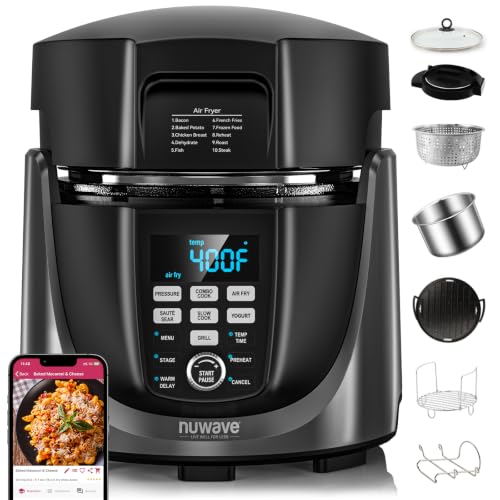
NuWave Duet Air Fryer, Electric Pressure Cooker and Grill Combo, 450-in-1
The Duet is the most ambitious NuWave cooker in this guide, combining an electric pressure cooker, an air fryer and a grill in one body with three removable lids. It is built for cooks who want one appliance to handle the whole week: pressure cooking a stew on Monday, air frying chicken on Tuesday and grilling vegetables at the weekend. The multi-cooker design also covers slow cooking, so it can replace a separate slow cooker as well as a countertop air fryer.
In everyday use, the Duet earns its place by cutting down on washing up. A stew can be seared, pressure cooked and kept warm in the same pot, and the air fryer lid can crisp the top of a dish without moving it to the oven. For a family, the practical benefit is time: dinner starts later and still finishes on schedule. The three lids do need a storage plan, so keep them in a cupboard near the cooker rather than scattered around the kitchen, and the cooker itself is best left on the counter if you use it several times a week. The Duet also works well for batch cooking. A large stew or a pot of beans cooked on a Sunday can be portioned into containers for the week, and the slow cook function means the same appliance can start the batch in the morning. Keep spare sealing rings on hand, since the ring absorbs smells from strong dishes such as curries and stews.
Key specs: 450-in-1 combination cooker with three removable lids; electric pressure cooker, air fryer and grill functions; slow cook function; multicooker design with digital controls.
Strengths:
- Three cooking methods in one body saves counter space and replaces several single-purpose appliances.
- Three removable lids let you switch between pressure cooking, air frying and grilling without extra equipment.
- Slow cooking is included, so the same appliance can start dinner in the morning and finish it in the evening.
Trade-offs:
- A combination appliance is larger and heavier than a single-purpose cooker, so it needs a dedicated spot.
- Switching lids takes a little practice, and the lids need storage space of their own.
- The breadth of functions means the learning curve is longer than a simple pressure cooker.
This is the right pick for a cook who wants one appliance to do the work of three, especially in a kitchen where counter space is limited and weeknight dinners need to be fast.
Best for: Busy households that want pressure cooking, air frying and grilling from a single NuWave appliance.
Not suited for: Cooks who already own a good pressure cooker and a good air fryer, or who prefer separate appliances for each job.
Check price on Amazon: NuWave Duet Air Fryer, Electric Pressure Cooker and Grill Combo, 450-in-1

NuWave Duet Electric Pressure Cooker and Air Fryer Combo with Probe, 450-in-1
This second Duet variant pairs the same pressure cooker and air fryer combination with an integrated digital temperature probe, and that one addition changes how the cooker is best used. The probe lets you cook roasts and large cuts of meat to a target internal temperature instead of guessing from time alone. For a cook who roasts a chicken or a pork loin on a regular basis, that is the difference between a good result and a repeatable one.
Cooking a roast with the probe is straightforward once you know the routine. Insert the probe into the thickest part of the meat, away from bone, set the target temperature on the display, and let the cooker do the rest. The probe model is most useful for chicken and pork, where the difference between done and overdone is small. Rest the meat for ten minutes after cooking so the juices settle, and remember that the internal temperature rises a few degrees during resting. The probe model is worth choosing if you cook a roast at least once a week. The probe pays for itself in consistent results, and it removes the most common cause of a disappointing roast: guessing the temperature. After a few cooks you will know the target temperatures for your household by heart.
Key specs: 450-in-1 pressure cooker and air fryer combination; integrated digital temperature probe; slow cooker and grill functions; digital temperature controls.
Strengths:
- The built-in probe takes the guesswork out of roasts and large cuts of meat.
- Pressure cooking and air frying in one body covers fast weeknight meals and crisp finishes.
- Slow cooking is included, so the cooker can handle long, gentle cooking as well as fast pressure cooking.
Trade-offs:
- The probe adds a part to clean and store, and it needs to be placed correctly to read well.
- As a combination appliance it is bulkier than a dedicated pressure cooker.
- The full feature set takes a few cooks to learn well.
This is the pick for cooks who roast meat regularly and want the probe to keep results consistent, while still keeping pressure cooking and air frying in the same appliance.
Best for: Roasts, whole chickens and large cuts where a target internal temperature matters.
Not suited for: Cooks who never roast large cuts, or who want the simplest possible pressure cooker with no extra parts.
Check price on Amazon: NuWave Duet Electric Pressure Cooker and Air Fryer Combo with Probe, 450-in-1

NuWave Pro Chef Induction Cooktop, Commercial-Grade Portable Burner
The Pro Chef is the heavy-duty option among the NuWave induction cooktops in this guide. It is a commercial-grade portable burner with 1800 watts of power and a large 8-inch heating coil, built for cooks who want a portable burner that behaves like a real hob rather than a compromise. It suits searing steaks, boiling water quickly and holding a steady simmer, and it can be carried to a buffet, a dorm room or a second cooking station when the main hob is busy.
In practice, the Pro Chef is at its best when you treat it like a real hob rather than a gadget. Preheat the pan on the burner, add oil when the pan is hot, and let meat sear without moving it. The 94 temperature settings are most useful at the low end, where a gentle simmer for sauces needs fine control, and at the high end, where a hard sear needs full power. It also works well as a buffet burner, keeping a pot of food hot at a low setting while guests serve themselves. The Pro Chef also suits a cook who entertains. Set it up as a second burner when the main hob is full, or use it at the table for a hot pot meal where guests cook their own food. The portable design means it can move from the kitchen to the dining room in seconds.
Key specs: Commercial-grade portable induction burner; 1800 watts; large 8-inch heating coil; 94 temperature settings.
Strengths:
- 1800 watts and a large coil give it genuine searing power for a portable burner.
- 94 temperature settings allow fine control from a gentle simmer to a hard sear.
- The portable design adds a burner anywhere with a flat surface and a power outlet.
Trade-offs:
- It is a single burner, so it cannot replace a full hob for multi-pot cooking.
- Induction cooking needs magnetic cookware, so some existing pots and pans will not work on it.
- At full power it draws a lot of electricity, so it should not share an outlet with other heavy appliances.
This is the pick for a cook who wants a serious portable burner for searing and fast boiling, whether as a second hob or as the main burner in a small kitchen.
Best for: High-heat searing, fast boiling and use as an extra burner anywhere.
Not suited for: Cooks who need several burners at once, or whose cookware is not induction compatible.
Check price on Amazon: NuWave Pro Chef Induction Cooktop, Commercial-Grade Portable Burner

NuWave Portable Induction Cooktop Diamond with Probe, 100 to 500 Degrees Fahrenheit
The Diamond cooktop pairs a portable induction burner with a temperature probe, and that combination suits delicate cooking better than raw power alone. The probe reads the food or liquid temperature directly, so sauces, custards and candy can be held at a precise temperature instead of being judged by the dial. The temperature range runs from 100 to 500 degrees Fahrenheit with 91 temperature settings, which covers everything from keeping a sauce warm to searing.
The Diamond cooktop is the model to reach for when a recipe says to hold a sauce at a precise temperature. Hollandaise, custard and chocolate all benefit from the probe, because they split or seize when the heat runs away. Set the probe in the liquid, choose the target temperature, and let the cooktop hold it while you prepare the rest of the meal. The wide temperature range also suits melting chocolate and keeping a soup warm without scorching the base. The Diamond cooktop is also useful for tempering chocolate and making caramel, both of which need steady, precise heat. The probe reads the temperature of the mixture directly, so you can hold it in the right range without a separate thermometer. That precision is hard to achieve on a standard hob.
Key specs: Portable induction cooktop with probe; 100 to 500 degrees Fahrenheit; 91 temperature settings; 12-inch shatter-resistant ceramic glass surface.
Strengths:
- The probe gives direct temperature control, which is ideal for sauces, custards and candy.
- 91 temperature settings cover a wide range from gentle warming to searing.
- The 12-inch shatter-resistant glass surface is easy to clean and sized for standard pans.
Trade-offs:
- The probe is an extra part to manage, and it must be positioned correctly to read accurately.
- It is a single burner, so it suits one-pot cooking rather than a full multi-pot meal.
- Induction cooking requires magnetic cookware.
This is the pick for cooks who make sauces, custards or candy and want the probe to hold an exact temperature, or for anyone who values precise control over raw power.
Best for: Sauces, custards, candy and any dish where holding an exact temperature matters.
Not suited for: Cooks who mainly want maximum power for searing, or who cook with several pots at once.

NuWave Precision Gold Portable Induction Cooktop, Single Burner, 8-Inch Coil
The Precision Gold is the straightforward single-burner induction cooktop in the NuWave line, and its strength is that it does the basics well without extra complexity. The 8-inch coil heats evenly across standard pans, the 12-inch shatter-resistant glass surface is easy to wipe clean, and the single-burner design makes it a natural second hob, travel burner or dorm-room cooker. It is the model to choose when you want induction cooking without a probe or a commercial-grade power rating.
For everyday cooking, the Precision Gold handles the jobs a single burner is asked to do: frying eggs, sauteing vegetables, simmering a sauce and boiling water for pasta. The even heat from the 8-inch coil means food browns uniformly rather than burning in one spot. It is also a practical choice for a dorm room or a small apartment, where a full hob is not available, and it stores flat in a cupboard when it is not needed. The Precision Gold is a good choice for a first induction cooktop, because there is little to learn. Set the temperature, put the pan on, and cook. The simple controls mean there is no manual to study, and the even heat means food cooks predictably from the first use.
Key specs: Single-burner portable induction cooktop; 8-inch heating coil; 12-inch shatter-resistant ceramic glass surface; countertop induction hot plate design.
Strengths:
- The 8-inch coil gives even heating across standard frying pans and saucepans.
- The shatter-resistant glass surface wipes clean with little effort.
- The simple single-burner design is easy to use and easy to store.
Trade-offs:
- It has no probe, so temperature control relies on the dial rather than a direct reading.
- A single burner cannot handle a multi-pot meal on its own.
- It needs magnetic cookware, so aluminium or copper pans without a magnetic base will not work.
This is the pick for a cook who wants a simple, reliable portable induction burner for everyday single-pot cooking, a second hob or a small kitchen.
Best for: Everyday single-burner cooking, second hobs and small kitchens.
Not suited for: Cooks who need probe-based temperature control or a commercial-grade power rating.
Check price on Amazon: NuWave Precision Gold Portable Induction Cooktop, Single Burner, 8-Inch Coil

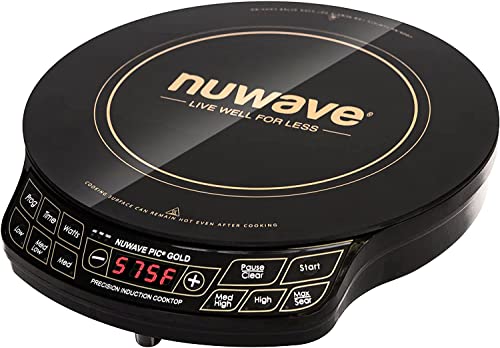
NuWave Gold Precision Induction Cooktop, 100 to 575 Degrees Fahrenheit
The Gold Precision cooktop offers the widest temperature range of any induction model in this guide, running from 100 to 575 degrees Fahrenheit, with three wattage settings to match the job. That range makes it the most flexible single burner here: low enough to keep food warm without scorching, and hot enough for a hard sear. The large 8-inch heating coil spreads heat across the base of the pan, which helps when you are browning meat or bringing a large pot to the boil.
The Gold Precision cooktop is the flexible option because its temperature range covers the extremes. At the low end it keeps a sauce warm without scorching, which is useful when dinner is ready before everyone is home. At the high end it sears a steak properly. The three wattage settings let you match the power to the task, which also helps when the cooker shares a circuit with other appliances. In daily use, it is the burner you reach for when you are not sure what the job will need. The Gold Precision cooktop suits a cook who wants one burner to do everything. The wide temperature range means it can replace a warming tray at the low end and a searing burner at the high end. Keep it on the counter if you cook daily, since it is the burner you will reach for most often.
Key specs: Portable induction cooktop; 100 to 575 degrees Fahrenheit; three wattage settings; large 8-inch heating coil.
Strengths:
- The 100 to 575 degree range covers gentle warming, simmering and hard searing in one burner.
- Three wattage settings let you match power use to the cooking task.
- The large 8-inch coil heats pans evenly across the base.
Trade-offs:
- A single burner cannot cook a multi-pot meal by itself.
- Induction cooking needs magnetic cookware.
- The wide temperature range takes a little practice to use well at the extremes.
This is the pick for a cook who wants one portable burner that can do almost everything, from keeping a sauce warm to searing a steak, without buying a second burner.
Best for: Cooks who want the widest temperature range in a single portable burner.
Not suited for: Cooks who need several burners at once, or whose pans are not induction compatible.
Check price on Amazon: NuWave Gold Precision Induction Cooktop, 100 to 575 Degrees Fahrenheit
Buying Guide
Start by choosing between a combination cooker and an induction cooktop, because they solve different problems. A combination cooker such as the Duet replaces several appliances and suits cooks who want fast, one-pot meals with minimal washing up. An induction cooktop suits cooks who already own good pans and want precise, portable heat. Buying the wrong type is the most common mistake in this category, so settle the question before comparing models.
For combination cookers, check capacity against your household. A family of four or more will use the larger combination models regularly, while a single cook or a couple may find a smaller footprint more practical. Look at the lids and accessories that come with the cooker, because a model that needs extra parts bought separately costs more than its headline figure suggests. For induction cooktops, check the temperature range and the number of temperature steps rather than the wattage alone. More steps mean finer control, which matters for sauces and simmering.
Consider where the cooker will live. Combination cookers are tall and need clearance above them for steam, plus storage for extra lids. Induction cooktops are flat and easy to store, but they need a stable, flat surface and a power outlet. Measure your counter before you buy, and think about whether the appliance will stay out permanently or be put away after each use. A cooker that is awkward to store is a cooker that stops being used.
Finally, match the controls to your patience. Digital controls with presets suit cooks who want to press a button and walk away. A probe suits cooks who like to cook to a target temperature. Neither is better in general; the right choice is the one you will actually use. If you cook roasts often, the probe models earn their place. If you cook simple weeknight meals, a straightforward combination cooker or a single-burner induction cooktop will serve you better.
Think about noise and heat as well. Combination cookers release steam, so they need clearance above them and should not sit directly under a low cabinet. Induction cooktops are quiet and cool to the touch outside the cooking zone, which makes them good for a dining table or a buffet. If you cook in an open-plan home, the quieter option will be appreciated during long cooks, and a cooker that vents steam into a cabinet will cause problems over time.
Finally, think about the power supply. Induction cooktops and combination cookers draw significant power, so they should not share a circuit with another heavy appliance such as a kettle or a microwave. If the breaker trips when you cook, the cooker is not faulty; the circuit is overloaded. A dedicated outlet solves the problem, and it is worth arranging before you buy a high-wattage model.
How to Use and Care for Your Cooker
Combination cookers need the lid seals and valves cleaned regularly. Food and steam leave residue on the sealing ring, and a dirty ring can affect how well the cooker seals. Wash the ring and the inner pot after each use, dry them fully, and store the lid upside down or ajar so air can circulate. Check the steam release valve for blockages before each pressure cooking session, and replace a worn sealing ring when it no longer sits flat.
Induction cooktops are easier to maintain. The glass surface should be wiped after each use once it has cooled, because spilled food bakes on if it is left. Use a soft cloth and a mild cleaner, and avoid dragging heavy cast iron across the glass. Keep the air vents clear, since the electronics inside rely on airflow to stay cool. Store the cooktop flat, and do not stack heavy items on top of it.
For both types, keep the power cord in good condition and never immerse the main body in water. Wipe the outside with a damp cloth and dry it before storage. If a cooker starts to behave differently, such as taking longer to reach pressure or heating unevenly, check the seal, the cookware and the power supply before assuming the appliance is broken. Most problems come from a worn seal, the wrong pan or a shared circuit.
For induction cooktops, keep the glass surface free of grit before you put a pan down. A grain of sand or sugar trapped under a pan can scratch the glass when the pan moves. Wipe the surface before cooking as well as after, and lift pans rather than sliding them. If the glass does get a mark, a ceramic hob cleaner and a soft cloth will usually remove it without damage.
For combination cookers, descale the inner pot now and then if you live in a hard water area. Mineral deposits build up on the heating element and the pot, and they reduce efficiency over time. A soak in warm water with a little vinegar, followed by a thorough rinse, removes most deposits without damaging the coating.
Common Mistakes to Avoid
The most common mistake is buying a combination cooker for pressure cooking and then using it only as an air fryer, or the reverse. Both functions work, but you pay for the combination, so use it. Another frequent mistake is overfilling a pressure cooker. Fill it only to the recommended level, because food and liquid expand under pressure and an overfilled pot can block the valve.
With induction cooktops, the usual error is using the wrong cookware. Aluminium, copper and some stainless steel pans will not work unless they have a magnetic base. Test a pan with a fridge magnet before you buy a cooktop: if the magnet sticks firmly to the base, the pan will work. A related mistake is using a pan much smaller than the coil, which wastes energy and heats unevenly.
A third mistake is ignoring the learning curve. Combination cookers and probe cooktops both reward a few practice cooks. Start with a forgiving recipe, learn how long your model takes to reach pressure or to hold a temperature, and keep notes. Cooks who expect perfect results on the first try often blame the appliance for what is really unfamiliarity.
A fourth mistake is storing a combination cooker with the lid sealed shut. Moisture trapped inside breeds smells and can damage the sealing ring. Always store the lid ajar or upside down, and let the inner pot dry fully before it goes back in. The same applies to induction cooktops: do not stack heavy items on the glass, and do not store the cooktop on its side where it can fall.
Final Recommendation
If you want one appliance to cover the most cooking, choose the NuWave Duet with the probe, because it combines pressure cooking, air frying, grilling and slow cooking with the temperature control that makes roasts reliable. If you want the most versatile portable burner, choose the Gold Precision induction cooktop for its wide temperature range. If you want a simple, dependable single burner, the Precision Gold is the straightforward choice. For more ideas on induction cooking, see our guides to the best 2-burner induction cooktops and the best 2-burner induction cooktops under 60. For pressure cooking, our guides to the best 7-in-1 programmable pressure cookers and the best electric pressure cookers under 100 cover the wider category in more depth.
Whichever model you choose, buy the cooker that matches the meals you actually cook, not the one with the longest feature list. A combination cooker earns its place by being used daily, and an induction cooktop earns its place by giving you precise heat exactly when you need it.
Frequently Asked Questions
Are NuWave cookers good for beginners?
Yes. The combination cookers use preset programmes that handle the timing, and the induction cooktops use stepped temperature controls that are easy to learn. Start with a simple recipe, follow the manual for the first few cooks, and the controls become second nature quickly.
Do I need special cookware for a NuWave induction cooktop?
Yes, induction cooking needs magnetic cookware. Cast iron and most stainless steel pans work, while plain aluminium and copper pans do not unless they have a magnetic base. Test a pan with a fridge magnet: if it sticks firmly, the pan will work on induction.
Can the Duet really replace a slow cooker?
Yes, the Duet models in this guide include a slow cook function, so they can handle recipes written for a slow cooker. The capacity and shape are different from a traditional oval slow cooker, so very large roasts may fit better in a dedicated slow cooker.
What is the difference between the two Duet models here?
Both combine pressure cooking, air frying, grilling and slow cooking. The difference is the integrated digital temperature probe on the second model, which reads the internal temperature of roasts and large cuts directly. Choose the probe model if you roast meat often.
How do I clean a NuWave combination cooker?
Wash the inner pot and the sealing ring after each use, dry them fully, and wipe the body with a damp cloth. Check the steam valve for blockages before pressure cooking, and store the lid ajar so air can circulate and the ring stays fresh.
Can I use a NuWave induction cooktop as my only hob?
Yes, for many households a single portable induction burner is enough, especially for one-pot meals, eggs, sauces and sauteing. If you regularly cook with several pots at once, you will want a second burner or a full hob as well.
Do NuWave combination cookers need special recipes?
No. Most pressure cooker and slow cooker recipes work in the Duet models, and the presets handle the timing. Start with a recipe written for a pressure cooker or a slow cooker, follow the liquid amounts carefully, and adjust the timing after the first cook.
Can I use metal utensils with a NuWave combination cooker?
It depends on the pot. A stainless steel pot handles metal utensils, while a ceramic or nonstick pot needs wooden or silicone utensils to protect the coating. Check the manual for your model and use the gentlest utensil that does the job.


