When food is prepared in volume, whether in a restaurant, a catering kitchen or a small food factory, a home food processor is quickly out of its depth. The bowls are too small, the motors overheat, and the blades dull under the load. What those kitchens need is a commercial food processor: a bigger bowl, a stronger motor and parts built to be cleaned and serviced every day.
The best food factory processors in this guide range from large home-style machines with 14- and 16-cup bowls to true commercial units with 1800-watt motors and 4-quart capacities. All seven are real, currently listed products, and each one is suited to a different scale of work, from a large family kitchen to a professional prep line.
Below we compare the seven picks, explain what each one does well and where it compromises, and finish with a buying guide that covers capacity, power, blades and cleaning, so you can match the machine to the volume you actually process.
Before the detailed reviews, it is worth saying how this guide is put together. The seven picks below were chosen from the products available for food factory processors on Amazon, looking for models that cover the main sizes, styles and budgets rather than seven versions of the same thing. Each one is a real, currently listed product with a clear identity: a brand, a model and a set of features you can check on its listing. The comparison table that follows gives the headline detail for each pick, and the individual sections explain the strengths and the trade-offs honestly, so a model that is wrong for your household is easy to spot before you spend money on it.
In this guide
Quick picks: best food factory processors
| # | Product | Where to buy |
|---|---|---|
| 1 | Cuisinart Food Processor 14-Cup | Check on Amazon |
| 2 | Hakka Commercial Food Processor 1800W | Check on Amazon |
| 3 | Ninja Professional Plus Food Processor BN601 | Check on Amazon |
| 4 | VEVOR Commercial Food Processor 550W | Check on Amazon |
| 5 | Waring Food Processor WFP16S 4-Quart | Check on Amazon |
| 6 | Breville BFP810 Sous Chef 16 Cup Food Processor | Check on Amazon |
| 7 | Waring Food Processor WFP11S 2.5 Quart | Check on Amazon |
Quick Comparison
The table below gives the headline detail for each of the seven food processors, so you can shortlist by capacity and power before reading the full reviews.
| Product | Key Detail | Best For |
|---|---|---|
| Cuisinart Food Processor 14-Cup | 14-cup, 720 W, slicing & shredding discs | large household or small catering kitchen |
| Hakka Commercial Food Processor 1800W | 1800 W, variable speed, commercial vegetable cutter | restaurant or food production kitchen |
| Ninja Professional Plus Food Processor BN601 | 9-cup, 1000 W, Auto-iQ presets | family cook who wants push-button processing |
| VEVOR Commercial Food Processor 550W | 550 W, 6 blades, 1600 RPM, stainless steel | small restaurant prep line |
| Waring Food Processor WFP16S 4-Quart | 4-quart, 2 HP motor, commercial | professional kitchen with high prep volume |
| Breville BFP810 Sous Chef 16 Cup Food Processor | 16-cup, variable slicing disc, stainless steel | cook who processes in large batches |
| Waring Food Processor WFP11S 2.5 Quart | 2.5-quart, 3/4 HP motor, commercial | small professional kitchen |

1. Cuisinart Food Processor 14-Cup
If you want a dependable option without overthinking the choice, the Cuisinart Food Processor 14-Cup deserves a close look. The Cuisinart 14-cup food processor is a 720-watt machine built for mincing, dicing, shredding, pureeing and kneading dough in large batches.
What makes it easy to live with is the way the details fit together. Its 14-cup bowl is big enough for a family meal or a small catering job, and the wide feed tube takes whole vegetables so there is less pre-cutting. The strong motor and reversible slicing and shredding discs handle everything from hard cheese to soft dough without stalling.
What stands out:
- Capacity: the 14-cup bowl handles large batches in one go.
- Versatility: it chops, slices, shreds, purees and kneads dough.
- Motor: 720 watts keeps the blade turning through dense food.
Trade-offs to know:
- Size: it is a large machine that needs permanent counter space.
- Parts: the discs and blades need safe storage and careful washing.
Keeping it in good shape does not take much effort. Wash the bowl and blades by hand where possible, dry the blade before storing, and keep the discs in their holder so the edges stay sharp.
Choose this one if your priority is big capacity and real versatility and you want a food processor that simply does its job well.
Where does the Cuisinart Food Processor 14-Cup fit in this roundup? Its headline detail is 14-cup, 720 w, slicing & shredding discs, and that shapes who should buy it. For a large household or small catering kitchen, this is a natural match, because the features line up with the way that household actually uses the product. The other models in this guide are not worse, they are simply aimed at different needs: more capacity, more power, a lower cost, or a particular feature. The practical way to choose is to list the three things you will use the product for most often, then check which model covers those three things best. If this one covers them, the extra features on other models are unlikely to matter to you.
A quick pre-purchase check is worth the minute it takes. First, make sure the Cuisinart Food Processor 14-Cup fits where you plan to keep it, both on the counter and in storage, and that you can reach its controls comfortably. Second, check the parts list against what you need, since the exact accessories included can change between listings. Third, look at the cleaning instructions: a model that is easy to wash will be used far more than one that is not. These are small points, but they decide whether a food processor becomes part of your daily routine or ends up at the back of a cupboard.
In practice, the Cuisinart Food Processor 14-Cup rewards a simple routine. Keep it clean, keep it accessible, and use it for the jobs it handles best rather than forcing it to do everything. That is how a good food processor earns its place: not by being the most powerful or the most featured model in the guide, but by being the one you reach for without thinking. If you buy it, give it a few weeks of regular use before judging it, since most products of this kind feel better once you know their settings and their limits.
Check price on Amazon: Cuisinart Food Processor 14-Cup

2. Hakka Commercial Food Processor 1800W
The Hakka Commercial Food Processor 1800W stands out for buyers who want solid everyday performance. The Hakka commercial food processor is an 1800-watt electric vegetable cutter with limitless speed control, built for heavy-duty commercial prep work.
Day to day, this is a straightforward product to use. Its powerful motor and variable speed let the operator match the cut to the job, from fine dicing to coarse chopping, without stopping to change blades. The heavy-duty construction suits a restaurant or food factory setting where the processor runs for long stretches every day.
What stands out:
- Power: 1800 watts cuts through dense vegetables without slowing.
- Speed control: limitless speed adjustment suits different foods and cuts.
- Commercial build: it is made for long daily runs, not occasional home use.
Trade-offs to know:
- Noise: a powerful commercial motor is louder than a home processor.
- Footprint: it needs a solid bench and storage space for its parts.
Maintenance is one of the quieter strengths here. Clean the cutting parts after each use, dry the blades, and check the speed control and fittings regularly.
It is a natural fit for a restaurant or food production kitchen where commercial power and speed control matters more than having the longest feature list.
It helps to place the Hakka Commercial Food Processor 1800W against the rest of this guide before deciding. With 1800 w, variable speed, commercial vegetable cutter as its headline, it is aimed squarely at a restaurant or food production kitchen, and it does that job without asking you to pay for features you may never use. Some buyers will prefer the largest or most powerful option here, and for heavy use that is the right call. But most households use a food processor for the same handful of jobs every week, and a model that handles those jobs well, fits the space available, and is easy to clean will get used far more than a bigger machine that is a chore to take out of the cupboard.
There are a few things worth checking before ordering the Hakka Commercial Food Processor 1800W. Start with size: measure the spot it will occupy and the storage space for its parts, and remember that the listed dimensions do not include the room you need to open lids, lift baskets or slide out drawers. Next, confirm the included accessories and the cleaning method, since both vary between models. And consider the household: the best food processor for your home is one that everyone who needs it can use confidently, from the first day, without a manual on the counter.
The real test of the Hakka Commercial Food Processor 1800W comes in the first month of ownership. If it is easy to take out, simple to use and quick to clean, it will become part of your routine, and that is when it pays for itself. A food processor that sits in a cupboard is wasted money, however good its specifications look on paper. So when you choose, weigh convenience as heavily as capacity or power: the model you actually use every week is always the best value in the long run.
Check price on Amazon: Hakka Commercial Food Processor 1800W

3. Ninja Professional Plus Food Processor BN601
The Ninja Professional Plus Food Processor BN601 is one of the most practical choices in this roundup, and it earns its place by getting the basics right. The Ninja Professional Plus BN601 is a 1000-watt, 9-cup food processor with Auto-iQ presets that chop, slice, puree and mix dough at the touch of a button.
In daily use, the design choices behind this model show up in small ways. The presets take the guesswork out of processing, pulsing and timing the cut for you, which suits cooks who want consistent results without watching the bowl. Its 9-cup bowl is a practical middle size for family cooking, big enough for a meal and small enough to store.
What stands out:
- Presets: Auto-iQ programs handle chopping, slicing, pureeing and dough.
- Power: 1000 watts powers through hard vegetables and dough.
- Size: nine cups is a good balance between capacity and storage.
Trade-offs to know:
- Presets over control: experienced cooks may want finer manual control than the presets allow.
- Plastic bowl: the bowl needs care to avoid scratches and staining.
Care and upkeep are simple enough for most households. Wash the bowl and blade promptly after use, and avoid abrasive cleaners that cloud the plastic.
This pick fits best in a family cook who wants push-button processing, and it suits buyers who value powerful presets and a practical size over extra features they will rarely use.
Compared with the other picks in this guide, the Ninja Professional Plus Food Processor BN601 sits in a useful middle ground. Its key detail, 9-cup, 1000 w, auto-iq presets, tells you most of what you need to know: this is a model built for family cook who wants push-button processing, rather than a specialist that only suits one kind of household. If you are choosing between this and the larger or more powerful models here, the deciding question is how often you will use the extra capacity. A bigger or stronger model is only worth its size and cost if your cooking genuinely needs it; for everyday use, a well-matched mid-size model is often the better buy, since it is easier to store, quicker to clean and simpler to live with day after day.
Before you buy, a few quick checks will save trouble later. Measure the space where the Ninja Professional Plus Food Processor BN601 will live, including the height under your cabinets if it will sit on a countertop, and check the door or drawer where its parts will be stored. Confirm what is included in the box, since accessories and spare parts vary between listings, and read the care instructions so you know how to wash it before the first use. Finally, think about who will use it: a food processor should be simple enough for everyone in the household to operate safely, not just the person who buys it.
Getting the most from the Ninja Professional Plus Food Processor BN601 is mostly a matter of habit. Use it for the jobs it does best, keep its parts clean and dry between uses, and store it where you can reach it without moving three other things first. A food processor that is easy to reach is a food processor that gets used, and regular use is what turns a purchase into good value. Over time you will learn its quirks: the setting that works best for your recipes, the order that makes prep fastest, and the cleaning routine that keeps it in good shape.
Check price on Amazon: Ninja Professional Plus Food Processor BN601

4. VEVOR Commercial Food Processor 550W
If you want a dependable option without overthinking the choice, the VEVOR Commercial Food Processor 550W deserves a close look. The VEVOR commercial food processor is a 550-watt electric vegetable slicer with six blades, two feeding holes and a 1600 RPM stainless steel cutting system.
What makes it easy to live with is the way the details fit together. The six blades cover different cuts, and the two feed holes let you slice long vegetables and small items without swapping parts mid-job. Its stainless steel build wipes clean quickly, which suits a busy prep line where the machine is used and washed repeatedly.
What stands out:
- Blade range: six blades cover slicing, shredding and dicing in one machine.
- Feed holes: two feeding holes suit both long and small vegetables.
- Steel build: stainless steel is easy to clean and stands up to daily use.
Trade-offs to know:
- Power: 550 watts is modest for a commercial machine, so very dense food needs smaller batches.
- Setup: changing blades takes a minute, so plan the prep order.
Keeping it in good shape does not take much effort. Clean and dry the blades after each session, and store them in their guards so the edges stay sharp.
Choose this one if your priority is many cuts in one steel machine and you want a food processor that simply does its job well.
Where does the VEVOR Commercial Food Processor 550W fit in this roundup? Its headline detail is 550 w, 6 blades, 1600 rpm, stainless steel, and that shapes who should buy it. For a small restaurant prep line, this is a natural match, because the features line up with the way that household actually uses the product. The other models in this guide are not worse, they are simply aimed at different needs: more capacity, more power, a lower cost, or a particular feature. The practical way to choose is to list the three things you will use the product for most often, then check which model covers those three things best. If this one covers them, the extra features on other models are unlikely to matter to you.
A quick pre-purchase check is worth the minute it takes. First, make sure the VEVOR Commercial Food Processor 550W fits where you plan to keep it, both on the counter and in storage, and that you can reach its controls comfortably. Second, check the parts list against what you need, since the exact accessories included can change between listings. Third, look at the cleaning instructions: a model that is easy to wash will be used far more than one that is not. These are small points, but they decide whether a food processor becomes part of your daily routine or ends up at the back of a cupboard.
In practice, the VEVOR Commercial Food Processor 550W rewards a simple routine. Keep it clean, keep it accessible, and use it for the jobs it handles best rather than forcing it to do everything. That is how a good food processor earns its place: not by being the most powerful or the most featured model in the guide, but by being the one you reach for without thinking. If you buy it, give it a few weeks of regular use before judging it, since most products of this kind feel better once you know their settings and their limits.
Check price on Amazon: VEVOR Commercial Food Processor 550W
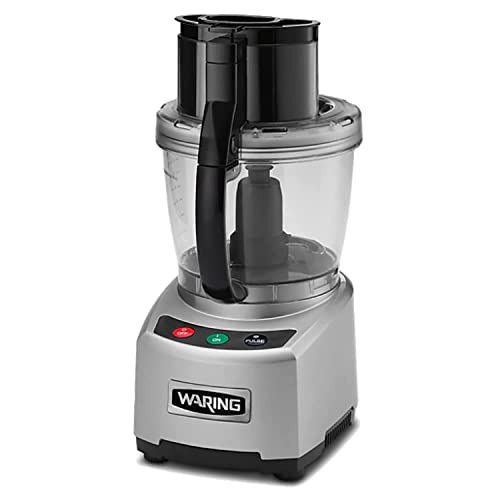
5. Waring Food Processor WFP16S 4-Quart
The Waring Food Processor WFP16S 4-Quart stands out for buyers who want solid everyday performance. The Waring WFP16S is a commercial food processor with a 4-quart capacity and a 2-horsepower motor, built for large-batch vegetable prep in professional kitchens.
Day to day, this is a straightforward product to use. Its large bowl and strong motor handle the volume a restaurant needs, from slicing onions for a service to shredding cheese in bulk. Waring is a long-established commercial brand, so the machine is built to be serviced and kept running rather than replaced.
What stands out:
- Capacity: four quarts is a serious batch size for a professional kitchen.
- Motor: two horsepower keeps the blade speed up under a full load.
- Serviceability: a commercial brand with parts and service support.
Trade-offs to know:
- Price and size: a commercial machine costs more and takes more bench space than a home model.
- Weight: it is heavy to move, so it needs a permanent station.
Maintenance is one of the quieter strengths here. Wash the bowl and blades after service, dry them fully, and follow the manual for motor care and blade changes.
It is a natural fit for a professional kitchen with high prep volume where true commercial capacity and power matters more than having the longest feature list.
It helps to place the Waring Food Processor WFP16S 4-Quart against the rest of this guide before deciding. With 4-quart, 2 hp motor, commercial as its headline, it is aimed squarely at a professional kitchen with high prep volume, and it does that job without asking you to pay for features you may never use. Some buyers will prefer the largest or most powerful option here, and for heavy use that is the right call. But most households use a food processor for the same handful of jobs every week, and a model that handles those jobs well, fits the space available, and is easy to clean will get used far more than a bigger machine that is a chore to take out of the cupboard.
There are a few things worth checking before ordering the Waring Food Processor WFP16S 4-Quart. Start with size: measure the spot it will occupy and the storage space for its parts, and remember that the listed dimensions do not include the room you need to open lids, lift baskets or slide out drawers. Next, confirm the included accessories and the cleaning method, since both vary between models. And consider the household: the best food processor for your home is one that everyone who needs it can use confidently, from the first day, without a manual on the counter.
The real test of the Waring Food Processor WFP16S 4-Quart comes in the first month of ownership. If it is easy to take out, simple to use and quick to clean, it will become part of your routine, and that is when it pays for itself. A food processor that sits in a cupboard is wasted money, however good its specifications look on paper. So when you choose, weigh convenience as heavily as capacity or power: the model you actually use every week is always the best value in the long run.
Check price on Amazon: Waring Food Processor WFP16S 4-Quart

6. Breville BFP810 Sous Chef 16 Cup Food Processor
The Breville BFP810 Sous Chef 16 Cup Food Processor is one of the most practical choices in this roundup, and it earns its place by getting the basics right. The Breville Sous Chef 16 is a 16-cup food processor in brushed stainless steel, designed to chop, slice and shred large batches with ease.
In daily use, the design choices behind this model show up in small ways. Its wide feed chute takes whole foods, and the variable slicing disc adjusts thickness without changing discs, which saves time during prep. The large bowl and strong motor suit cooks who process in bulk, from weekly meal prep to catering-sized batches.
What stands out:
- Capacity: sixteen cups is the largest bowl in this guide.
- Adjustable slicing: the variable disc changes thickness without a disc swap.
- Build: the brushed steel body looks good and wipes clean.
Trade-offs to know:
- Counter space: it is a large machine that dominates a small kitchen.
- Weight: the steel body and big bowl make it heavy to lift and store.
Care and upkeep are simple enough for most households. Wash the bowl, lid and discs after use, dry the blade, and store the discs where their edges will not dull.
This pick fits best in a cook who processes in large batches, and it suits buyers who value the biggest bowl and flexible slicing over extra features they will rarely use.
Compared with the other picks in this guide, the Breville BFP810 Sous Chef 16 Cup Food Processor sits in a useful middle ground. Its key detail, 16-cup, variable slicing disc, stainless steel, tells you most of what you need to know: this is a model built for cook who processes in large batches, rather than a specialist that only suits one kind of household. If you are choosing between this and the larger or more powerful models here, the deciding question is how often you will use the extra capacity. A bigger or stronger model is only worth its size and cost if your cooking genuinely needs it; for everyday use, a well-matched mid-size model is often the better buy, since it is easier to store, quicker to clean and simpler to live with day after day.
Before you buy, a few quick checks will save trouble later. Measure the space where the Breville BFP810 Sous Chef 16 Cup Food Processor will live, including the height under your cabinets if it will sit on a countertop, and check the door or drawer where its parts will be stored. Confirm what is included in the box, since accessories and spare parts vary between listings, and read the care instructions so you know how to wash it before the first use. Finally, think about who will use it: a food processor should be simple enough for everyone in the household to operate safely, not just the person who buys it.
Getting the most from the Breville BFP810 Sous Chef 16 Cup Food Processor is mostly a matter of habit. Use it for the jobs it does best, keep its parts clean and dry between uses, and store it where you can reach it without moving three other things first. A food processor that is easy to reach is a food processor that gets used, and regular use is what turns a purchase into good value. Over time you will learn its quirks: the setting that works best for your recipes, the order that makes prep fastest, and the cleaning routine that keeps it in good shape.
Check price on Amazon: Breville BFP810 Sous Chef 16 Cup Food Processor


7. Waring Food Processor WFP11S 2.5 Quart
If you want a dependable option without overthinking the choice, the Waring Food Processor WFP11S 2.5 Quart deserves a close look. The Waring WFP11S is a commercial food processor with a 2.5-quart capacity and a 3/4-horsepower motor, built for vegetable chopping in professional kitchens.
What makes it easy to live with is the way the details fit together. Its smaller bowl suits a prep station that processes in moderate batches, while the commercial motor keeps the blade turning under load. As a Waring commercial model it is built to be serviced and kept running, with parts available for the long term.
What stands out:
- Commercial build: a professional motor and bowl built for daily use.
- Right size: 2.5 quarts suits moderate batches without waste.
- Serviceability: a commercial brand with parts support.
Trade-offs to know:
- Capacity: it is the smallest commercial bowl in this guide.
- Weight: it is heavy for its size and needs a fixed spot.
Keeping it in good shape does not take much effort. Wash the bowl and blades after service and dry them fully before storing.
Choose this one if your priority is commercial quality in a smaller bowl and you want a food processor that simply does its job well.
Where does the Waring Food Processor WFP11S 2.5 Quart fit in this roundup? Its headline detail is 2.5-quart, 3/4 hp motor, commercial, and that shapes who should buy it. For a small professional kitchen, this is a natural match, because the features line up with the way that household actually uses the product. The other models in this guide are not worse, they are simply aimed at different needs: more capacity, more power, a lower cost, or a particular feature. The practical way to choose is to list the three things you will use the product for most often, then check which model covers those three things best. If this one covers them, the extra features on other models are unlikely to matter to you.
A quick pre-purchase check is worth the minute it takes. First, make sure the Waring Food Processor WFP11S 2.5 Quart fits where you plan to keep it, both on the counter and in storage, and that you can reach its controls comfortably. Second, check the parts list against what you need, since the exact accessories included can change between listings. Third, look at the cleaning instructions: a model that is easy to wash will be used far more than one that is not. These are small points, but they decide whether a food processor becomes part of your daily routine or ends up at the back of a cupboard.
In practice, the Waring Food Processor WFP11S 2.5 Quart rewards a simple routine. Keep it clean, keep it accessible, and use it for the jobs it handles best rather than forcing it to do everything. That is how a good food processor earns its place: not by being the most powerful or the most featured model in the guide, but by being the one you reach for without thinking. If you buy it, give it a few weeks of regular use before judging it, since most products of this kind feel better once you know their settings and their limits.
Check price on Amazon: Waring Food Processor WFP11S 2.5 Quart
Buying Guide: How to Choose Food Factory Processors
A food processor for factory-scale or restaurant work is judged by different standards than a home model. The points below are the ones that decide whether the machine keeps up with your prep list or becomes the bottleneck.
Capacity
Capacity is the first filter: a 9-cup bowl suits family cooking, while 14 to 16 cups or a 4-quart commercial bowl suits a restaurant or catering job. A bowl that is too small means stopping to empty it, which costs more time than the bigger machine costs money. Measure your largest regular batch before you choose.
Motor power
Power decides whether the blade keeps speed under load. Home processors run at 450 to 1000 watts, while commercial units go to 1800 watts or 2 horsepower. Dense food like dough, hard cheese and root vegetables needs the stronger end, and a motor that stalls is a motor that will burn out early.
Blades and discs
Look for slicing and shredding discs, a dough blade and a variable slicing disc if you can get one. The wider the range of cuts, the fewer machines you need on the bench. Check that replacement blades are available and affordable, since blades are a running cost in a commercial kitchen.
Feed tube and chute
A wide feed tube takes whole vegetables and cuts prep time sharply, since you stop pre-cutting everything to fit. Two feed holes are useful when you slice both long and small items. A narrow tube is the most common frustration with an otherwise good processor.
Cleaning and service
In a commercial setting the processor is washed after every service, so the bowl, lid and blades should come apart and clean quickly, and the motor base should wipe down easily. Prefer brands with available spare parts and a service network, since a processor that cannot be repaired is a short-lived purchase.
Frequently Asked Questions
What size food processor do I need for a restaurant?
For a restaurant, start at 14 cups or a 4-quart commercial bowl. Smaller bowls force constant emptying during service prep, which slows the whole line. The Waring WFP16S and the Breville 16-cup in this guide are the right scale.
Can a food processor knead dough?
Yes, most of the models here include a dough blade or a dough function, and the Ninja BN601 even has an Auto-iQ dough preset. Keep batches within the bowl capacity, and let the motor rest between batches so it does not overheat.
How do I keep food processor blades sharp?
Use the blades only for food, never for frozen blocks or bones, wash and dry them promptly, and store them in guards or holders so the edges do not knock against other tools. Replace a blade as soon as it tears rather than cuts.
Is a commercial food processor louder than a home one?
Generally yes, since the motors are larger and run faster. The difference is most noticeable with the 1800-watt and 2-horsepower models. If noise matters, process in shorter runs and keep the lid firmly locked.
What is the difference between a food processor and a blender?
A food processor uses a wide bowl and interchangeable blades to chop, slice, shred and knead, while a blender uses a tall jar to liquefy and puree. For salads, dough and sliced vegetables, a processor is the right tool; for smoothies and soups, use a blender.
A Final Tip Before You Buy
Whatever food processor you choose, give yourself a simple test before you order: picture the product in your home, in the place it will live, being used by the people who will use it most. If you can see it fitting there, being taken out without a struggle, and being cleaned without a sigh, it is the right choice. If you hesitate on any of those points, look again at the comparison table and pick the model that removes the hesitation. A food processor that fits your home and your habits is worth far more than a more impressive model that does not, and the seven picks in this guide cover enough range that there is a good fit here for most households.
Conclusion
The right food processor is the one sized for your largest regular batch, with enough power to keep the blade turning under a full load. For a home or small catering kitchen, the Cuisinart 14-cup or the Breville 16-cup cover most jobs. For a restaurant or food production setting, the Hakka 1800-watt and the Waring 4-quart are built for that volume.
Whichever you choose, keep spare blades on hand, clean the machine after every session, and it will repay the investment in faster prep for years.
One last point: the best time to buy is when you have a clear use in mind, not when a deal appears. A food processor bought for a real job gets used from the first week, while one bought on impulse often waits for a job that never comes. Measure your space, check the listing for the exact model described here, and choose the pick that matches your household. Then put it to work: the value of a good food processor is not in the box it arrives in, but in the meals, mornings or rooms it improves week after week.

