Every autumn, the same problem arrives in kitchens that garden, hunt, buy in bulk or simply hate waste: more food than the household can eat before it turns. Two very different machines promise to solve it. A dehydrator blows warm air over sliced food for hours until it is dry enough to store. A freeze dryer takes the opposite road — it freezes the food solid, pulls a deep vacuum, and coaxes the ice out as vapour, leaving the food’s shape, colour and structure almost untouched. Both end with a shelf and a sealed container, but the food that comes out, the bill that arrives each month and the noise in the corner of the room could hardly be more different.
This guide puts three home freeze dryers and three food dehydrators side by side, because the honest first question in this category is not which model to buy but which technology deserves the counter space and the money. Freeze drying wins on quality and on how completely the food comes back to life with water; dehydrating wins on simplicity, size and the size of the commitment. One disclosure before the detail: this site may earn an affiliate commission when readers buy through links on this page, and that is how guides like this stay free to read. It does not change which machines made the list or what is said about their weaknesses, and every judgement below rests on manufacturer documentation, stated specifications and the physics of the two processes rather than on any claim of kitchen trials.
A note on how the six were judged, because these machines cannot be assessed the way a toaster can. For freeze dryers, the evidence is the refrigeration and vacuum hardware: how cold the chamber gets, what kind of pump ships in the box, how much food a batch holds and how the maker expects owners to maintain the pump between runs. For dehydrators, it is airflow design, tray area, temperature range and how evenly a full load can dry without the owner shuffling trays. Where a machine has a long public track record with gardeners, hunters and backpackers, that history counts. What no machine here can do is rescue poor preparation — uneven slices, overfilled trays and food sealed while still warm will defeat the best hardware on this list.
In this guide
Quick picks: best food freeze dryer dehydrators
| # | Product | Where to buy |
|---|---|---|
| 1 | Harvest Right Medium Home Freeze Dryer | Check on Amazon |
| 2 | Harvest Right Small Home Freeze Dryer | Check on Amazon |
| 3 | Stay Fresh Freeze Dryer | Check on Amazon |
| 4 | Excalibur 9-Tray Dehydrator | Check on Amazon |
| 5 | COSORI Premium 6-Tray Dehydrator | Check on Amazon |
| 6 | Nesco Snackmaster Pro | Check on Amazon |
Two technologies, two different foods
Dehydrating is the older and simpler craft. Food is sliced, laid on trays and held in moving air at a low temperature — warm enough to drive moisture out over six to fourteen hours, cool enough not to cook the food outright. Water leaves as liquid vapour from the surface, the food shrinks and concentrates, and the result is leathery, chewy or crisp depending on the ingredient: jerky, fruit leather, apple rings, dried herbs, tomato chips. Texture changes permanently. A dried strawberry will never be a strawberry again; it becomes a sweet, dense chew that is delicious on its own terms. Nutrients survive reasonably well, though heat and oxygen take a toll on the most delicate vitamins, and the finished food keeps for months in a sealed jar rather than years.
Freeze drying is closer to a pause button. The food is frozen hard, then the pressure around it is dropped so low that ice turns straight to vapour without passing through a liquid phase — sublimation, the same process that slowly shrinks ice cubes left in a freezer for months. Because the water leaves as gas from within a rigid frozen structure, the food barely shrinks. A freeze-dried strawberry keeps its shape, its colour and most of its nutritional profile, and when water is added back it rehydrates into something recognisably close to the original. Complete meals — casseroles, scrambled eggs, pasta dishes, even ice cream — survive the process, which is something warm air simply cannot do. Makers of home freeze dryers commonly describe shelf lives measured in decades for properly dried and sealed food, against months to a year or so for typical dehydrated produce.
The costs of that quality are time, noise and machinery. A freeze-drying cycle commonly runs a full day and can stretch well beyond it for wet, dense loads, because the machine must freeze, then patiently pull vapour out of food that insulates its own core. The vacuum pump runs for much of that time and sounds like what it is — a piece of workshop equipment, not a kitchen appliance. A dehydrator, by contrast, is a quiet fan in a plastic or steel box that can live on a shelf. Neither technology is better in the abstract. They answer different questions: the dehydrator asks how to preserve this week’s glut cheaply and simply; the freeze dryer asks how to store food, at near-original quality, for the long term.
There is one more difference that rarely appears on spec sheets and decides many purchases in practice: forgiveness. Dehydrating forgives. A batch can be checked, tasted, given another hour, rescued from slight over-drying by conditioning, and eaten happily even when imperfect. Freeze drying is closer to a contract — the food must be prepared properly, the machine maintained, the cycle left alone and the result sealed promptly — and in exchange it forgives nothing but delivers something close to the original food. Households that enjoy process and routine tend to find the contract satisfying; households that preserve in spare moments between other jobs tend to be happier with the forgiving machine, and there is no shame in either answer.
Inside a freeze-drying cycle, hour by hour
Because freeze drying is the less familiar process, it helps to walk through what the machine actually does with a day of its life. The first hours are simply freezing: the chamber drives the food well below ordinary freezer temperatures and holds it there until the load is frozen through its core, because any pocket that is merely cold rather than frozen will melt under vacuum and ruin the batch’s structure. Only then does the pump take over, pulling the chamber down to a pressure at which ice cannot exist as liquid. The long middle of the cycle is sublimation proper — heat is applied gently to the trays while the cold trap captures the vapour leaving the food, and the bulk of the water migrates out over many hours. The final phase is a secondary drying, warmer and slower, aimed at the last bound moisture that clings inside the food’s structure; it is this phase the machine’s sensors judge, extending it until the readings say the batch is genuinely dry.
Two practical consequences follow. First, the starting condition of the food matters enormously: pre-freezing a load in a ordinary freezer before it goes in shortens the machine’s own freezing phase and is standard practice among experienced owners, and slicing food thin and even gives vapour a short, uniform path out. Second, the cycle cannot be hurried by impatience — opening the door to check, or pulling a batch early because it feels dry, admits moist air and forfeits the very dryness the long hours bought. Dehydrating has its own version of the same lesson in miniature: the last hour of a run removes a disproportionate share of the remaining moisture, and food pulled early because it looks done is the food that moulds in the jar.
What to look for
Start with the output you actually want
The technology decision should be made on the plate, not the spec sheet. If the goal is snacks — jerky, dried fruit, vegetable crisps, herbs, fruit leather — a dehydrator produces exactly the food wanted, and a freeze dryer’s extra fidelity buys nothing. If the goal is ingredients and meals that return to life — berries that taste fresh in winter porridge, garden vegetables that cook like fresh, complete camping meals, emergency stores that a family will genuinely eat — only sublimation delivers it. Some foods also draw a hard line: fatty items dry poorly in both systems, and very sugary items can stay tacky in a dehydrator long after the timer ends. Deciding what will actually be preserved, month after month, matters more than any single specification below.
Batch capacity and cycle time
Capacity is quoted differently by the two camps and must be translated before comparing. Dehydrators are measured in tray count and drying area: more trays and more square footage mean a whole garden harvest can be processed in one run instead of three. Freeze dryers are measured in trays too, but the meaningful figure is the weight of fresh food per batch and the amount of water the machine can pull per cycle — wet foods like melon or soup load the system far more heavily than the same weight of sliced apple. Cycle time interacts with capacity: a dehydrator finishing in eight hours can run twice a day, while a freeze dryer occupied for thirty hours processes its batches strictly one at a time. Households preserving a harvest should count weekly throughput, not single-batch size.
Evenness: airflow in one camp, cold and vacuum in the other
In a dehydrator, evenness is an airflow problem. Horizontal-flow designs push air across each tray from a rear fan, so every layer receives similar treatment and strong flavours stay in their own layer. Vertical-flow designs rise from a base fan through stacked trays; they are cheaper and more compact, but upper trays dry slower and the owner is expected to rotate trays during the run. In a freeze dryer, evenness is a refrigeration and vacuum problem: the chamber must hold a deep, stable freeze and the vacuum must stay low and steady for many hours, because any drift shows up as a batch that feels dry on the surface and spoils from a damp core. Pump quality and the machine’s own dryness sensing matter more here than any headline number.
Noise and where the machine will live
Placement deserves thought before purchase, not after the first overnight run. A dehydrator’s fan is a background hum most households tolerate in a kitchen or utility room, though light sleepers will still banish it from nearby bedrooms. A freeze dryer is a different commitment: the vacuum pump is genuinely loud, the machine sheds heat, and cycles run around the clock, so it belongs in a garage, basement or utility space where a day of mechanical noise disturbs nobody. Freeze dryers are also heavy floor-standing or bench-filling equipment with a drain line and pump oil to manage; dehydrators are lift-away appliances. Renters and small kitchens should weigh that footprint honestly.
Maintenance the owner actually has to do
Dehydrator upkeep is washing: trays, mesh screens and the occasional sticky fruit-leather sheet, plus a wipe of the base. Freeze dryer upkeep is a small maintenance regime. Oil-filled vacuum pumps need their oil filtered or changed on a schedule measured in batches; oil-free pumps remove that chore at a higher purchase price and with their own long-term service questions. Door seals must stay clean to hold vacuum, the chamber needs defrosting and drying between batches, and a batch interrupted by a neglected seal or tired oil can be lost entirely. None of this is difficult, but it is scheduled, and buyers who dislike maintaining machines should count it as part of the price.
Running costs, in words
Neither machine is expensive to feed with electricity per hour, but the freeze dryer’s hours are so much longer that its energy per batch is the larger figure, and its true running costs include pump oil, filters and replacement seals over the years. Dehydrator running costs are close to the electricity alone, with mesh sheets and solid fruit-leather trays the only consumables most owners ever buy. Storage supplies are shared by both camps: oxygen absorbers, quality jars or metallised storage bags and a way to seal them. The sensible comparison is cost per batch over the machine’s life, spread across the food it preserves — a figure that rewards the machine that gets used every week, whichever technology it is.
Controls and the work before the work
Finally, judge the controls by the routine they create. On a dehydrator, a timer with automatic shut-off and a thermostat that covers both the gentle herb end and the hotter jerky end are worth more than novelty settings, because the machine will spend most of its life running unattended. On a freeze dryer, the meaningful controls are the ones governing dryness judgement and extra dry time, since the owner’s real job is preparation: washing, slicing evenly, blanching the vegetables that need it, pre-freezing loads, and portioning food so the sealed results match how the household eats. Both machines reward prep and punish improvisation, and the model whose workflow makes prep easiest is often the one that gets used most.
Storage after drying
Both processes end at the same vulnerable moment: dry food meets room air and starts drinking moisture back. Food must cool, be checked for hidden damp — a conditioning period in a sealed jar, watched for condensation, is the classic safeguard for dehydrated goods — and then be sealed away from oxygen and light. Freeze-dried food is the more fragile of the two once opened, because its porous structure absorbs humidity fast; portions should be sized so a container is finished soon after opening. The machine is only half the system, and the picks below are judged partly on how sensibly their makers support the storage half of the job.
The six picks
Three freeze dryers and three dehydrators follow, in an order that walks from the most capable freeze dryer down to the simplest dehydrator. Each is the right answer for somebody; the who-it-suits line at the end of each review is the fastest way to find which somebody is you.

Harvest Right Medium Home Freeze Dryer: the default home freeze dryer
Harvest Right effectively created the home freeze-drying category, and the medium model is the size most households land on: a four-tray chamber that takes a family-scale batch of fresh food at a time, in a cabinet that sits on a sturdy bench or a rolling cart. The machine automates the whole cycle — freezing, vacuum, drying and the final dryness check — and its control approach is deliberately plain: load the trays, close the door, and let the sensors decide when the batch is done rather than guessing by the clock. Both oil-filled and oil-free pump options exist in the range, which lets buyers choose between a lower purchase price with oil changes, or a higher one without.
Its strengths are maturity and ecosystem. Because so many of these machines are in homes, the accumulated public knowledge around them — batch settings for everything from grated cheese to raw eggs, maintenance walk-throughs, troubleshooting for every error message — is deeper than for any rival, and accessories such as spare trays, tray lids and storage supplies are easy to source. The medium size is also the honest sweet spot: big enough that a garden harvest or a bulk meat purchase clears in a few batches, small enough that a partial load does not feel wasteful. For long-term food storage — the use case freeze drying exists for — this is the benchmark the rest of the category is measured against.
The trade-offs are the category’s trade-offs, concentrated. It is heavy, it is loud while the pump runs, a batch occupies it for a day or more, and the oil pump version asks for regular filtering and changes. The chamber needs defrosting and a thorough dry between runs, which adds turnaround time the headline cycle figures omit. Owners also need a circuit and a corner that can host a warm, humming machine around the clock. None of that is hidden, but buyers arriving from the dehydrator world routinely underestimate all of it.
Ownership rhythm settles into a pattern most households find manageable: a batch loaded in the evening, a day of running, an evening of unloading, defrosting and sealing, then a rest day for the machine. Owners preserving garden produce learn to pre-freeze the next load while the current one runs, which keeps the chamber turning over at close to its practical maximum. It is also worth knowing that the medium machine’s appetite is flexible — a two-tray load of herbs runs happily in a four-tray chamber — so the size punishes nobody on small days; it simply caps the big ones.
Strengths: the most established home freeze dryer, with automated cycles and sensor-based dryness checks; four-tray capacity that suits family-scale preserving; deep accessory and knowledge ecosystem; pump choice between oil-filled and oil-free. Trade-offs: long, loud cycles; real bench space and weight; pump oil upkeep on the standard version; defrost and drying time between batches. Who it suits: households committed to long-term storage — gardeners, bulk buyers and emergency-preparedness planners — who have a utility space for it and want the proven option, so confirm which pump ships in the box when you check price on Amazon.
Check price on Amazon: Harvest Right Medium Home Freeze Dryer

Harvest Right Small Home Freeze Dryer: freeze drying for smaller households
The small model is the same idea at three-quarter scale: three trays instead of four, a chamber sized for couples, small households and modest harvests, and a footprint that asks slightly less of the room it lives in. Everything said about the medium’s automation, pump options and ecosystem applies here, because the platform is shared; what changes is throughput. A batch is smaller, and for foods that arrive in a rush — a berry glut, a deer season, a market bargain — the smaller chamber means more sequential days of running to clear the same pile.
Why choose it, then? Because freeze dryers punish oversizing quietly. A machine run half-empty still runs a full cycle, still makes its noise and still asks for its maintenance, and the household that preserves a few trays a week gains nothing from the larger chamber except the bill for it. The small model also suits a deliberate second-machine logic less often discussed: it is the more sensible first freeze dryer for anyone unsure whether the hobby will stick, since the preserving habits it teaches — slicing thin, pre-freezing, sealing promptly — transfer unchanged if a bigger machine ever follows. Its output still rehydrates beautifully and still stores for the long term; only the batch arithmetic differs.
The limitations mirror its sibling’s, with the capacity caveat on top. Cycle times per batch are not proportionally shorter, because physics does not scale down with the cabinet, so weekly throughput falls by more than the tray count suggests. The pump is the same class of equipment and makes the same class of noise. And the per-batch economics — electricity, oil, storage supplies — are spread across less food, which matters to anyone preserving in serious volume.
There is also a social dimension to the smaller machine: it is the size most often bought by households preserving for one or two people, and its second-hand market reflects that — units surface regularly when owners upgrade, which says something reassuring about both its durability and its role as the category’s training size. Tray-for-tray, its output quality is indistinguishable from the medium’s; nobody tasting rehydrated berries will know which chamber they came from. The decision really is arithmetic: count the trays a typical week asks for, and buy the chamber that matches.
Strengths: full freeze-drying quality in the smallest footprint the platform offers; same automation and accessory ecosystem as the larger models; sensible entry point for couples and small households; pump options mirror the rest of the range. Trade-offs: three-tray batches clear a glut slowly; cycle times stay long despite the smaller load; running costs spread over less food per batch; still heavy and loud. Who it suits: smaller households, herb and berry growers, and first-time freeze dryers who want the genuine article without the largest cabinet, so weigh the tray count against your biggest typical harvest when you check price on Amazon.
Check price on Amazon: Harvest Right Small Home Freeze Dryer

Stay Fresh Freeze Dryer: the challenger built around the pump
Stay Fresh entered the category by attacking the home freeze dryer’s least loved component: the vacuum pump. Its machines are built around an industrial-style oil-free pump approach and a stainless chamber, with the maker’s pitch centred on throughput and reduced routine maintenance — no oil to filter, no oil mist to manage, and cycle design aimed at moving batches through briskly. For buyers whose research keeps circling back to pump anxiety, that pitch lands. The machine otherwise follows the category pattern: trays of food, an automated freeze-and-dry cycle, and dryness judged by the machine rather than by hope.
The appeal is real but should be weighed with clear eyes. Oil-free does not mean maintenance-free: seals still need care, the chamber still needs defrosting and drying, and an oil-free pump that eventually needs service is a different ownership proposition from one whose wear item is a bottle of oil. Stay Fresh is also the younger brand, which cuts both ways — its designs respond to complaints owners voiced about the incumbent, but its installed base, accessory shelf and long-term parts story are thinner, and the accumulated public knowledge around settings and quirks is a fraction of Harvest Right’s. Buyers are trading a known quantity for a design philosophy.
Where the trade makes sense is workload. A household that will run the machine constantly — a market gardener, a raw pet-food preparer, a large family preserving in bulk — feels pump maintenance as a weekly friction, and a machine designed to minimise it earns its place. Occasional users, by contrast, may never run enough batches for oil changes to matter, and for them the incumbent’s ecosystem is worth more than the challenger’s pump.
The stainless chamber deserves a mention of its own, because chamber hygiene is an underrated part of this category: a freeze dryer processes raw meats, eggs and dairy alongside fruit, and a chamber that wipes down cleanly and resists staining and odour retention makes the defrost-and-clean interval between batches shorter and more thorough. Combined with the pump design, the picture is of a machine specified by people who run theirs hard and clean it often — a legitimate design priority, provided the buyer’s own routine matches it.
Strengths: oil-free pump design removes the category’s most disliked chore; stainless build and brisk cycle aims; automated operation on the familiar tray pattern; aimed squarely at heavy, frequent use. Trade-offs: younger brand with a smaller knowledge and accessory ecosystem; oil-free is not maintenance-free, and pump service is a bigger event when it comes; long-term parts availability less proven. Who it suits: high-volume preservers who will run batch after batch and want pump upkeep designed down to a minimum, so read the pump and warranty terms carefully when you check price on Amazon.
Check price on Amazon: Stay Fresh Freeze Dryer

Excalibur 9-Tray Dehydrator: the horizontal-airflow benchmark
If the freeze dryers above are the new technology, the Excalibur is the dehydrator perfected over decades. Nine large trays sit in a cabinet with the fan and heater at the back, pushing air horizontally across every layer at once — the design the rest of the category is compared against. The consequences are practical: no tray rotation, no flavour migration between a tray of onions and a tray of apples, and an evenness across a full load that vertical machines cannot match without supervision. The adjustable thermostat spans the range from delicate herbs to the hotter finish jerky recipes call for, and the tray area swallows a serious garden harvest in a single run.
Excalibur’s other quiet advantage is that it is a system rather than an appliance. Solid sheets for fruit leather and liquids, fine mesh screens for herbs and small berries, and spare trays are all part of the catalogue, and the square tray format doubles as a proofing box for bread dough and yoghurt in many kitchens — a second job that earns the counter space back. The design has been stable for years, which means parts, advice and second-hand knowledge are everywhere. For a household whose preserving is snacks, ingredients and garden produce rather than decades-long storage, this class of machine is not the budget compromise; it is simply the right tool.
The compromises are size and sound. Nine trays make a wide, deep box that dominates a counter and needs a home between uses, and the fan, while far quieter than a vacuum pump, is a purposeful whoosh rather than silence. There is no freeze-drying magic here: food shrinks, textures change, and storage life is measured in months. Buyers should also note that tray count and the presence of a timer vary across the range, so the exact configuration matters more than the badge.
Loading discipline is the one skill it asks for. Nine trays invite abundance, and produce sliced at mixed thicknesses will finish at mixed times even in perfectly even air; the machine removes the airflow variable, not the preparation one. Owners who slice uniformly find the Excalibur close to a load-and-forget appliance, with jerky, fruit and herbs all finishing predictably. It also bears repeating that a dehydrator of this size doubles as a small preserving factory for the autumn glut — the weekend it processes a neighbour’s apple tree is the weekend it justifies itself.
Strengths: horizontal airflow dries full loads evenly with no tray rotation; generous nine-tray area for harvest-scale batches; wide, adjustable temperature range; deep accessory system and a design with a long track record. Trade-offs: large counter footprint; fan noise is present if not intrusive; results are dehydrated food, with its changed textures and shorter storage life; configurations vary across the range. Who it suits: gardeners, jerky makers and snack-focused preservers who process big loads and want the even, hands-off dehydrator, so confirm the tray count and timer on the exact model when you check price on Amazon.
Check price on Amazon: Excalibur 9-Tray Dehydrator

COSORI Premium 6-Tray Dehydrator: the modern mid-size choice
COSORI’s premium dehydrator takes the horizontal-airflow idea and packages it for a contemporary kitchen: a stainless-steel body, six stainless trays instead of plastic, a rear fan, and digital controls with a timer and a clear temperature readout. The digital side matters more than it sounds. Dehydrating is a set-and-leave process measured in half-days, and a machine that holds a precise temperature, counts down its own run and shuts itself off fits real life better than a dial and a guess — herbs at the gentle end, jerky at the hot end, and no returning to a kitchen to switch a forgotten machine off.
Stainless trays are the other considered choice. They wash cleanly, shrug off the staining that tomato and berry juices leave on plastic, and suit households trying to move food-contact surfaces away from plastic where they reasonably can. Six trays is the honest middle capacity: enough for a weekly shop’s worth of fruit, a batch of jerky or a modest garden surplus, in a cabinet noticeably smaller than the nine-tray benchmark above. The included mesh screen and fruit-leather sheet cover the two jobs that most often send new owners shopping for accessories on day one.
What it gives up against the Excalibur is scale and ecosystem depth: fewer trays, less area, and a younger accessory catalogue. Against the budget machines below, it gives up nothing except the lowest price. Its fan is respectably quiet for the class, though, as with every dehydrator, a full overnight run is best placed where the hum will not be the house’s soundtrack. As with the freeze dryers, exact bundle contents vary, and the tray material in the listing should match the stainless build described here.
The digital control set also changes who succeeds with it. A novice can follow a recipe’s stated temperature and time literally — set the degrees, set the hours, walk away — where a dial machine asks for translation and guesswork. That literalness shortens the learning curve that puts many first dehydrators in cupboards. And when the run ends, the stainless trays go in the dishwasher or the sink without the soaking ritual sticky plastic can demand, which quietly determines whether the machine gets used again next week.
Strengths: stainless body and trays that resist staining and wash easily; precise digital temperature control and timer with automatic shut-off; horizontal airflow for even drying; sensible six-tray size for weekly preserving. Trade-offs: less capacity than nine-tray rivals; accessory ecosystem still growing; fan hum on overnight runs; bundle contents vary by listing. Who it suits: households preserving regularly in moderate batches who value tidy controls and stainless construction over maximum tray area, so verify the trays in the listing are stainless when you check price on Amazon.
Check price on Amazon: COSORI Premium 6-Tray Dehydrator
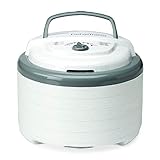

Nesco Snackmaster Pro: the simple, affordable way in
The Nesco takes the older vertical-flow design — a base fan pushing warm air up through stacked trays — and refines it with a top-mounted fan arrangement and a patented airflow pattern intended to spread heat more evenly than the crude stackers of the past. It is the lightest, smallest and least expensive machine in this guide, it expands by adding trays, and it asks almost nothing of its owner: slice, stack, set the dial, and rotate the trays once or twice during the run. For a first dehydrator, that simplicity is the entire argument, and it is a good one.
Vertical flow’s known weakness is evenness, and the Nesco does not repeal physics: trays nearer the moving air dry faster, delicate items on the wrong layer can over-dry while a lower layer lags, and strong flavours drift between layers in a way horizontal machines prevent. The maker’s airflow design narrows the gap without closing it, and the honest technique — rotating trays and grouping similar foods — is part of owning one. Capacity per run is also modest, which suits snack batches and small surpluses but will frustrate anyone facing a tree’s worth of apples.
Set against its price class, though, the Nesco’s results are entirely respectable: jerky, fruit, herbs and vegetable crisps all come out as they should, the temperature dial covers the useful range, and the machine’s small footprint means it actually gets used instead of exiled to a cupboard. Many committed preservers started on exactly this class of machine and upgraded only when volume demanded it. As an experiment in whether dehydrating suits a household, it risks the least money and the least space on the answer.
It is worth being precise about what the rotation chore costs: a few seconds, two or three times across a long run, in exchange for a machine that costs and weighs a fraction of the horizontal models. For the foods beginners actually make — apple chips, banana slices, jerky, herbs — that trade is heavily in the Nesco’s favour, and its results on those staples are why the design has survived in a market full of cleverer boxes. Buy the bigger machines when the harvest demands them, not before.
Strengths: the most affordable and compact route into dehydrating; expandable tray stack; simple dial control with a useful temperature range; light enough to store away between uses. Trade-offs: vertical airflow needs tray rotation for even results; modest capacity per run; flavours can migrate between layers; plastic trays rather than stainless. Who it suits: beginners, small kitchens and snack-scale preservers who want to learn the craft before committing counter space or serious money, so check how many trays the bundle includes when you check price on Amazon.
Check price on Amazon: Nesco Snackmaster Pro
Side by side: the six at a glance
Numbers alone will not choose between these six, because the first divide is technological rather than incremental. The table below compares them qualitatively, on the axes this guide has argued matter: what the process does to the food, how much it handles at once, what it asks of the room and of the owner.
| Machine | Technology | Batch style | Noise and placement | Upkeep |
|---|---|---|---|---|
| Harvest Right Medium | Freeze drying | Four trays, family-scale batches | Loud pump; garage or utility room | Pump oil care, defrosting, seals |
| Harvest Right Small | Freeze drying | Three trays, smaller batches | Loud pump; bench or cart | Pump oil care, defrosting, seals |
| Stay Fresh | Freeze drying | Tray batches aimed at frequent runs | Pump noise; utility space | Oil-free pump; seals and defrosting |
| Excalibur 9-Tray | Dehydrating, horizontal flow | Nine trays, harvest-scale loads | Fan hum; counter or pantry | Tray and screen washing |
| COSORI Premium 6-Tray | Dehydrating, horizontal flow | Six trays, weekly batches | Fan hum; counter | Tray washing; digital controls |
| Nesco Snackmaster Pro | Dehydrating, vertical flow | Expandable stack, snack batches | Gentle fan; stores away | Tray washing and rotation |
Read the table as two shortlists rather than one ranking. Within freeze drying, the choice is about batch size and pump philosophy. Within dehydrating, it is about airflow and tray area. Across the divide, the choice is about the food itself — and no specification in either camp can substitute for deciding, honestly, which kind of preserved food the household will still be glad of in February.
Matching the machine to what you preserve
Garden gluts. Volume and timing rule. A nine-tray dehydrator clears a tomato or apple surge in a weekend of runs, while a medium freeze dryer preserves the same harvest at higher quality but across more days. Gardeners who mostly dry herbs, peppers and snack produce belong in the dehydrator camp; those building a winter store of vegetables that cook like fresh belong in the other.
Meals and emergency stores. Only freeze drying preserves complete cooked meals and holds quality across years, which is why preparedness buyers concentrate in that camp. The medium Harvest Right is the natural centre of gravity; heavy rotators of stored food should weigh the Stay Fresh’s pump philosophy.
Jerky, snacks and lunchbox food. Dehydrating, unambiguously. The texture is the point, the machines are cheap to run, and the COSORI and Excalibur cover moderate and large batches respectively, with the Nesco as the low-risk first step.
Backpacking and camping food. Freeze-dried meals are dramatically lighter and rehydrate into real dinners, which is why long-distance walkers prize them; a home freeze dryer lets frequent campers make their own. Occasional campers are better served by dehydrating ingredients — vegetables, sauces dried to leather, jerky — and accepting the extra weight.
Pet treats and raw feeding. Both technologies serve here: dehydrators make simple dried treats cheaply, while freeze dryers handle raw ingredients in the form raw feeders prefer. Frequency decides — daily raw preparation points at the freeze dryers, occasional treat-making at the dehydrators.
Small kitchens and renters. Space votes first here. A dehydrator stores in a cupboard and runs on a counter; a freeze dryer needs a permanent station, a suitable circuit and a room where its pump can be loud at 3 a.m. Renters with a garage or a tolerant utility room can still make the freeze dryer work, and many do, but the honest default for a small rented kitchen is the dehydrator camp — with the COSORI’s footprint the middle path and the Nesco the one that disappears entirely between uses. Choosing the machine that fits the home is not settling; a used dehydrator preserves more food than an exiled freeze dryer ever will.
Owning a freeze dryer: the part the brochure understates
Because the commitment differs so sharply, freeze dryer ownership deserves its own honest paragraph. A cycle is not an event but an occupation: the machine freezes for hours, dries for many more, and finishes when its sensors are satisfied, which for wet loads can mean a second day. The pump’s voice accompanies much of that. Between batches the chamber must defrost and stand open to dry, and skipping that step invites odours and mould in a machine whose entire purpose is food safety. Oil-pump owners add a rhythm of filtering and changing oil; every owner adds a rhythm of checking seals and keeping the drain line clear. Households that find this picture appealing — a small, steady preserving practice — tend to love these machines. Households that find it wearying tend to own expensive garage ornaments, and the dehydrator column of this guide exists for them.
Storage: the half of the system nobody advertises
Whichever machine does the drying, the food’s life is decided in the hour after the cycle ends. Warm food sealed immediately sweats inside its container; food left standing in kitchen air reabsorbs the humidity the machine just spent a day removing. The working routine is unglamorous: cool the batch, test a piece for any hint of coolness or bend that betrays hidden moisture, condition dehydrated goods in a sealed jar for several days while watching for condensation, then seal the batch in portions with an oxygen absorber, in a jar or a metallised bag, labelled with the food and the date. Freeze-dried portions deserve extra discipline, because the porous, bone-dry structure drinks room moisture faster than dehydrated food does. Stored cool, dark and sealed, dehydrated food holds its quality for months and freeze-dried food for far longer — but both figures assume the sealing half of the job was done as carefully as the drying half.
Portion sizing is the detail that separates stores that work from stores that waste. A large bag opened weekly for a spoonful of berries admits fresh humid air at every opening, and the food at the top ages months faster than the food at the bottom. Sealing in the portions a household actually uses — a meal’s worth of vegetables, a week’s worth of snacks, a single camping dinner — costs a few extra bags at sealing time and repays it every time a portion is opened, used completely and never exposed twice.
What a year of preserving actually looks like
The two technologies also differ in the calendar they impose. Dehydrating follows the garden’s rhythm in short bursts: a Saturday of tomatoes, a weeknight of herbs, a weekend of jerky before a trip. The machine comes out, runs, washes and goes away, and a household can drift in and out of the habit without penalty. Freeze drying rewards a steadier cadence. Because a batch occupies the machine for a day or more and the chamber needs its defrost between runs, owners tend to settle into a weekly rhythm — pre-freezing through the week, running batches across the weekend, sealing on Sunday — and the households that thrive with one talk about it the way bakers talk about a sourdough starter: a small, regular practice rather than an occasional project.
That rhythm shapes what each machine is for across a year. The dehydrator’s year is spiky and social: snacks for trips, gifts of dried fruit, the autumn glut cleared in a fortnight. The freeze dryer’s year is cumulative: each batch adds sealed portions to a store that grows quietly — garden vegetables in summer, bulk meat when it is cheap, cooked meals doubled deliberately so the surplus becomes next month’s fast dinners, camping food built up trip by trip. Judged across that year, the dehydrator’s value is convenience per batch, while the freeze dryer’s value compounds per shelf. Buyers who picture their own year honestly — spiky or cumulative — usually find the technology question answers itself, and the remaining choice is only which model in the winning camp fits the space and the workload.
One more calendar consideration belongs to anyone preserving for storage rather than snacks: rotation. Sealed food is only an asset if it gets eaten and replaced while it is at its best, and the freeze dryer’s long storage horizons tempt owners to build a store and forget it. The households that get the most from either machine label everything with food and date, keep the store where it is seen, and plan meals that draw it down steadily — a discipline that matters more to the value of the whole enterprise than any difference between the models in this guide.
Common mistakes that ruin good batches
The failures in this category are remarkably consistent. Slices of uneven thickness dry unevenly in any machine, leaving thick pieces damp inside a finished-looking batch. Trays loaded edge to edge choke airflow in a dehydrator and overload the vapour capacity of a freeze dryer. Sugary and fatty foods are expected to behave like lean produce, and do not. Batches are sealed warm, or left unsealed overnight, undoing the run. And in freeze drying, the subtlest error is trusting the timer over the machine’s dryness check — or overriding it — because a batch that feels dry can still hold moisture in its core, where it will quietly spoil a sealed bag from the inside. Every one of these is a technique error, not a machine error, which is the encouraging news: the second batch is always better than the first.
Frequently asked questions
Is freeze-dried food healthier than dehydrated food?
Freeze drying generally preserves more of the original nutritional profile, because the food is never heated and oxidation is limited by the vacuum; delicate vitamins that warm air degrades survive the cold process better. Dehydrated food remains nutritious — the main losses are some heat-sensitive vitamins and the concentration of sugars as water leaves — and for snacks and ingredients the practical difference is modest. The larger nutritional variable is the food itself and what is added to it, not the machine.
How long does freeze-dried food really keep?
Properly dried, sealed with an oxygen absorber and stored cool and dark, freeze-dried food is commonly described by its makers as keeping for years and potentially decades, far beyond dehydrated food’s typical months to a year or so. Those figures assume the food was fully dry when sealed and the seal stays intact; a damp core or a punctured bag shortens the story drastically, which is why the storage routine in this guide matters as much as the machine.
Can a dehydrator do everything a freeze dryer does?
No. A dehydrator cannot preserve complete cooked meals in rehydratable form, cannot match freeze drying’s retention of shape, colour and fresh texture, and cannot reach the same storage life. What it can do — snacks, jerky, herbs, dried fruit and vegetables — it does more cheaply, quietly and simply. The overlap between the two is real but partial, and most households are honestly served by one technology chosen well.
Where should a freeze dryer be installed?
Somewhere the household does not live: a garage, basement or utility room with a suitable electrical supply, a surface that can carry the weight, room for the heat the machine sheds, and tolerance for pump noise running around the clock. It also needs a home for its drain line and, for oil-pump models, sensible access for oil changes. Kitchens are where people imagine putting one; utility spaces are where owners end up glad they put it.
What foods should not go in either machine?
Very fatty items are the classic problem in both: butter, fatty cuts and oily foods dry poorly, turn rancid and can coat a freeze dryer’s chamber and pump in the attempt. Pure honey, jam and very high-sugar items resist dehydrating into a stable dry form. Peanut butter and similar dense fatty pastes are poor candidates everywhere. Lean meats, most fruit and vegetables, herbs, cooked grains and complete lean meals are the reliable core for both technologies.
The last word
Choose the technology by the food you want in February, buy the machine that fits the room and the routine you actually have, and the harvest will take care of itself.


