A rub has a harder job in a smoker than it has anywhere else in cooking. On a grill, seasoning meets fierce heat for a few minutes and its work is done. In a smoker, the same blend of salt, sugar, pepper and spice sits on the meat for eight, ten, sometimes fourteen hours, dissolving into surface moisture, reacting with smoke, and slowly building the dark, savoury crust — the bark — that people judge a brisket or a pork shoulder by before they ever taste the meat inside. A rub that is brilliant over high heat can fail that long shift completely: its sugar scorches into bitterness, its fine powders wash off in rendered fat, or its delicate herbs fade to nothing by hour six.
This guide compares six bottled rubs built for that long shift, and they take genuinely different positions on the questions that matter. How much sugar is safe across a twelve-hour cook? Should the grind be coarse enough to stand up as texture, or fine enough to melt into a glaze? Is one all-purpose bottle enough, or does each meat deserve its own blend? Prices in this category move with pack sizes and seasonal sales, so instead of printing figures that would age badly, each pick ends with a pointer to the current listing. One disclosure before we start: this site may earn an affiliate commission when readers buy through links on the page, and that is how guides like this stay free to read. It does not change which rubs made the list or what we say about their weaknesses.
A word about how these six were judged, because a rub cannot be assessed the way a gadget can. The evidence here is the label and the physics: the ingredient order and what it implies about proportions, the grind size visible in the shaker, the salt form — coarse kosher-style flakes behave differently from fine table salt — and how each blend’s construction answers the known behaviour of sugar, pepper and paprika across long, low heat. Where a rub has a long public track record in competition barbecue and backyard cooking, that history counts too. What no rub can do is rescue bad meat or bad fire management, and the trade-offs below are written with that honesty in mind.
The short version runs like this. If brisket is your religion, the coarse Texas-style blends — Meat Church Holy Cow and Hardcore Carnivore Black — are the two poles of that world, one pepper-forward and traditional, the other darkened with charcoal and built with very little sugar. If one bottle has to cover a whole mixed cookout, Killer Hogs The BBQ Rub is the balanced centre of the category. Sweet ribs and pork butts belong to Heath Riles Sweet BBQ Rub, chicken and turkey to Kosmos Q Dirty Bird, and Plowboys Yardbird is the fine-ground competition blend that quietly handles pork and poultry with a polish the coarser rubs cannot match. The rest of this guide explains the reasoning, because the best rub for a brisket flat and the best rub for a spatchcocked chicken are answers to different questions.
In this guide
Quick picks: best rubs for smokers
| # | Product | Where to buy |
|---|---|---|
| 1 | Meat Church Holy Cow | Check on Amazon |
| 2 | Killer Hogs The BBQ Rub | Check on Amazon |
| 3 | Heath Riles BBQ Sweet BBQ Rub | Check on Amazon |
| 4 | Kosmos Q Dirty Bird | Check on Amazon |
| 5 | Hardcore Carnivore Black | Check on Amazon |
| 6 | Plowboys BBQ Yardbird Rub | Check on Amazon |
Why a smoker asks more of a rub than a grill does
Smoke changes what a rub is for. In the first hours of a cook, the meat’s surface is cool and damp, and that dampness is what smoke compounds stick to. A rub applied before the cook becomes part of that sticky surface: its salt draws out moisture, the moisture dissolves some of the salt and sugar, and the resulting tacky layer — pitmasters call it the pellicle stage of a cook — catches smoke far more effectively than bare, dry meat would. This is why the same blend tastes smokier on a shoulder smoked for ten hours than on a chop grilled for ten minutes, even before any difference in the fire itself. The rub is not just flavouring the meat; it is helping to build the surface the smoke will flavour.
Time is the second difference, and it is less forgiving. Sugar begins to caramelise at moderate temperatures and to burn not far above them, and while a smoker runs cooler than a grill, it runs for far longer, with the meat’s surface spending hours in exactly the range where sugars darken steadily. A sweet rub that is delightful on ribs at hour three can turn acrid on a brisket at hour twelve, not because the temperature spiked but because the exposure accumulated. Pepper and paprika have their own timelines: coarse black pepper keeps its bite and its texture through a whole cook, while fine powders and delicate dried herbs give up their aromatics early and contribute mostly colour by the end. A rub designed for smoking is, in effect, a blend designed to still taste like itself after a very long, slow transformation.
The third difference is bark, the crust that low-and-slow cooking is famous for. Bark is not burnt meat and it is not a coating of rub sitting on the surface; it is the product of proteins, sugars and smoke compounds polymerising together over hours into a dark, chewy, intensely flavoured shell. Rub construction decides what kind of bark you get. Coarse particles — cracked pepper, coarse salt, raw sugar crystals — create a craggy, textured bark with real crunch at the edges. Fine powders produce a smoother, more uniform crust that slices cleanly and photographs beautifully. Neither is correct in the abstract. Brisket tradition leans coarse and rugged; competition pork leans smooth and glossy. The picks below are explicit about which kind of bark each one builds, because that choice, more than any single ingredient, is what you are actually buying.
What to look for in a rub for the smoker
Salt and sugar: the ratio that runs the whole cook
Every rub in this category is a negotiation between salt and sugar, and the order of the ingredient list tells you who won. Salt does the structural work: it seasons, it draws moisture to the surface where smoke can stick, and given time it works its way into the meat through dry brining. Sugar does the expressive work: it balances salt and heat, feeds caramelisation, and helps build the deep mahogany colour that makes smoked meat look like smoked meat. A rub with sugar listed first is a sweet rub whatever the front label claims, and a rub where salt and pepper lead is a savoury one. Neither is a flaw. The flaw is a mismatch between the ratio and the cook in front of you.
The practical rule is about exposure. The longer and hotter the cook, the more a high-sugar rub risks tipping from caramelised to scorched, which is why brisket blends traditionally keep sugar low or absent entirely, while rib rubs — cooking for a shorter window, often wrapped partway through — can afford to be generous. Wrapping changes the maths again: meat wrapped in foil or paper with a sweet rub steams in its own juices, and the sugar dissolves into a glaze rather than sitting exposed to the fire.
Grind size: coarse particles build bark, fine powders build glaze
Hold two rubs side by side and the most visible difference is the grind. Coarse blends — cracked or sixteen-mesh black pepper, flaky salt, coarse raw sugar — sit on the meat as distinct particles. Across a long cook they soften at the edges but keep their identity, producing the rugged, craggy bark that Central Texas brisket is famous for, with genuine texture in every slice. Coarse particles also resist washing off: as fat renders and drips, a coarse rub has enough mass and grip to stay where it was put, while a fine powder can migrate and pool in the crevices, seasoning unevenly.
Fine rubs play a different game. Milled to a powder, they dissolve almost completely into the surface moisture, seasoning uniformly and setting into the smooth, even, lacquered crust that competition judges reward on ribs and chicken. On poultry skin, fine is close to non-negotiable: coarse pepper under or on skin creates gritty patches and can shield the skin from rendering evenly, while a fine rub lets the skin crisp as a single sheet. The cost of fine is fragility over very long cooks — there is less structure to survive fourteen hours — and a tendency to clump in humid air, which the next section takes up. Choosing a grind is choosing a texture, and the picks below state theirs plainly.
Ingredients, anti-caking agents and what “natural” leaves out
Read past the headline spices and a rub label tells a second story. Most commercial blends include an anti-caking agent — silicon dioxide or calcium silicate are the common ones — because ground spices absorb humidity and set into a brick inside the shaker. This is not a scandal; it is what keeps a rub pourable in a humid summer kitchen, and the amounts are small. What matters more is what the spice list reveals about freshness economics: paprika and chilli powders lose their colour and punch within months once ground, garlic and onion powders can turn harsh as they age, and a blend built on cheap, old spices will taste dusty no matter how good the recipe is.
Two label items deserve specific attention. The first is the form of the salt: a rub built on coarse kosher-style salt seasons more gently by volume than one built on fine table salt, so two rubs applied “the same way” can salt very differently — another reason application guidance below is given by coverage, not by spoonfuls. The second is sugar form. Raw or turbinado sugar, with its large crystals and trace of molasses, tolerates long heat better than refined white sugar and dissolves more slowly; brown sugar brings moisture and a deeper caramel note but clumps eagerly and scorches a touch sooner. The ingredient list, read carefully, predicts most of a rub’s behaviour before the smoker is ever lit.
MSG, mustard, gluten and other allergen flags
Barbecue rubs sit at an awkward crossroads of dietary concerns, and the label is the only reliable map. Monosodium glutamate is the first flag: many competition-born blends include it for the savoury depth it adds, many home cooks prefer to avoid it, and neither position is irrational. What matters is that the choice be visible — the picks below note where a blend is built with glutamate savouriness in mind and where the same depth is pursued through tomato powder, mushroom or yeast-derived ingredients instead. Mustard is the second flag, because ground mustard seed is a classic rub ingredient — it is the quiet backbone of several famous blends — and it is also a declared allergen in many jurisdictions, hiding in products whose front labels never mention it.
Gluten is subtler. Pure spices are naturally gluten-free, but some blends carry maltodextrin carriers, soy-sauce powders or anti-caking blends processed on shared lines, and cross-contact statements vary by brand. Celery is worth a mention too: celery juice powder and celery seed appear in “no nitrite” and flavour-base contexts and are a genuine allergen for a minority of people. The honest summary is that this category rewards label-reading more than most of the spice aisle, and anyone cooking for guests with allergies should treat the shaker’s fine print as part of the recipe. Where a pick below is notably clean or notably loaded on these axes, the review says so.
Packaging: shaker jars, bulk bags and the freshness clock
A rub begins losing its best aromatics the day it is ground, and packaging decides how gracefully it ages. The standard shaker jar — with a dual flap for sprinkling and spooning — is the right format for most households: it seals reasonably, doses easily with one hand while the other holds the meat, and its modest size means the contents are used while they are still lively. Bulk bags and large foodservice tubs cost less per ounce and make sense for competitors and caterers, but every opening admits humid air, and a half-used bag at the back of a cupboard a year later is a shadow of what was bought. If you buy big, decanting a working amount into a jar and sealing the rest tightly, cool and dark, is the difference between a bargain and a slow waste.
Shelf life guidance on most rubs runs to a year or two, and the rub will be safe far beyond the point where it is interesting. Paprika fades first, visibly, from brick red to brown; dried herbs and the allium powders follow it; salt and pepper are effectively immortal. A simple household rule follows from this: buy the size you will finish within a season of regular cooking, date the jar when it arrives, and let the brisket rub — coarse, simple, mostly salt and pepper — be the one you buy in quantity, since it has the least to lose.
Specialist blends versus one all-purpose bottle
The deepest divide in this category is philosophical. Specialist rubs are built for one meat and one tradition: a brisket rub is salt, pepper and restraint; a poultry rub manages sugar carefully because skin burns and sweetens differently from bark; a rib rub balances sweetness against the wrap. All-purpose rubs accept a compromise on each of those fronts in exchange for covering everything respectably, and for many households that trade is correct — a brisket cooked twice a year does not justify a dedicated bottle going stale. The honest test is your own cooking calendar. Smoke one meat most of the time and the specialist for that meat will repay its shelf space within two cooks. Cook everything, often, and a strong all-purpose bottle plus one specialist for your favourite is the shelf that serious backyard cooks tend to end up with.
Layering is the middle path, and it is how many experienced cooks actually work: a savoury base layer — often a simple salt-and-pepper blend — with a second, sweeter or more aromatic rub dusted over it for colour and finish. Layering lets a cook tune sweetness per cook without owning six bottles, and it explains why some picks below are described as bases rather than complete answers. What layering cannot do is fix a rub whose grind is wrong for the meat; texture is set by the coarsest layer and stays set.
Binders: what goes between the meat and the rub
A binder is the thin layer — yellow mustard is the classic, hot sauce, oil and plain water all have their adherents — spread on the meat to give the rub something to grip. Its flavour contribution is negligible; mustard’s sharpness cooks away entirely, leaving no trace a taster could find. Its real function is evenness: a binder turns a patchy sprinkle into a uniform coat, which matters most with fine rubs and most on smooth surfaces like poultry skin or a trimmed brisket flat. On a long cook, the meat’s own moisture does much of this work unaided, which is why many traditionalists use nothing at all and lose nothing by it.
Where binders genuinely earn their place is in the details. A light coat of oil helps coarse rubs cling to lean cuts that will not weep much moisture early on. Mustard’s slight acidity is harmless on pork and beef but worth avoiding on delicate fish, where water or a neutral oil is kinder. And a binder should always be thin — a glaze, not a sauce — because a thick layer steams under the rub and can leave the bark soft in exactly the places it should be firmest.
Technique: dry brining, timing and how much rub to use
The most consequential decision happens before the rub even goes on: whether its salt gets time to work. A rub applied minutes before the cook seasons the surface and little more — most of its salt stays in the bark. The same rub applied the night before behaves as a dry brine: the salt draws out moisture, dissolves into it, and is carried back into the meat as the surface reabsorbs the liquid, seasoning the interior and helping it hold moisture through a long cook. For thick cuts — brisket, pork shoulder, a whole turkey — that overnight rest is the single largest upgrade available, and it costs nothing but planning. The meat should sit uncovered on a rack in the refrigerator, where the cold air also dries the surface, and a dry surface is what bark is built on.
There is one honest complication, and it is sugar. A rub left on overnight performs beautifully when it is salt-led, but a heavily sweetened rub can draw moisture and then hold it against the surface, softening the very exterior the cook is trying to set. The common resolution among experienced cooks is to separate the steps: salt or a savoury base rub the night before, and the sweeter finishing rub an hour before the meat goes on. That sequence is one reason several picks below are described by their salt-to-sugar posture rather than by flavour alone — it decides when in the process the bottle does its work.
Quantity is the question every label answers badly, because the right measure is coverage, not spoonfuls. The reliable visual standard is a complete, even coat where the meat’s surface is fully coloured but its texture still shows through — a rub applied so thickly that the meat disappears under a dry crust will shed that crust in sheets as fat renders, while a timid dusting leaves the bark pale and under-seasoned. As a rough orientation, large cuts like brisket and pork shoulder take a generous handful spread across every face including the sides; ribs take less than instinct suggests, because the meat is thin and both faces are seasoned; poultry sits in between, with the added rule that rub belongs on the skin, not under it, unless the skin will be removed before serving. Leftover rub that has touched raw meat belongs in the bin, never back in the jar — a small discipline that separates careful cooks from lucky ones.
Finally, the wrap. Many long cooks are wrapped partway through — in foil for speed and moisture, in butcher paper for a firmer bark — and the wrap is where sweet rubs take their revenge or earn their keep. Sealed in foil with its own juices, a sugary rub dissolves into a glaze that can be superb on ribs and cloying on brisket; paper breathes enough to preserve more of the crust’s texture. None of this is an argument against sweet rubs — it is an argument for choosing the rub with the whole cook already in mind.
The six rubs, reviewed
Each pick is assessed on the same axes: its salt-to-sugar posture, its grind and the bark that grind builds, the meats it is genuinely built for, and where its construction lets it down. The order walks from the brisket traditionalists through the all-purpose centre of the category to the poultry and competition specialists.
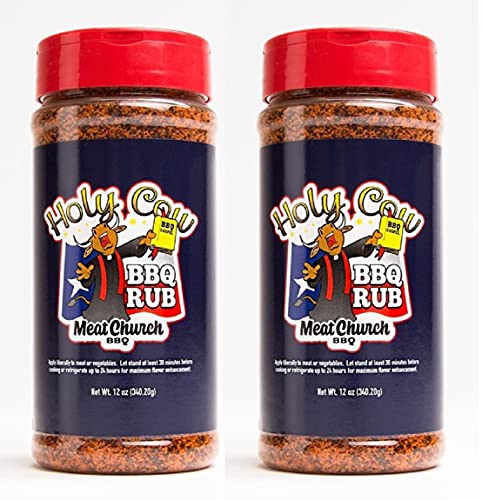
Meat Church Holy Cow — the Texas brisket benchmark
Holy Cow, from Matt Pittman’s Meat Church line out of Texas, is the bottled expression of the Central Texas brisket creed: coarse black pepper first, salt close behind, garlic and paprika in supporting roles, and sugar kept so low it barely registers. The grind is the headline. The pepper is genuinely coarse — the kind of cracked, uneven grind that comes from a mill set wide, not from powder with ambitions — and across a twelve-hour cook those particles hold their structure, building the craggy, dark, almost crunchy bark that brisket people cross state lines for. This is a rub that understands its assignment: on a brisket, the rub’s job is texture and pepper warmth, and the beef is supposed to supply the flavour.
That focus cuts both ways, and the label is honest about it if you read the ingredient order. There is very little here to sweeten or round out leaner meats, and on ribs or chicken the blend reads as what it is — a beef rub visiting other animals. The pepper, so right on a thick brisket flat, can dominate a thin cut, and anyone sensitive to pepper heat should know this is a forward expression of it, not a background note. Within its intended territory, though, the construction is close to faultless: coarse salt that seasons without harshness, enough garlic to deepen the pepper, and a restraint with sugar that means it can be applied the night before as a true dry brine without softening the surface it is meant to crust.
Strengths: genuinely coarse pepper grind that survives a full brisket cook as texture; salt-led formula that works as an overnight dry brine; very low sugar, so no scorch risk across the longest cooks; deep competition and backyard track record specifically on brisket; layers cleanly under a sweeter finishing rub for cooks who want both.
Trade-offs: pepper-forward to a degree that will overwhelm thin cuts and delicate meats; offers almost no sweetness or colour help on pork, where it reads austere; the coarse grind needs a binder or a well-dried surface to cling evenly on smooth cuts; brisket-only value — households that rarely smoke beef will underuse it.
Who it suits: the brisket cook, whether devout or aspiring, who wants the Central Texas result without grinding pepper by hand at midnight, and who seasons by the philosophy that beef needs salt, pepper, smoke and time — in that order.
If a packer brisket is the reason your smoker exists, this coarse, pepper-led bottle is the closest thing to the Lockhart counter you can shake from a jar — check price on Amazon.
Check price on Amazon: Meat Church Holy Cow
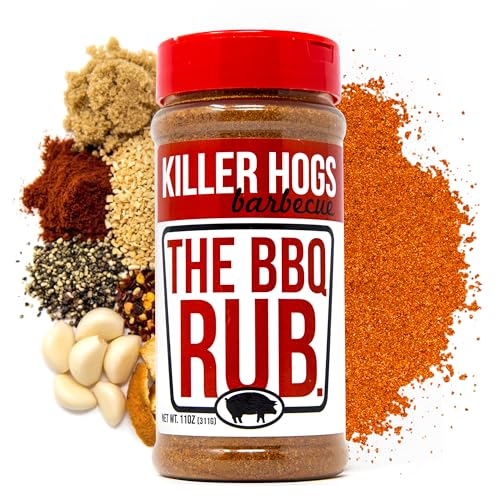
Killer Hogs The BBQ Rub — the balanced all-rounder
Malcom Reed’s Killer Hogs The BBQ Rub is the bottle that built a following by refusing to specialise. Sugar and salt sit near the front of the label together, with paprika, chilli powders, garlic and a little mustard warmth behind them, and the result is the category’s centre of gravity: sweet enough to give ribs their mahogany glow, salty enough to season a pork shoulder properly, and mild enough in heat that a whole family eats without negotiation. The grind is fine-to-medium, dissolving into the surface rather than standing on it, which produces the smooth, even, deeply coloured bark that competition photographs are made of. On pork in particular, this is the rub whose colour other rubs are compared against.
Balance, by definition, means winning nowhere outright. On brisket, the sugar content and fine grind give a competent, good-looking result that a Texas-style blend beats for texture and depth; the sweetness that flatters pork needs watching across the very longest cooks, and most experienced users apply it closer to cook time rather than as an overnight brine. The heat level, pitched for the broadest audience, will leave chilli devotees reaching for a second bottle or a pinch of cayenne of their own.
Strengths: the most even salt-sugar balance in this roundup, genuinely at home on pork, ribs and chicken; fine-to-medium grind sets into a smooth, deeply coloured bark; mild, family-friendly heat that layers easily for those who want more; long competition pedigree on the barbecue circuit; the single-bottle answer for mixed cookouts.
Trade-offs: sugar content argues for applying near cook time on the longest smokes rather than overnight; brisket texture cannot match the coarse Texas blends; heat is deliberately gentle, which spice seekers will find tame; the fine grind can clump in humid storage if the jar is left open near steam.
Who it suits: the household that smokes a bit of everything and wants one dependable bottle to do it with — especially pork-first cooks who value colour and balance over extremes in any direction.
Households that smoke a little of everything and want one jar that never picks the wrong fight will find this balanced, pork-flattering blend the easiest recommendation in the category — check price on Amazon.
Check price on Amazon: Killer Hogs The BBQ Rub

Heath Riles BBQ Sweet BBQ Rub — the rib and pork specialist
Heath Riles built his name on competition ribs, and his Sweet BBQ Rub is exactly what the name promises: a sugar-forward blend, built on brown sugar’s deeper caramel register, with paprika and mild chilli warmth arranged underneath to keep the sweetness tasting like barbecue rather than dessert. The grind is fine, engineered to dissolve into the surface of a rib and set — especially across a foil wrap — into the glossy, lacquered finish that defines the competition rib look. Where a Texas brisket rub is about restraint, this bottle is about generosity: it is designed to be the flavour and the colour of the finished rib, not a supporting act.
The same generosity defines its limits, and they are the classic sweet-rub limits stated plainly. Sugar this prominent has a ceiling on exposure: on ribs cooked hot and fast by barbecue standards, or through a long unwrapped cook, the edges can push past caramel into scorch, and on a brisket-length smoke this is simply the wrong tool. The sweetness also polarises — households raised on savoury, pepper-led barbecue sometimes find a full coat one-dimensional, which is why the layering approach described earlier, a savoury base with this rub dusted over it, is the way many experienced cooks deploy it. Used inside its design window — ribs, pork butt, pork belly, anything wrapped or glazed — it is as accomplished as bottled sweetness gets.
Strengths: brown-sugar depth that caramelises into an exceptional rib glaze, especially across a foil wrap; fine grind dissolves evenly for the smooth competition finish; paprika and mild chilli keep the sweetness anchored in barbecue flavour; a favourite layered over savoury base rubs for colour and finish; excellent on pork belly and burnt-end style cooks.
Trade-offs: the sugar ceiling is real — long unwrapped cooks and brisket are outside its design window; sweetness-forward profile will not convert devotees of savoury Texas style; fine, sugary blends are the most prone to clumping in the jar; as an overnight application it can keep the surface tacky rather than dry.
Who it suits: the rib cook chasing the glossy, sweet, competition-style finish, and pork lovers generally — anyone whose favourite bite in barbecue is the caramelised edge of a well-wrapped rack.
Rib cooks chasing that glossy, caramelised, wrap-friendly finish should start here, because this is the sweet rub the competition circuit keeps reaching for — check price on Amazon.
Check price on Amazon: Heath Riles BBQ Sweet BBQ Rub

Kosmos Q Dirty Bird — the poultry specialist
Poultry is where generic rubs most often fail, and Dirty Bird from Kosmos Q exists because of that failure. Chicken and turkey skin is a unique seasoning surface: it needs to render and crisp, it scorches sugar faster than bark does, and it sits over mild meat that a heavy hand can bury. Dirty Bird answers with a fine grind that coats skin as a single even sheet, a sugar level tuned noticeably below the pork rubs — present for colour, restrained enough to respect a long smoke — and a savoury, herb-leaning spice profile with gentle heat that seasons the bird without turning it into a generic barbecue flavour delivery system. The result the blend is built for is skin that colours deeply and stays intact, over meat that still tastes like chicken.
Its specialisation is genuine, which means the compromises are too. On brisket, the fine grind and poultry-tuned salt level produce a thin, polite bark that beef cooks will find underwhelming, and the herb notes that flatter a turkey sit oddly on a pork shoulder. The bottle also rewards correct technique more than most: rub scattered under loosened skin does little, rub piled on wet skin clumps, and the blend performs at its best on skin patted properly dry — a step the label cannot take for you. Within its brief, though, it solves the actual problems of smoked poultry — even coverage, controlled sugar, skin that crisps — rather than merely being a pork rub in a different coloured jar, which is rarer in this category than it should be.
Strengths: fine grind coats poultry skin evenly and lets it crisp as one sheet; sugar restrained to a level long smokes and delicate skin can tolerate; savoury, herb-leaning profile that seasons without masking mild meat; equally at home on whole birds, spatchcocked chickens and turkey; a natural partner for brined birds, where its surface seasoning completes the process.
Trade-offs: too fine and too gently salted to build a serious bark on brisket or shoulder; herb character is a poor match for traditional pork profiles; demands dry skin to perform — it will clump on a wet bird; households that smoke poultry rarely will not finish the jar while it is lively.
Who it suits: anyone whose smoker sees whole chickens, Thanksgiving turkeys or trays of thighs more often than briskets — and competition cooks who treat chicken as the category where rounds are won and lost.
If your smoker spends its life cooking chickens and turkeys, this fine, skin-aware blend solves the problems generic rubs keep causing — check price on Amazon.
Check price on Amazon: Kosmos Q Dirty Bird

Hardcore Carnivore Black — the low-sugar dark horse
Hardcore Carnivore Black, created by Australian pitmaster Jess Pryles, is the most visually dramatic rub in this guide and the most dietarily deliberate. Its signature ingredient is activated charcoal — food-grade, flavour-neutral, and present for one reason: it gives beef a deep, jet-black bark that looks like a steakhouse crust hours before a conventional rub would get there. Underneath the theatre, the formula is a savoury salt, pepper and garlic construction with strikingly little sugar, which makes it the pick of this roundup for cooks managing sugar intake who refuse to accept a paler, lesser brisket as the price. On beef, and on beef cooked over live fire especially, the effect is remarkable: the blackened exterior of a much longer cook, with a clean, savoury, peppery flavour that never turns sweet or scorched.
The charcoal is also the source of every caveat. A rub that colours meat black on contact removes the cook’s oldest instrument — judging doneness and bark development by eye — and newcomers can find themselves flying blind, dependent on temperature and touch sooner than they expected. The blackening is cosmetic confidence, and on pork or poultry it can look less like bark and more like an accident; this is a beef instrument, full stop. There is also a practical note worth stating plainly: activated charcoal can interfere with the absorption of some medications, a fact the brand itself acknowledges, so households where that matters should treat this bottle as an occasional guest rather than a house rub.
Strengths: very low sugar, making it the natural pick for sugar-conscious cooks and the longest cooks; activated charcoal delivers a deep black bark and crust appearance far earlier than conventional rubs; clean salt-pepper-garlic profile that lets beef flavour lead; exceptional on steaks and beef ribs as well as brisket; no scorch ceiling to manage across extended smokes.
Trade-offs: the instant black colour removes visual doneness cues, which unsettles less experienced cooks; looks wrong on pork and poultry — a beef-only tool in practice; activated charcoal can affect absorption of some medications, so it is not for every household; the dramatic crust can read as burnt to guests who do not know the trick.
Who it suits: brisket and beef cooks who want the steakhouse-black crust without sugar — including anyone cooking low-sugar by necessity rather than fashion — and grillers who finish steaks over open flame.
Beef cooks who need a genuinely low-sugar rub that still delivers a black, steakhouse crust will not find a more deliberate bottle than this one — check price on Amazon.
Check price on Amazon: Hardcore Carnivore Black

Plowboys BBQ Yardbird Rub — the fine-ground competition all-rounder
Yardbird, from Todd Johns and the Plowboys BBQ team, carries a name that undersells it: built originally for competition chicken, it became one of the most decorated all-purpose rubs in American barbecue, with a long record on pork as well. The construction explains the double life. The grind is the finest in this roundup, a true powder that melts into a surface and sets as a smooth, uniform, almost polished crust. The flavour is savoury-led with sugar in a supporting role rather than the lead — paprika, garlic, chilli and a gentle sweetness composed so that nothing arrives first or loudest. Where Killer Hogs builds its balance around sweetness, Yardbird builds its around savoury depth, and the difference is obvious the moment the two sit side by side on identical ribs.
A powder this fine asks for a little technique and repays it. Sprinkled from a height, it falls evenly; dumped from the jar at close range, it lands in drifts that season unevenly and can cake on a damp surface — the classic fine-rub failure, and the reason a thin binder earns its keep with this bottle. The smoothness that wins on ribs and chicken is, on brisket, a matter of taste: cooks who want rugged Texas texture will find the finish too refined, while cooks who slice brisket for presentation often prefer exactly this clean, even crust. Its heat is mild and its salt precise, which makes it the easiest rub here to layer — a dusting of something coarser or sweeter over a Yardbird base is a combination with a great deal of silverware behind it.
Strengths: the finest, most even-setting grind in this roundup, for a smooth competition-grade crust; savoury-led balance that flatters pork and chicken without sweetness taking over; an exceptional competition record across multiple categories; mild heat and measured salt make it the easiest base for layering; performs beautifully on ribs, where its polish shows most.
Trade-offs: powder-fine texture will drift and cake if applied heavily onto damp meat from close range; brisket traditionalists will find the resulting bark too smooth and refined; the understated profile may read as quiet to palates that like a rub to announce itself; like all fine blends, it loses its aromatics faster in storage than the coarse picks.
Who it suits: the detail-minded cook — competition-curious or simply particular — who values an even, polished finish on ribs and chicken and wants a savoury base that layers gracefully with everything else on the shelf.
Cooks who prize a polished, even finish and a savoury base that layers with everything should give this competition-proven powder the last word on their ribs — check price on Amazon.
Check price on Amazon: Plowboys BBQ Yardbird Rub
The six rubs at a glance
| Rub | Built for | Sweetness | Grind | Bark style | Overnight dry brine? |
|---|---|---|---|---|---|
| Meat Church Holy Cow | Brisket and beef | Minimal | Coarse | Rugged, peppery, craggy | Yes — ideal for it |
| Killer Hogs The BBQ Rub | All-purpose, pork first | Moderate | Fine to medium | Smooth, deep mahogany | Better near cook time |
| Heath Riles Sweet BBQ Rub | Ribs and pork | High | Fine | Glossy, lacquered glaze | No — apply before cooking |
| Kosmos Q Dirty Bird | Chicken and turkey | Low to moderate | Fine | Thin, even, skin-friendly | Pairs with a wet or dry brine |
| Hardcore Carnivore Black | Beef, low-sugar cooks | Very low | Medium | Jet black, steakhouse crust | Yes |
| Plowboys Yardbird | Chicken and pork | Low to moderate | Very fine | Smooth, polished, uniform | Yes, as a savoury base |
Read the table the way a cook would use it: start from the meat column, check the sweetness against the length of your cook, and let the grind confirm the texture you want on the plate.
Matching the rub to the meat
Brisket rewards restraint and texture. The meat is rich, the cook is the longest in barbecue, and the flavour that should dominate is beef and smoke — which is why the two beef picks in this guide are both salt-and-pepper constructions with minimal sugar, differing mainly in how they build their crust: Holy Cow through coarse pepper that stays textural, Hardcore Carnivore Black through charcoal that darkens the surface from the first hour. A sweet rub on a brisket is not a crime, but it is a decision to fight the cook’s length, and the wrap becomes a rescue operation rather than a technique. Beef ribs follow the same logic with even more enthusiasm, since their fat and size forgive a heavy, coarse hand.
Pork is where rubs get to perform. A shoulder’s long cook and heavy fat can carry sweetness, colour and spice in a way brisket never asks for, and the category’s best pork results come from the balanced-to-sweet middle of this guide: Killer Hogs for an even, crowd-pleasing mahogany, Heath Riles Sweet when the cook involves a wrap and a glaze, Yardbird when the finish needs to be smooth and precise. Ribs narrow the choice further by cooking faster and presenting more surface per bite — the rub is a larger share of the rib experience than of any other cut, which is why rib specialists accept sugar levels that would be reckless on a shoulder left unwrapped.
Poultry and the rest follow the skin rule: whatever touches skin should be fine, moderate in sugar, and applied to a dry surface. Dirty Bird is the specialist answer; Yardbird is the generalist that handles birds nearly as well. Fish, rarely the headline of a smoker guide, deserves one sentence: it wants the lightest touch in this entire article — a fine, low-sugar dusting, closer to Dirty Bird’s restraint than to anything sweet — because smoke overwhelms delicate flesh faster than any rub can protect it.
Five mistakes that quietly ruin a good rub
The first is seasoning to the clock instead of the cut: salting a brisket with a sweet rub the night before, because the routine says overnight, and waking to a tacky, weeping surface that never quite sets. Match the rub’s sugar to the schedule, not the schedule to habit. The second is the close-range dump — shaking a fine rub from two inches above the meat so it lands in drifts, then wondering why one rib is seasoned and the next is bland. Every rub in this guide performs better sprinkled from a height, in two light passes, than in one heavy one.
The third is judging by the first hour. Rubs look wrong early: the colour is raw, the surface is wet, the pepper sits pale. Bark is a late development, and cooks who intervene — more rub, more spray, an early wrap — in response to hour-two appearances routinely undo hour-ten results. The fourth is the contaminated jar: rub shaken over steaming meat absorbs that steam, and rub sprinkled from a hand that has handled raw meat carries the kitchen’s least welcome ingredient back into storage. Decant what you need into a small bowl and work from that.
Frequently asked questions
How far ahead should I apply a rub before smoking?
It depends on the rub’s salt-to-sugar posture. Salt-led blends like Holy Cow, Hardcore Carnivore Black and Yardbird reward a long rest — anywhere from a few hours to overnight in the refrigerator, uncovered on a rack — because their salt works into the meat as a dry brine while the surface dries for bark. Sweet rubs like Heath Riles Sweet, and balanced ones like Killer Hogs on the longest cooks, are better applied an hour or so before the meat goes on, so the sugar spends its time caramelising in the smoker rather than drawing moisture on a tray. Poultry rubs sit in between: Dirty Bird can go on the night before if the skin is left uncovered to dry, which is exactly what crisp skin wants.
Can I use one of these rubs in an oven or air fryer instead of a smoker?
Yes, with adjusted expectations. The seasoning itself is heat-agnostic, and every pick here will flavour roasted or air-fried meat perfectly well — Yardbird and Dirty Bird on chicken and Killer Hogs on pork are all excellent away from smoke. What changes is the bark equation: without hours of low, humid, smoky air, the crust develops faster and thinner, and the sugar-heavy blends need more watching because dry oven and air fryer heat can push caramelisation further in the last minutes than a smoker would.
What is the difference between a rub and a seasoning blend?
In practice, intent and construction. A rub is built to be applied thickly, by the handful, as a coating that becomes part of the finished surface — its salt level, grind and sugar are all calibrated for that heavy application and for long exposure to heat. A general seasoning blend is built to be applied by the pinch or teaspoon as a flavour accent, and many are far too salty, too fine or too delicate to survive being packed onto a brisket for twelve hours. The six products in this guide are rubs in the strict sense. Reaching for a favourite all-purpose seasoning and applying it at rub quantities is one of the more reliable ways to produce oversalted, scorched meat.
How should I store rubs, and when should I replace them?
Cool, dark and sealed is the whole doctrine: a cupboard away from the stove’s steam, lids closed properly, and bulk quantities decanted into a working jar so the main supply is opened rarely. Time is the enemy in a specific order — paprika and chilli powders fade in colour and warmth first, the dried herbs go quiet next, and the allium powders risk turning harsh over time, while salt and pepper are effectively permanent. As a household rule, a paprika-led rub is at its best within a season or two of regular cooking and merely acceptable after that. If a rub has lost its colour and smells dusty rather than pungent when the jar opens, it has already given its verdict: replace it before it costs you a brisket.
Is a binder necessary before applying the rub?
No, but it is often useful, and the distinction matters. Given thirty minutes, the meat’s own surface moisture will grab a rub adequately for most cooks, and traditionalists who use nothing get excellent bark. A thin binder — plain yellow mustard is the classic, and its flavour cooks away entirely — buys evenness: it helps fine rubs like Yardbird and Dirty Bird coat smooth surfaces without bare patches, and helps coarse rubs cling to lean cuts. Keep it to a thin glaze rather than a sauce, avoid acidic binders on delicate fish, and never let the binder become a layer the bark has to steam through. It is a tool for uniformity, not a flavouring and not a ritual.
The bottom line
Six bottles, three philosophies. The Texas pair — Holy Cow’s coarse pepper and Hardcore Carnivore Black’s charcoal darkness — hold that brisket wants salt, texture and restraint, with Black adding the low-sugar route to the same destination. The centre of the category, Killer Hogs and Yardbird, argues for balance in two dialects, one sweet-led and one savoury, between them covering almost any mixed cookout a household will host. And the specialists, Heath Riles Sweet for the glazed rib and Dirty Bird for the bird itself, make the case that some meats deserve a blend built for them alone. Choose by the meat you cook most, respect the sugar ceiling on long smokes, and buy the size you will finish while it is still alive with paprika. Do that, and the rub stops being the variable you worry about — it becomes the crust your smoker is known for.


