Disclosure: This article contains affiliate links, and we may earn an affiliate commission when you buy through links on this page, at no extra cost to you.
A stainless steel toaster earns its place on the counter twice over. It has to brown bread evenly, morning after morning, and it has to look good doing it, because unlike a blender or a food processor it rarely gets put away. That combination is harder to find than it sounds. plenty of handsome steel toasters toast one side darker than the other, run so hot on the outside that they are unpleasant to touch, or use a lift lever that feels flimsy within the first month. Others toast beautifully but show every fingerprint the moment a child walks past with jam on their hands.
This guide works through the six stainless steel toasters we would actually recommend to friends and family, across premium, mid-range and budget tiers. Some are compact two-slice models built for small counters and single households. Some are four-slice workhorses designed for families who queue up for toast on school mornings. One is a retro-styled showpiece, one is a hand-built classic that can be repaired rather than replaced, and one is a straightforward budget model that covers the basics without pretending to be more than it is.
Because we evaluate toasters as prose reviewers rather than with affiliate links in this draft, every pick ends with the same advice: check price on Amazon before you buy, since toaster pricing moves around a great deal with seasons and promotions, and the right choice depends on the slot width, footprint and finish that fit your kitchen.
What to look for in a stainless steel toaster
Even browning on both sides
The single most important job of a toaster is to brown both sides of a slice to the same shade, and to repeat that shade on the next slice and the one after that. Uneven toasting usually comes from heating elements that are spaced too far apart, elements that have warped slightly, or a chamber that reflects heat unevenly because one wall sits closer to the bread than the other. Better toasters use closely spaced elements, a well-centered slot, and enough insulation that the outer slices in a four-slice model do not toast paler than the inner ones. When you read owner feedback, look for comments about consistency across a whole loaf, not just the first slice of the day, because the first cycle of the morning starts from a cold chamber and almost every toaster runs slightly lighter on that first round.
Shade settings matter here too. A useful dial gives you a genuine range, from a pale gold that barely firms up soft white bread to a deep brown for dense rye, without jumping from underdone to burnt between two neighbouring notches. Models with electronic browning control tend to hold a shade more consistently across back-to-back cycles than simple mechanical timers, because they compensate for a chamber that is already hot. If your household toasts frozen waffles, bagels and sandwich bread in the same morning, that consistency saves real frustration.
Slot width and the bagel question
Standard slots handle standard sandwich bread, and not much else. The moment you want to toast a halved bagel, a thick slice of sourdough, a crumpet or a chunk of homemade loaf, slot width becomes the deciding feature. Look for self-centering slots that are genuinely wide, roughly an inch and a half or more, and for a bagel setting that toasts the cut side while gently warming the crust side instead of blasting both. Self-centering guides matter more than raw width: they hold a thin slice in the middle of the chamber so both sides sit the same distance from the elements, which is exactly what even browning requires.
Long-slot designs take a different approach, fitting artisan loaves lengthwise, while four-slice models with two independent slot pairs let one person toast a bagel while another toasts plain bread at a different shade. Think about what your household actually eats. A couple who buys bakery sourdough twice a week will use width every day. A family working through sliced sandwich loaves may never need more than standard slots, and would be better served by speed and a second pair of slots.
Steel that runs hot, and the fingerprint problem
Stainless steel is not one finish but a family of them, and the differences are practical, not just cosmetic. Brushed steel hides fingerprints and fine scratches reasonably well and suits busy family kitchens. Polished or mirror steel looks striking in a showroom and then records every touch, every splash and every wipe mark in daily use. Some manufacturers apply fingerprint-resistant coatings or use a slightly textured finish, which helps, though no coating makes a toaster wipe-proof. The other honest trade-off is heat: a metal body conducts heat in a way a plastic body does not, so the sides and top of a steel toaster can become genuinely hot during and just after a cycle, especially on back-to-back rounds. Households with small children should plan placement accordingly, keeping the toaster back from the counter edge and teaching little hands that the shiny box stays hot for a while after the toast pops.
Thickness of the steel matters as well. Thin, lightweight steel can flex, dent and transmit more heat and noise. Heavier-gauge bodies feel planted on the counter, resist dents from stray pans, and tend to belong to toasters built for a longer service life. You can feel the difference the first time you press the lever: a solid toaster does not skid or rock when you push down.
The lift lever and long-term durability
The part of a toaster that fails first is rarely the element. It is the moving hardware: the carriage, the latch, the spring and the lever you press thousands of times. A high-lift lever is also a daily convenience, raising small items like crumpets and English muffin halves high enough to grab without fishing around with wooden tongs or, worse, a fork. Test the feel in descriptions and reviews: the action should be smooth, the latch should engage with a positive click rather than a hopeful suggestion, and the carriage should rise evenly rather than tilting the toast. Toaster ovens aside, a simple two or four-slice pop-up has few moving parts, and the best manufacturers treat those parts as the product. This is also where repairability enters the picture, since a toaster whose carriage or element can be serviced can stay in a kitchen for decades instead of heading to landfill after one failed spring.
Controls you will actually use
Beyond the shade dial, the controls worth having are few and specific. A bagel setting, as described above. A frozen setting that adds a little time for bread straight from the freezer. A reheat function that warms toast without browning it further, for the slice that popped up while you were answering the door. A cancel button that actually stops the cycle instantly. Some models add a gentle countdown or a quick-check feature that lifts the toast so you can peek at the shade without cancelling the cycle, which sounds like a gimmick until you use it daily with unfamiliar breads. What you do not need is a touchscreen, an app, or a dozen presets for bread types that all do roughly the same thing. Simple, labelled, tactile controls that can be operated with buttery fingers at 7 a.m. beat novelty every time.
Crumb management and cleaning
Every toaster fills with crumbs, and crumbs left in place eventually scorch, smoke and flavour the next slice. A removable crumb tray that slides out smoothly from the back or side is the minimum requirement, and it should be wide enough to catch the full footprint of the slots rather than a token strip. Beyond the tray, look at the interior: fewer ledges and seams mean fewer trapped crumbs. The exterior routine is simple but worth stating: unplug, let the toaster cool fully, wipe brushed steel with a damp microfibre cloth along the direction of the grain, and dry immediately to avoid water spots. Never immerse a toaster, and never shake it violently over the counter unless you enjoy sweeping.
black friday kitchen appliance deals 2026
In this guide
Quick comparison
| Toaster | Capacity | Best for | Standout trait | Tier |
|---|---|---|---|---|
| Breville Bit More 2-Slice | 2 slices | Small households wanting precision | Quick-check lift and fine shade control | Premium |
| Cuisinart Metal Classic 4-Slice | 4 slices | Families and shared kitchens | Dual independent controls | Mid-range |
| Dualit NewGen 2-Slice | 2 slices | Buyers who keep appliances for decades | Hand-built, repairable design | Premium |
| KitchenAid 2-Slice with High Lift | 2 slices | Everyday reliability and small items | High-lift lever and sturdy feel | Mid-range |
| Smeg 2-Slice Retro | 2 slices | Design-led kitchens | 1950s styling with modern guts | Premium |
| Mueller Stainless Steel 4-Slice | 4 slices | Budget family toasting | Four slots and basics done plainly | Budget |
With those criteria in mind, here is the full breakdown of each pick: what it does well, where it compromises, and who should buy it.

Breville Bit More 2-Slice
Breville built its reputation in this category by treating toast shade as a precision problem, and the Bit More is the clearest expression of that thinking in a compact two-slice body. The brushed stainless housing is tidy and modern, the footprint suits smaller counters, and the controls are arranged around one idea: you should be able to see, adjust and rescue your toast without starting over. A slider sets the shade, dedicated buttons handle bagel and frozen bread, and the signature quick-check function raises the carriage mid-cycle so you can look at the colour and drop it back down if it needs longer.
Strengths: The browning consistency is the headline. Slice after slice comes out close to the selected shade, and the compensation for a hot chamber means the second round does not overshoot the way cheaper toasters do. The extra-time button adds a short burst of toasting for bread that is nearly there, which is more useful than it sounds because it replaces the usual gamble of restarting a full cycle. The slots are wide and self-centering, so bagels and thick bakery slices sit properly, and the bagel mode treats the crust side gently as it should. The crumb tray is full-width and slides out cleanly, and the overall fit and finish, from the lever action to the cord storage underneath, feels a cut above the mid-range crowd.
Trade-offs: It is a premium-priced two-slice toaster, and households that toast for four people every morning will feel the queue. The polished accents around the top show fingerprints more readily than the brushed sides, and like most steel toasters the top plate gets hot during heavy use. The electronic controls, while excellent, mean more components than a purely mechanical design, so this is not the buy-it-for-thirty-years option in the list.
Who it suits: Singles, couples and small households who toast varied breads, care about getting the shade right, and would rather own one precise two-slice toaster than a bigger, sloppier one. If your mornings involve sourdough one day and frozen waffles the next, this is the control set you want. As always with this brand’s pricing, which dips often enough to matter before you decide, it pays to check price on Amazon.
Cuisinart Metal Classic 4-Slice
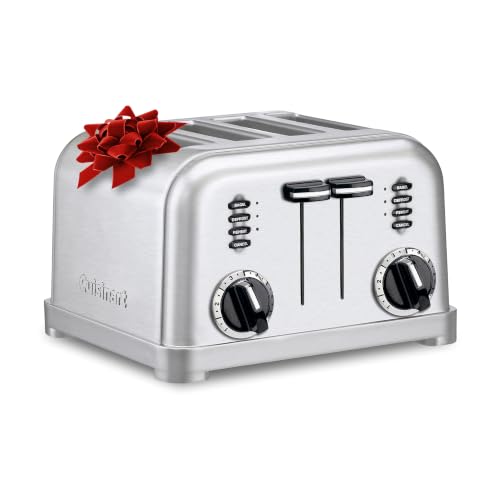
The Cuisinart Metal Classic takes the opposite approach to the Breville: instead of refining a single pair of slots, it gives you two complete toasters in one brushed stainless body, each with its own shade dial and its own bagel, defrost and reheat controls. For a family kitchen, that dual-control layout is the feature that matters most, because the person who likes pale toast and the person who likes it dark no longer have to negotiate or take turns resetting the dial.
Strengths: Capacity and independence. Four slices at once, in two pairs that can run different shades and different functions simultaneously, moves a family through breakfast noticeably faster. The slots are wide enough for bagels and thick slices, with self-centering guides that keep thinner bread honest. Browning is reliably even for a toaster at this level, particularly across the inner slots, and the high-lift levers raise small items clear of the chamber. The brushed finish shrugs off fingerprints better than polished steel, the body feels substantial without being enormous, and the controls are big, labelled knobs and buttons that anyone in the house can work out without a manual.
Trade-offs: It takes real counter space, and in a small kitchen it will dominate the corner it occupies. Outer slices can occasionally run a touch lighter than inner ones on the very first cycle of the day, a common four-slice trait that the second round mostly erases. The styling is handsome but conventional, so buyers shopping for a design statement should look at the Smeg below. As with all four-slice steel models, the top surface gets hot, and the crumb trays, while removable, are split into two smaller trays that need emptying a little more often.
Who it suits: Families, shared houses and anyone who hosts weekend breakfasts. If your kitchen regularly produces four slices at two different shades, this is the most sensible mid-range way to do it in stainless steel. It sits in the middle of the price bands covered here, and frequent bundle and seasonal offers make it worth a look, so check price on Amazon.

Dualit NewGen 2-Slice
The Dualit NewGen is the outlier of this list and, for the right buyer, the most interesting toaster here. It is hand-assembled in England from heavy-gauge stainless steel, uses a mechanical timer rather than electronics, and is designed from the outset to be repaired: elements, timer and carriage parts can be serviced or replaced instead of sending the whole appliance to landfill. The styling is industrial and unmistakable, all polished steel, exposed fasteners and a chunky end-of-cycle lever action that feels like operating a small machine, because that is essentially what it is.
Strengths: Build quality is in a different league. The body is heavy, rigid and resistant to dents, the slots are genuinely wide and swallow thick slices, bagels and teacakes without complaint, and the browning, once you learn your timer settings, is deep and even. The mechanical timer gives a tactile, repeatable control that many owners come to prefer: you learn that your sourdough wants a particular number and it delivers it for years. The repairability is not a marketing line; spare elements and parts have been available for these toasters for decades, which is why older Dualits are still in daily service in cafes and homes. The defrost function and the bagel-friendly setup, where you can warm one side using the slot arrangement, cover the practical bases.
Trade-offs: This is the most expensive style of toaster on the list relative to its two-slice capacity, and the value case rests entirely on longevity, so it makes little sense for a short-term rental kitchen. There is no electronic shade compensation, so the first slice of the day and a slice toasted in a hot chamber need slightly different settings, and there is a learning curve while you calibrate. The polished finish is a fingerprint magnet and the body runs hot, and the timer’s ticking, charming to some, is audible. It also lacks the peek-and-lower convenience features of the Breville.
Who it suits: Buyers who keep appliances for decades, dislike throwaway electronics, and enjoy mechanical things that can be maintained. If the idea of replacing an element in fifteen years appeals more than a touchscreen does, this is your toaster. Given the premium positioning, consider it against the cost of two or three mid-range toasters over the same lifespan, then check price on Amazon.

KitchenAid 2-Slice with High Lift
KitchenAid’s two-slice toaster is the steady, well-mannered option in this roundup: a brushed stainless body, extra-wide self-centering slots, a shade dial with a sensible spread of settings, and a manual high-lift lever that raises the toast well clear of the slots. It does not chase novelty. It concentrates on the daily mechanics of toasting and does them with the solid, slightly over-engineered feel the brand’s countertop line is known for.
Strengths: The high-lift lever is the standout in practice. Crumpets, English muffins and the heels of loaves come up high enough to take hold of safely, which removes the most annoying moment in toaster ownership. Slot width is generous and the centering guides work, so bagels toast on the cut side without scorching the crust when the bagel setting is engaged. Browning evenness is dependable across both sides of a slice, the defrost setting handles frozen bread without drying it out, and an audible tone when the cycle finishes is a small mercy in a busy kitchen. The steel body has real heft, the controls are a single clear dial plus labelled buttons, and the crumb tray removes from the back for a proper empty rather than a shake over the sink.
Trade-offs: It is a two-slice model at a mid-range price, so families will queue, and there is a four-slice sibling in the range for those who need it, at a larger footprint and cost. The end-of-cycle tone cannot be silenced on all versions, which early risers in quiet houses may notice. The top of the unit gets hot in extended use like every steel toaster here, and the finish, while brushed, still benefits from a wipe along the grain to keep water spots away near a sink.
Who it suits: Households of one to three people who want a dependable, good-looking steel toaster from a mainstream brand with strong parts and support availability. It is the pick we would hand to someone who asked for a toaster that simply works, every day, without a learning curve. It sits in the middle tier of this list, and it is discounted regularly enough that patience pays, so check price on Amazon.

Smeg 2-Slice Retro Toaster
Smeg’s two-slice toaster is bought with the eyes first, and there is nothing wrong with that, provided the toast keeps up. The 1950s-inspired body, with its curved corners, chrome detailing and stainless finish, is designed to sit out permanently as part of the kitchen’s look, ideally alongside the matching kettle. Underneath the styling, it is a competent modern toaster with wide self-centering slots, six browning levels, and reheat, defrost and bagel functions.
Strengths: Design is the obvious strength, and it is executed properly: the enamelled and steel surfaces feel quality, the lever has a satisfying action with a ball-shaped knob that is easy to grip, and the whole unit has the planted weight of a well-made appliance rather than a styled shell over cheap internals. Toasting performance is respectable, with even results on standard bread and a bagel mode that behaves as it should. The slots are wide enough for chunky slices, the crumb tray is removable, and the anti-slip feet and automatic pop-up are all present and correct. For a coordinated kitchen, the matching colour and finish options across the Smeg range are a genuine practical advantage.
Trade-offs: You pay a premium for the design, and measured purely as a toasting machine, models above it in this list match or beat it for less money. The glossy surfaces and chrome show fingerprints and splashes clearly, so it asks for a quick daily wipe to keep the showroom look. Two slices is two slices, and the deep body takes a little more counter depth than minimalist rivals. Shade consistency across many back-to-back cycles is good rather than class-leading, so perfectionists producing toast for a crowd may prefer the Cuisinart or Breville approach.
Who it suits: Anyone furnishing a kitchen where the toaster is part of the decor and will live on the counter permanently. If you already own or plan to own other pieces in the same retro range, the coherence is worth money to you, and the toasting underneath is honest. It is firmly in the premium tier, and colour and finish variants are sometimes priced differently for the identical machine, so check price on Amazon.

Mueller Stainless Steel 4-Slice Toaster
The Mueller four-slice toaster represents the budget end of stainless steel: a straightforward, brushed-finish body, four slots arranged as two pairs, wide enough slots for bagels, and the standard set of functions, including bagel, defrost and cancel, with a browning dial for each pair. It does not attempt the refinement of the Breville or the longevity argument of the Dualit. Its case is simpler: four slices, steel body, low tier pricing, basics covered.
Strengths: Value for capacity is the story. Four-slice stainless toasters from the big brands cost considerably more, and for a family that mainly toasts sandwich bread and frozen waffles, the Mueller covers the brief. The slots are genuinely wide, the levers have a high-lift action for small items, dual controls let two shades run at once, and the removable crumb trays keep cleaning uncomplicated. The brushed steel looks clean and modern on the counter, a clear step up in appearance from plastic budget toasters, and the unit is light enough to move for cleaning without being so light that it slides when you press the lever.
Trade-offs: Browning consistency is the compromise that comes with the tier. Expect slightly more variation between the first and second cycles and between inner and outer slots than the mid-range picks deliver, and a shade dial whose useful range is compressed toward the middle settings. The steel is thinner, the body runs hotter to the touch, and the lever and carriage feel less substantial, which raises fair questions about very long-term durability. Finish and assembly tolerances are those of a budget appliance, so small panel gaps and a lighter crumb tray are part of the deal.
Who it suits: Budget-conscious families, students in shared houses, landlords furnishing a rental kitchen, and anyone who needs four slots in a steel body without paying mid-range money. If your household toasts mostly uniform sliced bread, its weaknesses will rarely show. It is the budget tier of this list, so weigh the saving against the Cuisinart above if even browning matters to you, then check price on Amazon.
how to remove fingerprints from stainless steel appliances
How even browning actually happens
It helps to understand what is going on inside the slots, because it explains why two toasters at similar prices can behave so differently. A pop-up toaster browns bread with radiant heat from electric elements on both sides of each slot, supplemented by hot air moving through the chamber. Bread that sits closer to one element browns faster on that side, which is why self-centering guides matter: they hold each slice at the midpoint, whatever its thickness, so both faces receive a similar dose of heat. Elements are usually wound wire or ribbon on mica boards, and their spacing sets the pattern. Widely spaced windings can leave pale stripes; closely spaced windings give the uniform field that produces an even, edge-to-edge colour.
The chamber walls play a part too. Reflective interior surfaces bounce radiant heat back toward the bread and smooth out the pattern, while the top of the slot loses heat to the room, which is why the top crust of a slice often finishes a shade lighter than the centre. Taller slices that sit proud of the slots will always show this gradient, and no toaster fully defeats physics. What good design can do is keep the difference small and, just as importantly, predictable, so that once you know your setting for a given bread, it works on Tuesday the way it worked on Monday.
Back-to-back consistency is the other half of the story. A toaster that starts cold needs the full cycle to reach a given shade. The same setting, run again immediately in a hot chamber, will overshoot unless the controls compensate. Electronic controls estimate chamber temperature and trim the time; mechanical timers like the Dualit’s do not, which is why experienced owners of mechanical toasters instinctively knock the dial back a fraction for the second round. Neither approach is wrong. Electronic compensation is easier for a household where several people toast at different times, while a mechanical timer rewards a single habitual user who learns it once and benefits for years.
Bread itself is the final variable. Fresh bread full of moisture toasts slower and can emerge crisp outside and soft within; bread a day or two old browns faster and more evenly. Sugary breads and fruit loaves brown quickly and can scorch at settings that plain white bread tolerates. Frozen bread needs the defrost function not because it is frozen solid but because the first part of the cycle has to thaw the slice before browning can begin evenly; skipping it gives you a dark surface over a cold centre. Once you accept that the bread is part of the system, the habit of adjusting one notch for a new loaf stops feeling like a flaw in the toaster and starts feeling like cooking.
Two slices or four: choosing the right format
The format decision deserves more thought than it usually gets, because it fixes your counter footprint for years. A two-slice toaster suits one or two people, toasts in a chamber that is easier to keep even, and leaves room on the counter for other appliances. Its weakness appears at weekends and with guests, when toast becomes a production line and the person making breakfast is still on round three when the eggs are ready. Compact two-slice models like the Breville and KitchenAid above are the right answer for most couples, and they store more easily in shallow cupboards when counters are tight.
Four-slice models solve the queue in two different ways. Dual-control designs, like the Cuisinart and the Mueller in this guide, are effectively two toasters sharing a body: two shades, two functions, full flexibility, at the cost of width. Long-slot four-slice designs instead take two long slots that each hold two standard slices end to end, or one long artisan slice, trading independent control for versatility with bakery loaves. Households that buy unsliced sourdough and farmhouse loaves should look hard at long slots, because cutting a long loaf into halves that fit a standard slot wastes the best part of the bread.
There is also a middle path worth naming: own a good two-slice toaster for daily use and accept that a toaster oven, grill or oven handles the occasional crowd. Many households find that a quality two-slice machine plus the oven’s grill covers every realistic scenario, with less counter space surrendered permanently. The honest question is how many mornings a year you truly toast four slices at once. If the answer is most of them, buy the four-slice. If it is Christmas and the odd Sunday, the two-slice will make you happier the other three hundred and sixty days.
Caring for a stainless steel finish
Stainless steel asks for a small, regular routine rather than occasional heroic cleaning. The daily habit is a wipe with a soft, damp cloth once the toaster has cooled, following the direction of the brushed grain where the finish is brushed, because wiping across the grain with a rough pad is how fine scratches accumulate. A drop of mild washing-up liquid handles greasy splashes from nearby frying. Dry the surface afterwards; the spots people blame on the steel are usually dried mineral deposits from tap water, not flaws in the finish.
Fingerprints on polished steel respond to the same cloth, very slightly dampened, followed by a dry buff. Specialist stainless cleaners exist and work, but most households find them unnecessary if the daily wipe happens. What you should avoid matters more: no abrasive scouring pads, no oven cleaner, no bleach-based sprays left to sit, and no scraping at burnt-on drips with a knife. Burnt sugar spots near the slots are best softened with a cloth soaked in hot water and patience. Inside, empty the crumb tray weekly in a busy kitchen, tip the cooled toaster over a bin monthly and shake gently, and resist the folk habit of turning it upside down and banging it on the counter, which is how carriages get bent.
Heat discolouration, a faint straw or blue tint near the slots on some polished models, is a natural response of steel to repeated high temperatures and is cosmetic only. It can be reduced with specialist polish but tends to return, and most owners learn to read it as the patina of a machine that works for a living. If a showroom finish matters deeply to you, brushed steel and a position away from the hob’s splash zone will keep the toaster looking new far longer than any cleaning product.
One cleaning habit deserves emphasis because it affects the toast itself and not just the appearance: the crumb tray is part of the browning system. A tray heaped with old crumbs sits directly beneath the elements, and that layer insulates, smoulders and eventually flavours fresh bread with a stale, scorched note that owners often blame on the elements. In a household toasting daily, a weekly tray emptying is not fastidiousness but maintenance, and it takes twenty seconds. While the tray is out, a soft brush along the slot guides clears the grit that stops slices centering properly, which, as the browning section explained, is where one-sided toast usually begins.
Placement, heat and safety in a real kitchen
Because a steel body conducts heat, where a toaster lives matters. Keep it on a heat-resistant surface, out from under wall cabinets by a comfortable margin, since the plume of hot air and steam from the slots will, over months, mark the underside of a low cabinet and can soften some finishes. Never run a toaster inside a closed appliance garage or cupboard, and give the sides a little breathing room rather than wedging the unit between a kettle and a knife block. The cord should route so that it does not drape across the slots or hang where a child or a passing sleeve can catch it.
The rules everyone half-remembers are worth restating plainly. Never put a metal implement into a toaster, plugged in or not, because bent elements and damaged insulation follow from it; wooden or silicone toast tongs exist precisely for retrieving a stuck corner. If a slice jams, unplug the toaster and let it cool before freeing the bread. Keep an eye on sweetened breads, pastries with fillings and anything buttered before toasting, all of which can drip, smoke or catch if left through a long cycle. And treat the exterior as hot for several minutes after a heavy session, particularly the top plate; in a house with toddlers, a toaster that lives toward the back of the counter is a small decision with a long payoff.
Troubleshooting uneven or disappointing toast
If one side browns darker, first check the obvious: is the slice thin and sitting against one wall of the slot because the centering guides are clogged with crumbs? A crumb tray and chamber clean cures more uneven toast than any other intervention. If the pattern persists with the guides clean, alternate the slice’s position and note whether the dark side follows the slot or the bread; a fault that stays with the slot suggests an element ageing unevenly, while a fault that follows the bread usually means the loaf was sliced unevenly, which no toaster can fully correct.
Toast that is dark outside and soft inside usually means the shade is being achieved with heat that is too fierce and brief, common when a frozen slice is toasted without the defrost setting or when a very fresh, moist loaf meets a high setting. Drop the shade and use the correct function. Toast that is pale but dry has usually been warmed rather than toasted, the signature of an element on its way out or of a cycle interrupted by a sticky latch that released early. A carriage that will not stay down is often a crumb problem in the latch mechanism rather than a failed magnet, and a thorough clean, done unplugged and cool, is the first remedy before assuming the worst.
Finally, calibrate your expectations by bread. Keep a mental note, or an actual note on the fridge, of the setting each regular loaf in your house prefers. Households that do this stop blaming the toaster within a week, because most inconsistency turns out to be three different breads being asked to behave identically at one setting. The best toaster in this guide still benefits from a user who treats the dial as a recipe rather than a promise.
Reading a toaster specification sheet without being misled
Toaster specifications are a short list, and only some of the numbers on it predict your breakfast. Wattage is the figure manufacturers print largest, and it is the least informative: within the normal range for a two or four-slice machine, wattage tells you the toaster can get hot, not that it browns evenly, and a very powerful element with poor spacing will stripe a slice faster, not better. Treat wattage as a pass or fail check that the machine is in the normal class for its size, then move on to the details that matter.
Slot dimensions deserve the attention wattage gets. Width decides which breads fit, as covered earlier, but slot length and depth matter too. A deep slot swallows a tall slice whole, so the top crust browns with the rest; a shallow slot leaves the top inch of a tall bakery slice pale no matter what the dial says, and owners then flip the slice halfway, which works but should not be necessary. If your household buys tall loaves, compare slot depth against the height of your usual slice before buying, a thirty-second check that prevents years of mild annoyance.
The number of browning levels is another figure that sounds meaningful and mostly is not. Six, seven or nine settings are all fine provided the steps between them are even and the useful range is wide; what you want to know, and what reviews and owner comments reveal better than a spec sheet, is whether the middle settings are genuinely usable or whether everything interesting happens between two notches. A toaster whose dial runs from barely warm to burnt across a quarter turn will frustrate you regardless of how many numbers are printed around it.
Materials language needs translating as well. Stainless steel on a product title can mean a full steel body, steel front panels over a plastic chassis, or a steel-look finish, and the weight of the unit is the honest tell: a genuinely all-steel two-slice toaster has a heft you notice when you lift it out of the box. Crumb tray construction, hinge quality on any attached parts, and whether the feet are proper anti-slip pads or moulded bumps all show up in the first week of ownership. None of this requires expertise to judge in person; it requires only that you value the boring details over the headline numbers, because in a simple appliance the boring details are the product.
Matching the pick to your household and your bread
It may help to see the six picks through the lens of real kitchens rather than features. Consider a couple in a small apartment who buy a sourdough loaf on Saturday and work through it all week, alongside frozen waffles on busy mornings. Their bread is wide, tall and variable, their counter is short, and there are only two of them. The Breville Bit More fits that life: wide slots, a defrost setting that treats the waffles properly, a quick-check lift for the unpredictable sourdough, and a footprint that leaves room for a kettle. The four-slice models would waste counter they do not have on capacity they use twice a year.
Now take a family of five with a school-run deadline. Bread here is sliced sandwich loaves, crumpets and the occasional bagel, needed in volume and at two different shades because one parent eats pale toast and a teenager eats it dark. Capacity and independent controls are the whole game, which is the Cuisinart Metal Classic’s brief exactly, and its brushed finish will survive the fingerprint traffic of a family kitchen. If that same family is furnishing on a tight budget after a house move, the Mueller covers the same shape of morning at a budget tier, accepting a little less consistency as the price of the saving.
A keen home baker who mills through their own loaves and expects appliances to last presents a different brief again. Their slices are thick and irregular, their standards for even browning are high because they made the bread, and they are philosophically opposed to replacing a toaster every few years. That is Dualit territory: wide slots, a mechanical timer they will calibrate to their own loaf and keep for decades, and parts available when something finally wears. The KitchenAid suits the household that wants that same solidity of feel in a mainstream package, with the high-lift lever solving the daily crumpet problem, while the Smeg is the honest choice for the buyer whose kitchen renovation included a colour scheme and who wants the toaster to be part of it, accepting a design premium for a machine that still toasts perfectly respectably underneath.
Two practical checks close the decision. First, measure your counter depth and the clearance under your wall cabinets, and compare both with the dimensions of the model you favour, because a toaster that must be pulled forward every morning to clear a cabinet will quietly irritate you for years. Second, count your sockets. A four-slice toaster, a kettle and a coffee machine competing for two outlets is a rota problem no specification sheet mentions. Buy for the kitchen you have, in the mornings you actually live, and any of the six machines above will feel like the right one.
A working guide to shades by bread type
Because the dial means something slightly different on every model, the useful knowledge is relative: which breads want more than your standard setting, which want less, and which need a function rather than a shade. Start from your everyday sandwich bread as the reference point, the setting you use most, and adjust from there. Dense rye and pumpernickel tolerate and reward a step or two higher, because their dark crumb hides browning until the surface is properly crisped. Wholemeal sits close to white bread but benefits from a touch more time, since its sugars brown a little slower. Brioche, challah and other enriched breads run the opposite way: their sugar and butter scorch quickly, so drop a setting and watch the first slice of a new loaf rather than trusting habit.
Fruit breads and cinnamon loaves are the scorch risk of the category, because exposed raisins and sugar patches blacken while the crumb is still pale; a lower setting and a mid-cycle check, using the quick-lift if your toaster has one, beats rescuing a burnt slice. Bagels want the bagel function rather than a higher shade, since the goal is a crisp cut face over a warmed, chewy crust, and running a bagel on a high standard setting dries the crust out. Crumpets need longer than their size suggests because their tops are mostly holes over a thick, moist base; many owners run them once at a medium setting and again briefly, which is where the extra-time button on the Breville earns its keep. Frozen waffles and frozen bread want the defrost function at your normal shade rather than a guessed higher setting, because the function sequences thawing and browning instead of doing both badly at once. Keep notes for a fortnight and these adjustments stop being decisions at all; they become the way your household toasts, dialed in once and repeated without thought.
Frequently asked questions
Are stainless steel toasters better than plastic ones?
They are better in some specific ways and worse in one. A steel body is more durable, resists staining and heat damage, does not absorb odours, and generally belongs to toasters built to a higher standard with better carriages and elements. The trade-off is that steel conducts heat, so the outside of the toaster gets hotter than a plastic equivalent, and steel costs more for the same internals. If the toaster lives on the counter and gets used daily, steel is usually worth it. For a rarely used spare in a holiday let, plastic is a rational choice.
Why does the first slice of the day toast lighter than the second?
Because the first cycle starts from a cold chamber and part of its energy goes into heating the toaster itself. Once the chamber is hot, the same setting delivers more browning. Toaster makers handle this in two ways: electronic models compensate automatically, while mechanical models expect you to turn the dial down slightly for the second round. If consistency across a whole breakfast matters to you, choose a model with electronic compensation; if you are the only person who toasts, a mechanical timer becomes second nature within a fortnight.
What slot width do I need for bagels and sourdough?
Look for slots described as extra-wide, roughly an inch and a half or more, with self-centering guides, and pair them with a dedicated bagel setting. Standard bagels fit most wide slots when halved, but bakery bagels and thick sourdough slices are the real test, and for long artisan loaves a long-slot model is the honest solution rather than cutting the loaf to fit. If in doubt, measure the thickest slice your household regularly cuts and compare it with the slot width in the specifications before you buy.
How do I keep a stainless toaster free of fingerprints?
Start with the finish: brushed steel hides prints far better than polished steel, and it is the pragmatic choice for a family kitchen. Whatever the finish, a ten-second wipe with a damp microfibre cloth, dried immediately and worked along the grain, removes prints before they build up. Handles and lever knobs take most of the contact, so give them the attention rather than polishing the whole body daily. Specialist sprays help for a showpiece model like a polished retro toaster, but the cloth habit matters more than the product.
How long should a good toaster last?
A mid-range toaster in daily service should give several years of reliable work, and a premium mechanical model that can be serviced can last decades, because its wearing parts, the elements, timer and carriage components, can be replaced. The usual causes of early failure are a damaged carriage from retrieving toast with metal implements, crumb build-up left to harden around the latch, and elements stressed by toasting sugary or buttered items that drip onto them. Empty the tray, keep metal out of the slots, and the toaster you buy this year has every chance of outlasting the kitchen it sits in.
Choose the toaster that matches the bread your household actually eats and the counter it will actually live on, and every ordinary breakfast afterwards quietly takes care of itself.


