Disclosure: this article contains affiliate links, and airfryerkitchensupply.com may earn an affiliate commission when you buy through them, at no extra cost to you.
A glass cooktop looks effortless right up until the first serious boil-over. Then the pasta water dries into a gray mineral ring, a sugary sauce spot bakes into something that resembles amber glass, and the smooth black surface that sold you on the range starts showing every fingerprint, water spot, and faint rainbow smear under the kitchen lights. The good news is that glass-ceramic is tougher than it looks. The bad news is that it punishes the wrong cleaner: an abrasive powder that would be harmless on stainless steel can leave a permanent haze of micro-scratches on glass, and a dried sugar spill left through several heating cycles can bond hard enough to pit the surface when it finally comes off.
That is why “glass cooktop cleaner” is not one product but a small system. You need a cream or paste with enough polishing power for carbonized food, a gentler spray for the daily wipe-down, non-scratch pads that will not dull the finish, and — for the worst sugary burns — a razor scraper used at the right angle while the spill is still warm. The six products below cover that whole range, from a full starter kit to a simple daily spray, and each one is a real product made specifically for glass-ceramic surfaces rather than a general kitchen spray pressed into service.
We have also organized this guide around the three kinds of mess a glass top actually collects, because matching the cleaner to the mess matters more than brand loyalty. Mineral haze from hard water needs different chemistry than a polymerized grease film, and both are different again from the burnt sugar that behaves like molten candy. Get that match right and most cooktops clean up in minutes. Get it wrong and you can scrub for half an hour, or worse, scrub the shine off the glass itself.
What to look for in a glass cooktop cleaner
Know which mess you are fighting
Burnt sugar is the emergency case. When a sugary liquid — caramel, jam, sweetened sauce, even the syrup from candied yams — boils over onto a hot burner, it melts, spreads, and then carbonizes into a hard, glossy deposit. Manufacturers of glass-ceramic panels warn about sugar specifically because the deposit can contract as it cools and pull tiny chips out of the surface, a defect called pitting. The correct response is speed: while the spill is still warm and pliable, hold a razor scraper at a shallow angle and lift it off. Waiting until tomorrow turns a thirty-second job into a chiseling session, and some of the damage may already be done.
Mineral deposits are the slow case. If your tap water is hard, every boiled-over pot leaves a faint white or gray ring as the water evaporates and its calcium and magnesium stay behind. One ring is invisible; fifty rings build into a dull halo around your most-used burner that makes the whole top look tired. Mineral scale responds to mild acids and to fine polishing creams, and it responds best to consistency — a quick cream polish every week or two stops the halo from ever forming.
The third mess is the everyday film: cooking grease that aerosolizes, settles, and polymerizes under heat into a sticky layer that grabs dust and shows fingerprints. This film is what a daily spray is for. It does not need abrasives at all; it needs a degreasing surfactant and a clean microfiber cloth. Using a heavy polishing cream on this film works, but it is slow and wasteful, like washing a car with rubbing compound.
Polishing power without scratching: how these creams work
Glass-ceramic has a hardness that sits in an awkward middle ground. It resists most household chemicals easily, but it can be scratched by anything harder than itself — and that list includes the grit in scouring powders, the mineral fillers in some all-purpose abrasive cleansers, sand tracked onto a sponge from the sink, and the coarse side of a heavy-duty scrub pad. Purpose-made cooktop creams use very fine, soft polishing particles suspended in a thick liquid. The particles are hard enough to shear carbonized food off the surface but soft enough to slide over the glass itself without cutting it, and the cream keeps them lubricated and evenly distributed.
This is also why the pad matters as much as the cream. Every reputable cooktop cream is designed to be used with a non-scratch pad or a soft cloth. Swap in a green heavy-duty scouring pad and you have reintroduced exactly the abrasive the formulator worked to avoid. If a cleaner does not say it is safe for glass-ceramic cooktops on the label, assume it is not, no matter how gentle it feels between your fingers.
What never to use on a glass cooktop
Keep a short list of banned products taped inside a cabinet door if it helps. Abrasive powders and scouring cleansers not labeled for glass-ceramic are the first. Steel wool is the second, including the fine grades — it sheds tiny metal fragments that can embed and rust, and it scratches. Oven cleaner is the third: the caustic formulas meant for enamel oven cavities can etch and discolor glass-ceramic and will destroy the printed burner markings. Ammonia-based glass cleaners are safe on the surface itself but nearly useless on cooked-on grease, and they streak badly on a warm top. Finally, never use a knife, a paint scraper with a thick blade, or a razor held steeply like you are scraping a windshield — the tool for this job is a purpose-made cooktop scraper with a fresh single-edge blade, held almost flat.
The razor scraper: technique is everything
A scraper sounds alarming on glass, but used correctly it is the gentlest tool you own, because it removes the deposit instead of grinding through it. The rules are simple. Use a new, clean blade — a nicked or rusty blade is what scratches. Wet the deposit first with cooktop cream or a little water so the blade glides. Hold the scraper at roughly thirty to forty-five degrees, push with steady, moderate pressure, and work in short strokes, wiping the blade on a paper towel between passes. Keep the blade flat against the glass at all times; the moment you tilt onto a corner, the corner can dig. For burnt sugar, scrape while the top is still warm to the touch — warm, not hot enough to burn you — because the deposit softens and releases far more easily.
Two cautions belong here. Never scrape a top that is cracked or chipped; a blade can catch an edge and extend the damage, and a cracked cooktop is a replacement conversation, not a cleaning project. And never use the scraper as a daily tool. It is the specialist you call for carbonized spots, not a substitute for cream and a pad.
Induction versus radiant: same glass, different habits
Induction and radiant smoothtops share the same glass-ceramic panel, so every cleaner in this guide is safe for both. The cleaning rhythm differs, though. On a radiant top, the glass itself gets hot, so spills bake on where they land and burnt-on rings around the element are the dominant problem; the cream-and-scraper routine matters most. On an induction top, the glass stays comparatively cool except where the pan heats it, so spills bake less aggressively — but sugary liquids can still melt and spread from pan heat, and the sugar warning applies in full. Induction owners tend to fight fingerprints and water spots more than carbon, which pushes them toward daily sprays and polishing cloths. One more induction note: because the surface is a control panel as much as a burner, avoid flooding it with liquid; a damp cloth, not a soaked one, protects the touch controls.
Cream, paste, or spray: matching format to routine
Creams are the workhorses — thick enough to cling, strong enough to polish off a week’s cooking in one session. Pastes go a step further in concentration and are the choice for neglected tops and stubborn stains. Sprays are maintenance products: thin, fast, and streak-free, designed for the two-minute wipe after dinner. Most households that keep a glass top genuinely clean end up owning one of each type, which is why this list deliberately spans all three formats instead of crowning six near-identical creams.
Dwell time: the cheapest cleaning upgrade you own
Nearly every cooktop cream works better when it is given time, and nearly every frustrated review of a good cleaner traces back to skipping that time. The chemistry is unglamorous: the liquid phase of the cream softens the organic binder holding a deposit together, and the fine polishing particles do their work more easily once that binder lets go. On a fresh grease film, dwell time is irrelevant — wipe and go. On a baked ring or a mineral crust, spreading the cream and walking away for three to five minutes converts a scrubbing contest into a wiping exercise. Some cleaners suggest working immediately, so follow the label where it differs, but as a default habit, apply cream to the worst zones first and clean the easy zones while the hard ones soak.
Dwell time has one boundary: do not let cream dry completely on the glass and sit for hours, especially in a warm kitchen. A dried-out layer is harder to remove than the deposit under it, and it defeats the lubrication the polishing particles need. If life interrupts mid-clean, a light mist of water or a fresh dot of cream re-wets the layer and restores it. Think of the cream as a poultice with a working window, not as a coating to apply and forget.
Safety, fumes, and food-contact common sense
Cooktop creams are not food, and the surface you polish tonight is the surface a pot boils on tomorrow. Work with the kitchen ventilated, wipe the top thoroughly with a damp cloth after polishing until no residue remains, and then buff dry — leftover cream film is the main cause of the hazy, smoky smell some people notice the first time they heat a burner after cleaning. Keep cleaners capped and away from children, wash your hands after a scraping session (razor blades and cream residue are a poor mix), and dispose of used blades in a rigid container rather than loose in the trash. If you are sensitive to fragrances, note that several of these products carry a noticeable scent; the daily spray and the pads are the low-odor end of the list.
In this guide
Quick comparison
| Cleaner | Format | Best for | Scraper included | Character |
|---|---|---|---|---|
| Weiman Cook Top Cleaner Kit | Cream kit | First-time owners, full routine | Yes | Premium, complete |
| Cerama Bryte Cooktop Cleaner | Cream | Burnt-on food and mineral rings | No (sold separately) | Mid-range, classic |
| Bar Keepers Friend Cooktop Cleaner | Liquid cream | Stubborn stains, big households | No | Mid-range, economical per use |
| Weiman Glass Cook Top Daily Cleaner | Spray | Everyday fingerprints and light grease | No | Budget-friendly, fast |
| Scotch-Brite Cooktop Pads | Pads (2-pack) | Safe scrubbing with any cream | No | Budget-friendly, essential tool |
| Therapy Premium Ceramic Cooktop Cleaner | Cream | Gentle polish, plant-derived formula | No | Premium, low-chemical approach |
The kit and the creams below do the heavy work, the spray maintains, and the pads are the tool that makes every cream on the list safer and more effective. Read the picks in that spirit: most readers will choose one heavy cleaner, add the pads, and optionally add the spray.
The best glass cooktop cleaners, reviewed

Weiman Cook Top Cleaner Kit
If you have just bought a glass cooktop — or just bought a house that came with a neglected one — this kit is the most sensible single purchase on the list, because it assembles the entire correct routine in one box: a bottle of Weiman’s polishing cream, a non-scratch scrubbing pad, and a razor scraper with a handle. Nothing in the box is exotic, but having the scraper arrive alongside the cream matters more than it sounds. The single most common glass-top mistake is improvising a scraping tool from the junk drawer, and the kit removes that temptation on day one.
The cream itself is the classic Weiman formula, a thick white polish that spreads easily and stays where you put it instead of running toward the control panel. Worked in small circles with the included pad, it takes off the standard week of radiant-top abuse — the brown ring where the stockpot boiled over, the ghost of a cheese spill, the water-spot halo — in a couple of minutes per burner. It also buffs out the faint gray haze that makes an older top look permanently dirty, which is the result most new owners are actually hoping for. The scraper handles the carbonized spots the cream alone would take forever on, and the handle design keeps your fingers well away from the blade while giving you the low angle the technique requires.
Strengths: complete system in one box; cream polishes haze as well as food; scraper handle is genuinely well designed for the shallow angle; pad is correctly matched to the cream so there is no guesswork about scratch safety.
Trade-offs: as a kit it sits at the premium end of the category, and the cream bottle is not the largest here, so a big household that cooks on a radiant top daily will go through it faster than the bulk-oriented options below. The scraper’s blade will eventually need replacing, and you must source the same style of single-edge blade rather than whatever the hardware store has open.
Who it suits: new glass-top owners, anyone rehabbing a neglected cooktop, and anyone who wants one purchase that covers burnt food, haze, and daily upkeep without researching accessories. If you already own a good scraper and pads, buy a standalone cream instead; if you own nothing, start here and check price on Amazon.

Cerama Bryte Cooktop Cleaner
Cerama Bryte is the name that appliance manufacturers themselves have recommended for decades, and the brand’s cooktop cleaner has the longest track record in this category. It is a cream of medium thickness with a mild citrus character, formulated specifically for glass-ceramic and sold alongside the company’s own scraper and pads. Where some creams lean heavily on polishing action, Cerama Bryte’s formula is often praised for how it handles the two classic radiant-top problems: the browned, baked-on food ring and the white mineral crust that hard water leaves behind.
In practice, this is the cleaner we would hand to someone whose top has visible mineral halos. Applied to a cool top, allowed a minute to sit on the crusty ring, and worked with a non-scratch pad, it softens and lifts scale that a spray would not touch. It is also notably effective on the rainbow-like heat discoloration that appears around heavily used burners — not a stain sitting on the glass but a film bonded to it — and regular use keeps that discoloration from becoming the top’s permanent complexion. The formula rinses clean with a damp cloth and buffs to a genuinely glossy finish, which is why it remains the default recommendation in so many range manuals.
Strengths: excellent on mineral deposits and heat discoloration; long manufacturer-endorsed track record; pleasant, mild scent compared with harsher creams; a little goes a long way on routine cleaning.
Trade-offs: the cleaner is sold on its own, so first-time buyers must add a scraper and pads separately to have the full system. On fully carbonized sugar — the black, glassy kind — it works but slowly, and you will still reach for the scraper first. The bottle’s flip cap can dispense more than you need if you squeeze carelessly.
Who it suits: hard-water households fighting white rings, radiant-top owners dealing with heat discoloration, and anyone who wants the manufacturer-trusted classic rather than the newest formula. Pair it with the pads further down this list, and check price on Amazon.

Bar Keepers Friend Cooktop Cleaner
Bar Keepers Friend built its reputation on a powdered cleanser that you should absolutely not use on a glass cooktop — and then, sensibly, made a separate liquid cooktop cleaner that you should. This distinction matters and the company is clear about it: the Cooktop Cleaner in the squeeze bottle is a different, glass-safe formulation, using fine polishing agents in a liquid base rather than the aggressive grit of the powder. If anyone in your household reaches for cleaning products by brand familiarity, this is the bottle to have in the cabinet, because it removes the temptation to experiment with the powder.
As a working cleaner, it is a strong, economical cream that handles stubborn cooked-on stains with fewer passes than most. The liquid consistency spreads fast over a large top — relevant if you have a five-burner, thirty-six-inch surface — and the formula is particularly good on the greasy, polymerized film that builds up around burners in households that fry often. It also performs well on the metal trim and the glass control panel area, letting you do the whole front of the range with one product. The per-ounce cost works out favorably against the boutique creams, which is why it is the pick for families who clean the top several times a week and do not want to ration product.
Strengths: strong stain removal with modest effort; economical for frequent use; spreads easily over large cooktops; one bottle handles glass and adjacent trim.
Trade-offs: the liquid is thinner than a true cream, so it can run on the sloped edges of some cooktops if you apply too much. It carries a mild chemical scent while working. And the brand-name confusion is real — you must keep the powder version away from the glass, because the two products are not interchangeable despite sharing a logo.
Who it suits: heavy home cooks, large households, and owners of oversized cooktops who need stain power without premium-per-bottle pricing. It is also the safest Bar Keepers Friend product to keep in a shared household. Check price on Amazon.

Weiman Glass Cook Top Daily Cleaner
Every heavy cream on this list will also remove fingerprints — eventually, with buffing, and with far more effort than the job deserves. The daily spray exists because the actual secret to a good-looking glass cooktop is not the monthly deep clean; it is the ninety-second wipe after dinner that stops grease film from ever polymerizing. Weiman’s daily cleaner is a light spray formulated for glass-ceramic that cuts fresh grease, lifts water spots before they mineralize, and dries streak-free with a microfiber cloth.
Used nightly, it changes the maintenance equation entirely. Fresh splatter comes off while it is still soft, the control panel stays readable instead of smearing, and the heavy cream comes out of the cabinet every few weeks instead of every few days. Induction owners in particular tend to love this format, because on a top that rarely bakes food on, fingerprints and dust are ninety percent of the visible problem, and a spray plus a cloth solves both. It is also the right product for a quick polish before guests arrive, when the top is already clean but dull under the lights.
Be clear about its limits, though, because overselling a spray is how glass tops get scratched: when a daily spray fails on a burnt ring, frustrated users scrub harder with worse tools. This spray will not remove carbonized food, will not lift an established mineral crust, and is not meant to. It is a maintenance product, and judged as one it is excellent — fast, low-odor, and gentle enough for daily use on the printed markings and touch controls that harsher products can fade over time.
Strengths: genuinely streak-free finish with microfiber; fast enough to become a real nightly habit; gentle on touch controls and printed markings; light scent.
Trade-offs: no meaningful power against burnt-on or mineral deposits — it complements a cream, never replaces one. You will use it frequently, so the bottle empties on a schedule more like a counter spray than a cooktop cream.
Who it suits: induction owners, tidy daily cooks, and anyone whose cooktop problem is fingerprints and film rather than carbon. Buy it alongside a cream, not instead of one, and check price on Amazon.
Scotch-Brite Cooktop Pads
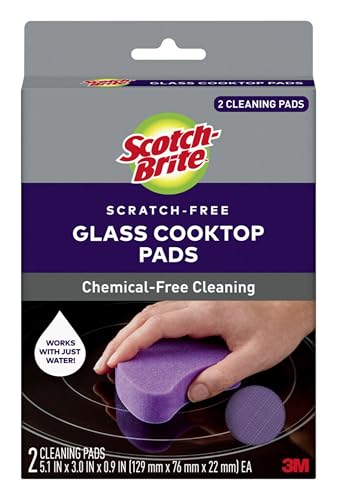
The only non-liquid pick on this list earns its place because the pad is where glass tops actually get scratched. Scotch-Brite’s cooktop pads are purpose-made for glass-ceramic: a scrubbing material aggressive enough to work a polishing cream into a baked-on ring, bonded in a way that will not cut the glass itself. They are the correct replacement for the three things people wrongly grab — the green heavy-duty scouring pad, the sponge’s rough side after it has been used on a gritty sink, and the melamine foam block that some social media posts recommend and glass manufacturers do not.
In use, the pads are unglamorous and exactly right. They hold cream well instead of pushing it around, they rinse clean under the tap, and they survive many cleaning sessions before the scrubbing face wears smooth — at which point you retire them to sink duty and open a fresh one, because a worn pad tempts you to press harder, and pressure is not a substitute for the right abrasive. The two-pack format is sensible: one pad lives with the cooktop creams, and the second rotates in when the first is drying. Used with any cream in this guide, they are the difference between polishing a deposit off and smearing it around.
One habit protects both the pads and the glass: dedicate them to the cooktop only. A pad that has scrubbed a roasting pan may carry embedded grit or a torn edge loaded with metal particles, and from then on it is a scratching tool no matter what its label says. Cooktop pads are cheap; a cooktop panel is a service call and a three-figure part. Keep the roles separate.
Strengths: the safe scrubbing surface every cream on this list assumes; durable across many sessions; inexpensive insurance against the most common cause of cooktop scratches; works with all brands of cream and paste.
Trade-offs: pads alone remove nothing — they are a tool, not a cleaner, and still need a cream for anything beyond fresh splatter. They do wear out, and a worn pad quietly stops working well before it looks destroyed.
Who it suits: every glass cooktop owner, full stop — but especially anyone buying a standalone cream that does not include a pad. Add a pack to whichever cleaner you choose and check price on Amazon.

Therapy Premium Ceramic Cooktop Cleaner
Therapy’s cooktop cleaner is the pick for readers who read ingredient labels. It is a cream cleaner for glass-ceramic built around a plant-derived formula, positioned as the gentler, lower-chemical route to the same polished finish — no harsh fumes, a mild scent, and a brand ethos aimed at households trying to reduce the aggressive chemistry under the sink. Skepticism is reasonable with “natural” cleaners, so the practical question is whether it cleans. On the everyday-to-moderate end of the mess spectrum — grease film, water spots, light baked-on rings, the general dullness that creeps over a top — yes, it does, polishing to a clear shine with a non-scratch pad and normal effort.
Where it asks for honesty is the far end of the spectrum. A fully carbonized sugar deposit or a season’s worth of neglected radiant rings will take more applications and more patience with this cream than with the hardest-working conventional formulas above, and the scraper remains non-negotiable for those jobs regardless of brand. That is a reasonable trade for many households: the cooktop messes that happen weekly are handled pleasantly and without fumes, and the rare catastrophic spill is handled by technique — warm glass, scraper, patience — more than by chemistry anyway.
The cream’s texture is on the thicker, pastier side, which helps it cling to a vertical-ish control panel strip and gives you working time on a stubborn spot without it drying out mid-scrub. It buffs off cleanly and is a good match for induction tops in homes with small children or scent-sensitive cooks, where the cleaning happens in the same airspace as dinner.
Strengths: plant-derived formula with mild scent and no harsh fumes; effective polish on everyday and moderate messes; thick texture clings well; comfortable for frequent use in scent-sensitive homes.
Trade-offs: sits at the premium end of the category, and the toughest carbonized deposits need repeat applications plus scraper work. If your top is already heavily neglected, rehab it first with a conventional cream, then maintain it with this.
Who it suits: households prioritizing gentler ingredients, induction owners with mostly light messes, and anyone who cleans often enough that fumes and scent genuinely matter. Check price on Amazon.
How to deep-clean a glass cooktop, step by step
Start with a cool top — cool enough to rest your palm on comfortably. Cleaning a hot or warm top with cream causes the product to dry on contact, smear, and smoke at the next heating, and it is the most common reason people conclude a good cleaner “doesn’t work.” Remove loose crumbs with a dry paper towel first, because dragging dry grit under a pad is a scratch risk all by itself.
Next, hunt for carbonized spots — the raised, dark, glassy deposits — and scrape those first, before any cream. Wet each spot with a few drops of cream or water, hold the scraper at a shallow angle, and push in short strokes, wiping the blade clean as you go. When a spot stops yielding shavings and feels level with the surface under a fingertip, it is done; the cream will handle the staining that remains.
Then apply the cream in small dots over the whole top, or at least over each burner zone, and work it in small circles with a non-scratch pad, spending your effort on the rings and halos rather than the open glass. Let the cream haze over for a minute or two — most formulas work better with that brief dwell — then wipe it away with a damp microfiber cloth, rinsing the cloth as it loads up. Finally, buff the dry top with a second, clean, dry microfiber cloth in long strokes. That last buff is not vanity: it removes the last of the residue, and residue left behind is what smokes and smells the next time you sear something.
Reading the stain: a field guide to what is on your glass
Before you choose a cleaner, spend ten seconds diagnosing what you are actually looking at, because glass tops collect five distinct deposits and each one answers to a different treatment. Run a clean fingertip across the mark first. If your finger catches on a raised edge and the deposit looks dark, glossy, or amber, you are dealing with carbonized food or burnt sugar — scraper territory first, cream second. If the mark is flat, white or pale gray, and feels very slightly chalky, it is mineral scale from evaporated water, and it belongs to the creams: apply, let it dwell, polish in circles. If it is flat, brownish, and sits in a ring exactly matching a burner outline, it is a baked-on food film that cream and a pad will take off with steady work.
The fourth deposit fools almost everyone the first time: the rainbow or oil-slick sheen that appears around a hard-worked burner. This is a heat-bonded film, sometimes combined with microscopic residue from a pan bottom, and it can look alarmingly like damage. It is not damage, and it usually yields to repeated cream polishing over two or three sessions rather than one heroic scrub. Work it a little each week and it fades; attack it in one session and you will tire long before it does. The fifth deposit is the true scratch — a line that catches light at every angle, feels like a groove under a fingernail, and does not change at all after polishing. Scratches are permanent. Naming them correctly matters because the honest response to a scratch is acceptance, while the response to every other deposit on this list is a product already in this guide.
There is also the white cloudy patch that appears after a wet pot boils dry or a starchy pot boils over repeatedly in the same spot. This is usually a dense mineral accumulation, sometimes combined with heat-stressed residue, and it responds to the same treatment as scale: cream, dwell time, patience, and several sessions. What it does not respond to is vinegar soaks left puddled on the glass for hours — a folk remedy that risks dulling the printed markings and does the mineral no more harm than a proper cream does in five minutes.
Cookware habits that decide how often you clean
Cleaner choice is only half of the glass-top equation; the pans you slide across the surface write the other half. Rough, unfinished cast iron bottoms are the classic offender — not because cast iron is forbidden on glass, since most manufacturers allow it, but because its sand-cast texture acts like fine sandpaper every time the pan is dragged instead of lifted. If you cook with cast iron on glass, build the lift-don’t-slide habit and check the pan’s bottom for burrs with a fingertip; a quick smoothing of a rough casting with fine sandpaper, done off the cooktop and followed by a thorough wash, removes the worst offenders. Aluminum pans can leave gray metallic transfer marks on the glass when they are slid while hot. Those marks look like scratches but are actually deposits, and cream removes most of them — another reason to diagnose before you despair.
Copper-bottom pans deserve a specific warning found in many range manuals: if a copper-bottom pan boils dry, the copper can bond to the glass in a way that is effectively permanent. Never leave any pan unattended to boil dry, but be doubly careful with copper. Enamel-coated cookware is gentle on glass until the enamel chips, at which point the exposed edge becomes a cutting tool. And glass or ceramic bakeware placed on a hot burner can do something worse than scratch — it can fuse or shatter from thermal shock. The cooktop’s glass is engineered for metal pans and direct element heat cycling, not for every heatproof object in the kitchen.
Two smaller habits pay outsized dividends. Wipe the bottom of any pan that has been sitting on the counter before it goes on the burner, because the counter is where pans pick up the salt grains and grit that later grind into the glass under a heavy pot. And when a spill happens, note what it was: a cook who knows “that was sugary” scrapes it warm and saves the surface, while “I’ll deal with it later” is how pitting starts.
Troubleshooting: rings, rainbows, and stubborn cases
The ring that survives the cream
When a baked-on ring survives a normal cream session, the failure is almost never the product — it is dwell time or sequence. Repeat the session but let the cream sit on the ring for several minutes before you start scrubbing, and re-check with a fingertip for a raised edge you may have missed; a deposit that feels level but still shows is stain, while one that catches a nail is still deposit, and deposit wants the scraper, not more cream. Work the ring in sections rather than the whole circumference at once, and expect a genuinely neglected ring to take two or three full sessions across a week. Glass cleaning rewards the same strategy as seasoning a pan: thin layers of effort, repeated.
Metal transfer marks that look like scratches
Gray or silvery streaks that appear after sliding an aluminum or light-colored pan are usually metal rubbed onto the glass, not grooves cut into it. The test is treatment: polish a small section with cream and a pad. Transfer marks lighten and vanish; scratches do not change. This single test has saved many owners from concluding their cooktop is ruined when it is merely decorated. Once you know you are prone to transfer marks — light aluminum pans are the usual source — the fix is behavioral: lift pans, and keep a cream session in the weekly rhythm.
Cloudiness that comes back in the same spot
If a cloudy patch keeps returning to one burner, look at what cooks there. A kettle or stockpot that boils over in the same place every week is re-laying mineral scale faster than you remove it, and the durable fix is a smaller fill level, a wider pot, or a wipe with the daily spray right after the boil, while the deposit is still just wet minerals rather than a baked crust. Cloudiness that returns without any spill at all may be residue from a previous cleaner that was never fully buffed out — try one careful session ending with an extra-long dry buff before blaming the glass.
When to stop cleaning and call for service
Cleaning has limits, and crossing them costs money. Stop and seek service if the glass is cracked, chipped at an edge, or if a white stress mark radiates from an impact point; cooking on cracked glass-ceramic is unsafe, and no cleaner is relevant to it. Stop, too, if a burner heats unevenly and scorches in a pattern that mirrors the element — that is an element or control problem expressing itself as a cleaning problem. Everything else on a glass top — carbon, scale, film, transfer marks, haze — is cosmetic, patient work, and the products above are sized for exactly that work.
Heavy-use scenarios: holidays, canning, and rental turnovers
Some cooking weeks are simply harder on glass than others, and planning for them beats scrubbing after them. Holiday cooking stacks every insult at once: sugary glazes for ham, cranberry sauce with its double load of sugar and acid, gravy that reduces and spatters, and four burners running for hours so that every spill bakes at full temperature. The workable strategy is triage during the event, not heroics after it. Keep the scraper and a damp cloth within reach, lift sugary spills while they are warm between courses, and accept a film of grease during service in exchange for catching the two deposits — sugar and starch — that harden into projects. The full deep-clean then happens the next morning on a cold top, in fifteen unhurried minutes instead of an hour of excavation.
Canning season is the mineral-scale championship: huge pots of water boiling for hours, steam condensing everywhere, and hard water evaporating at industrial rates. Expect the white halo and plan the cream polish for the day after a canning session rather than letting five sessions accumulate into a crust. Wiping the top with the daily spray while it is still slightly warm from the canner — warm, not hot — removes most of the fresh mineral before it bonds. Pressure canners and oversized stockpots also concentrate enormous weight on one burner zone, so inspect that zone for stress marks when the season ends.
Rental turnovers and inherited kitchens present the opposite problem: a top whose history you do not know, carrying deposits from a stranger’s habits. Diagnose before you spend — the fingertip test and a small cream test-patch will tell you within minutes whether you face removable deposits or permanent scratching, and that answer decides whether the top needs an evening of cleaning or a conversation about replacement. Work an inherited top in stages across several days if the buildup is severe; glass that took two years to crust over does not owe you a one-session recovery, and forcing it with aggressive tools is how a recoverable top becomes a scratched one.
The control panel and the edges: the forgotten half of the cooktop
Most cleaning advice stops at the burner zones, but the part of the cooktop your guests actually read is the control strip — and it has its own rules. Touch controls and printed markings tolerate the daily spray and a soft cloth indefinitely, but they resent abrasives even more than the cooking glass does, because the markings are printed on the surface rather than etched into it. A cooktop cream worked gently over the panel area with a cloth is fine for greasy buildup; a pad scrubbed with enthusiasm across the printed icons, week after week, will eventually fade the lettering that tells you which burner is which. Keep the heavy scrubbing on the burner glass and switch to cloth-only contact on the panel.
The perimeter deserves the same weekly attention. The seam where glass meets frame or countertop collects a dark line of grease and crumb paste that no amount of burner polishing will hide, and it cleans up best with the daily spray, a soft old toothbrush worked along the seam, and a wipe with a cloth. Spills that ran over the edge and baked onto the trim below the glass line respond to cream on a cloth and patience. Knobs, if your range has them rather than touch controls, pull off on most models and wash in the sink like any other greasy kitchen part — a small job that disproportionately improves how clean the whole range looks, because knobs are at eye level and at hand level for every visitor who reaches past them.
How the six picks divide the work
It is worth stating plainly how a real household ends up using this list, because nobody needs all six products. The minimum viable kit is one heavy cleaner plus the pads: choose the Weiman kit if you own no scraper, Cerama Bryte if mineral scale is your main enemy, Bar Keepers Friend if you clean often and want economy, or Therapy if you want the gentler formula and your messes are light to moderate. Add the daily spray if fingerprints and film are your daily reality, especially on induction. That is the whole decision. Everything else in this guide — the scraper technique, the stain diagnosis, the cookware habits — is free, and in the long run it protects your cooktop more than any single bottle will.
best kenmore under cabinet microwaves
Mistakes that quietly ruin glass tops
The first is cleaning a spill with the wrong urgency in both directions: sugary spills left to cool and harden, and cream applied to a still-hot top. Sugar gets scraped warm; everything else waits for cold. The second is sliding cookware. Cast iron especially should be lifted, not dragged, because a rough pan bottom is an abrasive with a handle. The third is using the cooktop as a counter — setting a gritty grocery bag or a hot lid from another pan directly on the glass invites both scratches and thermal stress. The fourth is the scouring powder experiment, usually performed by a helpful guest or a cleaner working from habit; it takes ten seconds to haze a panel and the haze does not come out. Finally, there is the neglected drip: sugary or starchy liquid that runs over the edge and bakes onto the trim below the glass line, ignored because it is off the cooking surface, until it is a permanent fixture. Wipe the edges and the frame with the daily spray as part of the same routine.
A realistic maintenance rhythm
Nightly, or after any messy cooking session: the daily spray and a microfiber wipe, two minutes at most. Weekly, if you cook daily on a radiant top or have hard water: a cream polish of the main burner zones to stay ahead of rings and scale. Monthly, or whenever the top starts to look dull under the lights: the full deep-clean with scraping, cream, and a careful buff. Pads get inspected monthly and replaced when the scrub face smooths out; scraper blades get replaced at the first sign of a nick or rust spot. That rhythm — light and frequent beating heavy and rare — is the entire secret, and every product on this list exists to serve one tier of it.
Keep the whole kit together in one spot — cream, spray, pads, scraper, and a small stack of microfiber cloths in the cabinet nearest the range. This sounds like mere tidiness, but it is actually the mechanism that makes the rhythm survive real life: a cleaner that takes three minutes to find is a cleaner that gets used next week instead of tonight, and tonight is when the spill is still easy. The households whose glass tops still gleam after five years are rarely the ones with the most products; they are the ones whose two or three products live within arm’s reach of the mess.
best convection wall ovens for new home
Frequently asked questions
Can I use a razor scraper on an induction cooktop?
Yes. Induction tops use the same glass-ceramic panel as radiant tops, and a proper cooktop scraper with a fresh blade, held at a shallow angle on a wetted spot, is the manufacturer-recommended way to remove burnt sugar and carbonized spills from both. Keep the blade flat, never dig with a corner, and never scrape a cracked panel.
Why does my cooktop still look hazy after cleaning?
Usually one of three reasons: leftover cream residue that was not buffed off dry, a built-up mineral film from hard water that needs repeated cream polishing rather than one pass, or — the one nobody wants — micro-scratching from an abrasive pad or powder used in the past. Residue and mineral haze both improve with the routine in this guide; established micro-scratches are permanent, which is why the banned list matters.
Is baking soda safe on a glass cooktop?
A baking soda paste is mildly abrasive and generally tolerated for light duty, and many people use it for gentle spot work. It is weaker than a purpose-made cream on baked-on food, and it should still be applied with a soft cloth or non-scratch pad, never a scouring pad. For anything beyond light soil, a formulated cooktop cream is faster, safer for the finish, and more predictable.
How do I remove a burnt sugar spill without scratching?
Act while the top is still warm if you can. Wet the deposit, hold a cooktop scraper at roughly thirty to forty-five degrees, and push in short strokes, wiping the blade between passes. Once the raised deposit is level with the surface, finish with cream and a non-scratch pad. If the spill has already cooled and hardened, soften it first with a hot, wet cloth laid over it for several minutes, then scrape.
Can I use the same cleaner on the glass oven door?
Cooktop creams are generally safe on the smooth glass of an oven door’s exterior and often work well on its baked-on splatter, but check your range manual first, and keep them away from door gaskets, vents, and any self-cleaning interior surfaces, which have their own strict rules. Never use oven cleaner on the cooktop to return the favor — the caustic formula can etch glass-ceramic.
Glass rewards the cook who treats cleaning as a two-minute habit rather than a monthly excavation, and the top you wipe tonight is the one that still looks new when everything else in the kitchen has aged around it.