Disclosure: As an Amazon Associate, airfryerkitchensupply.com earns from qualifying purchases. Links on this page are affiliate links; they cost you nothing extra. Prices and availability change often, so check the current Amazon listing before you buy.
This utensil holder review exists because the humble countertop crock is bought carelessly more often than almost any other kitchen item, and then lived with, irritably, for years. A utensil holder is not complicated, but the difference between a good one and a poor one shows up every single day: in whether it tips when you pull out the tongs, whether you can find the turner without a search, whether the bottom has quietly become a hygiene problem, and whether it still looks respectable beside the stove after a year of splashes. This review works through the category properly, using four widely available designs as reference points, so you can judge any holder, including ones not named here, against the tests that actually matter.
Key Takeaways
- A utensil holder is a daily-use tool station, not a decorative vase: judge it on stability, capacity, cleaning and reach.
- Knives never belong loose in a crock; use a block, strip or in-drawer tray instead.
- Wash the holder regularly and only return clean, dry utensils to it, because the base collects drips and food residue.
- Ceramic crocks are stable and handsome but must be retired when they chip or crack.
- Keep the holder near the stove at a heat-safe distance, loaded only with your genuine working set.
In this guide
Utensil Holder Review: The Tests That Decide Everything
Short verdict. A well-chosen utensil holder is worth it for almost anyone who cooks several times a week, and the mid tier of the market is where most people should land. This utensil holder review suits home cooks setting up a work zone beside the stove, renters who cannot install rails or strips, and anyone replacing a tippy, stained or undersized crock. It is not aimed at cooks who have already committed to a fully drawer-based system and love it, or at anyone looking for knife storage, because a crock is the wrong product for that job entirely.
What a Utensil Holder Is and Where the Utensil Holder Fits
A utensil holder, also called a crock or caddy, is an open countertop vessel that keeps your most-used cooking tools upright, visible and within one-handed reach of the stove. Its job sounds trivial until you cook a meal that moves quickly: a stir-fry, a pan sauce, eggs at the moment they set. In those minutes the holder is part of your workflow, and its design either disappears into the background or becomes a small recurring friction. The category splits into fixed crocks, rotating holders, divided holders and set-based holders that match other tools, and each style suits a different kitchen.
The four reference designs in this review cover that spread honestly. The OXO Good Grips Utensil Holder represents the mainstream fixed holder done carefully. The Cooler Kitchen Rotating Utensil Holder represents the turntable approach. The DOWAN Utensil Holder represents the ceramic crock tradition. The Home Hero Utensil Holder represents the coordinated-set approach, and the Get It Right and Sabatier designs appear in the comparison section as further reference points for silicone-friendly and classic kitchens.
Cooking is a sequence of small reaches. You reach for the turner while the eggs are setting, for the spoon while the sauce is thickening, for the tongs while the pasta is at exactly the point where thirty seconds matter. A utensil holder earns its place by making those reaches thoughtless. When the right tool is visible, upright and in the same place every day, your hand learns the map and your eyes stay on the pan. That sounds like a small thing until you compare it with the alternative: a drawer that must be opened with a hip, searched with one hand, and closed again while something on the stove needs you now.
This is why placement and contents matter as much as the holder itself. The working set beside the stove should be the tools used in almost every session: a turner, a spoon, a slotted spoon, tongs, a ladle, a whisk and perhaps a spatula for scraping bowls. Everything else, the once-a-month tools, can live in a drawer without costing you anything. A holder stuffed with occasional tools buries the daily ones. Edit the collection ruthlessly and the holder suddenly works twice as well, because every reach lands first time.
Design, Build and Setup
Design in this category is mostly about three things: the mouth, the base and the interior. A wide mouth lets tools fan out so handles separate and each one can be lifted cleanly. A narrow mouth forces a tight bundle where everything tangles. The base decides stability: weight low down, a broad footprint and, ideally, a surface that grips rather than skates across stone or laminate. The interior decides cleaning and noise. Smooth interiors wash easily and let tools slide in quietly; textured or divided interiors can organise better but collect residue in more corners.
Setup is genuinely minimal, which is part of the appeal. Unpack, wash before first use, dry, place at a heat-safe distance beside the stove, and load the working set with the tallest tools towards the back. Then do the honest stability test: pull tools out at real cooking speed and watch whether the holder rocks, lifts or creeps. A holder that passes on day one will pass for years. A holder that wobbles empty-handed will not improve with age, and it is better to learn that during the return window than during a dinner party.
The four reference holders below anchor this review. Each is treated in prose, positioned by tier in words rather than by any fixed price, and each earns a plain best-for and not-suited-for verdict.

OXO Good Grips Utensil Holder
a stainless-steel-look countertop holder built around a simple idea: a wide, open mouth, a weighted feel that resists tipping, and an interior shape that lets spatulas, spoons and turners fan out instead of jamming together in a tight bundle. In everyday use it suits cooks who keep a core set of tools within arm’s reach of the stove and who want those tools visible, upright and easy to grab one-handed while the other hand is holding a pan handle or a lid.
Best for: cooks who want a reliable, everyday holder in the mid tier of the market, positioned as a sensible mainstream choice rather than a bargain or a luxury piece. Not suited for: anyone expecting a utensil holder to store knives safely, because loose knives do not belong in an open crock under any circumstances. Check the current Amazon listing for this model before you buy, and confirm the finish and configuration match the version described here.
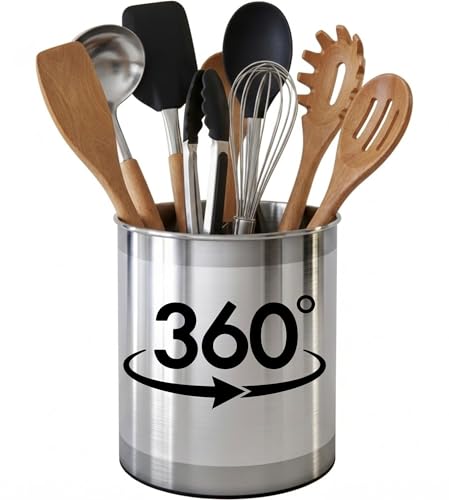
Cooler Kitchen Rotating Utensil Holder
a rotating countertop holder designed for cooks who are tired of digging past three spoons to find the tongs at the back. The turntable base lets the whole collection spin, so tools stored at the rear come to the front with a nudge. It works best on a clear stretch of counter where the holder can turn freely without clipping a backsplash, a paper towel stand or the side of a nearby appliance.
Best for: cooks who want a reliable, everyday holder in the mid tier of the market, positioned as a sensible mainstream choice rather than a bargain or a luxury piece. Not suited for: anyone expecting a utensil holder to store knives safely, because loose knives do not belong in an open crock under any circumstances. Check the current Amazon listing for this model before you buy, and confirm the finish and configuration match the version described here.
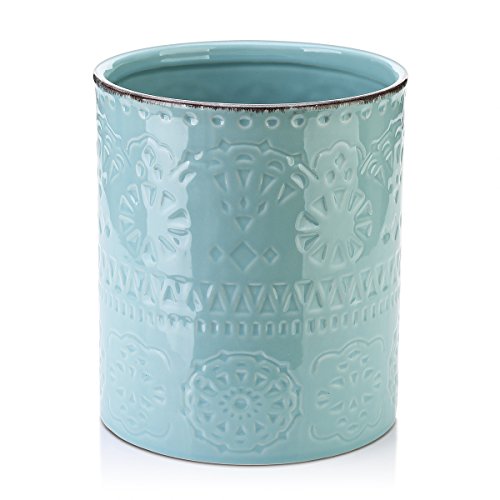
DOWAN Utensil Holder
a ceramic crock with the reassuring heft and glazed finish that many cooks prefer next to a stove. Ceramic brings real weight, which helps stability, and a smooth glaze that wipes clean easily. It also brings the one honest weakness of the material: ceramic can chip if it is knocked hard against a granite edge, a cast iron pan or a dropped heavy tool, and a chipped crock should be retired rather than kept in daily service.
Best for: cooks who want a reliable, everyday holder in the mid tier of the market, positioned as a sensible mainstream choice rather than a bargain or a luxury piece. Not suited for: anyone expecting a utensil holder to store knives safely, because loose knives do not belong in an open crock under any circumstances. Check the current Amazon listing for this model before you buy, and confirm the finish and configuration match the version described here.

Home Hero Utensil Holder
a countertop holder sold as part of a coordinated kitchen set approach, aimed at cooks who want the holder to match other tools rather than stand out as a separate purchase. Its appeal is organisation and a tidy, uniform look on the counter. It suits a starter kitchen or a refresh where several pieces are being replaced at once and a consistent finish matters as much as any single feature.
Best for: cooks who want a reliable, everyday holder in the mid tier of the market, positioned as a sensible mainstream choice rather than a bargain or a luxury piece. Not suited for: anyone expecting a utensil holder to store knives safely, because loose knives do not belong in an open crock under any circumstances. Check the current Amazon listing for this model before you buy, and confirm the finish and configuration match the version described here.
Material choice shapes daily life with a holder more than shape or colour does. Stainless steel is light, tough, and unbothered by knocks, though it can show water spots and fingerprints and may slide on a smooth counter unless the base is weighted or padded. Ceramic is heavy and stable with a classic look, but it can chip and should be retired when it does. Silicone and plastic holders are forgiving, quiet when tools are dropped in, and usually the easiest to wash, though they can hold odours if they are not cleaned regularly and they rarely feel as substantial. Bamboo and wood look warm and natural, but they dislike standing water, so the clean-and-dry rule matters even more with them.
None of these materials is simply the best. The right answer depends on your counter, your cookware and your habits. A household that cooks daily with heavy cast iron and metal tools will appreciate toughness. A cook with non-stick pans and silicone tools may prefer a softer, quieter holder. A small kitchen may need the lightest option that still stays put. Judge materials by the life they will actually live in your kitchen, not by a showroom photograph.
Performance in Real Use
Weeknight Cooking at Speed
In fast weeknight cooking, the holder’s value is measured in seconds and in attention. The turner is needed now, the spoon is needed while the other hand holds the pan, and the tongs are needed before the pasta overcooks. Fixed holders with a wide mouth perform beautifully here because the map never changes: the same tool is always in the same place. Rotating holders shine when the set is larger, because a nudge brings the back row forward, but they ask for a clear turning circle on the counter, which not every stove-side spot can offer.
Big, Messy Cooking Sessions
During a long session, a roast with sides, a curry, a baking project alongside, the holder accumulates used tools quickly. This is where capacity honesty matters. A holder that fits the working set with room to spare lets you park a sauce-covered spoon without it touching the clean tools. A holder that is already full turns every parking decision into a negotiation, and tools end up balanced on the stove or the counter instead, which is exactly the mess the holder was bought to prevent.
Cleaning and Hygiene in Practice
The least glamorous and most important truth about any utensil holder is hygiene. A crock that sits beside a stove collects more than utensils. It collects drips from a spoon lifted out of a sauce, splashes from a pan, steam that condenses and runs down handles, and small crumbs and residue that fall to the bottom and stay there. Over weeks, the base of a neglected holder becomes exactly the kind of damp, food-flecked corner that no kitchen should tolerate a few inches from the food being cooked.
The fix is simple and unglamorous: wash the holder regularly, on a rhythm rather than when it looks dirty. Empty it completely, wash it inside and out with hot soapy water or run it through the dishwasher if the maker allows it, and dry it fully before the utensils go back in. Just as important, utensils should go into the holder clean and dry. A spoon rinsed quickly and dropped in wet carries water to the bottom of the crock, where it pools quietly. A spoon washed properly and dried first keeps the whole system cleaner for far longer.
Build the habit around an existing cue. Many cooks wash the holder on the same day they wipe down the stove top, or whenever the holder is emptied for a big cooking session. While it is empty, look inside. Residue at the bottom, a sour smell, or a slimy feel are all signs the interval has been too long. None of this requires special products or effort; it requires only that the holder be treated as food-adjacent equipment, because that is exactly what it is.
Safety Around the Stove
One rule in this entire topic is not a matter of taste: knives do not belong loose in a utensil crock. Reaching into a crowded holder and closing your hand around what you hope is a spoon handle, while a chef knife blade sits somewhere in the same bundle, is a genuine cut hazard. It is the kind of accident that happens on an ordinary Tuesday, mid-recipe, with wet hands and divided attention.
Loose storage is also bad for the knives themselves. Blades knocked against ceramic walls, metal tongs and other blades lose their edge quickly, and tips can chip or bend. A knife that was carefully chosen and sharpened deserves better than a crock. Use a knife block, a magnetic strip mounted safely out of children’s reach, or an in-drawer knife tray that keeps each blade separated and covered. Our guide to how to choose a chef knife set that stores safely covers those storage options in more depth. Keep the crock for spoons, spatulas, turners, ladles, whisks and tongs, and the kitchen gets safer and the knives stay sharper.
Placement matters more than most buyers expect. A utensil holder lives beside the stove, which means it lives near heat, steam and splashing oil. Keep a sensible, heat-safe distance from burners: close enough to reach without leaning across a hot pan, far enough that the holder and the handles inside it are not sitting in direct heat or constant splatter. Handles that overhang a burner can get hot, and plastic handles stored too close to a flame or a glowing element can be damaged over time.
Stability is the other half of placement. A holder loaded with tall tools is top-heavy by nature, so weight in the base and a wide footprint are real functional advantages, not marketing extras. A weighted holder resists the slow creep and sudden tip that happen when you pull one utensil out quickly and the whole bundle shifts. Test any new holder the honest way: load it with your tallest, heaviest tools, then pull pieces out at cooking speed. If it rocks, slides or lifts on one side, it will eventually go over, usually at the worst moment, scattering hot-splashed tools across the counter.
Ceramic deserves one extra sentence here. A ceramic crock such as a DOWAN design is heavy and stable right up until it is knocked hard. Inspect the rim and base now and then. A small chip is not just cosmetic: it can harbour residue, scratch a counter, and grow into a crack. The retire rule is simple. When a ceramic crock chips or cracks, replace it. Do not demote it to holding sharper or heavier tools, and do not keep a cracked vessel beside the stove out of habit.
Strengths and Trade-Offs
Strengths
- One-handed, eyes-up access to the tools you use most, exactly when timing matters.
- No installation, no drilling and no commitment: a holder can move kitchens with you.
- A visible working set that guests and other household cooks can read at a glance.
Trade-offs
- It permanently occupies counter space in the most contested zone of the kitchen.
- It collects splatter and drips, so it adds a small but real cleaning obligation.
- It is the wrong home for knives and for rarely used tools, which still need proper storage elsewhere.
How It Compares
Against a divided drawer, the holder wins on speed and loses on clear counters and splatter protection; the full comparison is explored in utensil holder pros and cons. Against a wall rail, the holder wins on renter-friendliness and loses on counter space. Against simply using a spare jug or vase, a purpose-made holder wins on weight, stability and washability, which are not glamorous virtues but are the ones that decide whether the arrangement survives its first year. The Get It Right Utensil Holder deserves a mention for silicone-tool kitchens, and the Sabatier Utensil Crock for traditionalists: both are sensible reference points when the four main picks do not match your style.
The honest alternative to a countertop holder is a well-organised drawer, and for some kitchens it is the better answer. A drawer keeps counters completely clear, keeps tools away from stove splatter, and suits cooks who dislike visual clutter. With dividers, a drawer can be genuinely efficient; our notes on drawer dividers for a calmer utensil drawer show how much difference simple separation makes. The trade-off is speed and one-handed access. Mid-recipe, with a pan in one hand, opening a drawer and searching it is slower than glancing at a crock.
Many good kitchens use both: a slim holder by the stove for the daily working set, and a divided drawer for everything else, including the knives in a proper in-drawer tray. That hybrid is worth considering before buying the largest holder you can find. Counter space is the scarcest resource in most kitchens, and a holder should justify every inch it occupies by being used constantly. If a tool in the holder has not been touched in a month, it is telling you where it belongs.
Value in this category is not about finding the cheapest vessel that can hold a spoon. It is about cost spread over years of daily use. A holder is touched several times a day, every day, so even a mid-tier purchase divides into a trivial amount per use, while a flimsy holder that tips, slides, chips early or proves impossible to clean will annoy you at the same daily rate. The sensible tiers are easy to describe in words: entry-level holders cover the basics for a starter kitchen, mid-tier holders add weight, better finishes and easier cleaning, and premium holders sell materials, craftsmanship and looks that match a considered kitchen.
Spend according to how central the holder will be. If it will stand beside the stove for a decade, the mid tier is usually the sweet spot, and premium money is better justified by material and build than by gadgets. If it is for a temporary rental or a rarely used second kitchen, entry level is honest value. Either way, judge the purchase against the alternatives in this cluster, and read is a utensil holder worth it if you are still deciding whether to buy one at all.
Who Should Buy It and Who Should Skip It
Buy a countertop holder if you cook most days, if your stove-side drawer situation is awkward, or if several people cook in the same kitchen and need a shared, visible tool map. Use the checklist in utensil holder buying guide before ordering: working set counted, space measured, material chosen for your cookware, wash rhythm agreed, knife storage solved separately. Skip the holder, or buy the smallest one, if your counters are severely limited, if you cook rarely, or if a divided drawer already serves you perfectly well.
Setup, Care and Maintenance Essentials
Day-to-day care is mostly about rhythm. Wipe the outside when you wipe the stove, because the same splatter lands on both. Empty and wash the inside on a regular cycle, weekly in a busy kitchen and at least every couple of weeks in a quieter one. Dry it fully before refilling, and dry utensils before they go back in, because standing water at the bottom is the root of most holder problems, from smells to residue that bakes on in the warmth beside a stove.
Pay attention to the base and any feet or pads. Grit trapped under a holder can scratch stone and laminate counters when the holder is dragged rather than lifted. Lift to move, not slide. If the holder has a removable insert or divider, wash that too; inserts collect the same drips in their corners. None of this is difficult, and that is the point. A utensil holder is one of the simplest objects in the kitchen, and its care should be equally simple, folded into routines you already have rather than added as a new chore.
Small kitchens change the calculation. Counter space is precious, every appliance competes for the same few feet, and a bulky crock can feel like a tenant that does not pay rent. In a compact kitchen, look for a holder with a modest footprint and enough height to use vertical space, or consider a rotating design that lets a smaller base serve more tools because the back row is reachable. Wall-mounted rails and magnetic solutions exist too, though they suit lighter tools and need secure fixing.
What small kitchens cannot afford is the oversized holder bought for a collection that mostly lives elsewhere. Measure the actual spot, beside the stove but safely away from burner heat, and measure the tools that will live there. The tallest tool sets the practical height; the counter gap sets the footprint. A holder chosen against real measurements fits like it was made for the kitchen. A holder chosen from a product photograph alone often spends its life being moved from place to place, which is a sign it never had a home to begin with.
Final Verdict
A utensil holder is a small purchase with an outsized daily footprint. Choose a weighted, wide-mouthed holder in a material that suits your tools, keep it to the working set, wash it on a rhythm, keep knives out of it, and it will repay you in calm, fast cooking for years. That is the whole secret, and it is why the mid tier, rather than the cheapest or the most decorative option, is the recommendation of this review.
Ergonomics: Height, Reach and the One-Hand Rule
Ergonomics sounds like a word for office chairs, but it decides whether a utensil holder feels effortless or faintly annoying. The first factor is height relative to your tools. Handles should clear the rim by enough that your fingers can close around one handle without brushing three others, and the tool heads should sit below the point where the whole bundle becomes top-heavy. If your tallest tools lean at a dramatic angle, the holder is too short or too narrow for them, and every retrieval becomes a small negotiation with gravity.
The second factor is reach geometry. The holder should sit within the natural arc of your dominant hand when you stand at the stove, not behind the hob, not across a burner, and not in the corner formed by a wall and a backsplash where your wrist has to twist. Test placement with the stove cold first: stand where you cook, close your eyes, and reach. Where your hand lands is roughly where the holder wants to live, adjusted outward to a heat-safe distance from the burners.
The third factor is the one-hand rule. Everything about a holder should be operable one-handed, because the other hand is usually holding a pan, a lid or a plate. Retrieval one-handed, replacement one-handed, and, for rotating models, spinning one-handed. If any routine action needs two hands, the design is fighting your cooking rather than helping it, and that friction will be charged to you at every meal.
Batch Cooking and Meal Prep Days
Meal prep day is the opposite rhythm from weeknight cooking: hours rather than minutes, several recipes in parallel, and tools used in long rotations rather than quick grabs. The holder’s job changes accordingly. It becomes a staging post between tasks, the place a spatula waits while a tray is loaded, the place the good spoon rests between pots. On these days, capacity and parking matter more than split-second retrieval, and a holder that can accept a used tool gracefully, without contaminating the clean ones, earns its keep.
Prep cooks develop small systems around the holder. Clean tools on one side, in-use tools on the other, or a spoon rest beside the holder for the tool currently in play. None of this needs buying anything; it needs the holder to have enough room that a system is possible at all. A holder at its limit permits no system, which is why cooks who batch-cook should size up honestly when they buy.
Prep day is also wash day, conveniently. When the cooking is done and the holder is half empty anyway, empty it fully, wash it, dry it, and reload it with clean, dry tools. The rhythm costs five minutes at the end of a long session and resets the hygiene clock completely, which is the easiest version of the regular-washing rule to keep.
Longevity, Repair and Knowing When to Replace
A good utensil holder should last for years, and most do, because there is so little to fail. Fixed crocks have no failure modes beyond damage. Rotating holders add a bearing or a simple turntable mechanism, which can stiffen if residue works into it; a thorough wash usually restores it, and keeping the base clean and dry prevents it. Inserts and dividers can crack if dropped, and bases can lose their pads, which is worth fixing because a holder that slides is a holder halfway to tipping.
Replacement has clear triggers. Ceramic that chips or cracks is retired, full stop. Any holder that has become impossible to get truly clean, with residue baked into texture that washing no longer lifts, has reached the end of its hygienic life. A holder that tips under your current tool set may not be faulty; your set may have outgrown it, which is a sizing problem solved by the buying guide in this cluster rather than by blame.
When you do replace, the old holder often has an honest second life away from food: paintbrushes in a studio, tools in a garage, craft supplies on a desk. What it should not do is linger beside the stove out of sentiment while a cracked rim or a permanent residue problem stays in daily contact with your cooking.
The One-Week Trial: Testing the Concept Before You Commit
If you are unsure whether a countertop holder suits your kitchen at all, trial the idea before spending anything. Stand a sturdy, heatproof jug or container where the holder would live, load it with your genuine working set, and cook normally for a week. Notice three things. How often you reach for it without thinking. Whether the counter feels poorer for its footprint. And whether the tools you loaded were the right ones, because the trial almost always edits the set.
At the end of the week, the verdict is usually obvious. If the trial station became invisible infrastructure, a purpose-made holder will be better in every way: heavier, more stable, easier to wash and better looking. If the jug gathered dust or annoyed you daily, a divided drawer is your answer and you have saved a purchase. Either outcome is a success, because the question was answered by your kitchen rather than by marketing.
Trial cooks should still observe the standing rules during the experiment: no knives in the jug, a heat-safe distance from burners, and clean, dry tools only. A fair trial is a safe trial, and a week is long enough to learn the truth about your habits.
Auditing the Tools Themselves
A new holder is the perfect occasion to audit the tools that will live in it, because a holder faithfully displays whatever it is given, including tools that should have been retired years ago. Work through the candidate set one piece at a time. Wooden spoons that have split or gone rough can harbour residue and should be replaced. Silicone tools with nicked or melted edges have done their service. Tongs with tired springs and turners with loose handles are minor hazards disguised as old friends.
Duplicates deserve scrutiny too. Most kitchens own three wooden spoons where one good one is used, and the spares exist only because drawers hide them. A holder cannot hide anything, which is one of its virtues: it forces the honest question of which tools earn daily status. Keep the best of each type in the holder, move honest spares to the drawer, and let the rest go.
The audit usually shrinks the working set, and a smaller set makes every holder work better: more air, cleaner retrieval, easier washing. Buyers who audit first often discover they need a smaller, better holder than the one they were about to order, which is the rare shopping outcome that saves money and improves the kitchen at the same time.
The Evening Reset: Thirty Seconds That Keep the System Working
Kitchens that stay calm have rituals, and the holder benefits from one of the shortest. At the end of the day’s cooking, when the stove is wiped and the counters are cleared, give the holder thirty seconds. Return any migrated tools to the drawer. Take out anything that was parked dirty and wash it rather than leaving it overnight. Check that nothing sharp has been dropped in by a helper who did not know the rule, and move it to proper storage if it has. Glance at the base for the day’s drips.
That is all. Thirty seconds, folded into a routine that already exists, and the holder never reaches the state where a deep clean feels like an event. The weekly or fortnightly wash still matters, because the reset does not empty the crock, but the reset is what keeps the interval comfortable rather than archaeological.
Households find the reset easiest when one person owns it, usually whoever wipes the stove. Shared kitchens can rotate it. What matters is that it belongs to someone, because systems that belong to everyone in general tend to be maintained by no one in particular, and the holder, patient and silent, will simply accumulate the evidence.
Reading a Product Listing Like a Reviewer
Product listings for utensil holders are written to sell, but they can be read critically if you know which claims matter. Weight, described in words like weighted base or heavy-duty, is a genuine signal when it is specific about where the weight sits; a heavy rim helps nobody, while a heavy base is the whole game. Mouth shape matters more than overall silhouette: look for photographs with real tools loaded, not empty studio shots, and judge whether the tools fan or jam. Interior photographs matter too, because a smooth interior is a promise about washing that texture cannot keep.
Treat mechanism claims with friendly suspicion. A rotating base should turn under load, quietly, without wobbling, and the listing cannot prove that to you; only the first-day stability test in your own kitchen can. Divider claims deserve the same test: dividers help only if their compartments match your actual tools, and fixed dividers that match nothing are worse than none. Finish claims should be read against your cookware and your cleaning rhythm rather than against the photograph’s lighting.
Finally, read what the listing does not say. Silence about dishwasher guidance suggests hand washing. Silence about the base suggests an unweighted one. None of this makes a listing dishonest; it makes it a starting point. The tests in this cluster, load it, spin it, wash it, reach into it one-handed, are how a buyer finishes the job that a listing begins.
Questions Worth Asking Before Any Holder Earns Its Place
Before any holder is bought, borrowed or kept, run it past the questions that predict satisfaction. Does it hold the working set with room to spare, or merely hold it? Does it stay planted when the heaviest tool is pulled out quickly? Can every routine action be done one-handed? Does it wash easily, completely, in the way your household actually washes things? Does it sit at a heat-safe distance from the burners without crowding them? And does it have an honest answer for where the knives live, which is anywhere except inside it?
A holder that answers yes to all six will almost certainly succeed, whatever its style or tier. A holder that fails one question can sometimes be fixed: placement can change, a set can be edited, a wash rhythm can be agreed. A holder that fails three is the wrong holder, and no amount of attractive finish will rescue it, because the failures will be charged daily.
Keep the questions after the purchase too. Kitchens change: tools are added, counters are reorganised, households grow. Re-asking the six questions once a season keeps the holder matched to the kitchen it serves, and turns a one-off purchase into a small, well-run system that quietly supports every meal cooked around it.
Testing a Utensil Holder Properly: What to Check in the First Week of Use
The purchase is the easy part. A utensil holder proves itself at the counter beside the hob, within reach mid-cooking, in the middle of keeping everyday tools upright, visible and out of drawers, long after the packaging has gone. So work backwards from daily life: fix the routine, the space and the people in your mind first, and only then weigh the features that looked persuasive on a product page. The first check is the height and diameter against your longest and bulkiest tools, and it outranks everything else, because no styling or extra capacity compensates when that basic fit is wrong. Anything heavy, hot, sharp, load-bearing or electrically powered deserves a respectful pause in the decision, and the maker’s own guidance, read before purchase, is part of the specification.
Long-term performance usually comes down to whether you keep up with one routine: emptying and washing it regularly, and drying tools before they go back in. Decide honestly whether your household will do it before you rely on it. Think about handing the task over: if someone else had to use, clean or reset the utensil holder from your brief description alone, the design and your setup would pass or fail together. Beware of solving a problem you do not have, because the largest or most elaborate version of a utensil holder adds cleaning, storage and cost in effort to a routine a simpler version would have served perfectly. During the first week, keep a short note of every friction point, however small, because the minor annoyance repeated daily predicts long-term satisfaction better than first impressions do.
- Note every small friction point as it happens, not from memory later.
- Compare performance against the three jobs you bought it for.
- Put it through the toughest ordinary use in week one.
- Make the keep-or-return call from your notes while you still can.
- Re-inspect fit and moving parts once real use has settled in.
Before ordering, list everything the first week of use requires and confirm, item by item, whether it arrives with the utensil holder or has to be found separately. Read any review, this one included, as evidence from one household. The facts transfer; the verdict only transfers if your routine resembles the reviewer’s. Uncertainty about your own routine cannot be fixed by research about products. Settle how, where and how often the utensil holder will be used, and the shortlist usually shortens itself. Edge cases matter here: a small counter, where a wide holder eats the very workspace it should serve. A utensil holder chosen with that situation in mind will not need replacing the first time life deviates from the brochure.
Guests are an honest test: anything that needs explaining, warning or apologising for when visitors use the utensil holder is telling you something about its everyday fit as well. Attention is a budget too. A utensil holder that needs remembering, scheduling, monitoring or special handling spends it, so count that cost alongside the physical ones. Measure the real space, including clearance for doors, drawers, lids, handles and people passing, and write the numbers down before comparing anything, because memory is generous in exactly the wrong direction. When owners give up on a utensil holder, the cause is often tools toppling a light holder, and water pooling under utensils put away wet, not a dramatic breakdown, so treat that pattern as the main risk your decision has to answer.
The first fortnight involves unlearning old habits as much as learning new ones, so allow the utensil holder that adjustment period before delivering a final verdict, unless a basic fit check has failed. Decide whether the placement is permanent or provisional, and buy accordingly, because a utensil holder chosen for a fixed home and one chosen to move, fold or travel are different designs wearing similar names. Ownership is easier with a small paper trail. Keep the instructions, note the model details from the listing, and record any quirk as it appears rather than reconstructing it months later. For items that suffer from constant use without rest, a planned spare is not extravagance; it is how the routine survives the day the main one is wet, dirty, broken or missing.
Frequently Asked Questions
How often should you wash a utensil holder?
Wash the inside regularly rather than waiting until it looks dirty: weekly in a busy kitchen, and at least every couple of weeks in a quieter one. Empty it fully, wash it inside and out, and dry it completely before refilling. The bottom collects drips and food residue from tools lifted out of pans, and that residue is the main reason holders develop smells. Utensils should always go back in clean and dry, because a wet spoon dropped into the crock carries water straight to the bottom where it pools.
Can you put knives in a utensil holder?
No. Knives should never sit loose in a utensil crock. Reaching into a crowded holder and closing your hand near a hidden blade is a real cut hazard, and blades knocked against ceramic, metal and other edges dull and chip quickly. Store knives in a block, on a safely mounted magnetic strip, or in an in-drawer knife tray where each blade stays separated and covered. Keep the crock for spoons, spatulas, turners, ladles, whisks and tongs, and both your hands and your knives will be better off.
Where should a utensil holder sit on the counter?
Beside the stove, within easy reach, but at a sensible heat-safe distance from the burners. Close enough that you never lean across a hot pan to reach it, far enough that handles are not sitting in direct heat or constant splatter. Leave room around it so a rotating model can turn freely and so you can lift it out for washing without dragging it across the counter. If the only available spot crowds a burner, choose a slimmer holder rather than a closer one.
What should you do if a ceramic utensil crock chips?
Retire it. A chip is not just cosmetic: it can harbour residue in the rough edge, scratch the counter, and develop into a crack that eventually fails beside a hot stove. Ceramic crocks earn their place through weight and stability, but that bargain depends on the vessel staying intact. Replace a chipped or cracked crock, and do not demote it to holding heavier or sharper tools, which only increases the risk. The same rule applies to any holder that cracks, whatever it is made from.
How many utensils should a holder actually contain?
Only the working set you use most days: typically a turner, a spoon, a slotted spoon, tongs, a ladle, a whisk and a spatula or two. A holder crammed with occasional tools buries the daily ones and makes every retrieval a search. Keep the rest in a divided drawer, and keep knives in proper knife storage. If a tool in the holder has not been touched in a month, move it out. A holder with a little room to spare works better than a larger holder filled to the brim.
Is a rotating utensil holder better than a fixed crock?
It depends on your tools and your counter. A rotating holder, such as the Cooler Kitchen design, makes the back row reachable and suits deep collections on a clear stretch of counter. A fixed crock has no moving parts, is usually heavier and more stable, and suits a smaller working set. Neither is universally better. Choose rotation if you regularly lose tools at the back; choose a fixed, weighted crock if simplicity and stability matter more and your set is compact.
Related Reading
Keep building a calmer, safer work zone around the stove with these companion guides from the same kitchen series.
the best spatula turners for everyday cooking