Disclosure: As an Amazon Associate, airfryerkitchensupply.com earns from qualifying purchases. Links on this page are affiliate links; they cost you nothing extra. Prices and availability change often, so check the current Amazon listing before you buy.
An honest utensil holder pros and cons page has to do more than list good and bad points. It has to explain when each point actually bites. A countertop crock is a genuine quality-of-life upgrade for many kitchens and a genuine waste of precious counter space for others, and the difference is rarely the product: it is the match between the product and the kitchen it lands in. So this utensil holder pros and cons guide gives every advantage and disadvantage its evidence, then translates the balance for different kinds of cooks, and finishes with the buying and care habits that shrink the cons list in practice.
Key Takeaways
- The biggest pro is speed: one-handed, eyes-up access while food is cooking.
- The biggest con is permanent counter occupation in the kitchen’s most contested zone.
- Hygiene cuts both ways: tools are visible and aired, but the crock collects drips and must be washed regularly.
- Safety cuts both ways too: blunt tools are safer visible, but knives must never join them in the crock.
- Most cons shrink with discipline: a working set only, a wash rhythm, and correct placement.
In this guide
Utensil Holder Pros and Cons: The Balance in One View
Quick verdict. For daily cooks with a little stove-side space, the pros of a utensil holder comfortably outweigh the cons, provided the holder is kept to a working set and washed on a rhythm. For very small kitchens, rare cooks and devoted drawer organisers, the cons can legitimately win. This utensil holder pros and cons assessment suits anyone still undecided; the decision checklist in is a utensil holder worth it closes the question if you remain on the fence.
The Pros
Speed When It Matters Most
Cooking has moments where seconds and attention are the whole game, and a holder serves exactly those moments. The tool is upright, visible and reachable one-handed while your eyes stay on the pan. No drawer to open with a hip, no search, no closing anything afterwards. Across hundreds of meals a year, that fluency compounds into a calmer kitchen and fewer scorched sauces.
A Visible Map for Every Cook
There is a social side to a utensil holder that rarely gets mentioned. When someone else cooks in your kitchen, a guest, a partner, an adult child home for the weekend, the holder is the map they read. Tools visible and upright can be found without opening a single drawer or asking a single question. That makes shared cooking calmer and keeps guests from rummaging through drawers that may contain sharp or fragile things. A tidy holder quietly communicates where things live and, just as usefully, where they go back afterwards.
The same logic helps households with several cooks and different habits. Agree the working set once, keep it in the holder, and the nightly argument about where the good turner went simply disappears. Consistency is a feature. A holder that always contains the same tools in roughly the same arrangement becomes part of the kitchen’s muscle memory for everyone who uses it, and that shared fluency is worth more than any decorative finish.
No Installation and Total Portability
A holder asks nothing of your walls, your landlord or your DIY skills. It works in rentals, moves house when you do, and can be repositioned in seconds when your stove-side layout changes. Compared with rails, strips and fitted drawer systems, that flexibility is a real and underrated advantage, especially in kitchens that are still evolving.
Tools Stay Separated, Aired and Undamaged
Upright storage keeps tools from grinding against each other in a drawer tangle. Handles stay accessible, heads stay separated, and everything dries in open air rather than sitting in a closed drawer. Wooden spoons and silicone tools in particular live longer, calmer lives standing in a crock than rattling in a drawer.
An Honest, Accessible Price Tier
Few kitchen upgrades deliver daily benefit at this category’s tiers. Entry holders cover the basics, the mid tier adds the weight and finish most kitchens want, and premium options exist for those who value materials. There is no tier at which a sensible holder becomes a foolish purchase, which cannot be said of many kitchen categories.
The Cons
It Permanently Occupies Prime Counter Space
The stove-side counter is the most valuable real estate in the kitchen, and a holder takes a piece of it forever. In a generous kitchen that cost is trivial. In a small one it competes with chopping boards, resting trays and the cook’s own elbows, and it can lose that competition honestly.
It Collects Drips, Splatter and Residue
The least glamorous and most important truth about any utensil holder is hygiene. A crock that sits beside a stove collects more than utensils. It collects drips from a spoon lifted out of a sauce, splashes from a pan, steam that condenses and runs down handles, and small crumbs and residue that fall to the bottom and stay there. Over weeks, the base of a neglected holder becomes exactly the kind of damp, food-flecked corner that no kitchen should tolerate a few inches from the food being cooked.
The fix is simple and unglamorous: wash the holder regularly, on a rhythm rather than when it looks dirty. Empty it completely, wash it inside and out with hot soapy water or run it through the dishwasher if the maker allows it, and dry it fully before the utensils go back in. Just as important, utensils should go into the holder clean and dry. A spoon rinsed quickly and dropped in wet carries water to the bottom of the crock, where it pools quietly. A spoon washed properly and dried first keeps the whole system cleaner for far longer.
Build the habit around an existing cue. Many cooks wash the holder on the same day they wipe down the stove top, or whenever the holder is emptied for a big cooking session. While it is empty, look inside. Residue at the bottom, a sour smell, or a slimy feel are all signs the interval has been too long. None of this requires special products or effort; it requires only that the holder be treated as food-adjacent equipment, because that is exactly what it is.
It Tempts You to Store Knives Unsafely
One rule in this entire topic is not a matter of taste: knives do not belong loose in a utensil crock. Reaching into a crowded holder and closing your hand around what you hope is a spoon handle, while a chef knife blade sits somewhere in the same bundle, is a genuine cut hazard. It is the kind of accident that happens on an ordinary Tuesday, mid-recipe, with wet hands and divided attention.
Loose storage is also bad for the knives themselves. Blades knocked against ceramic walls, metal tongs and other blades lose their edge quickly, and tips can chip or bend. A knife that was carefully chosen and sharpened deserves better than a crock. Use a knife block, a magnetic strip mounted safely out of children’s reach, or an in-drawer knife tray that keeps each blade separated and covered. Our guide to how to choose a chef knife set that stores safely covers those storage options in more depth. Keep the crock for spoons, spatulas, turners, ladles, whisks and tongs, and the kitchen gets safer and the knives stay sharper.
Overfilling Quietly Destroys Its Own Point
A holder’s capacity is a discipline, not a dimension. Every occasional tool added makes the daily tools harder to reach, until the crock becomes a vertical junk drawer. The con is real but it is a habit problem wearing a product costume, which is why it appears in every honest utensil holder pros and cons list, including this one.
Materials Bring Their Own Failure Modes
Material choice shapes daily life with a holder more than shape or colour does. Stainless steel is light, tough, and unbothered by knocks, though it can show water spots and fingerprints and may slide on a smooth counter unless the base is weighted or padded. Ceramic is heavy and stable with a classic look, but it can chip and should be retired when it does. Silicone and plastic holders are forgiving, quiet when tools are dropped in, and usually the easiest to wash, though they can hold odours if they are not cleaned regularly and they rarely feel as substantial. Bamboo and wood look warm and natural, but they dislike standing water, so the clean-and-dry rule matters even more with them.
None of these materials is simply the best. The right answer depends on your counter, your cookware and your habits. A household that cooks daily with heavy cast iron and metal tools will appreciate toughness. A cook with non-stick pans and silicone tools may prefer a softer, quieter holder. A small kitchen may need the lightest option that still stays put. Judge materials by the life they will actually live in your kitchen, not by a showroom photograph.
Placement matters more than most buyers expect. A utensil holder lives beside the stove, which means it lives near heat, steam and splashing oil. Keep a sensible, heat-safe distance from burners: close enough to reach without leaning across a hot pan, far enough that the holder and the handles inside it are not sitting in direct heat or constant splatter. Handles that overhang a burner can get hot, and plastic handles stored too close to a flame or a glowing element can be damaged over time.
Stability is the other half of placement. A holder loaded with tall tools is top-heavy by nature, so weight in the base and a wide footprint are real functional advantages, not marketing extras. A weighted holder resists the slow creep and sudden tip that happen when you pull one utensil out quickly and the whole bundle shifts. Test any new holder the honest way: load it with your tallest, heaviest tools, then pull pieces out at cooking speed. If it rocks, slides or lifts on one side, it will eventually go over, usually at the worst moment, scattering hot-splashed tools across the counter.
Ceramic deserves one extra sentence here. A ceramic crock such as a DOWAN design is heavy and stable right up until it is knocked hard. Inspect the rim and base now and then. A small chip is not just cosmetic: it can harbour residue, scratch a counter, and grow into a crack. The retire rule is simple. When a ceramic crock chips or cracks, replace it. Do not demote it to holding sharper or heavier tools, and do not keep a cracked vessel beside the stove out of habit.
What the Trade-Offs Mean for You
For the daily family cook, speed and the shared map dominate, and the cons are manageable chores. For the small-kitchen cook, the counter-space con is structural, so the answer is a slim holder or none. For the non-stick cook, material choice decides whether the holder protects or threatens the cookware system around it. For the occasional cook, the honest verdict may be that a divided drawer wins, and this page’s job is to say so plainly. The style-by-style evidence behind these profiles is gathered in utensil holder reviews.
Context: The Holder Against the Alternatives
The honest alternative to a countertop holder is a well-organised drawer, and for some kitchens it is the better answer. A drawer keeps counters completely clear, keeps tools away from stove splatter, and suits cooks who dislike visual clutter. With dividers, a drawer can be genuinely efficient; our notes on drawer dividers for a calmer utensil drawer show how much difference simple separation makes. The trade-off is speed and one-handed access. Mid-recipe, with a pan in one hand, opening a drawer and searching it is slower than glancing at a crock.
Many good kitchens use both: a slim holder by the stove for the daily working set, and a divided drawer for everything else, including the knives in a proper in-drawer tray. That hybrid is worth considering before buying the largest holder you can find. Counter space is the scarcest resource in most kitchens, and a holder should justify every inch it occupies by being used constantly. If a tool in the holder has not been touched in a month, it is telling you where it belongs.
How to Buy Smart
The common buying mistakes repeat so reliably that they are worth listing plainly. Buying by looks alone, without checking whether your tallest tools fit without toppling. Buying the biggest model for a small counter. Storing knives in the crock because it is convenient, which is unsafe and ruins edges. Placing the holder tight against a burner, where handles heat up and finishes suffer. Filling it with every tool you own until nothing can be removed cleanly. And never washing it, because it does not look dirty from the outside.
Each mistake has the same cure: decide what the holder is for before you shop. Write down the working set it must hold, measure the space it must fit, choose a material that suits your cookware and your cleaning habits, and commit to the wash rhythm and the no-knives rule from day one. A holder bought that way is boringly successful. It sits there for years, doing a simple job well, which is the highest praise any kitchen staple can earn.
Value in this category is not about finding the cheapest vessel that can hold a spoon. It is about cost spread over years of daily use. A holder is touched several times a day, every day, so even a mid-tier purchase divides into a trivial amount per use, while a flimsy holder that tips, slides, chips early or proves impossible to clean will annoy you at the same daily rate. The sensible tiers are easy to describe in words: entry-level holders cover the basics for a starter kitchen, mid-tier holders add weight, better finishes and easier cleaning, and premium holders sell materials, craftsmanship and looks that match a considered kitchen.
Spend according to how central the holder will be. If it will stand beside the stove for a decade, the mid tier is usually the sweet spot, and premium money is better justified by material and build than by gadgets. If it is for a temporary rental or a rarely used second kitchen, entry level is honest value. Either way, judge the purchase against the alternatives in this cluster, and read is a utensil holder worth it if you are still deciding whether to buy one at all.
Setup and Care That Reduce the Cons
Day-to-day care is mostly about rhythm. Wipe the outside when you wipe the stove, because the same splatter lands on both. Empty and wash the inside on a regular cycle, weekly in a busy kitchen and at least every couple of weeks in a quieter one. Dry it fully before refilling, and dry utensils before they go back in, because standing water at the bottom is the root of most holder problems, from smells to residue that bakes on in the warmth beside a stove.
Pay attention to the base and any feet or pads. Grit trapped under a holder can scratch stone and laminate counters when the holder is dragged rather than lifted. Lift to move, not slide. If the holder has a removable insert or divider, wash that too; inserts collect the same drips in their corners. None of this is difficult, and that is the point. A utensil holder is one of the simplest objects in the kitchen, and its care should be equally simple, folded into routines you already have rather than added as a new chore.
Small kitchens change the calculation. Counter space is precious, every appliance competes for the same few feet, and a bulky crock can feel like a tenant that does not pay rent. In a compact kitchen, look for a holder with a modest footprint and enough height to use vertical space, or consider a rotating design that lets a smaller base serve more tools because the back row is reachable. Wall-mounted rails and magnetic solutions exist too, though they suit lighter tools and need secure fixing.
What small kitchens cannot afford is the oversized holder bought for a collection that mostly lives elsewhere. Measure the actual spot, beside the stove but safely away from burner heat, and measure the tools that will live there. The tallest tool sets the practical height; the counter gap sets the footprint. A holder chosen against real measurements fits like it was made for the kitchen. A holder chosen from a product photograph alone often spends its life being moved from place to place, which is a sign it never had a home to begin with.
Bottom Line
Weighed fairly, the utensil holder pros and cons land in favour of buying for most kitchens that cook often, and against buying for kitchens where counter space is the binding constraint. The pros are structural and daily; the cons are mostly habits and placement, which means they are within your control. Buy with the working-set rule in mind, place it safely, wash it on a rhythm, keep knives out, and the balance tilts further in your favour with every meal.
Family Kitchens: Children, Heights and Honest Rules
In a family kitchen, a utensil holder sits at a height that curious hands can sometimes reach, which makes its contents a safety decision as well as an organisation one. Blunt tools, spoons, spatulas, turners, are a low-risk contents list. Anything sharp, pointed or heavy enough to hurt a foot when pulled down is not. This is another reason the no-knives rule is absolute, and it extends to skewers, peelers with exposed blades and any tool whose business end you would not want explored by a small hand.
Placement helps too. A holder pushed back from the counter edge, at a heat-safe distance from burners, is harder for a child to tip or pull towards themselves, and a weighted base adds a second layer of protection against the accidental knock. Families should also agree the rule that tools go back clean and dry, because a holder at child height that smells of old residue is a holder a child will investigate.
The positive side is real: children learning to cook can read a holder like a picture book of tools. A young cook who can see the turner, the spoon and the tongs, and reach the one they need safely, learns the kitchen faster and with more confidence than one who must be handed every tool. A well-kept holder is, in that sense, a teaching aid.
Cooking for a Crowd: When the Holder Works Overtime
Hosting exposes a holder’s real capacity faster than any weekday dinner. Two cooks in the kitchen, a pan on every burner, and a steady traffic of spoons that are used, tasted with, rested and used again. In that environment the working set grows temporarily, and a holder with no spare room becomes a bottleneck. Experienced hosts solve this in one of two ways: either they choose a holder with genuine spare capacity for everyday life, or they stage a temporary second station, a spare crock or a clean tray by the prep area, for the duration of the event.
Hosting also sharpens the hygiene rules. More tools cycling through the holder means more drips reaching the bottom, and a holder that hosts a party should be washed after it, not returned silently to the weekly rhythm. It is also the moment when the no-knives rule matters most, because a crowded, sociable kitchen is exactly where a hand reaches casually into a crock while its owner is mid-conversation. Keep the celebration tools in the holder and the celebration knives in the block, and the evening stays a celebration.
Finally, hosting reveals the map effect at its best. A guest helping with gravy does not need to ask where anything is. The tools announce themselves. Hosts who cook with friends often say this, the holder quietly organising the social side of the kitchen, is the benefit they would least like to give up.
The One-Week Trial: Testing the Concept Before You Commit
If you are unsure whether a countertop holder suits your kitchen at all, trial the idea before spending anything. Stand a sturdy, heatproof jug or container where the holder would live, load it with your genuine working set, and cook normally for a week. Notice three things. How often you reach for it without thinking. Whether the counter feels poorer for its footprint. And whether the tools you loaded were the right ones, because the trial almost always edits the set.
At the end of the week, the verdict is usually obvious. If the trial station became invisible infrastructure, a purpose-made holder will be better in every way: heavier, more stable, easier to wash and better looking. If the jug gathered dust or annoyed you daily, a divided drawer is your answer and you have saved a purchase. Either outcome is a success, because the question was answered by your kitchen rather than by marketing.
Trial cooks should still observe the standing rules during the experiment: no knives in the jug, a heat-safe distance from burners, and clean, dry tools only. A fair trial is a safe trial, and a week is long enough to learn the truth about your habits.
Longevity, Repair and Knowing When to Replace
A good utensil holder should last for years, and most do, because there is so little to fail. Fixed crocks have no failure modes beyond damage. Rotating holders add a bearing or a simple turntable mechanism, which can stiffen if residue works into it; a thorough wash usually restores it, and keeping the base clean and dry prevents it. Inserts and dividers can crack if dropped, and bases can lose their pads, which is worth fixing because a holder that slides is a holder halfway to tipping.
Replacement has clear triggers. Ceramic that chips or cracks is retired, full stop. Any holder that has become impossible to get truly clean, with residue baked into texture that washing no longer lifts, has reached the end of its hygienic life. A holder that tips under your current tool set may not be faulty; your set may have outgrown it, which is a sizing problem solved by the buying guide in this cluster rather than by blame.
When you do replace, the old holder often has an honest second life away from food: paintbrushes in a studio, tools in a garage, craft supplies on a desk. What it should not do is linger beside the stove out of sentiment while a cracked rim or a permanent residue problem stays in daily contact with your cooking.
Seasonal Cooking: When the Working Set Changes
The working set is not fixed for the year. Summer brings tongs and turners for grilling-adjacent cooking and salads; winter brings ladles for soups and stews, mashers, and the long spoons of slow cooking. Baking seasons add whisks and spatulas in numbers a July kitchen never sees. A holder sized with a little generosity absorbs these rotations gracefully, while a holder bought exactly full in spring will overflow in December.
The seasonal swap is a good moment to audit. As tools rotate out, wash them; as they rotate in, check their condition. Wooden spoons that have split, silicone heads that have nicked, tongs whose spring has tired: the swap is when these things get noticed. It is also when the holder itself can be washed thoroughly and inspected, rim, base and interior, before the busy season begins.
None of this requires a bigger holder, only an honest one. Cooks who entertain heavily in one season sometimes keep a small overflow crock in a cupboard for those weeks alone, which is a cheaper and calmer solution than permanently oversizing the everyday holder for a peak that lasts a fortnight.
A Short History of the Countertop Crock
The utensil crock is older than the fitted kitchen. Farmhouse cooks kept spoons and ladles in stoneware jars beside the range because drawers were few and the range was where the work happened. The logic has survived every kitchen fashion since, including the decades when design magazines tried to banish all tools from view, because the underlying fact never changed: cooking happens at the stove, in real time, and the tools of the moment belong within reach of it.
What has changed is the material palette and the mechanisms. Stoneware gave way to stainless steel in professional-influenced kitchens, silicone arrived with the non-stick era, and rotating bases answered the modern habit of owning more tools than any previous generation of cooks. Coordinated sets arrived when kitchenware began to be sold as a look rather than as individual implements. Each wave solved a real problem and introduced a real trade-off, which is why the modern category offers styles instead of a single standard.
Understanding that history helps a buyer stay calm. There is no final, perfected holder at the end of this evolution, only a set of mature options matched to different kitchens. The crock on a farmhouse range and the rotating holder on a modern island are the same idea wearing different centuries, and both are judged by the same test: whether the cook reaches without thinking.
Auditing the Tools Themselves
A new holder is the perfect occasion to audit the tools that will live in it, because a holder faithfully displays whatever it is given, including tools that should have been retired years ago. Work through the candidate set one piece at a time. Wooden spoons that have split or gone rough can harbour residue and should be replaced. Silicone tools with nicked or melted edges have done their service. Tongs with tired springs and turners with loose handles are minor hazards disguised as old friends.
Duplicates deserve scrutiny too. Most kitchens own three wooden spoons where one good one is used, and the spares exist only because drawers hide them. A holder cannot hide anything, which is one of its virtues: it forces the honest question of which tools earn daily status. Keep the best of each type in the holder, move honest spares to the drawer, and let the rest go.
The audit usually shrinks the working set, and a smaller set makes every holder work better: more air, cleaner retrieval, easier washing. Buyers who audit first often discover they need a smaller, better holder than the one they were about to order, which is the rare shopping outcome that saves money and improves the kitchen at the same time.
Counters, Backsplashes and the Space Around the Holder
A holder does not live alone; it lives in a small neighbourhood of counter, backsplash and stove, and the neighbours matter. On stone counters, a holder with a smooth, clean base is a good citizen, while grit trapped underneath any holder will scratch when it is dragged, so lift rather than slide. On wood counters, standing water is the enemy, which makes the dry-before-loading rule and a dry base doubly important. On laminate, heat is the consideration, reinforcing the heat-safe distance from burners.
The backsplash decides whether a rotating holder can actually rotate and whether tall tools can lean slightly without striking tiles or glass. Measure the neighbourhood, not just the footprint: the swing of the tallest tool, the turn of the base, the reach of your hand arriving from the front. A holder that fits its neighbourhood disappears into it. A holder that ignores its neighbourhood spends its life being nudged, turned and apologised to.
Lighting plays a small part too. A holder in the shadow of wall cabinets can hide its own contents, which is one more argument for keeping the set small and consistent: a known map matters most when you cannot see it clearly, reaching by memory while the pan demands your eyes.
Reading a Product Listing Like a Reviewer
Product listings for utensil holders are written to sell, but they can be read critically if you know which claims matter. Weight, described in words like weighted base or heavy-duty, is a genuine signal when it is specific about where the weight sits; a heavy rim helps nobody, while a heavy base is the whole game. Mouth shape matters more than overall silhouette: look for photographs with real tools loaded, not empty studio shots, and judge whether the tools fan or jam. Interior photographs matter too, because a smooth interior is a promise about washing that texture cannot keep.
Treat mechanism claims with friendly suspicion. A rotating base should turn under load, quietly, without wobbling, and the listing cannot prove that to you; only the first-day stability test in your own kitchen can. Divider claims deserve the same test: dividers help only if their compartments match your actual tools, and fixed dividers that match nothing are worse than none. Finish claims should be read against your cookware and your cleaning rhythm rather than against the photograph’s lighting.
Finally, read what the listing does not say. Silence about dishwasher guidance suggests hand washing. Silence about the base suggests an unweighted one. None of this makes a listing dishonest; it makes it a starting point. The tests in this cluster, load it, spin it, wash it, reach into it one-handed, are how a buyer finishes the job that a listing begins.
Questions Worth Asking Before Any Holder Earns Its Place
Before any holder is bought, borrowed or kept, run it past the questions that predict satisfaction. Does it hold the working set with room to spare, or merely hold it? Does it stay planted when the heaviest tool is pulled out quickly? Can every routine action be done one-handed? Does it wash easily, completely, in the way your household actually washes things? Does it sit at a heat-safe distance from the burners without crowding them? And does it have an honest answer for where the knives live, which is anywhere except inside it?
A holder that answers yes to all six will almost certainly succeed, whatever its style or tier. A holder that fails one question can sometimes be fixed: placement can change, a set can be edited, a wash rhythm can be agreed. A holder that fails three is the wrong holder, and no amount of attractive finish will rescue it, because the failures will be charged daily.
Keep the questions after the purchase too. Kitchens change: tools are added, counters are reorganised, households grow. Re-asking the six questions once a season keeps the holder matched to the kitchen it serves, and turns a one-off purchase into a small, well-run system that quietly supports every meal cooked around it.
What a Month of Honest Use Teaches You
Predictions about a utensil holder, including the ones on this page, are only hypotheses until a month of real cooking has tested them. The first week teaches placement: you will move the holder once or twice, a few inches at a time, until it sits where your hand expects it, and that final position is data no measurement could have given you. The second week teaches capacity, because the tools you swore were daily will sort themselves into the genuinely used and the merely hopeful, and the hopeful ones will start their migration back to the drawer.
The third and fourth weeks teach maintenance truth. You will discover whether your household’s washing rhythm is the one you planned or a lazier one, and whether the material you chose forgives the real rhythm. You will also discover the small frictions that no review can predict for your kitchen specifically: a handle that catches the backsplash, a base that sings against the stone when it turns, a silhouette that fights your kettle for the same corner.
None of these lessons are failures. They are the normal settling-in of a working object, and they point to small, cheap corrections: edit the set, shift the position, agree the wash day, retire the tool that never belonged. A holder given a month of honest use and small corrections becomes fitted to its kitchen in a way no purchase, however well researched, can be on day one. Judge it then, and judge it fairly.
The Reference Holders Behind This Balance Sheet
Pros and cons mean little in the abstract, so this assessment is anchored in four real designs, treated in prose with qualitative tier positions.

OXO Good Grips Utensil Holder
The mainstream fixed holder: wide mouth, weighted feel, easy washing. Its pros are stability and simplicity; its con is that a large collection will outgrow it. Best for most kitchens in the mid tier. Not suited for: knife storage, ever.
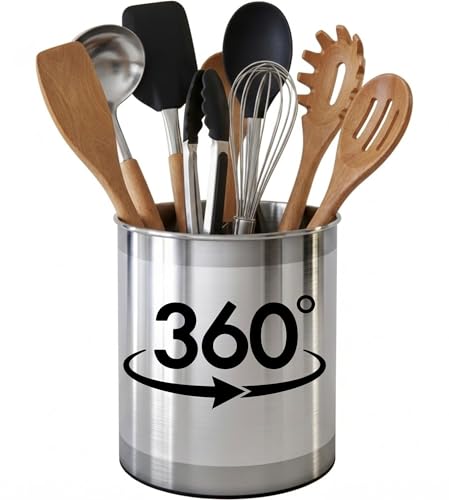
Cooler Kitchen Rotating Utensil Holder
The rotating option: its pro is access to the back row, its con is the clear turning circle it demands and a moving base that must be kept clean. Best for larger sets on open counters. Not suited for tight stove-side gaps.
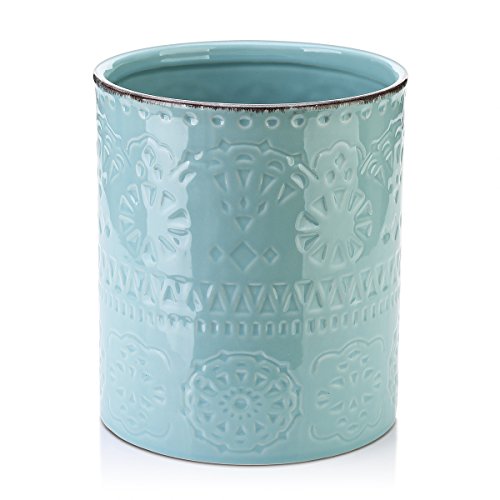
DOWAN Utensil Holder
The ceramic crock: its pros are weight, quiet use and a classic glazed finish; its honest con is that ceramic chips, and a chipped crock must be retired. Best for traditional kitchens. Not suited for anyone unwilling to inspect it now and then.

Home Hero Utensil Holder
The coordinated-set option: its pro is a unified look bought in one decision; its con is less freedom to mix best-in-class pieces. Best for starter and refreshed kitchens. Not suited for collectors building a set piece by piece.
The Trade-Offs in Daily Life: Where a Utensil Holder Earns Its Place and Where It Does Not
Buying a utensil holder takes an afternoon; living with it happens at the counter beside the hob, within reach mid-cooking, while keeping everyday tools upright, visible and out of drawers, and that daily reality is what this section judges. This section therefore starts with your routine rather than the product, because features only matter once they survive contact with your space, your schedule and your household. The first check is the height and diameter against your longest and bulkiest tools, and it outranks everything else, because no styling or extra capacity compensates when that basic fit is wrong. Prevention is unglamorous and effective: emptying and washing it regularly, and drying tools before they go back in, done consistently, protects performance better than any occasional rescue effort after problems have set in.
Anything heavy, hot, sharp, load-bearing or electrically powered deserves a respectful pause in the decision, and the maker’s own guidance, read before purchase, is part of the specification. Sometimes the right purchase is smaller than planned because an existing possession covers the heavy or rare jobs, leaving the new utensil holder to specialise in the frequent ones. Do not test your decision against a calm day. Test it against the rushed morning, the crowded evening or the week everything happens at once, because that is when a utensil holder earns or loses its place. Notice when the utensil holder will be used in a hurry and when it will be used with time to spare, because speed and ceremony reward different designs.
- Mark each advantage with how often it will actually matter.
- Mark each disadvantage with whether a simple habit can manage it.
- Choose the compromise your household complains about least.
- Test the verdict against your busiest week rather than your easiest.
- Weigh daily frictions more heavily than rare inconveniences.
Think a year ahead rather than a week. The utensil holder that suits this season, this household size and this room layout should ideally still suit the next version of all three. Flexibility is worth paying for only if you will use it. A utensil holder that folds, moves or converts impresses in the listing and matters only if your routine actually asks it to. Edge cases matter here: a small counter, where a wide holder eats the very workspace it should serve. A utensil holder chosen with that situation in mind will not need replacing the first time life deviates from the brochure. Check what the purchase does not include, because the missing mat, fitting, filter, cover, tool or connector discovered after delivery is a small cost and a large irritation.
The first fortnight involves unlearning old habits as much as learning new ones, so allow the utensil holder that adjustment period before delivering a final verdict, unless a basic fit check has failed. Apply this thinking to real candidates, such as the OXO Good Grips Utensil Holder or the Cooler Kitchen Rotating Utensil Holder: open the current listing, confirm the dimensions, parts and care details, and only then judge the photographs. Think about handing the task over: if someone else had to use, clean or reset the utensil holder from your brief description alone, the design and your setup would pass or fail together. Set a review date about a month after purchase and judge the utensil holder then against the three jobs you named, while adjusting, exchanging or returning is still practical.
There is no universal verdict here, only a match or a mismatch between the trade-offs of the utensil holder and the shape of your week. Nothing is kept forever. Favour the utensil holder you could repair, rehome or responsibly retire over the one that becomes an awkward problem the day it stops working. The opposite mistake is just as costly over time: a utensil holder that is slightly too small, too light or too basic for a daily routine will be resented long after the saving is forgotten. Keep the paperwork, digital or printed, in one known place: instructions, guarantee details and the measurements you took. Future you, troubleshooting at an inconvenient hour, will be grateful.
For items that suffer from constant use without rest, a planned spare is not extravagance; it is how the routine survives the day the main one is wet, dirty, broken or missing. A utensil holder can be excellent in isolation and wrong in your room, so judge it against the exact surroundings it will meet rather than against a showroom or a styled photograph. Wear arrives at predictable points: hinges, seals, edges, handles, surfaces and anything that is folded, dragged, filled or emptied. Inspect those areas in photographs and descriptions before you buy. Then turn to whether it can be washed properly, because the base collects more than you expect. It sounds secondary while you are shopping and becomes primary the moment the utensil holder joins your routine.
Frequently Asked Questions
How often should you wash a utensil holder?
Wash the inside regularly rather than waiting until it looks dirty: weekly in a busy kitchen, and at least every couple of weeks in a quieter one. Empty it fully, wash it inside and out, and dry it completely before refilling. The bottom collects drips and food residue from tools lifted out of pans, and that residue is the main reason holders develop smells. Utensils should always go back in clean and dry, because a wet spoon dropped into the crock carries water straight to the bottom where it pools.
Can you put knives in a utensil holder?
No. Knives should never sit loose in a utensil crock. Reaching into a crowded holder and closing your hand near a hidden blade is a real cut hazard, and blades knocked against ceramic, metal and other edges dull and chip quickly. Store knives in a block, on a safely mounted magnetic strip, or in an in-drawer knife tray where each blade stays separated and covered. Keep the crock for spoons, spatulas, turners, ladles, whisks and tongs, and both your hands and your knives will be better off.
Where should a utensil holder sit on the counter?
Beside the stove, within easy reach, but at a sensible heat-safe distance from the burners. Close enough that you never lean across a hot pan to reach it, far enough that handles are not sitting in direct heat or constant splatter. Leave room around it so a rotating model can turn freely and so you can lift it out for washing without dragging it across the counter. If the only available spot crowds a burner, choose a slimmer holder rather than a closer one.
What should you do if a ceramic utensil crock chips?
Retire it. A chip is not just cosmetic: it can harbour residue in the rough edge, scratch the counter, and develop into a crack that eventually fails beside a hot stove. Ceramic crocks earn their place through weight and stability, but that bargain depends on the vessel staying intact. Replace a chipped or cracked crock, and do not demote it to holding heavier or sharper tools, which only increases the risk. The same rule applies to any holder that cracks, whatever it is made from.
How many utensils should a holder actually contain?
Only the working set you use most days: typically a turner, a spoon, a slotted spoon, tongs, a ladle, a whisk and a spatula or two. A holder crammed with occasional tools buries the daily ones and makes every retrieval a search. Keep the rest in a divided drawer, and keep knives in proper knife storage. If a tool in the holder has not been touched in a month, move it out. A holder with a little room to spare works better than a larger holder filled to the brim.
Is a rotating utensil holder better than a fixed crock?
It depends on your tools and your counter. A rotating holder, such as the Cooler Kitchen design, makes the back row reachable and suits deep collections on a clear stretch of counter. A fixed crock has no moving parts, is usually heavier and more stable, and suits a smaller working set. Neither is universally better. Choose rotation if you regularly lose tools at the back; choose a fixed, weighted crock if simplicity and stability matter more and your set is compact.
Related Reading
Keep building a calmer, safer work zone around the stove with these companion guides from the same kitchen series.
how to choose a chef knife set that stores safely