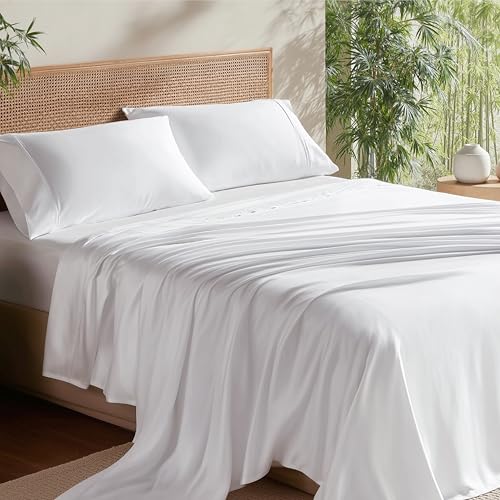
Disclosure: As an Amazon Associate, airfryerkitchensupply.com earns from qualifying purchases. Links on this page are affiliate links; they cost you nothing extra. Prices and availability change often, so check the current Amazon listing before you buy.
Learning how to clean a sheet set properly is the highest-value laundry skill in the bedroom, because sheets are washed more often than any other bedding and punished by every shortcut. The routine below is complete and deliberately ordinary: sort, treat, wash with room to move, dry with restraint, store fully dry. Follow it and an ordinary set stays smooth and bright for years; skip steps and even a fine set ages early. Everything here is safe, standard home laundry practice.
Key Takeaways
- Wash before first use, separate colours every time, and never overload the drum.
- Treat stains with cool water before washing — and inspect again before drying, because heat sets stains.
- Measure detergent; excess leaves residue that stiffens sheets and attracts soil.
- Dry gently and promptly, and store only when completely dry.
In this guide
How to Clean a Sheet Set: The Process at a Glance
The whole method fits in one breath: strip the bed and check for stains, sort the set by colour, pre-treat any marks with cool water and a little detergent, wash as a dedicated load on a gentle cycle with measured detergent, inspect before drying, dry gently and promptly, then fold, refit, or store completely dry. The sections below expand each stage with the details and the mistakes that matter, and the troubleshooting section handles everything that goes wrong when a stage is skipped.
What You Need
The Essentials
You need the sheet set itself, a washing machine with a gentle cycle, a standard laundry detergent you can measure rather than pour by instinct, cool water for pre-treating, and a way to dry gently — a dryer with a modest heat setting or a line. A mesh bag is optional for pillowcases if your machine is aggressive. That is the complete kit; specialist products are optional extras, not requirements, and most sheet damage comes from process errors rather than missing products.
Optional but Useful
A second sheet set is, indirectly, the most useful cleaning supply of all, because rotation means no wash is ever rushed against bedtime. A simple stain-treatment stick kept in the laundry area encourages the prompt treatment that saves sheets. A labelled basket or shelf for bedding keeps clean sets stored dry and together. None of these is necessary; all of them make the routine easier to keep, and a routine that is easy is a routine that survives busy weeks.
Safety and Before You Start
Read the care label on your specific set before the first wash and let it outrank every general instruction in this guide, including this one. Check pockets and pillowcases for tissues and small items, close any zips on accompanying bedding, and keep bleach and harsh additives away unless the label explicitly invites them. Work with cool water for stain treatment, unplug nothing, improvise nothing electrical — this is ordinary laundry, and its only real hazards are heat, haste, and ignoring the label. If anyone in the household has sensitive skin, an extra rinse cycle is a reasonable, gentle precaution.
The Steps in Full
Step One: Strip, Inspect and Sort
Cleaning a sheet set properly is mostly a matter of sequence: sort first, treat marks early, wash with room to move, dry with restraint, and store only when fully dry. Each step is simple, but skipping one quietly undoes the others — sheets stored faintly damp develop a stale smell no perfume disguises, and sheets washed in an overstuffed drum emerge twisted and under-rinsed even with good detergent. Work through the steps in order the first few times and they quickly become a single unthinking routine, which is exactly what laundry should be.
Strip the bed completely and inspect the set as it comes off — fitted sheet corners, pillowcase edges, and the flat sheet’s centre are where marks hide. Sort by colour immediately: whites with whites, colours with like colours, darks apart. This is also the moment to check the fitted sheet’s elastic and seams; catching a weakening corner early lets you rotate that set to lighter duty before it fails mid-night.
Step Two: Pre-Treat Marks with Cool Water
Run cool water through any mark from the back of the fabric, blot rather than rub, and work in a small amount of detergent with your fingers. Give it a few minutes to work while you load the machine. Hot water at this stage is the enemy — it can set protein-based and many everyday stains into the fibres — so patience and cool water do the heavy lifting. Stubborn marks may need a second treatment after washing rather than a harsher first one.
Step Three: Load the Machine Like You Mean It
Sheets wash as their own load wherever possible. They need room to move, unfold, and rinse; a drum stuffed to the door leaves them twisted, detergent trapped in the folds, and creases set like pleats. If you are washing two sets, they must share a colour group and fibre needs, and the drum must still look comfortably unfilled. Close the door on a load that looks slightly underdone and you have loaded it correctly — restraint here is the difference between washed sheets and merely wetted ones.
Step Four: Choose the Cycle and Measure the Detergent
When a set finally wears out, it usually tells you gradually: the fitted sheet’s elastic relaxes, the surface roughens, colours fade unevenly. Retire it gracefully to the linen cupboard’s lower league — dust covers, pet bedding, craft and moving protection — and replace the main rotation before the decline reaches the point of nightly annoyance. Bedding is a small daily pleasure, and the moment sheets stop feeling good, they have stopped doing their job. A household that replaces sheets on feel rather than on catastrophe always sleeps in bedding it likes.
Select a gentle cycle and the temperature the label directs — warm for most cotton, gentler and cooler for microfibre and delicate finishes. Measure detergent for the load size, erring on less: sheets are lightly soiled, excess detergent is hard to rinse out, and residue makes fabric feel stiff while attracting fresh soil faster. Skip fabric softener unless the label invites it, since coatings dull microfibre’s smoothness and reduce absorbency. An extra rinse is a kinder upgrade than any additive.
Step Five: Inspect Before Drying
As the set leaves the machine, check the marks you treated and glance over the rest. Anything still visible gets another round of treatment and, if needed, another wash — but it does not go into the dryer, because dryer heat can set a surviving stain permanently. This thirty-second inspection is the single highest-value habit in this entire guide; it is the last easy exit before a temporary mark becomes a permanent feature of the set.
Step Six: Dry Gently and Promptly
Dry on modest heat or on a line, and do not leave the finished load sitting in the machine, where damp folds breed creases and stale smells. Remove sheets promptly, shake them out, and either refit the bed or fold them straight away. Gentle drying protects elastic and fibres far better than the hottest setting, and sheets dried with restraint come out smoother — often smooth enough that ironing is a preference, never a necessity.
Step Seven: Fold, Rotate and Store Dry
Fold the set into one of its own pillowcases so the whole set stays together in the cupboard, and store it only when completely dry, in a clean dry place. Rotate sets so the same set is not washed relentlessly while its partner rests for months; even rotation is even wear. If a set is being stored after a guest visit, wash it first even if it looks untouched — freshness stored is freshness ready, and the next guests will notice the difference immediately.
Troubleshooting and Common Mistakes
Stains reward speed and punish heat. A mark treated promptly with cool water and a little detergent usually lifts in the wash; the same mark baked in by a hot wash or a hot dryer can become a permanent part of the fabric. Check the set as it comes off the bed and again as it leaves the machine, because the moment before drying is your last easy chance to re-treat anything that survived the wash. This one habit — inspect before drying — saves more sheets than any specialist product on the laundry shelf.
Detergent restraint is an underrated sheet skill. More detergent does not mean cleaner sheets; excess detergent is hard to rinse from fabric, leaves a residue that makes sheets feel stiff and attracts soil faster, and can dull colours over time. Measure for the load size, use less than your instinct suggests, and let water and movement do the work. Sheets are lightly soiled compared with work clothes — they need thorough rinsing more than chemical force — and they feel noticeably better washed that way.
The recurring failures map neatly onto skipped steps. Greyed whites mean colours were mixed or loads sat soiled too long. Stiff sheets mean detergent was overdosed or rinsing was cramped. A stale smell means sheets were stored before they were fully dry. Set stains mean heat arrived before treatment finished. Rough, pilling surfaces mean cycles were harsh, drums were overloaded, or towels and zips shared the load. Diagnose by the symptom, fix the step, and the same set usually recovers its manners within a wash or two.
Gear for This Guide: Sets That Reward Good Care
Two tier-positioned sets bracket the field for readers replacing a set while they learn this routine: an easy-care microfibre set that forgives busy laundry lives, and a cotton set that repays fibre-correct care with years of service.
Mellanni Sheet Set
The Mellanni Sheet Set is the household name of this group, a microfibre set whose reputation rests on softness from the first night and an easy-care routine that suits busy homes. The fabric feels smooth and slightly silky, resists wrinkles straight from the dryer, and comes in the kind of colour range that lets you match almost any bedroom. Positioned in the entry-to-mid tier, it is the set many families buy in multiples — one on the bed, one in the wash, one in the drawer — because rotation at this tier is a genuinely sensible strategy. Warm sleepers should note microfibre can feel cosier than cotton; cool and neutral sleepers usually love it immediately.
Best for: sleepers whose priorities match the description above, and households that will wash it per the label and keep it in regular rotation. Not suited for: buyers whose needs point the other way — a different fibre, a different level of protection, or a different tier — because no single product in this category honestly serves everyone, and choosing against your own sleeping habits is how good products end up in the returns pile. As a pick in this guide it carries a qualitative tier position rather than a link, so compare current listings on the qualities described here.

California Design Den Sheet Set
The California Design Den Sheet Set is the cotton specialist of the group, for buyers who have decided fibre first and want natural cotton with its breathability and familiar, honest feel. These sets suit hot sleepers and percale-or-sateen loyalists who find synthetic smoothness slightly clingy and prefer the way cotton breathes, softens with washing, and ages gracefully. Positioned in the mid-to-premium tier, this is the pick for people who keep sheets for years, wash them properly, separate colours without being asked, and regard bedding as a small daily pleasure worth doing right. If that description sounds like you, start here.
Best for: sleepers whose priorities match the description above, and households that will wash it per the label and keep it in regular rotation. Not suited for: buyers whose needs point the other way — a different fibre, a different level of protection, or a different tier — because no single product in this category honestly serves everyone, and choosing against your own sleeping habits is how good products end up in the returns pile. As a pick in this guide it carries a qualitative tier position rather than a link, so compare current listings on the qualities described here.
Maintenance: Keeping the Routine Alive
Keep the routine alive by making it automatic: a fixed wash day for the main bed, a guest set washed immediately after visitors, labels read once and their essentials noted where the laundry is done. Pair the routine with a mattress protector on the bed — the protector takes the spills, the sheets take the washing, and each layer’s care stays simple. Revisit this guide when a new fibre enters the house, because care per fibre is the one rule that changes as your bedding changes.
Putting It All Together: Living With the Choice
Seasonal thinking improves bedding more than most upgrades do. The bed that delights in January can genuinely disappoint in July, because warmth is a property of the whole stack, not of any one layer. Rather than searching for a mythical all-season perfection, many households keep the protector constant — protection is seasonless — and rotate the sheet set and duvet weight with the weather. That division of labour is tidy: the barrier never changes, the comfort layers do, and each purchase can be optimised for its actual job instead of compromised across all of them.
There is a particular pleasure in a bed made entirely of layers that are doing well: a mattress still clean under its protector, sheets smooth from a proper wash, a pillow that suits its sleeper. None of that requires luxury spending. It requires the unglamorous virtues — protection fitted early, colours separated, detergent measured, heat restrained, spares rotated — applied consistently by ordinary people on ordinary wash days. This guide’s real recommendation is that system, with the named products simply being reliable ways to stock it.
Shared beds add a negotiation layer that solo sleepers never face. Two people rarely agree perfectly on warmth, smoothness, or how much sound a bed should make, and bedding choices land in the middle of those preferences. The practical approach is to prioritise the layer each person feels most: the surface for the texture-sensitive partner, breathability for the hotter sleeper, quietness for the lighter sleeper. A protector or sheet set that represents a thoughtful compromise will be slept on happily for years, while a unilateral purchase that ignores one partner’s sleep tends to be relitigated at two in the morning.
If you share laundry duties, write the routine down. A note on the cupboard door — colours separate, gentle cycle, measured detergent, no hot drying for the protector, store only when dry — converts one person’s knowledge into a household system that survives holidays, teenagers, and helpful relatives. Most bedding damage in shared homes is not carelessness but inconsistent information, and a twenty-word note eliminates nearly all of it. Systems beat intentions, in laundry as in everything else.
Ownership, in the end, is the real review. The first night with new bedding tells you about novelty; the fiftieth wash tells you about the product. Everything recommended here was chosen to still be earning its place at the fiftieth wash — seams intact, elastic alive, surface smooth, barrier working — provided the simple care rules in this guide are followed. Keep those rules, keep a spare in the drawer, and the bed will quietly repay you every single night, which is all any of us actually ask of it.
Bedding also ages unevenly across a household, and planning for that saves money. The main bed works hardest and deserves the best of everything; children’s beds work dirtiest and deserve the most washable; guest beds work rarely and deserve reliability after long storage. Buying identical products for all three is tidier but rarely optimal. Match the tier and the construction to the duty each bed actually performs, and the household’s bedding budget suddenly stretches much further without any bed feeling short-changed.
If you are furnishing a bed from nothing, sequence the spending. Start with the mattress decision, protect it the same week it arrives, then buy two sheet sets rather than one so rotation begins immediately, and only then refine pillows and decorative layers. That order feels unglamorous — the protector is the least exciting item on the list — but it is the order that protects the largest purchase during its most vulnerable early weeks and builds the laundry rotation that keeps everything else lasting longer. Glamour can be added at any point; protection delayed is protection partly lost.
The environmental arithmetic of bedding quietly favours the approach this guide recommends. Protecting a mattress extends the life of the largest, hardest-to-dispose item in the bedroom. Rotating two sheet sets extends both beyond what either would manage alone. Washing gently, at sensible temperatures, with measured detergent, and drying with restraint all reduce the footprint of every load while also — not coincidentally — being exactly the care that makes fabrics last. Durability is the greenest feature a textile can have, and it is mostly a habit, not a purchase.
It is worth saying plainly that none of the products in this guide will fix a bed whose foundations have failed. A sagging mattress needs replacing, not dressing; a pillow that has gone flat needs retiring, not a new case. Bedding works its quiet magic on sound foundations, and part of buying well is recognising when the honest purchase is the foundation itself. Protect and dress what is sound, replace what is not, and never ask a thin layer of fabric to perform a structural rescue it was never designed for.
When a product description and your own priorities disagree, trust your priorities. A protector engineered for maximum barrier may be wrong for the hottest sleeper; the silkiest sheet set may be wrong for the household that washes everything hot and fast. Manufacturers design for an average sleeper who does not exist, in a household that resembles nobody’s. Your bed, your climate, your laundry, your partner, your dog — those are the specifications that matter, and every section of this guide has been written to help you apply them rather than to override them.
Finally, trust your own sleep over any guide’s ranking, including this one. Reviews and buying guides can narrow a field, explain trade-offs, and warn you off mismatches, but the final evidence is a week of your own nights: whether the bed felt right, whether the layers stayed put, whether laundry day was easy. Buy from sellers whose return terms respect that reality, judge on your own mattress in your own room, and keep the products that earn their place. Bedding is intimate equipment, and your verdict, honestly formed, is the one that counts.
It helps to think of bedding purchases on two different clocks. The mattress runs on a long clock, measured in years, and deserves slow, careful choosing. Protectors and sheets run on a shorter clock: they are washed constantly, they age visibly, and they are replaced on feel. Mixing the clocks up causes most buying mistakes — people either replace sheets far too late, sleeping on rough fabric for a year out of inertia, or replace a mattress early because an unprotected surface made it feel older than it was. Protect the long-clock purchase with short-clock purchases, and replace the short-clock items without sentimentality.
Reading care labels is a small literacy that pays for itself across the whole house. The label on a protector or sheet set compresses the maker’s entire knowledge of their fabric into a few lines: temperature, cycle, what to avoid, how to dry. Households that follow labels keep textiles noticeably longer than households that wash everything on one heroic setting, and the difference is not effort — the label takes twenty seconds to read, once — but attention. Tape a note inside the laundry cupboard door if several people share the washing, and the whole household inherits the benefit.
Small bedrooms and small budgets teach the same lesson: versatility beats specialisation. A protector that serves the main bed now can serve the guest bed later; a sheet set in a calm colour works in every season and with every duvet you will ever own. Choosing versatile, honestly made basics first builds a linen cupboard that can absorb life’s changes — a new mattress depth, a new partner’s preferences, a child arriving, a parent moving in — without starting again from nothing. Specialised luxuries can be layered on later, on top of a foundation that already works.
There is a quiet economics to all of this that rarely appears in product descriptions. The cost of protection and rotation is small spread across the nights it serves, while the cost of the item being protected is large and concentrated. Households that internalise that ratio tend to protect early, rotate sheets properly, and replace worn bedding on schedule — not because they are extravagant, but because they have done the arithmetic the other way and seen what an unprotected mattress and a single overworked sheet set actually cost across a few years of nightly use.
Humidity is the invisible variable in bedding performance. In a humid climate or a steamy flat, fabrics dry slower, store worse, and feel clammy sooner, which argues for quick-drying fibres, disciplined airing, and absolute strictness about storing only fully dry textiles. In a dry climate the same products behave almost effortlessly. Read every recommendation in this guide through your own climate: the right product in the wrong humidity regime will always feel like a disappointment, and the fix is usually process — airing, spacing, patience — rather than replacement.
Storage is the unglamorous final stage of bedding ownership. Clean sets stored fully dry, folded inside one of their own pillowcases, in a cupboard that is itself dry, stay fresh for months; the same sets stored faintly damp or in a steamy bathroom cupboard emerge smelling of their storage rather than their washing. Protectors store flat or loosely rolled rather than crushed into a ball, which treats the membrane kindly. Ten seconds of care at storage time is the difference between bedding that greets you fresh and bedding that needs re-washing before it can be used at all.
Allergy-adjacent language surrounds this category, so a word of discipline is worthwhile. Bedding can be part of a clean household routine — washed regularly, kept dry, changed often — and that routine is a reasonable comfort measure for anyone. What bedding cannot honestly promise is medical benefit, and this guide deliberately makes no such promise for any product in it. If a health condition is part of your household’s life, let your clinician guide the medical side and let bedding do its plain, useful work: being clean, dry, comfortable, and easy to keep that way.
A last word on colour and mood, because bedding is the largest textile surface in the room and sets its emotional temperature. Calm, pale bedding makes a small room feel larger and a busy mind quieter; deep colours ground a large room and forgive the realities of pets and children between washes. There is no correct palette, only the one that makes you exhale when you walk in at night. Choose the products in this guide by performance first, then let that exhale cast the final vote between the finalists.
There is a rhythm to well-run bedding that visitors never see and residents always feel. Sheets changed on a fixed day, protectors rotated without drama, spares folded and waiting, worn items retired before they become unpleasant — none of it is visible, and all of it is the difference between a bedroom that merely looks calm and one that actually is. The products in this guide are simply the cast; the routine is the play, and households that learn the routine find that even modest products perform like premium ones.
One more practical habit separates satisfied owners from disappointed ones: inspect on arrival. Unfold the product fully, check seams, elastic, and surface, test the fit on the actual bed, and run the first wash before the return window closes rather than after. Almost every bedding disappointment is discoverable in that first afternoon — a pocket too shallow, a surface rougher than expected, a skirt that will not grip — and almost every one is only fixable while returning is still easy. The first day is your quality-control department; use it while it is free.
Layering is the idea that ties this whole corner of the bedroom together. No single product makes a bed good; the mattress supports, the protector defends, the sheets touch, the pillow cradles, and each layer does its own job better when the others are doing theirs. Buying in that order of thinking — support first, protection second, surface third — prevents the common error of spending heavily on the visible layer while leaving the expensive layer underneath undefended. A modest protector under good sheets will out-serve beautiful sheets over a mattress that is slowly absorbing every spill of the year.
Finally, let the bed be the easiest system in your house to run. If a bedding routine needs a spreadsheet, it will fail; if it needs a fixed wash day, a spare set, and a note on a cupboard door, it will run itself for a decade. Every recommendation in this guide — protection early, rotation always, gentle washing, restrained heat, dry storage — was chosen because it survives contact with real, busy, forgetful households. Simple systems, honestly maintained, are what great sleep is actually made of.
A useful test for any bedding purchase is the two-in-the-morning test. Imagine the product failing at that hour — a corner loose, a spill spreading, a surface suddenly too warm — and ask what you would do. Good bedding has a two-in-the-morning answer: a spare set in the drawer, a protector that strips off in seconds, a fitted sheet that goes back on by feel. If the honest answer is misery until morning, the system needs a spare or a simpler product, and it is far better to learn that in the shop than in the dark.
Parents of teenagers, hosts of elderly relatives, owners of ageing pets — many households are quietly managing continence, medication spills, and middle-of-the-night accidents that product pages never mention. For those households a reliable waterproof barrier and fast-change bedding are not conveniences but dignity-preserving infrastructure, and they should be bought without embarrassment and in duplicate. This guide’s emphasis on honest barriers, quick changeovers, and spares in the drawer is written with those households firmly in mind, even when the examples sound like coffee and juice.
Think, too, about the order in which a bed is made after washing, because sequence prevents the classic frustrations. Protector first, seated at every corner and smoothed flat. Fitted sheet next, deepest corner first. Flat sheet and duvet last, falling evenly. Made in that order, the bed takes minutes and stays made; made in any other order, something is always being tugged out from under something else. It sounds trivial until you have remade a bed at midnight, at which point it becomes the most practical paragraph in this guide.
Children change the calculation completely, and honestly. Beds used by children see more spills, more accidents, more midnight drinks, and more washing than any other beds in the house, and bedding for them should be chosen for washability and changeover speed above elegance. A protector that can be stripped and refitted in minutes, and sheets that wash and dry quickly and come back smooth without ironing, are worth more in a child’s room than any refinement of hand-feel. Buy duplicates without guilt: in a child’s bedroom, the spare set is not a luxury, it is the system working as designed.
One under-discussed factor is the sound a household makes at night, and bedding’s contribution to it. A bed is an instrument whether you like it or not: every turn, every shift, every early-morning exit is either muffled by well-chosen layers or announced by crinkly, loose ones. Light sleepers learn this in the first week with a new product, which is why this guide returns so often to quietness as a first-class criterion rather than a footnote. When in doubt between two otherwise equal options, choose the quieter one — nobody has ever been kept awake by bedding that made too little noise.
Finally, keep a small honesty about replacement. Bedding does not last forever, and pretending otherwise leads to the slow misery of sleeping on worn-out layers out of inertia. Elastic relaxes, surfaces roughen, membranes quietly tire, colours fade — and each is a signal, not a failure of character. Replace the working layers when the signals accumulate, retire the old ones to lighter duty, and the bed returns to being what it should be: the most reliably pleasant place in the house, maintained by routine rather than by luck.
Temperature disagreements deserve their own strategy, because they are the most common bedding conflict in shared beds. Rather than averaging two preferences into a compromise neither partner enjoys, layer asymmetrically where the product allows it: the sheet and protector form the shared base, chosen for the hotter sleeper’s breathability, while warmth is added individually on top, where it can differ by side. Solving the conflict at the layer where difference is possible beats relitigating it at the layer where it is not, and both sleepers end up closer to their own ideal.
Travel teaches bedding lessons that home hides. After a week of hotel beds, most people come home knowing exactly what they like: the crispness or the softness, the weight or the lightness, the pillow height. Use that knowledge while it is fresh. The sheet and protector choices in this guide map directly onto those travel impressions — percale crispness, sateen smoothness, microfibre silkiness, a barrier you never noticed — and a purchase made in the week after a trip is often the best-judged purchase of the year, because your preferences are briefly, unusually clear to you.
Guests judge a bed in about four seconds, and what they judge is not thread specifications but freshness, smoothness, and whether everything stays in place. That is excellent news for hosts, because all three are process outcomes rather than price outcomes: bedding washed before first use and after every visit, a fitted sheet that genuinely fits, a protector quietly doing its work underneath. A modest set cared for properly will out-score an expensive set cared for carelessly in every guest’s memory, which is one more reason this guide spends so many words on routine.
When you are comparing listings, read for specifics and be suspicious of superlatives. A maker who tells you how the skirt is elasticated, how the set should be washed, and where the product’s trade-offs lie is giving you the material of a real decision. A listing built entirely from words like luxurious, premium, and revolutionary is giving you weather, not information. The products recommended in this guide were chosen because their descriptions survive that test: they say what the product is, what it suits, and what it does not do — and honest description correlates strongly with honest manufacture.
There is also the matter of the bed’s second life as furniture: reading chair, homework headquarters, film screen, dog sofa, sick bay. Layers chosen only for sleeping are often wrong for the bed’s daytime duties, which is another quiet argument for protection and washability over delicacy. A protector does not care whether the spill came from midnight water or afternoon juice; a washable sheet set does not care whether it is changed for sleep or for guests. Buy for the bed’s whole life and the night-time performance takes care of itself.
If budget forces a sequence, protect first and beautify later, every time. A protector bought in the mattress’s first week defends the full value of the largest purchase in the room, while decorative layers bought first defend nothing and can themselves be ruined by the first unprotected spill. Sheets come second, in pairs, because rotation is a durability feature disguised as a convenience. Pillows and decorative touches come last, when the working layers are sound. Households that follow this order rarely regret a purchase; households that reverse it often end up buying the working layers twice.
A word about buying for the bed you have rather than the bed in the photograph. Catalogue beds are dressed in daylight, on new mattresses, with everything freshly laundered and nothing lived in. Your bed hosts real life: a partner who runs warm, a dog with opinions, a child with a juice box, a Sunday-morning coffee habit. Products chosen for that bed — washable, forgiving, honestly fitted — will satisfy you daily, while products chosen to recreate a photograph will be quietly resented by Friday. Let your household’s actual habits write the specification, and let the photograph inspire only the colours.
Consider the bed from the perspective of the person who maintains it, because that person is usually you at the end of a long day. Every bedding choice is also a laundry choice: how often it must be washed, how gently, how long it takes to dry, how easily it goes back on. Products that respect the maintainer — machine washable, quick to refit, forgiving of an ordinary routine — stay in service for years, while fussy products are quietly abandoned to the back of the cupboard no matter how impressive their first week was. When two candidates seem equal, choose the one whose care routine you will actually keep.
Cleaning Edge Cases Most Sheet Set Owners Miss
Routine cleaning advice covers the average day, but a sheet set usually suffers from the exceptions: the neglected corner, the build-up you cannot see, the well-meant method that slowly damages a finish. This section deals with those edge cases, and with the simple schedule that stops them becoming repairs.
Start any deep clean of a sheet set by identifying where grime actually accumulates in this category, which is rarely the visible face. Work from the cleanest area to the dirtiest, use the mildest method that works, and test any new cleaner on a hidden patch first, because finishes in this category vary and a product safe on one can dull another. Set out everything you need before starting; a half-cleaned item left wet while you hunt for a cloth is how water marks and rust spots begin.
The stubborn cases follow a pattern: deposits and residues build exactly where the routine clean never reaches, and eventually present as fitted sheets creeping off corners because the pocket depth does not match the mattress. Treat those areas on a schedule rather than waiting for symptoms, soaking or dwelling time doing the heavy lifting instead of hard scrubbing, which trades a stain for a scratch. The edge case deserves its own plan too: guest beds and laundry turnaround, which decide whether one spare set is enough. Build that scenario into your calendar, for example after guests, heavy use or a seasonal change, instead of discovering it unprepared.
Finish with prevention, because the cheapest clean is the one that stays unnecessary longest: washing before first use and following care guidance to protect fibres and colour. Wipe down after messy uses rather than weekly in arrears, dry surfaces that are meant to be dry, and keep the basic kit, cloth, brush and your chosen cleaner, stored with or near the sheet set itself. Five habitual minutes after use reliably outperform an hour of rescue cleaning every month, in results and in how long the finish survives.
A Final Decision Checklist
- Start where grime hides, not where it shows, and work from cleanest to dirtiest.
- Soak or dwell before scrubbing, since most damage in this category comes from force.
- Treat the symptom areas on schedule, because fitted sheets creeping off corners because the pocket depth does not match the mattress begins as neglected build-up.
- Use the mildest method that works and test any new cleaner on a hidden patch first.
- Build the edge case into the calendar, because guest beds and laundry turnaround, which decide whether one spare set is enough is when cleaning gets skipped.
- Prevent the next clean while you finish this one, since washing before first use and following care guidance to protect fibres and colour.
- Keep the basic kit stored with the item itself, so small cleans happen immediately.
- Photograph the setup once it is clean and working well, as the standard for the next pass.
- After the deep clean, check the largest regular job, not the largest imaginable one, when judging whether the size is right.
- With the mildest cleaner first, check the shortlist against your written criteria, not against whichever listing photographs best.
- Before soaking anything, check compatibility once more before ordering parts or accessories, remembering that fabric type against how warm you sleep and the season you will use the set most.
- With the mildest cleaner first, check the failure signs monthly, so you catch the stage where fitted sheets creeping off corners because the pocket depth does not match the mattress is still a five-minute fix.
- On the weekly pass, check seasonal differences, since heat, guests and holiday loads test a sheet set differently from ordinary weeks.
Frequently Asked Questions
What temperature should I wash a sheet set at?
Follow the care label on your specific set first, because fibre decides temperature more than habit does. As a general orientation, cotton tolerates warm washing well, while microfibre and delicate finishes prefer gentler, cooler cycles and modest drying heat. The mistake to avoid is assuming hotter is cleaner: excess heat sets stains, fades colours, stresses elastic, and can roughen smooth fibres. Measured detergent, room to move in the drum, and a thorough rinse clean sheets more reliably than maximum temperature ever will.
Should I use fabric softener on sheets?
Use it only if the label invites it, and consider skipping it by default. Softener coats fibres, and on microfibre that coating dulls the smoothness you bought the set for; on absorbent fabrics it can reduce absorbency and leave a residue that builds up over washes. Many people find sheets washed with measured detergent and rinsed thoroughly feel clean and soft without any softener at all. If a set feels stiff, the cause is more often excess detergent residue than a lack of softener — rinse better before adding products.
How do I get a stain out of a sheet set?
Act quickly and keep heat away until the stain is gone. Blot rather than rub, rinse with cool water, work in a little detergent, and let it sit before washing the set as its own load. Then inspect before drying: heat from a dryer can set a surviving stain permanently, so the check between washing and drying is your most valuable moment. Repeat treatment on anything still visible rather than drying hopefully. Some old or set stains will only fade, and honest care advice admits that — prevention and speed beat every remedy.
How should I dry and store sheet sets?
Dry sheets fully but gently — modest heat or line drying protects fibres and elastic better than the hottest setting — and remove them promptly so they dry smooth rather than creased. Fold or refit them straight away; a set left in a heap wrinkles itself into extra work. Store sets only when completely dry, in a clean, dry cupboard, ideally folded inside one of their own pillowcases so the whole set stays together. Storing even slightly damp sheets invites a stale smell that no amount of airing fully erases.
How do I keep white sheets white and colours bright?
The unglamorous answer is separation: wash whites only with whites, colours only with like colours, every single time, because dye transfer and greying are cumulative and irreversible. Wash promptly rather than letting soiled sheets sit, measure detergent instead of overdosing, and rinse thoroughly so residue does not attract soil. Dry promptly too — sheets left damp in the machine pick up odours that read as dinginess. None of this needs specialist products; it needs consistency, which is why households with a fixed routine keep bright sheets for years.
Can I wash two sheet sets together?
Yes, if they share a colour group and fibre care needs, and if the combined load still leaves room in the drum for the fabric to move and rinse. Two sets crammed tightly wash worse than one set washed properly — they twist together, trap detergent, and emerge creased. If the machine looks full, it is full: split the load. Washing two compatible sets together on a gentle cycle with measured detergent is a reasonable laundry-day efficiency; washing everything you own in one heroic load is how sheets age before their time.
Related Guides and Next Steps
Continue with the guides that sit closest to this one: our sheet set review; sheet set reviews compared; our bed pillow review; the best bed sheet set options for a first rotation; pillow protectors for down pillows; bed sheet sets for guest rooms. Each covers a neighbouring decision — protection, bedding, or pillows — so the layers of the bed work together rather than being bought in isolation.