Disclosure: As an Amazon Associate, airfryerkitchensupply.com earns from qualifying purchases. Links on this page are affiliate links; they cost you nothing extra. Prices and availability change often, so check the current Amazon listing before you buy.
Any honest account of mailbox pros and cons has to begin by admitting the product is a compromise wearing a door: every gain in security costs convenience, every gain in capacity costs size, and the placement rules constrain all of it. This mailbox pros and cons guide weighs owning a modern, well-chosen mailbox — including the locking and parcel designs most buyers now consider — against the traditional open box and against doing nothing at all, so the trade-offs are visible before money moves.
Quick Verdict and Key Takeaways
Best for: households whose deliveries or street justify upgrading from an open box. Not suited for: quiet-street households with a sound existing box, for whom most pros below are theoretical and most cons are real. The balance in one line: the pros are about protection and fit — of mail, of parcels, of your daily routine — while the cons are about friction — keys, cost, size and rules. Whether the exchange favours you depends entirely on which side of that ledger your own street populates.
In this guide
The Pros — Mailbox Pros and Cons, Positive Side
Pro: Casual Theft Is Genuinely Defeated
A baffled locking box ends the commonest mail crimes outright. The opportunist working a street finds a door that does not open and mail that cannot be fished back out, and moves on within seconds. This is not a marginal improvement; it is the difference between exposure and protection for cheques, cards and prescriptions, on the exact streets where those losses occur.
Pro: Parcels Stop Living on the Porch
Parcel-capable designs remove the most visible failure of modern delivery — the box balanced on the porch in public view, in the rain, announcing both a delivery and, often, an empty house. Concealment alone deters much porch piracy, and weather protection is a daily dividend in wet climates.
Pro: Capacity Ends the Overflow Problem
A correctly sized box absorbs travel gaps, bundled weekend mail and catalogue season without the door standing open. Overflow is not cosmetic: it exposes mail to weather, advertises absence and can lead carriers to hold mail at the office. Sizing honestly converts a recurring small failure into a non-event.
Pro: Weather Protection Is Real
Modern overlapping door lips, drained floors and sound finishes keep mail dry in conditions that soak an old, sagging box. Anyone who has peeled apart a wet stack of envelopes understands this pro in their fingers. In snow and salt country, sound construction also resists the corrosion cycle that eats cheap boxes from the seams outward.
Pro: One Purchase Serves for Years
Few household objects amortise this well. A mainstream approved box, installed level on a sound post and maintained in minutes twice a year, commonly serves a decade or more, which makes even premium tiers inexpensive per year and makes durability the easiest economy in the category.
Pro: The Street Looks Better and Finds You Faster
A sound, well-mounted box with clear reflective numbers improves the streetscape, satisfies association standards and — the point that matters most — helps emergency services find your house at speed on the worst night of your life. Few purchases combine the cosmetic and the genuinely protective this directly.
Modern delivery patterns have quietly rewritten what a mailbox is for. Letter volume has fallen for years while small-parcel volume has climbed, so the box that suited a household a decade ago — letters, bills, a magazine — may now be the bottleneck for pharmacy mailers, market orders, subscription boxes in miniature and the constant small commerce of contemporary life. This is why parcel-capable and large-format boxes keep gaining ground, and why the honest first question in any mailbox decision is no longer about letters at all: it is about the largest and the most frequent thing that arrives. Answer that question from your own last month of deliveries, not from a product page, and the size and style decision mostly makes itself. The remaining questions — lock or not, steel or polymer, post or wall — then resolve in a sensible order.
The Cons — Mailbox Pros and Cons, Negative Side
Con: A Lock Means a Key, Every Day
The daily friction of a locking box is small and absolutely relentless: a key carried in rain, snow, darkness and armful-of-groceries conditions, for years. Households that collect mail casually, in passing, in slippers, feel this con most. It is the honest price of the security pro, and it should be weighed, not waved away.
Con: No Mailbox Is a Safe
Here is the locking honesty every buyer deserves before spending at the premium tier: a locking mailbox reduces casual theft, and that is all any mailbox honestly does. A determined thief with time, tools and privacy can defeat any residential mailbox, because the box is small, the steel is thin compared with a safe, and the whole unit is mounted outdoors where nobody watches it at 3 a.m. What a good lock and baffle actually buy you is the defeat of the common crimes — the opportunist who lifts doors along a street looking for cheques, cards and prescriptions, the fishing hand through an open slot, the quick pry with a screwdriver. Those are the thefts that actually happen, and a well-built locking box stops them cold. Just never store anything in any mailbox that you would store in a safe, and never let a lock talk you out of collecting mail promptly, which remains the cheapest security measure of all.
Con: Placement Rules Constrain Everything
Before any product comparison matters, the placement rules matter more. Curbside boxes must meet USPS placement rules: the carrier has to be able to serve the box from the vehicle without leaving the seat, which in practice means the box sits at the height and setback from the road that your local post office specifies — commonly with the bottom of the box roughly waist-to-hip height above the road surface and the door set back a short distance from the curb or road edge so the truck can pull alongside safely. Exact figures are set locally, so confirm them with your post office before you dig anything. A non-compliant box may not get delivery at all: the carrier can require you to move it, and mail can be held at the post office until the box complies. New box designs themselves should carry Postmaster General approval, which every mainstream model named in this guide does, but approval of the box does not excuse a non-compliant installation of it.
Con: Size and Tier Climb Together
Capacity and security both push the purchase upmarket and up in physical bulk. A parcel vault is furniture-scale; a heavy security box is genuinely heavy. For small lots, tidy streetscapes and modest delivery patterns, the capable box can simply be too much object — visually, spatially and financially — for the job it will actually do.
Con: Installation Is a Project, Not a Task
The 811 wait, the post setting, the alignment, the association check: a compliant installation is an afternoon plus lead time, and shortcuts reappear as held mail, re-dug holes or enforcement letters. Compared with screwing a wall box beside the door, the curbside project is real work, and renters or the less handy should count it honestly.
Con: Carriers and Couriers Must Be Able to Work With It
An arrangement your USPS carrier cannot serve to rule, or a locked box private couriers cannot open, converts security into missed deliveries. The system’s other users are a design constraint, and ignoring them is how a technically excellent mailbox becomes a daily problem with a key.
Your carrier is a stakeholder in this purchase, and designing for the carrier is designing for yourself. Carriers serve hundreds of boxes from a vehicle, in all weather, against a schedule; a box that opens smoothly with one hand, sits at the right height, presents its door to the vehicle window and closes securely with a positive latch gets served quickly and correctly. A box that sticks, sags, sits too low or requires the carrier to leave the vehicle generates friction that shows up as missed, late or held mail. The red signal flag matters too — it tells the carrier you have outgoing mail, and it should move freely and stay where it is put. If you are replacing a box, matching or improving the old serving position usually matters more than the new box’s styling. When in doubt, ask the carrier or the local post office what they prefer to serve; it is the cheapest expert consultation in the entire project.
What the Trade-Offs Mean for You
Mail theft is not evenly distributed, and an honest recommendation starts with your street rather than a national average. In many neighbourhoods an open tunnel box has served the same house for thirty years without an incident, and a premium locking box there buys peace of mind more than protection. In others — streets with reported porch piracy, clusters of rental turnover, boxes on isolated rural stretches where a car can idle unseen — mail disappears often enough that cheques, replacement cards and pharmacy deliveries become real losses. Judge your own risk by evidence: ask neighbours, check whether your post office offers informed delivery scanning so you know what should arrive each day, and notice whether boxes on your street already lock. Security spending should follow that evidence. Overspending on armour for a quiet street is merely wasteful; underspending on a targeted street is how identity theft starts.
Rural and long-driveway households use a mailbox differently, and the differences change the recommendation. Collection may be a deliberate trip rather than a passing habit, so capacity for several days matters; the box may sit far from the house and out of sight, which raises the value of a lock; weather exposure is usually harsher, with no house wall to break the wind; and plough or gravel-road spray arrives harder. Rural carriers also bundle more — catalogues, small farm-supply parcels, the week’s accumulated everything — into a single delivery. A large tunnel box or a large locking box serves this life best, mounted on a support that can be repaired with farm-shop tools after the inevitable knock. Reflective numbers matter doubly where there are no streetlights and the ambulance is navigating by mailbox posts and memory.
Wall-mount and porch households face a different equation. Where the carrier walks the route, a porch box or wall box keeps mail steps from your door, removes the post, the digging and the breakaway question entirely, and can look like part of the house rather than furniture at the curb. The constraints are capacity — wall boxes are smaller — and the walk-up theft pattern, which argues for a locking wall box in busier streets. Mail slots go furthest: nothing sits outside to steal from at all, though slot rules, door construction and the hallway landing zone need thought. Apartment and multi-unit readers should look at commercial cluster-style thinking even for small buildings, because individual curbside boxes multiplied across units multiply every problem in this guide. The right answer follows the delivery pattern your carrier actually walks or drives, which is why the post office conversation comes first in every version of this advice.
Context: The Main Designs Compared
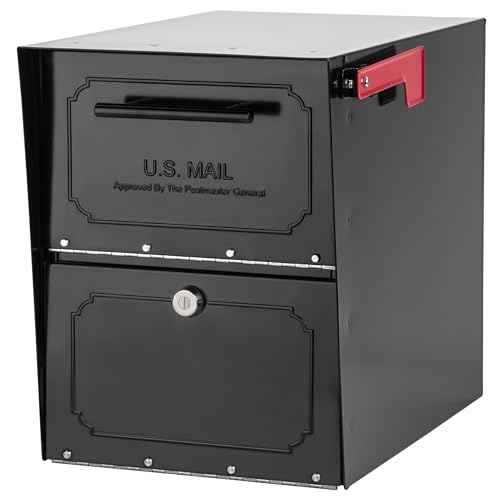
Architectural Mailboxes Oasis Classic
The Architectural Mailboxes Oasis Classic is a locking post-mount design built around a wide delivery door that accepts small parcels and padded mailers, not just envelopes. The body is galvanised steel with a powder-coated finish, the retrieval door locks, and incoming mail drops past a baffle so a hand reaching in from the delivery side cannot simply fish letters back out. It suits households that receive a steady flow of small online orders and want those deliveries out of sight rather than sitting on the porch. The trade-off is retrieval: you carry a key to your own mailbox, and the interior, while generous for a curbside box, still will not swallow a shoebox-sized parcel.

Mail Boss Mail Manager Pro
The Mail Boss Mail Manager Pro is a security-first locking mailbox built from thick galvanised steel with a patented anti-pry latch and a fastened, concealed hinge, designed specifically to resist the screwdriver-and-crowbar attacks that defeat cheaper locking boxes. Incoming mail slides through a slot that accepts small parcels and prescription bottles, then drops into a locked retrieval compartment. It sits at a premium tier and feels like it: heavy, tight and deliberately unfriendly to tampering. The trade-offs are weight, a higher tier, and a retrieval door you open with a key every single day, in every kind of weather.

dVault Parcel Drop
The dVault Parcel Drop is a large parcel-oriented locking box built around a drop door and an internal baffle: the carrier opens the top compartment, places the package, and closing the door tips it down into a locked lower vault that only your key opens. It is the closest a curbside product gets to a parcel safe, and it suits households whose deliveries have outgrown letter-sized thinking entirely. The trade-offs are size, weight and tier — this is furniture-scale hardware that needs a solid mounting plan — and even a parcel vault has a ceiling: oversized boxes still end up on the porch, and no mailbox of any kind should be treated as a true safe for valuables.
Gibraltar Mailboxes Elite Large
The Gibraltar Mailboxes Elite Large is a traditional, non-locking rural-style box in heavy galvanised steel, with the familiar rounded tunnel shape, a wide door and room for several days of mail, magazines and small packages laid flat. There is no lock and no baffle; security comes from simplicity, durability and price tier rather than hardware. It suits rural routes, long driveways and anyone whose carrier leaves bundled mail and catalogues that would choke a smaller box. The honest limitation is obvious: anyone can open it, so it is the wrong choice where mail theft, identity theft worries or porch piracy are part of your daily reality.
How to Buy Smart
Capacity deserves more thought than it gets, because the wrong size fails daily rather than occasionally. A standard box handles letters and a magazine or two; a large box swallows several days of accumulated mail, catalogues and a padded mailer without the carrier playing Tetris; a parcel-capable box changes the category entirely. Think about your real delivery pattern, not your ideal one: how many days pass between collections when you travel, how many small orders arrive in a normal week, whether prescriptions or chequebooks come by mail, and whether your carrier leaves bundled Saturday mail that doubles the volume. A box that overflows is not a minor inconvenience — an overstuffed door that will not close advertises absence, exposes mail to weather, and can lead the carrier to hold mail at the office. Buy for your worst normal week, not your best one, and remember that retrieval door size matters as much as interior volume: a cavernous box with a small door is a puzzle you solve daily.
Materials decide how a mailbox ages more than any other specification. Galvanised steel is the default for good reason — strong, affordable and rust-resistant — but the galvanising and powder coat are a system, and once a scratch or a door-edge wear point exposes bare steel, rust starts there and creeps. Aluminium never rusts in the steel sense and suits coastal air, at a higher tier and with a slightly softer feel. Moulded polymer cannot rust at all and shrugs off dents that would crease steel, though long sun exposure can fade and embrittle it. Stainless steel sits at the top tier and suits salt-air coasts best of all. Whichever material you choose, the moving parts decide the service life: hinges that are riveted loosely, latch springs that tire, and doors that never quite sealed from new are the failures owners actually report, long before a steel shell rusts through.
The real costs of a mailbox are mostly not the box. There is the post and mounting hardware, the numbers, possibly a replacement support if the old one is rotten, and the small tools most households half-own already. There is the time cost of installation done properly — the 811 wait, the post setting, the alignment — and the ongoing minute a day if you choose a locking box and carry a key in all weathers. There is also the cost of the wrong purchase: a too-small box replaced within a year costs more than the right box bought once, and a premium security box on a street that never needed it is money parked at the curb. Set against that, a mailbox is among the cheapest pieces of household infrastructure per year of service: a decent box installed well commonly serves for a decade or more, which makes buying for durability one of the few genuinely easy economies in home ownership.
Setup and Care That Reduce the Cons
Installation follows a fixed logic whatever the model: confirm the serving position with the post office, call 811 and wait for utility marks, set the post at the correct height and setback, mount the box level with the door facing the carrier’s approach, and finish with numbers and a flag check. The post itself is usually a treated timber post or an approved metal support, set deep enough to resist frost heave and casual knocks while still yielding in a real vehicle strike. A mounting board between post and box spreads the fastenings and lets you replace the box later without replacing the post. Level matters more than it looks: a box that tilts forward sheds its door seal, pools water at the front seam and eventually swings its door open in wind. Work in that order and the job is an afternoon; work out of order and you will dig the same hole twice.
Maintenance is light but not zero, and the owners who do it own boxes that last decades. Twice a year is enough: wash road film and salt off the finish, check the door swing and latch, put a drop of light oil on hinge points, confirm the flag moves freely, and look inside for the early rust freckles that a touch-up pen can stop in minutes. Check the post at ground level, where moisture and string-trimmer damage concentrate; a post that rocks in its hole will eventually misalign the door no matter how good the box is. Clear wasp nests promptly — carriers are stung every year reaching into boxes, and a carrier who fears your box serves it last and fastest. In winter, keep the approach shovelled so the truck can pull in, and after a plough pass, check that spray has not bent the door or packed snow into the seam.
Safety, Placement Rules and Honest Limits
Call 811 before digging a post hole — this is not a formality. The free national call-before-you-dig service arranges for buried utility lines on your property to be marked, and a mailbox post hole, shallow as it seems, is exactly the depth where shallow-buried cable, irrigation, gas laterals and fibre runs like to hide. Hitting a line ranges from expensive to genuinely dangerous, and liability for an unmarked-then-cut line generally lands on the person who dug without calling. The marking visit typically needs a few working days of lead time, so build it into your plan rather than treating installation as a single Saturday impulse. While you wait, you can assemble the box, treat the post and lay out the position with a stake and string so the marked lines and your planned hole can be compared calmly.
Before any product comparison matters, the placement rules matter more. Curbside boxes must meet USPS placement rules: the carrier has to be able to serve the box from the vehicle without leaving the seat, which in practice means the box sits at the height and setback from the road that your local post office specifies — commonly with the bottom of the box roughly waist-to-hip height above the road surface and the door set back a short distance from the curb or road edge so the truck can pull alongside safely. Exact figures are set locally, so confirm them with your post office before you dig anything. A non-compliant box may not get delivery at all: the carrier can require you to move it, and mail can be held at the post office until the box complies. New box designs themselves should carry Postmaster General approval, which every mainstream model named in this guide does, but approval of the box does not excuse a non-compliant installation of it.
The breakaway post rule is the piece of mailbox honesty most sellers skip. A mailbox post stands beside a road where vehicles occasionally leave the road, and a post that cannot yield turns a minor accident into a serious one. Road-safety guidance is consistent on this: posts should give way or break cleanly when struck, which means a properly sized wooden post or an approved breakaway support — and it emphatically means not filling a steel pipe with concrete, not anchoring the box into a masonry column at the road edge, and not building the decorative brick fortress that looks wonderful in listing photos. If a snowplough or a sliding car hits your installation, you want the box to lose. Check local rules too, because some road authorities specify acceptable supports and can require removal of hazardous installations. Sturdy matters for weather and theft resistance; immovable at the roadside is a hazard, not a feature.
Here is the locking honesty every buyer deserves before spending at the premium tier: a locking mailbox reduces casual theft, and that is all any mailbox honestly does. A determined thief with time, tools and privacy can defeat any residential mailbox, because the box is small, the steel is thin compared with a safe, and the whole unit is mounted outdoors where nobody watches it at 3 a.m. What a good lock and baffle actually buy you is the defeat of the common crimes — the opportunist who lifts doors along a street looking for cheques, cards and prescriptions, the fishing hand through an open slot, the quick pry with a screwdriver. Those are the thefts that actually happen, and a well-built locking box stops them cold. Just never store anything in any mailbox that you would store in a safe, and never let a lock talk you out of collecting mail promptly, which remains the cheapest security measure of all.
Parcel boxes and mail slots sit in a legal grey area worth understanding. USPS rules govern letter mail: carriers deliver USPS mail into approved receptacles, and a parcel box that is also your mailbox needs to function as an approved mailbox, not merely as a drop bin, if you expect letter delivery into it. Private carriers — the parcel services — are not bound by the same receptacle rules and will generally use a parcel box, a porch bench box or leave items where you instruct, but their policies vary and a locked box they cannot open is a box they will drive past. Mail slots cut through a door or wall have their own constraints: some local rules and homeowner associations restrict them, slots must still meet size and position expectations for the carrier to use them, and a slot drops your mail inside your home, which is wonderful for security and less wonderful when a wet catalogue lands on the hallway floor. None of this is a reason to avoid parcel boxes or slots; it is a reason to confirm with your local post office which arrangement your carrier will actually serve before you build around one.
Fit reflective house numbers as part of any mailbox project, and treat them as safety equipment rather than decoration. Paramedics, firefighters and police find houses by numbers, at night, often in rain, and a mailbox at the road edge is frequently the first — sometimes the only — numbered object they can see from a moving vehicle. Numbers should be large, contrasting and reflective, visible from both directions of travel, and kept clear of the shrubs and seasonal decorations that quietly swallow them. Many local ordinances specify a minimum number height for exactly this reason. If your new box has a number panel, use it; if it does not, adhesive reflective numbers on the door and post take minutes. When you test the installation, do the test that matters: drive past your own house after dark at normal speed and see whether a stranger could find you in a hurry.
Bottom Line
The pros win where evidence supports them: theft on your street, parcels on your porch, overflow in your current box. The cons win where they do not, and on a quiet street with a sound box the correct purchase is no purchase. That is the whole of the mailbox pros and cons argument, and it is why this guide keeps returning to your facts rather than to a ranking. Decide from evidence, install to the rules, and the balance you chose will keep proving itself twice a day.
Deep Dive: Second-Order Effects Buyers Miss
Outgoing mail is the forgotten half of the mailbox’s job, and it changes how a design performs in real life. The signal flag exists for the carrier, not for you: raised, it promises collection; a flag that sticks, droops or has been painted shut by an enthusiastic refinisher silently breaks that promise, and letters sit. Locking designs complicate outgoing mail in a way brochures underplay — many secure boxes are optimised for incoming protection, and outgoing letters may sit in a less protected tray or require the carrier’s key arrangement, so households that post cheques or documents regularly should examine the outgoing path of any locking design before buying. The daily rhythm matters too: mail collected after the carrier has passed waits a full day in whatever security the box provides, which is another quiet argument for the lock on evidenced streets and for prompt morning collection everywhere else.
It is worth being precise about what mail theft actually looks like, because the design response follows from the method. The dominant pattern is not the crowbar at midnight; it is the daytime opportunist, often on foot or in a slow car, lifting doors along a street and taking what is visible and valuable — cheques to wash, cards to activate, pharmacy packages, gift cards in birthday envelopes. A second pattern targets parcels: following delivery vehicles at a distance and collecting what is left in view. A third, rarer pattern is identity-focused, watching for bank and government correspondence at known addresses. The first pattern is defeated by any sound baffle and lock. The second is defeated by concealment — a parcel box, or simply deliveries that do not sit in public view. The third is defeated by prompt collection and informed delivery monitoring. Notice that all three responses are cheap, specific and evidence-led; none requires turning a mailbox into a bunker.
Technology has begun to circle the mailbox, and a balanced guide should say what is and is not yet useful. Delivery-notification sensors that tell your phone the door has opened are genuinely helpful for the theft-evidence question — they convert suspicion into a log — and for anyone whose box sits far from the house. Camera coverage of the mailbox area helps after an incident more than during one. What technology does not do is change the fundamentals: a sensor on a non-compliant, undersized, unlocked box gives you a beautifully documented bad mailbox. Fit the physical fundamentals first — position, size, lock where evidenced, sound build — and then, if the box is remote from the house or the street has a history, add notification as a genuinely useful layer. The order matters for the same reason it matters everywhere in this category: infrastructure first, features second.
Small multi-unit properties deserve their own paragraph in any complete mailbox treatment, because their failure mode is multiplication: four individual boxes means four posts, four locks, four maintenance obligations and four chances of a non-compliant position. The commercial answer — a cluster-style unit or a bank of wall-mounted compartments from a maker like Salsbury Industries — consolidates everything into one compliant installation with one maintenance rhythm, and carriers strongly prefer serving a single bank to hunting individual boxes. Landlords should also know that mail receptacle provision for tenants is a regulated expectation in many places, not a courtesy. For a duplex or a small rental row, the cluster approach often costs less than the multiplied individual approach once posts and labour are counted, and it ages as one asset instead of several liabilities. Even single households with a granny flat or a home business receiving client mail can borrow the thinking: separate, labelled, lockable capacity beats a domestic box overflowing with two households’ deliveries.
Climate deserves a section of its own in any deep mailbox analysis, because regional weather writes the failure report for this product category. In the snow belt, the mailbox lives in the plough’s splash zone: salt slurry arrives at speed several times a week all winter, finishes fail from the bottom edge upward, and posts take glancing blows that test both the set and the breakaway design. In hurricane and storm country, wind-driven rain finds every door seam, and a box that is merely rain-resistant in a showroom leaks horizontally in a gale. In the desert southwest, ultraviolet is the enemy — finishes chalk, polymer embrittles, and dark colours cook their contents. On the coast, salt air corrodes unprotected steel from the inside of seams outward, which is where aluminium and stainless earn their tiers. Choose for the weather you actually have, maintain for it, and the same box that fails in three years in the wrong climate serves fifteen in the right one.
Accessibility is an under-discussed mailbox criterion that matters to more households than product pages assume. Retrieval height, door weight, latch stiffness and key size all decide whether a box serves an older resident, a person with limited grip strength, or a household member using a wheelchair — and on the carrier’s side, serving position rules exist partly so that the box can be worked from a vehicle by a person doing it five hundred times a day. Households should test the retrieval action of any design with the actual people who will use it, favour large, positive latches over stiff precision ones where grip is limited, and consider a rear-retrieval design where the road side is dangerous to stand in. Where standard placement genuinely conflicts with a resident’s needs, talk to the local post office: accommodations are a conversation they are used to having, and a documented arrangement beats a non-compliant improvisation every time.
A little history explains why the rules feel the way they do. Rural free delivery created the curbside box: the carrier would serve any approved receptacle at the road, and standardisation followed because a route of hundreds of stops cannot negotiate with hundreds of individual designs. That is why approved dimensions, door actions and serving positions exist — they are the interface between your household and a logistics system, closer to a railway gauge than to a fashion rule. The modern additions to the category — baffles, locks, parcel vaults — are responses to new pressures on that old interface: identity crime and the parcel era. Reading the placement rules as part of that system, rather than as petty bureaucracy, makes them easier to follow and easier to get right: you are not decorating a post, you are connecting a household to a network that has run on standard fittings for over a century.
Winter operation deserves a dedicated note because it concentrates every mailbox weakness into one season. Keep the approach cleared so the delivery vehicle can pull alongside — a box the truck cannot reach is a box that does not get served, whatever its design. After plough passes, check for the three classic injuries: a door bent by spray impact, a seam packed with snow that will melt inward, and a post shifted just enough to misalign the latch. Never chip ice from a door with a metal tool; warm water and patience preserve the finish that keeps rust out. A light smear of petroleum jelly on the door seal discourages freeze-shut, and a torch-warmed key — never a forced one — opens a frozen lock without snapping it. Households in serious snow country should also weigh the sacrificial truth of the breakaway post: the season will test it, and replacing a yielded post in spring is the design succeeding, not failing.
Summer brings its own quieter mailbox curriculum. Heat inside a dark steel box can reach levels that matter for what waits inside it — medications are the serious case, and households receiving pharmacy mail in hot climates should collect promptly, choose lighter finishes, or site the box where afternoon shade reaches it, because no mainstream mailbox is insulated. Wasps and ants colonise quiet boxes every summer; a carrier stung reaching into yours will serve it last and fastest thereafter, so check inside weekly in season and clear nests promptly. Sun is the slow enemy of finishes and polymer alike, and the twice-yearly wash-and-inspect rhythm in this guide is timed partly to catch chalking and fade while a protective wax or touch-up can still answer it. None of this is burdensome; it is simply the seasonal half of owning roadside infrastructure, and households that fold it into existing garden rhythms barely notice it.
The Trade-Offs in Daily Life: Where a Mailbox Earns Its Place and Where It Does Not
The purchase is the easy part. A mailbox proves itself at the front of the home, at the kerb, wall or porch, in the middle of receiving daily post and the occasional parcel in all weather, long after the packaging has gone. So work backwards from daily life: fix the routine, the space and the people in your mind first, and only then weigh the features that looked persuasive on a product page. Start with the capacity against your real post, including magazines and small parcels. If that check fails, stop there, since the remaining virtues of any mailbox are built on a foundation your home has already rejected. A rotation or spare strategy suits some households, where one mailbox rests, dries, charges or waits in reserve while another works, and it can double useful life for surprisingly little organisation.
Lists of advantages and disadvantages flatten real life, so translate each point into a frequency: something that happens daily outweighs something that happens twice a year, whatever the bullet points suggest. Spaces lie in photographs and tape measures do not, so record the available dimensions, the swing and access clearances, and the route the mailbox takes through the door before it ever arrives. Try this decision exercise: write down three non-negotiable jobs, one acceptable compromise and one walk-away flaw. If a candidate survives that list, it deserves its place on the shortlist. Problems deserve a sequence, not a panic. Check the simple, free causes first, in the order a technician would, and only suspect the mailbox itself once those are ruled out.
- Give daily annoyances more weight than twice-a-year inconveniences.
- Score every advantage by how often your household will feel it.
- Sort disadvantages into fatal flaws and ones a routine can manage.
- Re-read the verdict imagining your busiest week, not your calmest.
- Decide which trade-off your household tolerates most easily.
There is always a learning curve, however small. Decide who in the household faces the steepest part of it with this mailbox and whether the design helps or hinders them. Separate the fatal flaws from the manageable ones: a con answered by a simple routine belongs in a different column from a con built into the design. Cleaning time is an ownership cost like any other, so favour the design whose care routine fits the time you genuinely have, not the time you would have in an ideal week. Wear arrives at predictable points: hinges, seals, edges, handles, surfaces and anything that is folded, dragged, filled or emptied. Inspect those areas in photographs and descriptions before you buy.
For something used every day, durability and fit deserve the larger share of your attention, because the purchase happens once and the using happens hundreds of times. If a guest can use the mailbox correctly without instruction, the design is intuitive; if they cannot, expect the same friction, softened only by habit, in your own routine. If two options still look equal, choose the one whose weaknesses land where you care least, because every design trades something away and the honest question is which trade your household tolerates best. Check for duplicated function in your own home first, because the item you already own that does part of this job changes what the new mailbox actually needs to be.
The most future-proof question is also the simplest: if your routine changed moderately, would this mailbox adapt, or would it become the wrong tool kept out of guilt? Edge cases matter here: regular parcel deliveries that a letter-sized box was never designed to swallow. A mailbox chosen with that situation in mind will not need replacing the first time life deviates from the brochure. Flexibility is worth paying for only if you will use it. A mailbox that folds, moves or converts impresses in the listing and matters only if your routine actually asks it to. Beware of solving a problem you do not have, because the largest or most elaborate version of a mailbox adds cleaning, storage and cost in effort to a routine a simpler version would have served perfectly.
Most disappointment with a mailbox traces back to water getting in, doors that stick and fixings loosening in exposed weather. It is a slow, predictable process, which is good news, because predictable problems can be designed out before you buy. A mailbox can be excellent in isolation and wrong in your room, so judge it against the exact surroundings it will meet rather than against a showroom or a styled photograph. When every option looks equally good, the missing information is rarely about the products; it is about your household, and that is the gap to close before spending anything. There is no universal verdict here, only a match or a mismatch between the trade-offs of the mailbox and the shape of your week.
Frequently Asked Questions
What is the biggest pro of a locking mailbox?
It defeats casual theft completely — the lifted door, the fishing hand, the quick pry — which together account for nearly all real-world mail theft. On a street where mail has gone missing, that single pro outweighs every con in this guide. On a street where it never has, the same feature is insurance you may never claim on, which is why the decision should follow evidence about your street rather than general anxiety.
What is the biggest con buyers underestimate?
Daily friction. The key carried in all weathers, the larger object at the curb, the installation project with its utility mark-out and placement rules — none is large, all are permanent. Buyers imagine the dramatic day the lock defeats a thief; they live the ordinary ten thousand days of retrieval. Weigh the ordinary days honestly and the decision usually clarifies itself.
Do parcel boxes have downsides beyond size?
Two worth naming. Private carriers are not bound by USPS receptacle rules and will not use a locked box they cannot open, so the arrangement needs delivery instructions and a post office conversation. And even a generous vault has a ceiling: oversized deliveries still land on the porch, so the box reduces rather than eliminates exposure. Neither downside defeats the concept where parcels are frequent; both belong in the decision.
Is an open traditional mailbox irresponsible?
No. On streets without theft history, the open tunnel box has served households reliably for generations, remains fully approved and carrier-loved, and costs a fraction of the secure designs. Irresponsibility in this category is not choosing an open box; it is choosing any box — open or armoured — without regard to placement rules, capacity or your street’s actual pattern. Fit is the virtue; hardware is secondary.
Can I reduce the cons after buying?
Mostly, yes. A spare key kept by the door reduces lock friction. Correct installation removes the rules cons permanently. Twice-yearly light maintenance prevents the rust and hinge wear that turn small cons into failures. Clear reflective numbers convert the box into a safety asset. The cons that cannot be reduced after purchase are size and tier, which is precisely why the pre-purchase evidence work matters more than any accessory.
When do the cons clearly win?
When your existing box is sound, compliant and honestly sized, your street has no theft pattern, and your deliveries are letter-scale. In that common situation every pro of upgrading is theoretical and every con — cost, bulk, keys, installation work — is immediate and real. The pros and cons framework exists to protect exactly this household from a purchase it does not need, as much as to guide the household that does.
Related Guides
the mailbox buying guide for criteria
mailbox reviews of specific designs
is a mailbox worth it for the value verdict
how to choose a mailbox step by step
how to install a mailbox correctly
home security systems for whole-house protection
patio umbrellas for shade over the front garden
outdoor rugs that survive rain on the porch
garden sheds for storing the tools this project needs