Disclosure: As an Amazon Associate, airfryerkitchensupply.com earns from qualifying purchases. Links on this page are affiliate links; they cost you nothing extra. Prices and availability change often, so check the current Amazon listing before you buy.
Short answer first, because the question is a mailbox worth it deserves one: a new or upgraded mailbox is worth it if your current arrangement is failing in a way you can name — leaking, overflowing, targeted by theft, or leaving parcels exposed — and it is not worth it if your existing box is sound, compliant and honestly matched to your mail. Everything below that short answer is evidence for it, organised so you can locate your own household in the argument within a few minutes.
Key Takeaways
Worth it if: mail has gone missing on your street, parcels sit exposed, your box overflows or leaks, or you are correcting a non-compliant installation anyway. Not worth it if: your box is sound and your street is quiet — in that case the premium features buy theory, not outcomes. The mailbox is cheap per year of service either way; the question is never really the money. It is whether the specific failure you are paying to fix actually exists at your address.
In this guide
What You Actually Get
Modern delivery patterns have quietly rewritten what a mailbox is for. Letter volume has fallen for years while small-parcel volume has climbed, so the box that suited a household a decade ago — letters, bills, a magazine — may now be the bottleneck for pharmacy mailers, market orders, subscription boxes in miniature and the constant small commerce of contemporary life. This is why parcel-capable and large-format boxes keep gaining ground, and why the honest first question in any mailbox decision is no longer about letters at all: it is about the largest and the most frequent thing that arrives. Answer that question from your own last month of deliveries, not from a product page, and the size and style decision mostly makes itself. The remaining questions — lock or not, steel or polymer, post or wall — then resolve in a sensible order.
Capacity deserves more thought than it gets, because the wrong size fails daily rather than occasionally. A standard box handles letters and a magazine or two; a large box swallows several days of accumulated mail, catalogues and a padded mailer without the carrier playing Tetris; a parcel-capable box changes the category entirely. Think about your real delivery pattern, not your ideal one: how many days pass between collections when you travel, how many small orders arrive in a normal week, whether prescriptions or chequebooks come by mail, and whether your carrier leaves bundled Saturday mail that doubles the volume. A box that overflows is not a minor inconvenience — an overstuffed door that will not close advertises absence, exposes mail to weather, and can lead the carrier to hold mail at the office. Buy for your worst normal week, not your best one, and remember that retrieval door size matters as much as interior volume: a cavernous box with a small door is a puzzle you solve daily.
Weather resistance is a design property, not a coating claim. Rain reaches a mailbox as wind-driven spray at the door seam, as splash-back from the road, and as meltwater wicking up the post. Good boxes overlap the door lip so water sheds outward, seal or drain the floor seam, and keep the mail platform slightly raised so a minor leak does not soak the bottom envelope. In snow country the enemies multiply: plough spray arrives with real force, road salt accelerates every corrosion process, and a box mounted too close to the road edge takes direct hits that bend doors and shear posts. In hard sun, finishes chalk and polymer fades. None of this is fully testable in a showroom, which is why construction details — seam overlaps, hinge protection, drainage, finish thickness — predict real-world dryness far better than any marketing claim about all-weather performance.
Put concretely, a well-chosen replacement buys four things. It buys dry mail in driven rain, through seals and overlaps your old sagging box lost years ago. It buys room — for the delivery pattern you have now, not the one you had when the old box was fitted. It buys concealment and, in locking form, genuine resistance to the casual theft that constitutes nearly all mail crime. And it buys a compliant, carrier-friendly installation whose value shows up silently, as mail that simply arrives, correctly, every day. None of these is glamorous. All four are the kind of value a household feels twice daily for a decade, which is the strongest form of worth-it this category offers.
The Real Costs Beyond Money
The real costs of a mailbox are mostly not the box. There is the post and mounting hardware, the numbers, possibly a replacement support if the old one is rotten, and the small tools most households half-own already. There is the time cost of installation done properly — the 811 wait, the post setting, the alignment — and the ongoing minute a day if you choose a locking box and carry a key in all weathers. There is also the cost of the wrong purchase: a too-small box replaced within a year costs more than the right box bought once, and a premium security box on a street that never needed it is money parked at the curb. Set against that, a mailbox is among the cheapest pieces of household infrastructure per year of service: a decent box installed well commonly serves for a decade or more, which makes buying for durability one of the few genuinely easy economies in home ownership.
Beyond money sit the costs buyers forget to price. A locking box costs a key carried in all weathers for years. A parcel vault costs curb space and visual bulk every day, whether or not a parcel arrives. Any curbside replacement costs an installation project — the utility mark-out wait, the digging, the alignment — and costs attention to rules that a wall box never demands. There is also an opportunity shape to the cost: the same afternoon and budget could go to lighting the approach, which some households need more. Honest worth-it arithmetic includes all of that, and still usually favours the upgrade where a real failure exists — which tells you how daily the dividends are when the purchase is justified.
Who It Pays Off For
The Household on a Targeted Street
Where mail has demonstrably gone missing, the calculation is not close. One intercepted replacement card or stolen cheque can cost more in time, fraud exposure and distress than the entire purchase, and a baffled locking box defeats the method those thefts use. For this household the question answers itself; the only real choice is which locking design fits the delivery pattern.
The Parcel-Heavy Household
Where small orders, pharmacy mailers and subscriptions arrive weekly and currently sit exposed, a large locking or parcel design converts a recurring risk and a recurring eyesore into a non-event. The payoff is partly security, partly weather, partly the simple dignity of a porch that is not a warehouse shelf. Frequency is the test: weekly exposure justifies; monthly exposure probably does not.
The Household Correcting an Installation Anyway
If the post is rotten, the position non-compliant or the box damaged, the marginal cost of choosing well is small because the project cost is already committed. This household should absolutely buy the considered version — right-sized, right-materialled, locked if evidence suggests — because it will not revisit the decision for a decade, and the difference between tiers is trivial spread across that service life.
Rural and long-driveway households use a mailbox differently, and the differences change the recommendation. Collection may be a deliberate trip rather than a passing habit, so capacity for several days matters; the box may sit far from the house and out of sight, which raises the value of a lock; weather exposure is usually harsher, with no house wall to break the wind; and plough or gravel-road spray arrives harder. Rural carriers also bundle more — catalogues, small farm-supply parcels, the week’s accumulated everything — into a single delivery. A large tunnel box or a large locking box serves this life best, mounted on a support that can be repaired with farm-shop tools after the inevitable knock. Reflective numbers matter doubly where there are no streetlights and the ambulance is navigating by mailbox posts and memory.
Who Should Skip It
Skip the upgrade if your box is sound, dry, compliant and honestly sized, and your street has no theft pattern: every benefit would be theoretical while every cost — money, bulk, keys, project time — is immediate. Skip the premium security tier if your evidence is a national news story rather than your own street’s experience. And skip the parcel vault if your largest regular arrival is a padded mailer; capacity you never use is the most expensive kind. Skipping is not neglect in these cases. It is the same evidence-based discipline, reaching the other answer.
Wall-mount and porch households face a different equation. Where the carrier walks the route, a porch box or wall box keeps mail steps from your door, removes the post, the digging and the breakaway question entirely, and can look like part of the house rather than furniture at the curb. The constraints are capacity — wall boxes are smaller — and the walk-up theft pattern, which argues for a locking wall box in busier streets. Mail slots go furthest: nothing sits outside to steal from at all, though slot rules, door construction and the hallway landing zone need thought. Apartment and multi-unit readers should look at commercial cluster-style thinking even for small buildings, because individual curbside boxes multiplied across units multiply every problem in this guide. The right answer follows the delivery pattern your carrier actually walks or drives, which is why the post office conversation comes first in every version of this advice.
Strengths and Trade-Offs of Owning the Upgrade
Strengths
- Casual theft and porch exposure are genuinely, not cosmetically, reduced.
- Capacity matched to real deliveries ends overflow and its knock-on problems.
- Cost per year of service is among the lowest of any household purchase.
Trade-Offs
- Daily key friction and a larger object at the curb are permanent, not introductory.
- No mailbox is a safe; the security bought is real but bounded.
- Placement rules and installation work are part of the price, whatever the tier.
Alternatives to Consider
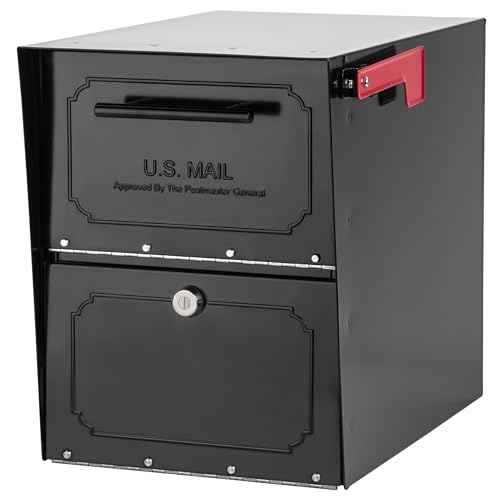
Architectural Mailboxes Oasis Classic
The Architectural Mailboxes Oasis Classic is a locking post-mount design built around a wide delivery door that accepts small parcels and padded mailers, not just envelopes. The body is galvanised steel with a powder-coated finish, the retrieval door locks, and incoming mail drops past a baffle so a hand reaching in from the delivery side cannot simply fish letters back out. It suits households that receive a steady flow of small online orders and want those deliveries out of sight rather than sitting on the porch. The trade-off is retrieval: you carry a key to your own mailbox, and the interior, while generous for a curbside box, still will not swallow a shoebox-sized parcel.

Mail Boss Mail Manager Pro
The Mail Boss Mail Manager Pro is a security-first locking mailbox built from thick galvanised steel with a patented anti-pry latch and a fastened, concealed hinge, designed specifically to resist the screwdriver-and-crowbar attacks that defeat cheaper locking boxes. Incoming mail slides through a slot that accepts small parcels and prescription bottles, then drops into a locked retrieval compartment. It sits at a premium tier and feels like it: heavy, tight and deliberately unfriendly to tampering. The trade-offs are weight, a higher tier, and a retrieval door you open with a key every single day, in every kind of weather.

dVault Parcel Drop
The dVault Parcel Drop is a large parcel-oriented locking box built around a drop door and an internal baffle: the carrier opens the top compartment, places the package, and closing the door tips it down into a locked lower vault that only your key opens. It is the closest a curbside product gets to a parcel safe, and it suits households whose deliveries have outgrown letter-sized thinking entirely. The trade-offs are size, weight and tier — this is furniture-scale hardware that needs a solid mounting plan — and even a parcel vault has a ceiling: oversized boxes still end up on the porch, and no mailbox of any kind should be treated as a true safe for valuables.
Gibraltar Mailboxes Elite Large
The Gibraltar Mailboxes Elite Large is a traditional, non-locking rural-style box in heavy galvanised steel, with the familiar rounded tunnel shape, a wide door and room for several days of mail, magazines and small packages laid flat. There is no lock and no baffle; security comes from simplicity, durability and price tier rather than hardware. It suits rural routes, long driveways and anyone whose carrier leaves bundled mail and catalogues that would choke a smaller box. The honest limitation is obvious: anyone can open it, so it is the wrong choice where mail theft, identity theft worries or porch piracy are part of your daily reality.
Two non-purchase alternatives deserve honest mention. Informed delivery scanning from the postal service tells you what should arrive each day, which catches theft by evidence rather than by armour, and costs nothing. And a post office box or parcel locker subscription removes the curbside question entirely for the most sensitive mail — worth considering where theft is severe, though it trades the problem for a daily trip. Neither replaces a sound home mailbox for most households; both belong in a complete worth-it analysis.
How to Get the Most Value If You Buy
Installation follows a fixed logic whatever the model: confirm the serving position with the post office, call 811 and wait for utility marks, set the post at the correct height and setback, mount the box level with the door facing the carrier’s approach, and finish with numbers and a flag check. The post itself is usually a treated timber post or an approved metal support, set deep enough to resist frost heave and casual knocks while still yielding in a real vehicle strike. A mounting board between post and box spreads the fastenings and lets you replace the box later without replacing the post. Level matters more than it looks: a box that tilts forward sheds its door seal, pools water at the front seam and eventually swings its door open in wind. Work in that order and the job is an afternoon; work out of order and you will dig the same hole twice.
Maintenance is light but not zero, and the owners who do it own boxes that last decades. Twice a year is enough: wash road film and salt off the finish, check the door swing and latch, put a drop of light oil on hinge points, confirm the flag moves freely, and look inside for the early rust freckles that a touch-up pen can stop in minutes. Check the post at ground level, where moisture and string-trimmer damage concentrate; a post that rocks in its hole will eventually misalign the door no matter how good the box is. Clear wasp nests promptly — carriers are stung every year reaching into boxes, and a carrier who fears your box serves it last and fastest. In winter, keep the approach shovelled so the truck can pull in, and after a plough pass, check that spray has not bent the door or packed snow into the seam.
Appearance is a legitimate criterion, and pretending otherwise produces ugly streets. The mailbox is the first object a visitor reads as they approach, homeowner associations often regulate its style and colour, and some historic districts specify traditional designs outright. Check any association rules before ordering, because a non-conforming box generates letters faster than it generates compliments. Within the rules, the honest guidance is to match the house’s own language: black steel suits almost everything, a moulded all-in-one design suits tidy suburban streetscapes, commercial aluminium suits modern and multi-unit settings, and decorative cast designs suit period homes. Whatever the style, keep the numbers legible and the flag functional; a beautiful box that emergency services cannot find is a failure wearing a costume. Finish quality is the part of appearance that ages, so weight it above styling flourishes.
Safety, Placement Rules and Honest Limits
Call 811 before digging a post hole — this is not a formality. The free national call-before-you-dig service arranges for buried utility lines on your property to be marked, and a mailbox post hole, shallow as it seems, is exactly the depth where shallow-buried cable, irrigation, gas laterals and fibre runs like to hide. Hitting a line ranges from expensive to genuinely dangerous, and liability for an unmarked-then-cut line generally lands on the person who dug without calling. The marking visit typically needs a few working days of lead time, so build it into your plan rather than treating installation as a single Saturday impulse. While you wait, you can assemble the box, treat the post and lay out the position with a stake and string so the marked lines and your planned hole can be compared calmly.
Before any product comparison matters, the placement rules matter more. Curbside boxes must meet USPS placement rules: the carrier has to be able to serve the box from the vehicle without leaving the seat, which in practice means the box sits at the height and setback from the road that your local post office specifies — commonly with the bottom of the box roughly waist-to-hip height above the road surface and the door set back a short distance from the curb or road edge so the truck can pull alongside safely. Exact figures are set locally, so confirm them with your post office before you dig anything. A non-compliant box may not get delivery at all: the carrier can require you to move it, and mail can be held at the post office until the box complies. New box designs themselves should carry Postmaster General approval, which every mainstream model named in this guide does, but approval of the box does not excuse a non-compliant installation of it.
The breakaway post rule is the piece of mailbox honesty most sellers skip. A mailbox post stands beside a road where vehicles occasionally leave the road, and a post that cannot yield turns a minor accident into a serious one. Road-safety guidance is consistent on this: posts should give way or break cleanly when struck, which means a properly sized wooden post or an approved breakaway support — and it emphatically means not filling a steel pipe with concrete, not anchoring the box into a masonry column at the road edge, and not building the decorative brick fortress that looks wonderful in listing photos. If a snowplough or a sliding car hits your installation, you want the box to lose. Check local rules too, because some road authorities specify acceptable supports and can require removal of hazardous installations. Sturdy matters for weather and theft resistance; immovable at the roadside is a hazard, not a feature.
Here is the locking honesty every buyer deserves before spending at the premium tier: a locking mailbox reduces casual theft, and that is all any mailbox honestly does. A determined thief with time, tools and privacy can defeat any residential mailbox, because the box is small, the steel is thin compared with a safe, and the whole unit is mounted outdoors where nobody watches it at 3 a.m. What a good lock and baffle actually buy you is the defeat of the common crimes — the opportunist who lifts doors along a street looking for cheques, cards and prescriptions, the fishing hand through an open slot, the quick pry with a screwdriver. Those are the thefts that actually happen, and a well-built locking box stops them cold. Just never store anything in any mailbox that you would store in a safe, and never let a lock talk you out of collecting mail promptly, which remains the cheapest security measure of all.
Parcel boxes and mail slots sit in a legal grey area worth understanding. USPS rules govern letter mail: carriers deliver USPS mail into approved receptacles, and a parcel box that is also your mailbox needs to function as an approved mailbox, not merely as a drop bin, if you expect letter delivery into it. Private carriers — the parcel services — are not bound by the same receptacle rules and will generally use a parcel box, a porch bench box or leave items where you instruct, but their policies vary and a locked box they cannot open is a box they will drive past. Mail slots cut through a door or wall have their own constraints: some local rules and homeowner associations restrict them, slots must still meet size and position expectations for the carrier to use them, and a slot drops your mail inside your home, which is wonderful for security and less wonderful when a wet catalogue lands on the hallway floor. None of this is a reason to avoid parcel boxes or slots; it is a reason to confirm with your local post office which arrangement your carrier will actually serve before you build around one.
Fit reflective house numbers as part of any mailbox project, and treat them as safety equipment rather than decoration. Paramedics, firefighters and police find houses by numbers, at night, often in rain, and a mailbox at the road edge is frequently the first — sometimes the only — numbered object they can see from a moving vehicle. Numbers should be large, contrasting and reflective, visible from both directions of travel, and kept clear of the shrubs and seasonal decorations that quietly swallow them. Many local ordinances specify a minimum number height for exactly this reason. If your new box has a number panel, use it; if it does not, adhesive reflective numbers on the door and post take minutes. When you test the installation, do the test that matters: drive past your own house after dark at normal speed and see whether a stranger could find you in a hurry.
The Decision Checklist
Answer yes or no, honestly: Has mail or a parcel gone missing at your address or on your street? Does your current box overflow, leak or fail to close? Do parcels regularly sit exposed on your porch? Is your installation non-compliant, damaged or due for post replacement anyway? Do your deliveries include items — cheques, cards, prescriptions — whose loss would genuinely hurt? Two or more yes answers: the upgrade is worth it, and the only remaining work is choosing the design. One yes: buy the targeted fix for that single failure, not the flagship. Zero: keep your box, maintain it, and spend the money where a failure actually exists.
Deep Dive: Value Over a Decade of Service
The mailbox’s environmental ledger is better than most household products, and worth a moment in a complete assessment. The product is almost entirely metal or durable polymer, contains no electronics in its mainstream forms, consumes nothing in operation, and serves for a decade or more — a profile most categories should envy. The honest debits are the galvanising and powder-coat processes, the eventual disposal of a large steel object, and the small waste of premature replacement when a wrong first purchase is discarded within a year. All three debits shrink under the same discipline this guide recommends for selfish reasons: buy the right box once, maintain it lightly, repair hinges and latches rather than replacing shells, and recycle the metal at end of life, which steel and aluminium both accept readily. Longevity is the greenest specification in the category, and it is also the cheapest — a rare case of the virtues and the savings pointing in precisely the same direction.
A little history explains why the rules feel the way they do. Rural free delivery created the curbside box: the carrier would serve any approved receptacle at the road, and standardisation followed because a route of hundreds of stops cannot negotiate with hundreds of individual designs. That is why approved dimensions, door actions and serving positions exist — they are the interface between your household and a logistics system, closer to a railway gauge than to a fashion rule. The modern additions to the category — baffles, locks, parcel vaults — are responses to new pressures on that old interface: identity crime and the parcel era. Reading the placement rules as part of that system, rather than as petty bureaucracy, makes them easier to follow and easier to get right: you are not decorating a post, you are connecting a household to a network that has run on standard fittings for over a century.
Climate deserves a section of its own in any deep mailbox analysis, because regional weather writes the failure report for this product category. In the snow belt, the mailbox lives in the plough’s splash zone: salt slurry arrives at speed several times a week all winter, finishes fail from the bottom edge upward, and posts take glancing blows that test both the set and the breakaway design. In hurricane and storm country, wind-driven rain finds every door seam, and a box that is merely rain-resistant in a showroom leaks horizontally in a gale. In the desert southwest, ultraviolet is the enemy — finishes chalk, polymer embrittles, and dark colours cook their contents. On the coast, salt air corrodes unprotected steel from the inside of seams outward, which is where aluminium and stainless earn their tiers. Choose for the weather you actually have, maintain for it, and the same box that fails in three years in the wrong climate serves fifteen in the right one.
Technology has begun to circle the mailbox, and a balanced guide should say what is and is not yet useful. Delivery-notification sensors that tell your phone the door has opened are genuinely helpful for the theft-evidence question — they convert suspicion into a log — and for anyone whose box sits far from the house. Camera coverage of the mailbox area helps after an incident more than during one. What technology does not do is change the fundamentals: a sensor on a non-compliant, undersized, unlocked box gives you a beautifully documented bad mailbox. Fit the physical fundamentals first — position, size, lock where evidenced, sound build — and then, if the box is remote from the house or the street has a history, add notification as a genuinely useful layer. The order matters for the same reason it matters everywhere in this category: infrastructure first, features second.
Outgoing mail is the forgotten half of the mailbox’s job, and it changes how a design performs in real life. The signal flag exists for the carrier, not for you: raised, it promises collection; a flag that sticks, droops or has been painted shut by an enthusiastic refinisher silently breaks that promise, and letters sit. Locking designs complicate outgoing mail in a way brochures underplay — many secure boxes are optimised for incoming protection, and outgoing letters may sit in a less protected tray or require the carrier’s key arrangement, so households that post cheques or documents regularly should examine the outgoing path of any locking design before buying. The daily rhythm matters too: mail collected after the carrier has passed waits a full day in whatever security the box provides, which is another quiet argument for the lock on evidenced streets and for prompt morning collection everywhere else.
It is worth being precise about what mail theft actually looks like, because the design response follows from the method. The dominant pattern is not the crowbar at midnight; it is the daytime opportunist, often on foot or in a slow car, lifting doors along a street and taking what is visible and valuable — cheques to wash, cards to activate, pharmacy packages, gift cards in birthday envelopes. A second pattern targets parcels: following delivery vehicles at a distance and collecting what is left in view. A third, rarer pattern is identity-focused, watching for bank and government correspondence at known addresses. The first pattern is defeated by any sound baffle and lock. The second is defeated by concealment — a parcel box, or simply deliveries that do not sit in public view. The third is defeated by prompt collection and informed delivery monitoring. Notice that all three responses are cheap, specific and evidence-led; none requires turning a mailbox into a bunker.
Small multi-unit properties deserve their own paragraph in any complete mailbox treatment, because their failure mode is multiplication: four individual boxes means four posts, four locks, four maintenance obligations and four chances of a non-compliant position. The commercial answer — a cluster-style unit or a bank of wall-mounted compartments from a maker like Salsbury Industries — consolidates everything into one compliant installation with one maintenance rhythm, and carriers strongly prefer serving a single bank to hunting individual boxes. Landlords should also know that mail receptacle provision for tenants is a regulated expectation in many places, not a courtesy. For a duplex or a small rental row, the cluster approach often costs less than the multiplied individual approach once posts and labour are counted, and it ages as one asset instead of several liabilities. Even single households with a granny flat or a home business receiving client mail can borrow the thinking: separate, labelled, lockable capacity beats a domestic box overflowing with two households’ deliveries.
Accessibility is an under-discussed mailbox criterion that matters to more households than product pages assume. Retrieval height, door weight, latch stiffness and key size all decide whether a box serves an older resident, a person with limited grip strength, or a household member using a wheelchair — and on the carrier’s side, serving position rules exist partly so that the box can be worked from a vehicle by a person doing it five hundred times a day. Households should test the retrieval action of any design with the actual people who will use it, favour large, positive latches over stiff precision ones where grip is limited, and consider a rear-retrieval design where the road side is dangerous to stand in. Where standard placement genuinely conflicts with a resident’s needs, talk to the local post office: accommodations are a conversation they are used to having, and a documented arrangement beats a non-compliant improvisation every time.
Winter operation deserves a dedicated note because it concentrates every mailbox weakness into one season. Keep the approach cleared so the delivery vehicle can pull alongside — a box the truck cannot reach is a box that does not get served, whatever its design. After plough passes, check for the three classic injuries: a door bent by spray impact, a seam packed with snow that will melt inward, and a post shifted just enough to misalign the latch. Never chip ice from a door with a metal tool; warm water and patience preserve the finish that keeps rust out. A light smear of petroleum jelly on the door seal discourages freeze-shut, and a torch-warmed key — never a forced one — opens a frozen lock without snapping it. Households in serious snow country should also weigh the sacrificial truth of the breakaway post: the season will test it, and replacing a yielded post in spring is the design succeeding, not failing.
Summer brings its own quieter mailbox curriculum. Heat inside a dark steel box can reach levels that matter for what waits inside it — medications are the serious case, and households receiving pharmacy mail in hot climates should collect promptly, choose lighter finishes, or site the box where afternoon shade reaches it, because no mainstream mailbox is insulated. Wasps and ants colonise quiet boxes every summer; a carrier stung reaching into yours will serve it last and fastest thereafter, so check inside weekly in season and clear nests promptly. Sun is the slow enemy of finishes and polymer alike, and the twice-yearly wash-and-inspect rhythm in this guide is timed partly to catch chalking and fade while a protective wax or touch-up can still answer it. None of this is burdensome; it is simply the seasonal half of owning roadside infrastructure, and households that fold it into existing garden rhythms barely notice it.
Small multi-unit properties deserve their own paragraph in any complete mailbox treatment, because their failure mode is multiplication: four individual boxes means four posts, four locks, four maintenance obligations and four chances of a non-compliant position. The commercial answer — a cluster-style unit or a bank of wall-mounted compartments from a maker like Salsbury Industries — consolidates everything into one compliant installation with one maintenance rhythm, and carriers strongly prefer serving a single bank to hunting individual boxes. Landlords should also know that mail receptacle provision for tenants is a regulated expectation in many places, not a courtesy. For a duplex or a small rental row, the cluster approach often costs less than the multiplied individual approach once posts and labour are counted, and it ages as one asset instead of several liabilities. Even single households with a granny flat or a home business receiving client mail can borrow the thinking: separate, labelled, lockable capacity beats a domestic box overflowing with two households’ deliveries.
One final worth-it consideration belongs to timing. A mailbox bought calmly, after the evidence work in this guide, is almost always bought well; the same purchase made in a panic the week after a theft, or in a rush the day before a trip, tends to overshoot on armour and undershoot on fit. If an incident has just happened, secure the immediate gap — collect mail promptly, use informed delivery, hold mail at the post office if you are travelling — and then make the considered purchase on a clear head. Urgency is a poor specifier of infrastructure, and this is infrastructure.
Worth It for Whom? A Mailbox Break-Even Test Based on Your Actual Routine
Most advice about a mailbox focuses on the day you buy it, yet satisfaction is decided later, at the front of the home, at the kerb, wall or porch, during receiving daily post and the occasional parcel in all weather. This section therefore starts with your routine rather than the product, because features only matter once they survive contact with your space, your schedule and your household. Before anything else, settle the capacity against your real post, including magazines and small parcels; it is the unglamorous detail that quietly decides whether the rest of the specification ever gets a chance to matter. Idle items still occupy your home. A mailbox with no proper resting place becomes clutter with a function, so settle its storage before it arrives rather than after.
Delegation exposes weak choices. A mailbox that only works in one person’s hands, with one person’s knack, is a fragile solution for a shared home. Dead heats between two candidates are broken by weaknesses, not strengths: pick the mailbox whose compromises fall on the jobs you do least often. Decisions sharpen when they are written. Three must-do jobs, one tolerated weakness and one absolute deal-breaker will separate suitable options for a mailbox faster than any feature table. There is always a learning curve, however small. Decide who in the household faces the steepest part of it with this mailbox and whether the design helps or hinders them.
- Estimate real monthly uses without optimism.
- Set the minimum usage that justifies keeping it.
- Include space, upkeep and parts in the true cost.
- Calendar a one-month check against your prediction.
- Name the simpler alternative and what it cannot do for you.
Anything heavy, hot, sharp, load-bearing or electrically powered deserves a respectful pause in the decision, and the maker’s own guidance, read before purchase, is part of the specification. Beware of solving a problem you do not have, because the largest or most elaborate version of a mailbox adds cleaning, storage and cost in effort to a routine a simpler version would have served perfectly. Attention is a budget too. A mailbox that needs remembering, scheduling, monitoring or special handling spends it, so count that cost alongside the physical ones. Permission to not buy is part of honest advice. If your current arrangement already handles the routine, the worth-it answer may simply be no, for now.
The opposite mistake is just as costly over time: a mailbox that is slightly too small, too light or too basic for a daily routine will be resented long after the saving is forgotten. If something does go wrong, your own notes are gold: dates, symptoms and what you already tried will get you a useful answer far faster than a general description of disappointment. The second check is whether the mounting position meets local delivery expectations and stays reachable, a point shoppers skip because it is hard to judge from photographs, yet it is painfully obvious within the first week of ownership. Also picture the opposite extreme, because regular parcel deliveries that a letter-sized box was never designed to swallow, and a choice that only works in average conditions will quietly disappoint at both ends of real life.
Every item leaves a footprint on the home beyond its dimensions: noise, mess, heat, moisture, effort or visual clutter. Weigh that footprint for a mailbox as seriously as its size. Check for duplicated function in your own home first, because the item you already own that does part of this job changes what the new mailbox actually needs to be. Shortlisted models, perhaps the Architectural Mailboxes Oasis Classic and the Mail Boss Mail Manager Pro, should each be put through the same checks in the same order, using the current listing details rather than an older screenshot or a remembered specification. Add up the minutes honestly: the washing, wiping, descaling, emptying, airing or reassembly a mailbox demands each week is part of its real specification.
Most faults that appear months in are really maintenance or setup faults wearing a disguise, so return to the basics, position, load, cleanliness and fit, before concluding anything has failed. Flexibility is worth paying for only if you will use it. A mailbox that folds, moves or converts impresses in the listing and matters only if your routine actually asks it to. A mailbox can be excellent in isolation and wrong in your room, so judge it against the exact surroundings it will meet rather than against a showroom or a styled photograph. Notice when the mailbox will be used in a hurry and when it will be used with time to spare, because speed and ceremony reward different designs.
Frequently Asked Questions
Is a locking mailbox worth it on a quiet street?
Usually not at the premium tier. Where no theft has touched your street, a locking box buys insurance against a risk your evidence does not show, paid for with a key carried daily for years. A sound mid-tier box, or your existing box maintained well, serves better. The exception is peace of mind itself: if mail anxiety genuinely bothers you, a modest locking design is a legitimate purchase — just make it with open eyes about what is being bought.
How long until a new mailbox pays for itself?
The framing misleads slightly, because a mailbox does not generate savings on a schedule; it prevents losses and daily friction. Spread across a typical decade-plus of service, even a premium tier costs very little per year — less than almost any other household fixture. The honest payback question is whether it prevents one real loss: a single stolen-cheque episode or one ruined parcel can exceed the whole purchase. Where no loss was ever likely, no payback exists, which is the skip case.
Is a parcel box worth it if I shop online a lot?
If ‘a lot’ means weekly deliveries that currently sit visible on your porch, yes — concealment and weather protection pay out constantly, and the theft deterrence is real. If your orders are occasional, small or collected promptly because someone is home, a large locking box captures most of the benefit at less bulk and tier. Count a month of actual porch exposure before deciding; the number, not the shopping habit in the abstract, is the evidence.
What if I am not sure my street has a theft problem?
Find out before spending; it takes an evening. Ask neighbours directly, ask at your local post office, and sign up for informed delivery scanning so you know what should arrive — a month of scans tells you whether items are disappearing. Evidence gathered this way converts the worth-it question from a guess into a measurement, and it is free. Spend after measuring, not before.
Does a new mailbox add value to the home?
Not in any appraised, line-item sense — and be suspicious of anyone who claims otherwise. What it adds is curb appeal, association compliance and one less visible defect when you sell, plus the daily function while you live there. Buy it for use, security and fit. If a tidy, correct installation also makes the front of the house look cared-for, count that as a pleasant side effect rather than the justification.
When is repairing the old box the better answer?
When the shell is sound and the failures are peripheral: a tired latch, a loose hinge, surface rust freckles, a wobbling post. Those are minutes-to-an-afternoon fixes that restore years of service. Repair stops being the answer when the box leaks at the seams, is undersized for your current deliveries, lacks a lock your street now needs, or sits in a position that must be corrected anyway — at that point replacement is the repair.
Related Guides
mailbox pros and cons in full
the mailbox buying guide for the method
mailbox reviews of the designs in question
how to choose a mailbox without guesswork
how to install a mailbox once, correctly
outdoor wall lights for the porch approach
driveway alarm systems that announce arrivals
home security systems for whole-house protection
patio umbrellas for shade over the front garden