Disclosure: As an Amazon Associate, airfryerkitchensupply.com earns from qualifying purchases. Links on this page are affiliate links; they cost you nothing extra. Prices and availability change often, so check the current Amazon listing before you buy.
So, is a knife sharpener worth it for an ordinary home kitchen, or is it another gadget destined for the cupboard of good intentions? The short answer is that a knife sharpener is worth it for the great majority of people who cook regularly with straight-edged knives, because it restores tools they already own, makes cutting safer and easier at every meal, and asks only minutes a month in return. It is not worth it for kitchens built on serrated and ceramic blades, for the very occasional cook whose knives can be serviced professionally once in a long while, or for anyone who knows the routine will not survive their own habits. The rest of this article earns that answer properly.
Is a Knife Sharpener Worth It? The Short Answer and Key Takeaways
Worth it if: you cook several times a week, your knives are sound steel and currently dull, and you will keep a simple routine: sharpen little and often, test edges on paper or food, wash and dry blades carefully, and store them in a block or sheath. Not worth it if: your drawer is mostly serrated or ceramic, your knives are chipped or bent and need repair first, or a professional service genuinely fits your life better.
- The value is restoration, not acquisition: your current knives perform like the set you thought you needed to buy.
- The returns are daily: easier prep, cleaner cuts and safer handling at the board, meal after meal.
- The costs are mostly non-monetary: a little counter or drawer space, minutes of maintenance, and a safety routine to keep.
- Alternatives exist and are respectable: professional sharpening, stones learned as a craft, or simply replacing budget knives, each suiting different households.
- The decision rule at the end of this article settles the question in seven honest answers.
In this guide
What You Actually Get
You get your knives back. That is the whole value proposition, and it is larger than it sounds, because most home knife sets are far better than their current edges suggest. A set dulled by a year of honest work performs like a cheap set; the same set, sharpened, performs like the considered purchase it originally was. Owners consistently describe the first session in the language of replacement, new knives, different kitchen, because the felt difference is that large. What you are buying, then, is not a sharpener. It is the performance you already paid for once, restored on demand, in your own kitchen, in minutes.
You also get a change in the texture of cooking. Prep stops being the tiring part. Onions dice without a fight, herbs slice cleanly, a chicken portions without sawing, and the cook’s hands arrive at the stove un-fatigued. That change repeats at every meal, which is why the sharpener’s value compounds in a way that a single-purpose gadget’s never does. A waffle maker delights monthly; a sharp knife delights daily. When people ask whether the tool is worth it, the honest arithmetic is not the purchase tier against the knife set’s tier; it is a few minutes of maintenance against hundreds of slightly harder meals.
And you get safety, the benefit nobody shops for. Sharp knives need light pressure, start where placed and rarely skid, and skidding dull knives are a quiet staple of kitchen first aid. A household that sharpens, and that keeps the handling routine sharpening demands, cutting away from the body, hands on handles, blades stored in a block or sheath away from children, has made its most-used tools both more pleasant and less likely to hurt anyone. Few purchases in the kitchen can claim both directions at once.
The Real Costs Beyond Money
The tier is the least interesting cost, and this guide discusses tiers rather than figures on principle. The real costs are space, time and attention. Space: an electric sharpener claims a permanent patch of counter if it is to be used often, and a household short on counter should count that honestly and consider a drawer-sized pull-through instead. Time: sessions are short, but they are not zero, and a guided system or stone asks for a genuinely unhurried block of it. Attention: sharpening is a small discipline. Abrasives need cleaning, electric units need unplugging before that cleaning, and freshly sharpened knives need careful washing, drying and storage every time, not just on the day of the session. None of these costs is large. All of them are recurring, and the worth-it question is really whether your household will pay recurring small costs for daily returns. Most cooking households, once they feel the returns, pay gladly.
There is also a learning cost, modest but real. Even the simplest sharpener rewards a few sessions of practice: learning the draw pace, the light pressure, the sound of a stage working. Guided systems and stones ask more. Budget an evening of patience with your least precious knives as part of the purchase, and treat it as the tuition every worthwhile kitchen skill charges.
Who It Pays Off For
The Daily Family Cook
This is the clearest case in the article. Knives work hard, dull steadily, and every meal benefits from their restoration. A staged electric or a ready pull-through pays off within the first week and keeps paying for years. If this is your household, the remaining question is only which route, and our knife sharpener buying guide answers it.
The Owner of a Good, Neglected Set
Many kitchens hold a quality set, perhaps a wedding or milestone purchase of the kind surveyed in our guide to the best chef knife sets, that has never been sharpened. For that household the sharpener is not an expense against the set; it is the unlocking of value already spent. The first session alone justifies the tool, and maintenance afterwards is trivial compared with the set’s working life.
The Enthusiast Growing a Collection
As knives multiply and improve, edges become a hobby’s foundation. A guided system or a set of stones turns sharpening into part of the pleasure, and the value calculation includes enjoyment, which is legitimate. The enthusiast should simply buy for control rather than convenience, and accept the time cost as part of the craft.
Who Should Skip It
The Serrated and Ceramic Household
If your working knives are mostly serrated or ceramic, a standard sharpener addresses a minority of your drawer and will disappoint as a flagship purchase. Service the serrations professionally when they tire, follow the maker for the ceramics, and spend the sharpener money elsewhere.
The Very Occasional Cook
If knives leave the drawer a few times a month, edges dull slowly and a professional service once in a long while may be the rational pattern: no tool to store, no routine to keep, bench-quality results. The sharpener is not poor value here so much as unnecessary machinery for a small problem.
The Household That Will Not Keep the Routine
Be honest. If freshly sharpened knives will live loose in a drawer, blades will be washed in a jumbled sink, and the sharpener will migrate to the back of a cupboard, the purchase fails on habits, not on quality. In that case, either commit to the small routine first, it is genuinely small, or choose professional sharpening and safe storage, and let discipline live where it can.
The Balance: Strengths and Trade-Offs of Owning One
Strengths
- Restores the performance of knives you already own, repeatedly, for years.
- Improves daily cooking and board safety at the same time, a rare combination.
- Guided tools need no prior skill; maintenance sessions take minutes.
Trade-Offs
- Excludes serrated, ceramic and single-bevel blades, which need other care.
- Asks for space, cleaning and a standing safety routine around fresh edges.
- Cannot repair damage, and cannot outrun hard boards or loose storage.
Alternatives to Consider
Professional sharpening is the strongest alternative: bench equipment, repair capability and zero routine, traded against turnaround and planning. It suits damaged knives, exotic blades and occasional cooks, and many sharpener owners still use it yearly for deeper work. Whetstones, explored in our guide to the best whetstone sharpening sets, are the craft alternative: cheapest in tier over a lifetime, richest in control, and honest about demanding practice. Replacing budget knives periodically is the third path; it is wasteful and quietly expensive in aggregate, and it never produces a truly keen kitchen, but for a drawer of very soft, inexpensive blades it is at least coherent. Judge the sharpener against these real alternatives, as knife sharpener pros and cons does in detail, and the purchase usually clarifies itself.
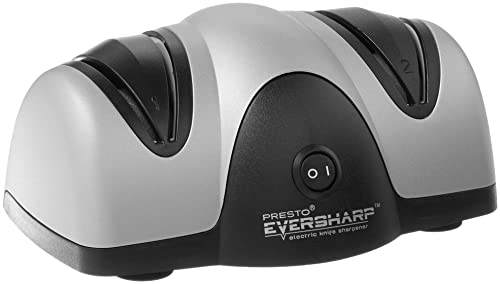
Presto EverSharp
Best for: the low-commitment way to test the worth-it question: entry tier, electric consistency, everyday knives.
the entry-tier electric option: a simpler staged electric sharpener from a long-running kitchen appliance brand, aimed at cooks who want motorised consistency without paying for the flagship experience. It asks a little more attention from the user than the premium route, particularly in how evenly you draw the blade, but it covers the core job of restoring tired everyday knives with minimal fuss and a modest counter footprint.

Chef’sChoice 15XV EdgeSelect
Best for: the full-commitment answer for a good set: premium consistency that makes the value obvious at every meal.
the premium electric route in this cluster: a staged electric sharpener from the best-known name in the category, built for households that want the machine to manage angle, pace and pressure while they simply draw the blade through. It sits at the premium tier of the sharpeners discussed here, and it earns discussion at that tier by consistency rather than novelty: session after session, knife after knife, the edge comes back in a way that makes a whole dull set feel new again.

Wüsthof Universal Handheld
Best for: the middle path for classic knives: a manual tool whose modest demands make its value easy to sustain.
the mid-tier pull-through from a knife maker rather than an appliance brand, which shows in its priorities: a protective hand guard, a steady grip and stages tuned for the kind of knives its maker sells. It suits cooks who own decent knives, want a manual tool with a little more care in its design than the most basic slots, and prefer to feel the blade through the process rather than hand the whole job to a motor.
How to Get the Most Value If You Buy
Work calmly and treat every blade as freshly sharpened from the moment it leaves the sharpener, because it is. Keep the sharpener stable on a non-slip surface, cut and draw the blade away from your body, hold the knife by the handle only, and never let fingers drift near the slots or the stone while the blade is moving. Test sharpness on paper or on food, never on skin. When you finish, wash and dry each blade carefully, dry it away from the edge, and store it in a block or a sheath away from children. If your sharpener is electric, unplug it before you clean it, every single time. Then: store the sharpener where you will use it, not where it looks tidy; sharpen little and often on the fine stages; hone between sessions; practise first on your least precious knife; and protect the results with a forgiving board and proper storage, the companions covered in our guide to the best cutting boards for home cooks. Learn the session from how to use a knife sharpener and compare ownership impressions in our knife sharpener reviews and the in-depth knife sharpener review. Value in this category is not bought; it is kept, by routine.
The Decision Checklist
Answer honestly. Do you cook with straight-edged knives at least a few times a week? Are those knives sound, unchipped and worth maintaining? Are they currently duller than they should be? Do you have a drawer corner or counter patch for a tool? Will you keep a five-minute safety and storage routine? Would you rather maintain at home than schedule a service? Is at least one route, electric, pull-through or guided, matched to your patience? Five or more yes answers: buy, and buy the route that fits. Three or fewer: choose professional sharpening for now, and revisit when your cooking changes. The checklist is the article in miniature, and it does not flatter either answer.
Going Deeper: the Ownership Picture Behind the Verdict
Edge Angles, Explained Without the Mystique
Every edge is a wedge, and the wedge shape decides how a knife behaves. A narrower wedge slips through food with less resistance and feels dramatically sharper, but its thin apex is more delicate and rolls or chips sooner. A wider wedge feels a touch more stubborn in dense vegetables yet shrugs off hard use, board contact and the occasional twist in a joint. Neither is better in the abstract; they suit different knives and different cooks. The practical lesson for sharpener shopping is compatibility. A sharpener shapes the edge it was designed to shape, so the one you choose should match the style of knives you actually own, slim blades or sturdy ones, rather than forcing every knife in the drawer toward a single geometry.
Steel, Hardness and What Your Sharpener Feels
Harder steel holds a fine edge longer but takes more patience to restore once it finally dulls, and it can chip where softer steel would merely roll. Softer steel gives up its edge sooner yet comes back quickly with modest abrasives and forgives rough treatment. This is why two households can own the same sharpener and report opposite experiences: the tool is only half the system, and the knives are the other half. If your set is built from hard, wear-resistant steel, expect sharpening sessions to be less frequent but more deliberate. If your knives are everyday workhorses in softer steel, expect quick, satisfying touch-ups and plan on doing them a little more often. Both patterns are normal ownership, not problems.
Serrated Knives Need a Different Conversation
A serrated edge is a row of small arcs and points, and it dulls differently from a straight edge: the points wear, the arcs polish smooth, and the saw action fades. Most countertop sharpeners are built for straight edges and either ignore serrations or address only part of the tooth pattern, so check what a model claims before assuming it covers your bread knife. Dedicated serration tools work one gullet at a time and demand patience, while many owners simply send a beloved bread knife to a professional when it finally tires. The good news is that serrated knives, used mostly on crusts and skins, often go years between interventions. The bad news is that forcing one through a straight-edge slot can damage both the teeth and the sharpener, so keep the two apart.
Ceramic and Coated Blades Deserve Caution
Ceramic blades are extremely hard and hold an edge for a long time, but that hardness makes them brittle and puts them outside the reach of most home sharpeners, whose abrasives and angles assume steel. Running a ceramic blade through a steel sharpener is a reliable way to chip it. Coated blades, the colourful non-stick style knives sold in many sets, raise a different issue: aggressive abrasives can strip or scar the coating near the edge even when the sharpening itself works. Read what a sharpener maker says about blade types before you buy, keep ceramic knives on their own manufacturer-approved path, and remember that a sharpener is a specialist tool. Expecting one small appliance to serve every material in the drawer is how good knives get hurt.
Scissors, Cleavers and Other Edge Cases
Some sharpeners offer a scissor slot or claim a cleaver setting, and these extras deserve a calm, sceptical look. Scissors sharpen along a very different geometry from knives, and a slot that treats them like a knife edge usually polishes rather than truly sharpens. Cleavers are thick, tall blades that may not sit correctly in guides designed for chef knives, and a poor fit means an uneven edge. None of this makes multi-role sharpeners useless; it means the extras should be treated as bonuses, not reasons to buy. Judge a sharpener first on the knives you use daily, the chef knife, the paring knife, the santoku, and let the occasional tools in the drawer be handled by the methods that suit them, even if that method is a professional bench.
Where a Sharp Knife Lives Between Uses
Sharpening is wasted if the edge spends its resting hours being knocked about. A slotted block protects edges well, provided the slots are clean and the knife is dry before it goes in. A sheath or blade guard is the simple, underrated answer for drawer storage, letting the knife live in a drawer without its edge fencing with spoons. A magnetic strip keeps edges visible and off surfaces, but knives must be placed and lifted carefully, flat against the strip, never dragged sideways across it. The worst homes for an edge are a loose drawer, a crowded utensil crock and the sink. Store every sharpened blade in a block or a sheath, on a strip if you prefer, and always out of reach of children, who should never be the ones to discover how sharp the knives have become.
Washing and Drying Without Undoing Your Work
A freshly sharpened knife should be washed by hand, promptly, and dried at once, and the technique matters. Wash it on its own rather than in a jumble, hold the handle only, and wipe from the spine toward the edge with the cloth moving away from the edge, never along it and never toward your fingers. Dry it the same way and put it straight into its block or sheath rather than leaving it on a draining board where the next person reaches blindly. Dishwashers are hard on edges twice over: blades knock against racks and other tools, and the damp heat encourages the fine corrosion that quietly eats an apex. Two minutes at the sink protects the edge you just spent ten minutes creating.
Your Cutting Board Is Part of the Sharpening System
Boards decide how long an edge survives. Wood and quality plastic boards receive the edge kindly, letting it sink a fraction into the surface instead of slamming to a stop. Glass, stone, ceramic and metal boards do the opposite: every cut ends with the apex striking a surface harder than itself, and the edge rolls or micro-chips accordingly. Cooks who sharpen faithfully and still fight dull knives very often find the culprit is a beautiful glass board they refuse to retire. If your board rings like a plate when the knife lands, it is undoing your sharpener’s work one cut at a time. Pair any sharpener in this guide with a forgiving board and the same knives will stay keen noticeably longer between sessions, which is the cheapest performance upgrade in the whole topic.
How Often Is Often Enough
There is no universal sharpening calendar, because households cook differently. A useful rhythm for most home kitchens is to hone lightly and often, whenever the knife starts to feel reluctant, and to truly sharpen when honing stops restoring the bite, which for a daily cook might be every few weeks and for a weekend cook a few times a year. Sharpening little and often is kinder than rare, heavy sessions: each session removes less metal, takes less time and keeps the knife in the pleasant zone where cooking feels easy. Waiting until a knife is completely blunt turns a five-minute touch-up into a restoration project and tempts you to press harder, rush the passes and make mistakes. Sharpness is a habit, not an event.
More of the Ownership Picture
The Burr: the Tiny Signal That Sharpening Is Working
As an abrasive works one side of an edge, it eventually pushes a whisper-thin foil of metal over the apex to the other side. That foil is called a burr, and feeling for it is how sharpeners have always known a side is finished: drawn very lightly, with fingertips moving across and away from the edge, never along it, a burr feels like a faint catch or roughness on the side opposite the one being worked. Building a burr along the whole edge, then repeating on the second side, then refining it away with lighter passes is the skeleton of nearly all sharpening, whether the abrasive sits in an electric sharpener, a pull-through slot or a stone. You do not need to master burr detection to use a guided sharpener, the guides do the sequencing for you, but understanding it explains why the stages are ordered the way they are.
Stropping and the Final Polish
A strop, traditionally leather, sometimes loaded with a fine polishing compound, is the finishing step that aligns and polishes an edge after sharpening. It removes the last traces of a burr and leaves the apex clean, which is why knives feel silkier after stropping even though almost no metal is removed. Guided systems often include a stropping or honing stage for exactly this reason, and electric models finish with a polishing stage that plays the same role. At home, a few light passes on a leather strop, or even careful strokes on the fine stage of your sharpener, deliver most of the benefit. Keep the pressure feather-light; pressing hard on a strop rounds the very apex you worked to create. Finishing gently is a theme that runs through all good sharpening.
Pull-Through Sharpeners, Honestly Appraised
A pull-through sharpener guides the blade between abrasive elements set at a fixed angle, and you supply the motion: seat the heel of the knife in the slot, draw it smoothly toward you, or push it away, following the maker’s direction, and let the abrasives do the cutting. The strengths are real: almost no learning curve, a small footprint, fast touch-ups and consistent angles for cooks who will never enjoy stones. The limits are equally real: fixed angles cannot suit every knife, coarse stages on some budget models remove metal eagerly, and the edge produced is a good working edge rather than a connoisseur’s edge. For the majority of home kitchens, that trade is entirely reasonable. The pull-through’s job is to make Tuesday’s dinner prep pleasant again in under a minute, and at that job it succeeds.
Electric Sharpeners, Honestly Appraised
An electric sharpener replaces your arm’s motion with a motor turning abrasive wheels or belts inside a guided housing. You place the blade in a slot, draw it through at the pace the guides set, and the machine keeps speed and pressure far more consistent than a beginner’s hand. Multi-stage models separate the work logically: a coarse stage to restore a tired edge, a finer stage to refine it, and a polishing stage to finish. The honest costs are counter space, a cord, a higher tier than manual tools, and the discipline to unplug the unit before cleaning it and to keep it stable on a non-slip surface while it runs. For households with a full set of dull knives and little appetite for technique, the electric route converts a dreaded chore into a short, repeatable routine.
Whetstones, Honestly Appraised
A whetstone is the oldest tool in this guide and still the most flexible: one stone, used with water or oil depending on its type, can repair a chip, set a new angle, refine an edge to a polish and handle blades no guided slot accepts. The price of that freedom is skill. You must hold a consistent angle by hand, manage the slurry, soak the stone if it asks for soaking, and keep it flat over time, because a dished stone sharpens unevenly. Many cooks find the learning process genuinely pleasurable, a quiet ten minutes of craft, and many others bounce off it entirely and cook with dull knives instead. Both reactions are honest. A sharpener you will actually use beats a superior stone that lives untouched in a cupboard, every single week of the year.
Guided Angle Systems: the Middle Path
Guided systems clamp the blade and move the abrasive along a rod or arm held at a chosen angle, splitting the difference between freehand stones and fixed slots. The clamp removes the hardest part of stone work, holding the angle, while the interchangeable abrasives restore the flexibility that pull-through tools give up. Sessions take longer than an electric touch-up and the setup is fussier, with clamps, stones and a small ritual of assembly, but the results can be excellent and the same kit serves hunting knives, pocket knives and kitchen blades alike. These systems suit the cook who enjoys a little process and owns varied blades. They suit less well the cook who wants a knife rescued in the middle of dinner prep, because nobody assembles a clamp jig while the onions wait.
Repairing Chips Is a Different Job From Sharpening
A chip is missing metal, a small bite taken out of the edge by bone, a frozen surface or a fall onto a hard floor. Sharpening a chipped knife on a fine stage alone merely polishes around the damage; the edge must first be ground back until the profile is continuous again, work for a coarse abrasive and patience, or for a professional with powered equipment. Small chips near the tip or heel can often be blended out during a thorough coarse-stage session at home. Larger damage, cracks, or a bent tip belong on a professional bench, where the repair can be done without overheating the steel or shortening the blade more than necessary. Knowing the boundary between maintenance and repair saves knives: home sharpeners are for keeping good edges good, not for rebuilding broken ones.
Bolsters, Heels and the Last Inch of Edge
Many traditional knives carry a thick bolster, the bolster being the heavy collar of metal between handle and blade, and on some designs it descends all the way to the edge. Over years of sharpening, the edge recedes slightly while the bolster does not, until the bolster starts to touch the board before the edge does and the heel of the knife stops cutting cleanly. Guided sharpeners vary in how close to the bolster they can work, and stones handle the area most flexibly in skilled hands. If your knife rocks on an uncut patch near the heel, that is the likely story, and a professional can re-profile the bolster during a service. It is a slow, years-long effect, not a reason to avoid any sharpener, but it explains a mysterious dullness that no amount of slot passes seems to fix.
Single-Bevel and Specialty Blades
Most Western kitchen knives are sharpened on both sides, forming a symmetrical wedge. Many traditional Japanese blades are single-bevel, ground on one side only, with a flat or gently hollow back, and they cut with a distinctive steering feel that specialists prize. A symmetrical guided sharpener will try to put a second bevel where the design never intended one, changing the knife’s character and performance. If you own single-bevel knives, or treasured blades with unusual geometry, treat them as their own category: stones in practised hands, or a professional who knows the style. The same caution applies to very thin, hard blades that can chip under coarse, aggressive abrasives. A good sharpener wardrobe is honest about which knives it should never meet.
Bread Knives, Paring Knives and Length Extremes
The extremes of the knife drawer test sharpeners in opposite ways. A long bread knife needs a system that supports its length without the tip diving or the handle colliding with the housing, and its serrations, as covered elsewhere in this guide, mostly sit outside straight-edge sharpening anyway. A short paring knife presents the reverse puzzle: there is little blade to guide, the handle dominates, and it is easy to sharpen only the middle of the edge while the tip and heel stay dull. Work slowly with small blades, keep fingers on the handle and well clear of the slot, and check the whole edge afterwards with the paper test in sections. Length extremes reward patience and punish hurry, which is true of sharpening generally and doubly true at the ends of the size range.
Workspace Setup: Light, Height and a Dry Towel
Good sharpening starts before the blade moves. Set the sharpener on a stable, non-slip surface at a comfortable counter height, with light falling across the edge so you can see what the abrasives are doing. For stone work, a damp towel under the stone stops it wandering mid-stroke, which matters because a stone that moves teaches your hands the wrong angle and can slide toward you. Keep a second dry towel for wiping blades between stages, wash and dry your hands so the handle grip stays secure, and clear the area of clutter, children and pets for the few minutes the work takes. These small preparations are the difference between a calm routine and a fumbled one, and they cost nothing but a moment of forethought.
Pressure: the Beginner’s Most Common Error
Almost every sharpening mistake reduces to pressure. Pressing hard feels productive and is nearly always wrong: it flexes thin edges away from the abrasive, overloads electric guides, digs stones unevenly and tires your hand into inconsistency. The abrasives are designed to cut under light, steady contact; your job is guidance, not force. In a pull-through slot, let the weight of the knife and a gentle downward settle do the work. In an electric model, the guides set the contact and you simply draw the blade at an even pace. On a stone, imagine you are slicing a thin layer off the surface rather than grinding down into it. When results disappoint, the first correction is almost never more pressure; it is slower, lighter, more even passes.
Sharpen Before the Big Cooking Day, Not During It
The best sharpening session happens on a quiet afternoon, not in the frantic hour before guests arrive. Knives sharpened in advance can be tested calmly, washed, dried and stored properly, and you start the big cook with every blade ready and your attention free for the food. Sharpening mid-recipe, by contrast, invites every error this guide warns about: wet hands, a crowded counter, haste, and a freshly sharpened blade immediately plunged into a sink of washing-up where the next person cannot see it. Build the habit of a short maintenance round when the kitchen is calm, perhaps while something roasts, and treat sharpening as part of mise en place for the week rather than an emergency repair performed under pressure.
Professional Sharpening Is a Legitimate Alternative
Nothing in this guide insists you sharpen your own knives. Local sharpening services, market stalls, knife shops and mail-in services exist precisely because professionals with powered equipment and long experience can restore edges, repair chips and re-profile bolsters quickly and well. The trade is convenience and turnaround: your knives leave the house, and you plan around their absence, while a home sharpener offers a five-minute fix at the moment of need. Many households sensibly use both, keeping a home tool for routine maintenance and sending knives out once in a long while for deeper work. Choosing professional help is not a failure of the home approach; it is one of the options the home approach should be compared against honestly, which the worth-it article in this cluster does in detail.
Caring for the Sharpener Itself
Sharpeners accumulate the evidence of their work: fine metal filings, abrasive dust and, around kitchen tools, the usual film of cooking life. Manual slots can usually be shaken out, brushed or wiped following the maker’s instructions, and some abrasive elements are replaceable when they finally wear smooth. Electric models collect filings inside the housing; unplug the unit before cleaning it, tip out what the manual allows you to tip out, and wipe the exterior with a dry or barely damp cloth rather than washing a motor under a tap. Stones need flattening as they dish with use, and guided systems need their clamps and rods wiped of grit before storage. A maintained sharpener stays accurate; a neglected one slowly becomes the reason edges come out uneven.
What a Sharpener Cannot Fix
Honest expectations protect both knives and tempers. A sharpener cannot repair a snapped tip, straighten a bent blade, remove deep rust pitting from the edge, or turn very soft, poor steel into a lasting edge; it can only shape the metal that is there. It also cannot compensate for a knife being used on a glass board, stored loose in a drawer and washed in a dishwasher between sessions, because those habits destroy edges faster than any home tool restores them. Judge a sharpener by the job it is actually for: restoring and maintaining sound edges on sound knives, safely and repeatably. Within that job description, the best models are genuinely excellent. Outside it, no purchase will save you, and the money is better spent on a board, a block and better habits.
Honing and Sharpening Are Not the Same Job
A honing rod does not really sharpen. It straightens an edge that has folded or rolled slightly to one side during use, nudging the metal back into line so the knife feels keen again for a while. True sharpening is different: it removes a small amount of metal and forms a fresh edge where the old one has worn, chipped or rounded away. Knowing which job your knife needs saves both time and steel. If a knife felt fine last week and merely drags a little today, a few careful passes on a honing rod, drawn away from your body with the handle held firmly, often restore it. If the knife slides across a tomato skin instead of biting, honing will not save it; the edge itself is gone and only an abrasive, in a sharpener or on a stone, will rebuild it.
Why Edges Go Dull in the First Place
Edges dull through three quiet mechanisms. The first is rolling: the very thin apex of the edge bends to one side when it meets something hard, such as a bone, a frozen surface or the rim of a pan. The second is abrasion: microscopic particles in food, boards and packaging wear the apex down a fraction at a time, the way a river rounds a stone. The third is corrosion at a scale too small to see, especially when blades sit damp in a sink or a closed dishwasher. None of these is a defect in the knife. They are the physics of a thin piece of steel meeting the world thousands of times, and they explain why even excellent knives need regular attention rather than occasional rescue missions.
Safe Ways to Test an Edge
Test sharpness on paper or on food, never on skin, and never with a thumb dragged along the edge. A sheet of ordinary printer paper held in one hand tells you a great deal: a keen edge slices downward through it cleanly, while a dull one tears, folds the sheet or refuses to start. A ripe tomato is the classic food test, because its skin resists a dull blade and yields to a sharp one with almost no downward pressure. An onion works too; a sharp knife enters without skidding, which is exactly the moment when dull knives become dangerous. Keep the testing hand clear of the cutting path, work on a stable board, and treat a blade that has just passed its test as the sharpest object in the room, because it now is.
The Break-Even Test in Practice: When a Knife sharpener Earns Its Place and When It Quietly Does Not
Worth is not a property of the product; it is a relationship between the product and the household using it. A knife sharpener earns its place when the jobs it does well are jobs your household actually has, week after week, in the knives you own and how you cook with them. It quietly fails to earn its place when its best features answer problems you rarely meet. The test below turns that idea into questions you can answer honestly before deciding.
This is where the value argument is won or lost. Start with fit, because fit failures cannot be fixed by enthusiasm later. In practice that means three things: check whether the sharpener handles both straight edges and any specialty blades you own; confirm the angle approach suits how much control you want over the process; and look at how securely it grips the counter or is held, because stability is safety. Write the answers down rather than holding them in your head, because a knife sharpener is usually chosen over several browsing sessions, and the constraint you checked on Monday is the one forgotten by Friday. If any of the three checks produces an awkward answer, treat it as information about format, not as a problem to wave away — a different format of knife sharpener often removes the conflict entirely, while a compromise on fit tends to be re-litigated every time the product is used.
Count this honestly, because occasional use changes the answer completely. Then picture the product in its real situations rather than its best one. The routine cases are easy to imagine: a household with one good knife and several everyday blades of mixed quality, or a keen cook maintaining knives of different styles and steels. The more useful exercise is the harder day: chips or damaged edges that a sharpener alone cannot restore; and mixing sharpening and honing up, and expecting one to do the other’s job. A knife sharpener does not need to be perfect in those moments, but it does need a workable answer to them — a way to be moved, covered, adjusted, cleaned or simply tolerated until conditions improve. If the honest answer is that the hard day would make you stop using it altogether, that is a decision-grade fact, and it is far cheaper to learn it now than after delivery.
The purchase justifies itself here, or it does not justify itself at all. Most disappointments trace back to a short list of avoidable errors. The common ones here are: sharpening a dirty blade, grinding grit along the edge as you work; running every knife through the coarsest stage every time, wearing steel needlessly; and testing sharpness carelessly on skin instead of on paper or produce. Notice that none of them is really about build quality. They are sequencing errors — deciding before measuring, assuming instead of checking, or copying someone else’s setup whose space and habits differ from yours. Reading any listing for a knife sharpener with those three errors in mind is a fast filter: if the page in front of you encourages one of them, slow down and return to your own measurements and routine.
Sentimental value aside, this is the practical test. Ownership also has a rhythm, and it is worth pricing that rhythm in before you commit. For a knife sharpener, the upkeep that keeps it pleasant is modest but specific: store it dry, especially designs with stones or water-based methods; keep knives clean and dry before sharpening sessions; and check guides and wheels for wear that changes how the blade sits. None of that is onerous on its own. The question is whether it attaches to a routine you already have — a weekly clean, a seasonal tidy, a habit of putting things away properly — or whether it requires a new routine invented from scratch, which is the kind that quietly lapses by the second month.
Frequently Asked Questions
Is a knife sharpener worth it for cheap knives?
Often, yes, within limits. Sound budget knives in ordinary steel sharpen willingly and cook far better keen than dull, and an entry-tier pull-through matches their tier sensibly. Very soft, poor-quality blades are the exception: they take an edge quickly and lose it just as quickly. Even then, a basic sharpener plus a honing habit usually beats cooking with them dull.
How long does a knife sharpener last?
Years of household service is the normal expectation. Abrasives gradually wear and can sometimes be replaced; housings need periodic cleaning of metal filings, with electric units unplugged first. The tool’s working life comfortably exceeds the time it takes to repay its tier in restored knives, which for a regular cook is a matter of the first few sessions.
Can I just use a honing rod instead?
A honing rod maintains an edge that still exists by realigning it, and it belongs in every knife kitchen. It cannot restore an edge that has worn away. Once a knife slides on a tomato despite honing, only an abrasive sharpener or stone rebuilds it. The two tools are partners, not substitutes: hone often, sharpen when honing stops working.
Is professional sharpening better value?
For occasional cooks, damaged knives and exotic blades, it can be. For regular cooks with mainstream knives, a home sharpener usually wins on convenience and long-run value, because edges can be refreshed the moment they fade rather than in batches on a schedule. Many households use both, and that combination is often the true best answer.
Will sharpening make my cooking noticeably better?
It will make it noticeably easier, which most cooks experience as better. Cuts take one pass, ingredients behave, herbs and produce look cleaner, and hands tire less. The improvement is largest for households whose knives are currently very dull; if your edges are already maintained, expect refinement rather than revelation.
What is the cheapest way to keep knives sharp?
In tier terms, a basic pull-through or an entry whetstone, paired with a honing rod and good habits, is the leanest complete system. The habits matter as much as the tool: a forgiving board, hand washing, careful drying and block or sheath storage stretch every sharpening session further, whatever you paid for the sharpener.
Related Reading
Decide the route in our knife sharpener buying guide, check the balance in knife sharpener pros and cons, and learn the routine in how to use a knife sharpener.


