Disclosure: As an Amazon Associate, airfryerkitchensupply.com earns from qualifying purchases. Links on this page are affiliate links; they cost you nothing extra. Prices and availability change often, so check the current Amazon listing before you buy.
This knife sharpener review starts with a confession: most cooks do not need a better knife nearly as much as they need their existing knives sharpened. A drawer of respectable blades, dulled by a year of boards, dishwashers and honest work, performs worse than a modest set kept keen, and the difference is not subtle. A sharp knife glides through an onion without skidding, slices a tomato under its own weight, and makes prep feel calm instead of combative. So this review examines the knife sharpener as a category the way an owner actually lives with one: the first rescue of a neglected set, the weekly touch-up, the safety habits that surround freshly sharpened edges, and the small design choices that decide whether a sharpener becomes a trusted routine or another gadget gathering dust beside the spiralizer.
Key Takeaways
- A knife sharpener restores the edge you already own; for most kitchens that matters more than buying another knife.
- The category divides into electric sharpeners, manual pull-through models, whetstones and guided angle systems, each trading speed, control and learning curve differently.
- Consistency is the product. Guided angles and staged abrasives produce repeatable edges that freehand beginners rarely match.
- Safety is a routine: a stable, non-slip base, hands on the handle only, sharpness tested on paper or food and never on skin, and blades washed, dried and stored in a block or sheath afterwards.
- The best sharpener is the one matched to your knives and your patience, and then actually used, little and often.
Short verdict: a good knife sharpener suits any household that cooks regularly with straight-edged knives and wants prep to feel easy again. It does not suit a kitchen of only serrated and ceramic blades, and it will not rescue knives that are chipped, bent or made of very poor steel. For everyone between those poles, it is among the highest-value small tools a kitchen can own.
In this guide
What a Knife Sharpener Is and Where It Fits
A knife sharpener is an abrasive system with guidance. The abrasive, which may be a wheel, a belt, a slot insert or a stone, removes a controlled amount of steel from both sides of the edge until the two faces meet again in a clean, keen apex. The guidance, which may be a sprung slot, an electric housing or a clamped rod, holds the angle steady so that an ordinary cook gets a result that once required an apprenticeship. Everything else about the category, the motors, the stages, the price tiers, the marketing language, is decoration on those two ideas. When a sharpener works well, it is because its abrasives are honest and its guidance is trustworthy. When one disappoints, it is almost always because one of those two elements was compromised to hit a tier or a shape.
Where it fits in a kitchen depends on the household. In a home that cooks daily, a sharpener is infrastructure, closer to the kettle than to the fondue set, because dull knives tax every single meal. In a home that cooks twice a week, it is a monthly maintenance tool that keeps a small set performing far above its tier. In both cases its competition is not really other sharpeners; it is the local professional service, the whetstone in the cupboard, and the quiet temptation to just buy a new knife and repeat the cycle. A home sharpener wins that contest on immediacy: the moment a knife feels dull, the fix is five minutes away, in your own kitchen, with no trip, no waiting and no blades leaving the house wrapped in a tea towel.
It is worth saying plainly what sharpening does to a cook’s confidence, because owners mention it more than any specification. Dull knives make people press, and pressing makes knives skid, and skidding is where kitchen cuts happen. A sharp knife, used with a light hand, goes where it is pointed and stops being a negotiation. Cooks who sharpen regularly describe prep becoming quieter and faster, not because they rush, but because each cut takes one pass instead of three. That change in feel is the real subject of this review, and it is why the category deserves the same serious attention usually reserved for the knives themselves.
Knife Sharpener Review: Design, Build and Setup
Across the category, build quality shows in the same places. The base should sit flat and stay put, ideally with suction feet, a weighted body or a grip design that anchors the tool, because a sharpener that wanders mid-stroke is both ineffective and unsafe; whatever you choose, set it on a stable, non-slip surface before the first pass. The guides should locate the blade positively, so you can feel when the knife is seated correctly rather than guessing. Stages should be clearly marked and genuinely different in coarseness, not three identical slots wearing different labels. On electric models, the housing should keep fingers far from the abrasives and the unit should feel composed rather than frantic when it runs. On manual models, the handle and guard arrangement decides whether your knuckles feel protected. None of this is glamorous, and all of it matters more than styling.
Setup, happily, is minimal across the whole category, and that is part of the appeal. An electric sharpener needs a clear patch of counter near an outlet, a quick read of the stage order in the manual, and a dry run of the motion with the unit off so your hands learn the path before the wheels turn. A pull-through needs a counter edge or a flat surface, a firm seat, and your non-dominant hand placed where the design intends it, on the handle, never near the slot. A guided system needs a few minutes of assembly and clamping. In every case, gather the knives first, wash and dry them, and work through them in a batch; sharpening is at its safest and most satisfying as a small, deliberate session rather than a single hurried knife between recipe steps.

Chef’sChoice 15XV EdgeSelect
Best for: households with a full set of good knives who want the most consistent, hands-off rescue and are happy at the premium tier.
the premium electric route in this cluster: a staged electric sharpener from the best-known name in the category, built for households that want the machine to manage angle, pace and pressure while they simply draw the blade through. It sits at the premium tier of the sharpeners discussed here, and it earns discussion at that tier by consistency rather than novelty: session after session, knife after knife, the edge comes back in a way that makes a whole dull set feel new again.
In design terms the premium electric approach treats sharpening as an appliance task: the housing locates the blade, the motor sets the pace, and staged abrasives sequence the work from restoration to polish. In extended home use, the virtue that owners praise is not raw speed but sameness; the tenth knife emerges like the first, and a cook with no technique at all gets an edge that would have taken months of stone practice to match. The compromises are the familiar appliance ones: counter space, a cord to manage, and the need for basic discipline, including unplugging the unit before cleaning out the filings it collects.
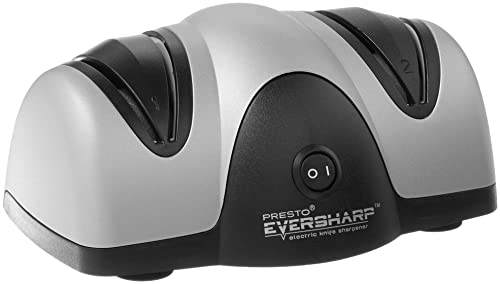
Presto EverSharp
Best for: cooks who want electric consistency on an entry-tier budget and are willing to supply a little more care in the draw.
the entry-tier electric option: a simpler staged electric sharpener from a long-running kitchen appliance brand, aimed at cooks who want motorised consistency without paying for the flagship experience. It asks a little more attention from the user than the premium route, particularly in how evenly you draw the blade, but it covers the core job of restoring tired everyday knives with minimal fuss and a modest counter footprint.
The entry electric design keeps the staged logic and trims the refinement. Guidance is simpler, the housing lighter, and the user’s own steadiness matters more, which is a fair trade at the tier and an honest one. For a household reviving a tired everyday set, the difference between this level and the premium level is smaller than the difference between either of them and the dull status quo, and that perspective is worth keeping when tiers tempt you upward.
Performance in Real Use
Rescuing a Neglected Set
The first session is the dramatic one. A typical neglected set, a chef knife that crushes tomatoes, a paring knife that tears, a santoku that needs a sawing motion for onions, gives a sharpener of any decent type an easy victory, because the gap between dull and sharp is enormous. Coarse stages earn their keep here, rebuilding edges that honing can no longer save, and the paper test turns theatrical as slices curl away where the sheet used to fold. Work knife by knife, wash and dry each finished blade and store it in the block before starting the next, so that at no point does a loose, freshly sharpened knife wait on the counter for an unsuspecting hand.
The Weekly Touch-Up
The sessions that follow are shorter and quieter, and they are the real life of the product. A knife that cooks daily needs only the fine stage or a few light passes to stay in the pleasant zone, and the whole round of knives takes less time than the washing-up. This is where design details compound: a sharpener that lives within reach gets used; one that requires a cupboard excavation gets postponed until the knives are dull enough to need the coarse stage again. Judge any model in this review by how gracefully it fits the five-minute version of the job, because that version is ninety percent of ownership.
Different Knives, Different Behaviour
No sharpener treats every blade identically, and honest testing means admitting it. Slim blades seat differently from thick ones; a long slicer needs support so its tip does not dive; a short paring knife offers little blade to guide and demands slow, careful passes with fingers kept on the handle and well away from the slot. Hard steels take longer to respond and then hold the result longer; softer steels revive quickly and fade sooner. A good sharpener narrows these differences without pretending to erase them, and a good owner learns their own set’s personalities within a few sessions.
Edges at the Table and the Board
The proof of sharpening is not the paper test but dinner. A restored edge portions a roast without tearing, shaves herbs without bruising them black, and cuts bread-adjacent work, ripe fruit, cooked proteins, with a cleanliness that changes how food looks on the plate. It also changes safety at the board: cuts start where intended, with light pressure, and the knife stops feeling like an opponent. If you take one idea from this performance section, take that one; sharpness is a safety feature wearing a performance costume.
Strengths and Trade-Offs
Strengths
- Restores knives you already own, at every tier far more cheaply in effort than replacing a set.
- Guided angles make good edges repeatable for cooks with no sharpening background.
- Staged abrasives handle the full arc from rescue to polish in one tool.
- Sessions are short, and little-and-often maintenance keeps knives permanently pleasant.
- Sharper knives are safer knives: less pressure, less skidding, cleaner cuts.
Trade-Offs
- Fixed-geometry tools cannot suit every blade; serrated, ceramic and single-bevel knives need other paths.
- Electric models take counter space and demand cleaning discipline, unplugged, after use.
- Coarse stages remove metal; overuse on healthy edges shortens a knife’s life for no benefit.
- No sharpener repairs chips, bends or poor steel, and none compensates for a glass board or loose drawer storage.

KitchenIQ 50009 Edge Grip
Best for: small kitchens and drawer storage, and cooks who want a quick working edge with zero setup ceremony.
the compact manual answer: a small two-stage pull-through that grips the edge of a counter or table to stay put while you work, small enough to live in a drawer and simple enough to use mid-week without ceremony. It sits at the entry tier and is honest about it, offering quick working edges for everyday knives rather than connoisseur finishes, and for small kitchens that trade is often exactly right.

Wüsthof Universal Handheld
Best for: owners of decent European-style knives who prefer a manual tool with a proper guard and a knife maker’s priorities.
the mid-tier pull-through from a knife maker rather than an appliance brand, which shows in its priorities: a protective hand guard, a steady grip and stages tuned for the kind of knives its maker sells. It suits cooks who own decent knives, want a manual tool with a little more care in its design than the most basic slots, and prefer to feel the blade through the process rather than hand the whole job to a motor.
How It Compares
Set the sharpening routes side by side and the pattern is a simple exchange of time, money and control. The whetstone, surveyed in our look at the best whetstone sharpening sets, offers the most control and the finest possible finish, and asks the most skill. The guided system below offers much of that control with the angle held for you, and asks time instead. Electric sharpeners ask the least of the user and give the most consistent everyday result. Pull-throughs ask almost nothing at all and give a sound working edge. Professional services ask only money and patience with turnaround, and give bench-level results including repairs. A household’s right answer usually combines two of these: a home tool for maintenance, and an occasional professional visit for the heavy work, a division of labour this cluster returns to in our knife sharpener buying guide and in the honest knife sharpener pros and cons.

Lansky Deluxe Controlled-Angle System
Best for: patient cooks and multi-blade households who enjoy process and want guided control across varied knives.
the guided-system representative: a clamp-and-rod kit that holds the blade while abrasive stones travel at a set angle, trading speed for control and versatility. It sits at the mid tier, takes longer per knife than any slot in this guide, and repays that time with edges you shaped deliberately. It is the choice in this cluster for the cook who treats sharpening as a small craft and owns blades beyond the standard kitchen set.
Who Should Buy It and Who Should Skip It
Buy a knife sharpener if you cook several times a week, own straight-edged knives worth keeping, and currently solve dullness by pressing harder or by quietly replacing blades. Buy one if your knife set came as a set, perhaps like the ones surveyed in our guide to the best chef knife sets, and has never been sharpened since the day it arrived; the transformation will feel like a second purchase. Skip a home sharpener, for now, if your drawer holds mostly serrated and ceramic knives, if your knives are chipped or bent and need a professional bench first, or if you know honestly that a maintenance gadget will join the others in the cupboard of good intentions; in that case, book a professional service and set a reminder instead. Before buying, run this short checklist: list the knives you actually use weekly, confirm they are straight-edged steel, decide where the sharpener will live, and choose the route, electric, pull-through or guided, that matches your patience. Then read the full knife sharpener reviews roundup for the category view, and is a knife sharpener worth it if the value question still nags.
Setup, Care and Maintenance Essentials
Work calmly and treat every blade as freshly sharpened from the moment it leaves the sharpener, because it is. Keep the sharpener stable on a non-slip surface, cut and draw the blade away from your body, hold the knife by the handle only, and never let fingers drift near the slots or the stone while the blade is moving. Test sharpness on paper or on food, never on skin. When you finish, wash and dry each blade carefully, dry it away from the edge, and store it in a block or a sheath away from children. If your sharpener is electric, unplug it before you clean it, every single time. Beyond safety, care is light: keep abrasives clean of metal filings, following the maker’s instructions; wipe housings rather than washing them; store manual sharpeners dry; and keep stones flat if stones are part of your setup. Pair the sharpener with forgiving storage and boards, the habits covered alongside the best cutting boards for home cooks, and your edges will last far longer between sessions. Finally, learn the basic session itself from how to use a knife sharpener, which walks through the process step by step.
Going Deeper: What Experience Teaches About Edges
Honing and Sharpening Are Not the Same Job
A honing rod does not really sharpen. It straightens an edge that has folded or rolled slightly to one side during use, nudging the metal back into line so the knife feels keen again for a while. True sharpening is different: it removes a small amount of metal and forms a fresh edge where the old one has worn, chipped or rounded away. Knowing which job your knife needs saves both time and steel. If a knife felt fine last week and merely drags a little today, a few careful passes on a honing rod, drawn away from your body with the handle held firmly, often restore it. If the knife slides across a tomato skin instead of biting, honing will not save it; the edge itself is gone and only an abrasive, in a sharpener or on a stone, will rebuild it.
Why Edges Go Dull in the First Place
Edges dull through three quiet mechanisms. The first is rolling: the very thin apex of the edge bends to one side when it meets something hard, such as a bone, a frozen surface or the rim of a pan. The second is abrasion: microscopic particles in food, boards and packaging wear the apex down a fraction at a time, the way a river rounds a stone. The third is corrosion at a scale too small to see, especially when blades sit damp in a sink or a closed dishwasher. None of these is a defect in the knife. They are the physics of a thin piece of steel meeting the world thousands of times, and they explain why even excellent knives need regular attention rather than occasional rescue missions.
Safe Ways to Test an Edge
Test sharpness on paper or on food, never on skin, and never with a thumb dragged along the edge. A sheet of ordinary printer paper held in one hand tells you a great deal: a keen edge slices downward through it cleanly, while a dull one tears, folds the sheet or refuses to start. A ripe tomato is the classic food test, because its skin resists a dull blade and yields to a sharp one with almost no downward pressure. An onion works too; a sharp knife enters without skidding, which is exactly the moment when dull knives become dangerous. Keep the testing hand clear of the cutting path, work on a stable board, and treat a blade that has just passed its test as the sharpest object in the room, because it now is.
Edge Angles, Explained Without the Mystique
Every edge is a wedge, and the wedge shape decides how a knife behaves. A narrower wedge slips through food with less resistance and feels dramatically sharper, but its thin apex is more delicate and rolls or chips sooner. A wider wedge feels a touch more stubborn in dense vegetables yet shrugs off hard use, board contact and the occasional twist in a joint. Neither is better in the abstract; they suit different knives and different cooks. The practical lesson for sharpener shopping is compatibility. A sharpener shapes the edge it was designed to shape, so the one you choose should match the style of knives you actually own, slim blades or sturdy ones, rather than forcing every knife in the drawer toward a single geometry.
Steel, Hardness and What Your Sharpener Feels
Harder steel holds a fine edge longer but takes more patience to restore once it finally dulls, and it can chip where softer steel would merely roll. Softer steel gives up its edge sooner yet comes back quickly with modest abrasives and forgives rough treatment. This is why two households can own the same sharpener and report opposite experiences: the tool is only half the system, and the knives are the other half. If your set is built from hard, wear-resistant steel, expect sharpening sessions to be less frequent but more deliberate. If your knives are everyday workhorses in softer steel, expect quick, satisfying touch-ups and plan on doing them a little more often. Both patterns are normal ownership, not problems.
Serrated Knives Need a Different Conversation
A serrated edge is a row of small arcs and points, and it dulls differently from a straight edge: the points wear, the arcs polish smooth, and the saw action fades. Most countertop sharpeners are built for straight edges and either ignore serrations or address only part of the tooth pattern, so check what a model claims before assuming it covers your bread knife. Dedicated serration tools work one gullet at a time and demand patience, while many owners simply send a beloved bread knife to a professional when it finally tires. The good news is that serrated knives, used mostly on crusts and skins, often go years between interventions. The bad news is that forcing one through a straight-edge slot can damage both the teeth and the sharpener, so keep the two apart.
Ceramic and Coated Blades Deserve Caution
Ceramic blades are extremely hard and hold an edge for a long time, but that hardness makes them brittle and puts them outside the reach of most home sharpeners, whose abrasives and angles assume steel. Running a ceramic blade through a steel sharpener is a reliable way to chip it. Coated blades, the colourful non-stick style knives sold in many sets, raise a different issue: aggressive abrasives can strip or scar the coating near the edge even when the sharpening itself works. Read what a sharpener maker says about blade types before you buy, keep ceramic knives on their own manufacturer-approved path, and remember that a sharpener is a specialist tool. Expecting one small appliance to serve every material in the drawer is how good knives get hurt.
Scissors, Cleavers and Other Edge Cases
Some sharpeners offer a scissor slot or claim a cleaver setting, and these extras deserve a calm, sceptical look. Scissors sharpen along a very different geometry from knives, and a slot that treats them like a knife edge usually polishes rather than truly sharpens. Cleavers are thick, tall blades that may not sit correctly in guides designed for chef knives, and a poor fit means an uneven edge. None of this makes multi-role sharpeners useless; it means the extras should be treated as bonuses, not reasons to buy. Judge a sharpener first on the knives you use daily, the chef knife, the paring knife, the santoku, and let the occasional tools in the drawer be handled by the methods that suit them, even if that method is a professional bench.
Where a Sharp Knife Lives Between Uses
Sharpening is wasted if the edge spends its resting hours being knocked about. A slotted block protects edges well, provided the slots are clean and the knife is dry before it goes in. A sheath or blade guard is the simple, underrated answer for drawer storage, letting the knife live in a drawer without its edge fencing with spoons. A magnetic strip keeps edges visible and off surfaces, but knives must be placed and lifted carefully, flat against the strip, never dragged sideways across it. The worst homes for an edge are a loose drawer, a crowded utensil crock and the sink. Store every sharpened blade in a block or a sheath, on a strip if you prefer, and always out of reach of children, who should never be the ones to discover how sharp the knives have become.
More Field Notes From the Sharpening Bench
Washing and Drying Without Undoing Your Work
A freshly sharpened knife should be washed by hand, promptly, and dried at once, and the technique matters. Wash it on its own rather than in a jumble, hold the handle only, and wipe from the spine toward the edge with the cloth moving away from the edge, never along it and never toward your fingers. Dry it the same way and put it straight into its block or sheath rather than leaving it on a draining board where the next person reaches blindly. Dishwashers are hard on edges twice over: blades knock against racks and other tools, and the damp heat encourages the fine corrosion that quietly eats an apex. Two minutes at the sink protects the edge you just spent ten minutes creating.
Your Cutting Board Is Part of the Sharpening System
Boards decide how long an edge survives. Wood and quality plastic boards receive the edge kindly, letting it sink a fraction into the surface instead of slamming to a stop. Glass, stone, ceramic and metal boards do the opposite: every cut ends with the apex striking a surface harder than itself, and the edge rolls or micro-chips accordingly. Cooks who sharpen faithfully and still fight dull knives very often find the culprit is a beautiful glass board they refuse to retire. If your board rings like a plate when the knife lands, it is undoing your sharpener’s work one cut at a time. Pair any sharpener in this guide with a forgiving board and the same knives will stay keen noticeably longer between sessions, which is the cheapest performance upgrade in the whole topic.
How Often Is Often Enough
There is no universal sharpening calendar, because households cook differently. A useful rhythm for most home kitchens is to hone lightly and often, whenever the knife starts to feel reluctant, and to truly sharpen when honing stops restoring the bite, which for a daily cook might be every few weeks and for a weekend cook a few times a year. Sharpening little and often is kinder than rare, heavy sessions: each session removes less metal, takes less time and keeps the knife in the pleasant zone where cooking feels easy. Waiting until a knife is completely blunt turns a five-minute touch-up into a restoration project and tempts you to press harder, rush the passes and make mistakes. Sharpness is a habit, not an event.
The Burr: the Tiny Signal That Sharpening Is Working
As an abrasive works one side of an edge, it eventually pushes a whisper-thin foil of metal over the apex to the other side. That foil is called a burr, and feeling for it is how sharpeners have always known a side is finished: drawn very lightly, with fingertips moving across and away from the edge, never along it, a burr feels like a faint catch or roughness on the side opposite the one being worked. Building a burr along the whole edge, then repeating on the second side, then refining it away with lighter passes is the skeleton of nearly all sharpening, whether the abrasive sits in an electric sharpener, a pull-through slot or a stone. You do not need to master burr detection to use a guided sharpener, the guides do the sequencing for you, but understanding it explains why the stages are ordered the way they are.
Stropping and the Final Polish
A strop, traditionally leather, sometimes loaded with a fine polishing compound, is the finishing step that aligns and polishes an edge after sharpening. It removes the last traces of a burr and leaves the apex clean, which is why knives feel silkier after stropping even though almost no metal is removed. Guided systems often include a stropping or honing stage for exactly this reason, and electric models finish with a polishing stage that plays the same role. At home, a few light passes on a leather strop, or even careful strokes on the fine stage of your sharpener, deliver most of the benefit. Keep the pressure feather-light; pressing hard on a strop rounds the very apex you worked to create. Finishing gently is a theme that runs through all good sharpening.
Pull-Through Sharpeners, Honestly Appraised
A pull-through sharpener guides the blade between abrasive elements set at a fixed angle, and you supply the motion: seat the heel of the knife in the slot, draw it smoothly toward you, or push it away, following the maker’s direction, and let the abrasives do the cutting. The strengths are real: almost no learning curve, a small footprint, fast touch-ups and consistent angles for cooks who will never enjoy stones. The limits are equally real: fixed angles cannot suit every knife, coarse stages on some budget models remove metal eagerly, and the edge produced is a good working edge rather than a connoisseur’s edge. For the majority of home kitchens, that trade is entirely reasonable. The pull-through’s job is to make Tuesday’s dinner prep pleasant again in under a minute, and at that job it succeeds.
Electric Sharpeners, Honestly Appraised
An electric sharpener replaces your arm’s motion with a motor turning abrasive wheels or belts inside a guided housing. You place the blade in a slot, draw it through at the pace the guides set, and the machine keeps speed and pressure far more consistent than a beginner’s hand. Multi-stage models separate the work logically: a coarse stage to restore a tired edge, a finer stage to refine it, and a polishing stage to finish. The honest costs are counter space, a cord, a higher tier than manual tools, and the discipline to unplug the unit before cleaning it and to keep it stable on a non-slip surface while it runs. For households with a full set of dull knives and little appetite for technique, the electric route converts a dreaded chore into a short, repeatable routine.
Whetstones, Honestly Appraised
A whetstone is the oldest tool in this guide and still the most flexible: one stone, used with water or oil depending on its type, can repair a chip, set a new angle, refine an edge to a polish and handle blades no guided slot accepts. The price of that freedom is skill. You must hold a consistent angle by hand, manage the slurry, soak the stone if it asks for soaking, and keep it flat over time, because a dished stone sharpens unevenly. Many cooks find the learning process genuinely pleasurable, a quiet ten minutes of craft, and many others bounce off it entirely and cook with dull knives instead. Both reactions are honest. A sharpener you will actually use beats a superior stone that lives untouched in a cupboard, every single week of the year.
Guided Angle Systems: the Middle Path
Guided systems clamp the blade and move the abrasive along a rod or arm held at a chosen angle, splitting the difference between freehand stones and fixed slots. The clamp removes the hardest part of stone work, holding the angle, while the interchangeable abrasives restore the flexibility that pull-through tools give up. Sessions take longer than an electric touch-up and the setup is fussier, with clamps, stones and a small ritual of assembly, but the results can be excellent and the same kit serves hunting knives, pocket knives and kitchen blades alike. These systems suit the cook who enjoys a little process and owns varied blades. They suit less well the cook who wants a knife rescued in the middle of dinner prep, because nobody assembles a clamp jig while the onions wait.
Repairing Chips Is a Different Job From Sharpening
A chip is missing metal, a small bite taken out of the edge by bone, a frozen surface or a fall onto a hard floor. Sharpening a chipped knife on a fine stage alone merely polishes around the damage; the edge must first be ground back until the profile is continuous again, work for a coarse abrasive and patience, or for a professional with powered equipment. Small chips near the tip or heel can often be blended out during a thorough coarse-stage session at home. Larger damage, cracks, or a bent tip belong on a professional bench, where the repair can be done without overheating the steel or shortening the blade more than necessary. Knowing the boundary between maintenance and repair saves knives: home sharpeners are for keeping good edges good, not for rebuilding broken ones.
Bolsters, Heels and the Last Inch of Edge
Many traditional knives carry a thick bolster, the bolster being the heavy collar of metal between handle and blade, and on some designs it descends all the way to the edge. Over years of sharpening, the edge recedes slightly while the bolster does not, until the bolster starts to touch the board before the edge does and the heel of the knife stops cutting cleanly. Guided sharpeners vary in how close to the bolster they can work, and stones handle the area most flexibly in skilled hands. If your knife rocks on an uncut patch near the heel, that is the likely story, and a professional can re-profile the bolster during a service. It is a slow, years-long effect, not a reason to avoid any sharpener, but it explains a mysterious dullness that no amount of slot passes seems to fix.
Single-Bevel and Specialty Blades
Most Western kitchen knives are sharpened on both sides, forming a symmetrical wedge. Many traditional Japanese blades are single-bevel, ground on one side only, with a flat or gently hollow back, and they cut with a distinctive steering feel that specialists prize. A symmetrical guided sharpener will try to put a second bevel where the design never intended one, changing the knife’s character and performance. If you own single-bevel knives, or treasured blades with unusual geometry, treat them as their own category: stones in practised hands, or a professional who knows the style. The same caution applies to very thin, hard blades that can chip under coarse, aggressive abrasives. A good sharpener wardrobe is honest about which knives it should never meet.
Bread Knives, Paring Knives and Length Extremes
The extremes of the knife drawer test sharpeners in opposite ways. A long bread knife needs a system that supports its length without the tip diving or the handle colliding with the housing, and its serrations, as covered elsewhere in this guide, mostly sit outside straight-edge sharpening anyway. A short paring knife presents the reverse puzzle: there is little blade to guide, the handle dominates, and it is easy to sharpen only the middle of the edge while the tip and heel stay dull. Work slowly with small blades, keep fingers on the handle and well clear of the slot, and check the whole edge afterwards with the paper test in sections. Length extremes reward patience and punish hurry, which is true of sharpening generally and doubly true at the ends of the size range.
Final Verdict
A knife sharpener is the rare kitchen purchase that improves tools you already own instead of adding new ones, and this review’s conclusion is uncomplicated: for the great majority of home cooks, a guided sharpener matched to their knives and their patience is money and counter space well spent. Choose the electric route for effortless consistency, the pull-through for speed and simplicity, or the guided system for control, and then build the small, safe routine around it. Your knives, and your dinners, will notice within the week.
Reading the Fine Print on a Knife sharpener: Detail Checks That Decide Satisfaction
A close reading of any single knife sharpener should go beyond the headline description and ask how the details behave once the novelty wears off. The checks below are the ones experienced owners wish they had made at the start, all of them grounded in the knives you own and how you cook with them. None of them requires specialist knowledge; they require looking at the listing, the room and your own routine at the same time, and being honest about where they do not line up.
Look past the headline claims and examine this detail closely. Start with fit, because fit failures cannot be fixed by enthusiasm later. In practice that means three things: match the sharpener type to your knife styles, since not every design suits every blade shape; check whether the sharpener handles both straight edges and any specialty blades you own; and confirm the angle approach suits how much control you want over the process. Write the answers down rather than holding them in your head, because a knife sharpener is usually chosen over several browsing sessions, and the constraint you checked on Monday is the one forgotten by Friday. If any of the three checks produces an awkward answer, treat it as information about format, not as a problem to wave away — a different format of knife sharpener often removes the conflict entirely, while a compromise on fit tends to be re-litigated every time the product is used.
This is the sort of detail a quick hands-on check would reveal. Then picture the product in its real situations rather than its best one. The routine cases are easy to imagine: a daily cook’s set of chef’s and utility knives used on boards every day, or a household with one good knife and several everyday blades of mixed quality. The more useful exercise is the harder day: very dull knives needing far more passes than a light maintenance touch-up; and chips or damaged edges that a sharpener alone cannot restore. A knife sharpener does not need to be perfect in those moments, but it does need a workable answer to them — a way to be moved, covered, adjusted, cleaned or simply tolerated until conditions improve. If the honest answer is that the hard day would make you stop using it altogether, that is a decision-grade fact, and it is far cheaper to learn it now than after delivery.
Owners notice this within the first month, not the first day. Most disappointments trace back to a short list of avoidable errors. The common ones here are: pressing down hard through a pull-through sharpener, which can damage the edge; sharpening a dirty blade, grinding grit along the edge as you work; and running every knife through the coarsest stage every time, wearing steel needlessly. Notice that none of them is really about build quality. They are sequencing errors — deciding before measuring, assuming instead of checking, or copying someone else’s setup whose space and habits differ from yours. Reading any listing for a knife sharpener with those three errors in mind is a fast filter: if the page in front of you encourages one of them, slow down and return to your own measurements and routine.
Frequently Asked Questions
How often should I sharpen my kitchen knives?
Hone lightly whenever a knife starts to feel reluctant, and truly sharpen when honing stops restoring the bite. For a household that cooks daily that might mean a short sharpening session every few weeks; for a weekend cook, a few times a year. Little and often is kinder to the steel than rare, heavy rescues, and it keeps every session short, calm and safe.
Can a knife sharpener damage my knives?
Used as directed, on the blade types it is designed for, a guided sharpener removes a small, controlled amount of metal and does no harm. Damage happens when the wrong blades are forced through, ceramic, single-bevel or heavily chipped knives in a standard slot, or when coarse stages are used with heavy pressure on healthy edges. Match the tool to the knife, use light pressure, and keep fingers on the handle and away from the slots.
Will a sharpener work on serrated or ceramic knives?
Generally, no. Most countertop sharpeners are built for straight-edged steel knives. Serrations need dedicated tools or a professional, and ceramic blades are too hard and brittle for steel-oriented abrasives and can chip. Check a model’s stated blade compatibility before buying, and keep specialty blades on their own care path rather than improvising.
Is an electric sharpener better than a manual one?
It is more consistent, not automatically better. Electric models control pace and contact for you and suit full sets and beginners. Manual pull-throughs are smaller, cheaper in tier, and quick for touch-ups. Guided systems and stones offer the most control for those willing to spend time. The best choice is the one that fits your knives, your kitchen and your temperament, and therefore actually gets used.
How do I know when a knife is sharp enough?
Test on paper or food, never on skin. A sharp edge slices cleanly down through a held sheet of paper and bites into a tomato skin with almost no pressure, instead of tearing, folding or skidding. When a knife passes those tests and cuts an onion without wandering, it is ready. Wash it, dry it carefully, and store it in a block or sheath.
Can sharpening fix a chipped knife?
Small chips can sometimes be blended out during a thorough coarse-stage session, but larger chips, cracks and bent tips are repair work, not maintenance. A professional can re-profile the edge without removing more steel than necessary. Home sharpeners excel at keeping sound edges sound; knowing where their job ends protects your best knives.
Related Reading
Continue with our knife sharpener reviews, the knife sharpener buying guide, knife sharpener pros and cons, and how to use a knife sharpener. For the knives themselves, see the best chef knife sets and the best cutting boards for home cooks.


