Disclosure: As an Amazon Associate, airfryerkitchensupply.com earns from qualifying purchases. Links on this page are affiliate links; they cost you nothing extra. Prices and availability change often, so check the current Amazon listing before you buy.
Kitchen cart reviews are only useful when they admit that different kitchens are buying different furniture under the same name. These kitchen cart reviews put six real product families side by side — wood enclosed carts, furniture-style carts, open utility carts and a premium butcher-block cart — and judge them on surface, storage and rolling, so you can see which pattern fits your room instead of chasing a single winner that fits nobody.
Key Takeaways
- There is no single best cart here; there are six good answers to six different kitchens.
- Enclosed wood carts win on calm and dust protection; open carts win on visibility, weight and price of entry.
- The top decides the daily experience: board on top, casters locked, heavy loads low.
- Premium money buys top quality and frame substance, not extra features — decide if that is your priority.
- Read the pattern, then check the current listing for the exact configuration in that family.
In one breath: families and traditional kitchens should start with Catskill Craftsmen and Home Styles; renters and small spaces with Winsome and Giantex; utility-first buyers with AmazonBasics; and serious daily prep cooks with John Boos.
In this guide
How These Kitchen Cart Reviews Were Judged
Start with the job, not the furniture. A kitchen cart earns its place in exactly three ways: it adds a work surface where the counters run out, it adds storage where the cabinets fall short, or it moves things — appliances, ingredients, a loaded tray — from one side of the kitchen to the other without a juggling act. Most carts do two of those jobs well and the third adequately, and the whole art of choosing is deciding which two matter in your kitchen. A cart bought for a job it does poorly becomes expensive clutter on wheels, while a cart bought for the right two jobs gets used every single day and quietly changes how the room works.
The work surface deserves the sternest honesty in this whole guide. Lock the casters before you use the top as a prep surface, every time, without exception — a cart that can roll will roll, usually at the exact moment a knife or a full bowl is involved. Treat the top as a landing and assembly surface first. A cart top is not a chopping block unless it is a rated butcher-block top, and even then you should work on a board placed on it, so the board takes the cuts, the board goes to the sink, and the top stays smooth and food-safe for years instead of scarred in a season.
Weight distribution is the quiet safety rule that separates a well-loaded cart from a tippy one. Put heavy appliances low — the stand mixer, the food processor, the cast-iron pot — on the bottom shelf or in the base cabinet, and keep the top and upper shelves for light, bulky things like mixing bowls, linens and cereal boxes. A top-heavy cart feels nervous when it rolls, strains its casters at one end, and in the worst case can tip toward a child or a pet that leans on it. Loaded low, the same cart feels planted, rolls straight, and stops without drama.
Kitchen Cart Reviews: The Six Families in Detail
Each family below is reviewed on the same three tests — surface, storage and rolling — so the comparisons stay honest from one to the next.
Catskill Craftsmen Kitchen Cart
a wood-forward cart in the classic American workshop tradition, built around a solid work top and enclosed storage below. It suits cooks who want the cart to feel like furniture rather than equipment, who store flour, mixing bowls and a stand mixer behind doors, and who like a top that reads as a real piece of kitchen joinery. In daily use its strength is calm: doors that close on the clutter, a top that takes a hot sheet pan without complaint once the casters are locked, and a footprint that parks neatly against a wall between jobs.
Review note: configurations within a family vary, so treat the pattern as the verdict and the current listing as the detail check before you buy.
Home Styles Kitchen Cart
a broad, furniture-style cart family that leans toward extra surface and generous cabinet space. It suits households that need the cart to double as a serving station and a storage cabinet at once, and that prefer a finished look from every side so the cart can stand in the open rather than hide in a corner. Its strength is versatility of layout: drawers for tools, cabinets for appliances, and a top wide enough to hold a coffee station on one end and a prep board on the other.
Review note: configurations within a family vary, so treat the pattern as the verdict and the current listing as the detail check before you buy.

Winsome Kitchen Cart
a lighter, simpler cart in the open-shelf tradition, easy to move and easy to live with. It suits renters, first kitchens and anyone who wants storage they can see at a glance, with baskets and bins doing the organising instead of doors. Its strength is honesty: nothing is hidden, nothing is heavy, assembly is straightforward, and the whole piece can be re-tasked from kitchen to craft room to entryway without drama when life changes.
Review note: configurations within a family vary, so treat the pattern as the verdict and the current listing as the detail check before you buy.

Giantex Kitchen Cart
a practical, value-minded cart that typically pairs a work top with shelves, a drawer and often a towel or spice detail. It suits cooks who want the most functions per footprint in a small kitchen and who are happy to trade heirloom materials for a sensible layout at an entry tier. Its strength is the checklist it covers at once: a place for the microwave or air fryer, open storage for daily staples, and casters that make a tiny kitchen rearrangable in minutes.
Review note: configurations within a family vary, so treat the pattern as the verdict and the current listing as the detail check before you buy.
AmazonBasics Kitchen Cart
a plain-spoken utility cart in the house-brand tradition, metal-framed and shelf-based, built for garages, pantries and hard-working kitchens alike. It suits buyers who care about load and mobility more than looks, and who want shelves that wipe clean and adjust to tall bottles and bulk buys. Its strength is indifference to abuse: spills, flour dust and heavy jars are all just another Tuesday, and the cart keeps rolling through all of it without asking for special care.
Review note: configurations within a family vary, so treat the pattern as the verdict and the current listing as the detail check before you buy.
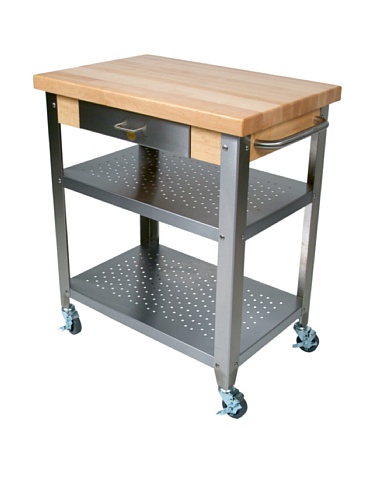
John Boos Kitchen Cart
a premium butcher-block cart from a maker whose name is attached to serious work surfaces. It suits committed cooks who prep daily, who want a top with genuine substance under the knife board, and who are willing to maintain real wood properly in exchange for decades of service. Its strength is the top itself and the frame beneath it: this is the cart you buy once, oil faithfully, and hand on, and it behaves like a small island rather than a trolley.
Review note: configurations within a family vary, so treat the pattern as the verdict and the current listing as the detail check before you buy.
Side-by-Side in Words
On surfaces, John Boos leads for substance, Catskill Craftsmen and Home Styles follow for generous furniture-grade tops, and the open utility patterns trade top quality for lightness. On storage, enclosed carts protect and conceal; open carts reveal and speed you up; drawers, where fitted, settle the small-tool clutter that otherwise lives on the top. On rolling, lighter carts steer easiest in tight galleys, while heavier wood carts track straightest on long pushes and feel calmest when loaded. None of these is a flaw list — it is a map of which strength you are buying.
Casters are the difference between a cart and a cupboard, so judge them like wheels, not decorations. Larger wheels roll more easily over grout lines, rug edges and the threshold strip between rooms, and at least two casters should lock firmly and release easily with a toe tap. Swivel casters at one end make steering through a galley kitchen simple, while fixed wheels at the other end keep the cart tracking straight on a long push. Test the locks with the cart loaded, not empty: a lock that holds an empty cart and creeps under a loaded one is a decoration, not a brake.
Materials set the maintenance contract you sign with the cart. Painted and sealed wood wipes clean and forgives spills, but edges can chip if the cart trades paint with door frames. Stainless and powder-coated metal shrug off water, heat and disinfectant, and suit utility-first kitchens, though they show fingerprints and can feel cold in a warm room. Natural wood tops are the warmest and the most repairable — a light sanding erases years — but they ask for oiling and for coasters under anything wet. Choose the contract you will actually honour, not the one you admire in theory.
Strengths and Trade-Offs Across the Range
- Strength: the category covers every tier honestly, from entry utility to premium butcher block, with real differences at each step.
- Strength: every pattern here can serve as prep, storage and serving furniture in the same week.
- Strength: carts are renter-friendly, renovation-free and removable — the lowest-risk capacity upgrade in the kitchen.
- Trade-off: choice itself is the burden; the wrong pattern in the right size still disappoints.
- Trade-off: lighter carts can feel less planted under heavy prep unless loaded low and locked properly.
- Trade-off: enclosed carts hide clutter and contents alike; you will open doors to check what open shelves would have shown you.
Which Pattern Suits Which Kitchen
Care is mostly a damp cloth and prompt attention. Wipe spills the day they happen, especially anything acidic, coloured or sugary, because finishes forgive speed and punish patience. Keep the casters free of the hair, string and grit they collect, since a choked wheel drags, marks floors and makes the cart feel heavier than it is. Tighten a loose handle the week it loosens. None of this is skilled work; it is the ordinary kindness that keeps a hard-working piece of furniture working hard, and five minutes a month covers nearly all of it.
Small kitchens gain the most and forgive the least. In a compact room a cart must park flush, roll without a three-point turn, and ideally offer a drop leaf, a sliding shelf or a top that overhangs nothing. Renters should favour carts that need no wall fixing and leave no trace, and everyone in a small space should prize vertical storage — shelves that use height the room can spare instead of floor it cannot. The test is simple: with the cart parked, can two people still pass, cook and open everything? If yes, the cart fits your life, not just your floor.
Think about the second job before you buy for the first. The cart that holds the air fryer on weekdays becomes the drinks station at a party, the baking centre on a Sunday, the homework dock on a school night and the extra landing strip beside the stove on every holiday. Versatility lives in plain surfaces, neutral storage and casters that actually roll, not in novelty features used twice. A spice rack insert, a wine grid or a towel bar is lovely when it matches your habits and dead weight when it does not, so let your real routines vote on every feature.
Keep reading across the cluster as you decide: the companion guide to kitchen cart review, the companion guide to kitchen cart buying guide, the companion guide to kitchen cart pros and cons, the matching bar cart guide, bar cart review, small kitchen rugs that survive life around a rolling cart, closet organiser ideas that translate to cart storage, kitchen vacuums for the crumbs a cart collects. Each companion piece takes one angle in depth, so together they cover the decision without repeating it.
Setup, Care and Maintenance Essentials
Assembly is part of the product, whether the listing dwells on it or not. A well-made cart arrives with labelled parts, holes that line up the first time and instructions written by someone who has built the thing. A poor one turns an evening into a negotiation with misaligned panels. Whatever you choose, build it on a blanket to protect the finish, keep the fasteners in a bowl so none escape, tighten in stages rather than fully at each step, and re-check every bolt after the first week of rolling, because new joints settle and a small wobble ignored becomes a loose frame.
Butcher-block tops ask for one simple habit in return for their beauty and toughness: regular oiling with a food-safe board oil, applied qualitatively whenever the wood looks dry, pale or thirsty rather than by a rigid calendar. Wipe the top clean and dry first, work the oil in with the grain, let it drink, and buff off the excess so the surface feels dry, not greasy. Neglected block dries, dulls and eventually splits at the seams; oiled block deepens in colour, shrugs off water rings, and stays pleasant under the hands for a very long time. It is ten quiet minutes that buy years.
Knife storage on a cart follows one rule with no exceptions: knives live in a block or on a magnetic strip, never loose in a drawer with other tools. A loose knife in a shared drawer dulls against everything it touches, hides its edge exactly where reaching fingers expect a spoon, and turns a rummage into a risk. A slim block on the cart top or a strip mounted on the cart’s side keeps edges protected, visible and instantly reachable while you prep, and it keeps the drawer for the tools that belong there — peelers, thermometers, tongs and the rest of the harmless crowd.
Final Verdict
Read these reviews as a matching exercise, not a podium. The right pattern in your size, loaded low, locked before prep and maintained in the simple way its materials ask, will feel like the best cart in the world — because in your kitchen, it is.
In Depth: Living With the Cart Day to Day
Light matters more than most buyers expect. A tall, dark, enclosed cart in a small north-facing kitchen can swallow the room’s brightness and make the corner it owns feel like a cupboard that escaped. Lighter finishes, open shelves and slimmer frames keep a small room airy, while a substantial wood cart in a large bright kitchen adds exactly the visual weight the space wants. Match the cart’s visual mass to the room’s light and size, not just its floor plan, and the piece will look chosen rather than parked.
Plan for the clean-out day, because it is coming. Once a season, empty the cart completely: the expired spice, the third peeler, the appliance you kept for a recipe you never repeated. A cart makes this easy — roll it to the table, unload, wipe every shelf, reload only what earns its place — and that ease is a hidden virtue. Storage that is painful to audit becomes storage that hides drift. The carts that stay useful for years are the ones their owners can empty in twenty minutes without dreading it.
Height relationships decide whether a cart feels like a colleague or an obstacle. A top that sits near your counter height lets you slide boards, bowls and trays across without lifting, and keeps prep posture natural through a long session. A much lower top turns every transfer into a stoop; a much higher one turns the cart into a shelf you reach up to. There is no universal right answer, only the right relationship to your counters and your own height, so picture the actual hand movements of your most common recipe before you choose.
Edges and corners carry the scars of a cart’s life, so look at them first. The corners meet door frames, the edges meet hips and pan handles, and the finish there tells you how the piece will age. Rounded or well-finished edges survive the meetings gracefully; sharp, thinly finished ones chip and show every encounter. In a family kitchen, rounded corners are also simply kinder to small heads at exactly cart height. A cart is the most mobile furniture in the room, and mobile furniture should be built — and chosen — for contact.
Think in zones and the cart finds its job description. Kitchens work when the prep zone, the cooking zone and the cleaning zone each hold their own tools, and most kitchens have one zone starved of storage while another overflows. A cart is the only storage you can assign to the starved zone without building anything: park the baking zone beside the oven, the coffee zone beside the water, the prep zone beside the board and knives — in a block or on a strip, never loose. Let the zones vote on where the cart lives and what it carries.
The secondhand and hand-me-down angle is worth a thought, because good carts circulate. A solid wood or metal cart survives owners the way a good pan does, and buying the solid pattern new means yours can be sold, gifted or re-tasked rather than landfilled when the kitchen changes. Flimsier pieces have one life and it is a short one. This is not sentiment; it is arithmetic about cost per year of service, and it is the same reasoning that favours the repairable top and the replaceable caster over the sealed, disposable design.
Guests reveal a cart’s social life. A cart becomes the drinks station, the dessert trolley, the place the extra chairs’ worth of dishes lands during a long dinner, and it does all of it without anyone standing in the cook’s working triangle. If you entertain, judge the cart partly as hosting equipment: does it present well from the dining side, roll quietly on your floors, and hold a serving load steady with its casters locked? A piece that works all week and hosts all weekend is earning its floor space twice.
Seasonal cooking changes what the cart must be. In preserving season it is a jar-and-lid staging post; in baking season it is flour, tins and cooling racks; in the holidays it is the overflow landing strip that saves the meal. A cart with flexible storage — shelves that take bins, a drawer that takes linens, a top that clears completely — adapts to each season without new furniture. Fixed, novelty storage adapts to one season and stores air for the other three, which is why plain, flexible layouts outlast clever ones in real kitchens.
Floor protection is a small clause with long consequences. Hard casters on soft floors, and grit trapped under any wheel, will mark a floor over months of rolling. Felt-friendly wheel materials, a habit of lifting rather than dragging a loaded cart over thresholds, and a quick sweep of the cart’s usual route before a long push all protect the surface underneath. Renters should care twice: the cart that was meant to leave no trace should not sign its name in scratches across the kitchen floor.
A cart changes how children learn a kitchen, for the better when it is set up with intent. A low shelf that is theirs — cups, a water jug they can manage, the snack boxes — gives small people a legitimate destination that is not the cook’s drawers. The same cart keeps the serious things high, closed and out of the story: knives in their block, glass and bottles behind doors, cleaning things elsewhere entirely. Furniture that gives children a place tends to be respected by them; furniture that is only forbidden tends to be climbed.
Electricity deserves one practical paragraph. Carts increasingly host appliances — the air fryer, the kettle, the mixer — and appliances need outlets, ventilation and a cord path that does not cross a walkway or dangle near water. Park an appliance cart within honest reach of an outlet, leave breathing room behind heat-making machines, and never run a cord under the cart’s own wheels. The cart should bring the appliance to the power safely, not stretch the power to the appliance dangerously, and a five-minute thought at setup prevents the daily tangle.
Smell and hygiene separate kitchen furniture from other furniture. A cart lives among onions, oils and dishwater, and its materials either shrug those off or absorb them. Sealed surfaces, washable bins and a top that tolerates a proper wipe-down stay fresh; raw, unsealed surfaces in splash zones slowly take on the kitchen’s biography. This is another argument for the board-on-top habit and for prompt wiping: the cart that is easy to clean gets cleaned, and the cart that gets cleaned stays welcome in the room where food happens.
Finally, trust the two-week rule for any big impression. In the first fortnight you will learn where the cart truly wants to park, what you actually reach for daily, and which shelf arrangement your hands prefer. Good carts invite rearrangement — bins move, shelves swap, the drawer changes jobs — and the willingness to re-sort once, early, is what turns a purchase into a system. Judge the cart after that re-sort, not before it, and choose a pattern flexible enough to deserve the second arrangement as much as the first.
Consider the morning test, because it reveals more than any showroom visit. On a weekday morning the cart either holds the coffee things where your half-awake hands expect them, parks clear of the kettle’s steam and the fridge door’s swing, and rolls aside without a thought — or it is in the way, and being in the way at seven in the morning is how furniture gets quietly hated. When you picture a cart, picture it at your least patient moment of the day, loaded with your real breakfast things, and ask whether the room still flows. If the answer is yes at breakfast, it will be yes at dinner.
Think about landing zones, the unglamorous places hot and heavy things go for ten seconds. Every kitchen runs out of them at the worst moment: the tray out of the oven, the pot off the hob, the shopping bag that cannot go on the floor. A cart parked beside the stove becomes the landing zone the kitchen was missing, and that single role justifies it on busy nights even if its shelves held nothing at all. Judge a cart’s top partly as a runway — clear, heat-aware with a trivet, close to the action — and keep it uncluttered enough to land on at short notice.
Noise is a quality nobody lists and everybody hears. A cart that rattles over grout lines, whose doors thud and whose drawers slam, makes a kitchen feel cheaper every time it moves. Solid frames, well-seated shelves and wheels that roll rather than skitter keep the piece quiet, and quiet reads as quality in daily life far more than any finish. When you roll a cart in a shop or imagine one from a description, listen in your mind: the right cart moves like furniture, not like luggage.
Each Pattern, Considered Closely
Catskill Craftsmen Kitchen Cart
In depth, the Catskill pattern rewards the cook who treats the cart as a small piece of joinery. The enclosed body keeps the visual field calm, the top invites a board and a bowl rather than clutter, and the whole piece improves with the same care you would give a good table: prompt wiping, oiling where the wood is natural, and a caster check each season. Its best room is a kitchen that is cooked in daily and seen by guests often, where calm storage and a furniture feel are worth more than featherweight mobility.
Home Styles Kitchen Cart
In depth, the Home Styles pattern is the diplomat of the range: broad enough to host a coffee station and a prep board at once, finished enough to stand in the open, and storage-rich enough to swallow a family’s awkward middle layer of kitchen things. It rewards households that serve from the cart as often as they prep on it. Its best room is the open-plan kitchen, where the cart is seen from the dining side all day and must earn its place visually as well as functionally.
Winsome Kitchen Cart
In depth, the Winsome pattern proves how far simplicity travels. Open shelves make every stored thing instantly findable, the light frame makes rearrangement a one-person whim, and the whole piece re-tasks gracefully when a kitchen’s needs change or a household moves. It rewards renters, first kitchens and visual cooks who think in glances. Its best room is the small or changing kitchen, where flexibility and low visual weight matter more than concealment, and where bins and baskets can supply whatever order the shelves leave open.
Giantex Kitchen Cart
In depth, the Giantex pattern is the checklist made furniture: top, drawer, shelves and small thoughtful extras combined in a compact footprint at an entry tier. It rewards buyers who measure success in functions covered per corner of floor. The honest trade is materials and heft — this is sensible, serviceable construction rather than heirloom joinery — and for a first cart, a small flat or a student kitchen, that trade is frequently the right one. Its best room is the compact kitchen that needs everything at once and forgives a practical finish.
AmazonBasics Kitchen Cart
In depth, the AmazonBasics pattern strips the idea to its working skeleton: frame, shelves, wheels, done. That plainness is its virtue in pantries, utility corners and kitchens that treat a cart as equipment. Shelves wipe clean, loads sit low and steady, and the cart shrugs off the flour dust and splashes that would worry a finer finish. It rewards buyers who rank load and mobility above looks. Its best room is the hard-working kitchen or the pantry wall, where the question is never how it photographs but how much it carries.
John Boos Kitchen Cart
In depth, the John Boos pattern is the connoisseur’s answer, and it asks connoisseur habits in return: oil the block by eye, board the heavy knife work anyway, and let the top gather the honest patina of daily prep rather than the scars of carelessness. In exchange it offers the most substantial work surface in this guide and a frame built for decades. It rewards the daily cook who preps seriously and maintains willingly. Its best room is the cook’s kitchen, where the cart is not furniture near the work but part of the work itself.
In Depth: Living With the Cart Day to Day
Light matters more than most buyers expect. A tall, dark, enclosed cart in a small north-facing kitchen can swallow the room’s brightness and make the corner it owns feel like a cupboard that escaped. Lighter finishes, open shelves and slimmer frames keep a small room airy, while a substantial wood cart in a large bright kitchen adds exactly the visual weight the space wants. Match the cart’s visual mass to the room’s light and size, not just its floor plan, and the piece will look chosen rather than parked.
Plan for the clean-out day, because it is coming. Once a season, empty the cart completely: the expired spice, the third peeler, the appliance you kept for a recipe you never repeated. A cart makes this easy — roll it to the table, unload, wipe every shelf, reload only what earns its place — and that ease is a hidden virtue. Storage that is painful to audit becomes storage that hides drift. The carts that stay useful for years are the ones their owners can empty in twenty minutes without dreading it.
Height relationships decide whether a cart feels like a colleague or an obstacle. A top that sits near your counter height lets you slide boards, bowls and trays across without lifting, and keeps prep posture natural through a long session. A much lower top turns every transfer into a stoop; a much higher one turns the cart into a shelf you reach up to. There is no universal right answer, only the right relationship to your counters and your own height, so picture the actual hand movements of your most common recipe before you choose.
Edges and corners carry the scars of a cart’s life, so look at them first. The corners meet door frames, the edges meet hips and pan handles, and the finish there tells you how the piece will age. Rounded or well-finished edges survive the meetings gracefully; sharp, thinly finished ones chip and show every encounter. In a family kitchen, rounded corners are also simply kinder to small heads at exactly cart height. A cart is the most mobile furniture in the room, and mobile furniture should be built — and chosen — for contact.
Think in zones and the cart finds its job description. Kitchens work when the prep zone, the cooking zone and the cleaning zone each hold their own tools, and most kitchens have one zone starved of storage while another overflows. A cart is the only storage you can assign to the starved zone without building anything: park the baking zone beside the oven, the coffee zone beside the water, the prep zone beside the board and knives — in a block or on a strip, never loose. Let the zones vote on where the cart lives and what it carries.
The secondhand and hand-me-down angle is worth a thought, because good carts circulate. A solid wood or metal cart survives owners the way a good pan does, and buying the solid pattern new means yours can be sold, gifted or re-tasked rather than landfilled when the kitchen changes. Flimsier pieces have one life and it is a short one. This is not sentiment; it is arithmetic about cost per year of service, and it is the same reasoning that favours the repairable top and the replaceable caster over the sealed, disposable design.
Guests reveal a cart’s social life. A cart becomes the drinks station, the dessert trolley, the place the extra chairs’ worth of dishes lands during a long dinner, and it does all of it without anyone standing in the cook’s working triangle. If you entertain, judge the cart partly as hosting equipment: does it present well from the dining side, roll quietly on your floors, and hold a serving load steady with its casters locked? A piece that works all week and hosts all weekend is earning its floor space twice.
Seasonal cooking changes what the cart must be. In preserving season it is a jar-and-lid staging post; in baking season it is flour, tins and cooling racks; in the holidays it is the overflow landing strip that saves the meal. A cart with flexible storage — shelves that take bins, a drawer that takes linens, a top that clears completely — adapts to each season without new furniture. Fixed, novelty storage adapts to one season and stores air for the other three, which is why plain, flexible layouts outlast clever ones in real kitchens.
Floor protection is a small clause with long consequences. Hard casters on soft floors, and grit trapped under any wheel, will mark a floor over months of rolling. Felt-friendly wheel materials, a habit of lifting rather than dragging a loaded cart over thresholds, and a quick sweep of the cart’s usual route before a long push all protect the surface underneath. Renters should care twice: the cart that was meant to leave no trace should not sign its name in scratches across the kitchen floor.
A cart changes how children learn a kitchen, for the better when it is set up with intent. A low shelf that is theirs — cups, a water jug they can manage, the snack boxes — gives small people a legitimate destination that is not the cook’s drawers. The same cart keeps the serious things high, closed and out of the story: knives in their block, glass and bottles behind doors, cleaning things elsewhere entirely. Furniture that gives children a place tends to be respected by them; furniture that is only forbidden tends to be climbed.
Electricity deserves one practical paragraph. Carts increasingly host appliances — the air fryer, the kettle, the mixer — and appliances need outlets, ventilation and a cord path that does not cross a walkway or dangle near water. Park an appliance cart within honest reach of an outlet, leave breathing room behind heat-making machines, and never run a cord under the cart’s own wheels. The cart should bring the appliance to the power safely, not stretch the power to the appliance dangerously, and a five-minute thought at setup prevents the daily tangle.
Smell and hygiene separate kitchen furniture from other furniture. A cart lives among onions, oils and dishwater, and its materials either shrug those off or absorb them. Sealed surfaces, washable bins and a top that tolerates a proper wipe-down stay fresh; raw, unsealed surfaces in splash zones slowly take on the kitchen’s biography. This is another argument for the board-on-top habit and for prompt wiping: the cart that is easy to clean gets cleaned, and the cart that gets cleaned stays welcome in the room where food happens.
Finally, trust the two-week rule for any big impression. In the first fortnight you will learn where the cart truly wants to park, what you actually reach for daily, and which shelf arrangement your hands prefer. Good carts invite rearrangement — bins move, shelves swap, the drawer changes jobs — and the willingness to re-sort once, early, is what turns a purchase into a system. Judge the cart after that re-sort, not before it, and choose a pattern flexible enough to deserve the second arrangement as much as the first.
Patterns Across Kitchen Cart Listings Worth Verifying Yourself
Reading across many kitchen cart listings and owner reports, the same patterns surface again and again, and they are more useful than any single verdict. This section gathers those recurring signals, explains what each one usually means in practice, and shows how to verify the important ones against the specific listing you are considering.
Across owner reports on the kitchen cart, praise clusters in a predictable place: households whose routine centres on extra counter space, storage and a movable serving station are consistently the happiest, and their reviews read almost boringly satisfied. Complaints cluster just as predictably around fit, which is why the first pattern to check in any listing is whether it states clearly the facts behind the top dimensions and shelf spacing against the appliances or items it must hold. Vague dimensions in a listing correlate with disappointed reviews more than any design flaw does.
The second pattern is the slow complaint. Early reviews glow; the criticisms that arrive months later describe a cart that drifts or rattles because the casters are unlocked or unevenly loaded. When you read reviews, sort mentally by ownership length rather than enthusiasm, and give extra weight to anyone describing the upkeep honestly, because wiping the top after prep work and tightening caster fittings that loosen with movement. Reports that mention a model like Home Styles holding up after a year of regular use tell you more than a dozen five-line first impressions.
The third pattern is mismatch, not malfunction. Owners who checked compatibility in advance, meaning caster quality for your floor type and whether the cart must pass through narrow doorways, rarely report the product failing them, while owners who assumed it would fit their setup supply most of the one-paragraph horror stories. Use reviews, then, as a checklist of things to verify on your chosen listing, and run the edge case early yourself: loading heavy appliances on top, which changes both stability and how easily it rolls. Verified against your own home, the crowd consensus becomes a reliable guide instead of background noise.
A Final Decision Checklist
- In listings, look first for clear statements behind the top dimensions and shelf spacing against the appliances or items it must hold; vagueness here predicts complaints.
- In owner reports, weight long-term posts describing how a cart that drifts or rattles because the casters are unlocked or unevenly loaded developed.
- Treat upkeep reports as data, because wiping the top after prep work and tightening caster fittings that loosen with movement is where ownership verdicts are decided.
- Cross-check compatibility claims, since caster quality for your floor type and whether the cart must pass through narrow doorways is the mismatch owners report most.
- Verify the edge case yourself rather than trusting reviews, because loading heavy appliances on top, which changes both stability and how easily it rolls.
- Write down your two most frequent uses and search reviews from owners with the same ones.
- Keep packaging and paperwork until your own first week confirms the consensus.
- Photograph the setup once it works well, so you can compare it with review photographs later.
- Note how often owners the edge case on a quiet day first, since loading heavy appliances on top is a poor thing to meet unprepared.
- Look for reports that the second year in advance: replaceable parts and a serviceable design matter more than launch-day shine.
Frequently Asked Questions
Can I really prep food on a kitchen cart top?
Yes, with two habits locked in. Lock the casters before you start, every time, so the surface cannot drift under a knife or a bowl, and work on a cutting board placed on the top rather than directly on it. A cart top is not a chopping block unless it is a rated butcher-block top, and even then the board should take the cuts and go to the sink afterwards. Used that way, a cart top is an excellent prep surface for assembly, rolling, mixing and landing hot pans on a trivet.
Where should heavy appliances live on a cart?
Low, always. The stand mixer, food processor and cast-iron cookware belong on the bottom shelf or in the base cabinet, where their weight steadies the cart instead of straining it. Light and bulky items — mixing bowls, linens, cereal boxes, a bread bin — belong up high. A low-loaded cart rolls straighter, stops more predictably, and is far less likely to feel tippy when a child leans on it or a caster meets a rug edge at an angle.
How do I look after a butcher-block cart top?
Keep it clean and dry day to day, and oil it with a food-safe board oil whenever it starts to look dry, pale or thirsty. Wipe the surface down first, work the oil in with the grain, let it absorb, then buff away the excess so the top feels dry rather than greasy. That is the whole routine, done qualitatively by eye rather than by calendar. Oiled block resists water rings and stains gracefully; neglected block dries out, dulls and can eventually split along its seams.
What is the safest way to store knives on a cart?
In a block or on a magnetic strip, never loose in a drawer with other tools. A loose knife dulls against everything around it and hides its edge exactly where fingers go rummaging for a spoon. A slim block on the top or a strip mounted on the side of the cart keeps edges protected, visible and within reach while you prep, and it keeps drawers for the harmless tools that belong there. It is one of the cheapest safety upgrades in the whole kitchen.
Do I need locking casters, or are they a nice extra?
Treat them as essential. At least two casters should lock, and the locks should hold with the cart fully loaded, not just empty. You will use the top as a work surface, lean on it while you roll dough, and park it beside a hot stove; in all three moments a cart that can creep is a hazard rather than a help. Test the locks on your own floor, including over any rug edge or threshold the cart will cross in normal use.
Will a kitchen cart work in a rental or a very small kitchen?
Usually, yes — carts are one of the few upgrades a renter can take with them. Choose a footprint that parks flush against a wall, casters that turn without a wide sweep, and a design that needs no wall fixing. Measure with doors and appliance doors open, not just against the empty room, and walk the route the cart will roll. If two people can still pass and cook with the cart parked, it fits your life as well as your floor.
Keep reading across the cluster as you decide: the companion guide to is a kitchen cart worth it, the companion guide to how to choose a kitchen cart, the companion guide to kitchen cart vs bar cart, the matching bar cart guide, bar cart reviews, compact air fryers for small kitchens that pair well with a cart, affordable kitchen mixers that often live on a cart’s low shelf, storage thinking for the bulky and the awkward. Each companion piece takes one angle in depth, so together they cover the decision without repeating it.
